


EN 15195:2023
(Main)Liquid petroleum products - Determination of ignition delay and derived cetane number (DCN) of middle distillate fuels by combustion in a constant volume chamber
Liquid petroleum products - Determination of ignition delay and derived cetane number (DCN) of middle distillate fuels by combustion in a constant volume chamber
This document specifies a test method for the quantitative determination of ignition delay of middle distillate fuels intended for use in compression ignition engines. The method utilizes a constant volume combustion chamber designed for operation by compression ignition, and employing direct injection of fuel into compressed air that is controlled to a specified pressure and temperature. An equation is given to calculate the derived cetane number (DCN) from the ignition delay measurement.
This document covers the ignition delay range from 2,58 ms to 6,34 ms (76,8 DCN to 33,9 DCN). The combustion analyser can measure shorter or longer ignition delays, but precision is not known.
This document is applicable to diesel fuels, including those containing fatty acid methyl esters (FAME) up to 30 % (V/V). The method is also applicable to middle distillate fuels of non-petroleum origin, oil-sands based fuels, blends of fuel containing biodiesel material, diesel fuel oils containing cetane number improver additives and low-sulfur diesel fuel oils. Furthermore, the method is applicable to paraffinic diesel from synthesis or hydrotreatment, containing up to a volume fraction of 7 % FAME [1]. However, users applying this document especially to unconventional distillate fuels are warned that the relationship between derived cetane number and combustion behaviour in real engines is not yet fully understood.
The test method is also applicable to the quantitative determination of the ignition characteristics of FAME, especially the ignition delay. However, analysis of the data available, regarding correlation with EN ISO 5165, is inconclusive. So the determination of derived cetane number for FAME fuel, also known as B100, has not been included in the precision determination as in Clause 12.
NOTE For the purpose of this document, the expression “% (V/V)” is used to represent the volume fraction and “% (m/m)” the mass fraction.
WARNING — The use of this document may involve hazardous materials, operations and equipment. This document does not purport to address all of the safety problems associated with its use. It is the responsibility of the user of this document to establish appropriate safety and health practices and determine the applicability of regulatory limitations prior to use.
Flüssige Mineralölerzeugnisse - Bestimmung des Zündverzugs und der abgeleiteten Cetanzahl (ACZ) von Kraftstoffen aus Mitteldestillaten in einer Verbrennungskammer mit konstantem Volumen
Dieses Dokument legt ein Prüfverfahren zur quantitativen Bestimmung des Zündverzugs von Kraftstoffen aus Mitteldestillaten für den Einsatz in Dieselmotoren fest. Das Verfahren nutzt eine Verbrennungskammer mit konstantem Volumen, die für den Betrieb durch Selbstzündung ausgelegt ist, und es setzt direkte Kraftstoffeinspritzung in komprimierte Luft ein, die auf festgelegte Druck- und Temperaturwerte geregelt wird. Die Berechnung der abgeleiteten Cetanzahl (ACZ) aus der Messung des Zündverzugs erfolgt über eine angegebene Gleichung.
Dieses Dokument umfasst den Zündverzugsbereich von 2,58 ms bis 6,34 ms (ACZ 76,8 bis ACZ 33,9). Mit dem Verbrennungsprüfgerät können sowohl kürzere als auch längere Zündverzüge gemessen werden, die Präzision ist jedoch nicht bekannt.
Dieses Dokument ist anwendbar auf Dieselkraftstoffe mit einem Gehalt an Fettsäuremethylestern (FAME) von bis zu 30 % (V/V). Die Prüfung ist ebenfalls anwendbar auf Mitteldestillate nicht mineralölstämmiger Herkunft, auf ölsandbasierte Kraftstoffe, auf Biodieselmaterial enthaltende Kraftstoffmischungen, auf Dieselkraftstoffe, welche Zündverbesserer enthalten, und auf Dieselkraftstoffe mit niedrigem Schwefelgehalt. Dieses Prüfverfahren ist auch auf paraffinischen Dieselkraftstoff aus Synthese oder Hydrierungsverfahren anwendbar, der einen Volumenanteil von bis zu 7 % Fettsäuremethylester (FAME) enthält [1]. Anwender, die dieses Dokument im Besonderen auf unkonventionelle Destillat-Kraftstoffe anwenden, werden jedoch darauf hingewiesen, dass die Beziehung zwischen der abgeleiteten Cetanzahl und dem Verbrennungsverhalten in realen Motoren noch nicht völlig geklärt ist.
Das Prüfverfahren ist weiterhin einsetzbar zur quantitativen Bestimmung der Zündeigenschaften, insbesondere des Zündverzuges, von FAME. Die Analyse der verfügbaren Daten hinsichtlich der Korrelation mit EN ISO 5165 ist jedoch nicht eindeutig. Daher wurde die Bestimmung der abgeleiteten Cetanzahl für FAME-Kraftstoffe, auch bekannt als B100, nicht in die Bestimmung der Präzision nach Abschnitt 12 einbezogen.
ANMERKUNG Für die Zwecke dieses Dokuments wird zur Angabe des Volumenanteils einer Substanz der Ausdruck „% (V/V)“ und für den Massenanteil einer Substanz der Ausdruck „% (m/m)“ verwendet.
WARNUNG — Die Anwendung dieses Dokuments kann die Anwendung gefährlicher Stoffe, Arbeitsgänge und Geräte mit sich bringen. Dieses Dokument beansprucht nicht, alle damit verbundenen Sicherheitsprobleme zu behandeln. Es liegt in der Verantwortung des Anwenders dieses Dokument, vor der Anwendung angemessene Maßnahmen im Hinblick auf Sicherheit und Gesundheit zu ergreifen, und die Anwendbarkeit einschränkender Vorschriften zu ermitteln.
Produits pétroliers liquides - Détermination du délai d'inflammation et de l'indice de cétane dérivé (ICD) des distillats moyens par combustion dans une chambre à volume constant
Le présent document spécifie une méthode d'essai pour la détermination quantitative du délai d’inflammation des distillats moyens utilisés comme carburants dans des moteurs à allumage par compression. Elle utilise une chambre de combustion à volume constant conçue pour la mise en œuvre d'un allumage par compression avec l'injection directe du carburant dans de l'air comprimé maintenu à une pression et une température données. Une équation est présentée pour calculer l'indice de cétane dérivé (ICD) à partir du délai d’inflammation mesuré.
Ce document couvre la gamme des délais d'inflammation de 2,58 ms à 6,34 ms (76,8 ICD à 33,9 ICD). L'analyseur de combustion peut mesurer des délais d'inflammation plus courts ou plus longs, mais la fidélité n'est pas connue.
Ce document est applicable aux carburants diesel, y compris ceux contenant des esters méthyliques d'acides gras (EMAG) jusqu'à 30 % (V/V). La méthode est également applicable aux distillats moyens d'origine non pétrolière, aux carburants à base de sables bitumineux, aux mélanges de carburants contenant du biodiesel, aux carburants diesel contenant des additifs améliorant l'indice de cétane et aux carburants diesel à faible teneur en soufre. Toutefois, les utilisateurs qui appliquent ce document, en particulier aux combustibles distillés non conventionnels, sont avertis que la relation entre l'indice de cétane dérivé et le comportement de combustion dans les moteurs réels n'est pas encore totalement comprise.
La méthode d'essai est également applicable à la détermination quantitative des caractéristiques d'inflammation des EMAG, en particulier le délai d'inflammation. Cependant, les données de corrélation disponibles avec l’EN ISO 5165, n'étaient pas concluantes. Ainsi, la détermination de l'indice de cétane dérivé pour le carburant EMAG, également connu sous le nom de B100, n'a pas été incluse dans la détermination de la fidélité indiquée dans l’Article 12.
NOTE Pour les besoins du présent document, les termes "% (V/V)" et "% (m/m)" sont utilisés pour représenter respectivement la fraction volumique et la fraction massique.
AVERTISSEMENT — L'utilisation du présent document peut impliquer l'utilisation de produits, d'opérations et d'équipements à caractère dangereux. Ce document n'est pas censé aborder tous les problèmes de sécurité concernés par sa mise en oeuvre. Il est de la responsabilité de l'utilisateur de consulter et d'établir des règles de sécurité et d'hygiène appropriées et de déterminer l'applicabilité des restrictions réglementaires avant utilisation.
Tekoči naftni proizvodi - Ugotavljanje zakasnitve vžiga in izpeljanega cetanskega števila (DCN) srednjih destilatov s sežigom v komori s stalno prostornino
Ta evropski standard določa preskusno metodo za kvantitativno ugotavljanje zakasnitve vžiga v srednje destilatnih gorivih, namenjenih za uporabo v motorjih s kompresijskim vžigom. Pri tej metodi se uporablja zgorevalna komora s konstantno prostornino, ki deluje na kompresijski vžig, z neposrednim vbrizgavanjem goriva v stisnjen zrak, pri čemer se nadzirata tlak in temperatura zraka. Navedena je enačba za izračun izpeljanega cetanskega števila (DCN) na podlagi merjenja zakasnitve vžiga.
Ta evropski standard se uporablja za dizelska goriva, vključno z gorivi, ki vsebujejo metilne estre maščobnih kislin (FAME) z deležem do 30 % (V/V). Metoda se uporablja tudi za srednje destilatna goriva nenaftnega izvora, goriva na osnovi oljnega peska, mešanice goriv z biodizlom, dizelska kurilna olja z aditivi za izboljšanje cetanskega števila in dizelska kurilna olja z nizko vsebnostjo žvepla. Toda uporabniki, ki ta standard uporabljajo zlasti za neobičajna destilatna goriva, morajo upoštevati, da povezava med izpeljanim cetanskim številom in lastnostmi zgorevanja v dejanskih motorjih še ni v celoti pojasnjena.
Preskusna metoda se uporablja tudi za kvantitativno ugotavljanje lastnosti vžiga za metilne estre maščobnih kislin (FAME), še zlasti zakasnitve vžiga. Toda razpoložljivi korelacijski podatki niso dali dokončnega odgovora o natančnosti enačbe. Zato ugotavljanje izpeljanega cetanskega števila za goriva, ki vsebujejo metilne estre maščobnih kislin (FAME), ni bilo vključeno v ugotavljanje natančnosti kot v členu 13).
Ta evropski standard vsebuje razpon zakasnitve vžiga od 2,8 do 6,3 ms (od 71 do 34 DCN). Analizator zgorevanja lahko izmeri krajše in daljše zakasnitve vžiga, toda ni znano s kakšno natančnostjo. Za te krajše ali daljše zakasnitve vžiga je korelacijska enačba za izpeljano cetansko število (DCV) podana v dodatku D.
OPOMBA 1: Ni na voljo informacij o tem, kako se izpeljana cetanska števila zunaj razpona od 34 do 71 primerjajo s standardom EN ISO 5165.
OPOMBA 2: V tem evropskem standardu je uporabljena oznaka »% (V/V)« in pomeni delež prostornine, »% (m/m)« pa delež mase.
OPOZORILO: Pri uporabi tega standarda so lahko prisotni nevarni materiali, postopki in oprema. Ta standard ne obravnava vseh varnostnih težav, ki se navezujejo na njegovo uporabo. Za vzpostavitev ustreznih varnostnih in zdravstvenih praks ter za določitev uporabnosti regulativnih omejitev pred uporabo je odgovoren uporabnik tega standarda.
General Information
- Status
- Published
- Publication Date
- 21-Mar-2023
- Technical Committee
- CEN/TC 19 - Petroleum products, lubricants and related products
- Drafting Committee
- CEN/TC 19/WG 35 - Ignition quality testing and correlation
- Current Stage
- 6060 - Definitive text made available (DAV) - Publishing
- Start Date
- 22-Mar-2023
- Due Date
- 18-Sep-2023
- Completion Date
- 22-Mar-2023
Relations
- Effective Date
- 07-Jul-2021
Overview
EN 15195:2023 (CEN) specifies a laboratory test method for measuring ignition delay of middle distillate fuels and for calculating the derived cetane number (DCN) using combustion in a constant volume combustion chamber. The method is intended for fuels used in compression-ignition (diesel) engines and provides a quantitative alternative to engine-based cetane testing. The standard covers ignition delays from 2.58 ms to 6.34 ms (equivalent to 76.8 DCN to 33.9 DCN). Measurement outside this range may be possible, but precision is not established.
Key topics and requirements
- Test principle: direct injection of fuel into compressed air at controlled pressure and temperature in a constant volume chamber; ignition delay is measured and converted to DCN via a specified equation (Clause 12).
- Scope of fuels: applicable to diesel fuels, blends containing FAME up to 30% (V/V), paraffinic diesel (synthesis/hydrotreatment) with up to 7% FAME, non‑petroleum middle distillates, oil-sands based fuels, fuels with cetane improvers and low-sulfur diesel.
- Limitations: DCN determination for neat FAME (B100) is not included in the standard precision statement; correlation with EN ISO 5165 for FAME is inconclusive. Relationship between DCN and real-engine behaviour for unconventional fuels is still being evaluated.
- Apparatus and operation: details on apparatus assembly, start-up, warm-up, calibration, verification, quality control, sampling and data acquisition are prescribed (Annexes A–C and Clause 10).
- Precision & reporting: the document provides repeatability and reproducibility within its validated range and specifies test report content and QC practices.
- Safety: explicit warning that hazardous materials and operations may be involved; users must implement appropriate safety and regulatory controls.
Applications and who uses it
- Fuel testing and quality control laboratories measuring ignition performance of diesel and biodiesel blends.
- Fuel producers and blenders validating fuel formulations and cetane-improver effects.
- Engine and component manufacturers assessing fuel ignition characteristics for engine calibrations.
- Regulatory bodies and standards organizations comparing DCN results or developing fuel specifications.
- Research institutions studying combustion characteristics of conventional and alternative middle distillates.
Practical benefits include repeatable DCN estimates without full engine tests, support for blend certification (including biodiesel blends), and comparative evaluation of cetane improvers.
Related standards
- EN ISO 5165 (engine-based cetane number methods) - correlation referenced but not identical
- EN ISO 3170 / EN ISO 3171 (sampling of petroleum liquids)
- EN ISO 3696 (laboratory water)
- ISO 1998-2 (petroleum terminology)
- IP 537 (purity of DCN reference materials)
- ASTM IQT / related ASTM methods (historical correlation and background)
Keywords: EN 15195:2023, derived cetane number (DCN), ignition delay, constant volume combustion chamber, middle distillate fuels, diesel fuel testing, FAME, cetane number.

Frequently Asked Questions
EN 15195:2023 is a standard published by the European Committee for Standardization (CEN). Its full title is "Liquid petroleum products - Determination of ignition delay and derived cetane number (DCN) of middle distillate fuels by combustion in a constant volume chamber". This standard covers: This document specifies a test method for the quantitative determination of ignition delay of middle distillate fuels intended for use in compression ignition engines. The method utilizes a constant volume combustion chamber designed for operation by compression ignition, and employing direct injection of fuel into compressed air that is controlled to a specified pressure and temperature. An equation is given to calculate the derived cetane number (DCN) from the ignition delay measurement. This document covers the ignition delay range from 2,58 ms to 6,34 ms (76,8 DCN to 33,9 DCN). The combustion analyser can measure shorter or longer ignition delays, but precision is not known. This document is applicable to diesel fuels, including those containing fatty acid methyl esters (FAME) up to 30 % (V/V). The method is also applicable to middle distillate fuels of non-petroleum origin, oil-sands based fuels, blends of fuel containing biodiesel material, diesel fuel oils containing cetane number improver additives and low-sulfur diesel fuel oils. Furthermore, the method is applicable to paraffinic diesel from synthesis or hydrotreatment, containing up to a volume fraction of 7 % FAME [1]. However, users applying this document especially to unconventional distillate fuels are warned that the relationship between derived cetane number and combustion behaviour in real engines is not yet fully understood. The test method is also applicable to the quantitative determination of the ignition characteristics of FAME, especially the ignition delay. However, analysis of the data available, regarding correlation with EN ISO 5165, is inconclusive. So the determination of derived cetane number for FAME fuel, also known as B100, has not been included in the precision determination as in Clause 12. NOTE For the purpose of this document, the expression “% (V/V)” is used to represent the volume fraction and “% (m/m)” the mass fraction. WARNING — The use of this document may involve hazardous materials, operations and equipment. This document does not purport to address all of the safety problems associated with its use. It is the responsibility of the user of this document to establish appropriate safety and health practices and determine the applicability of regulatory limitations prior to use.
This document specifies a test method for the quantitative determination of ignition delay of middle distillate fuels intended for use in compression ignition engines. The method utilizes a constant volume combustion chamber designed for operation by compression ignition, and employing direct injection of fuel into compressed air that is controlled to a specified pressure and temperature. An equation is given to calculate the derived cetane number (DCN) from the ignition delay measurement. This document covers the ignition delay range from 2,58 ms to 6,34 ms (76,8 DCN to 33,9 DCN). The combustion analyser can measure shorter or longer ignition delays, but precision is not known. This document is applicable to diesel fuels, including those containing fatty acid methyl esters (FAME) up to 30 % (V/V). The method is also applicable to middle distillate fuels of non-petroleum origin, oil-sands based fuels, blends of fuel containing biodiesel material, diesel fuel oils containing cetane number improver additives and low-sulfur diesel fuel oils. Furthermore, the method is applicable to paraffinic diesel from synthesis or hydrotreatment, containing up to a volume fraction of 7 % FAME [1]. However, users applying this document especially to unconventional distillate fuels are warned that the relationship between derived cetane number and combustion behaviour in real engines is not yet fully understood. The test method is also applicable to the quantitative determination of the ignition characteristics of FAME, especially the ignition delay. However, analysis of the data available, regarding correlation with EN ISO 5165, is inconclusive. So the determination of derived cetane number for FAME fuel, also known as B100, has not been included in the precision determination as in Clause 12. NOTE For the purpose of this document, the expression “% (V/V)” is used to represent the volume fraction and “% (m/m)” the mass fraction. WARNING — The use of this document may involve hazardous materials, operations and equipment. This document does not purport to address all of the safety problems associated with its use. It is the responsibility of the user of this document to establish appropriate safety and health practices and determine the applicability of regulatory limitations prior to use.
EN 15195:2023 is classified under the following ICS (International Classification for Standards) categories: 75.160.20 - Liquid fuels. The ICS classification helps identify the subject area and facilitates finding related standards.
EN 15195:2023 has the following relationships with other standards: It is inter standard links to EN 15195:2014. Understanding these relationships helps ensure you are using the most current and applicable version of the standard.
You can purchase EN 15195:2023 directly from iTeh Standards. The document is available in PDF format and is delivered instantly after payment. Add the standard to your cart and complete the secure checkout process. iTeh Standards is an authorized distributor of CEN standards.
Standards Content (Sample)
SLOVENSKI STANDARD
01-maj-2023
Nadomešča:
SIST EN 15195:2015
Tekoči naftni proizvodi - Ugotavljanje zakasnitve vžiga in izpeljanega cetanskega
števila (DCN) srednjih destilatov s sežigom v komori s stalno prostornino
Liquid petroleum products - Determination of ignition delay and derived cetane number
(DCN) of middle distillate fuels by combustion in a constant volume chamber
Flüssige Mineralölerzeugnisse - Bestimmung des Zündverzugs und der abgeleiteten
Cetanzahl (ACZ) von Kraftstoffen aus Mitteldestillaten in einer Verbrennungskammer mit
konstantem Volumen
Produits pétroliers liquides - Détermination du délai d'inflammation et de l'indice de
cétane dérivé (ICD) des distillats moyens par combustion dans une chambre à volume
constant
Ta slovenski standard je istoveten z: EN 15195:2023
ICS:
75.160.20 Tekoča goriva Liquid fuels
2003-01.Slovenski inštitut za standardizacijo. Razmnoževanje celote ali delov tega standarda ni dovoljeno.
EN 15195
EUROPEAN STANDARD
NORME EUROPÉENNE
March 2023
EUROPÄISCHE NORM
ICS 75.160.20 Supersedes EN 15195:2014
English Version
Liquid petroleum products - Determination of ignition
delay and derived cetane number (DCN) of middle
distillate fuels by combustion in a constant volume
chamber
Produits pétroliers liquides - Détermination du délai Flüssige Mineralölerzeugnisse - Bestimmung des
d'inflammation et de l'indice de cétane dérivé (ICD) Zündverzugs und der abgeleiteten Cetanzahl (ACZ) von
des distillats moyens par combustion dans une Kraftstoffen aus Mitteldestillaten in einer
chambre à volume constant Verbrennungskammer mit konstantem Volumen
This European Standard was approved by CEN on 13 February 2023.
CEN members are bound to comply with the CEN/CENELEC Internal Regulations which stipulate the conditions for giving this
European Standard the status of a national standard without any alteration. Up-to-date lists and bibliographical references
concerning such national standards may be obtained on application to the CEN-CENELEC Management Centre or to any CEN
member.
This European Standard exists in three official versions (English, French, German). A version in any other language made by
translation under the responsibility of a CEN member into its own language and notified to the CEN-CENELEC Management
Centre has the same status as the official versions.
CEN members are the national standards bodies of Austria, Belgium, Bulgaria, Croatia, Cyprus, Czech Republic, Denmark, Estonia,
Finland, France, Germany, Greece, Hungary, Iceland, Ireland, Italy, Latvia, Lithuania, Luxembourg, Malta, Netherlands, Norway,
Poland, Portugal, Republic of North Macedonia, Romania, Serbia, Slovakia, Slovenia, Spain, Sweden, Switzerland, Türkiye and
United Kingdom.
EUROPEAN COMMITTEE FOR STANDARDIZATION
COMITÉ EUROPÉEN DE NORMALISATION
EUROPÄISCHES KOMITEE FÜR NORMUNG
CEN-CENELEC Management Centre: Rue de la Science 23, B-1040 Brussels
© 2023 CEN All rights of exploitation in any form and by any means reserved Ref. No. EN 15195:2023 E
worldwide for CEN national Members.
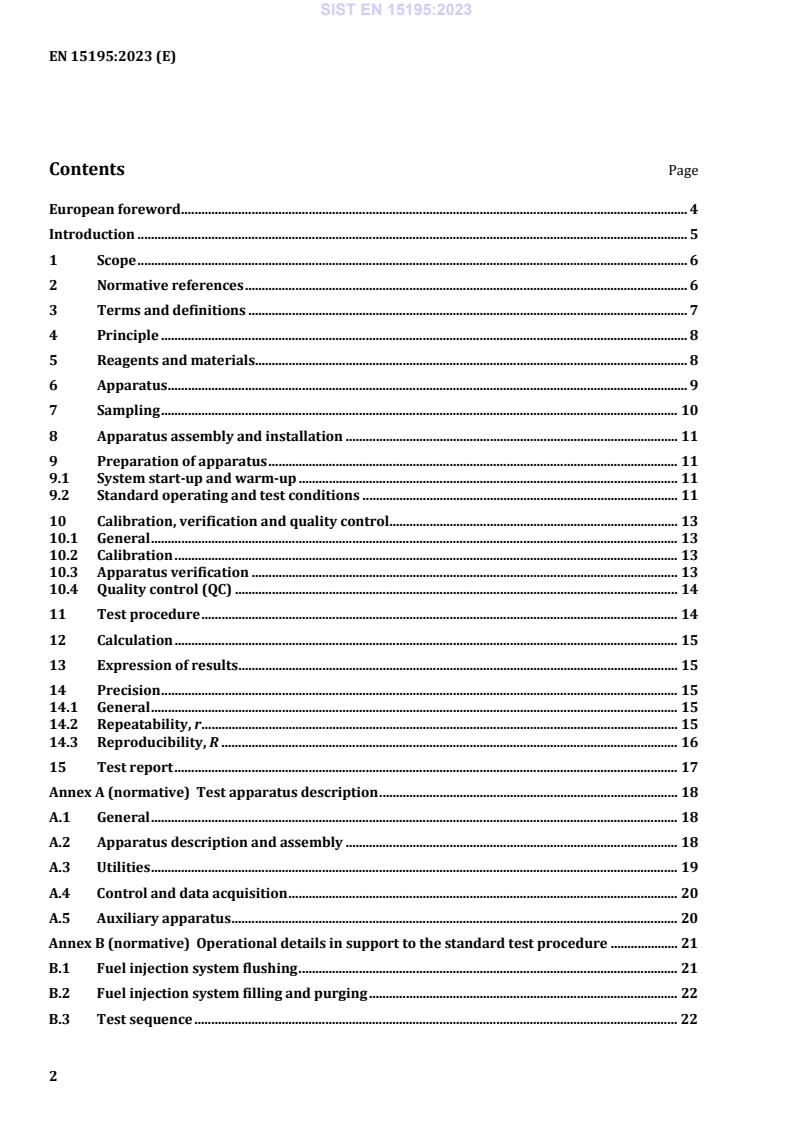
Contents Page
European foreword . 4
Introduction . 5
1 Scope . 6
2 Normative references . 6
3 Terms and definitions . 7
4 Principle . 8
5 Reagents and materials . 8
6 Apparatus . 9
7 Sampling . 10
8 Apparatus assembly and installation . 11
9 Preparation of apparatus . 11
9.1 System start-up and warm-up . 11
9.2 Standard operating and test conditions . 11
10 Calibration, verification and quality control. 13
10.1 General . 13
10.2 Calibration . 13
10.3 Apparatus verification . 13
10.4 Quality control (QC) . 14
11 Test procedure . 14
12 Calculation . 15
13 Expression of results . 15
14 Precision . 15
14.1 General . 15
14.2 Repeatability, r . 15
14.3 Reproducibility, R . 16
15 Test report . 17
Annex A (normative) Test apparatus description . 18
A.1 General . 18
A.2 Apparatus description and assembly . 18
A.3 Utilities . 19
A.4 Control and data acquisition . 20
A.5 Auxiliary apparatus . 20
Annex B (normative) Operational details in support to the standard test procedure . 21
B.1 Fuel injection system flushing . 21
B.2 Fuel injection system filling and purging . 22
B.3 Test sequence . 22
B.3.1 General . 22
B.3.2 Test sequence . 23
B.3.3 Data record . 24
B.4 Fuel injection system cleaning . 24
B.5 Alternative fuel injection system cleaning . 25
Annex C (informative) Apparatus maintenance . 26
C.1 General . 26
C.2 Daily maintenance . 26
C.3 Weekly maintenance . 26
C.4 Yearly maintenance . 26
Bibliography . 27
European foreword
This document (EN 15195:2023) has been prepared by Technical Committee CEN/TC 19 “Gaseous and
liquid fuels, lubricants and related products of petroleum, synthetic and biological origin”, the secretariat
of which is held by NEN.
This European Standard shall be given the status of a national standard, either by publication of an
identical text or by endorsement, at the latest by September 2023, and conflicting national standards shall
be withdrawn at the latest by September 2023.
Attention is drawn to the possibility that some of the elements of this document may be the subject of
patent rights. CEN shall not be held responsible for identifying any or all such patent rights.
This document supersedes EN 15195:2014.
The main changes compared to the previous edition are listed below:
— the Scope has been extended to paraffinic diesel from synthesis or hydrotreatment, in line with the
outcome of the interlaboratory study organized by CEN/TC 19 in 2013 [1];
— based on a review of PT data from EI and NEG correlation schemes, the lower end of the ignition
delay range has been expanded up to 2,58 ms (76,8 DCN), where it used to be up to 2,8 ms (71 DCN);
— the Introduction has been updated with historical information on the method development;
— Annex D on equation outside the method scope range has been removed.
Any feedback and questions on this document should be directed to the users’ national standards body.
A complete listing of these bodies can be found on the CEN website.
According to the CEN-CENELEC Internal Regulations, the national standards organisations of the
following countries are bound to implement this European Standard: Austria, Belgium, Bulgaria, Croatia,
Cyprus, Czech Republic, Denmark, Estonia, Finland, France, Germany, Greece, Hungary, Iceland, Ireland,
Italy, Latvia, Lithuania, Luxembourg, Malta, Netherlands, Norway, Poland, Portugal, Republic of North
Macedonia, Romania, Serbia, Slovakia, Slovenia, Spain, Sweden, Switzerland, Türkiye and the United
Kingdom.
Introduction
This document is derived from joint standardization work in the Energy Institute and ASTM
International. It was originally based on IP 498/06 [2] published by the Energy Institute and harmonized
with the equivalent ASTM standard test method [3].
The described method is an alternative quantitative determination of the cetane number of middle
distillate fuels intended for use in compression ignition engines. Correlation studies between this method
and EN ISO 5165 have been done and the results of this are incorporated in this document.
The basis of this method is the derived cetane number correlation equation as given in Clause 12. The
equation that relates ignition delay to derived cetane number, originally developed in 1997 [4], was:
(−0,658)
DCN = 83,99(ID-1,512) + 3,547. This equation was derived from a correlation test programme,
comprising ASTM National Exchange Group (NEG) check fuels, heptamethylnonane, cetane and in-house
check fuel. In 2005, the equation was re-evaluated by the EI and ASTM through the correlation of cetane
number data from the IP and the National Exchange Group (NEG) Diesel Fuel Engine Correlation Schemes
and ignition delay data on the same samples from the IP and NEG IQT Correlation Schemes collected over
a number of years [5]. In 2006, another ASTM evaluation [6] led to the actual equation, which showed an
optimal fit over the range of the scope.
On 13 July 2021 ASTM International granted usage of its national Diesel Exchange group program data
which enabled the lower end of the ignition delay scope to be expanded from 2,8 ms to 2,58 ms (from 71
DCN up to 76,8 DCN). The relevant subcommittee ASTM D02.01 has not endorsed this scope expansion
and therefore did not adopt the conclusions for its equivalent standard [3]. Supporting data have been
filed at CEN/TC 19 Secretariat.
The on-going validation of the equation as in Formula (1) is monitored and evaluated through the existing
monthly American and European fuel exchange programs. The validation data will be reviewed by
CEN/TC 19 with a frequency of at least every two years. As a result of that review, CEN/TC 19 decides to,
if necessary, modify the existing equation/correlation or develop a new one. As part of that review, the
sample types will be examined, and if certain types are underrepresented, further steps may be taken to
evaluate how they perform.
For the moment, the basics of one type of apparatus are described. Once more correlation data on
different types of derived cetane number testing equipment is available, CEN/TC 19 will consider revising
this document.
1 Scope
This document specifies a test method for the quantitative determination of ignition delay of middle
distillate fuels intended for use in compression ignition engines. The method utilizes a constant volume
combustion chamber designed for operation by compression ignition, and employing direct injection of
fuel into compressed air that is controlled to a specified pressure and temperature. An equation is given
to calculate the derived cetane number (DCN) from the ignition delay measurement.
This document covers the ignition delay range from 2,58 ms to 6,34 ms (76,8 DCN to 33,9 DCN). The
combustion analyser can measure shorter or longer ignition delays, but precision is not known.
This document is applicable to diesel fuels, including those containing fatty acid methyl esters (FAME) up
to 30 % (V/V). The method is also applicable to middle distillate fuels of non-petroleum origin, oil-sands
based fuels, blends of fuel containing biodiesel material, diesel fuel oils containing cetane number
improver additives and low-sulfur diesel fuel oils. Furthermore, the method is applicable to paraffinic
diesel from synthesis or hydrotreatment, containing up to a volume fraction of 7 % FAME [1]. However,
users applying this document especially to unconventional distillate fuels are warned that the
relationship between derived cetane number and combustion behaviour in real engines is not yet fully
understood.
The test method is also applicable to the quantitative determination of the ignition characteristics of
FAME, especially the ignition delay. However, analysis of the data available, regarding correlation with
EN ISO 5165, is inconclusive. So the determination of derived cetane number for FAME fuel, also known
as B100, has not been included in the precision determination as in Clause 12.
NOTE For the purpose of this document, the expression “% (V/V)” is used to represent the volume fraction and
“% (m/m)” the mass fraction.
WARNING — The use of this document may involve hazardous materials, operations and equipment. This
document does not purport to address all of the safety problems associated with its use. It is the
responsibility of the user of this document to establish appropriate safety and health practices and
determine the applicability of regulatory limitations prior to use.
2 Normative references
The following documents are referred to in the text in such a way that some or all of their content
constitutes requirements of this document. For dated references, only the edition cited applies. For
undated references, the latest edition of the referenced document (including any amendments) applies.
EN ISO 3170, Petroleum liquids - Manual sampling (ISO 3170)
EN ISO 3171, Petroleum liquids - Automatic pipeline sampling (ISO 3171)
EN ISO 3696, Water for analytical laboratory use - Specification and test methods (ISO 3696)
ISO 1998-2:1998, Petroleum industry — Terminology — Part 2: Properties and tests
ISO 4010, Diesel engines — Calibrating nozzle, delay pintle type
IP 537, Determination of the purity of Derived Cetane Number reference materials — Gas chromatography
method
3 Terms and definitions
For the purposes of this document, the terms and definitions given in ISO 1998-2:1998 and the following
apply.
ISO and IEC maintain terminology databases for use in standardization at the following addresses:
— IEC Electropedia: available at https://www.electropedia.org/
— ISO Online browsing platform: available at https://www.iso.org/obp
3.1
cetane number
CN
measure of the ignition performance of a diesel fuel in a standardized engine test [7] on a scale defined
by reference fuels
Note 1 to entry: It is expressed as the percentage by volume of hexadecane (cetane) in a reference blend having
the same ignition delay as the fuel for analysis. The higher the cetane number, the shorter the ignition delay.
Note 2 to entry: ISO 1998-2 expresses it as “number on a conventional scale, indicating the ignition quality of a
diesel fuel under standardized conditions”, but for this document the definition as given is chosen as with new
equipment on the market since 1998 the reference to an engine has become essential.
3.2
ignition delay
ID
period of time, in milliseconds, between the start of fuel injection and the start of combustion
Note 1 to entry: In the context of this document, this period is determined by movement and pressure sensors in
the instrument.
Note 2 to entry: In the context of this document, a significant and sustained increase in rate-of-change in
pressure, ensuring that combustion is in progress, identifies the start of the combustion.
3.3
derived cetane number
DCN
number calculated by using an equation that correlates a combustion analyser's ignition delay to the
cetane number
3.4
accepted reference value
ARV
value agreed upon as a reference for comparison
Note 1 to entry: The value is derived as (1) a theoretical or established value, based in scientific principles, (2) an
assigned value, based on experimental work of some national or international organization, or (3) a consensus value
based on collaborative experimental work under the auspices of a scientific or engineering group.
3.5
quality control sample
QC
stable and homogenous material(s) similar in nature to the materials under test, properly stored to
ensure integrity, and available in sufficient quantity for repeated long-term testing
3.6
calibration reference fluid
stable and homogenous fluid used to calibrate the performance of the combustion analyser
3.7
verification reference fluid
stable and homogenous fluid used to verify the performance of the combustion analyser
4 Principle
A test portion of the material under test is injected into a heated temperature- and pressure-controlled
constant volume combustion chamber which has previously been charged with compressed air. Sensors
detect the start of injection and the start of combustion for each single-shot cycle. A complete test
sequence consists of 15 preliminary combustion cycles to ensure apparatus equilibrium and 32
subsequent test cycles to obtain ignition delay values. The average ignition delay (ID) of these 32 cycles
is inserted into an equation to obtain the derived cetane number (DCN). The DCN obtained by this
procedure is an estimate of the cetane number (CN) obtained from the conventional large-scale engine
test EN ISO 5165.
5 Reagents and materials
5.1 Water, unless otherwise specified, meeting the requirements for grade 3 of EN ISO 3696.
5.2 Coolant system fluid, 50:50 (V/V) mixture of commercial grade radiator antifreeze (aluminium-
compatible, ethylene glycol-type) with water (5.1).
NOTE This mixture meets the boiling point requirements and gives adequate protection of the coolant system
against corrosion and mineral scale that can alter heat transfer and rating results. See the manufacturer’s manual
for the correct ethylene glycol-type antifreeze quality.
5.3 Calibration reference fluid, n-heptane of a purity of minimum 99,5 % (m/m) to be used as the
designated 3,78 ms ignition delay accepted reference value material.
If the initial purity is not known, the purity shall be checked in accordance with IP 537.
5.4 Verification reference fluid, methylcyclohexane of a purity of minimum 99,0 % (m/m) to be used
as the designated 10,4 ms ignition delay accepted reference value material.
If the initial purity is not known, the purity shall be checked in accordance with IP 537.
Even if the verification reference fluid meets the purity specification, it may not meet the Ignition Delay
requirements (see Table 2). It is recommended to either pass the suspect MCH through a filter column to
remove peroxide based impurities or to test a bottle of MCH that has been shown to meet the ID
requirements. It is recommended that each bottle of MCH is tested prior to its use as a verification
reference fluid to confirm it is of acceptable quality.
5.5 Quality control sample, stable and homogeneous material(s), similar in nature to the materials
under test (see 3.5).
5.6 Combustion charge air, of oxygen content 20,9 % (V/V) ± 1,0 % (V/V), and containing less than
0,003 % (V/V) hydro-carbons and less than 0,025 % (V/V) water.
NOTE 1 Oxygen content of combustion charge compressed air can vary between batches (cylinders). Significant
variation will lead to changes in ignition delay (higher oxygen content leads to a shorter ignition delay).
NOTE 2 The effects of oxygen concentration have been investigated [8].
5.7 Actuating air, oil-free compressed air containing less than 0,1 % (V/V) water supplied at a
minimum sustained pressure of 1,5 MPa.
5.8 Compressed nitrogen, of minimum purity 99,9 % (V/V).
6 Apparatus
6.1 Combustion analyser
The apparatus is described in more detail in Annex A. For the installation and set-up procedures, and for
detailed system description, refer to the manufacturer’s manual.
The system described in this document comprises: an insulated heated, constant volume combustion
chamber (see 6.1.2) with fluid cooling of designated areas; external, pneumatically actuated, chamber
inlet and exhaust valves, and associated piping; a heated, pneumatically-actuated, fuel injection pump; a
constant pressure fuel delivery system; a re-circulating coolant system; solenoids; sensors; controls;
connection fittings for the compressed gas utilities; and a computer to control test sequencing. Figure 1
gives a schematic outline of the analyser.
6.1.2 Combustion chamber, steel combustion chamber of capacity 0,213 l ± 0,002 l, further detailed
in Annex A.
6.2 Filter medium, with a nominal pore size 3 µm to 5 µm, made of glass fibre, polytetrafluorethylene
(PTFE) or polyamide 6.6, of a size appropriate to the apparatus being used for sample filtration (see 7.5).
Key
P1 combustion chamber pressure T5 (used for diagnostic functions)
P2 combustion charge air pressure T6 injector nozzle coolant passage temperature
P3 injection actuator air pressure T7 coolant return temperature
P4 inlet/exhaust valve actuator air pressure (gauge) T8 (used for diagnostic functions)
P5 sample fuel reservoir pressure (gauge) T9 combustion chamber air back temperature
T1 combustion chamber outer surface temperature N1 injector nozzle needle motion sensor
T2 fuel injection pump temperature C1 digital signal - fuel injection actuator
T3 combustion chamber pressure sensor temperature C2 digital signal - inlet valve actuator
T4 charge air temperature C3 digital signal - exhaust valve actuator
C4 digital signal – charge air valve actuator
charge air line fuel injection pump driver air line
inlet/exhaust valve actuator air line coolant system line
fuel reservoir utility nitrogen line high pressure fuel line
Mechanical system
1 charge air supply 18 exhaust to ventilation system
2 insulation 19 drain
3 inlet valve 20 liquid to air heat exchanger
4 hydrocarbon waste 21 air filter
5 nozzle bleed 22 fan
6 injector nozzle 23 coolant reservoir
7 fuel injection pump 24 chamber heating elements
8 fuel sample reservoir with or without a check valve 25 exhaust valve
9 plunger 26 combustion chamber pressure sensor coolant
housing
10 quick connect valved fitting 27 combustion chamber
11 fuel reservoir utility compressed nitrogen supply 28 injector nozzle needle extension pin
12 quick connect valved fitting 29 coolant filter
13 pneumatic driver air surge tank 30 coolant pump
14 pump heating elements 37 coolant flow indicator
15 hydrocarbon waste 38 injector nozzle coolant flow control valve
16 pump bleed 39 pressure sensor coolant flow control valve
17 actuator utility compressed air supply 40 pressure relief valve
Figure 1 — Schematic overview of combustion analyser
7 Sampling
7.1 Unless otherwise specified, obtain samples in accordance with the procedures given in EN ISO 3170
or EN ISO 3171.
7.2 To minimize exposure to UV emissions that can induce chemical reactions, which may affect
ignition delay measurement, collect and store samples in sample containers that are either constructed
of materials that minimize light reaching the sample such as a dark brown bottle, metal can or containers
that shall be wrapped or boxed in light-proof containers immediately after filling. If the sample is not to
be analysed within 24 h, retain in a dark, cool environment, and preferably under an inert gas.
NOTE 1 Exposure of petroleum fuels to UV and VIS wavelengths for even a short period of time has been shown
to affect ignition delay [9].
NOTE 2 The formation of peroxides and radicals, which affect the ignition delay, is minimized when the sample
is stored in the dark, under a nitrogen blanket in a cool environment.
7.3 Bring the laboratory sample to 18 °C to 32 °C before testing.
7.4 Inspect the sample before testing for wax precipitation. If precipitants are present, bring the test
sample to a temperature of approximately 14°C above the expected cloud point of the material being
tested, taking care not to lose any lower boiling range components. Agitate the sample to return
precipitants back in to the solution, ensuring the sample is homogeneous before filtering.
7.5 Filter the laboratory sample through the filter medium (see 6.2) at ambient temperature, without
vacuum. Use a positive pressure filtration system. Immediately collect the filtered sample in a container
as described in 7.2.
WARNING — If a glass syringe is used to filter the sample, ensure that the filter capsule is correctly
located on the syringe fitting. Do not apply excessive force to the plunger as this could result in the glass
syringe shattering. It is recommended that protective gloves are worn during the filtering operation.
8 Apparatus assembly and installation
Annex A and Annex B give more details on the apparatus assembly and installation. The apparatus
requires placement on a level floor with facilities for the hook-up of all utilities and gasses. The user shall
ensure compliance with all local and national codes. The apparatus requires an environment with a
temperature of 18 °C to 32 °C. The exhaust gases shall be directed into a low suction pressure fume
extraction system.
NOTE The heat exchange of the coolant system and the injection pump operate satisfactorily at 18 °C to 32 °C.
CAUTION 1 — The apparatus requires high-pressure compressed air at high flow for intermittent
short periods of time.
CAUTION 2 — The noise level without a noise reduction system is approximately 86 dB, measured
at 1,5 m distance, and approximately 77 dB with noise reduction. Local regulations may apply to
high noise levels, but ear protectors should be worn when equipment is in operation.
9 Preparation of apparatus
9.1 System start-up and warm-up
9.1.1 For more details refer to the manufacturer’s manual.
9.1.2 Switch on power to the combustion analyser and the coolant pump.
9.1.3 Warm up the system.
NOTE At the end of the automated warm-up sequence, the ramp-up and total warm-up times will be indicated
on the computer monitor. Typical values are 1 300 s to 1 800 s for ramp-up time and 1 500 s to 2 300 s for the total
warm-up time. Significant increases in the average ramp-up time (more than 5 %) or total warm-up time (more
than 10 %) indicates a potential malfunction of the heating elements of the combustion chamber. For diagnostic
procedures, refer to the manufacturer’s manual.
9.2 Standard operating and test conditions
9.2.1 Adjust the pressure (p5) of the nitrogen supply to the sample fuel reservoir to approximately
345 kPa (50 psi).
...
Questions, Comments and Discussion
Ask us and Technical Secretary will try to provide an answer. You can facilitate discussion about the standard in here.
Loading comments...