


EN 1993-1-5:2024/prA1
(Amendment)Eurocode 3 - Design of steel structures - Part 1-5: Plated structural elements
General Information
- Abstract
1.1 Scope of EN 1993-1-5
(1) This document provides rules for structural design of stiffened and unstiffened nominally flat plates which are subject to in-plane forces.
(2) Non-uniform stress distributions due to shear lag, in-plane load introduction and plate buckling are covered. The effects of out-of-plane loading are outside the scope of this document.
NOTE 1 The rules in this part complement the rules for class 1, 2, 3 and 4 sections, see EN 1993-1-1.
NOTE 2 For the design of slender plates which are subject to repeated direct stress and/or shear and also fatigue due to out-of-plane bending of plate elements ("breathing"), see EN 1993-2 and EN 1993-6.
NOTE 3 For the effects of out-of-plane loading and for the combination of in-plane effects and out-of-plane loading effects, see EN 1993-2 and EN 1993-1-7.
(3) Single plate elements are considered as nominally flat where the curvature radius r in the direction perpendicular to the compression satisfies, as illustrated in Figure 1.1:
r≥b^2/t (1.1)
where
b is the panel width;
t is the plate thickness.
Figure 1.1 - Definition of plate curvature
1.2 Assumptions
(1) Unless specifically stated, EN 1990, the EN 1991 series and EN 1993-1-1 apply.
(2) The design methods given in EN 1993-1-5 are applicable if
- the execution quality is as specified in EN 1090-2 and
- the construction materials and products used are as specified in the relevant parts of the EN 1993 series or in the relevant material product specifications.
- Status
- Not Published
- Publication Date
- 27-Apr-2027
- Technical Committee
- CEN/TC 250 - Structural Eurocodes
- Drafting Committee
- CEN/TC 250/SC 3/WG 5 - Evolution of EN 1993-1-5 - Plated structures
- Current Stage
- 4060 - Closure of enquiry - Enquiry
- Start Date
- 18-Jun-2026
- Due Date
- 12-May-2026
- Completion Date
- 18-Jun-2026

Overview
EN 1993-1-5:2024/prA1, developed by CEN under the Eurocode 3 suite, addresses the design of plated structural elements in steel structures. This standard provides comprehensive rules for the structural design and verification of both stiffened and unstiffened nominally flat steel plates subjected to in-plane forces. The document covers critical aspects such as non-uniform stress distributions from shear lag, localized loading, load introduction, and plate buckling. EN 1993-1-5 is widely referenced by engineers and designers to ensure the safety, reliability, and efficiency of steel structures using plated elements.
Key Topics
EN 1993-1-5:2024/prA1 sets the criteria for designing plated elements, with focus on the following key topics:
- Applicability: Covers nominally flat plates, including definitions for permissible curvature, panel width, and plate thickness.
- Stress Distribution: Addresses non-uniform stress resulting from shear lag and in-plane loading, providing guidelines for modeling and verification.
- Plate Buckling: Introduces provisions to prevent and assess buckling under direct stresses at ultimate limit states, including both stiffened and unstiffened plates.
- Shear Resistance: Provides methods to evaluate shear resistance, including the verification of both stiffened and unstiffened webs.
- Interaction Effects: Details combined effects of bending, shear, and axial forces, including new annexed guidance for N-M-V (normal force - moment - shear) interaction in plated girders.
- Stiffeners and Detailing: Sets standards for the use and classification of longitudinal and transverse stiffeners, including design and detailing requirements.
- Reduced Stress Method: Details methods for the reduced stress approach, increasing flexibility for geometric and loading situations.
Applications
EN 1993-1-5:2024/prA1 is crucial for professionals involved in the structural design of:
- Buildings and Industrial Halls: Used in beams, floor systems, and wall panels where steel plates act as key load-carrying members.
- Bridges: Application in plate girders and box girder design, especially under in-plane loading such as traffic-induced forces.
- Tanks and Silos: Where flat or nominally curved steel panels are subject to direct stresses.
- Cranes and Supporting Structures: For components experiencing both direct and shear forces in high-performance environments.
- General Steel Fabrication: Informing the design and execution of elements manufactured to EN 1090-2 and other relevant Eurocode provisions.
The standard’s stringent provisions ensure that plated elements deliver adequate strength, stability, and serviceability across varied structural typologies and loading scenarios. Its guidance on execution quality, material selection, and design verification is essential for compliance and reliability in modern steel construction.
Related Standards
EN 1993-1-5:2024/prA1 works in conjunction with several interconnected standards in the Eurocode series and beyond:
- EN 1990-1: Basis of structural and geotechnical design.
- EN 1993-1-1: General rules and rules for buildings - main reference for steel structural design, including composite structures.
- EN 1993-1-2: Structural fire design of steel structures.
- EN 1993-1-9: Fatigue assessment of steel structures.
- EN 1993-2: Design of steel bridges - critical for bridge elements experiencing out-of-plane effects.
- EN 1993-6: Design of crane supporting structures and fatigue from out-of-plane bending ("breathing").
- EN 1090-2: Execution of steel structures requirements.
- EN 1993-1-7: Complementary guidance for the combination of in-plane and out-of-plane loading.
- EN 1991 series: Actions on structures.
- EN 10346: For material specification of coated steel products.
EN 1993-1-5:2024/prA1 is an essential tool for professionals ensuring regulatory compliance, optimal material utilization, and robust performance of steel structures using plated elements in Europe and internationally.
Relations
- Amends
EN 1993-1-5:2024 - Eurocode 3 - Design of steel structures - Part 1-5: Plated structural elements - Effective Date
- 17-Sep-2025
Get Certified
Connect with accredited certification bodies for this standard

DIBt (Deutsches Institut für Bautechnik)
German Institute for Building Technology.
DIN CERTCO
DIN Group product certification.

Aboma Certification B.V.
Specialized in construction, metal, and transport sectors.
Sponsored listings
Frequently Asked Questions
EN 1993-1-5:2024/prA1 is a draft published by the European Committee for Standardization (CEN). Its full title is "Eurocode 3 - Design of steel structures - Part 1-5: Plated structural elements". This standard covers: 1.1 Scope of EN 1993-1-5 (1) This document provides rules for structural design of stiffened and unstiffened nominally flat plates which are subject to in-plane forces. (2) Non-uniform stress distributions due to shear lag, in-plane load introduction and plate buckling are covered. The effects of out-of-plane loading are outside the scope of this document. NOTE 1 The rules in this part complement the rules for class 1, 2, 3 and 4 sections, see EN 1993-1-1. NOTE 2 For the design of slender plates which are subject to repeated direct stress and/or shear and also fatigue due to out-of-plane bending of plate elements ("breathing"), see EN 1993-2 and EN 1993-6. NOTE 3 For the effects of out-of-plane loading and for the combination of in-plane effects and out-of-plane loading effects, see EN 1993-2 and EN 1993-1-7. (3) Single plate elements are considered as nominally flat where the curvature radius r in the direction perpendicular to the compression satisfies, as illustrated in Figure 1.1: r≥b^2/t (1.1) where b is the panel width; t is the plate thickness. Figure 1.1 - Definition of plate curvature 1.2 Assumptions (1) Unless specifically stated, EN 1990, the EN 1991 series and EN 1993-1-1 apply. (2) The design methods given in EN 1993-1-5 are applicable if - the execution quality is as specified in EN 1090-2 and - the construction materials and products used are as specified in the relevant parts of the EN 1993 series or in the relevant material product specifications.
1.1 Scope of EN 1993-1-5 (1) This document provides rules for structural design of stiffened and unstiffened nominally flat plates which are subject to in-plane forces. (2) Non-uniform stress distributions due to shear lag, in-plane load introduction and plate buckling are covered. The effects of out-of-plane loading are outside the scope of this document. NOTE 1 The rules in this part complement the rules for class 1, 2, 3 and 4 sections, see EN 1993-1-1. NOTE 2 For the design of slender plates which are subject to repeated direct stress and/or shear and also fatigue due to out-of-plane bending of plate elements ("breathing"), see EN 1993-2 and EN 1993-6. NOTE 3 For the effects of out-of-plane loading and for the combination of in-plane effects and out-of-plane loading effects, see EN 1993-2 and EN 1993-1-7. (3) Single plate elements are considered as nominally flat where the curvature radius r in the direction perpendicular to the compression satisfies, as illustrated in Figure 1.1: r≥b^2/t (1.1) where b is the panel width; t is the plate thickness. Figure 1.1 - Definition of plate curvature 1.2 Assumptions (1) Unless specifically stated, EN 1990, the EN 1991 series and EN 1993-1-1 apply. (2) The design methods given in EN 1993-1-5 are applicable if - the execution quality is as specified in EN 1090-2 and - the construction materials and products used are as specified in the relevant parts of the EN 1993 series or in the relevant material product specifications.
EN 1993-1-5:2024/prA1 is classified under the following ICS (International Classification for Standards) categories: 91.010.30 - Technical aspects. The ICS classification helps identify the subject area and facilitates finding related standards.
EN 1993-1-5:2024/prA1 has the following relationships with other standards: It is inter standard links to EN 1993-1-5:2024. Understanding these relationships helps ensure you are using the most current and applicable version of the standard.
EN 1993-1-5:2024/prA1 is available in PDF format for immediate download after purchase. The document can be added to your cart and obtained through the secure checkout process. Digital delivery ensures instant access to the complete standard document.
Standards Content (Sample)
SLOVENSKI STANDARD
01-maj-2026
Evrokod 3 - Projektiranje jeklenih konstrukcij - 1-5. del: Elementi pločevinaste
konstrukcije
Eurocode 3 - Design of steel structures - Part 1-5: Plated structural elements
Eurocode 3 - Bemessung und Konstruktion von Stahlbauten - Teil 1-5: Plattenförmige
Bauteile
Eurocode 3 - Calcul des structures en acier - Partie 1-5 : Eléments structuraux
constitués de plaques
Ta slovenski standard je istoveten z: EN 1993-1-5:2024/prA1
ICS:
91.010.30 Tehnični vidiki Technical aspects
91.080.13 Jeklene konstrukcije Steel structures
2003-01.Slovenski inštitut za standardizacijo. Razmnoževanje celote ali delov tega standarda ni dovoljeno.
DRAFT
EUROPEAN STANDARD
EN 1993-1-5:2024
NORME EUROPÉENNE
EUROPÄISCHE NORM
prA1
March 2026
ICS
English Version
Eurocode 3 - Design of steel structures - Part 1-5: Plated
structural elements
Eurocode 3 - Calcul des structures en acier - Partie 1-5 : Eurocode 3 - Bemessung und Konstruktion von
Eléments structuraux constitués de plaques Stahlbauten - Teil 1-5: Plattenförmige Bauteile
This draft amendment is submitted to CEN members for enquiry. It has been drawn up by the Technical Committee CEN/TC 250.
This draft amendment A1, if approved, will modify the European Standard EN 1993-1-5:2024. If this draft becomes an
amendment, CEN members are bound to comply with the CEN/CENELEC Internal Regulations which stipulate the conditions for
inclusion of this amendment into the relevant national standard without any alteration.
This draft amendment was established by CEN in three official versions (English, French, German). A version in any other
language made by translation under the responsibility of a CEN member into its own language and notified to the CEN-CENELEC
Management Centre has the same status as the official versions.
CEN members are the national standards bodies of Austria, Belgium, Bulgaria, Croatia, Cyprus, Czech Republic, Denmark, Estonia,
Finland, France, Germany, Greece, Hungary, Iceland, Ireland, Italy, Latvia, Lithuania, Luxembourg, Malta, Netherlands, Norway,
Poland, Portugal, Republic of North Macedonia, Romania, Serbia, Slovakia, Slovenia, Spain, Sweden, Switzerland, Türkiye and
United Kingdom.
Recipients of this draft are invited to submit, with their comments, notification of any relevant patent rights of which they are
aware and to provide supporting documentation.
Warning : This document is not a European Standard. It is distributed for review and comments. It is subject to change without
notice and shall not be referred to as a European Standard.
EUROPEAN COMMITTEE FOR STANDARDIZATION
COMITÉ EUROPÉEN DE NORMALISATION
EUROPÄISCHES KOMITEE FÜR NORMUNG
CEN-CENELEC Management Centre: Rue de la Science 23, B-1040 Brussels
© 2026 CEN All rights of exploitation in any form and by any means reserved Ref. No. EN 1993-1-5:2024/prA1:2026 E
worldwide for CEN national Members.
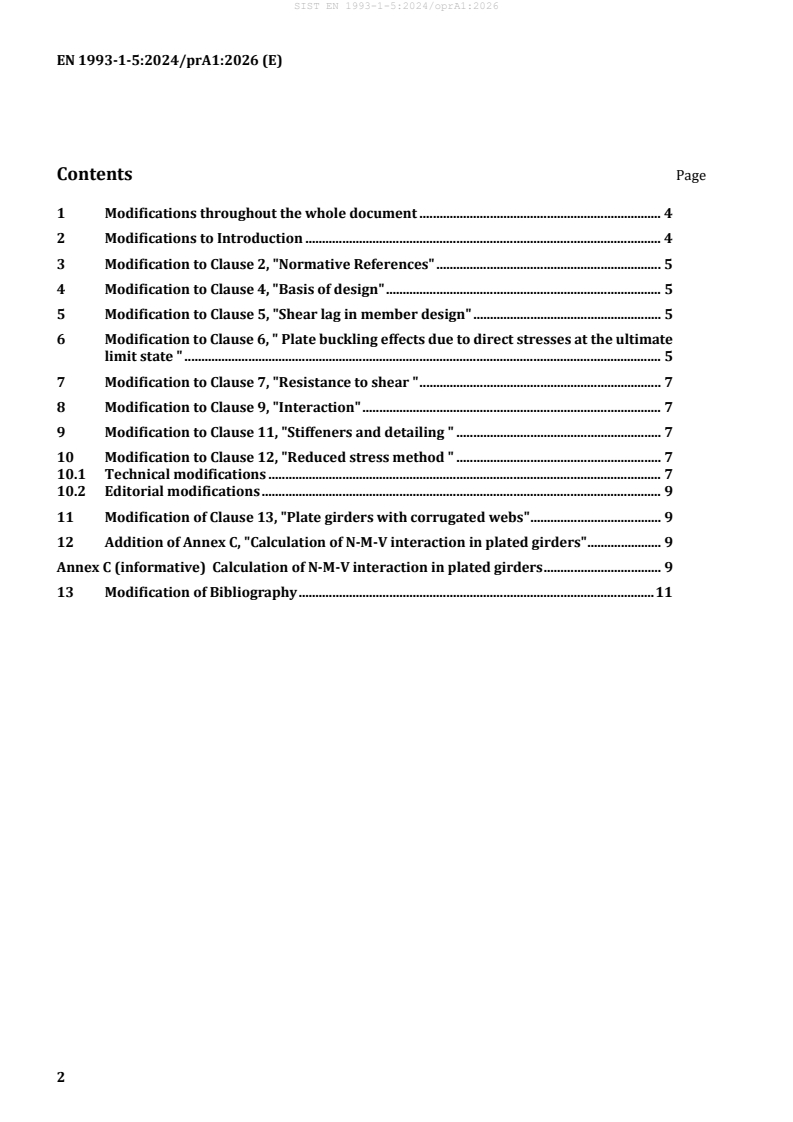
Contents Page
1 Modifications throughout the whole document . 4
2 Modifications to Introduction . 4
3 Modification to Clause 2, "Normative References" . 5
4 Modification to Clause 4, "Basis of design" . 5
5 Modification to Clause 5, "Shear lag in member design" . 5
6 Modification to Clause 6, " Plate buckling effects due to direct stresses at the ultimate
limit state " . 5
7 Modification to Clause 7, "Resistance to shear " . 7
8 Modification to Clause 9, "Interaction" . 7
9 Modification to Clause 11, "Stiffeners and detailing " . 7
10 Modification to Clause 12, "Reduced stress method " . 7
10.1 Technical modifications . 7
10.2 Editorial modifications . 9
11 Modification of Clause 13, "Plate girders with corrugated webs" . 9
12 Addition of Annex C, "Calculation of N-M-V interaction in plated girders" . 9
Annex C (informative) Calculation of N-M-V interaction in plated girders . 9
13 Modification of Bibliography . 11
European foreword
This document (EN 1993-1-5:2024/prA1:2025) has been prepared by Technical Committee CEN/TC 250
“Structural Eurocodes”, the secretariat of which is held by BSI. CEN/TC 250 is responsible for all
Structural Eurocodes and has been assigned responsibility for structural and geotechnical design matters
by CEN.
This document is an amendment to EN 1993-1-5:2024 and is currently submitted to the CEN Enquiry.
This document will amend EN 1993-1-5:2024.
NOTE Some modifications are purely editorial corrections to improve the quality of the document and these
will not be tagged in the consolidated publication, as noted after the modification.
The first generation of EN Eurocodes was published between 2002 and 2007. This document forms part
of the second generation of the Eurocodes, which have been prepared under Mandate M/515 issued to
CEN by the European Commission and the European Free Trade Association.
The Eurocodes have been drafted to be used in conjunction with relevant execution, material, product
and test standards, and to identify requirements for execution, materials, products and testing that are
relied upon by the Eurocodes.
The Eurocodes recognise the responsibility of each Member State and have safeguarded their right to
determine values related to regulatory safety matters at national level through the use of National
Annexes.
1 Modifications throughout the whole document
Add part number “-1” to the reference “EN 1990” and update throughout the text.
2 Modifications to Introduction
0.1 Replace “— New parts are under development, e.g. Eurocode for design of structural glass”
with “— EN 19100, Eurocode 10 — Design of glass structures”
0.1 Add the following new list item: “— New parts are under development, e.g. Eurocode for design of
fibre-polymer composite structures and design of tensioned membrane structures”
0.2 Replace in the first paragraph the reference to EN 1990 with “EN 1990-1 — Basis of structural and
geotechnical design — Part 1: New structures”.
0.2 Replace the list of the various parts of EN 1993 with:
EN 1993-1-1, Eurocode 3 — Design of Steel Structures — Part 1-1: General rules and rules for buildings;
EN 1993-1-2, Eurocode 3 — Design of Steel Structures — Part 1-2: Structural fire design;
EN 1993-1-3, Eurocode 3 — Design of Steel Structures — Part 1-3: Cold-formed members and sheeting;
NOTE Cold-formed hollow sections supplied according to EN 10219 (all parts) are covered in EN 1993-1-1.
EN 1993-1-4, Eurocode 3 — Design of Steel Structures — Part 1-4: Stainless steel structures;
EN 1993-1-5, Eurocode 3 — Design of Steel Structures — Part 1-5: Plated structural elements;
EN 1993-1-6, Eurocode 3 — Design of Steel Structures — Part 1-6: Strength and stability of shell structures;
EN 1993-1-7, Eurocode 3 — Design of Steel Structures — Part 1-7: Plate assemblies with elements under
transverse loads;
EN 1993-1-8, Eurocode 3 — Design of Steel Structures — Part 1-8: Joints;
EN 1993-1-9, Eurocode 3 — Design of Steel Structures — Part 1-9: Fatigue;
EN 1993-1-10, Eurocode 3 — Design of Steel Structures — Part 1-10: Material toughness and through-
thickness properties;
EN 1993-1-11, Eurocode 3 — Design of Steel Structures — Part 1-11: Tension components;
EN 1993-1-12, Eurocode 3 — Design of Steel Structures — Part 1-12: Additional rules for steel grades up to
S960;
EN 1993-1-13, Eurocode 3 — Design of Steel Structures — Part 1-13: Beams with large web openings;
EN 1993-1-14, Eurocode 3 — Design of Steel Structures — Part 1-14: Design assisted by finite element
analysis;
EN 1993-2, Eurocode 3 — Design of Steel Structures — Part 2: Bridges;
EN 1993-3, Eurocode 3 — Design of Steel Structures — Part 3: Towers, masts and chimneys;
EN 1993-4-1, Eurocode 3 — Design of Steel Structures — Part 4-1: Silos;
EN 1993-4-2, Eurocode 3 — Design of Steel Structures — Part 4-2: Tanks;
EN 1993-5, Eurocode 3 — Design of Steel Structures — Part 5: Piling;
EN 1993-6, Eurocode 3 — Design of Steel Structures — Part 6: Crane supporting structures;
EN 1993-7, Eurocode 3 — Design of Steel Structures — Part 7: Sandwich panels (under preparation).
3 Modification to Clause 2, "Normative References"
Replace the reference to EN 1990 by:
EN 1990-1, Eurocode — Basis of structural and geotechnical design — Part 1: New structures
4 Modification to Clause 4, "Basis of design"
4.3(3) Add the word “length” in the last part of the sentence to read: “… where L is the span length or twice
the distance from the support to the end of a cantilever.”
5 Modification to Clause 5, "Shear lag in member design"
5.2.1(2) Replace in the Figure 5.1 “β ” with “β " for “β :L = 0,25(L + L )” and replace “β ” with “β “ for
1 2 2 e 1 2 2 1
“β :L = 0,7L ” to show as follows:
1 e 2
“
s
Figure 5.1 — Effective length L for continuous beam and distribution of effective width”
e
5.2.1(2) Replace in Table 5.1 ”<" with "≤" for “β = (0,55 + 0,025 / κ) β , but β ≤ β ”.
0 1 0 1
6 Modification
...