


FprEN 15501
(Main)Thermal insulation products for building equipment and industrial installations - Factory made expanded perlite (EP) and exfoliated vermiculite (EV) products - Specification
General Information
- Abstract
This European Standard specifies the requirements for factory made expanded perlite and exfoliated vermiculite products which are used for the thermal insulation of building equipment and industrial installations with an operating temperature in the range of approximately 0°C to + 1 300°C.
NOTE Products covered by this standard can be used below 0°C but special tests regarding the suitability of the product in the intended application are advised and manufacturers advice should be heeded in all cases.
The products are manufactured in the form of boards, pipe sections, segment, prefabricated ware and special ware.
This standard describes product characteristics and includes procedures for testing, evaluation of conformity, marking and labelling.
Products covered by this standard are also used in prefabricated thermal insulation systems and composite panels; the performance of systems incorporating these products is not covered.
This standard does not specify the required level of a given property that shall be achieved by a product to demonstrate fitness for purpose in a particular application. The levels required for a given application can be found in regulations and invitations to tender.
This standard does not cover products for in-situ insulation (blowing or pouring) or products for the insulation of the building structure.
The standard does not cover the following acoustical aspects: direct airborne sound insulation and impact transmission noise index.
- Status
- Not Published
- Publication Date
- 22-Sep-2009
- Technical Committee
- CEN/TC 88 - Thermal insulating materials and products
- Drafting Committee
- CEN/TC 88/WG 10 - Building equipment and industrial installations
- Current Stage
- 5098 - Decision to abandon - Formal Approval
- Start Date
- 09-Jul-2010
- Completion Date
- 09-Jul-2010
- Directive
- Harmonized Standard305/2011 - Regulation (eu) No 305/2011 of the European Parliament and of the Council of 9 march 2011 laying down harmonised conditions for the marketing of construction products and repealing council directive 89/106/eec
Not Harmonized89/106/EEC - Construction products

Overview
FprEN 15501 (CEN) specifies requirements for factory-made expanded perlite (EP) and exfoliated vermiculite (EV) thermal insulation products used on building equipment and industrial installations. The standard covers products manufactured as boards, pipe sections, segments, prefabricated ware and special ware and is intended for service temperatures approximately 0 °C to +1 300 °C. It defines product characteristics and procedures for testing, evaluation of conformity, marking and labelling. Products may be used below 0 °C but require special suitability testing and manufacturer guidance.
Key Topics
- Material scope: Expanded perlite (EP) and exfoliated vermiculite (EV) factory-made products.
- Temperature range: Designed for applications roughly 0 °C to +1 300 °C (special testing advised for sub‑0 °C use).
- Product forms: Boards, slabs, pipe sections (including split pipe), segments, blocks and prefabricated items.
- Product characteristics and tests: Dimensional tolerances, thermal conductivity, apparent density, compressive and bending strength, dimensional stability, water vapour transmission, reaction to fire (see Annex B) and trace ion content. Test standards referenced include EN series and ISO methods (for example EN 1604, EN 13467, EN 13823, EN ISO 1716).
- Conformity and factory control: Requirements for Initial Type Testing (ITT), Factory Production Control (FPC) and designation coding are included; Annex A addresses FPC procedures.
- Marking and labelling: Rules for labelling products and CE marking information (Annex ZA) in relation to the EU Construction Products Directive.
- Limitations: Does not set performance levels for specific applications (those are determined by regulations or tender documents). It does not cover in-situ (blown or poured) insulation, insulation of building structural elements or acoustical performance (airborne sound, impact noise index).
Applications
- Insulation of mechanical building services (HVAC ducts, boilers, vessels) and industrial installations operating at low to very high temperatures.
- Use by manufacturers to develop and declare product performance and by testing laboratories to perform standardized assessments.
- Reference for specifiers, M&E engineers, architects and procurement teams when selecting EP/EV insulation for high‑temperature or corrosive environments where lightweight, refractory insulating materials are required.
- Useful for conformity bodies and contract authorities during tendering and CE-marking assessments.
Related Standards
- EN 1604 - Dimensional stability
- EN 13467 - Preformed pipe insulation dimensions
- EN 13823 / EN ISO 1716 - Reaction to fire test methods
- EN 13501-1 - Fire classification of construction products
Keywords: EN 15501, FprEN 15501, expanded perlite, exfoliated vermiculite, thermal insulation, building equipment, industrial installations, high-temperature insulation, CEN.
Get Certified
Connect with accredited certification bodies for this standard

ICC Evaluation Service
Building products evaluation and certification.

QAI Laboratories
Building and construction product testing and certification.

Aboma Certification B.V.
Specialized in construction, metal, and transport sectors.
Sponsored listings
Frequently Asked Questions
FprEN 15501 is a draft published by the European Committee for Standardization (CEN). Its full title is "Thermal insulation products for building equipment and industrial installations - Factory made expanded perlite (EP) and exfoliated vermiculite (EV) products - Specification". This standard covers: This European Standard specifies the requirements for factory made expanded perlite and exfoliated vermiculite products which are used for the thermal insulation of building equipment and industrial installations with an operating temperature in the range of approximately 0°C to + 1 300°C. NOTE Products covered by this standard can be used below 0°C but special tests regarding the suitability of the product in the intended application are advised and manufacturers advice should be heeded in all cases. The products are manufactured in the form of boards, pipe sections, segment, prefabricated ware and special ware. This standard describes product characteristics and includes procedures for testing, evaluation of conformity, marking and labelling. Products covered by this standard are also used in prefabricated thermal insulation systems and composite panels; the performance of systems incorporating these products is not covered. This standard does not specify the required level of a given property that shall be achieved by a product to demonstrate fitness for purpose in a particular application. The levels required for a given application can be found in regulations and invitations to tender. This standard does not cover products for in-situ insulation (blowing or pouring) or products for the insulation of the building structure. The standard does not cover the following acoustical aspects: direct airborne sound insulation and impact transmission noise index.
This European Standard specifies the requirements for factory made expanded perlite and exfoliated vermiculite products which are used for the thermal insulation of building equipment and industrial installations with an operating temperature in the range of approximately 0°C to + 1 300°C. NOTE Products covered by this standard can be used below 0°C but special tests regarding the suitability of the product in the intended application are advised and manufacturers advice should be heeded in all cases. The products are manufactured in the form of boards, pipe sections, segment, prefabricated ware and special ware. This standard describes product characteristics and includes procedures for testing, evaluation of conformity, marking and labelling. Products covered by this standard are also used in prefabricated thermal insulation systems and composite panels; the performance of systems incorporating these products is not covered. This standard does not specify the required level of a given property that shall be achieved by a product to demonstrate fitness for purpose in a particular application. The levels required for a given application can be found in regulations and invitations to tender. This standard does not cover products for in-situ insulation (blowing or pouring) or products for the insulation of the building structure. The standard does not cover the following acoustical aspects: direct airborne sound insulation and impact transmission noise index.
FprEN 15501 is classified under the following ICS (International Classification for Standards) categories: 91.100.60 - Thermal and sound insulating materials. The ICS classification helps identify the subject area and facilitates finding related standards.
FprEN 15501 is associated with the following European legislation: EU Directives/Regulations: 305/2011, 89/106/EEC; Standardization Mandates: M/103. When a standard is cited in the Official Journal of the European Union, products manufactured in conformity with it benefit from a presumption of conformity with the essential requirements of the corresponding EU directive or regulation.
FprEN 15501 is available in PDF format for immediate download after purchase. The document can be added to your cart and obtained through the secure checkout process. Digital delivery ensures instant access to the complete standard document.
Standards Content (Sample)
SLOVENSKI oSIST prEN 15501:2006
PREDSTANDARD
may 2006
Toplotnoizolacijski proizvodi za opremo stavb in industrijske inštalacije -
Proizvodi iz ekspandiranega perlita (EPB) in vermikulita (EV) - Specifikacije
Thermal insulation products for building equipment and industrial installations -
Factory made expanded perlite (EP) and exfoliated vermiculite (EV) products -
Specification
ICS 91.120.10 Referenčna številka
oSIST prEN 15501:2006(en)
© Standard je založil in izdal Slovenski inštitut za standardizacijo. Razmnoževanje ali kopiranje celote ali delov tega dokumenta ni dovoljeno
EUROPEAN STANDARD
DRAFT
prEN 15501
NORME EUROPÉENNE
EUROPÄISCHE NORM
March 2006
ICS
English Version
Thermal insulation products for building equipment and industrial
installations - Factory made expanded perlite (EP) and
exfoliated vermiculite (EV) products - Specification
Produits isolants thermiques pour l'équipement du bâtiment Wärmedämmstoffe für die Haustechnik und für
et les installations industrielles - Produits manufacturés en betriebstechnische Anlagen - Werkmäßig hergestellte
perlite expansée (EP) et à base de vermiculite exfoliée (EV) Produkte aus Blähperlit (EP) und expandiertem Vermiculite
- Spécification (EV) - Spezifikation
This draft European Standard is submitted to CEN members for enquiry. It has been drawn up by the Technical Committee CEN/TC 88.
If this draft becomes a European Standard, CEN members are bound to comply with the CEN/CENELEC Internal Regulations which
stipulate the conditions for giving this European Standard the status of a national standard without any alteration.
This draft European Standard was established by CEN in three official versions (English, French, German). A version in any other language
made by translation under the responsibility of a CEN member into its own language and notified to the Management Centre has the same
status as the official versions.
CEN members are the national standards bodies of Austria, Belgium, Cyprus, Czech Republic, Denmark, Estonia, Finland, France,
Germany, Greece, Hungary, Iceland, Ireland, Italy, Latvia, Lithuania, Luxembourg, Malta, Netherlands, Norway, Poland, Portugal, Romania,
Slovakia, Slovenia, Spain, Sweden, Switzerland and United Kingdom.
Recipients of this draft are invited to submit, with their comments, notification of any relevant patent rights of which they are aware and to
provide supporting documentation.
Warning : This document is not a European Standard. It is distributed for review and comments. It is subject to change without notice and
shall not be referred to as a European Standard.
EUROPEAN COMMITTEE FOR STANDARDIZATION
COMITÉ EUROPÉEN DE NORMALISATION
EUROPÄISCHES KOMITEE FÜR NORMUNG
Management Centre: rue de Stassart, 36 B-1050 Brussels
© 2006 CEN All rights of exploitation in any form and by any means reserved Ref. No. prEN 15501:2006: E
worldwide for CEN national Members.
prEN 15501:2006 (E)
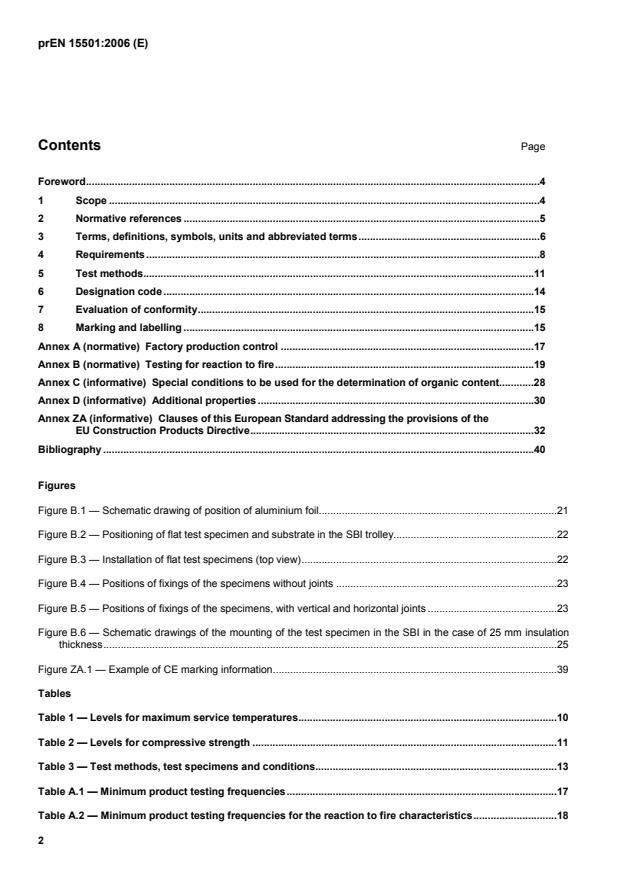
Contents Page
Foreword.4
1 Scope .4
2 Normative references .5
3 Terms, definitions, symbols, units and abbreviated terms.6
4 Requirements.8
5 Test methods.11
6 Designation code.14
7 Evaluation of conformity.15
8 Marking and labelling .15
Annex A (normative) Factory production control .17
Annex B (normative) Testing for reaction to fire.19
Annex C (informative) Special conditions to be used for the determination of organic content.28
Annex D (informative) Additional properties .30
Annex ZA (informative) Clauses of this European Standard addressing the provisions of the
EU Construction Products Directive.32
Bibliography .40
Figures
Figure B.1 — Schematic drawing of position of aluminium foil.21
Figure B.2 — Positioning of flat test specimen and substrate in the SBI trolley.22
Figure B.3 — Installation of flat test specimens (top view).22
Figure B.4 — Positions of fixings of the specimens without joints .23
Figure B.5 — Positions of fixings of the specimens, with vertical and horizontal joints .23
Figure B.6 — Schematic drawings of the mounting of the test specimen in the SBI in the case of 25 mm insulation
thickness.25
Figure ZA.1 — Example of CE marking information.39
Tables
Table 1 — Levels for maximum service temperatures.10
Table 2 — Levels for compressive strength .11
Table 3 — Test methods, test specimens and conditions.13
Table A.1 — Minimum product testing frequencies.17
Table A.2 — Minimum product testing frequencies for the reaction to fire characteristics.18
prEN 15501:2006 (E)
Table B.1 — Product parameters .19
Table B.2 — End use application parameters.20
Table D.1 — Test methods, test specimens, conditions and minimum testing frequencies .31
Table ZA.1 — Relevant clauses.33
Table ZA.2 - System(s) of attestation of conformity .34
Table ZA.3.1 — Assignment of evaluation of conformity tasks for products under system 1.35
Table ZA.3.2 — Assignment of evaluation of conformity tasks for products under system 3 or system 3
combined with system 4 for reaction to fire.36
prEN 15501:2006 (E)
Foreword
This document (prEN 15501:2006) has been prepared by Technical Committee CEN/TC 88 “Thermal insulating
materials and products”, the secretariat of which is held by DIN.
This document is currently submitted to the CEN Enquiry.
This European Standard has been prepared under a mandate given to CEN by the European Commission and the
European Free Trade Association, and supports the essential requirements of EU Directive(s).
For relationship with EU Directive(s), see informative Annex ZA which is an integral part of this standard.
Locally responsible authorities and contracting entities, who are bound by EU Directives to specify their
requirements using European harmonized product standards, shall be allowed to demand additional properties
outside the provisions of this standard if this is technically necessary due to prevailing operational conditions of the
building equipment or the industrial installation projected or due to safety regulations.
This European Standard contains five annexes:
Annex A (normative) Factory production control
Annex B (normative) Testing for reaction to fire
Annex C (normative) Special conditions to be used for the determination of organic content
Annex D (informative) Additional properties
Annex ZA (informative) Clauses of this European Standard addressing the provisions of the EU Construction
Products Directive
This European standard contains a Bibliography.
This European Standard is one of a series of standards for insulation products used in building equipment and
industrial installations, but this standard may be used in other areas where appropriate.
1 Scope
This European Standard specifies the requirements for factory made expanded perlite and exfoliated vermiculite
products which are used for the thermal insulation of building equipment and industrial installations with an
operating temperature in the range of approximately 0°C to + 1 300°C.
The products are manufactured in the form of boards, pipe sections, segments and prefabricated ware.
This standard describes product characteristics and includes procedures for testing, evaluation of conformity,
marking and labelling.
Products covered by this standard are also used in prefabricated thermal insulation systems and composite panels;
the performance of systems incorporating these products is not covered.
This standard does not specify the required level of a given property that shall be achieved by a product to
demonstrate fitness for purpose in a particular application. The levels required for a given application are to be
found in regulations and invitations to tender.
This standard does not cover products intended to be used for the insulation of building structure.
prEN 15501:2006 (E)
The standard does not cover the following acoustical aspects: direct airborne sound insulation, impact noise index
and sound absorption.
2 Normative references
The following referenced documents are indispensable for the application of this document. For dated references,
only the edition cited applies. For undated references, the latest edition of the referenced document (including any
amendments) applies.
EN 822, Thermal insulating products for building applications — Determination of length and width.
EN 823, Thermal insulating products for building applications — Determination of thickness.
EN 824, Thermal insulating products for building applications — Determination of squareness.
EN 825, Thermal insulating products for building applications — Determination of flatness.
EN 826, Thermal insulating products for building applications — Determination of compression behaviour.
EN 993-14, Methods of test for dense shaped refractory products. Determination of thermal conductivity by the
hot-wire (cross-array) method.
EN 1094-6, Insulating refractory products — Determination of permanent change in dimensions of shaped products
on heating.
EN 1604, Thermal insulating products for building applications -– Determination of dimensional stability under
specified temperature and humidity conditions.
EN 12086, Thermal insulating products for building applications — Determination of water vapour transmission
properties.
EN 12667, Thermal performance of building materials and products — Determination of thermal resistance by
means of guarded hot plate and heat flow meter methods — Products of high and medium thermal resistance.
EN 12939, Thermal performance of building materials and products — Determination of thermal resistance by
means of guarded hot plate and heat flow meter methods — Thick products of high and medium thermal resistance.
EN 13172:2001, Thermal insulating products — Evaluation of conformity.
EN 13238, Reaction to fire tests for building products — Conditioning procedures and general rules for selection of
substrates.
EN 13467, Thermal insulating products for building equipment and industrial installations — Determination of
dimensions, squareness and linearity of preformed pipe insulation.
EN 13468, Thermal insulating products for building equipment and industrial installations — Determination of trace
quantities of water soluble chloride, fluoride, silicate and sodium ions and pH.
EN 13501-1:2002, Fire classification of construction products and building elements — Part 1: Classification using
test data from reaction to fire test.
EN 13823, Reaction to fire tests for building products — Building products excluding flooring exposed to the
thermal attack by a single burning item.
EN ISO 1182, Reaction to fire tests for building products — Non-combustibility test (ISO 1182:2002).
EN ISO 1716, Reaction to fire tests for building products — Determination of the heat of combustion (ISO
1716:2002).
prEN 15501:2006 (E)
EN ISO 8497, Thermal insulation — Determination of steady-state thermal transmission properties of thermal
insulation for circular pipes (ISO 8497:1994).
prEN ISO 9229, Thermal insulation — Definitions of terms (ISO/DIS 9229:1997).
EN ISO 11925-2, Reaction to fire tests — Ignitability of building products subjected to direct impingement of flame
— Part 2: Single flame source test (ISO 11925-2:2002).
EN ISO 13787, Thermal insulating products for building equipment and industrial installations — Determination of
declared thermal conductivity (ISO 13787:2003).
3 Terms, definitions, symbols, units and abbreviated terms
3.1 Terms and definitions
For the purpose of this European standard, the following terms and definitions apply.
3.1.1 Terms and definitions as given in prEN ISO 9229
3.1.1.1
expanded perlite
lightweight granular (insulation) material manufactured from naturally occurring volcanic rock expanded by heat to
form a cellular structure
3.1.1.2
exfoliated vermiculite
insulation material which results from expanding or exfoliating a natural micaceous mineral by heating
3.1.1.3
board, slab
rigid or semi-rigid (insulation) product of rectangular shape and cross section in which the thickness is uniform and
substantially smaller than the other dimensions
NOTE Boards are usually thinner than slabs. They may also be supplied in tapered form.
3.1.1.4
pipe section
(insulation) product in the shape of a cylindrical annulus which may be split to facilitate application
3.1.1.5
segment
rigid insulation product for application to large diameter cylindrical or spherical equipment
3.1.1.6
block
(insulation) product generally of rectangular cross section and with a thickness not significantly smaller than the
width
3.1.2 Additional terms and definitions
3.1.2.1
level
given value which is the upper or lower limit of a requirement. The level is given by the declared value of the
characteristic concerned
3.1.2.2
class
combination of two levels of the same property between which the performance shall fall
prEN 15501:2006 (E)
3.1.2.3
prefabricated ware
pieces cut, abraded or otherwise formed
3.1.2.4
production line
assemblage of equipment that produces products in a continuous process. For ITT and FPC, each line is
considered separately
3.1.2.5
production unit
assemblage of equipment that produces products in a discontinuous process. For ITT and FPC, units using the
same process in one factory are considered together (as one production line)
3.2 Symbols, units and abbreviated terms
Symbols and units used in this standard:
b is the width mm
D is the inside diameter mm
i
d is the thickness mm
d is the declared thickness of the product mm
D
∆ε is the relative change in width %
b
∆ε is the relative change in thickness %
d
∆ε is the relative change in length %
l
L is the deviation from linearity mm
l is the length mm
λ is the thermal conductivity W/(m·K)
λ is the declared thermal conductivity W/(m·K)
D
µ is the water vapour diffusion resistance factor —
S is the deviation from squareness for boards on length and width mm/m
b
S is the deviation from squareness for boards on thickness mm
d
S is the deviation from flatness mm
max
σ is the compressive strength kPa
b
σ is the bending strength kPa
m
v is the deviation from squareness for pipe sections mm
ρ is the apparent density kg/m
a
X is the deformation at time t mm
t
Z is the water vapour resistance m h Pa/mg
BS is the symbol of the declared level for bending strength
CL is the symbol of the declared level for soluble chloride ions
F is the symbol of the declared level for soluble fluoride ions
CS(Y) is the symbol of the declared level for compressive strength
CS(10) is the symbol of the declared level for compressive stress at 10 % deformation
L is the symbol of the declared level for linearity
MU is the symbol of the declared value for water vapour diffusion resistance factor
ST(+) is the symbol of the declared level for maximum service temperature
Abbreviated terms used in this standard:
EP is Expanded Perlite
EV is Exfoliated Vermiculite
ITT is Initial Type Test
ML is Manufacturer’s Literature
FPC is Factory Production Control
RtF is Reaction to Fire
prEN 15501:2006 (E)
4 Requirements
4.1 General
Product properties shall be assessed in accordance with clause 5. To conform with this standard, products shall
meet the requirements of 4.2, and the requirements of 4.3 as appropriate.
For FPC, see Table A.1 and Table A.2.
NOTE 1 Information on additional properties is given in annex D.
One test result for a product property is the average of the measured values on the number of test specimens given
in Table 3.
NOTE 2 Apparent density is a useful parameter, among others, for identification but it should not be used as a basis for the
quality assessment of mineral wool products.
Apparent density of boards should be determined in accordance with EN 1602, Thermal insulating products for building
applications – Determination of the apparent density. No mean value of a product should deviate by more than ± 10 15% from
the declared value given in ML.
Apparent density of pipe sections, if voluntarily declared by the manufacturer, will be determined in accordance with EN 13470,
Thermal insulating products for building applications – Determination of the apparent density of preformed pipe insulation. No
mean value of a product should deviate by more than ± 15% from the declared value given in ML.
4.2 For all applications
4.2.1 Thermal conductivity
For flat specimens, thermal conductivity shall be based upon measurements carried out in accordance with EN
12667 or EN 12939 for thick products or EN 993-14 (this test is calibrated against EN 12939). For cylindrical
specimens EN ISO 8497 is used as specified in 5.3.2. The thermal conductivity values shall be declared by the
manufacturer and verified in accordance with EN ISO 13787. They shall be declared by the manufacturer at
reference mean temperatures covering the product service temperature range. The following conditions apply:
the measured values shall be expressed with three significant figures;
the declared thermal conductivity curve shall be given as a limit curve, defined in EN ISO 13787;
the values of the thermal conductivity, λ , shall be rounded upwards to the nearest 0,001 W/(m·K).
D
4.2.2 Dimensions and tolerances
4.2.2.1 Linear dimensions
The length, l, width, b, and thickness, d, of boards and the dimensions of pipe sections and special shapes shall be
respectively determined in accordance with EN 822, EN 823 and EN 13467. No test result shall deviate from the
manufacturer’s declared values.
4.2.2.1 Squareness
Deviation from squareness of boards, S and S , shall be determined in accordance with EN 824 and deviation
b d
from squareness for pipe sections and segments, v in accordance with EN 13467. The deviation from squareness
of boards on length and width, S , shall not exceed the manufacturer’s declared values and the deviation from
b
squareness of boards on thickness, S , shall not exceed the manufacturer’s declared values. For pipe sections and
d
segments the deviation from squareness, ν, shall not exceed the manufacturer’s declared values.
prEN 15501:2006 (E)
4.2.2.2 Flatness
Deviation from flatness, S , shall be determined for boards in accordance with EN 825. The deviation from
max
flatness, S , shall not exceed the manufacturer’s declared values.
max
4.2.2.3 Pipe section linearity
Deviation from linearity, L shall be determined in accordance with EN 13467. The deviation from linearity, L, shall
not exceed the manufacturer’s declared values.
4.2.3 Dimensional stability
Dimensional stability under specified temperature and humidity conditions shall be determined in accordance with
EN 1604. The test shall be carried out after storage for 48 h at (23 ± 2) °C and (90 ± 5) % relative humidity. The
relative changes in length, ∆ε and width, ∆ε shall not exceed the manufacturer’s declared values. The relative
l b
change in thickness, ∆ε shall not exceed the manufacturer’s declared values.
d
4.2.4 Reaction to fire
Reaction to fire classification (Euroclasses) shall be determined in accordance with EN 13501-1.
For products applied on a flat surface or a curved surface with a diameter above 500 mm, EN 13501-1 shall be
used.
If a flat product, which has a classification according to EN 13501-1, is used in a linear application, it does not
require an additional classification.
The product shall be tested according to annex B.
EP/EV Products containing less than 1% organic content are classified without testing as class A1 products.
NOTE For products applied on linear objects or with a diameter below or equal 500 mm, an amendment of EN 13501-
1:2002 is in preparation in accordance with Commission Decision of 26 August 2003 amending Decision 2000/147/EC
implementing Council Directive 89/106/EEC published in the Official Journal L 220, 3.9.2003, p.5.
4.2.5 Durability characteristics
4.2.5.1 General
The appropriate durability characteristics have been considered and are covered in 4.2.5.2, 4.2.5.3 and 4.2.5.4.
4.2.5.2 Durability of reaction to fire against ageing/degradation and high temperature
The reaction to fire performance of EP/EV products does not change with time or when subjected to high
temperature.
4.2.5.3 Durability of thermal resistance against ageing/degradation
The thermal conductivity of EP/EV products does not change with time. This is covered by 4.2.1 thermal
conductivity, 4.2.2 dimensions and tolerances and 4.2.3 dimensional stability or 4.3.2 maximum service
temperature (dimensional stability).
4.2.5.4 Durability of thermal resistance against high temperature
The thermal conductivity of EP/EV products does not change with time at any specific temperature within the
service temperature range. This is covered by 4.3.2 maximum service temperature (dimensional stability).
prEN 15501:2006 (E)
4.3 For specific applications
4.3.1 General
If there is no requirement for a property described in clause 4.3 for a product in use, then that property does not
need to be determined and declared by the manufacturer.
4.3.2 Maximum service temperature
The maximum service temperature, ST(+), for flat products shall be determined in accordance with EN 1094-6.
At the maximum service temperature, ST(+), the relative changes in length ∆ε, and width ∆ε , shall not exceed
l b
2,5%.
The maximum service temperature, ST(+), shall be declared in centigrades in levels with steps of 50 °C.
Table 1 — Levels for maximum service temperatures
Level Requirement
°C
ST(+) 650 ≥ 650
ST(+) 700 ≥ 700
ST(+) 750 ≥ 750
ST(+) 800 ≥ 800
ST(+) 850 ≥ 850
ST(+) 900 ≥ 900
ST(+) 950 ≥ 950
ST(+) 1000 ≥ 1000
ST(+) 1050 ≥ 1050
ST(+) 1100 ≥ 1100
ST(+) 1150 ≥ 1150
ST(+) 1200 ≥ 1200
ST(+) 1250 ≥ 1250
ST(+) 1300 ≥ 1300
prEN 15501:2006 (E)
4.3.3 Compressive strength of flat products
Compressive strength at 10 % deformation shall be determined in accordance with EN 826. No test result shall be
less than the value, given in Table 2, for the declared level.
Table 2 — Levels for compressive strength
Level Requirement
kPa
CS(10)250 ≥ 250
CS(10)500 ≥ 500
CS(10)1000 ≥ 1000
CS(10)2000 ≥ 2000
CS(10)5000 ≥ 5000
CS(10)10000 ≥ 10000
CS(10)15000 ≥ 15000
CS(10)20000 ≥ 20000
CS(10)30000 ≥ 30000
NOTE EN 826 is not applicable to pipe sections.
4.3.4 Water vapour transmission
The water vapour transmission shall be determined in accordance with EN 12086, and declared as the water
vapour diffusion resistance factor, µ.
4.3.5 Trace quantities of water soluble ions and the pH value
Trace quantities of water soluble chloride, fluoride, silicate and sodium ions and the pH value shall be determined,
if required, in accordance with EN 13468. The manufacturer shall declare one or more as appropriate as levels in
mg per kg of product, and the pH value as levels in steps of 0,5.
4.3.6 Release of dangerous substances
NOTE see annex ZA.
5 Test methods
5.1 Sampling
Flat test specimens shall be taken from the same sample and sufficient to cover the needed tests.
Pipe section specimens shall be taken from a sample consisting of at least 3 full size sections.
If this is not possible, the properties of the product shall be measured on the boards from which the product is
fabricated. In all cases dimensions and when relevant squareness and flatness shall be measured on the finished
product.
prEN 15501:2006 (E)
5.2 Conditioning
No special conditioning of the test specimens is needed unless otherwise specified in the test standard. The
outside surface of the test specimens shall be free from dust and water. In case of dispute, the test specimens shall
be stored at (23 ± 2) °C and (50 ± 5) % relative humidity for at least 6 h prior to testing.
5.3 Testing
5.3.1 General
Table 3 gives the dimensions of the test specimens, the minimum number of test specimens required to get one
test result and any specific conditions, which are necessary.
In the case of pipe sections and prefabricated wares cut from boards, the properties shall be determined on the
boards from which they are cut, except dimensions and, where relevant, linearity and squareness.
prEN 15501:2006 (E)
Table 3 — Test methods, test specimens and conditions
Clause Test method Test specimen Minimum Specific
dimensions number of conditions
No Title Flat Cylindrical
(mm) measurements
to get one test
result
4.2.1 Thermal EN 12667 ≥ 300 x 300 x d 1 —
conductivity or
EN 12939 ≥ 300 x 300 x d 1 —
or
EN 993-14 ≥ 230 x 114 x d 1 —
EN ISO 8497 Full-size 1 —
4.2.2 Dimensions and
tolerances
Length and width EN 822 EN 13467 Full-size 1 —
Thickness EN 823 EN 13467 Full-size 1 —
Inside diameter EN 13467 Full-size 1 —
4.2.2.2 Squareness EN 824 EN 13467 Full-size 1 —
4.2.2.3 Flatness EN 825 Full-size 1 —
4.2.2.4 Pipe section EN 13467 Full-size 1 —
linearity
4.2.3 Dimensional EN 1604 Full-size 1 —
stability
500 x 500 x d 3
250 x 250 x d 3
200 x 200 x d 3
4.2.4 Reaction to fire EN 13501-1 Annex B
4.3.2 Maximum service EN 1094-6 EN 1094-6 100 x 100 x d 3 —
temperature
4.3.3 Compressive EN 826 see 6.1 in EN 826 3 —
strength
4.3.4 Water vapour EN 12086 see 6.1 in EN 3 —
transmission 12086
EN 13469 see 6.1 in EN 3 see 6.1 in EN
13469 13469
4.3.5 Trace quantities of EN 13468 — 3
water soluble ions
and the pH value
a a
4.3.6 Release of — — —
dangerous
a
substances
a
Not yet available
5.3.2 Thermal conductivity
For flat test specimens thermal conductivity shall be determined in accordance with EN 12667 or EN 12939 or EN
993-14 (when EN 993-14 is calibrated against EN 12667 or EN 12939). For cylindrical test specimens thermal
conductivity shall be determined in accordance with EN ISO 8497.
prEN 15501:2006 (E)
The tests in accordance with EN ISO 8497 may be replaced by tests in accordance with EN 12667, EN 12939 for
thick products or EN 993-14, provided it has been demonstrated that the results are safe (higher) values.
The thermal conductivity shall be determined for the full temperature range of the product. For FPC see annex A.
The thermal conductivity shall be determined directly at the measured thickness. If this is not possible it shall be
determined by measurements on other thicknesses of the product providing that:
the product is of similar chemical and physical characteristics and is produced on the same production
unit/line;
and it can be demonstrated that the thermal conductivity does not vary more than 10 % over the range of
thicknesses where the calculation is applied.
Where a product is manufactured in a range of thicknesses, and the manufacturer chooses to characterize the
entire range by declaring only one thermal conductivity, the highest thermal conductivity of the range shall be
declared.
In the case of pipe sections, measurements made on two internal diameters of pipe sections at the greatest and
smallest insulation thickness for each of the diameters are deemed to be representative of the total product range.
NOTE Suitable sizes are 48 mm and 194 mm internal diameter.
The guarded hot plate method, EN 12667 or EN 12939 for thick products or EN 993-14, shall be deemed to be a
suitable method for measurements of pipe sections having an internal diameter exceeding 500 mm. Flat slabs shall
be prepared having the same thickness and density as the sections.
In the case of special shapes, flat slabs of suitable thickness size compaction and density shall be prepared.
5.3.3 Maximum service temperature
Maximum service temperature shall be determined in accordance with EN 1094-6 at the declared maximum service
temperature. Specimens for testing the maximum service temperature of pipe sections, segments and special
shapes may be cut from flat boards with the same composition and density as the pipe section or segment product.
5.3.4 Reaction to fire
Tests shall be carried out in accordance with EN 13501-1.
Rules for mounting and fixing are given in annex B.
6 Designation code
A designation code for the product shall be given by the manufacturer. The following shall be included except when
there is no requirement for a property described in 4.3:
The abbreviated term EP/EV
This European Standard number EN xxxxx
Maximum service temperature ST(+)
Compressive strength CS(10)i
Water vapour diffusion resistance factor Mui
Trace quantities of water soluble chloride ions Cli
Trace quantities of water soluble fluoride ions Fi
prEN 15501:2006 (E)
Trace quantities of water soluble silicate ions Sli
Trace quantities of water soluble sodium ions Nai
Level of the pH pHi
where “i” shall be used to indicate the relevant class or level.
The designation code for an EP/EV product is illustrated by the following example:
EP/EV – EN xxxxx – ST(+) 430 – CS(10)500
7 Evaluation of conformity
The manufacturer or his authorised representative shall be responsible for the conformity of his product with the
requirements of this European Standard. The evaluation of conformity shall be carried out in accordance with
EN 13172 and shall be based on initial type testing (ITT), factory production control (FPC) by the manufacturer,
including product assessment and tests on samples taken at the factory.
ITT shall be carried out in accordance with EN 13172 for all characteristics declared except thermal conductivity.
ITT for the thermal conductivity curve shall be carried out in accordance with EN ISO 13787.
For ITT testing of the λ curve and the maximum and minimum service temperatures only one test result is required,
using test specimens from four different production dates.
FPC testing shall be made for the characteristics listed in annex A.
The minimum frequencies of tests in the factory production control shall be in accordance with annex A. When
indirect testing is used, the correlation to direct testing shall be established in accordance with EN 13172.
If a manufacturer decides to group his products, it shall be done in accordance with EN 13172.
The manufacturer or his authorised representative shall make available, in response to a request, a certificate or
declaration of conformity as appropriate.
NOTE For the CE certificate and declaration of conformity, as appropriate, see ZA.2.2.
8 Marking and labelling
Products conforming with this standard shall be clearly marked, either on the product or on the label or on the
packaging, with the following information:
product name or other identifying characteristic;
name or identifying mark and address of the manufacturer or their authorised representative in the European
Economic Area;
year of manufacture (the last two digits);
shift or time of production and manufacturing plant or traceability code;
reaction to fire class; specific test conditions shall be indicated with the marking by reference to manufacturer's
literature, where relevant.
declared thermal conductivity; reference to ML, showing thermal conductivity as a function of mean
temperatures given as a table, curve or equation;
declared thickness, if appropriate;
prEN 15501:2006 (E)
designation code as given in clause 6;
type of facing, if any;
declared length and declared width or inside diameter, as appropriate;
number of pieces and area in the package, as appropriate.
NOTE For CE conformity mark see ZA.3.
prEN 15501:2006 (E)
Annex A
(normative)
Factory production control
Table A.1 — Minimum product testing frequencies
a
Clause Minimum testing frequency
No. Title
4.2.1 Thermal conductivity
at the declared temperature range 1 per 2 years
4.2.2 Dimensions and tolerances 1 per production lot
4.2.2.2 Squareness 1 per production lot
4.2.2.3 Flatness 1 per production lot
4.2.2.4 Pipe section linearity 1 per production lot
b
4.2.3 Dimensional stability ITT
4.2.4 Reaction to fire see Table A.2
b
4.3.2 Maximum service temperature ITT
4.3.3 Compressive strength 1 per production lot
b
4.3.4 Water vapour transmission ITT
b
4.3.5 Trace quantities of water soluble ions ITT
c
4.3.6 Release of dangerous substances
a
The minimum testing frequencies, expressed in test results required per period, shall be understood as the minimum for continuous
production for each production unit/line under stable conditions. In the case of pipe sections, it shall be understood as the minimum for
each production batch under stable conditions. In addition to the testing frequencies given above, testing of relevant properties of the
product shall be repeated when changes or modifications are made that are likely to affect the conformity of the product. For mechanical
properties, the testing frequencies are independent of the change of product. In addition, the manufacturer shall establish internal rules for
process adjustments related to these properties when changing the product.
b
ITT, see EN 13172.
c
Frequencies are not given.
prEN 15501:2006 (E)
Table A.2 — Minimum product testing frequencies for the reaction to fire characteristics
a
Clause Minimum testing frequency
c
No. Title Indirect testing
b
Direct testing
4.2.4
Product
Reaction to
fire class
Test method Frequency Test method Frequency
d
A1 prEN 13820 or EN ISO ITT and Check composition 1 per production lot
1182 and indirect testing
EN ISO 1716
(and EN 13823)
A2 EN ISO 1182 or ITT and Check raw material and composition 1 per production lot
EN ISO 1716 indirect testing
and EN 13823
a
The minimum testing frequencies expressed in test results required per period, shall be understood as the minimum for a product or product group for each production unit/line under stable conditions.
In addition to the testing frequencies given above, testing of relevant properties of the product shall be repeated when changes or modifications are made that are likely to affect the conformity of the
product.
b
Direct testing may be conducted either by a third party or by the manufacturer.
c
Indirect testing may be either on the product or on its components, it is only possible in case of product certification.
d
European Decision 96/603/EC : Materials to be considered as reaction to fire class A1 provided for in Decision 94/611/EC without the need for testing (of reaction to fire characteristics).
prEN 15501:2006 (E)
Annex B
(normative)
Testing for reaction to fire
B.1 Scope
This annex gives the basic rules for reaction to fire testing on EP/EV products, including instructions for
mounting and fixing, taking into account the end-use application, flat surface and pipe covering.
Products for the application on pipes with diameters up to 500 mm shall be mounted according to B.4. All
other products shall be tested as flat specimens.
NOTE This annex is necessary for CE marking.
B.2 Product and end use application parameters
The Tables B.1 and B.2 give the parameters which have to be considered when determining a products
reaction to fire performance and the field of application of the test result.
Table B.1 — Product parameters
Standards
Product parameters
EN 13823 EN ISO 11925-2
(Class A1 -D) (Class B - E)
Unfaced products
Thickness X –
Density – –
Chemical composition of product X X
Additional properties for faced products
Type of facings or coatings X X
Thickness/area weight of facing(s) or coatings X X
Type and amount of glue for facing X X
prEN 15501:2006 (E)
Table B.2 — End use application parameters
Standards
Product parameters
EN 13823 EN ISO 11925-2
(Class A1 -D) (Class B - E)
Substrate X X
Air gaps/cavities – –
Joints X –
Size and positioning of the test specimen X –
Product orientation and geometry – –
Fixing of test specimen X –
Exposure to thermal attack X X
Special prefabricated shapes, e.g. elbows, T-pieces, shall be deemed to have the same fire classification as
tested products of the same product group.
B.3 Standardized mounting and fixing
B.3.1 EN ISO 11925-2 (Ignitability)
a) The thickness of the EP/EV product does not influence the test result. Tests shall be performed on
samples with the largest thickness required by the manufacturer for reaction to fire classification. The
result is valid for all thicknesses.
b) The test specimen is mounted in the test apparatus fixed on steel plates or pipes.
B.3.2 EN 13823 (SBI)
Conditioning of the test specimens prior to testing shall follow the rules of EN 13823.
NOTE To prevent any damage of the SBI test equipment, an aluminium foil may be applied to the bottom of the test
specimen as shown in Figure B.1, if agreed with the manufacturer.
prEN 15501:2006 (E)
Key
1 Backing board
2 Test specimen
3 U-profile
4 Burner
5 Aluminium foil
Figure B.1 — Schematic drawing of position of aluminium foil
B.3.2.1 Substrate
The substrate to be used to test flat products as placed on the market is a steel sheet defined in EN 13238, for
pipe insulation testing always steel pipes. Any heat deformation of the metal substrate shall be prevented.
For specific applications of flat products, substrates as defined in EN 13238 (conditioning + substrates) may
be used.
B.3.2.2 Air gaps/cavities
EP/EV products are tested without air gaps/cavity between the test specimen and the substrate. An air gap of
at least 40 mm shall be used between the substrate and the backing board.
B.3.2.3 Joints for flat products
Horizontal or vertical joints shall always be positioned in accordance with 5.2.2.e) of EN 13823, where such
joints are required. The area of each section of the long wing formed as a consequence of the horizontal or
vertical joints shall be filled with full-sized products starting at the uninstalled part which is lowest and nearest
to the corner line between the two wings.
B.3.2.4 Size and positioning of flat test specimen
The size of the test specimens are given in 5.1 of EN 13823. The test specimen shall be cut from the products
including their facings or coatings. Positioning of the test specimens shall meet the following specification:
Products having larger dimensions than the SBI; test specimen shall be cut to size.
Products having smaller dimensions than the SBI; test specimen shall be mounted in such a way that
installation of full size products is started at the bottom corner line between both wings.
The specimens installed on the short wing shall cover (on their thickness) those installed on the long wing
with butt joint, see Figure B.2.
prEN 15501:2006 (E)
The maximum thickness of the test specimen including the substrate that can be installed in the SBI is
200 mm.
Key
1 Substrate
Figure B.2 — Positioning of flat test specimen and substrate in the SBI trolley
B.3.2.5 Fixing of flat test specimen
Products shall be fixed in the SBI in a way that is as close as possible to the method used in end use.
Products can either be mechanically fixed or glued.
A test performed on a product fully glued is equally valid for a product with glue applied in evenly distributed
stripes of dots.
Key
1 Backing boards
2 Substrate
3 Long wing test specimen
4 Short wing test specimen
5 Burner
Figure B.3 — Installation of flat test specimens (top view)
prEN 15501:2006 (E)
Figure B.4 — Positions of fixings of the specimens without joints
Figure B.5 — Positions of fixings of the specimens, with vertical and horizontal joints
To ensure that the vertical joint is always 200 mm from the corner the width of the parts on the large wing shall
be given as “200 + d” and “800 – d”.
B.3.2.6 Exposure to thermal attack
The surface of the product shall be exposed to the burner flame as delivered to the market, with or without
factory applied coatings. Classification results thus obtained are also valid for products where a non-
combustible covering (Euroclass A1) is installed in front of the product in the end use. In case combustible
coverings are installed in front of the product in the end use, extra fire testing and classification are required.
B.4 Additional standardized mounting and fixing conditions for pipe insulation
B.4.1 Dimensions of specimens
Products that can be tested in the SBI are pipe insulation with an inside diameter of 22 mm
...