

EN 1793-6:2012
(Main)Road traffic noise reducing devices - Test method for determining the acoustic performance - Part 6: Intrinsic characteristics - In situ values of airborne sound insulation under direct sound field conditions
- Abstract
This European Standard describes a test method for measuring a quantity representative of the intrinsic characteristics of airborne sound insulation for traffic noise reducing devices: the sound insulation index.
The test method is intended for the following applications:
- determination of the intrinsic characteristics of airborne sound insulation of noise reducing devices to be installed along roads, to be measured either in situ or in laboratory conditions;
- determination of the in situ intrinsic characteristics of airborne sound insulation of noise reducing devices in actual use;
- comparison of design specifications with actual performance data after the completion of the construction work;
- verification of the long term performance of noise reducing devices (with a repeated application of the method);
- interactive design process of new products, including the formulation of installation manuals.
The test method is not intended for the determination of the intrinsic characteristics of airborne sound insulation of noise reducing devices to be installed in reverberant conditions, e.g. inside tunnels or deep trenches or under covers.
Results are expressed as a function of frequency in one-third octave bands, where possible, between 100 Hz and 5 kHz. If it is not possible to get valid measurement results over the whole frequency range indicated, the results need to be given in a restricted frequency range and the reasons for the restriction(s) need to be clearly reported.
- Status
- Withdrawn
- Publication Date
- 13-Nov-2012
- Withdrawal Date
- 06-Oct-2026
- Technical Committee
- CEN/TC 226 - Road equipment
- Drafting Committee
- CEN/TC 226/WG 6 - Noise reducing devices
- Current Stage
- 9960 - Withdrawal effective - Withdrawal
- Start Date
- 27-Jun-2018
- Completion Date
- 07-Oct-2026

Relations
- Effective Date
- 08-Jun-2022
- Effective Date
- 25-Aug-2026
- Effective Date
- 28-Jan-2026
- Effective Date
- 28-Jan-2026
Get Certified
Connect with accredited certification bodies for this standard

BSMI (Bureau of Standards, Metrology and Inspection)
Taiwan's standards and inspection authority.
Zavod za gradbeništvo Slovenije (ZAG) - Inšpekcija
ZAG inspection body for construction products, structures, and materials.
Sponsored listings
Frequently Asked Questions
EN 1793-6:2012 is a standard published by the European Committee for Standardization (CEN). Its full title is "Road traffic noise reducing devices - Test method for determining the acoustic performance - Part 6: Intrinsic characteristics - In situ values of airborne sound insulation under direct sound field conditions". This standard covers: This European Standard describes a test method for measuring a quantity representative of the intrinsic characteristics of airborne sound insulation for traffic noise reducing devices: the sound insulation index. The test method is intended for the following applications: - determination of the intrinsic characteristics of airborne sound insulation of noise reducing devices to be installed along roads, to be measured either in situ or in laboratory conditions; - determination of the in situ intrinsic characteristics of airborne sound insulation of noise reducing devices in actual use; - comparison of design specifications with actual performance data after the completion of the construction work; - verification of the long term performance of noise reducing devices (with a repeated application of the method); - interactive design process of new products, including the formulation of installation manuals. The test method is not intended for the determination of the intrinsic characteristics of airborne sound insulation of noise reducing devices to be installed in reverberant conditions, e.g. inside tunnels or deep trenches or under covers. Results are expressed as a function of frequency in one-third octave bands, where possible, between 100 Hz and 5 kHz. If it is not possible to get valid measurement results over the whole frequency range indicated, the results need to be given in a restricted frequency range and the reasons for the restriction(s) need to be clearly reported.
This European Standard describes a test method for measuring a quantity representative of the intrinsic characteristics of airborne sound insulation for traffic noise reducing devices: the sound insulation index. The test method is intended for the following applications: - determination of the intrinsic characteristics of airborne sound insulation of noise reducing devices to be installed along roads, to be measured either in situ or in laboratory conditions; - determination of the in situ intrinsic characteristics of airborne sound insulation of noise reducing devices in actual use; - comparison of design specifications with actual performance data after the completion of the construction work; - verification of the long term performance of noise reducing devices (with a repeated application of the method); - interactive design process of new products, including the formulation of installation manuals. The test method is not intended for the determination of the intrinsic characteristics of airborne sound insulation of noise reducing devices to be installed in reverberant conditions, e.g. inside tunnels or deep trenches or under covers. Results are expressed as a function of frequency in one-third octave bands, where possible, between 100 Hz and 5 kHz. If it is not possible to get valid measurement results over the whole frequency range indicated, the results need to be given in a restricted frequency range and the reasons for the restriction(s) need to be clearly reported.
EN 1793-6:2012 is classified under the following ICS (International Classification for Standards) categories: 17.140.30 - Noise emitted by means of transport; 93.080.30 - Road equipment and installations. The ICS classification helps identify the subject area and facilitates finding related standards.
EN 1793-6:2012 has the following relationships with other standards: It is inter standard links to EN 1793-6:2018, IEC 61672-1:2002, EN 26802:1993, EN 1793-3:2025. Understanding these relationships helps ensure you are using the most current and applicable version of the standard.
EN 1793-6:2012 is available in PDF format for immediate download after purchase. The document can be added to your cart and obtained through the secure checkout process. Digital delivery ensures instant access to the complete standard document.
Standards Content (Sample)
2003-01.Slovenski inštitut za standardizacijo. Razmnoževanje celote ali delov tega standarda ni dovoljeno.]UDNXLärmschutzeinrichtungen an Straßen - Prüfverfahren zur Bestimmung der akustischen Eigenschaften - Teil 6: Produktspezifische Merkmale - In-situ der LuftschalldämmungDispositifs de réduction du bruit du trafic routier - Méthode d'essai pour la détermination de la performance acoustique - Partie 6: Caractéristiques intrinsèques - Valeurs in situ d'isolation aux bruits aériens dans des conditions de champ acoustique directRoad traffic noise reducing devices - Test method for determining the acoustic performance - Part 6: Intrinsic characteristics - In situ values of airborne sound insulation under direct sound field conditions93.080.30Cestna oprema in pomožne napraveRoad equipment and installations17.140.30Emisija hrupa transportnih sredstevNoise emitted by means of transportICS:Ta slovenski standard je istoveten z:EN 1793-6:2012SIST EN 1793-6:2013en,fr,de01-februar-2013SIST EN 1793-6:2013SLOVENSKI
STANDARD
EUROPEAN STANDARD NORME EUROPÉENNE EUROPÄISCHE NORM
EN 1793-6
November 2012 ICS 17.140.30; 93.080.30 English Version
Road traffic noise reducing devices - Test method for determining the acoustic performance - Part 6: Intrinsic characteristics - In situ values of airborne sound insulation under direct sound field conditions
Dispositifs de réduction du bruit du trafic routier - Méthode d'essai pour la détermination de la performance acoustique - Partie 6: Caractéristiques intrinsèques - Valeurs in situ d'isolation aux bruits aériens dans des conditions de champ acoustique direct
Lärmschutzvorrichtungen an Straßen - Prüfverfahren zur Bestimmung der akustischen Eigenschaften - Teil 6: Produktspezifische Merkmale - In-situ-Werte der Luftschalldämmung in gerichteten Schallfeldern This European Standard was approved by CEN on 29 September 2012.
CEN members are bound to comply with the CEN/CENELEC Internal Regulations which stipulate the conditions for giving this European Standard the status of a national standard without any alteration. Up-to-date lists and bibliographical references concerning such national standards may be obtained on application to the CEN-CENELEC Management Centre or to any CEN member.
This European Standard exists in three official versions (English, French, German). A version in any other language made by translation under the responsibility of a CEN member into its own language and notified to the CEN-CENELEC Management Centre has the same status as the official versions.
CEN members are the national standards bodies of Austria, Belgium, Bulgaria, Croatia, Cyprus, Czech Republic, Denmark, Estonia, Finland, Former Yugoslav Republic of Macedonia, France, Germany, Greece, Hungary, Iceland, Ireland, Italy, Latvia, Lithuania, Luxembourg, Malta, Netherlands, Norway, Poland, Portugal, Romania, Slovakia, Slovenia, Spain, Sweden, Switzerland, Turkey and United Kingdom.
EUROPEAN COMMITTEE FOR STANDARDIZATION
COMITÉ EUROPÉEN DE NORMALISATION EUROPÄISCHES KOMITEE FÜR NORMUNG
Management Centre:
Avenue Marnix 17,
B-1000 Brussels © 2012 CEN All rights of exploitation in any form and by any means reserved worldwide for CEN national Members. Ref. No. EN 1793-6:2012: ESIST EN 1793-6:2013
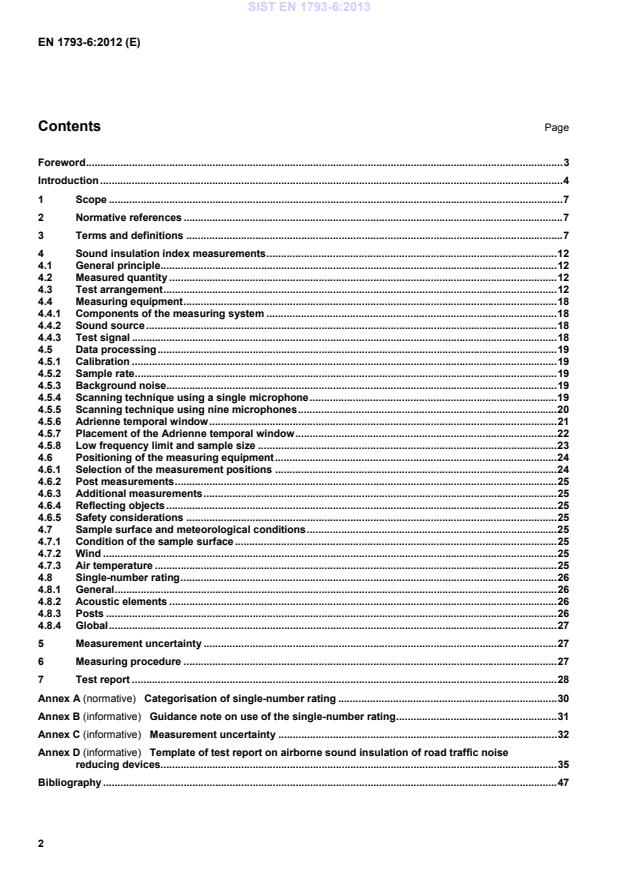
Categorisation of single-number rating . 30Annex B (informative)
Guidance note on use of the single-number rating . 31Annex C (informative)
Measurement uncertainty . 32Annex D (informative)
Template of test report on airborne sound insulation of road traffic noise reducing devices. 35Bibliography . 47 SIST EN 1793-6:2013
3 Foreword This document (EN 1793-6:2012) has been prepared by Technical Committee CEN/TC 226 “Road equipment”, the secretariat of which is held by AFNOR. This European Standard shall be given the status of a national standard, either by publication of an identical text or by endorsement, at the latest by May 2013, and conflicting national standards shall be withdrawn at the latest by March 2014. Attention is drawn to the possibility that some of the elements of this document may be the subject of patent rights. CEN [and/or CENELEC] shall not be held responsible for identifying any or all such patent rights. This European Standard has been prepared, under the direction of Technical Committee CEN/TC 226 “Road equipment”, by Working Group 6 “Anti noise devices”. EN 1793-6 is part of a series of documents and should be read in conjunction with the following: EN 1793-1, Road traffic noise reducing devices — Test method for determining the acoustic performance — Part 1: Intrinsic characteristics of sound absorption; EN 1793-2, Road traffic noise reducing devices — Test method for determining the acoustic performance — Part 2: Intrinsic characteristics of airborne sound insulation under diffuse sound field conditions; EN 1793-3, Road traffic noise reducing devices — Test method for determining the acoustic performance — Part 3: Normalized traffic noise spectrum; CEN/TS 1793-4, Road traffic noise reducing devices — Test method for determining the acoustic performance — Part 4: Intrinsic characteristics — In situ values of sound diffraction; CEN/TS 1793-5, Road traffic noise reducing devices — Test method for determining the acoustic performance — Part 5: Intrinsic characteristics — In situ values of sound reflection and airborne sound insulation. According to the CEN/CENELEC Internal Regulations, the national standards organisations of the following countries are bound to implement this European Standard: Austria, Belgium, Bulgaria, Croatia, Cyprus, Czech Republic, Denmark, Estonia, Finland, Former Yugoslav Republic of Macedonia, France, Germany, Greece, Hungary, Iceland, Ireland, Italy, Latvia, Lithuania, Luxembourg, Malta, Netherlands, Norway, Poland, Portugal, Romania, Slovakia, Slovenia, Spain, Sweden, Switzerland, Turkey and the United Kingdom. SIST EN 1793-6:2013
Key Keyh1: length of left barrier surface h1: length of partial cover surface envelope h2: length of right barrier surface e = w+h1 envelope, e = w+h1+h2
(a) Partial cover on both sides of the road(b) Partial cover on one side of the road
Key Key h1: length of left trench side h1: length of left barrier/building h2: length of right trench side h2: length of right barrier/building envelope, e = w+h1+h2 envelope, e = w+h1+h2 (c) Deep trench (d) Tall barriers or buildings
In all cases:
r: road surface;
w: width of open space. Figure 1 — Sketch of the reverberant condition check in four cases (not to scale) This European Standard introduces a specific quantity, called sound insulation index, to define the airborne sound insulation of a noise reducing device. This quantity should not be confused with the sound reduction index used in building acoustics, sometimes also called transmission loss. Research studies suggest that a very good correlation exists between data measured according to EN 1793-2 and data measured according to the method described in this document. SIST EN 1793-6:2013
7 1 Scope This European Standard describes a test method for measuring a quantity representative of the intrinsic characteristics of airborne sound insulation for traffic noise reducing devices: the sound insulation index. The test method is intended for the following applications: determination of the intrinsic characteristics of airborne sound insulation of noise reducing devices to be installed along roads, to be measured either in situ or in laboratory conditions; determination of the in situ intrinsic characteristics of airborne sound insulation of noise reducing devices in actual use; comparison of design specifications with actual performance data after the completion of the construction work; verification of the long term performance of noise reducing devices (with a repeated application of the method); interactive design process of new products, including the formulation of installation manuals. The test method is not intended for the determination of the intrinsic characteristics of airborne sound insulation of noise reducing devices to be installed in reverberant conditions, e.g. inside tunnels or deep trenches or under covers. Results are expressed as a function of frequency in one-third octave bands, where possible, between 100 Hz and 5 kHz. If it is not possible to get valid measurement results over the whole frequency range indicated, the results need to be given in a restricted frequency range and the reasons for the restriction(s) need to be clearly reported. 2 Normative references The following documents, in whole or in part, are normatively referenced in this document and are indispensable for its application. For dated references, only the edition cited applies. For undated references, the latest edition of the referenced document (including any amendments) applies. EN 1793-3, Road traffic noise reducing devices — Test method for determining the acoustic performance — Part 3: Normalized traffic noise spectrum IEC 61672-1:2002, Electroacoustics — Sound level meters — Part 1: Specifications 3 Terms and definitions For the purpose of this document, the following terms and definitions apply. 3.1 noise reducing device device that is designed to reduce the propagation of traffic noise away from the road environment Note 1 to entry: This may be a noise barrier, cladding, a road cover or an added device. These devices may include both acoustic and structural elements. 3.2 acoustical elements elements whose primary function is to provide the acoustic performance of the device SIST EN 1793-6:2013
plane facing the receiver side of the noise reducing device and touching the most protruding parts of the device under test within the tested area (see Figures 4 and 9) Note 1 to entry: The device under test includes both structural and acoustic elements. 3.8 source reference position
position facing the side to be exposed to noise when the device is in place, located at the reference height hS and placed so that its horizontal distance to the source reference plane is ds = 1 m (see Figures 2, 5, 8 and 9) Note 1 to entry: The actual dimensions of the loudspeaker used for the background research on which this European Standard is based are: 0,40 m x 0,285 m x 0,285 m (length x width x height). 3.9 measurement grid for sound insulation index measurements vertical measurement grid constituted of nine equally spaced points Note 1 to entry: A microphone is placed at each point (see Figures 3, 5, 6, 8, 9 and subclause 4.5). 3.10 barrier thickness for sound insulation index measurements distance tB between the source reference plane and the microphone reference plane at a height equal to the reference height hS (see Figures 4, 8 and 9) 3.11 free-field measurement for sound insulation index measurements measurement taken with the loudspeaker and the microphone in an acoustic free field in order to avoid reflections from any nearby object, including the ground (see Figure 6) 3.12 Adrienne temporal window composite temporal window described in 4.5.6 SIST EN 1793-6:2013
9 3.13 background noise noise coming from sources other than the source emitting the test signal 3.14 signal-to-noise ratio, S/N difference in decibels between the level of the test signal and the level of the background noise at the moment of detection of the useful event (within the Adrienne temporal window) 3.15 impulse response time signal at the output of a system when a Dirac function is applied to the input Note 1 to entry: The Dirac function, also called δ function, is the mathematical idealisation of a signal that is infinitely short in time which carries a unit amount of energy.
Key R: axis of rotation hB: barrier height
S: loudspeaker front panel hS: reference height dRS: distance R - S dS: horizontal distance loudspeaker - source reference plane Figure 2 —Sketch of the loudspeaker-microphone assembly in front of the noise reducing device under test for sound insulation index measurements (not to scale)
Key s: distance between two vertical or horizontal microphones in the grid hS: reference height hB: barrier height Figure 3 — Measurement grid for sound insulation index measurements (receiver side) and numbering of the measurement points (not to scale)
Key tB: barrier thickness at hS hS: reference height hB: barrier height Figure 4 — Sound source and microphone reference planes (side view, not to scale)
Key M: measurement grid s: distance between two vertical or horizontal microphones in the grid
hS: reference height
hB: barrier height
dS: horizontal distance [loudspeaker - source reference plane] at hS dM: horizontal distance [microphone 5 - source reference plane] at hS Figure 5 — Placement of the sound source and measurement grid for sound insulation index measurement (side view, not to scale)
Key S: loudspeaker front panel M: measurement grid hS: reference height dS: horizontal distance [loudspeaker - source reference plane] at hS tB: barrier thickness at hS dM: horizontal distance [microphone 5 - source reference plane] at hS dT: horizontal distance [loudspeaker - microphone 5] at hS NOTE MBSTdtdd++=; see Formula (3). Figure 6 — Sketch of the set-up for the reference “free-field” sound measurement for the determination of the sound insulation index (not to scale)SIST EN 1793-6:2013
is the width of the jth one-third octave frequency band; n = 9 is the number of scanning points. 4.3 Test arrangement The test method can be applied both in situ and on barriers purposely built to be tested using the method described here. In the second case, the specimen shall be built as follows (see Figure 7): SIST EN 1793-6:2013
13 a part, composed of acoustic elements; a post (if applicable for the specific noise reducing device under test); a part, composed of acoustic elements. The test specimen shall be mounted and assembled in the same manner as the manufactured device is used in practice with the same connections and seals.
The tested area is a circle having a radius of 2 m centred on the middle of the measurement grid. The sample shall be built large enough to completely include this circle for each measurement. For qualifying the sound insulation index of posts only, it is only necessary to have acoustic elements that extend 2 m or more on either side of the post (see Figure 7). If the device under test has a post to post distance less than 4 m, the distance between posts should be reduced accordingly but the overall minimum width of the construction should be the same as shown in Figure 7. SIST EN 1793-6:2013
(a): Sound insulation index measurements for elements and posts (b): Sound insulation index measurements in front of a post only
(c): Sound insulation index measurements in front of a sample
having a post to post distance smaller than 4 m Key Thin circles: tested area for elements Dotted circles: tested area for posts L: actual horizontal length of the acoustic elements having a post to post distance smaller than 4 m Ltot: minimal horizontal length of the sample if the post to post distance is smaller than 4 m Figure 7 — Sketch of the minimum sample required for measurements in laboratory conditions
Key S: loudspeaker front panel M: measurement grid hS: reference height hB:barrier height dS: horizontal distance [loudspeaker - source reference plane] at hS tB: barrier thickness at hS dM: horizontal distance [microphone 5 - source reference plane] at hS dT: horizontal distance [loudspeaker - microphone 5] at hS NOTE MBSTdtdd++=; see Formula (3) Figure 8 — Sketch of the set-up for the sound insulation index measurement — Normal incidence of sound on the sample — Transmitted component measurement in front of a flat noise reducing device (not to scale)
(a): Transmitted component measurements in front of a concave noise reducing device SIST EN 1793-6:2013
(b): Transmitted component measurements in front of a convex noise reducing device
(c): Transmitted component measurements in front of an inclined noise reducing device Key S: loudspeaker front panel M: measurement grid hS: reference height hB:barrier height dS: horizontal distance [loudspeaker - source reference plane] at hS tB: barrier thickness at hS dM: horizontal distance [microphone 5 - source reference plane] at hS dT: horizontal distance [loudspeaker - microphone 5] at hS NOTE MBSTdtdd++=; see Formula (3). Figure 9 — Examples of the set-up for the sound insulation index measurement — Normal incidence of sound on the sample (not to scale - informative) SIST EN 1793-6:2013
Key
1: device under test C: anti-aliasing filter H: impulse responses M: SI calculation 2: microphone D: analog/digital converter I: geometrical spreading correction N: sound insulation index 3: loudspeaker E: clock J: time windowing O: memory A: microphone amplifier F: signal generator K: Fourier transformation P: analyser or computer B: loudspeaker amplifier G: cross correlation L: power spectra
dM: horizontal distance [microphone 5 - source reference plane] at hS Figure 10 — Sketch representing the essential components of the measuring system SIST EN 1793-6:2013
19 the test method maintains a good background noise immunity, i.e. the effective S/N ratio can be made higher than 10 dB over the whole frequency range of interest within a short measurement time (no more than 5 min per impulse response); the sample rate can be chosen high enough to allow an accurate correction of possible time shifts in the impulse responses between the measurement in front of the sample and the free-field measurement due to temperature changes; the test signal is easy-to-use, i.e. it can be conveniently generated and fed to the sound source using only equipment which is available on the market. 4.5 Data processing 4.5.1 Calibration The measurement procedure here described is based on ratios of the power spectra of signals extracted from impulse responses sampled with the same equipment in the same place under the same conditions. Therefore, an absolute calibration of the measurement chain with regard to the sound pressure level is not needed. Nevertheless, it is recommended to check the correct functioning of the measurement chain from the beginning to the end of the measurement exercise. 4.5.2 Sample rate The frequency at which the microphone response is sampled depends on the specified upper frequency limit of the measurement and on the anti-aliasing filter type and characteristics. The sample rate fs shall have a value greater than 43 kHz. NOTE Although the signal is already unambiguously defined when the Nyquist criterion is met, higher sample rates facilitate a clear reproduction of the signal and the knowledge of the exact wave form. Therefore, with the prescribed sample rates, errors can be detected and corrected more easily, such as time shifts in the impulse responses between the measurement in front of the sample and the free-field measurement due to temperature changes. The sample rate shall be equal to the clock rate of the signal generator. The cut-off frequency of the anti-aliasing filter, fco, shall have a value: scokff≤ (2) where
k = 1/3 for the Chebyshev filter and k = 1/4 for the Butterworth and Bessel filters. For each measurement, the sample rate, the type and the characteristics of the anti-aliasing filter shall be clearly stated in each test report. 4.5.3 Background noise The effective signal-to-noise ratio S/N, taking into account sample averaging, shall be greater than 10 dB over the frequency range of measurements. NOTE Coherent detection techniques, such as the MLS cross-correlation, provide high S/N ratios. 4.5.4 Scanning technique using a single microphone The sound source shall be positioned as described in 3.9. SIST EN 1793-6:2013
4.5.5 Scanning technique using nine microphones As an alternative to the procedure described in 4.5.4, the procedure described below may be used, leading to the same results. The sound source shall be positioned as described in 3.9. The measurement grid shall be square, with a side length 2 s of 0,80 m. Its centre shall be located at the reference height hS. The grid shall be placed facing the side of the noise reducing device under test opposite to the side to be exposed to noise when the device is in place, so that its horizontal distance to the microphone reference plane is dM = 0,25 m (see Figures 3, 5, 6, 8 and 9). The grid shall be placed at a distance as large as possible from the edges of the noise reducing device under test. A set of nine microphones supported by a rigid frame shall be placed at the nine scanning points corresponding to the measurement grid and the nine impulse responses are measured simultaneously or in sequence. Each of these consists of the direct component, the transmitted component through the device under test, diffracted components and other parasitic reflections (Figure 12). A “free-field” impulse response shall be measured for each microphone position, keeping the supporting frame with the same geometrical configuration of the set-up and without the barrier present. In particular, the distance dT of the microphone position n. 5 from the sound source shall be kept constant (see Figure 6): B25,1tdtdd+=++=MBsT (4) where tB is the barrier thickness (see 3.11). Care shall be taken that the supporting frame does not alter the measurement result.
21 4.5.6 Adrienne temporal window For the purpose of this European Standard, windowing operations in the time domain shall be performed using a temporal window, called Adrienne temporal window, with the following specifications (see Figure 11): a leading edge having a left-half Blackman-Harris shape and a total length of 0,5 ms (“pre-window”); a flat portion having a total length of 5,18 ms (“main body”); a trailing edge having a right-half Blackman-Harris shape and a total length of 2,22 ms. The total length of the Adrienne temporal window is9,7,=ADRWT ms. NOTE
A four-term full Blackman-Harris window of length TW,BH is : ()−+−=BHWBHWBHWaa,3,2,106cos4cos2cosTtTtTtaatwπππ (5) where a0 = 0,35875; a1 = 0,48829; a2 = 0,14128; a3 = 0,01168; BHW,0Tt≤≤.
Figure 11 — The Adrienne temporal window, with the marker point MP SIST EN 1793-6:2013
Key
1 transmitted component 2 diffracted component 3 impulse response [relative units] 4 time (ms) Figure 12 — Example of application of the Adrienne temporal window to the transmitted component of an impulse response 4.5.8 Low frequency limit and sample size The method described in the present document can be used for different sample sizes. The low frequency limit fmin of sound insulation index measurements depends on the shape and width of the Adrienne temporal window. The width in turn depends on the smallest dimension (height or length) of the noise reducing device under test. In fact, the following unwanted components shall be kept out of the Adrienne temporal window for the transmitted components: the sound components diffracted by the edges of the noise reducing device under test; the sound components reflected by the ground on the receiver or source side of the noise reducing device under test. For noise reducing devices having a height smaller than the length, the most critical component is that diffracted by the top edge and therefore the critical dimension is the height. For noise reducing devices having a height smaller than the length, the low frequency limit fmin for sound insulation index measurements as a function of the height of the noise reducing device under test is given in Figure 13. The graph holds for an acoustic barrier with negligible thickness; for noise reducing devices with a greater thickness, the low frequency limit assumes smaller values. For qualification tests, the sample shall have the minimum dimensions specified in 4.3 (see Figure 7). These conditions give a low frequency limit for the sound insulation index of about 166 Hz, i.e. measurements are valid down to the 200 Hz one-third octave band. Measurement values below 166 Hz could be kept for information. SIST EN 1793-6:2013
Figure 13 — Low frequency limit fmin of sound insulation index measurements as a function of the height of the noise reducing device under test 4.6 Positioning of the measuring equipment 4.6.1 Selection of the measurement positions The measuring equipment shall be placed near the noise reducing device to be tested in positions selected according to the following rules. In any case, distances shall be measured with a relative uncertainty not greater than 1 percent of their nominal values. a) The loudspeaker is placed in the source reference position (see 3.9). b) The measurement grid is located on the opposite side of the noise barrier under test (see 3.10). c) If a single microphone is used, it is subsequently placed at each of the nine measurement points of the measurement grid and an impulse response is sampled at each measurement point. When the microphone is in the central position of the measurement grid (position n. 5), the acoustic centre of the sound source and the acoustic centre of the microphone shall lie on the same horizontal line. A “free-field” impulse response shall be measured for each microphone position, keeping the supporting frame with the same geometrical configuration of the set-up and without the barrier present (Figure 6). The nine measurements taken on the measurement grid plus the corresponding free-field measurements shall be
...