


FprEN 16881
(Main)Food processing machinery - Pasteurizers, vats and cream cookerss - Safety and hygiene requirements
Food processing machinery - Pasteurizers, vats and cream cookerss - Safety and hygiene requirements
This European Standard applies to discontinuous pasteurizers and cream cookers for ice cream mixes, pasty liquid products for gelato, pastry, chocolate and food processing, as described in 3.2.
This European Standard applies to fixed and movable artisan machinery (not designed to be moved during operation), with a capacity of not more than 600 l.
This European Standard deals with all significant hazards, hazardous situations and events relevant to the machinery, when they are used as intended and under conditions of misuse which are reasonably foreseeable by the manufacturer (see Clause 4).
This European Standard deals with the hazards which can arise during transport, assembly, commissioning, operation, cleaning, use, maintenance, decommissioning, dismantling, disabling and scrapping of the machine.
This European Standard covers the following types of machines:
- pasteurizers;
- ageing vats;
- cream cookers.
This European Standard is not applicable for pasteurizers and cream cookers without cooling systems.
This European Standard does not give requirements for heating and cooling equipment.
This European Standard is not applicable to machines which are manufactured before the date of publication of this European Standard by CEN.
Nahrungsmittelmaschinen - Pasteurisiergeräte, Bottiche und Eismaschinen - Sicherheits- und Hygieneanforderungen
Diese Europäische Norm gilt für diskontinuierliche Pasteurisiergeräte und Eismaschinen zur Verarbeitung von Eiskremmix, dickflüssigen Produkten für Eis, Teig und Schokolade sowie zur Lebensmittelverarbeitung, wie in 3.2 beschrieben.
Diese Europäische Norm gilt für fest installierte und ortsveränderliche Handwerksmaschinen (die nicht dazu bestimmt sind, während des Betriebs bewegt zu werden), mit einem Fassungsvermögen von nicht mehr als 600 l.
Diese Europäische Norm behandelt alle signifikanten Gefährdungen, gefahrbringende Situationen und Ereignisse, die auf diese Maschinen zutreffen, wenn sie bestimmungsgemäß und unter Bedingungen von durch den Hersteller vernünftigerweise vorhersehbaren Fehlanwendungen verwendet werden.
Diese Europäische Norm behandelt die Gefährdungen, die während Transport, Montage, Inbetriebnahme, Betrieb, Reinigung, Verwendung, Instandhaltung, Außerbetriebnahme, Demontage, Außerbetriebsetzung und Verschrottung der Maschine auftreten können.
Diese Europäische Norm deckt die folgenden Arten von Maschinen ab:
- Pasteurisiergeräte;
- Reifebottiche;
- Eismaschinen (Cremekocher).
Diese Europäische Norm gilt nicht für Pasteurisiergeräte und Eismaschinen ohne Kühlsystem.
Diese Europäische Norm stellt keine Anforderungen an Heiz und Kühlgeräte.
Diese Europäische Norm gilt nicht für Maschinen, die vor deren Veröffentlichung durch CEN hergestellt wurden.
Machines pour les produits alimentaires - Pasteurisateurs, cuves et cuiseurs de crème - Prescriptions relatives à la sécurité et l'hygiène
La présente Norme européenne s'applique aux pasteurisateurs discontinus et cuiseurs de crème pour les mélanges de crème glacée, produits liquides pâteux destinés à la fabrication de glaces artisanales, pâtisseries, chocolats et autres produits alimentaires, telles que décrits en 3.2.
La présente Norme européenne s'applique aux machines artisanales fixes et mobiles (non conçues pour être déplacées en cours de fonctionnement) d'une capacité inférieure ou égale à 600 l.
La présente Norme européenne traite de tous les phénomènes dangereux, situations et événements dangereux significatifs applicables aux machines lorsqu'elles sont utilisées normalement et dans les conditions de mauvais usage raisonnablement prévisible par le fabricant (voir Article 4).
La présente Norme européenne traite des phénomènes dangereux qui peuvent survenir pendant le transport, l'assemblage, la mise en service, le fonctionnement, le nettoyage, l'utilisation, la maintenance, la mise hors service, le démontage et la mise au rebut de la machine.
La présente Norme européenne couvre les types de machines suivants :
- les pasteurisateurs ;
- les cuves de maturation ;
- les cuiseurs de crème.
La présente Norme européenne ne s'applique pas aux pasteurisateurs et cuiseurs de crème dépourvus de systèmes de refroidissement.
La présente Norme européenne ne donne aucune prescription relative aux équipements de chauffage et de refroidissement.
La présente Norme européenne ne s’applique pas aux machines fabriquées avant la date de publication de la présente Norme européenne par le CEN.
Stroji za predelavo hrane - Pasterizatorji, kadi in kuhalniki za pripravo kreme - Varnostne in higienske zahteve
General Information
- Status
- Not Published
- Technical Committee
- CEN/TC 153 - Food processing machinery - Safety and hygiene specifications
- Drafting Committee
- CEN/TC 153/WG 6 - Artisan ice cream machinery
- Current Stage
- 5098 - Decision to abandon - Formal Approval
- Start Date
- 29-Sep-2021
- Completion Date
- 11-Feb-2026
Overview
FprEN 16881 - published by CEN - specifies safety and hygiene requirements for discontinuous pasteurizers, ageing vats and cream cookers used in small-scale food production (ice‑cream mixes, gelato, pastry, chocolate and similar pasty liquid products). The standard applies to fixed and movable artisan machinery (not intended to be moved during operation) with a rated capacity of not more than 600 l. It addresses hazards throughout the machine lifecycle (transport, assembly, commissioning, operation, cleaning, maintenance, decommissioning, dismantling and scrapping).
Key scope limits:
- Covers: pasteurizers, ageing vats, cream cookers (with cooling systems).
- Excludes: machines without cooling systems, heating/cooling equipment specification, and machines manufactured before the date of publication.
Key Topics and Requirements
FprEN 16881 is a type C machine standard (per EN ISO 12100) and complements general hygiene standards for food machinery. Major technical areas include:
- Risk identification and hazardous zones: identification of mechanical, electrical, thermal, noise, ergonomic and hygiene hazards; zoned access considerations (e.g., lid-to-hopper trapping points, rotating device feed openings, draw‑off openings).
- Mechanical safety: guarding, prevention of crushing and entrapment, loss of stability/tipping prevention.
- Electrical safety: protection against electric shock, EMC considerations, emergency stop, prevention of unexpected start‑up, enclosure IP ratings.
- Thermal safety: safe handling of hot surfaces and fluids.
- Hygiene and cleanability: materials of construction, surface finishes, design principles to ensure effective cleaning, sanitation and disinfection; includes normative annexes on cleanability and testing disinfection/pasteurization processes.
- Noise and ergonomics: guidance on noise testing, ergonomic design to reduce operator risk and strain.
- Documentation and verification: required instruction handbook, service manual, cleaning instructions, marking and verification/validation of safety and hygiene measures.
Applications and Who Uses It
FprEN 16881 is intended for:
- Manufacturers and machine designers of small-capacity pasteurizers, vats and cream cookers (artisan equipment).
- Food safety and hygiene engineers responsible for cleanability and sanitation validation.
- Compliance officers, notified bodies and testing labs assessing conformity with EU Machinery Directive requirements.
- Artisan ice‑cream, gelato and pastry producers specifying or purchasing safe, hygienic processing equipment.
Benefits include clearer conformity routes, reduced biological and physical hazards in product processing, and alignment with EU safety and hygiene expectations.
Related Standards
- EN ISO 12100 (risk assessment)
- EN 1672-2 (food processing hygiene)
- EN 60204-1 (electrical equipment of machines)
- EN ISO 3744 / EN ISO 11201 / EN ISO 4871 (acoustics)
- EN 349, EN 953, EN ISO 13849-1 (mechanical safety / guards / control systems)
Keywords: FprEN 16881, pasteurizers, cream cookers, ageing vats, food processing machinery, safety requirements, hygiene requirements, cleanability, CEN, artisan machinery.

Get Certified
Connect with accredited certification bodies for this standard

BSI Group
BSI (British Standards Institution) is the business standards company that helps organizations make excellence a habit.

Bureau Veritas
Bureau Veritas is a world leader in laboratory testing, inspection and certification services.

DNV
DNV is an independent assurance and risk management provider.
Sponsored listings
Frequently Asked Questions
FprEN 16881 is a draft published by the European Committee for Standardization (CEN). Its full title is "Food processing machinery - Pasteurizers, vats and cream cookerss - Safety and hygiene requirements". This standard covers: This European Standard applies to discontinuous pasteurizers and cream cookers for ice cream mixes, pasty liquid products for gelato, pastry, chocolate and food processing, as described in 3.2. This European Standard applies to fixed and movable artisan machinery (not designed to be moved during operation), with a capacity of not more than 600 l. This European Standard deals with all significant hazards, hazardous situations and events relevant to the machinery, when they are used as intended and under conditions of misuse which are reasonably foreseeable by the manufacturer (see Clause 4). This European Standard deals with the hazards which can arise during transport, assembly, commissioning, operation, cleaning, use, maintenance, decommissioning, dismantling, disabling and scrapping of the machine. This European Standard covers the following types of machines: - pasteurizers; - ageing vats; - cream cookers. This European Standard is not applicable for pasteurizers and cream cookers without cooling systems. This European Standard does not give requirements for heating and cooling equipment. This European Standard is not applicable to machines which are manufactured before the date of publication of this European Standard by CEN.
This European Standard applies to discontinuous pasteurizers and cream cookers for ice cream mixes, pasty liquid products for gelato, pastry, chocolate and food processing, as described in 3.2. This European Standard applies to fixed and movable artisan machinery (not designed to be moved during operation), with a capacity of not more than 600 l. This European Standard deals with all significant hazards, hazardous situations and events relevant to the machinery, when they are used as intended and under conditions of misuse which are reasonably foreseeable by the manufacturer (see Clause 4). This European Standard deals with the hazards which can arise during transport, assembly, commissioning, operation, cleaning, use, maintenance, decommissioning, dismantling, disabling and scrapping of the machine. This European Standard covers the following types of machines: - pasteurizers; - ageing vats; - cream cookers. This European Standard is not applicable for pasteurizers and cream cookers without cooling systems. This European Standard does not give requirements for heating and cooling equipment. This European Standard is not applicable to machines which are manufactured before the date of publication of this European Standard by CEN.
FprEN 16881 is classified under the following ICS (International Classification for Standards) categories: 67.260 - Plants and equipment for the food industry. The ICS classification helps identify the subject area and facilitates finding related standards.
FprEN 16881 is associated with the following European legislation: EU Directives/Regulations: 2006/42/EC; Standardization Mandates: M/396. When a standard is cited in the Official Journal of the European Union, products manufactured in conformity with it benefit from a presumption of conformity with the essential requirements of the corresponding EU directive or regulation.
FprEN 16881 is available in PDF format for immediate download after purchase. The document can be added to your cart and obtained through the secure checkout process. Digital delivery ensures instant access to the complete standard document.
Standards Content (Sample)
SLOVENSKI STANDARD
oSIST prEN 16881:2015
01-september-2015
Stroji za predelavo hrane - Pasterizatorji, kadi in kuhalniki za pripravo kreme -
Varnostne in higienske zahteve
Food processing machinery - Pasteurizers, vats and cream cookers - Safety and hygiene
requirements
Nahrungsmittelmaschinen - Pasteurisiergeräte, Bottiche und Eismaschinen - Sicherheits-
und Hygieneanforderungen
Machines pour les produits alimentaires - Pasteurisateurs, cuves et cuiseurs de crème -
Prescriptions relatives à la sécurité et l'hygiène
Ta slovenski standard je istoveten z: prEN 16881
ICS:
67.260 Tovarne in oprema za Plants and equipment for the
živilsko industrijo food industry
oSIST prEN 16881:2015 en,fr,de
2003-01.Slovenski inštitut za standardizacijo. Razmnoževanje celote ali delov tega standarda ni dovoljeno.
oSIST prEN 16881:2015
oSIST prEN 16881:2015
EUROPEAN STANDARD
DRAFT
prEN 16881
NORME EUROPÉENNE
EUROPÄISCHE NORM
June 2015
ICS 67.260
English Version
Food processing machinery - Pasteurizers, vats and cream
cookers - Safety and hygiene requirements
Machines pour les produits alimentaires - Pasteurisateurs, Nahrungsmittelmaschinen - Pasteurisiergeräte, Bottiche
cuves et cuiseurs de crème - Prescriptions relatives à la und Eismaschinen - Sicherheits- und
sécurité et l'hygiène Hygieneanforderungen
This draft European Standard is submitted to CEN members for enquiry. It has been drawn up by the Technical Committee CEN/TC 153.
If this draft becomes a European Standard, CEN members are bound to comply with the CEN/CENELEC Internal Regulations which
stipulate the conditions for giving this European Standard the status of a national standard without any alteration.
This draft European Standard was established by CEN in three official versions (English, French, German). A version in any other language
made by translation under the responsibility of a CEN member into its own language and notified to the CEN-CENELEC Management
Centre has the same status as the official versions.
CEN members are the national standards bodies of Austria, Belgium, Bulgaria, Croatia, Cyprus, Czech Republic, Denmark, Estonia,
Finland, Former Yugoslav Republic of Macedonia, France, Germany, Greece, Hungary, Iceland, Ireland, Italy, Latvia, Lithuania,
Luxembourg, Malta, Netherlands, Norway, Poland, Portugal, Romania, Slovakia, Slovenia, Spain, Sweden, Switzerland, Turkey and United
Kingdom.
Recipients of this draft are invited to submit, with their comments, notification of any relevant patent rights of which they are aware and to
provide supporting documentation.
Warning : This document is not a European Standard. It is distributed for review and comments. It is subject to change without notice and
shall not be referred to as a European Standard.
EUROPEAN COMMITTEE FOR STANDARDIZATION
COMITÉ EUROPÉEN DE NORMALISATION
EUROPÄISCHES KOMITEE FÜR NORMUNG
CEN-CENELEC Management Centre: Avenue Marnix 17, B-1000 Brussels
© 2015 CEN All rights of exploitation in any form and by any means reserved Ref. No. prEN 16881:2015 E
worldwide for CEN national Members.
oSIST prEN 16881:2015
prEN 16881:2015 (E)
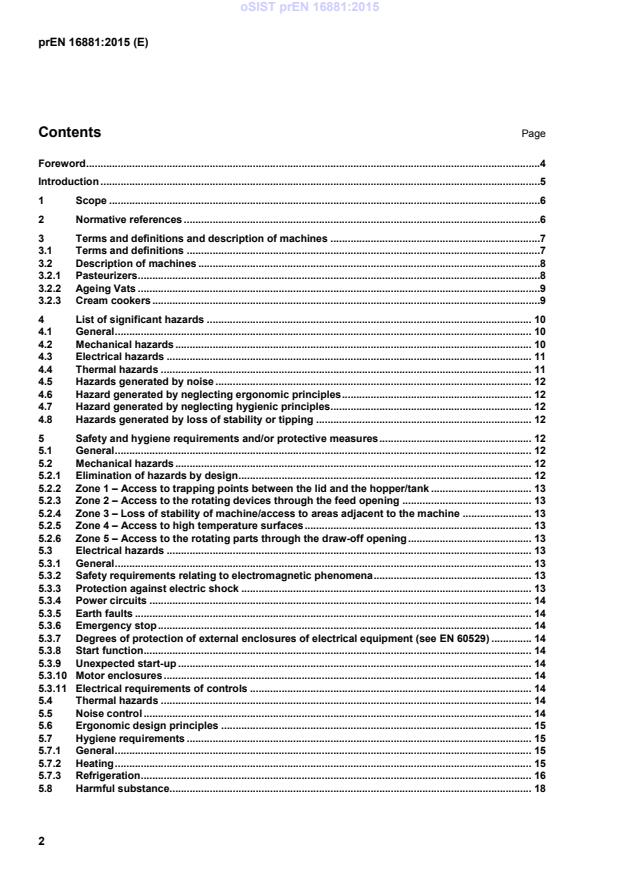
Contents Page
Foreword .4
Introduction .5
1 Scope .6
2 Normative references .6
3 Terms and definitions and description of machines .7
3.1 Terms and definitions .7
3.2 Description of machines .8
3.2.1 Pasteurizers .8
3.2.2 Ageing Vats .9
3.2.3 Cream cookers .9
4 List of significant hazards . 10
4.1 General . 10
4.2 Mechanical hazards . 10
4.3 Electrical hazards . 11
4.4 Thermal hazards . 11
4.5 Hazards generated by noise . 12
4.6 Hazard generated by neglecting ergonomic principles . 12
4.7 Hazard generated by neglecting hygienic principles . 12
4.8 Hazards generated by loss of stability or tipping . 12
5 Safety and hygiene requirements and/or protective measures . 12
5.1 General . 12
5.2 Mechanical hazards . 12
5.2.1 Elimination of hazards by design . 12
5.2.2 Zone 1 – Access to trapping points between the lid and the hopper/tank . 13
5.2.3 Zone 2 – Access to the rotating devices through the feed opening . 13
5.2.4 Zone 3 – Loss of stability of machine/access to areas adjacent to the machine . 13
5.2.5 Zone 4 – Access to high temperature surfaces . 13
5.2.6 Zone 5 – Access to the rotating parts through the draw-off opening . 13
5.3 Electrical hazards . 13
5.3.1 General . 13
5.3.2 Safety requirements relating to electromagnetic phenomena . 13
5.3.3 Protection against electric shock . 13
5.3.4 Power circuits . 14
5.3.5 Earth faults . 14
5.3.6 Emergency stop . 14
5.3.7 Degrees of protection of external enclosures of electrical equipment (see EN 60529) . 14
5.3.8 Start function . 14
5.3.9 Unexpected start-up . 14
5.3.10 Motor enclosures . 14
5.3.11 Electrical requirements of controls . 14
5.4 Thermal hazards . 14
5.5 Noise control . 14
5.6 Ergonomic design principles . 15
5.7 Hygiene requirements . 15
5.7.1 General . 15
5.7.2 Heating . 15
5.7.3 Refrigeration . 16
5.8 Harmful substance. 18
oSIST prEN 16881:2015
prEN 16881:2015 (E)
6 Verification of safety and hygiene requirements and/or protective measures . 18
7 Information of use . 18
7.1 General . 18
7.2 Instruction handbook . 18
7.3 Service manual . 20
7.4 Cleaning . 20
7.5 Marking . 20
Annex A (normative) Noise test code (Grade 2 of accuracy) . 21
A.1 Terms and definitions . 21
A.2 Installation and mounting conditions . 21
A.3 Operating conditions . 21
A.4 Emission sound pressure level determination . 21
A.5 Measurement uncertainties . 22
A.6 Information to be recorded . 22
A.7 Information to be reported . 22
A.8 Declaration and verification of noise emission values . 22
Annex B (normative) Principles of design to ensure the cleanability of the machinery . 23
B.1 Definitions . 23
B.2 Material of construction . 23
B.3 Design . 24
Annex C (normative) Testing Disinfection of Pasteurizers, Vats Machines . 41
C.1 Testing disinfection by cleaning . 41
C.2 Testing of the pasteurization process . 41
C.3 Testing during cream production . 42
Annex ZA (informative) Relationship between this European Standard and the Essential Requirements
of EU Directive 2006/42/EC . 43
Bibliography . 44
oSIST prEN 16881:2015
prEN 16881:2015 (E)
Foreword
This document (prEN 16881:2015) has been prepared by Technical Committee CEN/TC 153 “Machinery intended
for use with foodstuffs and feed”, the secretariat of which is held by DIN.
This document is currently submitted to the CEN Enquiry.
This document has been prepared under a mandate given to CEN by the European Commission and the European
Free Trade Association, and supports essential requirements of EU Directive(s).
For relationship with EU Directive(s), see informative Annex ZA, which is an integral part of this document.
oSIST prEN 16881:2015
prEN 16881:2015 (E)
Introduction
This European Standard is a type C standard as stated in EN ISO 12100:2010.
The machinery concerned and the extent to which hazards, hazardous situations and hazardous events are covered
are indicated in the scope of this document.
When provisions of this type C standard are different from those which are stated in type A or B standards, the
provisions of this type C standard take precedence over the provisions of the other standards for machines that have
been designed and built according to the provisions of this type C standard.
Complementary to the hygiene requirements common to all food processing machines, specific requirements for
cleanability and sanitation of the machines in the scope are formulated.
oSIST prEN 16881:2015
prEN 16881:2015 (E)
1 Scope
This European Standard applies to machines of ice cream mixes, pasty liquid products for gelato, pastry, chocolate
and food processing, as described in Clause 3.
The European Standard applies to fixed and movable artisan machinery (not designed to be moved during
operation), with a rated capacity of not more than 600 l.
This European Standard deals with all significant hazards, hazardous situations and events relevant to the
machinery, when they are used as intended and under conditions of misuse which are reasonably foreseeable by
the manufacturer (see Clause 4).
This European Standard deals with the hazards which can arise during transport, assembly, commissioning,
operation, cleaning, use, maintenance, decommissioning, dismantling, disabling and scrapping of the machine.
This European Standard covers the following types of machines:
— pasteurizers;
— ageing vats;
— cream cookers.
This European Standard does not apply to equipment feeding and dosing, equipment, supply of inert gas and
heating and cooling equipment and any extraction (container, extraction belt etc.).
This European Standard is not applicable to cream cookers without cooling systems
This European Standard is not applicable to machines which are manufactured before the date of publication of this
European Standard by CEN.
2 Normative references
The following documents, in whole or in part, are normatively referenced in this document and are indispensable for
its application. For dated references, only the edition cited applies. For undated references, the latest edition of the
referenced document (including any amendments) applies.
EN 349:1993+A1:2008, Safety of machinery - Minimum gaps to avoid crushing of parts of the human body
EN 574:1996+A1:2008, Safety of machinery - Two-hand control devices - Functional aspects - Principles for design
EN 614-1, Safety of machinery – Ergonomic design principles – Part 1: Terminology and general principles
EN 953, Safety of machinery – Guards – General requirements for the design and construction of fixed and movable
guards
EN 1672-2:2005+A1:2009, Food processing machinery - Basic concepts - Part 2: Hygiene requirements
EN 60204-1:2006, Safety of machinery - Electrical equipment of machines - Part 1: General requirements (IEC
60204:2005, modified)
EN 60529, Degrees of protection provided by enclosures (IP Code) (IEC 60529)
EN ISO 3744:2010, Acoustics - Determination of sound power levels and sound energy levels of noise sources
using sound pressure - Engineering methods for an essentially free field over a reflecting plane (ISO 3744:2010)
oSIST prEN 16881:2015
prEN 16881:2015 (E)
EN ISO 4287, Geometrical product specifications (GPS) - Surface texture: Profile method - Terms, definitions and
surface texture parameters (ISO 4287)
EN ISO 4871, Acoustics - Declaration and verification of noise emission values of machinery and equipment (ISO
4871)
EN ISO 11201, Acoustics - Noise emitted by machinery and equipment - Determination of emission sound pressure
levels at a work station and at other specified positions in an essentially free field over a reflecting plane with
negligible environmental corrections (ISO 11201)
EN ISO 11688-1, Acoustics - Recommended practice for the design of low-noise machinery and equipment - Part 1:
Planning (ISO/TR 11688-1)
EN ISO 12100:2010, Safety of machinery - General principles for design - Risk assessment and risk reduction (ISO
12100:2010)
EN ISO 13732-1, Ergonomics of the thermal environment - Methods for the assessment of human responses to
contact with surfaces - Part 1: Hot surfaces (ISO 13732-1)
EN ISO 13732-3, Ergonomics of the thermal environment - Methods for the assessment of human responses to
contact with surfaces - Part 3: Cold surfaces (ISO 13732-3)
EN ISO 13849-1:2008, Safety of machinery - Safety-related parts of control systems - Part 1: General principles for
design (ISO 13849-1:2006)
EN ISO 13850, Safety of machinery - Emergency stop - Principles for design (ISO 13850)
EN ISO 13857:2008, Safety of machinery - Safety distances to prevent hazard zones being reached by upper and
lower limbs (ISO 13857:2008)
EN ISO 14119:2013, Safety of machinery - Interlocking devices associated with guards - Principles for design and
selection (ISO 14119:2013)
3 Terms and definitions and description of machines
3.1 Terms and definitions
For the purposes of this document, the terms and definitions given in EN ISO 12100:2010 and the following apply.
3.1.1
hopper lid
mobile guard used to lock the hopper which contain the mixing device of the product
Note 1 to entry: The hopper lid is also used to restart the work cycle.
3.1.2
mixing device
suitable device to ensure mixing and circulation of the mixture
3.1.3
draw-off device
suitable device to allow the extraction of the finished product
3.1.4
hopper
part of the machinery suitable to store the mixture during the work cycle
oSIST prEN 16881:2015
prEN 16881:2015 (E)
3.1.5
compression type machines
machines where the cooling is performed by means of a refrigerant liquid at low pressure in a heat exchanger
(evaporator), the steam thus formed becomes a liquid by a mechanical compression higher pressure and cooling in
another heat exchanger (condenser)
3.1.6
condenser
heat exchanger in which after compression, the vaporized refrigerant is liquefied, giving off heat to external cooling
system
3.1.7
evaporator
heat exchanger in which, after the reduction of pressure, the refrigerant is vaporized by absorbing heat from the
medium which shall be cooled
3.2 Description of machines
3.2.1 Pasteurizers
Machine used for mixing, heating, cooling ingredients in order to produce and store the mix for artisan gelato (see
Figure 1), operated step by step or fully automatically, whose hopper can be heated or cooled by air or water
condensing unit, internal or remote.
Key
1 hopper
2 hopper lid (cover)
3 mixing device
4 draw-off device
5 heated or cooled device
6 compressor
7 condensing unit
8 castors/pins
Figure 1 — Typical layout of pasteurizers
oSIST prEN 16881:2015
prEN 16881:2015 (E)
3.2.2 Ageing Vats
Machine used for the storage and ageing the mix for artisan gelato (see Figure 2), operated step by step or fully
automatically, whose hopper can be heated or cooled by air or water condensing unit, internal or remote.
Key
1 hopper
2 hopper lid (cover)
3 mixing device
4 draw-off device
5 heated or cooled device
6 compressor
7 condensing unit
8 castors/pins
Figure 2 — Typical layout of vats
3.2.3 Cream cookers
Pasteurizer intended for use with liquid and thick mixes (see Figure 3), operated step by step or fully automatically,
whose hopper can be heated or cooled by air or water condensing unit, internal or remote.
oSIST prEN 16881:2015
prEN 16881:2015 (E)
Key
1 hopper
2 hopper lid (cover)
3 mixing device
4 draw-off device
5 heated or cooled device
6 compressor
7 condensing unit
8 castors/pins
Figure 3 — Typical layout of cream cookers
4 List of significant hazards
4.1 General
This clause contains all the significant hazards, hazardous situations and events, as far as they are dealt with in this
European Standard, identified by risk assessment as significant for this type of machinery and which require action
to eliminate or reduce the risk.
4.2 Mechanical hazards
The example shown in Figure 4 illustrates danger zones associated with these hazards:
oSIST prEN 16881:2015
prEN 16881:2015 (E)
Key
1 Zone 1
2 Zone 2
3 Zone 3
4 Zone 4
5 Zone 5
Figure 4 — Danger zones
Zone 1: Access to trapping points between the lid and the hopper/tank:
— crushing hazard of fingers and hands between the edge hopper and the lid;
Zone 2: Access to the rotating devices through the feed opening:
— hazards of trapping and shearing of arms between the blades of mixing device and the hopper/tank;
Zone 3: Loss of stability of machine - access to areas adjacent to the machine:
— hazard of trapping and crushing of whole or part of body if machine overturns;
Zone 4: Access to high temperature surfaces:
— hazard of scalds and burns, in case of accidental contact;
Zone 5: Access to the rotating parts through the draw-off opening:
— hazard of trapping and shearing of arms between the blades of rotating device.
4.3 Electrical hazards
Hazard of electric shock from direct or indirect contact with live components. Hazard of external influences on
electrical equipment (e.g. cleaning with water). If liquids such as spilled products or cleaning agents such as water
come into contact with the electrical conductors, there is a danger of electric shock.
4.4 Thermal hazards
High temperature of external parts and hand operated components creates a hazard of scalds and burns. This
hazard can be present also when the machinery is switched off.
oSIST prEN 16881:2015
prEN 16881:2015 (E)
4.5 Hazards generated by noise
Machinery can generate an airborne noise being able to involve a deterioration of hearing or accidents due to the
interferences with the oral communication and the perception of the acoustical signals. The noise can produce:
— ringing in the ears;
— tiredness, stress, etc.;
— other effects as loss of balance, loss of perception;
— interference with speech communication;
— inability to hear acoustic warning signals.
4.6 Hazard generated by neglecting ergonomic principles
During operation, cleaning and maintenance, there could be the risk for safety and health resulting from awkward
body postures or from an excessive effort. Movement or filling of the bowl especially at heights can create a risk of
injury to the body from lifting, pushing and pulling of heavy loads.
4.7 Hazard generated by neglecting hygienic principles
The neglect of hygienic principles can create unacceptable contamination of foodstuff and therefore a risk to human
health of the operator and consumer, i.e. through physical, chemical or microbial pollution.
4.8 Hazards generated by loss of stability or tipping
Risk of impact or crushing the body, in particular resulting from machinery with castors.
5 Safety and hygiene requirements and/or protective measures
5.1 General
Machinery shall be designed according to the principles of EN ISO 12100:2010 for hazard relevant but not
significant, which are not dealt with by this standard (e.g. sharp edges). This specific risk assessment shall be part of
the general risk assessment of the machine. When fixed guard, or parts of the machine acting as such, are not
permanently fixed, e.g. by welding, their fixing systems shall remain attached to the guards or to the machinery when
the guards are removed.
5.2 Mechanical hazards
5.2.1 Elimination of hazards by design
Unless otherwise specified, interlocking guards shall be at least interlocking without guard blocking as defined in
EN ISO 14119:2013, 4.2, and they shall comply with EN ISO 14119:2013, Clause 5, 7 and 8. Access to dangerous
zones of drive shafts, coupling between the motor and the reduction gear and transmission belts shall be prevented
by fixed guards or movable interlocking guards in accordance with EN 953. Any gaps between moving parts and
fixed parts of the machinery shall be so arranged that either it is not possible for a finger to enter the gap (i.e. a gap
of 6 mm or less) or the gap shall be sufficiently large to prevent trapping and crushing in accordance with
EN 349:1993+A1:2008, Table 1. The safety related parts of the control system shall meet at least a performance
level “c” defined in accordance with EN ISO 13849-1:2008. Openings in guards shall comply with
EN ISO 13857:2008, Table 4.
oSIST prEN 16881:2015
prEN 16881:2015 (E)
5.2.2 Zone 1 – Access to trapping points between the lid and the hopper/tank
Covers of hopper/tank when in opening position shall have a device keeping the covers in a stable position to
prevent unintentional closing (i.e. with balancing systems). The speed of closure of the lids, having a mass greater
than 2,8 kg, shall not be greater than 50 mm/s when the distance from the hopper/tank to the front edge of the lid is
less than 200 mm. Powered lid shall be operated by a hold-to-run control device in conformity to
EN 574:1996+A1:2008, 5.4.1, and shall remain in their position in case of power failure.
5.2.3 Zone 2 – Access to the rotating devices through the feed opening
Access to the zone in which it moves the rotary mixer shall be prevented by a lid/guard interlocked with guard
locking (see EN ISO 14119:2013, 4.3). Openings and/or slides in cover or in the hopper/tank shall be in accordance
with EN ISO 13857:2008, 4.5. For small openings shall be used EN ISO 13857:2008, Table 4. The interlocking
device of the lid shall operate at a maximum opening of the lid of 30 mm.
5.2.4 Zone 3 – Loss of stability of machine/access to areas adjacent to the machine
Machines shall be designed to be stable. For machines designed to be fixed to the floor, the instruction handbook
shall indicate the values of forces at the fixing points and the dimensions of the anchor points provided. Free
standing machines without castors shall not fall or tip over when tilted 10° from the horizontal plane in the most
unfavourable direction and containing the most unfavourable load. Free standing machines with castors shall have
at least two castors (or sets of castors) fitted with a locking device to prevent rolling or turning.
5.2.5 Zone 4 – Access to high temperature surfaces
Control knobs that have to be hand-gripped shall not exceed a 55 °C temperature. The parts of machinery surface
that can come into contact with the operator shall not exceed a 65 °C temperature. In all other cases guards shall be
provided.
5.2.6 Zone 5 – Access to the rotating parts through the draw-off opening
Access to rotating parts through the draw-off openings, e.g. mixing device shall be prevented by fixed or movable
guards. The guards shall be designed so that there is a good view of the area behind it (for example, grids) and the
size shall comply with the safety distances in EN ISO 13857:2008, Table 2. The guards shall be designed in
accordance with the requirements of EN 953. Openings in guards shall be in accordance with EN ISO 13857:2008,
Table 4. It shall not be possible to operate the mixing element when the guards are opened and the opening of a
guard shall stop the mixing element within 4 s when the machine is empty. If this is not possible, guards shall be
interlocked with guard locking which is released only when the mixing device has stopped.
5.3 Electrical hazards
5.3.1 General
The electrical equipment shall comply with EN 60204-1:2006, with the following precision.
5.3.2 Safety requirements relating to electromagnetic phenomena
The machines shall have sufficient immunity to electromagnetic disturbances to enable them to operate safely as
intended and not fail to danger when exposed to the levels and types of disturbances intended by the manufacturer.
The manufacturer of the machines shall design, install and wire the equipment and sub-assemblies taking into
account the recommendations of the suppliers of these sub-assemblies.
5.3.3 Protection against electric shock
The electrical equipment shall comply with EN 60204-1:2006, Clause 6. For movable machines the instruction
handbook shall contain recommended practice, such as, disconnecting the machine from the electrical supply before
moving it, and the need to avoid damaging the supply cable during movement.
oSIST prEN 16881:2015
prEN 16881:2015 (E)
5.3.4 Power circuits
Devices for detection and interruption of over-current shall be applied to each live conductor in compliance with
EN 60204-1:2006, 7.2.3. In case of single phase machines, no such device is required for earthed neutral conductor.
5.3.5 Earth faults
When equipment within the scope of this European Standard is supplied from a single phase conductor and an
earthed neutral conductor, there is no requirement for double pole interruption in the control circuit, according to
EN 60204-1:2006, 9.4.3.1.
5.3.6 Emergency stop
These machines do not require an emergency stop device. Nevertheless it is necessary an emergency stop, it shall
comply with EN ISO 13850:2008.
5.3.7 Degrees of protection of external enclosures of electrical equipment (see EN 60529)
Enclosures including control actuating devices, signals and display elements exposed motor shall be at least IP 54.
5.3.8 Start function
Start devices shall be designed to reduce the risk of inadvertent operation by conforming to EN 60204-1:2006, 10.6.
The start function can be actuated by closing the lid.
5.3.9 Unexpected start-up
The hazards from mechanical parts unexpectedly restarting by restoration of energy supply after an interruption shall
be provided by conforming to EN 60204-1:2006, 7.5.
5.3.10 Motor enclosures
Where a motor has a degree of protection lower than IP23 (see EN 60529), it shall be mounted inside an enclosure
(see EN 60204-1:2006, 14.2) that guarantees a minimum degree of protection of IP23 (see EN 60529). The whole
machine frame shall have a degree of protection IP24 (see EN 60529).
5.3.11 Electrical requirements of controls
Control actuating devices, signals and display elements shall have a degree of protection IP54 (see EN 60529).
5.4 Thermal hazards
Where hopper/tanks are heated and/or cooled, the temperatures of touchable surfaces in the working area shall
conform to EN ISO 13732-1. The contact period for surfaces intended to be touched during operation of the mixer
shall be assumed to be not less than 3 s. Where hopper/tanks are cooled, the requirements for the touchable
surfaces shall according to EN ISO 13732-3. The temperature of external condensing unit surfaces shall be in
conformity with EN ISO 13732-1.
5.5 Noise control
The machines shall be designed and constructed so that the risk due to the airborne noise emission is reduced to
the lowest levels, by applying in particular measures at source to control the noise (EN ISO 11688-1). The success
of the applied noise reduction measures is assessed on the basis of the actual noise emission values (see Annex A)
in relation to other machines of the same family.
oSIST prEN 16881:2015
prEN 16881:2015 (E)
5.6 Ergonomic design principles
The design of the machines shall take account of the principles given in EN 614-1. The force required to open
manually operated covers shall not exceed 150 N, e.g. by counterbalancing. Awkward body postures during
maintenances and cleaning as well as when filling and emptying the bowl shall be avoided. This can be achieved
through good ergonomic design and by using automatic loading and discharge equipment. Under best lifting
conditions the use of the machine shall not involve a person lifting more than 25 kg.
5.7 Hygiene requirements
5.7.1 General
5.7.1.1 Introduction
Machines shall be designed and manufactured in accordance with the requirements of EN 1672-2:2005+A1:2009
and Annex B of this European Standard give additional information. The instructions for use shall include
recommendations for cleaning procedures and advices on suitable (and, if appropriate) and unsuitable cleaning
materials, as well as any means necessary to protect the operator, such as personal protective equipment. The 3
zones defined in EN 1672-2:2005+A1:2009 are shown in Figure 5 and are in general at least as follows; the precise
boundary between the areas depends on the detailed design of the machine.
5.7.1.2 Food area
The food area is as follows:
— inside of the hopper/tank and hopper lid;
— mixer;
— draw-off device.
5.7.1.3 Splash area
The food area is as follows:
— outer part of the hopper/tank and lid;
— parts of the frame which face the draw-off device.
5.7.1.4 Non-food area
The rest of the machine.
5.7.2 Heating
The pasteurizer shall be designed and manufactured in such a way that they meet the following requirements:
a) Pasteurizer shall be fitted with a temperature gauge or temperature range gauge to control the temperature of
the mix in the tank. The measuring point shall be selected in such a way that the displayed temperature
corresponds to the product temperature of the mix in the tank
b) There are two options for the pasteurization process:
— reach the product temperature of the whole mix in the tank ≥ 65 °C and hold for 30 min or
— reach the product temperature of the whole mix in the tank ≥ 85 °C
oSIST prEN 16881:2015
prEN 16881:2015 (E)
5.7.3 Refrigeration
The pasteurizer shall be designed and manufactured in such a way that they meet the following requirements:
a) Pasteurizer shall be fitted with a temperature gauge or temperature range gauge to control the temperature of
the mix in the tank. The measuring point shall be selected in such a way that the displayed temperature
corresponds to the product temperature of the mix in the tank.
b) It shall be possible to hold the product temperature of the mix in the tank at 5 °C or colder.
c) If the mix in a tank is being heated or the mix is added to the tank at a higher product temperature, then it shall
be possible to cool the mix to at least 5 °C or lower at an ambient temperature of 25 °C in no longer than
120 min when heated to 65 °C. The successful pasteurization shall be documented in such a way that it can be
verified.
key
food zone
splash zone
non-food zone
Figure 5a) — Hygiene areas of cream cookers
oSIST prEN 16881:2015
prEN 16881:2015 (E)
key
food zone
splash zone
non-food zone
Figure 5b) — Hygiene areas of vats
key
food zone
splash zone
non-food zone
Figure 5c) — Hygiene areas of pasteurizers
Figure 5 — Hygiene areas of pasteurizers, vats and cream cookers
oSIST prEN 16881:2015
prEN 16881:2015 (E)
5.8 Harmful substance
Because the precaution requested will depend on the actual cleaning agent used, it is not possible to give any
technical requirement in this standard. The manufacturer shall give in the instruction handbook details on cleaning
products and the personal protective equipment to be used (gloves and aprons).
6 Verification of safety and hygiene requirements and/or protective measures
This clause contains the methods of the verification of the compliance with the safety requirements of this European
Standard. As far as the criteria for acceptance and the conditions during verification are self-evident, they can also
be found in the Table 1. Verification of the requirements can be made by means of inspection, calculation or testing.
These shall be applied to a machine in a fully commissioned condition but partial dismantling may be necessary for
the purpose of some checks. Such partial dismantling shall not invalidate the result of verification.
Table 1 — Methods of the verification of the compliance with the safety requirements
Relevant clause Method of verification
5.2.2 By verification of the function of the interlocking guard with guard
locking and the electrical circuit diagram
By measurement of the dimension
5.2.3 By visual inspection and verification of the function of the interlocking
guard with guard locking and the electrical circuit diagram
By functional test
5.2.4 By tilting test at 10° and verification of the instruction handbook
5.2.5 By measurement of the temperature and functional test
5.2.6 By verification of the function of the interlocking guard with guard
locking and the electrical circuit diagram
By measurement of the dimension
5.3 Verification shall be in accordance with EN 60204–1:2006, Clause 18
5.4 By measurement of the temperature
5.5 In accordance with Annex A
5.6 By visual inspection and verification of the instruction handbook
5.7 In accordance with EN 1672–2: 2005+A1:2009, Clause 6, and visual
examination and Annex C
7 Information of use
7.1 General
Information for use shall meet the requirements of EN ISO 12100:2010, Clause 6. An instruction handbook shall be
provided.
7.2 Instruction handbook
The manufacturer shall provide an instruction handbook in accordance with EN ISO 12100:2010, 6.5.
The instruction handbook shall include a training program for the operator.
The program shall include the instruction that the operators shall not:
oSIST prEN 16881:2015
prEN 16881:2015 (E)
a) access at any time to the pasteurizers, vats and cream cookers without having first isolated the main power
supply;
b) attempt to carry out electrical or mechanical repairs on the pasteurizer, vat and cream cooker, unless properly
authorized;
c) remove guards from the pasteurizer, vat and cream cooker unless properly authorized;
d) interfere with the interlocking devices on the pasteurizer, vat and cream cooker;
e) handle the scrapers / blades without using protective devices;
f) allow an untrained person to take charge of a pasteurizer, vat and cream cooker without supervision;
g) use any unauthorized or improvised means of gaining access to parts of the machines which are not normally
inaccessible;
h) move the machine, except for applying precautions described in the handbook to avoid electrical risks and
tipping over risks.
The instruction handbook shall recommend that the user arranges a program of inspections to be carried out
regularly by a responsible person to verify that all guards and cover are secure and properly in position and that all
protective devices are functioning correctly.
The manufacturer should give the periods between inspections.
The instruction handbook shall provide:
— minimum specifications for extraction equipment, if required;
— values of forces at the fixing points and their dimensions, where the machine is fixed on the floor;
— warning to the operator during maintenance on the hazard of residual voltage especially on capacitors;
— information about prevention measures which have to be taken by the user including warning to use suitable
flooring to prevent slipping;
— instructions to isolating the machine in a safe condition in the event of repair or maintenance;
— cleaning shall be only be performed when the power supply is turned off;
— method of cleaning food areas, splash areas and non-food areas and the recommended cleaning products (see
7.4);
— the limits that shall be respected and the measures to be taken for ensuring stability during use, transportation,
assembly, dismantling when out of service, testing or foreseeable breakdown;
— the operating method to be followed in the event of accident or breakdown; if a blockage is likely to occur, the
operating method to be followed so as to enable the equipment to be safely unblocked;
— the specifications of the spare parts to be used, when these affect the health and safety of operators;
— if need be: the description of the adjustment and maintenance operations to be carried out by the user and the
preventive maintenance measures to be observed;
— if need be: instructions designed to enable adjustments and maintenance to be carried out safely, including the
protective measures to be taken during these operations;
oSIST prEN 16881:2015
prEN 16881:2015 (E)
— in the case of machinery capable of being plugged into an electricity supply: information warning the user that
he shall be able to check that the plug remains visible from any of the points to which he has access;
— the instruction handbook (and any sales literature describing the performances of the machine) shall contain the
following information on airborne noise emissions, determined and declared in accordance with Annex A:
— the A-weighted emission sound pressure level at workstations, where this exceeds 70 dB(A); where this
level does not exceed 70 dB(A), this fact shall be indicated;
— the peak C-weighted instantaneous sound pressure value at workstations, where this exceeds 63 Pa
(130 dB in relation to 20 μPa);
— the A-weighted sound power level emitted by the machinery, where the A-weighted emission sound
pressu
...
Questions, Comments and Discussion
Ask us and Technical Secretary will try to provide an answer. You can facilitate discussion about the standard in here.
Loading comments...