

prEN 15132
(Main)Container shells for mobile waste containers with a capacity up to 1 700 l - Performance requirements and test methods
General Information
- Abstract
This document specifies the requirements for container shells for mobile waste containers with a capacity up to 1 700 l covered by EN 840-1 to EN 840-4.
Only for container shells with volume optimization – CS-VO, the subcontainer is an applicable model.
This document specifies the general performance characteristics of such shells as well as the test methods, and gives recommendations for installation.
- Status
- Not Published
- Publication Date
- 16-Jan-2028
- Technical Committee
- CEN/TC 183 - Waste management
- Drafting Committee
- CEN/TC 183/WG 1 - Waste containers
- Current Stage
- 4060 - Closure of enquiry - Enquiry
- Start Date
- 18-Jun-2026
- Due Date
- 11-Jun-2026
- Completion Date
- 18-Jun-2026

Overview
prEN 15132 is a draft European Standard developed by CEN, specifying the performance requirements and test methods for container shells designed for mobile waste containers up to a capacity of 1,700 liters. These container shells house the waste containers and serve as essential street furniture for efficient and hygienic waste collection. The standard applies to containers covered by EN 840-1 to EN 840-4 and introduces advanced features such as volume optimization (CS-VO) and waste-mechatronics devices, supporting modern urban waste management needs.
Key Topics
General Requirements
- Materials and Construction: All materials must be compatible and prevent chemical interactions or injuries from sharp edges, ensuring user safety.
- Design: Container shells must facilitate easy cleaning, disinfection, and prevent waste retention. Dimensions, clearances, and loading heights are regulated for usability and safety.
- Safety Features: Doors, hatches, and edges are designed to prevent accidents. Specific radii are prescribed for edges based on traffic levels.
Volume Optimization (CS-VO)
- Integrated Compaction: CS-VO shells use automatic mechanisms to compact waste, increasing efficiency and reducing collection frequency.
- Operational Safety: Safety control systems prevent overloads or hazardous conditions during waste compaction.
- User Interaction: Features may include handles, pedals, or automated entries to facilitate user access while maintaining safety.
Waste-Mechatronics
- Smart Functions: Electronic and mechanical devices (waste-mechatronics) can be fitted for functionalities such as:
- User identification
- Waste volume monitoring
- Locking mechanisms to restrict access or limit waste quantity
- Data transmission for remote monitoring
- Protection: Devices are tested for resistance to dust (IP65), water jets, and external impacts (IK07) to ensure durability in public environments.
Performance Testing
prEN 15132 outlines comprehensive test methods to validate the durability, safety, and long-term usability of container shells, including:
- Stability against tipping
- Function and endurance of doors and hatches
- Roof load resistance
- Corrosion and weathering resistance
- Noise emission levels
- Mechanical robustness to vandalism or accidental impacts
Applications
Container shells compliant with prEN 15132 are widely used by:
- Municipalities for public waste collection in urban and residential areas.
- Facility managers to organize waste storage in private complexes, parks, and commercial premises.
- Waste management operators seeking to optimize collection schedules and improve sanitation standards.
- Smart city projects, employing waste-mechatronics for advanced data gathering, user access control, and service optimization.
The standard ensures that container shells perform safely and efficiently under varied environmental and operational conditions, helping stakeholders meet both regulatory and practical objectives.
Related Standards
For complete regulatory and technical alignment, prEN 15132 references and relates to several important standards:
- EN 840-1 to EN 840-4: Mobile waste and recycling containers - Definitions and dimensions.
- EN ISO 9227: Corrosion resistance test methods.
- EN ISO 3744: Acoustic measurement for environmental noise.
- EN 60204-1: Safety requirements for electrical equipment of machinery.
- EN 60529 & EN 62262: Ingress protection (IP) and impact resistance (IK) ratings for enclosure durability.
- EN ISO 877-1 & EN ISO 4892-2: Weathering resistance of plastics under solar/radiation exposure.
Implementing prEN 15132 ensures container shells are not only compliant with European waste management directives but are also robust, safe, and fit for modern, efficient waste collection operations.
Relations
- Effective Date
- 28-Jan-2026
- Effective Date
- 28-Jan-2026
- Effective Date
- 28-Jan-2026
- Effective Date
- 08-Oct-2025
Get Certified
Connect with accredited certification bodies for this standard

CIS Institut d.o.o.
Personal Protective Equipment (PPE) certification body. Notified Body NB-2890 for EU Regulation 2016/425 PPE.

Kiwa BDA Testing
Building and construction product certification.
Kmetijski inštitut Slovenije
Agricultural Institute of Slovenia. Soil testing, plant health, agricultural product analysis.
Sponsored listings
Frequently Asked Questions
prEN 15132 is a draft published by the European Committee for Standardization (CEN). Its full title is "Container shells for mobile waste containers with a capacity up to 1 700 l - Performance requirements and test methods". This standard covers: This document specifies the requirements for container shells for mobile waste containers with a capacity up to 1 700 l covered by EN 840-1 to EN 840-4. Only for container shells with volume optimization – CS-VO, the subcontainer is an applicable model. This document specifies the general performance characteristics of such shells as well as the test methods, and gives recommendations for installation.
This document specifies the requirements for container shells for mobile waste containers with a capacity up to 1 700 l covered by EN 840-1 to EN 840-4. Only for container shells with volume optimization – CS-VO, the subcontainer is an applicable model. This document specifies the general performance characteristics of such shells as well as the test methods, and gives recommendations for installation.
prEN 15132 is classified under the following ICS (International Classification for Standards) categories: 13.030.40 - Installations and equipment for waste disposal and treatment. The ICS classification helps identify the subject area and facilitates finding related standards.
prEN 15132 has the following relationships with other standards: It is inter standard links to EN ISO 16810:2024, EN ISO 16823:2025, EN ISO 16811:2025, EN 15132:2006. Understanding these relationships helps ensure you are using the most current and applicable version of the standard.
prEN 15132 is available in PDF format for immediate download after purchase. The document can be added to your cart and obtained through the secure checkout process. Digital delivery ensures instant access to the complete standard document.
Standards Content (Sample)
SLOVENSKI STANDARD
01-maj-2026
Ohišja premičnih zabojnikov za odpadke s prostornino do 1700 l - Zahtevane
lastnosti in preskusne metode
Container shells for mobile waste containers with a capacity up to 1 700 l - Performance
requirements and test methods
Abfallbehälterschränke für fahrbare Abfallsammelbehälter mit einem Nennvolumen bis 1
700 l - Anforderungen an die Ausführung und Prüfverfahren
Abris pour conteneurs roulants à déchets de capacité inférieure ou égale à 1 700 l -
Exigences de performance et méthodes d'essai
Ta slovenski standard je istoveten z: prEN 15132
ICS:
13.030.40 Naprave in oprema za Installations and equipment
odstranjevanje in obdelavo for waste disposal and
odpadkov treatment
2003-01.Slovenski inštitut za standardizacijo. Razmnoževanje celote ali delov tega standarda ni dovoljeno.
DRAFT
EUROPEAN STANDARD
NORME EUROPÉENNE
EUROPÄISCHE NORM
March 2026
ICS 13.030.40 Will supersede EN 15132:2006
English Version
Container shells for mobile waste containers with a
capacity up to 1 700 l - Performance requirements and test
methods
Abris pour conteneurs roulants à déchets de capacité Abfallbehälterschränke für fahrbare
inférieure ou égale à 1 700 l - Exigences de Abfallsammelbehälter mit einem Nennvolumen bis 1
performance et méthodes d'essai 700 l - Anforderungen an die Ausführung und
Prüfverfahren
This draft European Standard is submitted to CEN members for enquiry. It has been drawn up by the Technical Committee
CEN/TC 183.
If this draft becomes a European Standard, CEN members are bound to comply with the CEN/CENELEC Internal Regulations
which stipulate the conditions for giving this European Standard the status of a national standard without any alteration.
This draft European Standard was established by CEN in three official versions (English, French, German). A version in any other
language made by translation under the responsibility of a CEN member into its own language and notified to the CEN-CENELEC
Management Centre has the same status as the official versions.
CEN members are the national standards bodies of Austria, Belgium, Bulgaria, Croatia, Cyprus, Czech Republic, Denmark, Estonia,
Finland, France, Germany, Greece, Hungary, Iceland, Ireland, Italy, Latvia, Lithuania, Luxembourg, Malta, Netherlands, Norway,
Poland, Portugal, Republic of North Macedonia, Romania, Serbia, Slovakia, Slovenia, Spain, Sweden, Switzerland, Türkiye and
United Kingdom.
Recipients of this draft are invited to submit, with their comments, notification of any relevant patent rights of which they are
aware and to provide supporting documentation.
Warning : This document is not a European Standard. It is distributed for review and comments. It is subject to change without
notice and shall not be referred to as a European Standard.
EUROPEAN COMMITTEE FOR STANDARDIZATION
COMITÉ EUROPÉEN DE NORMALISATION
EUROPÄISCHES KOMITEE FÜR NORMUNG
CEN-CENELEC Management Centre: Rue de la Science 23, B-1040 Brussels
© 2026 CEN All rights of exploitation in any form and by any means reserved Ref. No. prEN 15132:2026 E
worldwide for CEN national Members.
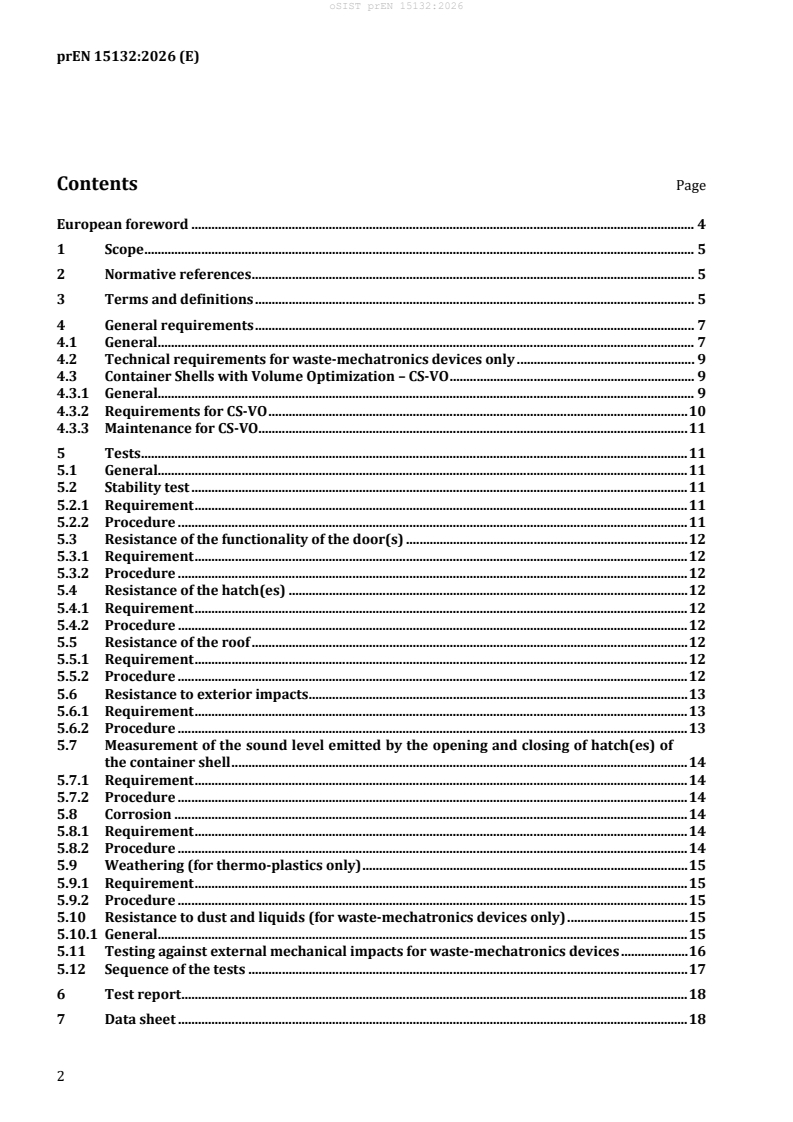
Contents Page
European foreword . 4
1 Scope . 5
2 Normative references . 5
3 Terms and definitions . 5
4 General requirements . 7
4.1 General. 7
4.2 Technical requirements for waste-mechatronics devices only . 9
4.3 Container Shells with Volume Optimization – CS-VO . 9
4.3.1 General. 9
4.3.2 Requirements for CS-VO . 10
4.3.3 Maintenance for CS-VO . 11
5 Tests . 11
5.1 General. 11
5.2 Stability test . 11
5.2.1 Requirement . 11
5.2.2 Procedure . 11
5.3 Resistance of the functionality of the door(s) . 12
5.3.1 Requirement . 12
5.3.2 Procedure . 12
5.4 Resistance of the hatch(es) . 12
5.4.1 Requirement . 12
5.4.2 Procedure . 12
5.5 Resistance of the roof . 12
5.5.1 Requirement . 12
5.5.2 Procedure . 12
5.6 Resistance to exterior impacts . 13
5.6.1 Requirement . 13
5.6.2 Procedure . 13
5.7 Measurement of the sound level emitted by the opening and closing of hatch(es) of
the container shell . 14
5.7.1 Requirement . 14
5.7.2 Procedure . 14
5.8 Corrosion . 14
5.8.1 Requirement . 14
5.8.2 Procedure . 14
5.9 Weathering (for thermo-plastics only) . 15
5.9.1 Requirement . 15
5.9.2 Procedure . 15
5.10 Resistance to dust and liquids (for waste-mechatronics devices only) . 15
5.10.1 General. 15
5.11 Testing against external mechanical impacts for waste-mechatronics devices . 16
5.12 Sequence of the tests . 17
6 Test report . 18
7 Data sheet . 18
8 Marking and user information . 18
8.1 Marking . 18
8.2 User information . 18
9 Additional recommendations . 19
9.1 General recommendations . 19
9.2 Recommendations for vandalism, violation and tampering . 19
Annex A (normative) Weathering test . 20
Bibliography . 21
European foreword
This document (prEN 15132:2026) has been prepared by Technical Committee CEN/TC 183 “Waste
management”, the secretariat of which is held by DIN.
This document will supersede EN 15132:2006.
The main changes compared to the previous edition are as follows:
• Insertion of new topic Container Shells with Volume Optimization;
• Insertion of new topic Waste-Mechatronics and relative tests.
1 Scope
This document specifies the requirements for container shells for mobile waste containers with a
capacity up to 1 700 l covered by EN 840-1 to EN 840-4.
Only for container shells with volume optimization – CS-VO, the subcontainer is an applicable model.
This document specifies the general performance characteristics of such shells as well as the test
methods, and gives recommendations for installation.
2 Normative references
The following documents are referred to in the text in such a way that some or all of their content
constitutes requirements of this document. For dated references, only the edition cited applies. For
undated references, the latest edition of the referenced document (including any amendments) applies.
EN ISO 105-B02, Textiles — Tests for colour fastness — Part B02: Colour fastness to artificial light: Xenon
arc fading lamp test (ISO 105-B02)
EN ISO 877-1, Plastics - Methods of exposure to solar radiation - Part 1: General guidance (ISO 877-1)
EN ISO 4892-2, Plastics — Methods of exposure to laboratory light sources — Part 2: Xenon-arc lamps
(ISO 4892-2)
EN ISO 9227, Corrosion tests in artificial atmospheres — Salt spray tests (ISO 9227)
EN ISO 3744:2010, Acoustics - Determination of sound power levels and sound energy levels of noise
sources using sound pressure - Engineering methods for an essentially free field over a reflecting plane
(ISO 3744:2010)
EN 60204-1, Safety of machinery - Electrical equipment of machines - Part 1: General requirements
3 Terms and definitions
For the purposes of this document, the following terms and definitions apply.
ISO and IEC maintain terminology databases for use in standardization at the following addresses:
— ISO Online browsing platform: available at https://www.iso.org/obp
— IEC Electropedia: available at https://www.electropedia.org/
3.1
mobile waste container
appropriately designed container fitted with wheels intended to temporarily store waste
3.2
container shell
equipment used as street furniture for housing mobile waste container
3.3
ground level
level where the user is standing while filling the container shell
3.4
loading height
vertical distance between the base of the container shell and the bottom of the shell’s filling aperture(s)
3.5
total height
vertical distance between the ground level and the highest point of the container shell
3.6
clearance
empty area from the container shell walls to the waste container
3.7
container shell with volume optimization
CS-VO
static container shell for the collection of municipal waste, fed by hand, equipped with a device for
optimization of the volume of waste inside a sub-container located inside the container
Note 1 to entry: The static shell container is equipped with an electric drive mechanism, operating in low voltage,
able to exert a push on the waste, acting along an axis with a mainly vertical course, achieving a reduction in its
volume
3.8
waste-mechatronics
combination of mechanical engineering and electronic engineering applied to waste collection including
mechanical and/or electronic devices fitted on a container shell for locking the lid/s and/or for
restricting the quantity of waste loadable and/or for filling level measuring, temperature control,
localization or any other data measurement than can be made
3.9
waste-mechatronics device
WMD
mechanical and/or electromechanical and/or electronic device installed on board a container shell for
the purposes specified in paragraph 3.8
3.10
waste access restriction
WAR
waste access device with a specific volume for restricting the quantity of waste loadable, with a tri-
dimensional room, typically a cap consisting of one or two rotating drums or a rotating flap operating in
combination with a movable diaphragm
3.11
waste access limitation
WAL
waste access device with a specific bi-dimensional shape for limiting the dimension of the waste
loadable, including a flap in the lid, typically one or more filling apertures with specific shapes for
limiting the dimension of the waste loadable or a rotating flap or a grill with various filling apertures
3.12
lid/s locking device
LLD
system for the locking and unlocking of one or more lids by means of a manual or automatic device in
order to prevent improper use of the container and its contents
3.13
filling level measuring
FLM
device for the determination of the quantity of waste inside a receptacle with a certain known volume,
by measuring the filling level of that receptacle
3.14
user identification
process which consists in accurately recognising and verifying a user by reading a data carrier
3.15
data carrier
device carrying data which can be recognised by an electro-magnetic, optical or other reading device
3.16
determination of the quantity of waste
DQW
determination of the waste volume stored within the receptacle and/or weighing of the waste mass
and/or counting of conferring operations
3.17
interface
connection between two systems; the connection could be mechanical and/or optical and/or electrical
and/or electronic
3.18
user interface
specific area onto the container shell in which a person can identify and/or interact with a container
shell by an interface
3.19
equipped container shell
container shell for waste collection with mechatronic devices fitted on
3.20
max total mass
limit the amount of waste collected into a container
4 General requirements
4.1 General
Any construction material of the container shell shall allow the conformity of the shell with the tests of
this document.
If different construction materials are used, they shall prevent any reciprocal incompatibility (i.e.
chemical interaction) that could damage them.
All parts of the container shell with which the user may be in contact shall prevent any risk of injury:
obvious aggressivity of external surfaces, sharp edges (edges with a radius less than 1,4 mm are
considered as sharp edges), pinching risks etc.
In order to reduce the risks of using container shells on roads, it is mandatory to observe the following
minimum outside radius for at least all vertical edges outside the structure of the container shell:
• for roads and places with low vehicular traffic: minimum external radius of 3,5 mm;
• for roads and places with high vehicular traffic: minimum external radius of 30 mm.
Self locking doors and hatches shall allow the opening from inside.
The interior of the container shell shall not be able to retain wastes or cause obstruction for cleaning
and disinfecting. It shall also be designed in order to resist damage from interior impacts due to
handling of containers into the container shell.
Installation conditions may require sealing devices.
The bottom edge of the shell’s door(s) shall be at least 30 mm above the ground level on which the
waste containers are moved.
Loading height HL shall not exceed 1,50 m.
The container shell shall be designed so that the hatches (if present) shall not remain opened after use.
To locate the waste container in the container shell, a minimum clearance shall be respected between
container shell and the dimensions of waste containers to be used as defined in the relevant parts 1 to 4
of EN 840.
The clearance shall be minimum 15 mm. Upper free space shall allow the tilting and/or the extraction of
the container.
The clearance shall be considered between the maximum dimensions of used waste containers and the
closest wall.
a) Example of container shell with waste access limitation – WAL
b) Example of container shell with waste access restriction – WAR
Figure 1
4.2 Technical requirements for waste-mechatronics devices only
In case the container shell is equipped with waste-mechatronics devices, the following minimum
requirements characteristics shall also be respected:
• Resistance to dust and liquids: IP65
• External mechanical impacts for waste-mechatronics devices: IK07
More information is contained in the respective test sections.
4.3 Container Shells with Volume Optimization – CS-VO
4.3.1 General
The abbreviation CS-VO will be used below to indicate a Container Shell with Volume Optimization.
The aim is to increase the efficiency of the container by progressively crushing waste delivered by
citizens and tourists. The goal is to reduce the number of empties that an operator shall perform
manually. The volume reduction ratio is typically between 2:1 and 7:1.
Figure 2 — Image of a CS-VO only for illustrative purposes
Waste can be mixed waste or recyclable fractions (e.g. paper, plastic, aluminium cans, fast food waste).
The overall dimensions of the container shell with volume optimization are for instance around
80x80xh160 cm.
The CS-VO container is typically equipped with a photovoltaic system with an energy storage system.
The waste is introduced manually by means of a lateral opening located on a side of the container and
falls into an internal sub-container. The opening for the insertion of waste typically includes a door with
handle and pedal. As an alternative there is an open entry, which is only closed by a safety-hatch when
litter is being compacted.
The sub-container can be a plastic or metal small container specially made or it can be a mobile
container equipped with or without wheels. The volume of the sub-container is typically between 80
and 360 l.
The CS-VO container shell is equipped with an electro-mechanical device that periodically reduces the
volume of waste by acting along an axis with a mainly vertical course.
The CS-VO container shell is equipped with a door for the extraction and emptying of the sub-container.
The CS-VO can be equipped with waste-mechatronics devices to perform one or more functions, such
as: user identification, detection of the filling level of the sub-container, detection of a break-in, light
warning to users of the possible unavailability of the container, fire detection, data transmission by
modem or other data exchange device with a central system.
The CS-VO container shell typically operates at low voltage;
...