

EN ISO 5084:1996
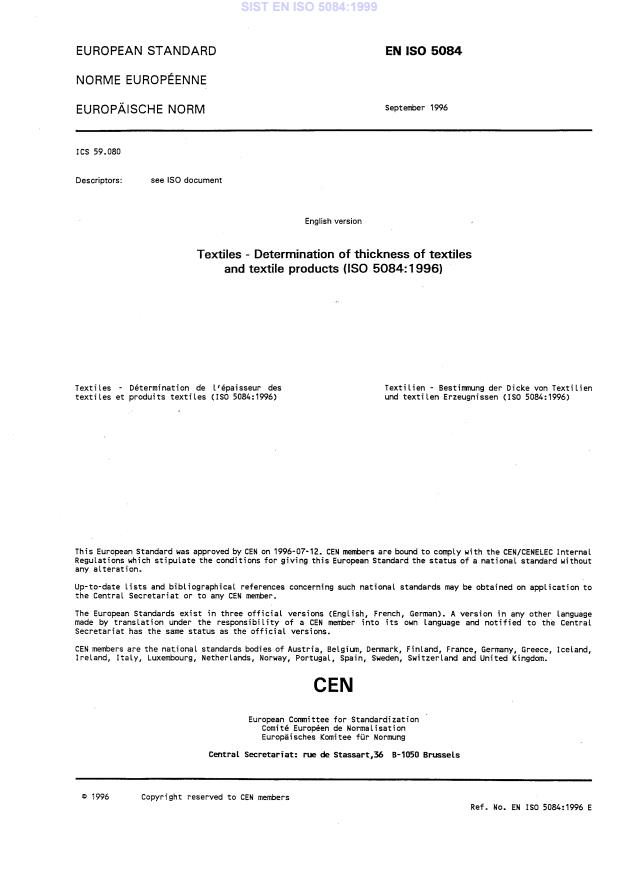
(Main)Textiles - Determination of thickness of textiles and textile products (ISO 5084:1996)
General Information
- Abstract
Describes a method for the determination of the thickness of textiles and textile products under specified pressure. Not applicable to textile floor coverings, nonwovens, geotextiles and coated fabrics. replaces the first edition.
- Status
- Published
- Publication Date
- 31-Aug-1996
- Withdrawal Date
- 30-Mar-1997
- Technical Committee
- CEN/TC 248 - Textiles and textile products
- Drafting Committee
- CEN/TC 248/SC 2 - Physical properties
- Current Stage
- 9093 - Decision to confirm - Review Enquiry
- Start Date
- 14-Jun-2006
- Completion Date
- 14-Jun-2006

Overview
EN ISO 5084:1996 - Textiles: Determination of thickness of textiles and textile products (ISO 5084:1996) specifies a laboratory method to measure the thickness of textile materials under a defined pressure. Published as a CEN-adopted ISO method (second edition, 1996), it replaces the first edition and defines apparatus, conditioning, sampling and test procedure for repeatable textile thickness measurement. The standard is not applicable to textile floor coverings, nonwovens, geotextiles or coated fabrics (see Annex B for alternatives).
Key topics and technical requirements
- Principle: Thickness = perpendicular distance between a reference plate and a parallel circular presser-foot under a specified pressure.
- Conditioning: Samples must be conditioned in the standard atmosphere for textiles (ISO 139) before testing.
- Apparatus: Requirements include a thickness tester with
- interchangeable presser-feet (recommended area 2000 ± 20 mm² - circular presser-foot diameter 50.5 ± 0.2 mm),
- reference plate (plane surface, diameter ≥ presser-foot + 50 mm),
- thickness gauge capable of 0.01 mm accuracy,
- means to apply and maintain specified pressures.
- Applied pressure: Recommended pressure is (1 ± 0.01) kPa; an alternative lower pressure (0.1 ± 0.001) kPa may be used for raised-pile or loop fabrics.
- Test procedure:
- Clean and zero the tester; place specimen relaxed and free of creases.
- Lower presser-foot and read thickness after (30 ± 5) s.
- Take at least five measurements on a sample or five specimens.
- Results and reporting:
- Report arithmetic mean to 0.01 mm, coefficient of variation (%) and 95% confidence limits (to 0.01 mm).
- Test report must state the standard reference, fabric description, presser-foot area used, applied pressure, number of tests and any deviations from the procedure.
- Annexes:
- Annex A (normative) covers test area positions and alternative presser-foot areas for narrow or sensitive fabrics.
- Annex B (informative) lists related standards (e.g., ISO 1765, ISO 9073-2, ISO 9863).
Applications and practical value
- Ensures consistent, repeatable measurement of fabric thickness for quality control, specification compliance and material comparison.
- Used in:
- textile manufacturing QA/QC,
- laboratory testing and certification,
- product development and material selection,
- compliance testing for apparel, technical textiles (except listed exclusions).
- Useful for determining thickness parameters that affect insulation, drape, compressibility, layering, and end-use performance.
Who should use this standard
- Textile test laboratories, manufacturers, R&D and quality engineers, suppliers and specifiers who require a standardized method for thickness measurement and reporting.
Related standards
- ISO 139 - standard atmosphere for conditioning and testing
- ISO 1765, ISO 9073-2, ISO 9863 - referenced for floor coverings, nonwovens and geotextiles respectively
Keywords: EN ISO 5084:1996, determination of thickness, textile thickness measurement, thickness tester, presser-foot, standard atmosphere, textile testing.
Relations
- Effective Date
- 09-Feb-2026
- Effective Date
- 28-Jan-2026
- Effective Date
- 28-Jan-2026
- Referred By
EN 15586:2008 - Textiles - Methods of testing the fibre proof properties of fabrics: Rubbing test - Effective Date
- 28-Jan-2026
- Effective Date
- 28-Jan-2026
- Effective Date
- 28-Jan-2026
- Effective Date
- 28-Jan-2026
- Effective Date
- 28-Jan-2026
- Effective Date
- 28-Jan-2026
- Effective Date
- 28-Jan-2026
- Effective Date
- 28-Jan-2026
- Effective Date
- 28-Jan-2026
- Effective Date
- 28-Jan-2026
- Effective Date
- 28-Jan-2026
- Consolidated By
ISO 5084:1996 - Textiles — Determination of thickness of textiles and textile products - Effective Date
- 12-Feb-2026
Get Certified
Connect with accredited certification bodies for this standard

Control Union Certifications
Global certification for agriculture and sustainability.

Hohenstein Institut
Textile testing and certification.

Bureau Veritas Bangladesh
Bureau Veritas certification services in Bangladesh.
Sponsored listings
Frequently Asked Questions
EN ISO 5084:1996 is a standard published by the European Committee for Standardization (CEN). Its full title is "Textiles - Determination of thickness of textiles and textile products (ISO 5084:1996)". This standard covers: Describes a method for the determination of the thickness of textiles and textile products under specified pressure. Not applicable to textile floor coverings, nonwovens, geotextiles and coated fabrics. replaces the first edition.
Describes a method for the determination of the thickness of textiles and textile products under specified pressure. Not applicable to textile floor coverings, nonwovens, geotextiles and coated fabrics. replaces the first edition.
EN ISO 5084:1996 is classified under the following ICS (International Classification for Standards) categories: 59.080 - Products of the textile industry. The ICS classification helps identify the subject area and facilitates finding related standards.
EN ISO 5084:1996 has the following relationships with other standards: It is inter standard links to EN IEC 63203-204-2:2025, EN ISO 734:2023, EN ISO 22630:2015, EN 15586:2008, EN ISO 734:2015, EN 1492-1:2000+A1:2008, EN 14882:2005, EN ISO 734-2:2010, EN ISO 14244:2016, EN 14404-1:2024, EN 13567:2002+A1:2007, EN ISO 9167:2019, EN ISO 734-1:2006, EN 17428:2023, ISO 5084:1996. Understanding these relationships helps ensure you are using the most current and applicable version of the standard.
EN ISO 5084:1996 is available in PDF format for immediate download after purchase. The document can be added to your cart and obtained through the secure checkout process. Digital delivery ensures instant access to the complete standard document.
Standards Content (Sample)
SLOVENSKI STANDARD
01-marec-1999
Tekstilije - Ugotavljanje debeline tekstilij (ISO 5084:1996)
Textiles - Determination of thickness of textiles and textile products (ISO 5084:1996)
Textilien - Bestimmung der Dicke von Textilien und textilen Erzeugnissen (ISO
5084:1996)
Textiles - Détermination de l'épaisseur des textiles et produits textiles (ISO 5084:1996)
Ta slovenski standard je istoveten z: EN ISO 5084:1996
ICS:
59.080.30 Tkanine Textile fabrics
2003-01.Slovenski inštitut za standardizacijo. Razmnoževanje celote ali delov tega standarda ni dovoljeno.
IS0
INTERNATIONAL
STANDARD
Second edition
1996-09-o 1
- Determination of thickness of
Textiles
textiles and textile products
- Dktermination de I’6paisseur des textiles et prod&s textiles
Textiles
Reference number
IS0 50847 996(E)
IS0 5084: 1996(E)
Foreword
IS0 (the International Organization for Standardization) is a worldwide
federation of national standards bodies (IS0 member bodies). The work
of preparing International Standards is normally carried out through IS0
technical committees. Each member body interested in a subject for
which a technical committee has been established has the right to be
represented on that committee. International organizations, governmental
and non-governmental, in liaison with ISO, also take part in the work. IS0
collaborates closely with the International Electrotechnical Commission
(IEC) on all matters of electrotechnical standardization.
Draft International Standards adopted by the technical committees are
circulated to the member bodies for voting. Publication as an International
Standard requires approval by at least 75 % of the member bodies casting
a vote.
International Standard IS0 5084 was prepared by Technical Committee
I SO/TC 38, Textiles.
This second edition cancels and replaces the first edition
(IS0 5084:1977), which has been technically revised.
Annex A forms an integral part of this International Standard. Annex B is
for information only.
0 IS0 1996
All rights reserved. Unless otherwise specified, no part of this publication may be reproduced
or utilized in any form or by any means, electronic or mechanical, including photocopying and
microfilm, without permission in writing from the publisher.
International Org anization for Standardization
Case Postale 56 l CH-121 1 Geneve 20 l Switzerland
Printed in Switzerland
ii
IS0 5084: 1996(E)
INTERNATIONAL STANDARD 0 IS0
Textiles - Determination of thickness of textiles and
textile products
4 Principle
1 Scope
The thickness of a specimen is measured as the dis-
This International Standard specifies a method for the
tance between the reference plate on which the
determination of the thickness of textiles and textile
specimen rests and a parallel circular presser-foot that
products when under a specified pressure. It is not
exerts a specified pressure on the area of the textile
applicable to textile floor coverings, nonwovens,
under test.
geotextiles and coated fabrics for which specific
International Standards exist (see annex B).
A test specimen is placed between two reference
plates which exert a known pressure on the speci-
men. The perpendicular distance between the refer-
ence plates is measured and recorded after a
2 Normative references
specified time.
The following standards contain provisions which,
through reference in this text, constitute provisions 5 Apparatus
of this International Standard. At the time of publi-
cation, the editions indicated were valid. All standards
5.1 Thickness tester
are subject to revision, and parties to agreements
The confirmation system for the thickness tester shall
based on this International Standard are encouraged
to investigate the possibility of applying the most re- comply with IS0 IOOIZ-1. The thickness tester shall
cent editions of the standards indicated below. incorporate (or be equipped with) the following el-
ements.
Members of IEC and IS0 maintain registers of cur-
rently valid International Standards.
5.1.1 Interchangeable presser-feet, of area appro-
IS0 139: 1973, Textiles - Standard atmospheres for
priate to the type of fabric to be tested.
conditioning and testing.
The recommended pressure-foot area for the test is
IS0 10012-I : 1992, Quality assurance requirements (2 000 + 20) mm’, corresponding to a circular
for measuring equipment - Part I: Metrological presser-foot of diameter (50,5 + 0,2) mm (see also
-
confirmation system for measuring equlpmen t. annex A). If other test areas have to be used, this
shall be agreed by the interested parties and shall be
stated in the test report.
5.1.2 Reference plate, with a plane upper surface
3 Definition
of diameter at least 50 mm greater than that of the
For the purposes of this International Standard, the presser-foot (5.1.1).
following definition applies.
5.1.3 Means for moving
...