


EN 13163:2001
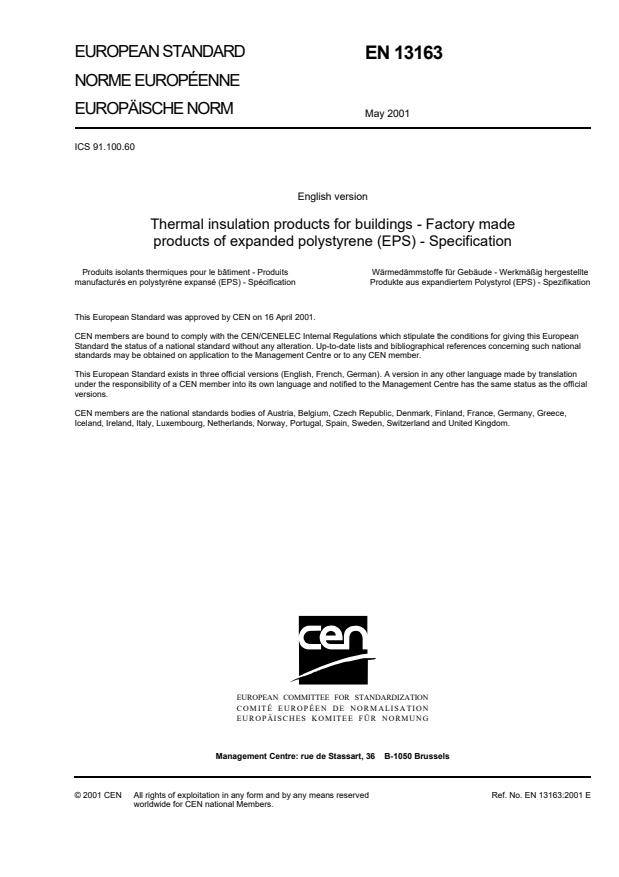
(Main)Thermal insulation products for buildings - Factory made products of expanded polystyrene (EPS) - Specification
Thermal insulation products for buildings - Factory made products of expanded polystyrene (EPS) - Specification
This European Standard specifies the requirements for factory made products of expanded polystyrene, with or without facings or coatings which are used for the thermal insulation of buildings. The products are manufactured in the form of boards or rolls or other preformed ware. The standard describes product characteristics and includes procedures for testing, marking and labelling. Products covered by this standard are also used in prefabricated thermal insulation systems and composite panels; the structural performance of systems incorporating these products is not covered.
Wärmedämmstoffe für Gebäude - Werkmäßig hergestellte Produkte aus expandiertem Polystyrol (EPS) - Spezifikation
Diese Europäische Norm legt die Anforderungen für wermäßig hergestellte Produkte aus EPS mit oder ohne Kaschierung fest, die für die Wärmedämmung von Gebäuden benutzt werden. Die Produkte werden in der Form von Platten oder Rollen oder anderer vorgeformter Ware hergestellt. Diese Norm beschreibt die Stoffeigenschaften und enthält die Prüfverfahren und Festlegungen für die Konformitätsbewertung, die Kennzeichnung und die Etikettierung. Die in dieser Norm Beschriebenen Produkte werden auch für die schalldämmung und in vorgefertigten Wärmedämmsystemen und Mehrschicht-Verbundplatten angewendet; die Eigenschaften von Systemen mit diesen Produkten werden nicht behandelt. Diese Norm legt keine Anforderungsniveaus für eine vorgegebene Eigenschaft fest, die ein Produkt erreichen muss, um für einen bestimmten Anwendungsfall tauglich zu sien. Für bestimmte Anwendungen benötigte Klassen und Stufen können Regelwerken oder übereinstimmenden Normen entnommen werden. Diese Norm gilt nicht für Produkte, deren Nennwert des Wärmedurchlasswiderstandes niedriger ist als 0,25 m² . K/W oder deren Nennwert der Wärmeleitfähigkeit bei 10°C Mitteltemperatur größer ist als 0,060 W/ (m . K).
Produits isolants thermiques pour le bâtiment - Produits manufacturés en polystyrène expansé (EPS) - Spécification
La présente Norme européenne spécifie les exigences auxquelles doivent satisfaire les produits manufacturés en polystyrène expansé, avec ou sans parements ou revêtements, utilisés pour l'isolation thermique des bâtiments. Les produits sont fabriqués sous forme de panneaux ou de rouleaux ou toute autre présentation préformée.
La présente norme décrit les caractéristiques du produit et inclut les procédures d'essai, d'évaluation de la conformité, de marquage et d'étiquetage.
Les produits du domaine d'application de la présente norme sont également utilisés pour l'isolation acoustique, dans des systèmes d'isolation thermique et dans des panneaux composites préfabriqués ; la performance des systèmes dans lesquels entrent ces produits n'est pas définie.
La présente norme ne spécifie pas, pour une propriété donnée, la classe ou le niveau que doit atteindre un produit pour démontrer son aptitude à l'emploi dans une application particulière. Les classes et niveaux requis pour une application donnée figurent dans les réglementations ou normes non conflictuelles.
Les produits dont la résistance thermique déclarée à une température de 10 °C est inférieure à 0,25 m2.K/W ou dont la conductivité thermique déclarée à une température de 10 °C est supérieure à 0,060 W/(m×K) ne sont pas du domaine d'application de la présente norme.
Toplotnoizolacijski proizvodi za stavbe - Proizvodi iz ekspandiranega polistirena (EPS) - Specifikacija
General Information
- Status
- Withdrawn
- Publication Date
- 22-May-2001
- Withdrawal Date
- 25-Nov-2008
- Technical Committee
- CEN/TC 88 - Thermal insulating materials and products
- Drafting Committee
- CEN/TC 88/WG 4 - Expanded polystyrene foam (EPS)
- Current Stage
- 9960 - Withdrawal effective - Withdrawal
- Start Date
- 26-Nov-2008
- Completion Date
- 26-Nov-2008
- Directive
- 89/106/EEC - Construction products
Relations
- Effective Date
- 22-Dec-2008
- Effective Date
- 28-Jan-2026
- Effective Date
- 22-Dec-2008

Get Certified
Connect with accredited certification bodies for this standard

ICC Evaluation Service
Building products evaluation and certification.

QAI Laboratories
Building and construction product testing and certification.

Aboma Certification B.V.
Specialized in construction, metal, and transport sectors.
Sponsored listings
Frequently Asked Questions
EN 13163:2001 is a standard published by the European Committee for Standardization (CEN). Its full title is "Thermal insulation products for buildings - Factory made products of expanded polystyrene (EPS) - Specification". This standard covers: This European Standard specifies the requirements for factory made products of expanded polystyrene, with or without facings or coatings which are used for the thermal insulation of buildings. The products are manufactured in the form of boards or rolls or other preformed ware. The standard describes product characteristics and includes procedures for testing, marking and labelling. Products covered by this standard are also used in prefabricated thermal insulation systems and composite panels; the structural performance of systems incorporating these products is not covered.
This European Standard specifies the requirements for factory made products of expanded polystyrene, with or without facings or coatings which are used for the thermal insulation of buildings. The products are manufactured in the form of boards or rolls or other preformed ware. The standard describes product characteristics and includes procedures for testing, marking and labelling. Products covered by this standard are also used in prefabricated thermal insulation systems and composite panels; the structural performance of systems incorporating these products is not covered.
EN 13163:2001 is classified under the following ICS (International Classification for Standards) categories: 91.100.60 - Thermal and sound insulating materials. The ICS classification helps identify the subject area and facilitates finding related standards.
EN 13163:2001 has the following relationships with other standards: It is inter standard links to EN 13163:2008, EN 12691:2006, EN 13163:2001/AC:2005. Understanding these relationships helps ensure you are using the most current and applicable version of the standard.
EN 13163:2001 is associated with the following European legislation: EU Directives/Regulations: 305/2011, 89/106/EEC; Standardization Mandates: M/103. When a standard is cited in the Official Journal of the European Union, products manufactured in conformity with it benefit from a presumption of conformity with the essential requirements of the corresponding EU directive or regulation.
EN 13163:2001 is available in PDF format for immediate download after purchase. The document can be added to your cart and obtained through the secure checkout process. Digital delivery ensures instant access to the complete standard document.
Standards Content (Sample)
2003-01.Slovenski inštitut za standardizacijo. Razmnoževanje celote ali delov tega standarda ni dovoljeno.Thermal insulation products for buildings - Factory made products of expanded polystyrene (EPS) - SpecificationToplotnoizolacijski proizvodi za stavbe - Proizvodi iz ekspandiranega polistirena (EPS) - SpecifikacijaProduits isolants thermiques pour le bâtiment - Produits manufacturés en polystyrene expansé (EPS) - SpécificationWärmedämmstoffe für Gebäude - Werkmäßig hergestellte Produkte aus expandiertem Polystyrol (EPS) - Spezifikation91.100.60Thermal and sound insulating materialsICS:SIST EN 13163:2002enTa slovenski standard je istoveten z:EN 13163:200101-marec-2002SIST EN 13163:2002SLOVENSKI
STANDARD
EUROPEAN STANDARDNORME EUROPÉENNEEUROPÄISCHE NORMEN 13163May 2001ICS 91.100.60English versionThermal insulation products for buildings - Factory madeproducts of expanded polystyrene (EPS) - SpecificationProduits isolants thermiques pour le bâtiment - Produitsmanufacturés en polystyrène expansé (EPS) - SpécificationWärmedämmstoffe für Gebäude - Werkmäßig hergestellteProdukte aus expandiertem Polystyrol (EPS) - SpezifikationThis European Standard was approved by CEN on 16 April 2001.CEN members are bound to comply with the CEN/CENELEC Internal Regulations which stipulate the conditions for giving this EuropeanStandard the status of a national standard without any alteration. Up-to-date lists and bibliographical references concerning such nationalstandards may be obtained on application to the Management Centre or to any CEN member.This European Standard exists in three official versions (English, French, German). A version in any other language made by translationunder the responsibility of a CEN member into its own language and notified to the Management Centre has the same status as the officialversions.CEN members are the national standards bodies of Austria, Belgium, Czech Republic, Denmark, Finland, France, Germany, Greece,Iceland, Ireland, Italy, Luxembourg, Netherlands, Norway, Portugal, Spain, Sweden, Switzerland and United Kingdom.EUROPEAN COMMITTEE FOR STANDARDIZATIONCOMITÉ EUROPÉEN DE NORMALISATIONEUROPÄISCHES KOMITEE FÜR NORMUNGManagement Centre: rue de Stassart, 36
B-1050 Brussels© 2001 CENAll rights of exploitation in any form and by any means reservedworldwide for CEN national Members.Ref. No. EN 13163:2001 E
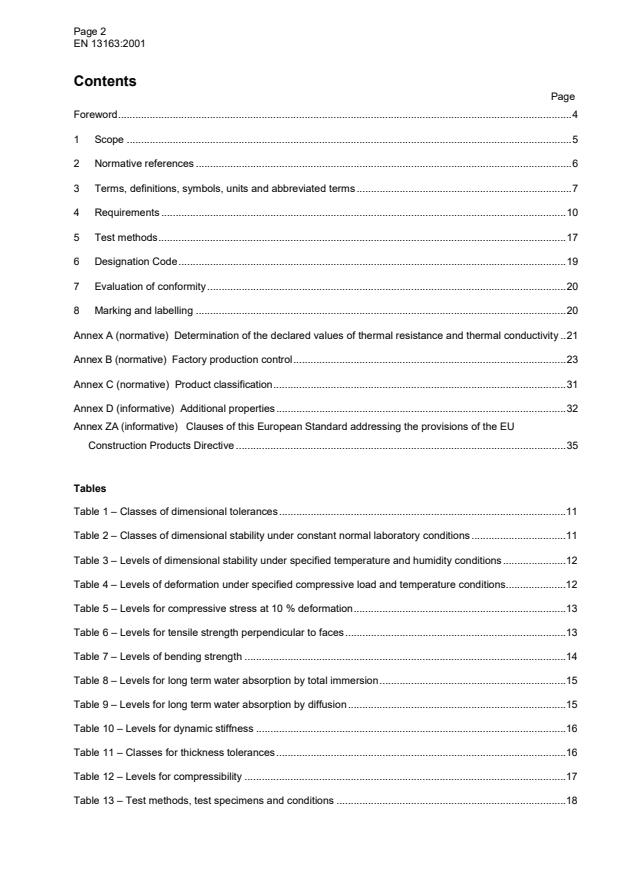
Page 2EN 13163:2001ContentsPageForeword.41Scope.52Normative references.63Terms, definitions, symbols, units and abbreviated terms.74Requirements.105Test methods.176Designation Code.197Evaluation of conformity.208Marking and labelling.20Annex A (normative)
Determination of the declared values of thermal resistance and thermal conductivity.21Annex B (normative)
Factory production control.23Annex C (normative)
Product classification.31Annex D (informative)
Additional properties.32Annex ZA (informative)
Clauses of this European Standard addressing the provisions of the EU Construction Products Directive.35TablesTable 1 – Classes of dimensional tolerances.11Table 2 – Classes of dimensional stability under constant normal laboratory conditions.11Table 3 – Levels of dimensional stability under specified temperature and humidity conditions.12Table 4 – Levels of deformation under specified compressive load and temperature conditions.12Table 5 – Levels for compressive stress at 10 % deformation.13Table 6 – Levels for tensile strength perpendicular to faces.13Table 7 – Levels of bending strength.14Table 8 – Levels for long term water absorption by total immersion.15Table 9 – Levels for long term water absorption by diffusion.15Table 10 – Levels for dynamic stiffness.16Table 11 – Classes for thickness tolerances.16Table 12 – Levels for compressibility.17Table 13 – Test methods, test specimens and conditions.18
Page 3EN 13163:2001Table A.1 – Values for k for one sided 90 % tolerance interval
with a confidence level of 90 %.22Table B.1 – Minimum product testing frequencies.23Table B.2 – Minimum product testing frequencies for the reaction to fire characteristics.25Table B.3 – Thickness effect parameter, L,
for the determination
of the declared thermal conductivity, D.29Table C.1 – Classification of EPS products.31Table C.2 – Classification of load bearing EPS products with acoustical properties.31Table D.1 – Correlation between bending strength and shear strength.32Table D.2 –Tabulated values of water vapour diffusion resistance index and water vapour permeability.33Table D.3 – Test methods.33Table ZA.1 – Relevant clauses.35Table ZA.2.1 – Systems of attestation of conformity of factory made products for any intended use.36Table ZA.2.2 – Systems of attestation of conformity of factory made products for uses subject to regulationson reaction to fire.37Table ZA.3 - Example CE marking information.39
Page 4EN 13163:2001ForewordThis European Standard has been prepared by Technical Committee CEN/TC 88 "Thermal insulating materialsand products", the secretariat of which is held by DIN.This European Standard shall be given the status of a national standard, either by publication of an identical textor by endorsement, at the latest by November 2001, and conflicting national standards shall be withdrawn at thelatest by March 2003.This European Standard has been prepared under a mandate given to CEN by the European Commission andthe European Free Trade Association, and supports essential requirements of EU Directive(s).For relationship with EU Directive(s), see informative annex ZA, which is an integral part of this standard.This European Standard contains five annexes:Annex A (normative)Determination of the declared values of thermal resistance and thermalconductivityAnnex B (normative)Factory production controlAnnex C (normative)Product classificationAnnex D (informative)Additional propertiesAnnex ZA (informative)Clauses of this European Standard addressing the provisions of the EUConstruction Products DirectiveThis European Standard is one of a series of standards for insulation products used in buildings, but thisstandard may be used in other areas where appropriate.In pursuance of Resolution BT 20/1993 revised, CEN/TC 88 have proposed defining the standards listed belowas a European package of standards, setting (21 months after availability) as the date of withdrawal (dow) ofnational standards which conflict with the European Standards of this package.The package of standards comprises the following group of interrelated standards for the specifications offactory made thermal insulation products, all of which come within the scope of CEN/TC 88:EN 13162, Thermal insulation products for buildings – Factory made mineral wool (MW) products –Specification.EN 13163, Thermal insulation products for buildings – Factory made products of expandedpolystyrene (EPS) – Specification.EN 13164, Thermal insulation products for buildings – Factory made products of extruded polystyrenefoam (XPS) – Specification.EN 13165, Thermal insulation products for buildings – Factory made rigid polyurethane foam(PUR) products – Specification.EN 13166, Thermal insulation products for buildings – Factory made products of phenolic foam (PF) –Specification.EN 13167, Thermal insulation products for buildings – Factory made cellular glass (CG) products – Specification.EN 13168, Thermal insulation products for buildings – Factory made wood wool (WW) products –Specification.EN 13169, Thermal insulation products for buildings – Factory made products of expanded perlite (EPB)
Page 5EN 13163:2001– Specification.EN 13170, Thermal insulation products for buildings – Factory made products of expanded cork (ICB) –Specification.EN 13171, Thermal insulation products for buildings – Factory made wood fibre (WF) products
–Specification.According to the CEN/CENELEC Internal Regulations, the national standards organizations of the followingcountries are bound to implement this European Standard: Austria, Belgium, Czech Republic, Denmark,Finland, France, Germany, Greece, Iceland, Ireland, Italy, Luxembourg, Netherlands, Norway, Portugal, Spain,Sweden, Switzerland and the United Kingdom.1 ScopeThis European Standard specifies the requirements for factory made products of expanded polystyrene, with orwithout facings or coatings, which are used for the thermal insulation of buildings. The products aremanufactured in the form of boards or rolls or other preformed ware.The standard describes product characteristics and includes procedures for testing, evaluation of conformity,marking and labelling.Products covered by this standard are also used for sound insulation and in prefabricated thermal insulationsystems and composite panels; the performance of systems incorporating these products is not covered.The standard does not specify the required class or level of a given property to be achieved by a product todemonstrate fitness for purpose in a particular application. The classes and levels required for a givenapplication are to be found in regulations or non-conflicting standards.Products with a declared thermal resistance lower than 0,25 m²K/W or a declared thermal conductivity at 10 Cgreater than 0,060 W/(mK) are not covered by this standard.
Page 6EN 13163:20012 Normative referencesThis European Standard incorporates by dated or undated reference, provisions from other publications. Thesenormative references are cited at the appropriate places in the text and the publications are listed hereafter. Fordated references, subsequent amendments to, or revisions of, any of these publications apply to this EuropeanStandard only when incorporated in it by amendment or revision. For undated references the latest edition of thepublication referred to applies (including amendments).EN 822, Thermal insulating products for building applications – Determination of length and width.EN 823, Thermal insulating products for building applications – Determination of thickness.EN 824, Thermal insulating products for building applications – Determination of squareness.EN 825, Thermal insulating products for building applications – Determination of flatness.EN 826, Thermal insulating products for building applications – Determination of compression behaviour.EN 1602, Thermal insulating products for building applications – Determination of apparent density.EN 1603, Thermal insulating products for building applications – Determination of dimensional stability underconstant normal laboratory conditions (23 °C / 50 % relative humidity).EN 1604, Thermal insulating products for building applications – Determination of dimensional stability underspecified temperature and humidity conditions.EN 1605, Thermal insulating products for building applications – Determination of deformation underspecified compressive load and temperature conditions.EN 1606, Thermal insulating products for building applications – Determination of compressive creep.EN 1607, Thermal insulating products for building applications – Determination of tensile strengthperpendicular to faces.prEN ISO 1182, Reaction to fire tests for building products - Non-combinability test (ISO/DIS 1182:1998).prEN ISO 1716, Reaction to fire tests for building products – Determination of calorific value (ISO/DIS1716:1998).prEN ISO 9229, Thermal insulation – Definitions of terms (ISO/DIS 9229:1997).prEN ISO 11925-2, Reaction to fire tests for building products – Part 2: Ignitability when subjected todirect impingement of flame (ISO/DIS 11925-2:1998).EN 12085, Thermal insulating products for building applications – Determination of linear dimensions of testspecimens.EN 12086, Thermal insulating products for building applications – Determination of water vapourtransmission properties.EN 12087, Thermal insulating products for building applications – Determination of long-term waterabsorption by immersion.EN 12088, Thermal insulating products for building applications – Determination of long-term waterabsorption by diffusion.EN 12089, Thermal insulating products for building applications – Determination of bending behaviour.EN 12090, Thermal insulating products for building applications – Determination of shear behaviour.EN 12091, Thermal insulating products for building applications – Determination of freeze-thaw resistance.
Page 7EN 13163:2001EN 12431, Thermal insulating products for building applications – Determination of thickness for floating floorinsulating products.ISO 12491, Statistical methods for quality control of building materials and components.prEN 12667, Thermal performance of building material and products – Determination of thermal resistance bymeans of guarded hot plate and heat flow meter methods – Products of high and medium thermal resistance.EN 12939, Thermal performance of building materials and products – Determination of thermalresistance by means of guarded hot plate and heat flow meter methods – Thick products of high andmedium thermal resistance.EN 13172:2001, Thermal insulating products – Evaluation of conformity.prEN 13501-1, Fire classification of construction products and building elements – Part 1: Classificationusing test data from reaction to fire test.prEN 13823, Reaction to fire tests for building products – Building products excluding floorings exposed to thethermal attack by a single burning item.EN 29052-1, Acoustics – Determination of dynamic stiffness – Part 1: Materials used under floating floors indwellings.3 Terms, definitions, symbols, units and abbreviated terms3.1 Terms and definitionsFor the purpose of this standard, the following terms and definitions apply. Other relevant definitions are to befound in prEN ISO 9229.3.1.1expanded polystyrene (EPS)rigid cellular plastic material, manufactured by moulding beads of expandable polystyrene or one of itscopolymers, with an air filled closed cellular structureexpanded polystyrene blockrigid insulation product or material generally of rectangular cross section and with a thickness not significantlysmaller than the width. Blocks are supplied trimmed or untrimmed3.1.3expanded polystyrene boardrigid insulation product (cut, moulded, or continuously foamed) of rectangular shape and cross section in whichthe thickness is significantly smaller than the other dimensions. Boards may be of uniform thickness or tapered.The board edges may be of various sorts (e.g., square, half lapped, tongue and groove)3.1.4expanded polystyrene rollboards or strips bonded to a flexible facing, supplied in a wound or folded form, which form a continuousinsulation layer when unrolled3.1.5preformed wareinsulation shapes formed by cutting or grinding from blocks or boards or by shape moulding3.1.6levelthe given value, which is the upper or lower limit of a requirement. The level is given by the declared value ofthe characteristic concerned
Page 8EN 13163:20013.1.7classa combination of two levels of the same property between which the performance shall fall, where the levels aregiven by the declared value of the characteristic concerned3.2 Symbols, units and abbreviated termsSymbols and units used in this standard:1 - is the prediction interval1bis the widthmmcis the compressibilitymmdis the thicknessmmis the water vapour permeabilitymg/(Pahm)dBis the thickness under a load of 2 kPa after removal of an additional load of 48 kPammdLis the thickness under a load of 250 PammdNis the nominal thickness of the productmmdsis the thickness of the test specimenmmbis the relative change in width%dis the relative change in thickness%lis the relative change in length%1is the deformation after step A in accordance with EN 1605%2is the deformation after step B in accordance with EN 1605%ctis the compressive creep%tis the total relative thickness reduction%Edynis the dynamic elasticity modulusMN/m²kis a factor related to the number of test results available1lis the lengthmmLis the thickness effect parameter190, 90is the 90 % fractile with a confidence level of 90 % for the thermal conductivityW/(mK)Dis the declared of thermal conductivityW/(mK)iis one test result of thermal conductivityW/(mK)i’is one test result of thermal conductivity for which the thickness effect is not negligibleW/(mK)meanis the mean thermal conductivityW/(mK)predis the predicted thermal conductivity with a prediction interval of 90 %W/(mK)is the water vapour diffusion resistance factor1nis the number of test results1ais the apparent densitykg/m³R90/90is the 90 % fractile with a confidence level of 90 % for the thermal resistancem²K/WRDis the declared thermal resistancem²K/WRiis one test result of thermal resistancem²K/WRi’is one test result of thermal resistance for which the thickness effect is not negligiblem²K/WRmeanis the mean thermal resistancem²K/W
Page 9EN 13163:2001s'is the dynamic stiffnessMN/m³10is the compressive stress at 10 % deformationkPa10, meanis the mean compressive stress at 10 % deformationkPa10, predis the predicted compressive stress at 10 % deformation with a prediction interval of 90 %kPabis the bending strengthkPacis the compressive stresskPamtis the tensile strength perpendicular to faceskPaSbis the deviation from squarenessmm/msis the estimate of the standard deviation of the thermal conductivityW/(mK)Smaxis the deviation from flatnessmmsRis the estimate of the standard deviation of the thermal resistancem²K/Wtis the testing timedis the shear strengthkPaWdVis the water absorption by diffusion%Wlpis the long-term water absorption by partial immersionkg/m²Wltis the long-term water absorption by total immersion%X0is the initial deformation after 60 s from the beginning of the loadingmmXctis the compressive creepmmXtis the deformation at time t (total thickness reduction)mmZis the water vapour resistancem²hPa/mgBSis the symbol of the declared level for bending strengthCC (i1/i2/y)cis the symbol of the declared level for compressive creepCPis the symbol of the declared level for compressibilityCS(10)is the symbol of the declared level for compressive stress at 10 % deformationDS(N)is the symbol of the declared class for dimensional stability under constant normal laboratoryconditionsDS(TH)is the symbol of the declared level for dimensional stability under specified temperature andhumidityDLTis the symbol of the declared level for dimensional stability under load and temperature conditionsLis the symbol of the declared class for length tolerancesMUis the symbol of the declared water vapourPis the symbol of the declared class for flatness toleranceSis the symbol of the declared class for squareness toleranceSDis the symbol of the declared level for dynamic stiffnessTis the symbol of the declared class for thickness toleranceTRis the symbol of the declared level for tensile strength perpendicular to facesWis the symbol of the declared class for width toleranceWD(V)is the symbol of the declared level for water absorption by diffusionWL(T)is the symbol of the declared level for long term water absorption by total immersionZis the symbol of the declared water vapour resistance valueAbbreviated terms used in this standard:EPSis Expanded PolyStyreneITTis Initial Type Test
Page 10EN 13163:20014 Requirements4.1 GeneralProduct properties shall be assessed in accordance with clause 5. To comply with this standard, products shallmeet the requirements of 4.2, and the requirements of 4.3 as appropriate.NOTE
Information on additional properties is given in annex D.One test result for a product property is the average of the measured values on the number of test specimensgiven in Table 13. Wherever limit values are used, they shall represent the value achieved by at least 90 % ofthe production with a confidence level of 90 %.For mechanical properties no single measured value within the consecutive group used for obtaining the testresult, shall be more than 10 % lower than the limit value defining the level. For non-mechanical properties adeviation from the limit value may be required and where appropriate these are expressed in the text.4.2 For all applications4.2.1
Thermal resistance and thermal conductivityThermal resistance and thermal conductivity shall be based upon measurements carried out in accordance withprEN 12667 or EN 12939 for thick products.The thermal resistance and the thermal conductivity shall be determined in accordance with annex A anddeclared by the manufacturer according to the following:– the reference mean temperature shall be 10 C;– the measured values shall be expressed with three significant figures;NOTE
Zeros on the left hand side are not counted as significant figures.– the thermal resistance, RD, shall always be declared. The thermal conductivity, D, shall be declared wherepossible;– the declared thermal resistance, RD, and the declared thermal conductivity, D, shall be given as limit valuesrepresenting at least 90 % of the production, determined with a confidence level of 90 %;– the value of
thermal conductivity, 90/90, shall be rounded upwards to the nearest 0,001 W/(mK) anddeclared as D in levels with steps of 0,001 W/(mK);– the declared thermal resistance, RD, shall be calculated from the nominal thickness, dN, and thecorresponding thermal conductivity, 90/90, unless measured directly. For products for which compressibilityis measured (see 4.3.13) the RD shall be calculated using dL instead of dN. For the calculation of thedeclared thermal conductivity, D, related to the corresponding nominal thickness, factors for the thicknesseffect conversions are given in annex B;– the value of thermal resistance, R90/90, when calculated from the nominal thickness, dN, and thecorresponding
thermal conductivity, 90/90, shall be rounded downwards to the nearest 0,05 m²K/W, anddeclared as RD in levels with steps of 0,05 m²K/W;– the value of R90/90, for those products for which only the thermal resistance is measured directly, shall berounded downwards to the nearest 0,05 m²K/W, and declared as RD in levels with steps of 0,05 m²K/W.4.2.2
Length and widthLength, l, and width, b, shall be determined in accordance with EN 822. No test result shall deviate from thenominal values by more than the tolerances given in Table 1 for the declared class.
Page 11EN 13163:20014.2.3
ThicknessThickness, d, shall be determined in accordance with EN 823. No test result shall deviate from the nominalthickness, dN, by more than the tolerances given in Table 1, for the declared class.4.2.4
SquarenessSquareness shall be determined in accordance with EN 824. The deviation from squareness on length andwidth, Sb, shall not exceed the tolerances given in Table 1, for the declared class.4.2.5
FlatnessFlatness shall be determined in accordance with EN 825. The maximum deviation from flatness, Smax, shall notexceed the tolerances given in Table 1 for the declared class. This test shall not be performed when the testsdescribed in 4.3.13 are used.Table 1 – Classes of dimensional tolerancesPropertyClassTolerancesBoardsRollsLengthL1± 0,6 % or ± 3 mm a-1 %L2± 2 mm+ unrestrictedWidthW1± 0,6 % or ± 3 mm a± 0,6 %W2± 2 mmor ± 3 mm aThickness bT1± 2 mmT2± 1 mmSquarenessS1± 5 mm / 1000 mmS2± 2 mm / 1000 mmFlatness cP1 ± 30 mmP2± 15 mmP3± 10 mmP4± 5 mma Whichever gives the greatest numerical tolerance.b Further classes see 4.3.13.1.c Flatness is expressed per metres run.4.2.6
Dimensional stability4.2.6.1Dimensional stability under constant normal laboratory conditionsDimensional stability under constant normal laboratory conditions (23 °C, 50 % relative humidity) shall bedetermined in accordance with EN 1603. The relative changes in length, l, and width, b, shall not exceedthe values given in Table 2 for the declared class.Table 2 – Classes of dimensional stability under constant normal laboratory conditionsClassRequirement%DS(N) 5 0,5DS(N) 2 0,24.2.6.2Dimensional stability under specified temperature and humidity conditionsDimensional stability under specified temperature and humidity conditions shall be determined in accordancewith EN 1604. The test shall be carried out after storage for 48 h at (23 ± 2) C and (90 ± 5) % relative humidity.
Page 12EN 13163:2001The relative changes in length, l, width, b, and thickness, d, shall not exceed 1 %. The test shall not beperformed when the more severe test, described in 4.3.2, is used for a product in a specific application.4.2.7
Bending strengthBending strength, b, shall be determined in accordance with EN 12089. For handling purposes, products shallhave a minimum level of bending strength of 50 kPa.4.2.8
Reaction to fireReaction to fire classification (Euroclasses) shall be determined in accordance with prEN 13501-1.4.3 For specific applications4.3.1
GeneralIf there is no requirement for a
property described in 4.3 for a product in use, then the property does not needto be determined and declared by the manufacturer.4.3.2
Dimensional stability under specified temperature and humidity conditionsDimensional stability under specified temperature and humidity conditions shall be determined in accordancewith EN 1604. The test shall be carried out for the conditions given in Table 3. The relative changes in length,l, width, b, and thickness, d, shall not exceed the values given in Table 3 for the declared level.Table 3 – Levels of dimensional stability under specified temperature and humidity conditionsLevelConditionRequirement%DS(70,-)148 h, 70 °C1DS(70,-)248 h, 70 °C2DS(70,-)348 h, 70 °C3DS(70, 90)148 h, 70 °C, 90 %14.3.3
Deformation under specified compressive load and temperature conditionsDeformation under specified compressive load and temperature conditions shall be determined in accordancewith EN 1605. For each test condition the difference between the relative deformation, 1, after step A and 2,after step B as described in EN 1605 shall not exceed the values given in Table 4 for the declared level.Table 4 – Levels of deformation under specified compressive load and temperature conditionsLevelConditionRequirement%DLT(1)5load: 20 kPatemperature: (80 ± 1) Ctime: (48 ± 1) h 5DLT(2)5load: 40 kPatemperature: (70 ± 1) Ctime: (168 ± 1) h 5DLT(3)5load: 80 kPatemperature: (60 ± 1) Ctime: (168 ± 1) h 5
Page 13EN 13163:20014.3.4
Compressive stress at 10 % deformationCompressive stress at 10 % deformation, 10, shall be determined in accordance with EN 826. No test resultshall be less than the value given in Table 5 for the declared
level.NOTE
The compressive stress at 10 % deformation is not a design value.Table 5 – Levels for compressive stress at 10 % deformationLevelRequirementkPaCS(10)30 30CS(10)50 50CS(10)60 60CS(10)70 70CS(10)80 80CS(10)9090CS(10)100 100CS(10)120 120CS(10)150 150CS(10)200 200CS(10)250 250CS(10)300 300CS(10)350 350CS(10)400 400CS(10)500 500Products for which compressive stress is claimed shall satisfy the bending strength requirements given in TableC.1 (for handling purposes).4.3.5
Tensile strength perpendicular to facesTensile strength perpendicular to faces, mt, shall be determined in accordance with EN 1607. No test resultshall be less than the value given in Table 6, for the declared level.Table 6 – Levels for tensile strength perpendicular to facesLevelRequirementkPaTR20 20TR50 50TR80 80TR100 100TR150 150TR200 200TR400 4004.3.6
Bending strengthBending strength, b, shall be determined in accordance with EN 12089. No test result shall be less than thevalue given in Table 7 for the declared level.
Page 14EN 13163:2001Table 7 – Levels of bending strengthLevelRequirementkPaBS50 50BS75 75BS100 100BS115 115BS125 125BS135 135BS150 150BS170 170BS200 200BS250 250BS350 350BS450 450BS525 525BS600 600BS750 7504.3.7
Point loadFor EPS products the effects of foot traffic shall be assessed by means of determination of compressivestress at 10 % deformation in accordance with EN 826, see 4.3.4.4.3.8
Compressive creepCompressive creep, ct, and the total thickness reduction, t, shall be determined after at least one hundredtwenty two days of testing at a declared compressive stress, c, given in steps of at least 1 kPa, and theresults extrapolated thirty times to obtain the declared levels in accordance with EN 1606. Compressive creepshall be declared in levels, i2, and the total thickness reduction shall be declared in levels, i1, with steps of0,5 % at the declared stress. No test result shall exceed the declared levels at the declared stress.NOTE 1
Examples for declaration of levels for compressive creep.LevelTest time tdaysExtrapolation timeyearsDeclared stress ckPaRequirement%CC(i1/i2/10)
c12210ci1
iCC(i1/i2/25)
c30425candCC(i1/i2/50)
c60850ci2
iNOTE 2
Referring to the designation code CC(i1/i2/y)c, according to clause 6, a declared level CC(2,5/2/50)100, as forexample, indicates a value not exceeding 2 % for compressive creep and 2,5 % for total thickness reduction afterextrapolation at 50 years (i. e. 30
608) under a declared stress of 100 kPa.4.3.9
Water absorption4.3.9.1Long term water absorption by immersionLong term water absorption by immersion shall be determined in accordance with EN 12087. No test result ofthe water absorption by total immersion, Wlt, shall exceed the value given in Table 8 for the declared level.No test result of water absorption by partial immersion, Wlp, shall exceed 0,5 kg/m².
Page 15EN 13163:2001Table 8 – Levels for long term water absorption by total immersionLevelRequirement%WL(T)5 5,0WL(T)3 3,0WL(T)2 2,0WL(T)1 1,04.3.9.2Long term water absorption by diffusionLong term water absorption by diffusion shall be determined in accordance with EN 12088. No test result of thewater absorption, WdV, shall exceed the value given in Table 9, for the declared level.Table 9 – Levels for long term water absorption by diffusionLevelRequirement%WD(V)15 15WD(V)10 10WD(V)5 5WD(V)3 3NOTE
The long term water absorption by diffusion is not only used as an accelerated test but can also be used forclassification.4.3.10
Freeze-thaw resistanceFreeze-thaw resistance shall be determined in accordance with EN 12091 using samples prepared by totalimmersion in accordance with EN 12087. The reduction of compressive stress at 10 % deformation, 10, shall beless than 10 % after 300 freeze-thaw cycles.4.3.11
Water vapour transmissionWater vapour transmission properties shall be determined in accordance with EN 12086 and declared as thewater vapour diffusion resistance factor, µ, for homogeneous products and as the water vapour resistance, Z,for faced products. No test result of µ shall be greater than the declared value and no test result of Z shall beless than the declared value.In the absence of measurement data, the water vapour resistance diffusion factor, µ, of EPS products may bechosen from Table D.2.4.3.12
Dynamic stiffnessDynamic stiffness, s’, shall be determined in accordance with EN 29052-1, without preloading. No test resultshall exceed the value given in Table 10, for the declared level.
Page 16EN 13163:2001Table 10 – Levels for dynamic stiffnessLevelRequirementMN/m³SD50 50SD40 40SD30 30SD20 20SD15 15SD10 10SD7 7SD5 5For products in level CP2 (see 4.3.13.3), if the imposed load exceeds 5,0 kPa, the dynamic stiffness, s', shall bedetermined under the imposed load plus the self-weight of the screed.4.3.13
Compressibility4.3.13.1Thickness, dLThe thickness, dL, shall be determined in accordance with EN 12431 under a load of 250 Pa. No test resultshall deviate from the declared thickness, dL, by more than the tolerances given in Table 11 for the labelledclass.Table 11 – Classes for thickness tolerancesClassTolerancesT3-5 % or –1 mm a+15 % or +3 mm aT40+10 % or +2 mm for dL < 35 mm a+15 % or +3 mm for dL
35 mm aa Whichever gives the greatest numerical tolerance.NOTE
The declared value of dL should preferably be indicated in steps of 5 mm, the smallest value of dL being 15 mm.4.3.13.2Thickness, dBThe thickness, dB, shall be determined in accordance with EN 12431 with a pause of 300 s before measuringdB.4.3.13.3Compressibility, cCompressibility, c, shall be determined as the difference between dL and dB. No test result shall exceed thevalues given in Table 12 for the declared level.
Page 17EN 13163:2001Table 12 – Levels for compressibilityLevelImposed load on thescreedkPaRequirementmmTolerancemmCP5 2,0 5CP4 3,0 4CP3 4,0 3 2 for dL < 35 3 for dL
35CP2 5,0 2 1 for dL < 35 2 for dL
35NOTE
The levels of the imposed load on the screed are taken from ENV 1991-2-1, Eurocode 1 – Basis of design andactions on structures – Part 2.1: Actions on structures – Densities, self-weight and imposed loads.4.3.13.4Long term thickness reductionIf the imposed load on the screed exceeds 5 kPa only products having a declared level of compressibility ofCP2 may be used and their long-term thickness reduction shall be determined.The total thickness reduction, Xt, = X0 + Xct shall be determined after one hundred and twenty two days of testingat the imposed load plus the self-weight of the screed, in accordance with EN 1606 and extrapolated thirtytimes, corresponding to ten years. The ten years value shall not exceed the declared level of compressibility c(see 4.3.13).4.3.14
Apparent densityApparent density, a, shall be determined in accordance with EN 1602 when it is needed for indirect testing.4.3.15
Release of dangerous substancesNOTE
See annex ZA.5 Test methods5.1 SamplingTest specimens shall be taken from the same sample with a total area not less than 1 m² and sufficient to coverthe needed tests. The shorter side of the sample shall not be less than 300 mm or a full size of the productwhichever is smaller.5.2 ConditioningConditioning of the test specimens shall be carried out for at least 6 h at (23 ± 5) C unless otherwise specifiedin the test standard. In case of dispute, the test specimens shall be stored at (23 ± 2) C and (50 ± 5) % relativehumidity for at least fourteen days prior to testing.5.3 Testing5.3.1GeneralTable 13 gives the dimensions of test specimens and the minimum number of measurements required to getone test result and any specific conditions, which are necessary.5.3.2Thermal resistance and thermal conductivityThermal resistance and thermal conductivity shall be determined in accordance with prEN 12667 or EN 12939for thick products and under the following conditions:
Page 18EN 13163:2001– at a mean temperature of (10
0,3) °C;– after conditioning in accordance with 5.2;– after preparation in accordance with the procedure in Table 13.NOTE
Thermal
resistance and the thermal conductivity may also be measured at mean temperatures other than 10 C,providing that the accuracy of the relationship between temperature and thermal properties is sufficiently well documented.Thermal resistance and thermal conductivity shall be determined directly at measured thickness. In the eventthat this is not possible, they shall be determined by measurements on other thicknesses of the productproviding that:– the product is of similar chemical and physical characteristics and is produced on the same production unit;– and it can be demonstrated in accordance with EN 12939 that the thermal conductivity does not vary morethan 2 % over the range of the thickness where the calculation is applied.Table 13 – Test methods, test specimens and conditionsDimensions in millimetresClauseTestmethodTest specimenLength and width a, bMinimum numberof measurementsto getSpecific conditionsNoTitleone
test result c4.2.1Thermal resistance and thermalconductivityprEN 12667 orEN 12939See prEN 12667or EN 129391–4.2.2Length and widthEN 822Full-size1–4.2.3ThicknessEN 823Full-size1Load of(250
5) Pa4.2.4SquarenessEN 824Full-size1–4.2.5FlatnessEN 825Full-size1–4.2.6.1Dimensional stability underconstant normal laboratoryconditionsEN 1603Full-size3–4.2.6.2Dimensional stability underspecified temperature and humidityconditionsEN 1604200
2003–4.2.7 and4.3.6Bending strengthEN 12089300 150
50 d or(5
d + 50)
d e3Method B4.2.8Reaction to fireSee prEN 13501-1–4.3.2Dimensional stability underspecified temperature andhumidityEN 1604200
2003–4.3.3Deformation under specifiedcompressive load andtemperature conditionsEN 160550
503Layers orcoverings have tobe cut off.4.3.4Compressive stress at 10 %deformationEN 82650
503Grinding4.3.5Tensile strength perpendicular tofacesEN 160750
503–4.3.8Compressive creepEN 160650
50 f2Grinding4.3.9.1Long term water absorption byimmersionEN 12087200
2003Total: Method 1Aand 2A
Page 19EN 13163:2001Table 13 – Test methods, test specimens and conditions (continued)4.3.9.2Long term water absorption bydiffusionEN 12088500
5002–4.3.10Freeze-thaw resistanceEN 12091200
2006Preparation by EN120874.3.11Water vapour transmissionEN 12086100
1005Set B4.3.12Dynamic stiffnessEN 29052-1200
2003–Thickness, dLEN 12431–Thickness, dBEN 12431Measured 300 safter the preloadhas been removed4.3.13Long term thickness reductionEN 1606200
2003–4.3.14Apparent densityEN 1602Full-size5–4.3.15Release of dangerous substancesg–––a Full-size product thickness, except for 4.2.7, 4.3.3, 4.3.4, 4.3.5, 4.3.6 and 4.3.8.b Test specimen dimensions shall be determined in accordance with EN 12085.c For calculation of
the 90 % fractile and 90 % confidence level, the individual measurement shall be used.d Sample size used for boards of 50 mm and above.e For boards of thickness d < 50 mm.f Or otherwise agreed by parties concerned.g Not yet available.6 Designation CodeA designation code for the product shall be given by the manufacturer. The following shall be included exceptwhen there is no requirement for a property described in 4.3:– The expanded polystyrene abbreviated term EPS– This European Standard numberEN 13163– Thickness toleranceTi– Length toleranceLi– Width toleranceWi– Squareness toleranceSi– Flatness tolerancePi– Dimensional stability under specified temperature and humidityDS(TH)i– Bending strengthBSi– Compressive stress at 10 % deformationCS(10)i– Dimensional stability under laboratory conditionDS(N)i– Deformation under specific compressive load and temperatureDLT(i)5– Tensile strength perpendicular to facesTRi– Compressive creepCC(i1/i2/y)c– Long term water absorptionWL(T)i– Water absorption by diffusionWD(V)i– Water vapour diffusion transmissionMUi or Zi– Dynamic stiffnessSDi– CompressibilityCPiwhere “i” shall be used to indicate the relevant class or level, „c“ shall be used to indicate the compressivestress and “y” to indicate the number of years.
Page 20EN 13163:2001The designation code for an EPS product is illustrated by the following example:EPS – EN 13163 – T1 – L1 – W1 – S1 – P1 – BS100 – CS(10)60 – DS(N)5 – DLT(1)5 – TR50 – WL(T)5 – WD(V)157 Evaluation of conformityThe manufacturer or his authorised representative shall be responsible for the conformity of his product with therequirements of this European Standard. The evaluation of conformity shall be carried out in accordance withEN 13172 and shall be based on factory production control and tests on samples taken at the factory.If a manufacturer decides to group his products it shall be done in accordance with EN 13172.The minimum frequencies of tests in the factory production control shall be in accordance with annex B of thisstandard. When indirect testing is used, the correlation to direct testing shall be established in accordance withEN 13172.NOTE 1
The system of attestation of conformity for the CE marking of the product is chosen in accordance with annexZA of this standard (see ZA.2.2). For products of expanded polystyrene (EPS) the footnote * of Table ZA.2.2 appliesexcept when it can be demonstrated to the notified body for a particular product that no stage in the production processwill result in an improvement of the reaction to fire classification (see Table ZA.2.2, footnote **).The manufacturer or his authorised representative shall make available, in response to a request, a certificateor declaration of conformity as appropriate.NOTE 2
For the CE certificate and declaration of conformity, as appropriate, see annex ZA.2.3.8 Marking and labellingProducts conforming with this standard shall be clearly marked, either on the product or on the label or on thepackaging, with the following information:– product name or other identifying characteristic;– name or identifying mark and address of the manufacturer or his authorised representative;– year of manufacture (the last two digits);– shift or time of production and manufacturing plant or traceability code;– reaction to fire class;– declared thermal resistance;– declared thermal conductivity;– nominal thickness;– designation code as given in clause 6;– type of facing, if any;– nominal length, nominal width;– number of pieces and area in the package, as appropriate.NOTE
For CE marking and labelling see annex ZA.3.
Page 21EN 13163:2001Annex A(normative)Determination of the declared values of thermal resistance and thermalconductivityA.1
IntroductionIt is the responsibility of the manufacturer to determine the declared values of and thermal resistance andthermal conductivity. He will have to demonstrate conformity of the product to its declared values. The declaredvalues of thermal resistance and thermal conductivity and of a product are the expected values of theseproperties during an economically reasonable working life under normal conditions, assessed throughmeasured data at reference conditions.A.2
Input dataThe manufacturer shall have at least ten test results for thermal resistance or thermal conductivity, obtainedfrom internal or external direct measurements in order to calculate the declared values. The direct thermalresistance or thermal conductivity measurements shall be carried out at regular intervals spread over a period ofthe last twelve month. If less than ten test results are available, that period may be extended until ten tes
...
Questions, Comments and Discussion
Ask us and Technical Secretary will try to provide an answer. You can facilitate discussion about the standard in here.
Loading comments...