

EN 13171:2008
(Main)Thermal insulating products for buildings - Factory made wood fibre (WF) products - Specification
- Abstract
This European Standard specifies the requirements for factory made wood fibre products, with or without facings or coatings, which are used for the thermal insulation of buildings . The products are manufactured in the form of rolls, batts, felts, boards or slabs.
This European Standard describes product characteristics and includes procedures for testing, evaluation of conformity, marking and labelling.
Products covered by this European Standard are also used in prefabricated thermal insulation systems and composite panels; the performance of systems incorporating these products is not covered.
This European Standard does not specify the required level of a given property to be achieved by a product to demonstrate fitness for purpose in a particular application. The classes and levels required for a given application are to be found in regulations or non conflicting standards.
Products with a declared thermal resistance lower than 0,50 m2K/W or a declared thermal conductivity greater than 0,070 W/(mK) at 10 °C are not covered by this European Standard.
This European Standard does not cover in situ insulation products and products intended to be used for the insulation of building equipment and industrial installations.
- Status
- Withdrawn
- Publication Date
- 25-Nov-2008
- Withdrawal Date
- 27-Nov-2012
- Technical Committee
- CEN/TC 88 - Thermal insulating materials and products
- Drafting Committee
- CEN/TC 88 - Thermal insulating materials and products
- Current Stage
- 9960 - Withdrawal effective - Withdrawal
- Start Date
- 28-Nov-2012
- Completion Date
- 28-Nov-2012
89/106/EEC - Construction productsOJ Ref: C, C 152 OJ Date: 04-Jul-2009

Relations
- Effective Date
- 22-Dec-2008
- Effective Date
- 22-Dec-2008
- Effective Date
- 22-Dec-2008
- Effective Date
- 05-Dec-2012
Get Certified
Connect with accredited certification bodies for this standard

DIBt (Deutsches Institut für Bautechnik)
German Institute for Building Technology.
DIN CERTCO
DIN Group product certification.

Aboma Certification B.V.
Specialized in construction, metal, and transport sectors.
Sponsored listings
Frequently Asked Questions
EN 13171:2008 is a standard published by the European Committee for Standardization (CEN). Its full title is "Thermal insulating products for buildings - Factory made wood fibre (WF) products - Specification". This standard covers: This European Standard specifies the requirements for factory made wood fibre products, with or without facings or coatings, which are used for the thermal insulation of buildings . The products are manufactured in the form of rolls, batts, felts, boards or slabs. This European Standard describes product characteristics and includes procedures for testing, evaluation of conformity, marking and labelling. Products covered by this European Standard are also used in prefabricated thermal insulation systems and composite panels; the performance of systems incorporating these products is not covered. This European Standard does not specify the required level of a given property to be achieved by a product to demonstrate fitness for purpose in a particular application. The classes and levels required for a given application are to be found in regulations or non conflicting standards. Products with a declared thermal resistance lower than 0,50 m2K/W or a declared thermal conductivity greater than 0,070 W/(mK) at 10 °C are not covered by this European Standard. This European Standard does not cover in situ insulation products and products intended to be used for the insulation of building equipment and industrial installations.
This European Standard specifies the requirements for factory made wood fibre products, with or without facings or coatings, which are used for the thermal insulation of buildings . The products are manufactured in the form of rolls, batts, felts, boards or slabs. This European Standard describes product characteristics and includes procedures for testing, evaluation of conformity, marking and labelling. Products covered by this European Standard are also used in prefabricated thermal insulation systems and composite panels; the performance of systems incorporating these products is not covered. This European Standard does not specify the required level of a given property to be achieved by a product to demonstrate fitness for purpose in a particular application. The classes and levels required for a given application are to be found in regulations or non conflicting standards. Products with a declared thermal resistance lower than 0,50 m2K/W or a declared thermal conductivity greater than 0,070 W/(mK) at 10 °C are not covered by this European Standard. This European Standard does not cover in situ insulation products and products intended to be used for the insulation of building equipment and industrial installations.
EN 13171:2008 is classified under the following ICS (International Classification for Standards) categories: 91.100.60 - Thermal and sound insulating materials. The ICS classification helps identify the subject area and facilitates finding related standards.
EN 13171:2008 has the following relationships with other standards: It is inter standard links to EN 13171:2001, EN 13171:2001/AC:2005, EN 13171:2001/A1:2004, EN 13171:2012. Understanding these relationships helps ensure you are using the most current and applicable version of the standard.
EN 13171:2008 is associated with the following European legislation: EU Directives/Regulations: 305/2011, 89/106/EEC; Standardization Mandates: M/103. When a standard is cited in the Official Journal of the European Union, products manufactured in conformity with it benefit from a presumption of conformity with the essential requirements of the corresponding EU directive or regulation.
EN 13171:2008 is available in PDF format for immediate download after purchase. The document can be added to your cart and obtained through the secure checkout process. Digital delivery ensures instant access to the complete standard document.
Standards Content (Sample)
2003-01.Slovenski inštitut za standardizacijo. Razmnoževanje celote ali delov tega standarda ni dovoljeno.Toplotnoizolacijski proizvodi za stavbe - Proizvodi iz lesnih vlaken (WF) - SpecifikacijaWärmedämmstoffe für Gebäude - Werkmäßig hergestellte Produkte aus Holzfasern (WF) - SpezifikationProduits isolants thermiques pour le bâtiment - Produits manufacturés en fibres de bois (WF) - SpécificationThermal insulating products for buildings - Factory made wood fibre (WF) products - Specification91.100.60Thermal and sound insulating materialsICS:Ta slovenski standard je istoveten z:EN 13171:2008SIST EN 13171:2009en,fr,de01-februar-2009SIST EN 13171:2009SLOVENSKI
STANDARDSIST EN 13171:2002/AC:2006SIST EN 13171:2002/A1:2004SIST EN 13171:20021DGRPHãþD
EUROPEAN STANDARDNORME EUROPÉENNEEUROPÄISCHE NORMEN 13171November 2008ICS 91.100.60Supersedes EN 13171:2001
English VersionThermal insulating products for buildings - Factory made woodfibre (WF) products - SpecificationProduits isolants thermiques pour le bâtiment - Produitsmanufacturés en fibres de bois (WF) - SpécificationWärmedämmstoffe für Gebäude - Werkmäßig hergestellteProdukte aus Holzfasern (WF) - SpezifikationThis European Standard was approved by CEN on 18 October 2008.CEN members are bound to comply with the CEN/CENELEC Internal Regulations which stipulate the conditions for giving this EuropeanStandard the status of a national standard without any alteration. Up-to-date lists and bibliographical references concerning such nationalstandards may be obtained on application to the CEN Management Centre or to any CEN member.This European Standard exists in three official versions (English, French, German). A version in any other language made by translationunder the responsibility of a CEN member into its own language and notified to the CEN Management Centre has the same status as theofficial versions.CEN members are the national standards bodies of Austria, Belgium, Bulgaria, Cyprus, Czech Republic, Denmark, Estonia, Finland,France, Germany, Greece, Hungary, Iceland, Ireland, Italy, Latvia, Lithuania, Luxembourg, Malta, Netherlands, Norway, Poland, Portugal,Romania, Slovakia, Slovenia, Spain, Sweden, Switzerland and United Kingdom.EUROPEAN COMMITTEE FOR STANDARDIZATIONCOMITÉ EUROPÉEN DE NORMALISATIONEUROPÄISCHES KOMITEE FÜR NORMUNGManagement Centre: rue de Stassart, 36
B-1050 Brussels© 2008 CENAll rights of exploitation in any form and by any means reservedworldwide for CEN national Members.Ref. No. EN 13171:2008: ESIST EN 13171:2009
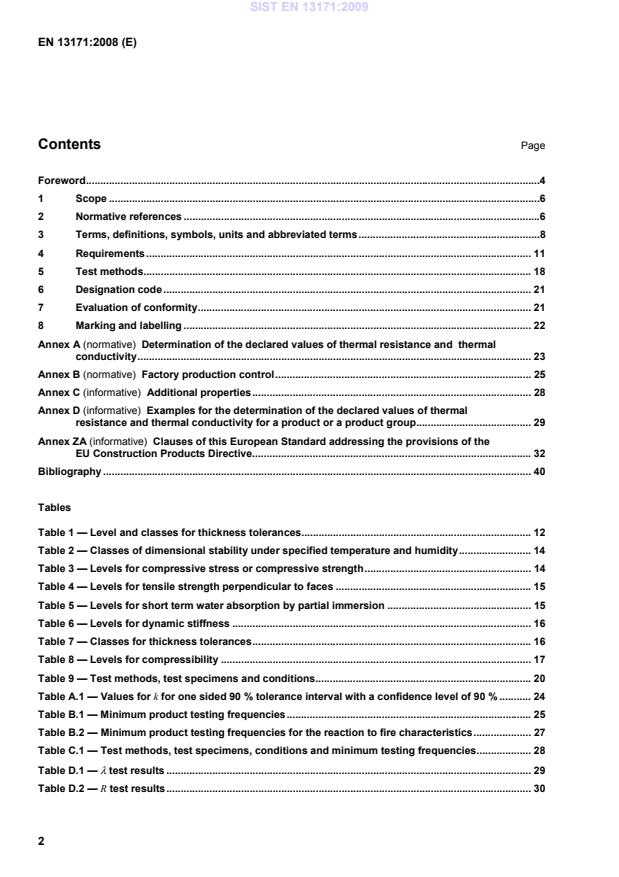
Determination of the declared values of thermal resistance and
thermal conductivity . 23 Annex B (normative)
Factory production control . 25 Annex C (informative)
Additional properties . 28 Annex D (informative)
Examples for the determination of the declared values of thermal resistance and thermal conductivity for a product or a product group . 29 Annex ZA (informative)
Clauses of this European Standard addressing the provisions of the EU Construction Products Directive. 32 Bibliography . 40
Tables Table 1 — Level and classes for thickness tolerances. 12 Table 2 — Classes of dimensional stability under specified temperature and humidity . 14 Table 3 — Levels for compressive stress or compressive strength . 14 Table 4 — Levels for tensile strength perpendicular to faces . 15 Table 5 — Levels for short term water absorption by partial immersion . 15 Table 6 — Levels for dynamic stiffness . 16 Table 7 — Classes for thickness tolerances . 16 Table 8 — Levels for compressibility . 17 Table 9 — Test methods, test specimens and conditions. 20 Table A.1 — Values for k for one sided 90 % tolerance interval with a confidence level of 90 % . 24 Table B.1 — Minimum product testing frequencies . 25 Table B.2 — Minimum product testing frequencies for the reaction to fire characteristics . 27 Table C.1 — Test methods, test specimens, conditions and minimum testing frequencies . 28 Table D.1 — λ test results . 29 Table D.2 — R test results . 30 SIST EN 13171:2009
1 Scope This European Standard specifies the requirements for factory made wood fibre products, with or without facings or coatings, which are used for the thermal insulation of buildings1. The products are manufactured in the form of rolls, batts, felts, boards or slabs. This European Standard specifies product characteristics and includes procedures for testing, evaluation of conformity, marking and labelling. Products covered by this European Standard are also used in prefabricated thermal insulation systems and composite panels; the performance of systems incorporating these products is not covered. This European Standard does not specify the required level of a given property to be achieved by a product to demonstrate fitness for purpose in a particular application. The classes and levels required for a given application are to be found in regulations or non-conflicting standards. Products with a declared thermal resistance lower than 0,50 m2⋅K/W or a declared thermal conductivity greater than 0,070 W/(m⋅K) at 10 °C are not covered by this European Standard. This European Standard does not cover in situ insulation products and products intended to be used for the insulation of building equipment and industrial installations. 2 Normative references The following referenced documents are indispensable for the application of this document. For dated references, only the edition cited applies. For undated references, the latest edition of the referenced document (including any amendments) applies.
EN 822, Thermal insulating products for building applications — Determination of length and width EN 823, Thermal insulating products for building applications — Determination of thickness EN 824, Thermal insulating products for building applications — Determination of squareness EN 825, Thermal insulating products for building applications — Determination of flatness EN 826, Thermal insulating products for building applications — Determination of compression behaviour EN 1602, Thermal insulating products for building applications — Determination of apparent density EN 1603, Thermal insulating products for building applications — Determination of dimensional stability under constant normal laboratory conditions (23 °C/50 % relative humidity) EN 1604:1996, Thermal insulating products for building applications — Determination of dimensional stability under specified temperature and humidity conditions EN 1606, Thermal insulating products for building applications — Determination of compressive creep
1 Wood fibre products for applications other than thermal insulation are covered by EN 316, Wood fibreboards —Definition, classification and symbols.
EN 12090, Thermal insulating products for building applications — Determination of shear behaviour
EN 12431, Thermal insulating products for building applications — Determination of thickness for floating floor insulation products EN 12667, Thermal performance of building materials and products — Determination of thermal resistance by means of guarded hot plate and heat flow meter methods — Products of high and medium thermal resistance EN 12939, Thermal performance of building materials and products — Determination of thermal resistance by means of guarded hot plate and heat flow meter methods — Thick products of high and medium thermal resistance EN 13172:2008, Thermal insulating products — Evaluation of conformity2 EN 13501-1, Fire classification of construction products and building elements — Part 1: Classification using data from reaction to fire test EN 29052-1, Acoustics — Determination of dynamic stiffness — Part 1: Materials used under floating floors in dwellings
EN 29053, Acoustics — Materials for acoustical applications - Determination of airflow resistance (ISO 9053:1991) EN ISO 354, Acoustics — Measurement of sound absorption in a reverberation room (ISO 354:2003) EN ISO 9229:2007, Thermal insulation — Vocabulary (ISO 9229:2007) EN ISO 11654, Acoustics — Sound absorbers for use in buildings — Rating of sound absorption (ISO 11654:1997) EN ISO 11925-2, Reaction to fire tests — Ignitability of building products subjected to direct impingement of flame – Part 2: Single-flame source test (ISO 11925-2:2002) EN ISO 13823:2002, Reaction to fire tests for building products — Building products excluding floorings exposed to the thermal attack by a single burning item ISO 12491, Statistical methods for quality control of building materials and components
2 under review
NOTE The level is given by the declared value of the characteristic concerned. 3.1.2.2 class combination of two levels of the same property between which the performance shall fall SIST EN 13171:2009
One test result for a product property is the average of the measured values on the number of test specimens given in Table 9.
4.2 For all applications 4.2.1 Thermal resistance and thermal conductivity Thermal resistance and thermal conductivity shall be based upon measurements carried out in accordance with EN 12667 or EN 12939 for thick products. The thermal resistance and thermal conductivity shall be determined in accordance with Annex A and declared by the manufacturer according to the following: the reference mean temperature shall be 10 °C; the measured values shall be expressed with three significant figures; for products of uniform thickness, the thermal resistance, RD, shall always be declared. The thermal conductivity, λD, shall be declared where possible. Where appropriate, for products of non-uniform thickness (e.g. for sloped and tapered products) only the thermal conductivity, λD, shall be declared. the declared thermal resistance, RD, and the declared thermal conductivity, λD, shall be given as limit values representing at least 90 % of the production, determined with a confidence level of 90 %; the value of thermal conductivity, λ90/90, shall be rounded upwards to the nearest 0,001 W/(m⋅K) and declared as λD in levels with steps of 0,001 W/(m⋅K); the declared thermal resistance, RD, shall be calculated from the nominal thickness, dN, and the corresponding thermal conductivity, λ90/90; the value of thermal resistance, R90/90, when calculated from the nominal thickness, dN, and the corresponding declared thermal conductivity, λ90/90, shall be rounded upwards to the nearest 0,05 m2⋅K/W, and declared in levels with steps of 0,05 m2⋅K/W; the value of R90/90, for those products for which only the thermal resistance is measured directly, shall be rounded downwards to the nearest 0,05 m2⋅K/W and declared as RD in levels with steps of 0,05 m2⋅K/W. Examples of the determination of the declared values of thermal resistance, RD, and the thermal conductivity, λD, are given in Annex D. 4.2.2 Length and width Length, l, and width, b, shall be determined in accordance with EN 822. No test result shall deviate from the nominal values by more than the following: SIST EN 13171:2009
This test shall not be performed when the tests described in 4.3.10 are used. 4.2.4 Squareness Squareness shall be determined in accordance with EN 824. The deviation from squareness on length and width, Sb, of boards and slabs shall not exceed 5 mm/m. 4.2.5 Flatness Flatness shall be determined in accordance with EN 825. The deviation from flatness, of boards and slabs, Smax, shall not exceed 6 mm. 4.2.6 Dimensional stability 4.2.6.1 Dimensional stability under constant normal laboratory conditions Dimensional stability under constant normal laboratory conditions (23 °C/50 % relative humidity) shall be determined in accordance with EN 1603.The relative changes in length, ûεl and width, ûεb, shall not exceed 0,5 % and in thickness, ûεd, 1 %. The relative change in flatness, ûεs, shall not exceed 1 mm/m. 4.2.6.2 Dimensional stability under specified temperature and humidity conditions Dimensional stability under specified temperature and humidity conditions shall be determined in accordance with EN 1604, the test shall be carried out after storage for 48 h at (23 ± 2) °C and (90 ± 5) % relative humidity. The test specimens shall then be reconditioned at (23 ± 2) °C and (50 ± 5) % relative humidity for 24 h. The relative changes in length, ûεl, width, ûεb, and in thickness, ûεd, shall not exceed 1 %. This test shall not be performed when the more severe test, described in 4.3.2.2, is used. SIST EN 13171:2009
Table 2 — Classes of dimensional stability under specified temperature and humidity Class Conditions Requirement DS (70, –) 1 48 h, 70 °C ≤ 1 % DS (70, –) 2 48 h, 70 °C ≤ 2 % DS (70, –) 3 48 h, 70 °C ≤ 3 % DS (70, 90) 1 48 h, 70 °C, 90 % ≤ 1 % DS (70, 90) 2 48 h, 70 °C, 90 % ≤ 2 % DS (70, 90) 3 48 h, 70 °C, 90 % ≤ 3 %
4.3.3 Compressive stress or compressive strength Compressive stress at 10 % deformation, σ10, or the compressive strength, σm, shall be determined in accordance with EN 826. No test result for either the compressive stress at 10 % deformation, σ10, or the compressive strength, σm, whichever is the smaller, shall be less than the value, given in Table 3, for the declared level. Table 3 — Levels for compressive stress or compressive strength Level Requirement kPa CS(10\Y)5 ≥ 5,0 CS(10\Y)10 ≥ 10 CS(10\Y)20 ≥ 20 CS(10\Y)40 ≥ 40 CS(10\Y)70 ≥ 70 CS(10\Y)100 ≥ 100
4.3.4 Tensile strength perpendicular to faces Tensile strength perpendicular to the faces, σmt, shall be determined in accordance with EN 1607. No test result shall be less than the value given in Table 4 for the declared level.SIST EN 13171:2009
4.3.5 Point load The effects of foot traffic shall be assessed by means of determination of compressive stress at 10 % deformation or compressive strength in accordance with EN 826, see 4.3.3. 4.3.6 Compressive creep Compressive creep, Xct, and total thickness reduction, Xt, shall be determined after at least one hundred and twenty two days of testing at a declared compressive stress, σc, given in steps of at least 1 kPa and the results extrapolated thirty times corresponding to ten years, to obtain the declared levels in accordance with EN 1606. Compressive creep shall be declared in levels, i2, and the total thickness reduction shall be declared in levels, i1, with steps of 0,1 mm at the declared stress. No test result shall exceed the declared level at the declared stress. 4.3.7 Short term water absorption Short term water absorption by partial immersion, Wp, shall be determined in accordance with EN 1609 including any facings or coatings. No test result shall exceed the value given in Table 5 for the declared level. Table 5 — Levels for short term water absorption by partial immersion Level Requirement kg/m2 WS0,5 ≤ 0,5 WS1,0 ≤ 1,0 WS2,0 ≤ 2,0
For products in levels CP2 (see 4.3.10.3), if the imposed load exceeds 5,0 kPa, the dynamic stiffness shall be determined under the imposed load plus the self-weight of the screed. 4.3.10 Compressibility 4.3.10.1 Thickness, dL Thickness, dL, shall be determined in accordance with EN 12431 under a load of 250 Pa. No test result shall deviate from the nominal thickness, dN, by more than the tolerances given in Table 7 for the declared class. Table 7 — Classes for thickness tolerances Class Tolerances T5 –5 % or –1 mma +15 % or +3 mma T6 –1 mm +10 % or +2 mma a Whichever gives the greatest numerical tolerance.
NOTE 1 The levels of the imposed load on the screed have been taken from ENV 1991-2-1 Eurocode 1 — Basis of design and actions on structures — Part 2-1: Actions on structures — Densities, self-weight and imposed loads. NOTE 2 A test result is the mean of the readings for the number of test specimens tested. The levels CP3, CP4 and CP5 relate to the thickness tolerance class T5 and the levels CP2 to the thickness tolerance class T6. 4.3.10.4 Long term thickness reduction If the imposed load on the screed exceeds 5,0 kPa only products having a declared level of compressibility of CP2 may be used and their long-term thickness reduction shall be determined. The total thickness reduction, Xt = X0 + Xct, shall be determined after one hundred twenty two days of testing at the imposed load plus the self-weight of the screed, in accordance with EN 1606 and extrapolated thirty times, corresponding to ten years. The ten years value shall not exceed the declared level of compressibility, (see 4.3.10.3). 4.3.11 Sound absorption Sound absorption coefficient shall be determined in accordance with EN ISO 354. The sound absorption characteristics shall be calculated in accordance with EN ISO 11654 using the values for the practical sound absorption coefficient, αp, at the frequencies: 125 Hz, 250 Hz, 500 Hz, 1 000 Hz, 2 000 Hz and 4 000 Hz and the single number value for the weighted sound absorption coefficient, αw. αp and αw shall be rounded to the nearest 0,05 (αp larger than 1 shall be expressed as αp = 1) and declared in levels with steps of 0,05. No result of αp and αw shall be lower than the declared level. SIST EN 13171:2009
5 Test methods 5.1 Sampling Test specimens shall be taken from the same sample with a total area not less than 1 m2 and sufficient to cover the needed tests. The shorter side of the sample shall not be less than 300 mm or full size of the product whichever is the smaller. 5.2 Conditioning No special conditioning of the test specimens is needed unless otherwise specified in the test standard. In case of dispute, the test specimens shall be stored at (23 ± 2) °C and (50 ± 5) % relative humidity for at least 24 h prior to testing. 5.3 Testing 5.3.1 General Table 9 gives the dimensions of the test specimens, the minimum number of measurements required to get one test result and any specific conditions which are necessary. 5.3.2 Thermal resistance and thermal conductivity Thermal resistance and thermal conductivity shall be determined in accordance with EN 12667 or EN 12939 for thick products and under the following conditions: at a mean temperature of (10 ± 0,3) °C; after conditioning in accordance with 5.2. NOTE Thermal resistance and thermal conductivity may also be measured at mean temperatures other than 10 °C, providing that the accuracy of the relationship between temperature and thermal properties is well documented. SIST EN 13171:2009
see 4.3.3 - – 4.3.6 Compressive creep EN 1606 200 × 200 3 Grinding 4.3.7 Water absorption EN 1609 200 × 200 4 Method A 4.3.8 Water vapour transmission EN 12086 See 6.1 in EN 12086:1997 3 b 4.3.9 Dynamic stiffness EN 29052-1 200 × 200 3 – 4.3.10 Thickness, dL EN 12431 200 × 200 3 Class T5, T6 Thickness, dB EN 12431 Long term thickness reduction EN 1606 4.3.11 Sound absorption EN ISO 354 Minimum 10 m2 1 To be reported 4.3.12 Air flow resistivity EN 29053 Apparatus dependent 3 Method A 4.3.13 Apparent density EN 1602> 200 × 200 3 – 4.3.14 Release of dangerous substances
c – – – 4.3.15 Continuous glowing combustion c – – – a Full-size product thickness, except for 4.2.8. b Exception: When testing products with water vapour barrier, in accordance with EN 12086, the specimen thickness to measure is equal to the water vapour barrier thickness plus 2 mm to 3 mm. c When drafting this standard, no European harmonized test method was available.
For the EC certificate and declaration of conformity, as appropriate, see ZA.2.2. 8 Marking and labelling Products conforming to this standard shall be clearly marked, either on the product or on the label or on the packaging, with the following information: product name or other identifying characteristic; name or identifying mark and address of the manufacturer or his authorised representative; shift or time of production and manufacturing plant or traceability code; reaction to fire class; declared thermal resistance; declared thermal conductivity; nominal thickness; designation code as given in Clause 6; type of facing, if any; nominal length, nominal width; number of pieces and area in the package, as appropriate. NOTE For CE marking and labelling see ZA.3. SIST EN 13171:2009
Determination of the declared values of thermal resistance and
thermal conductivity A.1 General It is the responsibility of the manufacturer to determine the declared values of thermal resistance and thermal conductivity. He will have to demonstrate conformity of the product to its declared values. The declared values of thermal resistance and thermal conductivity of a product are the expected values of these properties during an economically reasonable working life under normal conditions, assessed through measured data at reference conditions. A.2 Input data The manufacturer shall have at least ten test results for thermal resistance or thermal conductivity, obtained from internal or external direct measurements in order to calculate the declared values. The direct thermal resistance or thermal conductivity measurements shall be carried out at regular intervals spread over a period of the last twelve months. If less than ten test results are available, that period may be extended until ten test results are obtained, but with a maximum period of three years, within which the product and production conditions have not changed significantly. For new products the ten thermal resistance or thermal conductivity test results shall be carried out spread over a minimum period of ten days. The declared values shall be calculated according to the method given in A.3 and shall be recalculated at intervals not exceeding three months of production. A.3 Declared values A.3.1 General The derivation of the declared values RD and λD from the calculated values R90/90 and λ90/90 shall use the rules given in 4.2.1 which include the rounding conditions. A.3.2 Case where thermal resistance and thermal conductivity are declared The declared values RD and λD shall be derived from the calculated values R90/90 and λ90/90 which are determined using the equations A.1, A.2 and A.3. λ90/90 = λmean + k × sλ (A.1) 1)(12meani−−=∑=nsniλλλ (A.2) R90/90 = dN/λ90/90 (A.3) SIST EN 13171:2009
...