

ASTM E2510-20
(Test Method)Standard Test Method for Torque Calibration or Conformance of Rheometers
General Information
- Abstract
SIGNIFICANCE AND USE
5.1 The test method calibrates or demonstrates conformity of the torque signal of a rheometer at ambient temperature.
5.2 A calibration factor thus determined may be used to obtain correct torque values.
5.3 This test method may be used in research, development, specification acceptance, and quality control or assurance.
SCOPE
1.1 This test method describes the calibration or performance conformance for the torque signal generated by commercial or custom-built rheometers. The specific range of the test depends upon the torque range of the rheometer.
1.2 The values stated in SI units are to be regarded as standard. No other units of measurement are included in this standard.
1.3 This standard does not purport to address all of the safety concerns, if any, associated with its use. It is the responsibility of the user of this standard to establish appropriate safety, health, and environmental practices and determine the applicability of regulatory limitations prior to use.
1.4 This international standard was developed in accordance with internationally recognized principles on standardization established in the Decision on Principles for the Development of International Standards, Guides and Recommendations issued by the World Trade Organization Technical Barriers to Trade (TBT) Committee.
- Status
- Published
- Publication Date
- 31-Mar-2020
- Technical Committee
- E37 - Thermal Measurements
- Drafting Committee
- E37.08 - Rheology

Overview
ASTM E2510-20, "Standard Test Method for Torque Calibration or Conformance of Rheometers," is a widely recognized ASTM International standard developed for the calibration and verification of the torque signal in commercial or custom-built rheometers. Ensuring accurate torque measurements is critical for evaluating the rheological properties of materials, such as viscosity and viscoelasticity. This standard provides a consistent method for calibrating rheometers at ambient temperature and establishes procedures to demonstrate their conformance to performance requirements. The proper application of calibration factors derived from this method directly supports research, product development, specification acceptance, and ongoing quality assurance.
Key Topics
- Torque Signal Calibration: Establishes procedures for calibrating the torque measurement of rheometers by applying a known force at a defined radius.
- SI Unit Conformance: All measurements and calculations are standardized to SI units to ensure global alignment and reproducibility.
- Precision and Bias: Provides guidance on estimating the measurement uncertainty arising from the mass, moment arm, and local gravitational acceleration.
- Reporting Requirements: Outlines the information needed in calibration reports, including instrument details, calibration constants, conformity values, and method version.
- Safety Considerations: Reminds users to implement appropriate safety, health, and environmental practices when conducting these procedures.
Applications
ASTM E2510-20 is an essential standard in several contexts:
- Research and Development: Enables laboratories to ensure the accuracy of rheological data when formulating new materials, such as polymers, food products, or pharmaceuticals.
- Quality Control and Assurance: Vital for process control and product consistency in manufacturing by confirming rheometer performance aligns with required specifications.
- Instrument Certification: Used by calibration service providers and manufacturers during instrument installation, maintenance, or after repairs.
- Compliance and Specification Acceptance: Required by regulatory bodies and customers to demonstrate that rheological measurements conform to standardized methods.
By referencing ASTM E2510-20, organizations can ensure their rheological testing processes are reliable and trusted by both industry and regulatory authorities.
Related Standards
ASTM E2510-20 cites and aligns with several other standards to enhance reliability and terminology consistency:
- ASTM E4 – Practices for Force Verification of Testing Machines: Offers guidance on verifying and calibrating force-indicating systems, applicable to calibration setups in rheometry.
- ASTM E473 – Terminology Relating to Thermal Analysis and Rheology: Standardizes terminology for clear communication across disciplines.
- ASTM E617 – Specification for Laboratory Weights and Precision Mass Standards: Ensures accuracy in calibration masses used for torque applications.
- ASTM E1142 – Terminology Relating to Thermophysical Properties: Establishes common definitions, facilitating precision in thermal and rheological property measurement.
Practical Value
Implementing ASTM E2510-20 ensures:
- Accurate Material Characterization: Reliable torque calibration directly improves measurement of material properties like viscosity and modulus, essential for material selection and product development.
- Regulatory Compliance: Satisfies requirements from regulatory bodies and clients who demand documented instrument performance and traceability.
- Process Optimization: Consistent torque calibration enables early detection of equipment drift, reducing downtime and maintaining high production standards.
Keywords: ASTM E2510-20, torque calibration, rheometer conformance, rheological measurements, quality assurance, instrument calibration, SI units, material testing, viscosity, viscoelasticity, laboratory standards, ASTM rheometer standard.
Relations
- Replaces
ASTM E2510-07(2013) - Standard Test Method for Torque Calibration or Conformance of Rheometers - Effective Date
- 01-Apr-2020
- Effective Date
- 01-Oct-2023
- Effective Date
- 01-Oct-2023
- Effective Date
- 15-Aug-2023
- Effective Date
- 01-Oct-2018
- Effective Date
- 01-May-2015
- Effective Date
- 15-Aug-2014
- Effective Date
- 15-Aug-2014
- Effective Date
- 01-Jun-2014
- Effective Date
- 01-Apr-2014
- Effective Date
- 15-Feb-2014
- Effective Date
- 01-Sep-2012
- Effective Date
- 01-Aug-2011
- Effective Date
- 15-Jun-2011
- Effective Date
- 15-Jun-2011
Get Certified
Connect with accredited certification bodies for this standard

BSMI (Bureau of Standards, Metrology and Inspection)
Taiwan's standards and inspection authority.
Sponsored listings
Frequently Asked Questions
ASTM E2510-20 is a standard published by ASTM International. Its full title is "Standard Test Method for Torque Calibration or Conformance of Rheometers". This standard covers: SIGNIFICANCE AND USE 5.1 The test method calibrates or demonstrates conformity of the torque signal of a rheometer at ambient temperature. 5.2 A calibration factor thus determined may be used to obtain correct torque values. 5.3 This test method may be used in research, development, specification acceptance, and quality control or assurance. SCOPE 1.1 This test method describes the calibration or performance conformance for the torque signal generated by commercial or custom-built rheometers. The specific range of the test depends upon the torque range of the rheometer. 1.2 The values stated in SI units are to be regarded as standard. No other units of measurement are included in this standard. 1.3 This standard does not purport to address all of the safety concerns, if any, associated with its use. It is the responsibility of the user of this standard to establish appropriate safety, health, and environmental practices and determine the applicability of regulatory limitations prior to use. 1.4 This international standard was developed in accordance with internationally recognized principles on standardization established in the Decision on Principles for the Development of International Standards, Guides and Recommendations issued by the World Trade Organization Technical Barriers to Trade (TBT) Committee.
SIGNIFICANCE AND USE 5.1 The test method calibrates or demonstrates conformity of the torque signal of a rheometer at ambient temperature. 5.2 A calibration factor thus determined may be used to obtain correct torque values. 5.3 This test method may be used in research, development, specification acceptance, and quality control or assurance. SCOPE 1.1 This test method describes the calibration or performance conformance for the torque signal generated by commercial or custom-built rheometers. The specific range of the test depends upon the torque range of the rheometer. 1.2 The values stated in SI units are to be regarded as standard. No other units of measurement are included in this standard. 1.3 This standard does not purport to address all of the safety concerns, if any, associated with its use. It is the responsibility of the user of this standard to establish appropriate safety, health, and environmental practices and determine the applicability of regulatory limitations prior to use. 1.4 This international standard was developed in accordance with internationally recognized principles on standardization established in the Decision on Principles for the Development of International Standards, Guides and Recommendations issued by the World Trade Organization Technical Barriers to Trade (TBT) Committee.
ASTM E2510-20 is classified under the following ICS (International Classification for Standards) categories: 17.060 - Measurement of volume, mass, density, viscosity. The ICS classification helps identify the subject area and facilitates finding related standards.
ASTM E2510-20 has the following relationships with other standards: It is inter standard links to ASTM E2510-07(2013), ASTM E473-23b, ASTM E1142-23b, ASTM E617-23, ASTM E617-18, ASTM E1142-15, ASTM E1142-14b, ASTM E473-14, ASTM E4-14, ASTM E1142-14a, ASTM E1142-14, ASTM E1142-12, ASTM E1142-11b, ASTM E1142-11a, ASTM E473-11a. Understanding these relationships helps ensure you are using the most current and applicable version of the standard.
ASTM E2510-20 is available in PDF format for immediate download after purchase. The document can be added to your cart and obtained through the secure checkout process. Digital delivery ensures instant access to the complete standard document.
Standards Content (Sample)
This international standard was developed in accordance with internationally recognized principles on standardization established in the Decision on Principles for the
Development of International Standards, Guides and Recommendations issued by the World Trade Organization Technical Barriers to Trade (TBT) Committee.
Designation: E2510 − 20
Standard Test Method for
Torque Calibration or Conformance of Rheometers
This standard is issued under the fixed designation E2510; the number immediately following the designation indicates the year of
original adoption or, in the case of revision, the year of last revision. A number in parentheses indicates the year of last reapproval. A
superscript epsilon (´) indicates an editorial change since the last revision or reapproval.
1. Scope angular frequency, frequency, loss modulus, rheometer, storage
modulus, strain, stress, viscoelasticity, viscometer, viscometry,
1.1 This test method describes the calibration or perfor-
and viscosity.
mance conformance for the torque signal generated by com-
3.2 Definitions:
mercial or custom-built rheometers. The specific range of the
test depends upon the torque range of the rheometer.
3.2.1 torque, n—force applied through a moment arm that
produces or tends to produce rotation (N · m).
1.2 The values stated in SI units are to be regarded as
standard. No other units of measurement are included in this
4. Summary of Test Method
standard.
4.1 A known force is applied to a rheometer coupling shaft
1.3 This standard does not purport to address all of the
safety concerns, if any, associated with its use. It is the through a moment arm to produce a torque. The torque thus
applied is measured and compared to the indicated torque. The
responsibility of the user of this standard to establish appro-
priate safety, health, and environmental practices and deter- ratio between indicated and applied torque is used to create a
calibration coefficient that may be used in future determina-
mine the applicability of regulatory limitations prior to use.
1.4 This international standard was developed in accor- tions.
dance with internationally recognized principles on standard-
4.2 The known force generated by suspended precision
ization established in the Decision on Principles for the
mass or masses is transmitted to the rheometer coupling shaft
Development of International Standards, Guides and Recom-
by a line and an appropriate series of pulleys.
mendations issued by the World Trade Organization Technical
4.3 Torque is mathematically defined by Eq 1:
Barriers to Trade (TBT) Committee.
τ 5dFsinφ (1)
2. Referenced Documents
where:
2.1 ASTM Standards:
τ = torque,
E4 Practices for Force Verification of Testing Machines
d = the length of the moment arm (m),
E473 Terminology Relating to Thermal Analysis and Rhe-
F = the applied force (N), and
ology
φ = the angle to the moment arm over which the force is
E617 Specification for Laboratory Weights and Precision
applied (°).
Mass Standards
4.3.1 If the force is applied tangentially at right angles (that
E1142 Terminology Relating to Thermophysical Properties
is, φ = 90°) to the moment arm, then sinφ = 1 and Eq 1 reduces
to Eq 2:
3. Terminology
τ 5dF (2)
3.1 Specific technical terms used in this test method are
definedinTerminologiesE473andE1142.Thesetermsinclude
4.4 The moment arm in this test method is created by
attaching a fixture of known radius to the rheometer coupling
shaft in lieu of a geometry, tool, or plate. The radius of the
fixture is the value of d in Eq 2.
This test method is under the jurisdiction ofASTM Committee E37 on Thermal
Measurements and is the direct responsibility of Subcommittee E37.08 on Rheol-
4.5 A force is applied to the fixture at a tangent by a
ogy.
suspended mass through a thin wire and a suitable pulley
Current edition approved April 1, 2020. Published May 2020. Originally
approved in 2007. Last previous edition approved in 20013 as E2510 – 07 (2013).
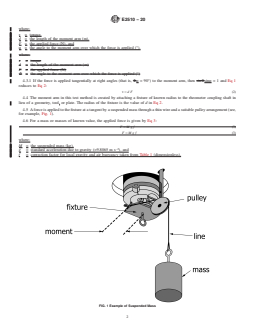
arrangement (see, for example, Fig. 1).
DOI: 10.1520/E2510-20.
For referenced ASTM standards, visit the ASTM website, www.astm.org, or 4.6 For a mass or masses of known value, the applied force
contact ASTM Customer Service at service@astm.org. For Annual Book of ASTM
is given by Eq 3:
Standards volume information, refer to the standard’s Document Summary page on
the ASTM website. F 5Mgf (3)
Copyright © ASTM International, 100 Barr Harbor Drive, PO Box C700, West Conshohocken, PA 19428-2959. United States
E2510 − 20
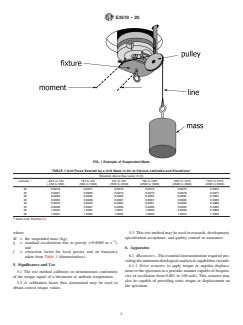
FIG. 1 Example of Suspended Mass
A
TABLE 1 Unit Force Exerted by a Unit Mass in Air at Various Latitudes and Elevations
Elevation Above Sea Level, m (ft)
Latitude, ° –30.5 to 152 152 to 457 457 to 762 762 to 1067 1067 to 1372 1372 to 1676
(–100 to 500) (500 to 1500) (1500 to 2500) (2500 to 3500) (3500 to 4500) (4500 to 5500)
20 0.9978 0.9977 0.9976 0.9975 0.9975 0.9974
25 0.9981 0.9980 0.9979 0.9979 0.9978 0.9977
30 0.9985 0.9984 0.9983 0.9982 0.9982 0.9981
35 0.9989 0.9988 0.9987 0.9987 0.9986 0.9985
40 0.9993 0.9993 0.9992 0.9991 0.9990 0.9989
45 0.9998 0.9997 0.9996 0.9996 0.9995 0.9994
50 1.0003 1.0002 1.0001 1.0000 0.9999 0.9999
55 1.0007 1.0006 1.0005 1.0005 1.0004 1.0003
A
Taken from Practice E4.
where: 5.3 This test method may be used in research, development,
specification acceptance, and quality control or assurance.
M = the suspended mass (kg),
–2
g = standard acceleration due to gravity (=9.8065 m s ),
and 6. Apparatus
f = correction factor for local gravity and air buoyancy
6.1 Rheometer—The essential instrumentation required pro-
taken from Table 1 (dimensionless).
vidingtheminimumrheologicalanalyticalcapabilitiesinclude:
5. Significance and Use
6.1.1 Drive actuator, to apply torque or angular displace-
ment to the specimen in a periodic manner capable of frequen-
5.1 The test method calibrates or demonstrates conformity
cies of oscillation from 0.001 to 100 rad/s. This actuator may
of the torque signal of a rheometer at ambient temperature.
also be capable of providing static torque or displacement on
5.2 A calibration factor thus determined may be used to
the specimen.
obtain correct torque values.
E2510 − 20
6.1.2 Coupling shaft, or other means to transmit the torque 7. Preparation of Apparatus
or displacement from the motor to the specimen.
7.1 Mountthetestfixturetothecouplingshaftinsuchaway
6.1.3 Geometry or tool, to fix the specimen between the
that a line or lines connected to a mass or masses transmits the
drive shaft and a stationary position.
force of the suspended mass or masses tangentially to the test
6.1.4 Sensor, to measure the torque developed by the
fixture and coupling shaft.An illustrative example is shown in
specimen, a position sensor to measure the angular displace-
Fig. 1.
ment of 50 nanoradians of the test specimen, or both.
6.1.5 Temperature sensor, to provide an indication of the 8. Calibration and Standardization
specimen temperature readable to within 60.1 °C.
8.1 Prepare the apparatus for testing according to the
6.1.6 Furnace, or heating/cooling element, to provide con-
manufacturers recommendation as described in the operations
trolled heating or cooling of a specimen at a constant tempera-
manual.
ture or at a constant rate within the temperature range of
interest.
9. Proce
...
This document is not an ASTM standard and is intended only to provide the user of an ASTM standard an indication of what changes have been made to the previous version. Because
it may not be technically possible to adequately depict all changes accurately, ASTM recommends that users consult prior editions as appropriate. In all cases only the current version
of the standard as published by ASTM is to be considered the official document.
Designation: E2510 − 07 (Reapproved 2013) E2510 − 20
Standard Test Method for
Torque Calibration or Conformance of Rheometers
This standard is issued under the fixed designation E2510; the number immediately following the designation indicates the year of
original adoption or, in the case of revision, the year of last revision. A number in parentheses indicates the year of last reapproval. A
superscript epsilon (´) indicates an editorial change since the last revision or reapproval.
1. Scope
1.1 This test method describes the calibration or performance conformance for the torque signal generated by commercial or
custom-built rheometers. The specific range of the test depends upon the torque range of the rheometer.
1.2 The values stated in SI units are to be regarded as standard. No other units of measurement are included in this standard.
1.3 There is no ISO standard equivalent to this test method.
1.3 This standard does not purport to address all of the safety concerns, if any, associated with its use. It is the responsibility
of the user of this standard to establish appropriate safety safety, health, and healthenvironmental practices and determine the
applicability of regulatory limitations prior to use.
1.4 This international standard was developed in accordance with internationally recognized principles on standardization
established in the Decision on Principles for the Development of International Standards, Guides and Recommendations issued
by the World Trade Organization Technical Barriers to Trade (TBT) Committee.
2. Referenced Documents
2.1 ASTM Standards:
E4 Practices for Force Verification of Testing Machines
E473 Terminology Relating to Thermal Analysis and Rheology
E617 Specification for Laboratory Weights and Precision Mass Standards
E1142 Terminology Relating to Thermophysical Properties
3. Terminology
3.1 Specific technical terms used in this test method are defined in Terminologies E473 and E1142. These terms include angular
frequency, frequency, loss modulus, rheometer, storage modulus, strain, stress, viscoelasticity, viscometer, viscometry, and
viscosity.
3.2 Definitions:
3.2.1 torque, n—force applied through a moment arm that produces or tends to produce rotation (N · m).
4. Summary of Test Method
4.1 A known force is applied to a rheometer coupling shaft through a moment arm to produce a torque. The torque thus applied
is measured and compared to the measuredindicated torque. The ratio between indicated and applied torque is used to create a
calibration coefficient that may be used in future determinations.
4.2 The known force generated by suspended precision mass or masses is transmitted to the rheometer coupling shaft by a line
and an appropriate series of pulleys.
4.3 Torque is mathematically defined by Eq 1:
τ5 d FsinΦ (1)
τ5d Fsinφ (1)
This test method is under the jurisdiction of ASTM Committee E37 on Thermal Measurements and is the direct responsibility of Subcommittee E37.08 on Rheology.
Current edition approved March 1, 2013April 1, 2020. Published April 2013May 2020. Originally approved in 2007. Last previous edition approved in 200720013 as
E2510 – 07. 07 (2013). DOI: 10.1520/E2510-07R13.10.1520/E2510-20.
For referenced ASTM standards, visit the ASTM website, www.astm.org, or contact ASTM Customer Service at service@astm.org. For Annual Book of ASTM Standards
volume information, refer to the standard’s Document Summary page on the ASTM website.
Copyright © ASTM International, 100 Barr Harbor Drive, PO Box C700, West Conshohocken, PA 19428-2959. United States
E2510 − 20
where:
τ = torque,
d = the length of the moment arm (m),
F = the applied force (N), and
φ = the angle to the moment arm over which the force is applied (°).
where:
τ = torque
d = the length of the moment arm (m)
F = the applied force (N)
Φ = the angle to the moment arm over which the force is applied (°)
4.3.1 If the force is applied tangentially at right angles (that is, Φφ = 90°) to the moment arm, then sinΦsinφ = 1 and Eq 1
reduces to Eq 2:
τ5 d F (2)
4.4 The moment arm in this test method is created by attaching a fixture of known radius to the rheometer coupling shaft in
lieu of a geometry, tool, or plate. The radius of the fixture is the value of d in Eq 2.
4.5 A force is applied to the fixture at a tangent by a suspended mass through a thin wire and a suitable pulley arrangement (see,
for example, Fig. 1).
4.6 For a mass or masses of known value, the applied force is given by Eq 3:
F 5 M g f (3)
F 5 M g f (3)
where:
M = the suspended mass (kg),
–2
g = standard acceleration due to gravity (=9.8065 m s ), and
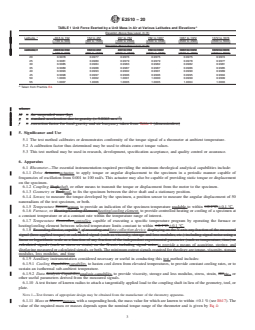
f = correction factor for local gravity and air buoyancy taken from Table 1 (dimensionless).
FIG. 1 Example of Suspended Mass
E2510 − 20
A
TABLE 1 Unit Force Exerted by a Unit Mass in Air at Various Latitudes and Elevations
Elevation Above Sea Level, m (ft)
Latitude, ° –30.5 to 152 152 to 457 457 to 762 762 to 1067 1067 to 1372 1372 to 1676
(–100 to 500) (500 to 1500) (1500 to 2500) (2500 to 3500) (3500 to 4500) (4500 to 5500)
Elevation Above Sea Level, m (ft)
Latitude, ° –30.5 to 152 152 to 457 457 to 762 762 to 1067 1067 to 1372 1372 to 1676
(–100 to 500) (500 to 1500) (1500 to 2500) (2500 to 3500) (3500 to 4500) (4500 to 5500)
20 0.9978 0.9977 0.9976 0.9975 0.9975 0.9974
25 0.9981 0.9980 0.9979 0.9979 0.9978 0.9977
30 0.9985 0.9984 0.9983 0.9982 0.9982 0.9981
35 0.9989 0.9988 0.9987 0.9987 0.9986 0.9985
40 0.9993 0.9993 0.9992 0.9991 0.9990 0.9989
45 0.9998 0.9997 0.9996 0.9996 0.9995 0.9994
50 1.0003 1.0002 1.0001 1.0000 0.9999 0.9999
55 1.0007 1.0006 1.0005 1.0005 1.0004 1.0003
A
Taken from Practice E4.
where:
M = the suspended mass (kg)
–2
g = standard acceleration due to gravity (= 9.8065 m s )
f = correction factor for local gravity and air buoyancy taken from Table 1 (dimensionless)
5. Significance and Use
5.1 The test method calibrates or demonstrates conformity of the torque signal of a rheometer at ambient temperature.
5.2 A calibration factor thus determined may be used to obtain correct torque values.
5.3 This test method may be used in research, development, specification acceptance, and quality control or assurance.
6. Apparatus
6.1 Rheometer—The essential instrumentation required providing the minimum rheological analytical capabilities include:
6.1.1 Drive Actuator,actuator, to apply torque or angular displacement to the specimen in a periodic manner capable of
frequencies of oscillation from 0.001 to 100 rad/s. This actuator may also be capable of providing static torque or displacement
on the specimen.
6.1.2 Coupling Shaft,shaft, or other means to transmit the torque or displacement from the motor to the specimen.
6.1.3 Geometry or Tool,tool, to fix the specimen between the drive shaft and a stationary position.
6.1.4 Sensor, to measure the torque developed by the specimen, a position sensor to measure the angular displacement of 50
nanoradians of the test specimen, or both.
6.1.5 Temperature Sensor,sensor, to provide an indication of the specimen temperature readable to within 60.1°C.60.1 °C.
6.1.6 Furnace, or Heating/Cooling Element,heating/cooling element, to provide controlled heating or cooling of a specimen at
a constant temperature or at a constant rate within the temperature range of interest.
6.1.7 Temperature Controller,controller, capable of executing a specific temperature program by operating the furnace or
heating/cooling element between selected temperature limits constant to within 60.1°C.60.1 °C.
6.1.8 Recording Device, capableA of recording anddata collection device, displaying on the Y-axis any fraction of the measured
signal (here applied torque) or calculated signal (such as viscosity, storage and loss modulus, etc.) including signal noise using a
linear or logarithmic scale as a function of any fraction of the independent experimental parameter (such as temperature, time) or
calculated signals (such as stress or strain) on the X-axis including signal noise.to provide a means of acquiring, storing, and
displaying measured or calculated signals, or both. Th
...