

ASTM C78/C78M-22
(Test Method)Standard Test Method for Flexural Strength of Concrete (Using Simple Beam with Third-Point Loading)
General Information
- Abstract
SIGNIFICANCE AND USE
4.1 This test method is used to determine the flexural strength of specimens prepared and cured in accordance with Test Methods C42/C42M or Practices C31/C31M or C192/C192M. Results are calculated and reported as the modulus of rupture. For the same specimen size, the strength determined will vary if there are differences in specimen preparation, curing procedure, moisture condition at time of testing, and whether the beam was molded or sawed to size.
4.2 The measured modulus of rupture generally increases as the specimen size decreases.3,4,5
4.3 The results of this test method may be used to determine compliance with specifications or as a basis for mixture proportioning, evaluating uniformity of mixing, and checking placement operations by using sawed beams. It is used primarily in testing concrete for the construction of slabs and pavements.
4.4 For identical test specimens, the modulus of rupture obtained by this test method will, on average, be lower than that obtained by Test Method C293/C293M.
SCOPE
1.1 This test method covers the determination of the flexural strength of concrete by the use of a simple beam with third-point loading.
1.2 The values stated in either SI units or inch-pound units are to be regarded separately as standard. The values stated in each system may not be exact equivalents; therefore, each system shall be used independently of the other. Combining values from the two systems may result in non-conformance with the standard.
1.3 This standard does not purport to address all of the safety concerns, if any, associated with its use. It is the responsibility of the user of this standard to establish appropriate safety, health, and environmental practices and determine the applicability of regulatory limitations prior to use.
1.4 This international standard was developed in accordance with internationally recognized principles on standardization established in the Decision on Principles for the Development of International Standards, Guides and Recommendations issued by the World Trade Organization Technical Barriers to Trade (TBT) Committee.
- Status
- Published
- Publication Date
- 28-Feb-2022
- Technical Committee
- C09 - Concrete and Concrete Aggregates
- Drafting Committee
- C09.61 - Testing for Strength
Buy Documents
ASTM C78/C78M-22 - Standard Test Method for Flexural Strength of Concrete (Using Simple Beam with Third-Point Loading)
REDLINE ASTM C78/C78M-22 - Standard Test Method for Flexural Strength of Concrete (Using Simple Beam with Third-Point Loading)
Overview
ASTM C78/C78M-22: Standard Test Method for Flexural Strength of Concrete (Using Simple Beam with Third-Point Loading) establishes procedures for determining the flexural strength of concrete using the third-point loading method. The standard outlines how to prepare, cure, and test beam specimens to calculate the modulus of rupture-a key indicator of a concrete’s resistance to bending. This test is crucial for quality control and ensuring compliance with specifications in concrete manufacturing, particularly for construction applications like slabs and pavements.
Key Topics
- Flexural Strength Evaluation: Assesses the maximum resistance of a concrete specimen to bending forces, reported as the modulus of rupture.
- Test Specimen Preparation: Details specimen preparation according to referenced standards (ASTM C42/C42M, C31/C31M, C192/C192M), influencing test results due to differences in preparation, curing, and moisture condition.
- Apparatus Requirements:
- Use of a simple beam and a third-point loading apparatus
- Testing machines must allow continuous loading and precise force measurement
- Apparatus must maintain specified span lengths and loading block configurations
- Testing Procedure: Specifies moist curing conditions, proper specimen orientation, consistent loading rates, and measurement of specimen dimensions post-test.
- Calculation and Reporting: Outlines equations and required measurements for calculating modulus of rupture, and specifies comprehensive reporting requirements.
- Precision and Limitations: Discusses expected variability both within a laboratory and between different testing facilities.
Applications
The ASTM C78/C78M-22 test method is widely used in the construction and concrete industries for:
- Quality Control of Concrete: Ensures mixture uniformity, effective placement, and verifies strength compliance with project specifications.
- Design and Construction of Slabs and Pavements: Provides reliable data for structural engineers, especially for concrete used in highways, runways, and industrial flooring, where flexural strength is critical to performance and durability.
- Mixture Proportioning: Data from the test can inform adjustments to concrete mix proportions to achieve target strength properties.
- Compliance Assessment: Used as an acceptance test for evaluating whether supplied concrete meets established flexural strength criteria as required by codes or project specifications.
- Research and Development: Supports concrete material innovation, product development, and validation of new mix designs or curing methods.
Related Standards
ASTM C78/C78M-22 references several other key ASTM standards for concrete testing and specimen preparation:
- ASTM C31/C31M: Practice for Making and Curing Concrete Test Specimens in the Field
- ASTM C42/C42M: Test Method for Obtaining and Testing Drilled Cores and Sawed Beams of Concrete
- ASTM C192/C192M: Practice for Making and Curing Concrete Test Specimens in the Laboratory
- ASTM C293/C293M: Test Method for Flexural Strength of Concrete (Using Simple Beam with Center-Point Loading)
- ASTM C617/C617M: Practice for Capping Cylindrical Concrete Specimens
- ASTM C670: Practice for Preparing Precision and Bias Statements for Test Methods for Construction Materials
- ASTM E4: Practices for Force Calibration and Verification of Testing Machines
- ASTM C125 & E6: Standard terminology for concrete and mechanical testing
Practical Value
Implementing ASTM C78/C78M-22 provides a standardized, internationally recognized procedure for flexural strength testing of concrete, ensuring consistent, reliable results. Adhering to this standard aids in optimizing concrete performance, minimizing the risk of structural failures, and streamlining compliance for construction professionals, paving the way for safe, durable, and high-quality concrete works.
Keywords: flexural strength test, ASTM C78/C78M-22, concrete modulus of rupture, third-point loading, concrete quality control, concrete pavement, construction materials testing
Relations
- Refers
ASTM C31/C31M-24a - Standard Practice for Making and Curing Concrete Test Specimens in the Field - Effective Date
- 01-Apr-2024
- Effective Date
- 01-Feb-2024
- Effective Date
- 01-Jan-2024
- Refers
ASTM C31/C31M-24 - Standard Practice for Making and Curing Concrete Test Specimens in the Field - Effective Date
- 01-Jan-2024
- Refers
ASTM C39/C39M-23 - Standard Test Method for Compressive Strength of Cylindrical Concrete Specimens - Effective Date
- 01-Dec-2023
- Effective Date
- 01-Oct-2023
- Effective Date
- 15-Dec-2019
- Effective Date
- 01-Jan-2019
- Effective Date
- 01-Oct-2018
- Effective Date
- 01-Jul-2018
- Effective Date
- 15-Mar-2018
- Effective Date
- 01-Jan-2018
- Refers
ASTM C31/C31M-18 - Standard Practice for Making and Curing Concrete Test Specimens in the Field - Effective Date
- 01-Jan-2018
- Refers
ASTM C39/C39M-17b - Standard Test Method for Compressive Strength of Cylindrical Concrete Specimens - Effective Date
- 01-Aug-2017
- Effective Date
- 15-Dec-2016
Buy Documents
ASTM C78/C78M-22 - Standard Test Method for Flexural Strength of Concrete (Using Simple Beam with Third-Point Loading)
REDLINE ASTM C78/C78M-22 - Standard Test Method for Flexural Strength of Concrete (Using Simple Beam with Third-Point Loading)
Get Certified
Connect with accredited certification bodies for this standard

DIBt (Deutsches Institut für Bautechnik)
German Institute for Building Technology.
DIN CERTCO
DIN Group product certification.

Aboma Certification B.V.
Specialized in construction, metal, and transport sectors.
Sponsored listings
Frequently Asked Questions
ASTM C78/C78M-22 is a standard published by ASTM International. Its full title is "Standard Test Method for Flexural Strength of Concrete (Using Simple Beam with Third-Point Loading)". This standard covers: SIGNIFICANCE AND USE 4.1 This test method is used to determine the flexural strength of specimens prepared and cured in accordance with Test Methods C42/C42M or Practices C31/C31M or C192/C192M. Results are calculated and reported as the modulus of rupture. For the same specimen size, the strength determined will vary if there are differences in specimen preparation, curing procedure, moisture condition at time of testing, and whether the beam was molded or sawed to size. 4.2 The measured modulus of rupture generally increases as the specimen size decreases.3,4,5 4.3 The results of this test method may be used to determine compliance with specifications or as a basis for mixture proportioning, evaluating uniformity of mixing, and checking placement operations by using sawed beams. It is used primarily in testing concrete for the construction of slabs and pavements. 4.4 For identical test specimens, the modulus of rupture obtained by this test method will, on average, be lower than that obtained by Test Method C293/C293M. SCOPE 1.1 This test method covers the determination of the flexural strength of concrete by the use of a simple beam with third-point loading. 1.2 The values stated in either SI units or inch-pound units are to be regarded separately as standard. The values stated in each system may not be exact equivalents; therefore, each system shall be used independently of the other. Combining values from the two systems may result in non-conformance with the standard. 1.3 This standard does not purport to address all of the safety concerns, if any, associated with its use. It is the responsibility of the user of this standard to establish appropriate safety, health, and environmental practices and determine the applicability of regulatory limitations prior to use. 1.4 This international standard was developed in accordance with internationally recognized principles on standardization established in the Decision on Principles for the Development of International Standards, Guides and Recommendations issued by the World Trade Organization Technical Barriers to Trade (TBT) Committee.
SIGNIFICANCE AND USE 4.1 This test method is used to determine the flexural strength of specimens prepared and cured in accordance with Test Methods C42/C42M or Practices C31/C31M or C192/C192M. Results are calculated and reported as the modulus of rupture. For the same specimen size, the strength determined will vary if there are differences in specimen preparation, curing procedure, moisture condition at time of testing, and whether the beam was molded or sawed to size. 4.2 The measured modulus of rupture generally increases as the specimen size decreases.3,4,5 4.3 The results of this test method may be used to determine compliance with specifications or as a basis for mixture proportioning, evaluating uniformity of mixing, and checking placement operations by using sawed beams. It is used primarily in testing concrete for the construction of slabs and pavements. 4.4 For identical test specimens, the modulus of rupture obtained by this test method will, on average, be lower than that obtained by Test Method C293/C293M. SCOPE 1.1 This test method covers the determination of the flexural strength of concrete by the use of a simple beam with third-point loading. 1.2 The values stated in either SI units or inch-pound units are to be regarded separately as standard. The values stated in each system may not be exact equivalents; therefore, each system shall be used independently of the other. Combining values from the two systems may result in non-conformance with the standard. 1.3 This standard does not purport to address all of the safety concerns, if any, associated with its use. It is the responsibility of the user of this standard to establish appropriate safety, health, and environmental practices and determine the applicability of regulatory limitations prior to use. 1.4 This international standard was developed in accordance with internationally recognized principles on standardization established in the Decision on Principles for the Development of International Standards, Guides and Recommendations issued by the World Trade Organization Technical Barriers to Trade (TBT) Committee.
ASTM C78/C78M-22 is classified under the following ICS (International Classification for Standards) categories: 91.100.30 - Concrete and concrete products. The ICS classification helps identify the subject area and facilitates finding related standards.
ASTM C78/C78M-22 has the following relationships with other standards: It is inter standard links to ASTM C31/C31M-24a, ASTM C670-24a, ASTM C670-24, ASTM C31/C31M-24, ASTM C39/C39M-23, ASTM C617/C617M-23, ASTM C125-19a, ASTM C125-19, ASTM C125-18b, ASTM C125-18a, ASTM C42/C42M-18, ASTM C125-18, ASTM C31/C31M-18, ASTM C39/C39M-17b, ASTM C125-16. Understanding these relationships helps ensure you are using the most current and applicable version of the standard.
ASTM C78/C78M-22 is available in PDF format for immediate download after purchase. The document can be added to your cart and obtained through the secure checkout process. Digital delivery ensures instant access to the complete standard document.
Standards Content (Sample)
This international standard was developed in accordance with internationally recognized principles on standardization established in the Decision on Principles for the
Development of International Standards, Guides and Recommendations issued by the World Trade Organization Technical Barriers to Trade (TBT) Committee.
Designation: C78/C78M − 22
Standard Test Method for
Flexural Strength of Concrete (Using Simple Beam with
Third-Point Loading)
This standard is issued under the fixed designation C78/C78M; the number immediately following the designation indicates the year of
original adoption or, in the case of revision, the year of last revision. A number in parentheses indicates the year of last reapproval. A
superscript epsilon (´) indicates an editorial change since the last revision or reapproval.
This standard has been approved for use by agencies of the U.S. Department of Defense.
1. Scope* C125 Terminology Relating to Concrete and Concrete Ag-
gregates
1.1 Thistestmethodcoversthedeterminationoftheflexural
C192/C192M Practice for Making and Curing Concrete Test
strength of concrete by the use of a simple beam with
Specimens in the Laboratory
third-point loading.
C293/C293M TestMethodforFlexuralStrengthofConcrete
1.2 The values stated in either SI units or inch-pound units
(Using Simple Beam With Center-Point Loading)
are to be regarded separately as standard. The values stated in
C617/C617M Practice for Capping Cylindrical Concrete
each system may not be exact equivalents; therefore, each
Specimens
system shall be used independently of the other. Combining
C670 Practice for Preparing Precision and Bias Statements
values from the two systems may result in non-conformance
for Test Methods for Construction Materials
with the standard.
E4 Practices for Force Calibration and Verification of Test-
1.3 This standard does not purport to address all of the ing Machines
safety concerns, if any, associated with its use. It is the
E6 Terminology Relating to Methods of Mechanical Testing
responsibility of the user of this standard to establish appro-
3. Terminology
priate safety, health, and environmental practices and deter-
3.1 Definitions:
mine the applicability of regulatory limitations prior to use.
3.1.1 For definitions of terms used in this test method, refer
1.4 This international standard was developed in accor-
to Terminology C125 and Terminology E6.
dance with internationally recognized principles on standard-
3.2 Definitions of Terms Specific to This Standard:
ization established in the Decision on Principles for the
3.2.1 flexural strength—maximum resistance of a speci-
Development of International Standards, Guides and Recom-
men subjected to bending.
mendations issued by the World Trade Organization Technical
Barriers to Trade (TBT) Committee.
3.2.1.1 Discussion—In this test method, flexural strength is
reported as the modulus of rupture.
2. Referenced Documents
3.2.2 flexural testing apparatus—fixture used to apply force
2.1 ASTM Standards:
to the beam specimen and consists of loading and support
C31/C31M Practice for Making and Curing Concrete Test
blocks.
Specimens in the Field
3.2.3 loading block—component of the testing apparatus in
C39/C39M Test Method for Compressive Strength of Cylin-
the shape of a portion of a cylinder that is used to apply a force
drical Concrete Specimens
to the beam specimen.
C42/C42M Test Method for Obtaining and Testing Drilled
3.2.4 modulus of rupture—calculated stress, assuming
Cores and Sawed Beams of Concrete
linear-elastic behavior, in the tensile face of a beam specimen
at the maximum bending moment during a standard test
method.
This test method is under the jurisdiction of ASTM Committee C09 on
3.2.5 span length—distance between lines of support, or
Concrete and ConcreteAggregates and is the direct responsibility of Subcommittee
C09.61 on Testing for Strength. reaction, for the beam specimen, and it is equal to three times
Current edition approved March 1, 2022. Published March 2022. Originally
the nominal depth of the beam.
approved in 1930. Last previous edition approved in 2021 as C78/C78M – 21. DOI:
10.1520/C0078_C0078M-22.
3.2.5.1 Discussion—For example, for a 100 mm [4 in.]
For referenced ASTM standards, visit the ASTM website, www.astm.org, or
nominaldepthbeam,thespanlengthis300 mm[12 in.]andfor
contact ASTM Customer Service at service@astm.org. For Annual Book of ASTM
a 150 mm [6 in.] nominal depth beam, the span length is
Standards volume information, refer to the standard’s Document Summary page on
the ASTM website. 450 mm [18 in.]. See 3.2.6.1, for discussion of reaction block.
*A Summary of Changes section appears at the end of this standard
Copyright © ASTM International, 100 Barr Harbor Drive, PO Box C700, West Conshohocken, PA 19428-2959. United States
C78/C78M − 22
3.2.6 support block—component of the testing apparatus in 5.1.1.1 The testing machine shall conform to the require-
the shape of a portion of a cylinder that is used to provide a ments of the sections on Basis ofVerification, Corrections, and
reaction to the force applied to the beam specimen. Time Interval Between Verifications of Practice E4.
5.1.1.2 Verify the accuracy of the testing machine in accor-
3.2.6.1 Discussion—If the testing apparatus applies force to
dance with Practice E4, except that the verified loading range
the top of the beam, this block supports the beam. If the testing
shall be as required for flexural testing.Verification is required:
apparatus applies force to the bottom of the beam, the support
(1) Within 13 months of the last verification,
block may be considered a reaction block because it provides
(2) On original installation,
a line of reaction at the top of the beam and does not support
(3) After relocation,
the beam.
(4) After making repairs or adjustments that affect the
3.2.7 testing machine—mechanical device for applying
operation of the force applying system or the values displayed
force to a specimen.
on the load indicator, except for zero adjustments that com-
pensate for the weight of loading or support blocks or
4. Significance and Use
specimen, or both, or
4.1 This test method is used to determine the flexural
(5) Whenever there is reason to suspect the accuracy of the
strength of specimens prepared and cured in accordance with
indicated forces.
Test Methods C42/C42M or Practices C31/C31M or C192/
5.2 Flexural Testing Apparatus—The third point loading
C192M. Results are calculated and reported as the modulus of
method shall be used to determine the flexural strength of
rupture. For the same specimen size, the strength determined
concrete. The loading blocks and support blocks shall be
will vary if there are differences in specimen preparation,
designed so that forces applied to the beam will be along lines
curing procedure, moisture condition at time of testing, and
perpendicular to the side faces of the beam and applied without
whether the beam was molded or sawed to size.
eccentricity. A diagram of the flexural testing apparatus is
4.2 The measured modulus of rupture generally increases as
shown in Fig. 1.
3,4,5
the specimen size decreases.
NOTE 1—The flexural testing apparatus shown in Fig. 1 may be used
4.3 The results of this test method may be used to determine
inverted.Inthiscase,theloadingblockswillbeatthebottomofthebeam,
compliance with specifications or as a basis for mixture while the reaction blocks will be at the top of the beam.
proportioning, evaluating uniformity of mixing, and checking
5.2.1 The flexural testing apparatus shall be capable of
placement operations by using sawed beams. It is used primar-
maintaining the span length and distance between the lines of
ily in testing concrete for the construction of slabs and
loading within 61.0 mm [60.05 in.] of the specified values.
pavements.
5.2.2 Theratioofthehorizontaldistancebetweenthelineof
application of the force and the line of the nearest reaction to
4.4 For identical test specimens, the modulus of rupture
the depth of the beam shall be 1.0 6 0.03.
obtained by this test method will, on average, be lower than
that obtained by Test Method C293/C293M. 5.2.3 The loading blocks and support blocks shall not be
more than 65 mm [2.50 in.] high, measured from the center or
5. Apparatus the axis of the ball or the axis of the rod and shall extend
entirely across or beyond the full width of the specimen. Each
5.1 Testing Machine—Hand operated testing machines hav-
case, the block surface in contact with the specimen shall not
ing pumps that do not provide a continuous loading in one
departfromaplanebymorethan0.05 mm[0.002 in.]andshall
stroke are not permitted. Motorized pumps or hand operated
beaportionofacylinder,theaxisofwhichiscoincidentalwith
positive displacement pumps having sufficient volume in one
either the axis of the rod or center of the ball, whichever the
continuous stroke to complete a test without requiring replen-
block is pivoted upon. The angle subtended by the curved
ishment are permitted and shall be capable of applying loads at
surface of each block shall be at least 0.80 rad [45°].
a uniform rate without shock or interruption. The testing
5.2.4 At least every six months or as specified by the
machine shall be equipped with a means of recording or
manufacturer of the flexural testing apparatus, clean and
holding the peak value that will indicate the maximum load, to
lubricate metal-to-metal contact surfaces, such as internal
within 1 % accuracy, applied to the specimen during a test.
concave surfaces and steel balls and rods of the loading blocks
5.1.1 Verification:
and support blocks (Fig. 1).The lubricant shall be a petroleum-
type oil, such as conventional motor oil, or as specified by the
manufacturer of the apparatus.
Tanesi, J; Ardani, A. Leavitt, J. "Reducing the Specimen Size of Concrete
5.2.5 The support blocks shall be free to rotate.
Flexural Strength Test (AASHTO T97) for Safety and Ease of Handling," Trans-
portation Research Record: Journal of the Transportation Research Board, No.
5.2.6 The loading blocks and support blocks shall be
2342, Transportation Research Board of National Academies, Washington, D.C.,
maintained in a vertical position and in contact with the rod or
2013.
4 ball by means of spring-loaded screws that hold them in
Carrasquillo, P.M. and Carrasquillo, R. L “Improved Concrete Quality Control
contact with the rod or ball. The uppermost bearing plate and
Procedures Using Third Point Loading”, Research Report 119-1F, Project 3-9-87-
1119, Center For Transportation Research, The University of Texas at Austin,
centerpointballinFig.1maybeomittedifthetestingmachine
November 1987.
has a spherically seated bearing block that meets the require-
Bazant, Z. and Novak, D. “Proposal for Standard Test of Modulus of Rupture
ments of Test Method C39/C39M, provided one rod and one
of Concrete with its Size Dependence,” ACI Materials Journal, January-February
2001. ball are used as pivots for the upper loading blocks.
C78/C78M − 22
FIG. 1 Schematic of Flexural Testing Apparatus for Third-Point Loading Method
6. Test Specimens 7.2 Tolerances for specimen ages are as follows:
A
Test Age Permissible Tolerance
6.1 The test specimen shall conform to all requirements of
24 h ± 0.5 h
Test Method C42/C42M or Practices C31/C31M or C192/
3 days ±2 h
C192M applicable to beam specimens and shall have a test
7 days ±6 h
28 days ±20 h
span within 2 % of being three times its depth as tested. The
90 days ±2 days
sides of the specimen shall be at right angles with the top and
bottom. All surfaces shall be smooth and free of scars,
A
For test ages not listed, the test age tolerance is ±2.0 % of the specified age.
indentations, holes, or inscribed identification marks.
7.3 For molded specimens, turn the test specimen on its side
6.2 Provided the smaller cross-sectional dimension of the
with respect to its position as molded and center it on the
beam is at least three times the nominal maximum size of the
support blocks. When using sawed specimens, position the
coarse aggregate, the modulus of rupture can be determined
specimen so that the tension face corresponds to the top or
using different specimen sizes. However, measured modulus of
3,4
bottom of the specimen as cut from the parent material. Center
rupture generally increases as specimen s
...
This document is not an ASTM standard and is intended only to provide the user of an ASTM standard an indication of what changes have been made to the previous version. Because
it may not be technically possible to adequately depict all changes accurately, ASTM recommends that users consult prior editions as appropriate. In all cases only the current version
of the standard as published by ASTM is to be considered the official document.
Designation: C78/C78M − 21 C78/C78M − 22
Standard Test Method for
Flexural Strength of Concrete (Using Simple Beam with
Third-Point Loading)
This standard is issued under the fixed designation C78/C78M; the number immediately following the designation indicates the year of
original adoption or, in the case of revision, the year of last revision. A number in parentheses indicates the year of last reapproval. A
superscript epsilon (´) indicates an editorial change since the last revision or reapproval.
This standard has been approved for use by agencies of the U.S. Department of Defense.
1. Scope*
1.1 This test method covers the determination of the flexural strength of concrete by the use of a simple beam with third-point
loading.
1.2 The values stated in either SI units or inch-pound units are to be regarded separately as standard. The values stated in each
system may not be exact equivalents; therefore, each system shall be used independently of the other. Combining values from the
two systems may result in non-conformance with the standard.
1.3 This standard does not purport to address all of the safety concerns, if any, associated with its use. It is the responsibility
of the user of this standard to establish appropriate safety, health, and environmental practices and determine the applicability of
regulatory limitations prior to use.
1.4 This international standard was developed in accordance with internationally recognized principles on standardization
established in the Decision on Principles for the Development of International Standards, Guides and Recommendations issued
by the World Trade Organization Technical Barriers to Trade (TBT) Committee.
2. Referenced Documents
2.1 ASTM Standards:
C31/C31M Practice for Making and Curing Concrete Test Specimens in the Field
C39/C39M Test Method for Compressive Strength of Cylindrical Concrete Specimens
C42/C42M Test Method for Obtaining and Testing Drilled Cores and Sawed Beams of Concrete
C125 Terminology Relating to Concrete and Concrete Aggregates
C192/C192M Practice for Making and Curing Concrete Test Specimens in the Laboratory
C293/C293M Test Method for Flexural Strength of Concrete (Using Simple Beam With Center-Point Loading)
C617/C617M Practice for Capping Cylindrical Concrete Specimens
C670 Practice for Preparing Precision and Bias Statements for Test Methods for Construction Materials
C1077 Practice for Agencies Testing Concrete and Concrete Aggregates for Use in Construction and Criteria for Testing Agency
Evaluation
E4 Practices for Force Calibration and Verification of Testing Machines
E6 Terminology Relating to Methods of Mechanical Testing
This test method is under the jurisdiction of ASTM Committee C09 on Concrete and Concrete Aggregates and is the direct responsibility of Subcommittee C09.61 on
Testing for Strength.
Current edition approved March 1, 2021March 1, 2022. Published March 2021March 2022. Originally approved in 1930. Last previous edition approved in 20182021 as
C78/C78M – 18.21. DOI: 10.1520/C0078_C0078M-21.10.1520/C0078_C0078M-22.
For referenced ASTM standards, visit the ASTM website, www.astm.org, or contact ASTM Customer Service at service@astm.org. For Annual Book of ASTM Standards
volume information, refer to the standard’s Document Summary page on the ASTM website.
*A Summary of Changes section appears at the end of this standard
Copyright © ASTM International, 100 Barr Harbor Drive, PO Box C700, West Conshohocken, PA 19428-2959. United States
C78/C78M − 22
3. Terminology
3.1 Definitions:
3.1.1 For definitions of terms used in this test method, refer to Terminology C125 and Terminology E6.
3.2 Definitions of Terms Specific to This Standard:
3.2.1 flexural strength—maximum resistance of a specimen subjected to bending.
3.2.1.1 Discussion—
In this test method, flexural strength is reported as the modulus of rupture.
3.2.2 flexural testing apparatus—fixture used to apply force to the beam specimen and consists of loading and support blocks.
3.2.3 loading block—component of the testing apparatus in the shape of a portion of a cylinder that is used to apply a force to
the beam specimen.
3.2.4 modulus of rupture—calculated stress, assuming linear-elastic behavior, in the tensile face of a beam specimen at the
maximum bending moment during a standard test method.
3.2.5 span length—distance between lines of support, or reaction, for the beam specimen, and it is equal to three times the
nominal depth of the beam.
3.2.5.1 Discussion—
For example, for a 100 mm [4 in.] nominal depth beam, the span length is 300 mm [12 in.] and for a 150 mm [6 in.] nominal depth
beam, the span length is 450 mm [18 in.]. See 3.2.6.1, for discussion of reaction block.
3.2.6 support block—component of the testing apparatus in the shape of a portion of a cylinder that is used to provide a reaction
to the force applied to the beam specimen.
3.2.6.1 Discussion—
If the testing apparatus applies force to the top of the beam, this block supports the beam. If the testing apparatus applies force
to the bottom of the beam, the support block may be considered a reaction block because it provides a line of reaction at the top
of the beam and does not support the beam.
3.2.7 testing machine—mechanical device for applying force to a specimen.
4. Significance and Use
4.1 This test method is used to determine the flexural strength of specimens prepared and cured in accordance with Test Methods
C42/C42M or Practices C31/C31M or C192/C192M. Results are calculated and reported as the modulus of rupture. For the same
specimen size, the strength determined will vary if there are differences in specimen preparation, curing procedure, moisture
condition at time of testing, and whether the beam was molded or sawed to size.
3,4,5
4.2 The measured modulus of rupture generally increases as the specimen size decreases.
4.3 The results of this test method may be used to determine compliance with specifications or as a basis for mixture
proportioning, evaluating uniformity of mixing, and checking placement operations by using sawed beams. It is used primarily in
testing concrete for the construction of slabs and pavements.
4.4 For identical test specimens, the modulus of rupture obtained by this test method will, on average, be lower than that obtained
by Test Method C293/C293M.
Tanesi, J; Ardani, A. Leavitt, J. "Reducing the Specimen Size of Concrete Flexural Strength Test (AASHTO T97) for Safety and Ease of Handling," Transportation
Research Record: Journal of the Transportation Research Board, No. 2342, Transportation Research Board of National Academies, Washington, D.C., 2013.
Carrasquillo, P.M. and Carrasquillo, R. L “Improved Concrete Quality Control Procedures Using Third Point Loading”, Research Report 119-1F, Project 3-9-87-1119,
Center For Transportation Research, The University of Texas at Austin, November 1987.
Bazant, Z. and Novak, D. “Proposal for Standard Test of Modulus of Rupture of Concrete with its Size Dependence,” ACI Materials Journal, January-February 2001.
C78/C78M − 22
5. Apparatus
5.1 Testing Machine—Hand operated testing machines having pumps that do not provide a continuous loading in one stroke are
not permitted. Motorized pumps or hand operated positive displacement pumps having sufficient volume in one continuous stroke
to complete a test without requiring replenishment are permitted and shall be capable of applying loads at a uniform rate without
shock or interruption. The testing machine shall be equipped with a means of recording or holding the peak value that will indicate
the maximum load, to within 1 % accuracy, applied to the specimen during a test.
5.1.1 Verification:
5.1.1.1 The testing machine shall conform to the requirements of the sections on Basis of Verification, Corrections, and Time
Interval Between Verifications of Practice E4.
5.1.1.2 Verify the accuracy of the testing machine in accordance with Practice E4, except that the verified loading range shall be
as required for flexural testing. Verification is required:
(1) Within 13 months of the last verification,
(2) On original installation,
(3) After relocation,
(4) After making repairs or adjustments that affect the operation of the force applying system or the values displayed on the
load indicator, except for zero adjustments that compensate for the weight of loading or support blocks or specimen, or both, or
(5) Whenever there is reason to suspect the accuracy of the indicated forces.
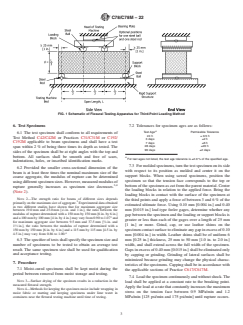
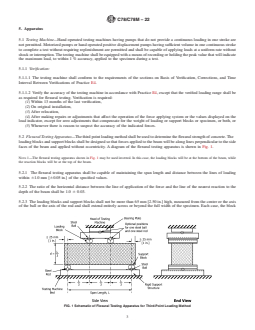
5.2 Flexural Testing Apparatus—The third point loading method shall be used to determine the flexural strength of concrete. The
loading blocks and support blocks shall be designed so that forces applied to the beam will be along lines perpendicular to the side
faces of the beam and applied without eccentricity. A diagram of the flexural testing apparatus is shown in Fig. 1.
NOTE 1—The flexural testing apparatus shown in Fig. 1 may be used inverted. In this case, the loading blocks will be at the bottom of the beam, while
the reaction blocks will be at the top of the beam.
5.2.1 The flexural testing apparatus shall be capable of maintaining the span length and distance between the lines of loading
within 61.0 mm [60.05 in.] of the specified values.
5.2.2 The ratio of the horizontal distance between the line of application of the force and the line of the nearest reaction to the
depth of the beam shall be 1.0 6 0.03.
5.2.3 The loading blocks and support blocks shall not be more than 65 mm [2.50 in.] high, measured from the center or the axis
of the ball or the axis of the rod and shall extend entirely across or beyond the full width of the specimen. Each case, the block
FIG. 1 Schematic of Flexural Testing Apparatus for Third-Point Loading Method
C78/C78M − 22
surface in contact with the specimen shall not depart from a plane by more than 0.05 mm [0.002 in.] and shall be a portion of a
cylinder, the axis of which is coincidental with either the axis of the rod or center of the ball, whichever the block is pivoted upon.
The angle subtended by the curved surface of each block shall be at least 0.80 rad [45°].
5.2.4 At least every six months or as specified by the manufacturer of the flexural testing apparatus, clean and lubricate
metal-to-metal contact surfaces, such as internal concave surfaces and steel balls and rods of the loading blocks and support blocks
(Fig. 1). The lubricant shall be a petroleum-type oil, such as conventional motor oil, or as specified by the manufacturer of the
apparatus.
5.2.5 The support blocks shall be free to rotate.
5.2.6 The loading blocks and support blocks shall be maintained in a vertical position and in contact with the rod or ball by means
of spring-loaded screws that hold them in contact with the rod or ball. The uppermost bearing plate and center point ball in Fig.
1 may be omitted if the testing machine has a spherically seated bearing block that meets the requirements of Test Method
C39/C39M, provided one rod and one ball are used as pivots for the upper loading blocks.
6. Test Specimens
6.1 The test specimen shall conform to all requirements of Test Method C42/C42M or Practices C31/C31M or C192/C192M
applicable to beam specimens and shall have a test span within 2 % of being three times its depth as tested. The sides of the
specimen shall be at right angles with the top and bottom. All surfaces shall be smooth and free of scars, indentations, holes, or
inscribed identification marks.
6.2 Provided the smaller cross-sectional dimension of the beam is at least three times the nominal maximum size of the coarse
aggregate, the modulus of rupture can be determined using different specimen sizes. However, measured modulus of rupture
3,4
generally increases as specimen size decreases. (Note 2).
NOTE 2—The strength ratio for beams of different sizes depends primarily on the maximum size of aggregate. Experimental data obtained in two different
studies have shown that for maximum aggregate size between 19.0 mm and 25.0 mm [ ⁄4 in. and 1 in.], the ratio between the modulus of rupture
determined with a 150 mm by 150 mm [6 in. by 6 in.] and a 100 mm by 100 mm [4 in. by 4 in.] may vary from 0.90 to 1.07 and for maximum aggregate
3 1
size between 9.5 mm and 37.5 mm [ ⁄8 in. and 1 ⁄2 in.], the ratio between the modulus of rupture determined with a 150 mm by 150 mm [6 in. by 6 in.]
and a 115 mm by 115 mm [4.5 in. by 4.5 in.] may vary from 0.86 to 1.00.
6.3 The specifier of tests shall speci
...