

ASTM D8192-23
(Test Method)Standard Test Method for Hardness in Colored and Colorless Water
General Information
- Abstract
SIGNIFICANCE AND USE
5.1 Hardness salts in water, notably calcium and magnesium, are the primary cause of tube and pipe scaling, which frequently causes failures and loss of process efficiency due to clogging or loss of heat transfer, or both.
5.2 Hardness is caused by any polyvalent cations, but those other than Ca+2 and Mg+2 are seldom present in more than trace amounts. The term hardness was originally applied to water in which it was hard to wash; it referred to the soap-wasting properties of water. With most normal alkaline water, these soap-wasting properties are directly related to the calcium and magnesium content.
SCOPE
1.1 This test method covers the determination of hardness in water by titration with potentiometric detection via optical sensor. This test method is applicable to waters that are free of chemicals that will complex calcium or magnesium. The lower detection limit of this test method is approximately 2 mg/L to 5 mg/L as CaCO3; the upper limit can be extended to all concentrations by sample dilution. It is possible to differentiate between hardness due to calcium ions and that due to magnesium ions by this test method.
1.2 This test method is applicable to both colorless and colored water samples including groundwater, surface water, wastewater, and drinking water.
1.3 The values stated in SI units are to be regarded as standard. No other units of measurement are included in this standard.
1.4 This standard does not purport to address all of the safety concerns, if any, associated with its use. It is the responsibility of the user of this standard to establish appropriate safety, health, and environmental practices and determine the applicability of regulatory limitations prior to use.
1.5 This international standard was developed in accordance with internationally recognized principles on standardization established in the Decision on Principles for the Development of International Standards, Guides and Recommendations issued by the World Trade Organization Technical Barriers to Trade (TBT) Committee.
- Status
- Published
- Publication Date
- 14-Apr-2023
- Technical Committee
- D19 - Water
- Drafting Committee
- D19.05 - Inorganic Constituents in Water

Overview
ASTM D8192-23 is the Standard Test Method for Hardness in Colored and Colorless Water, developed by ASTM International. This standard sets out a precise method for determining water hardness-primarily due to calcium and magnesium ions-by titration with potentiometric detection using an optical sensor. The standard applies to a wide variety of water types, including colored and colorless samples, such as groundwater, surface water, wastewater, and drinking water. Water hardness analysis is crucial as excessive hardness is a leading cause of scaling in pipes and tubes, which can compromise industrial and domestic water systems by causing clogging, reducing heat transfer efficiency, and increasing maintenance costs.
Key Topics
Scope of Application
ASTM D8192-23 covers water samples free from chemicals that might complex with calcium or magnesium. The method features a lower detection limit of 2-5 mg/L as CaCO₃, with no specified upper limit due to the feasibility of sample dilution.Method Principle
Hardness is determined via titration using disodium ethylenediamine tetraacetate (EDTA), with the equivalence point identified by a shift in color-monitored either by an optical sensor or visually. The method enables differentiation between calcium and magnesium hardness.Potentiometric and Optical Sensing
The test employs an automatic titrator equipped with an optical sensor sensitive to color changes between 500 nm and 700 nm. This ensures objective detection and improved reproducibility over manual methods.Sample Types
Applicable to a vast range of water samples, including:- Groundwater
- Surface water
- Wastewater
- Drinking water
Precision and Quality Control
The standard outlines strict quality control requirements, including the analysis of check standards and laboratory control samples at specified frequencies, ensuring accuracy and repeatability.
Applications
Water Treatment Facilities
Routine monitoring of water hardness for compliance with industry standards and to prevent scaling of infrastructure.Industrial Water Systems
Ensuring optimal performance of boilers, heat exchangers, and pipelines by monitoring scaling potential.Environmental Monitoring
Assessment of water quality in natural and treated waters for ecological studies and regulatory compliance.Municipal Water Supply
Verification and maintenance of drinking water hardness within acceptable ranges for consumer health and equipment longevity.Laboratory Water Analysis
Used as a standard procedure in commercial and research laboratories for precise and repeatable water hardness measurements.
Related Standards
ASTM D1129 - Terminology Relating to Water
Provides definitions for key terms used across ASTM water standards.ASTM D1193 - Specification for Reagent Water
Sets requirements for water purity used in laboratory analysis.ASTM D2777 - Practice for Determination of Precision and Bias
Guides the determination of repeatability and reproducibility for water analysis methods.ASTM D3370 - Practices for Sampling Water from Flowing Process Streams
Specifies procedures for obtaining representative water samples.ASTM D5847 - Practice for Writing Quality Control Specifications for Water Analysis
Outlines best practices for incorporating quality control in water testing laboratories.
Practical Value
The ASTM D8192-23 standard helps laboratories, utilities, and industries obtain reliable data on water hardness-essential for maintaining efficiency in water distribution, industrial processing, and ensuring water quality for end users. Its scope includes both colored and colorless samples, with an emphasis on objectivity and reproducibility through automated optical detection. By establishing uniform test methods and clear reporting procedures, this standard supports compliance, process optimization, and environmental stewardship across water-related sectors.
Relations
- Effective Date
- 01-May-2020
- Effective Date
- 01-Aug-2018
- Effective Date
- 01-Aug-2018
- Effective Date
- 15-Jun-2012
- Effective Date
- 15-Jun-2011
- Effective Date
- 01-Dec-2010
- Effective Date
- 01-Mar-2010
- Effective Date
- 01-Oct-2008
- Effective Date
- 15-Jan-2008
- Effective Date
- 01-Dec-2007
- Effective Date
- 15-Dec-2006
- Effective Date
- 01-Sep-2006
- Effective Date
- 01-Sep-2006
- Effective Date
- 15-Aug-2006
- Effective Date
- 01-Mar-2006
Get Certified
Connect with accredited certification bodies for this standard

CIS Institut d.o.o.
Personal Protective Equipment (PPE) certification body. Notified Body NB-2890 for EU Regulation 2016/425 PPE.

Kiwa BDA Testing
Building and construction product certification.
Kmetijski inštitut Slovenije
Agricultural Institute of Slovenia. Soil testing, plant health, agricultural product analysis.
Sponsored listings
Frequently Asked Questions
ASTM D8192-23 is a standard published by ASTM International. Its full title is "Standard Test Method for Hardness in Colored and Colorless Water". This standard covers: SIGNIFICANCE AND USE 5.1 Hardness salts in water, notably calcium and magnesium, are the primary cause of tube and pipe scaling, which frequently causes failures and loss of process efficiency due to clogging or loss of heat transfer, or both. 5.2 Hardness is caused by any polyvalent cations, but those other than Ca+2 and Mg+2 are seldom present in more than trace amounts. The term hardness was originally applied to water in which it was hard to wash; it referred to the soap-wasting properties of water. With most normal alkaline water, these soap-wasting properties are directly related to the calcium and magnesium content. SCOPE 1.1 This test method covers the determination of hardness in water by titration with potentiometric detection via optical sensor. This test method is applicable to waters that are free of chemicals that will complex calcium or magnesium. The lower detection limit of this test method is approximately 2 mg/L to 5 mg/L as CaCO3; the upper limit can be extended to all concentrations by sample dilution. It is possible to differentiate between hardness due to calcium ions and that due to magnesium ions by this test method. 1.2 This test method is applicable to both colorless and colored water samples including groundwater, surface water, wastewater, and drinking water. 1.3 The values stated in SI units are to be regarded as standard. No other units of measurement are included in this standard. 1.4 This standard does not purport to address all of the safety concerns, if any, associated with its use. It is the responsibility of the user of this standard to establish appropriate safety, health, and environmental practices and determine the applicability of regulatory limitations prior to use. 1.5 This international standard was developed in accordance with internationally recognized principles on standardization established in the Decision on Principles for the Development of International Standards, Guides and Recommendations issued by the World Trade Organization Technical Barriers to Trade (TBT) Committee.
SIGNIFICANCE AND USE 5.1 Hardness salts in water, notably calcium and magnesium, are the primary cause of tube and pipe scaling, which frequently causes failures and loss of process efficiency due to clogging or loss of heat transfer, or both. 5.2 Hardness is caused by any polyvalent cations, but those other than Ca+2 and Mg+2 are seldom present in more than trace amounts. The term hardness was originally applied to water in which it was hard to wash; it referred to the soap-wasting properties of water. With most normal alkaline water, these soap-wasting properties are directly related to the calcium and magnesium content. SCOPE 1.1 This test method covers the determination of hardness in water by titration with potentiometric detection via optical sensor. This test method is applicable to waters that are free of chemicals that will complex calcium or magnesium. The lower detection limit of this test method is approximately 2 mg/L to 5 mg/L as CaCO3; the upper limit can be extended to all concentrations by sample dilution. It is possible to differentiate between hardness due to calcium ions and that due to magnesium ions by this test method. 1.2 This test method is applicable to both colorless and colored water samples including groundwater, surface water, wastewater, and drinking water. 1.3 The values stated in SI units are to be regarded as standard. No other units of measurement are included in this standard. 1.4 This standard does not purport to address all of the safety concerns, if any, associated with its use. It is the responsibility of the user of this standard to establish appropriate safety, health, and environmental practices and determine the applicability of regulatory limitations prior to use. 1.5 This international standard was developed in accordance with internationally recognized principles on standardization established in the Decision on Principles for the Development of International Standards, Guides and Recommendations issued by the World Trade Organization Technical Barriers to Trade (TBT) Committee.
ASTM D8192-23 is classified under the following ICS (International Classification for Standards) categories: 13.060.50 - Examination of water for chemical substances. The ICS classification helps identify the subject area and facilitates finding related standards.
ASTM D8192-23 has the following relationships with other standards: It is inter standard links to ASTM D1129-13(2020)e2, ASTM D1066-18e1, ASTM D1066-18, ASTM D2777-12, ASTM D1066-11, ASTM D3370-10, ASTM D1129-10, ASTM D3370-08, ASTM D2777-08, ASTM D3370-07, ASTM D1066-06, ASTM D1129-06a, ASTM D1129-06ae1, ASTM D2777-06, ASTM D1193-06. Understanding these relationships helps ensure you are using the most current and applicable version of the standard.
ASTM D8192-23 is available in PDF format for immediate download after purchase. The document can be added to your cart and obtained through the secure checkout process. Digital delivery ensures instant access to the complete standard document.
Standards Content (Sample)
This international standard was developed in accordance with internationally recognized principles on standardization established in the Decision on Principles for the
Development of International Standards, Guides and Recommendations issued by the World Trade Organization Technical Barriers to Trade (TBT) Committee.
Designation: D8192 − 23
Standard Test Method for
Hardness in Colored and Colorless Water
This standard is issued under the fixed designation D8192; the number immediately following the designation indicates the year of
original adoption or, in the case of revision, the year of last revision. A number in parentheses indicates the year of last reapproval. A
superscript epsilon (´) indicates an editorial change since the last revision or reapproval.
1. Scope D2777 Practice for Determination of Precision and Bias of
Applicable Test Methods of Committee D19 on Water
1.1 This test method covers the determination of hardness in
D3370 Practices for Sampling Water from Flowing Process
water by titration with potentiometric detection via optical
Streams
sensor. This test method is applicable to waters that are free of
D5847 Practice for Writing Quality Control Specifications
chemicals that will complex calcium or magnesium. The lower
for Standard Test Methods for Water Analysis
detection limit of this test method is approximately 2 mg ⁄L to
5 mg/L as CaCO ; the upper limit can be extended to all
3. Terminology
concentrations by sample dilution. It is possible to differentiate
3.1 Definitions—For definitions of terms used in this test
between hardness due to calcium ions and that due to magne-
method, refer to Terminology D1129.
sium ions by this test method.
3.2 Definitions of Terms Specific to This Standard:
1.2 This test method is applicable to both colorless and
3.2.1 equivalent parts per million (epm), n—unit chemical
colored water samples including groundwater, surface water,
equivalent weight of solute per million unit weights of solu-
wastewater, and drinking water.
tion.
1.3 The values stated in SI units are to be regarded as
3.2.2 laboratory control sample (LCS), n—solution with
standard. No other units of measurement are included in this
certified hardness.
standard.
3.2.3 optical sensor, n—potentiometric sensor for titration
1.4 This standard does not purport to address all of the
with photometric endpoint recognition.
safety concerns, if any, associated with its use. It is the
responsibility of the user of this standard to establish appro-
4. Summary of Test Method
priate safety, health, and environmental practices and deter-
4.1 Calcium and magnesium ions in water are sequestered
mine the applicability of regulatory limitations prior to use.
by the addition of disodium ethylenediamine tetraacetate
1.5 This international standard was developed in accor-
(EDTA). The equivalence point of the reaction is detected by
dance with internationally recognized principles on standard-
3, 4
means of Eriochrome Black T, which has a red color in the
ization established in the Decision on Principles for the
presence of calcium and magnesium and a blue color when
Development of International Standards, Guides and Recom-
they are sequestered. This can be determined by both manual
mendations issued by the World Trade Organization Technical
colorimetric titration with visual detection or by automatic
Barriers to Trade (TBT) Committee.
titration using an optical sensor. During a manual titration the
titrant is added by the operator and color change is determined
2. Referenced Documents
by visual inspection. This can lead to subjective and inaccurate
2.1 ASTM Standards:
results. This method describes the use of an automatic titrator
D1066 Practice for Sampling Steam
equipped with an optical sensor to accurately add known
D1129 Terminology Relating to Water
volumes of titrant and accurately determine the titration
D1193 Specification for Reagent Water
equivalence or end point. During an automatic titration, the
optical sensor measures absorbance at a particular wavelength
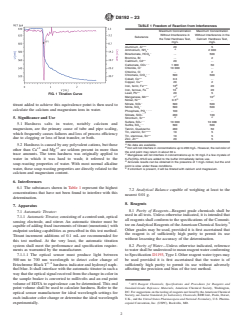
that is converted to a millivolt signal and plotted versus titrant
This test method is under the jurisdiction of ASTM Committee D19 on Water
volume. See Fig. 1. At the equivalence point, where the color
and is the direct responsibility of Subcommittee D19.05 on Inorganic Constituents
change from red to blue occurs, there will be a corresponding
in Water.
inflection or break point on the titration curve. The volume of
Current edition approved April 15, 2023. Published May 2023. DOI: 10.1520/
D8192-23.
For referenced ASTM standards, visit the ASTM website, www.astm.org, or
contact ASTM Customer Service at service@astm.org. For Annual Book of ASTM Eriochrome is a registered trademark of Huntsman Petrochemical, LLC.
Standards volume information, refer to the standard’s Document Summary page on 3–Hydroxy–4–(1–hydroxy–2–napththyl) azo–7–nitro–1 naphthalenesulfonic
the ASTM website. acid, sodium salt, Color Index 14645.
Copyright © ASTM International, 100 Barr Harbor Drive, PO Box C700, West Conshohocken, PA 19428-2959. United States
D8192 − 23
TABLE 1 Freedom of Reaction from Interferences
Maximum Concentration Maximum Concentration
Without Interference in Without Interference in the
Substance
the Total Hardness Test, Calcium Hardness Test,
mg/L mg/L
+++
Aluminum, Al 20 5
+ A
Ammonium, NH 2 000
–
Bicarbonate, HCO . 500
Bromine, Br . 2
++
Cadmium, Cd 20 .
– –
Carbonate, CO 1 000 50
–
Chloride, Cl 10 000 .
Chlorine, Cl . 2
– –
Chromate, CrO 500 500
++
Cobalt, Co 0.3 .
++
Copper, Cu 20 2
+++ B
Iron, ferric, Fe 10 20
++ B
Iron, ferrous, Fe 10 20
++
Lead, Pb 20 5
FIG. 1 Titration Curve
++ C C
Manganese, Mn 1 10
++ D
Nickel, Ni 0.5 .
–
Nitrate, NO 500 500
titrant added to achieve this equivalence point is then used to
–
Nitrite, NO 500 500
calculate the calcium and magnesium ions in water. – – –
Phosphate, PO 100 .
– –
Silicate, SiO 200 100
++ E E
5. Significance and Use
Strontium, Sr
– –
Sulfate, SO 10 000 10 000
5.1 Hardness salts in water, notably calcium and – –
Sulfite, SO 500 500
magnesium, are the primary cause of tube and pipe scaling, Tannin, Quebracho 200 50
++++
Tin, stannic, Sn 10 5
which frequently causes failures and loss of process efficiency
++
Tin, stannous, Sn 10 5
due to clogging or loss of heat transfer, or both. ++
Zinc, Zn 20 5
A
5.2 Hardness is caused by any polyvalent cations, but those No data are available.
B
+2 +2
Iron will not interfere in concentrations up to 200 mg/L. However, the red color of
other than Ca and Mg are seldom present in more than
the end point may return in about 30 s.
trace amounts. The term hardness was originally applied to C
Manganese will not interfere in concentrations up to 10 mg/L if a few crystals of
K Fe(CN) ·3H O are added to the buffer immediately before use.
water in which it was hard to wash; it referred to the
4 6 2
D
Accurate results can be obtained in the presence of 1 mg/L nickel, but the end
soap-wasting properties of water. With most normal alkaline
point is slow under these conditions.
E
water, these soap-wasting properties are directly related to the
If strontium is present, it will be titrated with calcium and magnesium.
calcium and magnesium content.
6. Interferences
6.1 The substances shown in Table 1 represent the highest
7.2 Analytical Balance capable of weighing at least to the
concentrations that have not been found to interfere with this
nearest 0.01 g.
determination.
8. Reagents
7. Apparatus
8.1 Purity of Reagents—Reagent grade chemicals shall be
7.1 Automatic Titrator:
used in all tests. Unless otherwise indicated, it is intended that
7.1.1 Automatic Titrator, consisting of a control unit, optical
all reagents shall conform to the specifications of the Commit-
sensing electrode, and stirrer. An automatic titrator must be
tee on Analytical Reagents of the American Chemical Society.
capable of adding fixed increments of titrant (monotonic) with
Other grades may be used, provided it is first ascertained that
endpoint seeking capabilities as prescribed in this test method.
the reagent is of sufficiently high purity to permit its use
Titrant increment additions of 0.1 mL are recommended for
without lessening the accuracy of the determination.
this test method. At the very least, the automatic titration
system shall meet the performance and specification require-
8.2 Purity of Water—Unless otherwise indicated, reference
ments as warranted by the manufacturer. to water shall be understood to mean reagent water conforming
7.1.1.1 The optical sensor must produce light between to Specification D1193, Type I. Other reagent water types may
500 nm to 700 nm wavelength to detect color change of be used provided it is first ascertained that the water is of
3, 4
Eriochrome Black T hardness indicator and hydroxyl naph- sufficiently high purity to permit its use without adversely
thol blue. It shall interface with the automatic titrator in such a affecting the precision and bias of the test method.
way that the optical signal received from the change in color in
the sample beaker is converted to millivolts and an end point
volume of EDTA to equivalence can be determined. This end
ACS Reagent Chemicals, Specifications and Procedures for Reagents and
Standard-Grade Reference Materials, American Chemical Society, Washington,
point volume shall be used to calculate hardness. Refer to the
DC. For suggestions on the testing of reagents not listed by the American Chemical
optical
...