

ASTM D6037-21
(Test Method)Standard Test Methods for Dry Abrasion Mar Resistance of High Gloss Coatings
General Information
- Abstract
SIGNIFICANCE AND USE
5.1 Coatings, particularly the high gloss coatings used on automobiles, boats, toys, etc., are subject to a wide variety of conditions (for example, wiping, cleaning, and exposure) that can mar their surface. The ability of these coatings to maintain their appearance is an important product attribute. These test methods provide a way to estimate the ability of high gloss coatings to resist mar damage.
5.2 These test methods do not provide fundamental values. However they are suitable for estimating the ability of high gloss coatings to resist mar.
5.3 Since the susceptibility of coatings to marring varies widely, the number of cycles that are needed to cause “relevant” mar damage also varies. Usually, 2 to 50 cycles are sufficient.
SCOPE
1.1 This test method covers procedures for evaluating the relative mar resistance of high gloss coatings. Two test methods are included. Test Method A uses a device that rotates the test specimen on a vertical axis, against the sliding rotation of two abrading wheels. Test Method B uses a device that reciprocates a specimen in a horizontal plane over a stationary wheel that has been fitted with abrasive paper and is advanced after each double stroke. Either method can be used to evaluate the dry abrasion mar resistance of coatings applied to planar, rigid surfaces. Each test method provides good discrimination between highly mar resistant coatings.
Note 1: The mar resistance values obtained by these test methods have no absolute significance. They should only be used to derive relative performance rankings for test panels that have been prepared from the series of coatings that are currently being evaluated. If mar resistance values are quoted between laboratories, it is essential that a common standard be measured and that the values be compared to that standard. Even then, the values should be used with caution.
1.2 The values stated in SI units are to be regarded as standard. No other units of measurement are included in this standard.
1.3 This standard does not purport to address all of the safety concerns, if any, associated with its use. It is the responsibility of the user of this standard to establish appropriate safety, health, and environmental practices and determine the applicability of regulatory limitations prior to use.
1.4 This international standard was developed in accordance with internationally recognized principles on standardization established in the Decision on Principles for the Development of International Standards, Guides and Recommendations issued by the World Trade Organization Technical Barriers to Trade (TBT) Committee.
- Status
- Published
- Publication Date
- 31-May-2021
- Technical Committee
- D01 - Paint and Related Coatings, Materials, and Applications
- Drafting Committee
- D01.23 - Physical Properties of Applied Paint Films
Overview
ASTM D6037-21: Standard Test Methods for Dry Abrasion Mar Resistance of High Gloss Coatings is an internationally recognized standard developed by ASTM International. This document specifies procedures to evaluate the relative mar resistance-the ability to withstand abrasion-induced surface marring-of high gloss coatings. Such coatings are extensively used in applications where visual appearance and surface durability are critical, including automotive finishes, boats, toys, flooring, and consumer goods. Because high gloss surfaces are susceptible to mars from cleaning, wiping, and general wear, assessing their ability to retain appearance is essential for manufacturers and quality assurance professionals.
These test methods allow for the comparative ranking of coating performance under controlled, reproducible laboratory conditions, supporting research, product development, quality control, and material selection.
Key Topics
- Mar Resistance Testing: Defines mar resistance as a coating’s ability to resist permanent surface deformation or fracture from dynamic mechanical force.
- Two Test Methods Provided:
- Test Method A: Uses a rotating device with two abrading wheels acting on a vertically mounted specimen.
- Test Method B: Utilizes a reciprocating motion where the specimen slides over a stationary wheel fitted with abrasive paper.
- Gloss Measurement: Evaluation is based on gloss retention, determined by measuring gloss before and after abrasion using a glossmeter.
- Relative Performance: Results are not absolute values; instead, they provide a reliable basis to compare the mar resistance of a series of coatings.
- Reproducibility and Standardization: Emphasizes strict adherence to method parameters for cross-lab comparison, including specimen preparation and environmental conditioning.
- Repeatability and Reproducibility: Includes data on the expected variability within and between laboratories to guide statistical validity.
Applications
ASTM D6037-21 is highly valuable in industries where the appearance and surface integrity of high gloss coatings are crucial. Practical uses include:
- Automotive Finishes: Assists manufacturers in selecting and verifying topcoats that can resist mar damage from car washes, dusting, and routine maintenance.
- Marine and Recreational Products: Guides quality control for high gloss coatings on boats and toys often exposed to physical contact and cleaning.
- Flooring and Furniture: Helps flooring manufacturers and wood finishers assess clear coatings' resilience against foot traffic and daily wear.
- Quality Control Laboratories: Standardizes evaluation protocols for comparing product batches or competitor products.
- Product Development: Supports R&D in formulating new coatings with enhanced mar resistance.
- Supplier Quality Assurance: Assures that supplied coatings meet specified resistance requirements before acceptance or integration into final products.
Related Standards
ASTM D6037-21 is part of a suite of standards for coatings testing and evaluation. Key related documents include:
- ASTM D523: Test Method for Specular Gloss-establishes gloss measurement techniques used in D6037.
- ASTM D609 and D823: Cover preparation and uniform application of test panels for paint and coatings evaluation.
- ASTM D1005 and D7091: Methods for measuring dry-film thickness of organic coatings, ensuring consistency in test samples.
- ASTM D4060: Test Method for Abrasion Resistance of Organic Coatings by the Taber Abraser, referenced for abraser apparatus.
- ASTM D3924: Standard environment for conditioning and testing coatings.
- ASTM D4449: Visual evaluation of gloss differences, which may complement mar resistance assessments.
- Practice E177 and E691: Statistical protocols for precision, bias, and interlaboratory studies.
Manufacturers, coating formulators, and quality assurance professionals can rely on ASTM D6037-21 to enable consistent, credible evaluation of high gloss coatings' dry abrasion mar resistance, ultimately ensuring products meet demanding performance expectations in practical applications.
Relations
- Effective Date
- 01-Jun-2020
- Effective Date
- 01-Dec-2017
- Effective Date
- 01-Apr-2016
- Effective Date
- 01-May-2014
- Effective Date
- 01-Jan-2014
- Effective Date
- 01-May-2013
- Effective Date
- 01-May-2013
- Effective Date
- 01-Nov-2012
- Effective Date
- 01-Jun-2012
- Effective Date
- 01-Apr-2012
- Effective Date
- 01-Nov-2011
- Effective Date
- 01-Jun-2011
- Effective Date
- 01-Oct-2010
- Effective Date
- 01-Feb-2010
- Effective Date
- 01-Dec-2008
Get Certified
Connect with accredited certification bodies for this standard

DVS-ZERT GmbH
German welding certification society.
CARES (UK Certification Authority for Reinforcing Steels)
UK certification for reinforcing steels and construction.
EWF/IIW (European/International Welding Federation)
International welding personnel certification.
Sponsored listings
Frequently Asked Questions
ASTM D6037-21 is a standard published by ASTM International. Its full title is "Standard Test Methods for Dry Abrasion Mar Resistance of High Gloss Coatings". This standard covers: SIGNIFICANCE AND USE 5.1 Coatings, particularly the high gloss coatings used on automobiles, boats, toys, etc., are subject to a wide variety of conditions (for example, wiping, cleaning, and exposure) that can mar their surface. The ability of these coatings to maintain their appearance is an important product attribute. These test methods provide a way to estimate the ability of high gloss coatings to resist mar damage. 5.2 These test methods do not provide fundamental values. However they are suitable for estimating the ability of high gloss coatings to resist mar. 5.3 Since the susceptibility of coatings to marring varies widely, the number of cycles that are needed to cause “relevant” mar damage also varies. Usually, 2 to 50 cycles are sufficient. SCOPE 1.1 This test method covers procedures for evaluating the relative mar resistance of high gloss coatings. Two test methods are included. Test Method A uses a device that rotates the test specimen on a vertical axis, against the sliding rotation of two abrading wheels. Test Method B uses a device that reciprocates a specimen in a horizontal plane over a stationary wheel that has been fitted with abrasive paper and is advanced after each double stroke. Either method can be used to evaluate the dry abrasion mar resistance of coatings applied to planar, rigid surfaces. Each test method provides good discrimination between highly mar resistant coatings. Note 1: The mar resistance values obtained by these test methods have no absolute significance. They should only be used to derive relative performance rankings for test panels that have been prepared from the series of coatings that are currently being evaluated. If mar resistance values are quoted between laboratories, it is essential that a common standard be measured and that the values be compared to that standard. Even then, the values should be used with caution. 1.2 The values stated in SI units are to be regarded as standard. No other units of measurement are included in this standard. 1.3 This standard does not purport to address all of the safety concerns, if any, associated with its use. It is the responsibility of the user of this standard to establish appropriate safety, health, and environmental practices and determine the applicability of regulatory limitations prior to use. 1.4 This international standard was developed in accordance with internationally recognized principles on standardization established in the Decision on Principles for the Development of International Standards, Guides and Recommendations issued by the World Trade Organization Technical Barriers to Trade (TBT) Committee.
SIGNIFICANCE AND USE 5.1 Coatings, particularly the high gloss coatings used on automobiles, boats, toys, etc., are subject to a wide variety of conditions (for example, wiping, cleaning, and exposure) that can mar their surface. The ability of these coatings to maintain their appearance is an important product attribute. These test methods provide a way to estimate the ability of high gloss coatings to resist mar damage. 5.2 These test methods do not provide fundamental values. However they are suitable for estimating the ability of high gloss coatings to resist mar. 5.3 Since the susceptibility of coatings to marring varies widely, the number of cycles that are needed to cause “relevant” mar damage also varies. Usually, 2 to 50 cycles are sufficient. SCOPE 1.1 This test method covers procedures for evaluating the relative mar resistance of high gloss coatings. Two test methods are included. Test Method A uses a device that rotates the test specimen on a vertical axis, against the sliding rotation of two abrading wheels. Test Method B uses a device that reciprocates a specimen in a horizontal plane over a stationary wheel that has been fitted with abrasive paper and is advanced after each double stroke. Either method can be used to evaluate the dry abrasion mar resistance of coatings applied to planar, rigid surfaces. Each test method provides good discrimination between highly mar resistant coatings. Note 1: The mar resistance values obtained by these test methods have no absolute significance. They should only be used to derive relative performance rankings for test panels that have been prepared from the series of coatings that are currently being evaluated. If mar resistance values are quoted between laboratories, it is essential that a common standard be measured and that the values be compared to that standard. Even then, the values should be used with caution. 1.2 The values stated in SI units are to be regarded as standard. No other units of measurement are included in this standard. 1.3 This standard does not purport to address all of the safety concerns, if any, associated with its use. It is the responsibility of the user of this standard to establish appropriate safety, health, and environmental practices and determine the applicability of regulatory limitations prior to use. 1.4 This international standard was developed in accordance with internationally recognized principles on standardization established in the Decision on Principles for the Development of International Standards, Guides and Recommendations issued by the World Trade Organization Technical Barriers to Trade (TBT) Committee.
ASTM D6037-21 is classified under the following ICS (International Classification for Standards) categories: 25.220.01 - Surface treatment and coating in general. The ICS classification helps identify the subject area and facilitates finding related standards.
ASTM D6037-21 has the following relationships with other standards: It is inter standard links to ASTM D1005-95(2020), ASTM D823-17, ASTM D3924-16, ASTM E177-14, ASTM D523-14, ASTM E691-13, ASTM E177-13, ASTM D823-95(2012), ASTM D609-00(2012), ASTM D7091-12, ASTM E691-11, ASTM D3924-80(2011), ASTM E177-10, ASTM D4060-10, ASTM D4449-08. Understanding these relationships helps ensure you are using the most current and applicable version of the standard.
ASTM D6037-21 is available in PDF format for immediate download after purchase. The document can be added to your cart and obtained through the secure checkout process. Digital delivery ensures instant access to the complete standard document.
Standards Content (Sample)
This international standard was developed in accordance with internationally recognized principles on standardization established in the Decision on Principles for the
Development of International Standards, Guides and Recommendations issued by the World Trade Organization Technical Barriers to Trade (TBT) Committee.
Designation: D6037 − 21
Standard Test Methods for
Dry Abrasion Mar Resistance of High Gloss Coatings
This standard is issued under the fixed designation D6037; the number immediately following the designation indicates the year of
original adoption or, in the case of revision, the year of last revision. A number in parentheses indicates the year of last reapproval. A
superscript epsilon (´) indicates an editorial change since the last revision or reapproval.
1. Scope* 2. Referenced Documents
1.1 This test method covers procedures for evaluating the 2.1 ASTM Standards:
relative mar resistance of high gloss coatings. Two test D523 Test Method for Specular Gloss
methods are included. Test MethodAuses a device that rotates D609 Practice for Preparation of Cold-Rolled Steel Panels
the test specimen on a vertical axis, against the sliding rotation for Testing Paint, Varnish, Conversion Coatings, and
of two abrading wheels. Test Method B uses a device that Related Coating Products
reciprocates a specimen in a horizontal plane over a stationary D823 Practices for Producing Films of Uniform Thickness
wheel that has been fitted with abrasive paper and is advanced of Paint, Coatings and Related Products on Test Panels
after each double stroke. Either method can be used to evaluate D1005 Test Method for Measurement of Dry-Film Thick-
the dry abrasion mar resistance of coatings applied to planar, ness of Organic Coatings Using Micrometers
rigid surfaces. Each test method provides good discrimination D3924 Specification for Standard Environment for Condi-
between highly mar resistant coatings. tioning and Testing Paint, Varnish, Lacquer, and Related
Materials
NOTE1—Themarresistancevaluesobtainedbythesetestmethodshave
D4060 Test Method for Abrasion Resistance of Organic
no absolute significance. They should only be used to derive relative
Coatings by the Taber Abraser
performance rankings for test panels that have been prepared from the
series of coatings that are currently being evaluated. If mar resistance
D4449 Test Method for Visual Evaluation of Gloss Differ-
values are quoted between laboratories, it is essential that a common
ences Between Surfaces of Similar Appearance
standard be measured and that the values be compared to that standard.
D7091 Practice for Nondestructive Measurement of Dry
Even then, the values should be used with caution.
Film Thickness of Nonmagnetic Coatings Applied to
1.2 The values stated in SI units are to be regarded as
Ferrous Metals and Nonmagnetic, Nonconductive Coat-
standard. No other units of measurement are included in this
ings Applied to Non-Ferrous Metals
standard.
E177 Practice for Use of the Terms Precision and Bias in
1.3 This standard does not purport to address all of the
ASTM Test Methods
safety concerns, if any, associated with its use. It is the
E691 Practice for Conducting an Interlaboratory Study to
responsibility of the user of this standard to establish appro-
Determine the Precision of a Test Method
priate safety, health, and environmental practices and deter-
3. Terminology
mine the applicability of regulatory limitations prior to use.
1.4 This international standard was developed in accor-
3.1 Definitions of Terms Specific to This Standard:
dance with internationally recognized principles on standard-
3.1.1 mar resistance, n—the ability of a coating to resist
ization established in the Decision on Principles for the
permanent deformation or fracture, resulting from the applica-
Development of International Standards, Guides and Recom-
tion of a dynamic mechanical force.
mendations issued by the World Trade Organization Technical
4. Summary of Test Method
Barriers to Trade (TBT) Committee.
4.1 The coatings that are being evaluated are applied at
uniform dry film thickness to planar panels of uniform surface
These test methods are under the jurisdiction of ASTM Committee D01 on texture. After drying or curing, or both, the panels are marred.
Paint and Related Coatings, Materials, and Applications and are the direct
responsibility of Subcommittee D01.23 on Physical Properties of Applied Paint
Films. For referenced ASTM standards, visit the ASTM website, www.astm.org, or
Current edition approved June 1, 2021. Published June 2021. Originally contact ASTM Customer Service at service@astm.org. For Annual Book of ASTM
approved in 1996. Last previous edition approved in 2018 as D6037 – 18. DOI: Standards volume information, refer to the standard’s Document Summary page on
10.1520/D6037-21. the ASTM website.
*A Summary of Changes section appears at the end of this standard
Copyright © ASTM International, 100 Barr Harbor Drive, PO Box C700, West Conshohocken, PA 19428-2959. United States
D6037 − 21
FIG. 1 Abrader for Method A
Mar resistance is assessed by measuring the coating’s gloss 6.3 Abrader (Fig. 1) —An abrasion tester as described in
within the abraded and unabraded areas of test panels. Mar Test Method D4060 shall be used. In this method only
resistance is directly related to the coating’s ability to retain the 500 g load per wheel is used unless otherwise specified.
gloss in abraded areas. 3
6.4 Refacing Disc—An S-11 refacing disc for resurfacing
NOTE 2—Subjective evaluations may be made visually by comparing
the abrasive wheels.
abraded panels with a measured abraded standard using one of the
procedures in Test Method D4449.
6.5 Abrasive Wheels—“Calibrase” wheels CS-10, unless
otherwise specified or agreed upon by the interested parties.
5. Significance and Use
Wheels that have worn to the diameter of the wheel label must
5.1 Coatings, particularly the high gloss coatings used on not be used. Prior to testing, ensure the expiration date has not
automobiles, boats, toys, etc., are subject to a wide variety of passed.
conditions (for example, wiping, cleaning, and exposure) that
6.6 Glossmeter,with20°geometryandamaximumwidthof
can mar their surface. The ability of these coatings to maintain
the measurement area of 10 mm; complying with Test Method
their appearance is an important product attribute. These test
D523. In addition, geometry that places the panel with the test
methods provide a way to estimate the ability of high gloss
surface facing upwards tends to minimize the chance of stray
coatings to resist mar damage.
lightaffectingthemeasurementwhencompletecoverageofthe
5.2 These test methods do not provide fundamental values. opening is not attained.
However they are suitable for estimating the ability of high
NOTE 3—For coatings that are semi- to high-gloss, a glossmeter with a
gloss coatings to resist mar.
60° geometry may be better suited.
5.3 Since the susceptibility of coatings to marring varies
7. Preparation of Specimens
widely, the number of cycles that are needed to cause “rel-
7.1 Apply a uniform coating of the material to be tested to
evant” mar damage also varies. Usually, 2 to 50 cycles are
rigid panels having both surfaces substantially plane and
sufficient.
parallel. Specimens shall be a disk or a square plate with a
TEST METHOD A
6.5 mm hole centrally located on each panel. Typical dimen-
sions for a test panel are 100 mm in diameter or 100 mm by
6. Apparatus
6.1 Application Equipment, as described in Practices D609
The sole source of supply of the apparatus known to the committee at this time
and D823. is Taber Industries, 455 Bryant Street, North Tonawanda, NY 14120. If you are
aware of alternative suppliers, please provide this information to ASTM Interna-
6.2 Film Thickness Measuring Apparatus, as described in
tional Headquarters.Your comments will receive careful consideration at a meeting
Test Methods D1005 or D7091. of the responsible technical committee, which you may attend.
D6037 − 21
100 mm. Thickness of the specimen should be no greater than from the center of the specimen and 90° apart. Record the
6.5 mm unless an S-21 extension nut is utilized. mean of these four readings as “Unabraded Gloss.”
7.2 Prepare and coat panels in accordance with Practices
NOTE 6—It is recommended that the panel be marked, or a template be
created, to ensure that measurements are taken in the area that will be
D609 and D823.
abraded.
7.2.1 Panels, that is, metal panels with a 6.5 mm hole
drilled in the center to accommodate the mounting spindle, are 10.2 Mountthetestpanelontheturntablewiththesidetobe
available. abraded facing up. Lower the abrasive wheels, adjust the
7.2.2 If it is not convenient to apply test coatings to panels, vacuumpick-upnozzleasoutlinedin8.1.3,andsetthevacuum
other planar, distortion-free substrates can be used by substi- suction as outlined in 8.1.4.Affix the auxiliary masses marked
tuting a “Drive Pin Type” specimen holder for the standard 500gtoeachpivotedarmandsubjectthetestpaneltoabrasion
panel holder. for a selected number of cycles. An abrasion of 10 cycles is
typically used, unless otherwise agreed upon (see 5.3). Use a
NOTE 4—It is important that the panels be planar for reproducible
soft bristle brush or compressed air to remove residue from the
results. Cutting and drilling of painted panels is not recommended.
NOTE 5—Measurements are color dependent. Dark colors give lower specimen after abrasion.
valuesofglossretention.Tostandardize,itisrecommendedthattestingbe
10.3 Repeating 10.1, measure the gloss at four positions
done using a black coating. Clearcoats are applied over a black basecoat.
within the abraded area immediately following the abrasion
For other colors a black panel should be included as a control.
test unless otherwise agreed upon by the interested parties.
8. Standardization Record the mean of these four readings as “Abraded Gloss.”
10.3.1 If the panel was marked for measurement of un-
8.1 To ensure that the abrading function of the wheels is
abraded gloss, the glossmeter can be easily placed in the
maintained at a constant level, prepare the abrading wheels
correct position for measuring abraded gloss. However, to
prior to each test.
compensateforanyabrasionunevenness,itmaybedesirableto
8.1.1 Mount the abrasive wheels on their respective flange
makeminoradjustmentstopanelpositiontogetthefourlowest
holders, taking care not to handle them by their abrasive
gloss readings within the abraded area.
surfaces.
8.1.2 A load of 500 g (per wheel) shall be used, unless 10.4 Calculate the percent gloss retention for each panel
otherwise agreed upon by the interested parties. from the following equation:
8.1.3 Mount an S-11 abrasive disc on the turntable and
percent gloss retention 5 100 3 abraded gloss/unabraded gloss (1)
~ !
secure in place with the clamp plate, nut and clamping ring.
10.5 Repeat 10.1 – 10.4 on at least one additional test
Lower the abrading heads carefully until the wheels rest
specimen of the material under test.
squarely on the abrasive disc. Place the vacuum pick-up nozzle
in position and adjust it to a distance of 3 mm 61 mm above NOTE 7—While the minimum of two coated panels is acceptable,
evaluating three or more panels per material will provide greater confi-
the S-11 refacing disc.
dence in your test results.
8.1.4 Set the vacuum suction force to 100.
8.1.5 Resurface the wheels by running them 25 cycles. In 10.6 Calculate the grand mean from the means obtained for
each case lightly brush the residue from the resurfacing each of the panels used to test a particular coating and report as
operation off each wheel. Each S-11 resurfacing disk is good the percent gloss retention for that coating.
for one resurfacing operation, after which it shall be discarded.
11. Report
9. Conditioning
11.1 Report the following information:
9.1 Cure the coated panels under conditions of temperature 11.1.1 The percent gloss retention values that were obtained
for each coating in the series;
and humidity as agreed upon between the interested parties.
11.1.2 The number of panels that were tested for each of the
9.2 Unless otherwise agreed upon, condition the coated
coatings evaluated;
panelsforatleast24hat23°C 62°Cand50% 65 %relative
11.1.3 Theabrasivewheel,load,andnumberofcyclesused;
humidity in accordance with Specification D3924. Conduct the
11.1.4 A plot of percent gloss retention versus number of
test in the same environment or immediately after removal
abrasion cycles, if more than one number of abrasion cycles
therefrom.
was used; and
11.1.5 Any deviation from the test procedure.
10. Procedure
10.1 Using a glossmeter that is calibrated and verified for
12. Precision and Bias
accuracy, measure the 20° gloss (see Note 3) at four positions
12.1 Precision—The precision of this test method is based
within the test area that will be abraded, approximately 38 mm
on an interlaboratory study ofASTM D6037, Test Methods for
Dry Abrasion Mar Resistance of High Gloss Coatings —
The sole source of supply of primed Taber panels known to the committee at
this time is ACT Test Panels, LLC, 273 Industrial Drive, Hillsdale, MI. If you are
aware of alternative suppliers, please provide this information to ASTM Interna- Supporting data have b
...
This document is not an ASTM standard and is intended only to provide the user of an ASTM standard an indication of what changes have been made to the previous version. Because
it may not be technically possible to adequately depict all changes accurately, ASTM recommends that users consult prior editions as appropriate. In all cases only the current version
of the standard as published by ASTM is to be considered the official document.
Designation: D6037 − 18 D6037 − 21
Standard Test Methods for
Dry Abrasion Mar Resistance of High Gloss Coatings
This standard is issued under the fixed designation D6037; the number immediately following the designation indicates the year of
original adoption or, in the case of revision, the year of last revision. A number in parentheses indicates the year of last reapproval. A
superscript epsilon (´) indicates an editorial change since the last revision or reapproval.
1. Scope*
1.1 This test method covers procedures for evaluating the relative mar resistance of high gloss coatings. Two test methods are
included. Test Method A uses a device that rotates the test specimen on a vertical axis, against the sliding rotation of two abrading
wheels. Test Method B uses a device that reciprocates a specimen in a horizontal plane over a stationary wheel that has been fitted
with abrasive paper and is advanced after each double stroke. Either method can be used to evaluate the dry abrasion mar resistance
of coatings applied to planar, rigid surfaces. Each test method provides good discrimination between highly mar resistant coatings.
NOTE 1—The mar resistance values obtained by these test methods have no absolute significance. They should only be used to derive relative performance
rankings for test panels that have been prepared from the series of coatings that are currently being evaluated. If mar resistance values are quoted between
laboratories, it is essential that a common standard be measured and that the values be compared to that standard. Even then, the values should be used
with caution.
NOTE 1—The mar resistance values obtained by these test methods have no absolute significance. They should only be used to derive relative performance
rankings for test panels that have been prepared from the series of coatings that are currently being evaluated. If mar resistance values are quoted between
laboratories, it is essential that a common standard be measured and that the values be compared to that standard. Even then, the values should be used
with caution.
1.2 The values stated in SI units are to be regarded as standard. No other units of measurement are included in this standard.
1.3 This standard does not purport to address all of the safety concerns, if any, associated with its use. It is the responsibility
of the user of this standard to establish appropriate safety, health, and environmental practices and determine the applicability of
regulatory limitations prior to use.
1.4 This international standard was developed in accordance with internationally recognized principles on standardization
established in the Decision on Principles for the Development of International Standards, Guides and Recommendations issued
by the World Trade Organization Technical Barriers to Trade (TBT) Committee.
2. Referenced Documents
2.1 ASTM Standards:
D523 Test Method for Specular Gloss
D609 Practice for Preparation of Cold-Rolled Steel Panels for Testing Paint, Varnish, Conversion Coatings, and Related Coating
Products
D823 Practices for Producing Films of Uniform Thickness of Paint, Coatings and Related Products on Test Panels
D1005 Test Method for Measurement of Dry-Film Thickness of Organic Coatings Using Micrometers
These test methods are under the jurisdiction of ASTM Committee D01 on Paint and Related Coatings, Materials, and Applications and are the direct responsibility of
Subcommittee D01.23 on Physical Properties of Applied Paint Films.
Current edition approved Nov. 1, 2018June 1, 2021. Published December 2018June 2021. Originally approved in 1996. Last previous edition approved in 20132018 as
ɛ1
D6037 – 13D6037 – 18. . DOI: 10.1520/D6037-18.10.1520/D6037-21.
For referenced ASTM standards, visit the ASTM website, www.astm.org, or contact ASTM Customer Service at service@astm.org. For Annual Book of ASTM Standards
volume information, refer to the standard’s Document Summary page on the ASTM website.
*A Summary of Changes section appears at the end of this standard
Copyright © ASTM International, 100 Barr Harbor Drive, PO Box C700, West Conshohocken, PA 19428-2959. United States
D6037 − 21
D3924 Specification for Standard Environment for Conditioning and Testing Paint, Varnish, Lacquer, and Related Materials
D4060 Test Method for Abrasion Resistance of Organic Coatings by the Taber Abraser
D4449 Test Method for Visual Evaluation of Gloss Differences Between Surfaces of Similar Appearance
D7091 Practice for Nondestructive Measurement of Dry Film Thickness of Nonmagnetic Coatings Applied to Ferrous Metals
and Nonmagnetic, Nonconductive Coatings Applied to Non-Ferrous Metals
E177 Practice for Use of the Terms Precision and Bias in ASTM Test Methods
E691 Practice for Conducting an Interlaboratory Study to Determine the Precision of a Test Method
3. Terminology
3.1 Definitions of Terms Specific to This Standard:
3.1.1 mar resistance, n—the ability of a coating to resist permanent deformation or fracture, resulting from the application of a
dynamic mechanical force.
4. Summary of Test Method
4.1 The coatings that are being evaluated are applied at uniform dry film thickness to planar panels of uniform surface texture.
After drying or curing, or both, the panels are marred. Mar resistance is assessed by measuring the coating’s gloss within the
abraded and unabraded areas of test panels. Mar resistance is directly related to the coating’s ability to retain gloss in abraded areas.
NOTE 2—Subjective evaluations may be made visually by comparing abraded panels with a measured abraded standard using one of the procedures in
Test Method D4449.
5. Significance and Use
5.1 Coatings, particularly the high gloss coatings used on automobiles, boats, toys, etc., are subject to a wide variety of conditions
(for example, wiping, cleaning, and exposure) that can mar their surface. The ability of these coatings to maintain their appearance
is an important product attribute. These test methods provide a way to estimate the ability of high gloss coatings to resist mar
damage.
5.2 These test methods do not provide fundamental values. However they are suitable for estimating the ability of high gloss
coatings to resist mar.
5.3 Since the susceptibility of coatings to marring varies widely, the number of cycles that are needed to cause “relevant” mar
damage also varies. Usually, 2 to 50 cycles are sufficient.
FIG. 1 Abrader for Method A
D6037 − 21
TEST METHOD A
6. Apparatus
6.1 Application Equipment, as described in Practices D609 and D823.
6.2 Film Thickness Measuring Apparatus, as described in Test Methods D1005 or D7091.
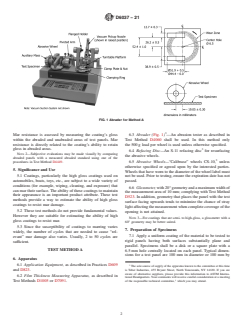
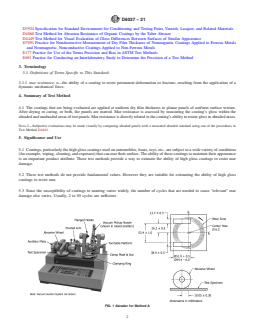
6.3 Abrader (Fig. 1) —An abrasion tester as described in Test Method D4060 shall be used. In this method only the 500 g load
per wheel is used unless otherwise specified.
6.4 Refacing Disc—anAn S-11 refacing disc for resurfacing the abrasive wheels.
6.5 Abrasive Wheels—“Calibrase” wheels CS-10, unless otherwise specified or agreed upon by the interested parties. Wheels that
have worn to the diameter of the wheel label must not be used. Prior to testing, ensure the expiration date has not passed.
6.6 Glossmeter, with 20° geometry complying with Test Methodand a maximum width D523 but with an opening no larger than
25 mmof the measurement area of 10 mm; complying with Test Method D523by 75 mm to accommodate 100 mm by 100 mm
test panels. . In addition, geometry that places the panel with the test surface facing upwards tends to minimize the chance of stray
light affecting the measurement when complete coverage of the opening is not attained.
NOTE 3—For coatings that are semi- to high-gloss, a glossmeter with a 60° geometry may be better suited.
7. Preparation of Specimens
7.1 Apply a uniform coating of the material to be tested to rigid panels having both surfaces substantially plane and parallel.
Specimens shall be a disk or a square plate with a 6.5 mm 6.5 mm hole centrally located on each panel. Typical dimensions for
a test panel are 100 mm in diameter or 100 mm by 100 mm. Thickness of the specimen should be no greater than 6.5 mm unless
an S-21 extension nut is utilized.
7.2 Prepare and coat panels in accordance with Practices D609 and D823.
7.2.1 Panels, that is, metal panels with a 6.5 mm hole drilled in the center to accommodate the mounting spindle, are available.
7.2.2 If it is not convenient to apply test coatings to panels, other planar, distortion-free substrates can be used by substituting
a “Drive Pin Type” specimen holder for the standard panel holder.
NOTE 4—It is important that the panels be planar for reproducible results. Cutting and drilling of painted panels is not recommended.
NOTE 5—Measurements are color dependent. Dark colors give lower values of gloss retention. To standardize, it is recommended that testing be done
using a black coating. Clearcoats are applied over a black basecoat. For other colors a black panel should be included as a control.
8. Standardization
8.1 To ensure that the abrading function of the wheels is maintained at a constant level, prepare the abrading wheels prior to each
test.
8.1.1 Mount the abrasive wheels on their respective flange holders, taking care not to handle them by their abrasive surfaces.
The sole source of supply of the apparatus known to the committee at this time is Taber Industries, 455 Bryant Street, North Tonawanda, NY 14120. If you are aware
of alternative suppliers, please provide this information to ASTM International Headquarters. Your comments will receive careful consideration at a meeting of the responsible
technical committee, which you may attend.
The sole source of supply of primed Taber panels known to the committee at this time is ACT Test Panels, LLC, 273 Industrial Drive, Hillsdale, MI. If you are aware
of alternative suppliers, please provide this information to ASTM International Headquarters. Your comments will receive careful consideration at a meeting of the responsible
technical committee, which you may attend.
D6037 − 21
8.1.2 A load of 500 g (per wheel) shall be used, unless otherwise agreed upon by the interested parties.
8.1.3 Mount an S-11 abrasive disc on the turntable and secure in place with the clamp plate, nut and clamping ring. Lower the
abrading heads carefully until the wheels rest squarely on the abrasive disc. Place the vacuum pick-up nozzle in position and adjust
it to a distance of 3 mm 61 mm above the S-11 refacing disc.
8.1.4 Set the vacuum suction force to 100.
8.1.5 Resurface the wheels by running them 25 cycles. In each case lightly brush the residue from the resurfacing operation off
each wheel. Each S-11 resurfacing disk is good for one resurfacing operation, after which it shall be discarded.
9. Conditioning
9.1 Cure the coated panels under conditions of temperature and humidity as agreed upon between the interested parties.
9.2 Unless otherwise agreed upon, condition the coated panels for at least 24 h at 23°C 6 2°C and 50 % 6 5 % relative humidity
in accordance with Specification D3924. Conduct the test in the same environment or immediately after removal therefrom.
10. Procedure
10.1 Using a glossmeter that is calibrated and verified for accuracy, measure the 20° gloss (see Note 3) at four positions within
the test area that will be abraded, approximately 38 mm from the center of the specimen and 90° apart. Record the mean of these
four readings as “Unabraded Gloss.”
NOTE 6—It is recommended that the panel be marked, or a template be created, to ensure that measurements are taken in the area that will be abraded.
10.2 Mount the test panel on the turntable with the side to be abraded facing up. Lower the abrasive wheels, adjust the vacuum
pick-up nozzle as outlined in 8.1.3, and set the vacuum suction as outlined in 8.1.4. Affix the auxiliary masses marked 500 g to
each pivoted arm and subject the test panel to abrasion for a selected number of cycles. An abrasion of 10 cycles is typically used,
unless otherwise agreed upon (see 5.3). Use a soft bristle brush or compressed air to remove residue from the specimen after
abrasion.
10.3 Repeating 10.1, measure the gloss at four positions within the abraded area immediately following the abrasion test unless
otherwise agreed upon by the interested parties. Record the mean of these four readings as “Abraded Gloss.”
10.3.1 If the panel was marked for measurement of unabraded gloss, the glossmeter can be easily placed in the correct position
for measuring abraded gloss. However, to compensate for any abrasion unevenness, it may be desirable to make minor adjustments
to panel position to get the four lowest gloss readings within the abraded area.
10.4 Calculate the percent gloss retention for each panel from the following equation:
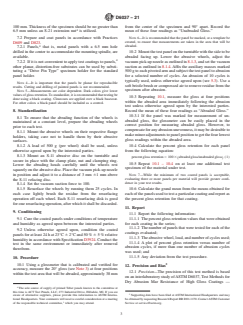
percent gloss retention 5 100 3~abraded gloss/unabraded gloss! (1)
10.5 Repeat 10.1 – 10.4 on at least one additional test specimen of the material under test.
NOTE 7—While the minimum of two coated panels is acceptable, evaluating three or more panels per material will provide greater confidence in your
test results.
10.6 Calculate the grand mean from the means obtained for each of the panels used to test a particular coating and report as the
percent gloss retention for that coating.
11. Report
11.1 Report the following information:
11.1.1 The percent gloss retention values that were obtained for each coating in the series.series;
D6037 − 21
11.1.2 The number of panels that were tested for each of the coatings evaluated.evaluated;
11.1.3 The abrasive wheel, load, and number of cycles used.used;
11.1.4 A plot of percent gloss retention versus number of abrasion cycles, if more than one number of abrasion cycles was
used.used; and
11.1.5 Any deviation from the test procedure.
12. Precision and Bias
12.1 Precision—The precision of this test method is based on an interlaboratory study of ASTM D6037, Test Methods for Dry
Abrasion Mar Resistance of
...