

ASTM D8380-21
(Test Method)Standard Test Method for Dry Abrasion Resistance of Hydrophobic and Omniphobic Coatings
General Information
- Abstract
SIGNIFICANCE AND USE
5.1 The test method is to be used to determine the abrasion resistance or mechanical durability of thin omniphobic or thin hydrophobic coatings. These coatings are often used to enhance the surface’s value by promoting fingerprint resistance, water removal, stain resistance, and easy-clean properties. A comparison of the contact angle and the depreciation of that contact angle due to exposure to mechanical abrasion determines the coating’s ability to remain effective after exposure to environmental abrasion.
5.1.1 The test method is used to appraise the removal of thin films when gravimetric measurements will not yield a detectable change in film mass due to the small amount of material comprising these films, which are on the order of nanometers thick.
5.1.2 Only fully cured specimens are evaluated unless otherwise specified and agreed upon by the interested parties.
5.2 Different coating materials may be evaluated for relative durability by evaluating abrasion cycles versus water contact angle using this method.
5.3 Different curing or conditioning methods may be evaluated by preparing test specimens with the same coating and then evaluating abrasion resistance using this method.
SCOPE
1.1 This test method describes a procedure for evaluating dry abrasion resistance of a thin hydrophobic or omniphobic coating, or both. The coating is typically less than 100 nm thick and is applied to a planar, glass substrate by application methods including, but not limited to, physical vapor deposition (PVD), dip, or spray.
1.2 Units—The values stated in SI units are to be regarded as standard. No other units of measurement are included in this standard with the exception of angular measurement which are reported in degrees.
Note 1: This test method measures a static contact angle and is not equivalent to Test Method C813 which measures an advancing contact angle.
Note 2: Test Method D4060 is not applicable to hydrophobic and omniphobic coatings because the molecular monolayer does not generally result in a detectable weight change to the specimen after subjecting it to abrasion.
1.3 This standard does not purport to address all of the safety concerns, if any, associated with its use. It is the responsibility of the user of this standard to establish appropriate safety, health, and environmental practices and determine the applicability of regulatory limitations prior to use.
1.4 This international standard was developed in accordance with internationally recognized principles on standardization established in the Decision on Principles for the Development of International Standards, Guides and Recommendations issued by the World Trade Organization Technical Barriers to Trade (TBT) Committee.
- Status
- Published
- Publication Date
- 31-Dec-2020
- Technical Committee
- D01 - Paint and Related Coatings, Materials, and Applications
- Drafting Committee
- D01.23 - Physical Properties of Applied Paint Films
Overview
ASTM D8380-21 is a globally recognized standard test method for evaluating the dry abrasion resistance of hydrophobic and omniphobic coatings. Developed by ASTM International, this method specifically addresses the performance and mechanical durability of ultra-thin surface treatments-typically less than 100 nanometers thick-applied to planar glass substrates. These specialty coatings are widely used to impart valuable functional properties such as fingerprint resistance, water repellency, stain resistance, and easy-clean surfaces. ASTM D8380-21 enables objective comparison of coating effectiveness following exposure to mechanical abrasion, providing essential data for quality assurance, product development, and regulatory compliance within the coatings industry.
Key Topics
- Test Method Purpose: Determines abrasion resistance and mechanical durability of thin hydrophobic and omniphobic coatings unable to show mass loss by gravimetric means due to their nanometer-scale thickness.
- Performance Metrics: Uses water contact angle measurement to assess surface properties before and after defined abrasion cycles, indicating how well the coating retains its hydrophobic or omniphobic characteristics.
- Specimen Requirements: Testing is conducted on fully cured coatings applied to planar glass, ensuring consistency and minimizing substrate interference in abrasion resistance evaluation.
- Test Apparatus: Involves reciprocating abrasion using steel wool (#0000 grade) under controlled pressure, followed by static contact angle measurements with a goniometer or contact angle meter.
- Repeatability and Reproducibility: Structured to deliver reliable, comparative results across laboratories for various coating materials and process parameters.
Applications
ASTM D8380-21 is a critical tool in the development and assessment of next-generation coatings for numerous sectors, including:
- Consumer Electronics: Evaluates touchscreen or display coatings for smudge- and fingerprint-resistance, vital for user experience and product longevity.
- Architectural and Automotive Glass: Assesses rain-repellent and self-cleaning coatings for windows, mirrors, and facades, optimizing performance in real-world, abrasive environments.
- Optical Devices: Supports the manufacture of lenses, sensors, and film surfaces where optical clarity and easy maintenance are paramount.
- Research and Development: Useful for academic and industrial laboratories comparing new monolayer or thin film chemistries for robustness and environmental durability.
- Quality Control: Enables manufacturers to benchmark products and ensure consistent abrasion resistance during bulk production.
The test method is particularly suited to coatings where traditional wear tests (such as Taber abraser methods) do not yield measurable mass loss, providing a reliable alternative for ultra-thin film technologies.
Related Standards
Implementing ASTM D8380-21 benefits from familiarity with several supporting and related standards, including:
- ASTM D4060 - Test Method for Abrasion Resistance of Organic Coatings by the Taber Abraser (note: not suitable for molecular monolayer coatings).
- ASTM C813 - Test Method for Hydrophobic Contamination on Glass by Contact Angle Measurement.
- ASTM D5946 - Test Method for Corona-Treated Polymer Films Using Water Contact Angle Measurements.
- ASTM D7490 - Test Method for Measurement of the Surface Tension of Solid Coatings, Substrates and Pigments using Contact Angle Measurements.
- ASTM D1193 - Specification for Reagent Water, used in droplet contact angle tests.
- ASTM E177 and E691 - Guides for describing precision, bias, and interlaboratory study practice.
ASTM D8380-21 aligns with international standardization principles and is intended for global application in technical, regulatory, and commercial settings. Through standardized evaluation, it fosters the advancement and reliable use of advanced hydrophobic and omniphobic coatings across industries.
Relations
- Effective Date
- 01-Jan-2024
- Effective Date
- 01-May-2017
- Effective Date
- 01-Jul-2016
- Effective Date
- 01-Dec-2014
- Effective Date
- 01-May-2014
- Effective Date
- 01-May-2013
- Effective Date
- 01-May-2013
- Effective Date
- 01-Aug-2012
- Effective Date
- 01-Nov-2011
- Effective Date
- 01-Jun-2011
- Effective Date
- 01-Jan-2011
- Effective Date
- 01-Oct-2010
- Effective Date
- 01-Feb-2010
- Effective Date
- 01-Feb-2010
- Effective Date
- 01-Nov-2009
Get Certified
Connect with accredited certification bodies for this standard

DVS-ZERT GmbH
German welding certification society.
CARES (UK Certification Authority for Reinforcing Steels)
UK certification for reinforcing steels and construction.
EWF/IIW (European/International Welding Federation)
International welding personnel certification.
Sponsored listings
Frequently Asked Questions
ASTM D8380-21 is a standard published by ASTM International. Its full title is "Standard Test Method for Dry Abrasion Resistance of Hydrophobic and Omniphobic Coatings". This standard covers: SIGNIFICANCE AND USE 5.1 The test method is to be used to determine the abrasion resistance or mechanical durability of thin omniphobic or thin hydrophobic coatings. These coatings are often used to enhance the surface’s value by promoting fingerprint resistance, water removal, stain resistance, and easy-clean properties. A comparison of the contact angle and the depreciation of that contact angle due to exposure to mechanical abrasion determines the coating’s ability to remain effective after exposure to environmental abrasion. 5.1.1 The test method is used to appraise the removal of thin films when gravimetric measurements will not yield a detectable change in film mass due to the small amount of material comprising these films, which are on the order of nanometers thick. 5.1.2 Only fully cured specimens are evaluated unless otherwise specified and agreed upon by the interested parties. 5.2 Different coating materials may be evaluated for relative durability by evaluating abrasion cycles versus water contact angle using this method. 5.3 Different curing or conditioning methods may be evaluated by preparing test specimens with the same coating and then evaluating abrasion resistance using this method. SCOPE 1.1 This test method describes a procedure for evaluating dry abrasion resistance of a thin hydrophobic or omniphobic coating, or both. The coating is typically less than 100 nm thick and is applied to a planar, glass substrate by application methods including, but not limited to, physical vapor deposition (PVD), dip, or spray. 1.2 Units—The values stated in SI units are to be regarded as standard. No other units of measurement are included in this standard with the exception of angular measurement which are reported in degrees. Note 1: This test method measures a static contact angle and is not equivalent to Test Method C813 which measures an advancing contact angle. Note 2: Test Method D4060 is not applicable to hydrophobic and omniphobic coatings because the molecular monolayer does not generally result in a detectable weight change to the specimen after subjecting it to abrasion. 1.3 This standard does not purport to address all of the safety concerns, if any, associated with its use. It is the responsibility of the user of this standard to establish appropriate safety, health, and environmental practices and determine the applicability of regulatory limitations prior to use. 1.4 This international standard was developed in accordance with internationally recognized principles on standardization established in the Decision on Principles for the Development of International Standards, Guides and Recommendations issued by the World Trade Organization Technical Barriers to Trade (TBT) Committee.
SIGNIFICANCE AND USE 5.1 The test method is to be used to determine the abrasion resistance or mechanical durability of thin omniphobic or thin hydrophobic coatings. These coatings are often used to enhance the surface’s value by promoting fingerprint resistance, water removal, stain resistance, and easy-clean properties. A comparison of the contact angle and the depreciation of that contact angle due to exposure to mechanical abrasion determines the coating’s ability to remain effective after exposure to environmental abrasion. 5.1.1 The test method is used to appraise the removal of thin films when gravimetric measurements will not yield a detectable change in film mass due to the small amount of material comprising these films, which are on the order of nanometers thick. 5.1.2 Only fully cured specimens are evaluated unless otherwise specified and agreed upon by the interested parties. 5.2 Different coating materials may be evaluated for relative durability by evaluating abrasion cycles versus water contact angle using this method. 5.3 Different curing or conditioning methods may be evaluated by preparing test specimens with the same coating and then evaluating abrasion resistance using this method. SCOPE 1.1 This test method describes a procedure for evaluating dry abrasion resistance of a thin hydrophobic or omniphobic coating, or both. The coating is typically less than 100 nm thick and is applied to a planar, glass substrate by application methods including, but not limited to, physical vapor deposition (PVD), dip, or spray. 1.2 Units—The values stated in SI units are to be regarded as standard. No other units of measurement are included in this standard with the exception of angular measurement which are reported in degrees. Note 1: This test method measures a static contact angle and is not equivalent to Test Method C813 which measures an advancing contact angle. Note 2: Test Method D4060 is not applicable to hydrophobic and omniphobic coatings because the molecular monolayer does not generally result in a detectable weight change to the specimen after subjecting it to abrasion. 1.3 This standard does not purport to address all of the safety concerns, if any, associated with its use. It is the responsibility of the user of this standard to establish appropriate safety, health, and environmental practices and determine the applicability of regulatory limitations prior to use. 1.4 This international standard was developed in accordance with internationally recognized principles on standardization established in the Decision on Principles for the Development of International Standards, Guides and Recommendations issued by the World Trade Organization Technical Barriers to Trade (TBT) Committee.
ASTM D8380-21 is classified under the following ICS (International Classification for Standards) categories: 25.220.01 - Surface treatment and coating in general. The ICS classification helps identify the subject area and facilitates finding related standards.
ASTM D8380-21 has the following relationships with other standards: It is inter standard links to ASTM D16-24, ASTM D5946-17, ASTM D16-16, ASTM D16-14, ASTM E177-14, ASTM E177-13, ASTM E691-13, ASTM D16-12, ASTM E691-11, ASTM D16-11a, ASTM D16-11, ASTM E177-10, ASTM D16-10, ASTM D4060-10, ASTM C813-90(2009). Understanding these relationships helps ensure you are using the most current and applicable version of the standard.
ASTM D8380-21 is available in PDF format for immediate download after purchase. The document can be added to your cart and obtained through the secure checkout process. Digital delivery ensures instant access to the complete standard document.
Standards Content (Sample)
This international standard was developed in accordance with internationally recognized principles on standardization established in the Decision on Principles for the
Development of International Standards, Guides and Recommendations issued by the World Trade Organization Technical Barriers to Trade (TBT) Committee.
Designation: D8380 − 21
Standard Test Method for
Dry Abrasion Resistance of Hydrophobic and Omniphobic
Coatings
This standard is issued under the fixed designation D8380; the number immediately following the designation indicates the year of
original adoption or, in the case of revision, the year of last revision.Anumber in parentheses indicates the year of last reapproval.A
superscript epsilon (´) indicates an editorial change since the last revision or reapproval.
1. Scope D16TerminologyforPaint,RelatedCoatings,Materials,and
Applications
1.1 This test method describes a procedure for evaluating
D1193Specification for Reagent Water
dry abrasion resistance of a thin hydrophobic or omniphobic
D4060Test Method for Abrasion Resistance of Organic
coating,orboth.Thecoatingistypicallylessthan100nmthick
Coatings by the Taber Abraser
and is applied to a planar, glass substrate by application
D5946Test Method for Corona-Treated Polymer Films Us-
methods including, but not limited to, physical vapor deposi-
ing Water Contact Angle Measurements
tion (PVD), dip, or spray.
D7490TestMethodforMeasurementoftheSurfaceTension
1.2 Units—The values stated in SI units are to be regarded
of Solid Coatings, Substrates and Pigments using Contact
asstandard.Nootherunitsofmeasurementareincludedinthis
Angle Measurements
standard with the exception of angular measurement which are
E177Practice for Use of the Terms Precision and Bias in
reported in degrees.
ASTM Test Methods
E691Practice for Conducting an Interlaboratory Study to
NOTE 1—This test method measures a static contact angle and is not
equivalent to Test Method C813 which measures an advancing contact Determine the Precision of a Test Method
angle.
NOTE 2—Test Method D4060 is not applicable to hydrophobic and 3. Terminology
omniphobiccoatingsbecausethemolecularmonolayerdoesnotgenerally
3.1 Definitions—Definitions used in this test method are in
result in a detectable weight change to the specimen after subjecting it to
accordance withTerminology D16, unless otherwise specified.
abrasion.
1.3 This standard does not purport to address all of the 3.2 Definitions of Terms Specific to This Standard:
safety concerns, if any, associated with its use. It is the 3.2.1 abrasion cycle, n—in abrasion testing, one or more
responsibility of the user of this standard to establish appro- movements of the abradant across a material surface, or the
priate safety, health, and environmental practices and deter- materialsurfaceacrosstheabradant,thatpermitsareturntoits
mine the applicability of regulatory limitations prior to use.
starting position; for this test method, one abrasion cycle is a
1.4 This international standard was developed in accor- complete back and forth motion.
dance with internationally recognized principles on standard-
3.2.2 static contact angle, Ө (degrees), n—the angle be-
ization established in the Decision on Principles for the
tween the substrate surface and the tangent line drawn to the
Development of International Standards, Guides and Recom-
droplet surface at the three-phase point, when a liquid drop is
mendations issued by the World Trade Organization Technical
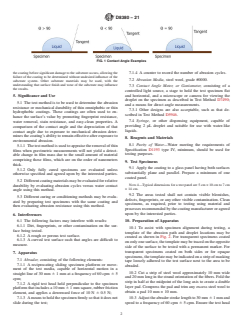
resting on a plane solid surface (see Fig. 1).
Barriers to Trade (TBT) Committee.
4. Summary of Test Method
2. Referenced Documents
4.1 The coating is applied in a uniform thickness to planar
2.1 ASTM Standards:
glass panels and, after curing, the surface is abraded using a
C813TestMethodforHydrophobicContaminationonGlass
reciprocating rubbing action under controlled conditions of
by Contact Angle Measurement
pressure and abrasive action. Droplets of type IV grade of
reagent water are placed on the surface of the specimen, and
1 the contact angle values are measured and then averaged. The
This test method is under the jurisdiction of ASTM Committee D01 on Paint
and Related Coatings, Materials, andApplications and is the direct responsibility of
test specimen is subjected to abrasion in the same location,
Subcommittee D01.23 on Physical Properties of Applied Paint Films.
until the failure threshold has been reached. Abrasion resis-
Current edition approved Jan. 1, 2021. Published February 2021. DOI: 10.1520/
tance is assessed by measuring the water contact angle within
D8380-21.
theabradedareaofthetestspecimenandreportingthenumber
For referenced ASTM standards, visit the ASTM website, www.astm.org, or
contact ASTM Customer Service at service@astm.org. For Annual Book of ASTM
of abrasion cycles.
Standards volume information, refer to the standard’s Document Summary page on
the ASTM website. NOTE 3—Aglass substrate was selected because the abradant will wear
Copyright © ASTM International, 100 Barr Harbor Drive, PO Box C700, West Conshohocken, PA 19428-2959. United States
D8380 − 21
FIG. 1 Contact Angle Examples
thecoatingbeforesignificantdamagetothesubstrateoccurs,allowingthe
7.1.4 A counter to record the number of abrasion cycles.
failure of the coating to be determined without undesired influence of the
7.2 Abrasion Media, steel wool, grade #0000.
substrate system. Other substrate materials may be used, with the
understanding that surface finish and wear of the substrate may influence
7.3 Contact Angle Meter, or Goniometer, consisting of a
the results.
controlled light source, a stage to hold the test specimen flat
and horizontal, and a microscope or camera for viewing the
5. Significance and Use
droplet on the specimen as described in Test Method D7490;
5.1 The test method is to be used to determine the abrasion
and a means for direct angle measurements.
resistance or mechanical durability of thin omniphobic or thin
7.3.1 Other designs are also acceptable, such as that de-
hydrophobic coatings. These coatings are often used to en-
scribed in Test Method D5946.
hance the surface’s value by promoting fingerprint resistance,
7.4 Syringe, or other dispensing equipment, capable of
water removal, stain resistance, and easy-clean properties. A
providing 2 µL droplet and suitable for use with water-like
comparison of the contact angle and the depreciation of that
liquids.
contact angle due to exposure to mechanical abrasion deter-
minesthecoating’sabilitytoremaineffectiveafterexposureto
8. Reagents and Materials
environmental abrasion.
8.1 Purity of Water—Water meeting the requirements of
5.1.1 Thetestmethodisusedtoappraisetheremovalofthin
Specification D1193 type IV, minimum, should be used for
films when gravimetric measurements will not yield a detect-
testing purposes.
able change in film mass due to the small amount of material
comprising these films, which are on the order of nanometers
9. Test Specimens
thick.
9.1 Apply the coating to a glass panel having both surfaces
5.1.2 Only fully cured specimens are evaluated unless
substantially plane and parallel. Prepare a minimum of one
otherwise specified and agreed upon by the interested parties.
coated panel.
5.2 Differentcoatingmaterialsmaybeevaluatedforrelative
NOTE 4—Typical dimensions for a test panel are 5 cm × 10 cm to 7 cm
durability by evaluating abrasion cycles versus water contact
×14cm.
angle using this method.
9.2 The areas tested shall not contain visible blemishes,
5.3 Different curing or conditioning methods may be evalu-
defects, fingerprints, or any other visible contamination. Clean
ated by preparing test specimens with the same coating and
specimens, as required, prior to testing using material and
then evaluating abrasion resistance using this method.
processesrecommendedbythecoatingmanufactureroragreed
upon by the interested parties.
6. Interferences
6.1 The following factors may interfere with results:
10. Preparation of Apparatus
6.1.1 Dirt, fingerprints, or other contamination on the sur-
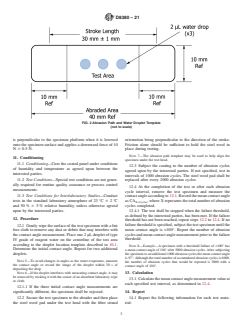
10.1 To assist with specimen alignment during testing, a
face being tested.
template of the abrasion path and droplet locations may be
6.1.2 A rough or porous test surface.
created as shown in Fig. 2. For transparent specimens coated
6.1.3 A curved test surface such that angles are difficult to
ononlyonesurface,thetemplatemaybetracedontheopposite
measure.
side of the surface to be tested with a permanent marker. For
transparent specimens coated on both sides or for opaque
7. Apparatus
specimens,thetemplatemaybeindicatedonastripofmasking
7.1 Abrader, consisting of the following elements:
tape loosely adhered to the test surface next to the area to be
7.1.1 A reciprocating sliding specimen platform or move-
abraded.
ment of the test media, capable of horizontal motion in a
10.2 Cut a strip of steel wool approximately 10 mm wide
straight line of 30 mm 6 1 mm at a frequency of 60 cpm 6 5
and20mmlonginthestrandorientationofthefibers.Foldthe
cpm;
strip in half at the midpoint of the long axis to create a double
7.1.2 A rigid test head held perpendicular to the specimen
layer pad. Compress the pad and trim any excess steel wool to
platformthatincludesa10mm 61mmsquare,rubberfriction
obtain a pad 10 mm × 10 mm.
element, and applies a downward force of 10 N 6 0.5 N;
7.1.3 Ameanstoholdthespecimenfirmlysothatitdoesnot 10.3 Adjusttheabraderstrokelengthto30mm 61mmand
slide during the test; speed to a frequency of 60 cpm 6 5 cpm. Ensure the test head
D8380 − 21
FIG. 2 Abrasion Path and Water Drop
...