

ASTM B135/B135M-17
(Specification)Standard Specification for Seamless Brass Tube
General Information
- Abstract
ABSTRACT
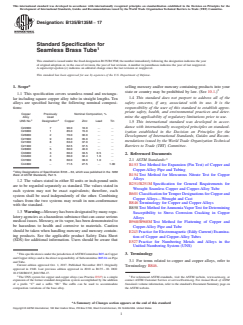
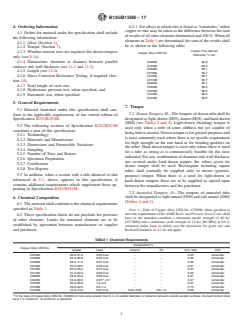
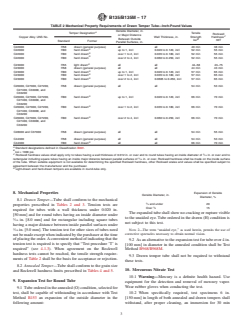
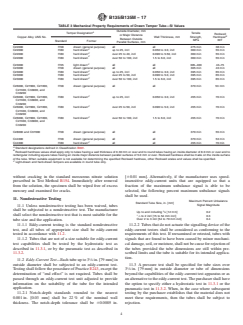
This specification covers seamless round and rectangular including square copper alloy tube in straight lengths. The following copper alloys are specified and classified according to their nominal compositions: UNS No. C22000, UNS No. C23000, UNS No. C26000, UNS No. C27000, UNS No. C27200, UNS No. C27400, UNS No. C28000, UNS No. C33000, UNS No. C33200, UNS No. C37000, and UNS No. C44300. The tempers of drawn tube shall be designated as light-drawn (H55), drawn (H58), and hard-drawn (H80). Light-drawn (bending) temper is used only when a tube of some stiffness but yet capable of being bent is needed. Drawn temper is for general purposes and is most commonly used where there is no specific requirement for high strength on the one hand or for bending qualities on the other. Hard-drawn temper is used only where there is need for a tube as strong as is commercially feasible for the sizes indicated. For any combination of diameter and wall thickness not covered under hard-drawn temper, the values given for drawn temper shall be used. The tempers of annealed tube shall be designated as light anneal (O50) and soft anneal (O60). The tubes shall undergo mechanical tests such as tension test, Rockwell hardness test, and expansion test in order to determine certain properties such as tensile strength and hardness. A mercury nitrate test shall be done to detect and remove mercury vapor. Nondestructive tests such as eddy-current test, hydrostatic test, and pneumatic test shall be done as well.
SCOPE
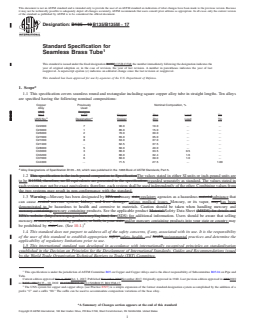
1.1 This specification covers seamless round and rectangular including square copper alloy tube in straight lengths. Ten alloys are specified having the following nominal compositions:
Copper
Previously
Nominal Composition, %
Alloy
Used
UNS No.2
DesignationA
Copper
Zinc
Lead
Tin
C22000
7
90.0
10.0
...
...
C23000
1
85.0
15.0
...
...
C26000
2
70.0
30.0
...
...
C27000
9
65.0
35.0
...
...
C27200
8
63.0
37.0
...
...
C27400
...
62.5
37.5
...
...
C28000
5
60.0
40.0
...
...
C33000
3
66.0
33.5
0.5
...
C33200
4
66.0
32.4
1.6
...
C37000
6
60.0
39.0
1.0
...
C44300
...
71.5
27.5
...
1.00(A) Alloy Designations of Specification B135 – 63, which was published in the 1966 Book of ASTM Standards, Part 5.
1.2 The values stated in either SI units or inch-pound units are to be regarded separately as standard. The values stated in each system may not be exact equivalents; therefore, each system shall be used independently of the other. Combining values from the two systems may result in non-conformance with the standard.
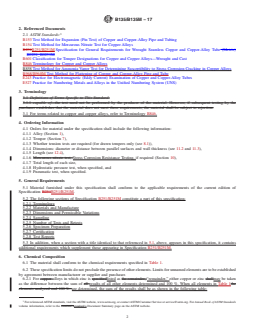
1.3 Warning—Mercury has been designated by many regulatory agencies as a hazardous substance that can cause serious medical issues. Mercury, or its vapor, has been demonstrated to be hazardous to health and corrosive to materials. Caution should be taken when handling mercury and mercury containing products. See the applicable product Safety Data Sheet (SDS) for additional information. Users should be aware that selling mercury and/or mercury containing products into your state or country may be prohibited by law. (See 10.1.)2
1.4 This standard does not purport to address all of the safety concerns, if any, associated with its use. It is the responsibility of the user of this standard to establish appropriate safety, health, and environmental practices and determine the applicability of regulatory limitations prior to use.
1.5 This international standard was developed in accordance with internationally recognized principles on standardization established in the Decision on Principles for the Development of International Standards, Guides and Recommendations issued by the World Trade Organization Technical Bar...
- Status
- Published
- Publication Date
- 30-Sep-2017
- Technical Committee
- B05 - Copper and Copper Alloys
- Drafting Committee
- B05.04 - Pipe and Tube
Overview
ASTM B135/B135M-17: Standard Specification for Seamless Brass Tube outlines requirements for seamless round, rectangular, and square copper alloy tubes supplied in straight lengths. Published by ASTM International, this standard covers a range of copper alloys, detailing chemical composition, temper designations, and mechanical property requirements. It is widely adopted in industries where brass tubing of high integrity and reliable mechanical properties is essential.
The specification is applicable to commercial, industrial, and governmental uses and supports both SI and inch-pound units, requiring separate application to ensure compliance. ASTM B135/B135M-17 ensures that seamless brass tubing meets stringent quality, safety, and performance criteria.
Key Topics
- Copper Alloy Coverage: This standard applies to alloys such as UNS C22000, C23000, C26000, C27000, C27200, C27400, C28000, C33000, C33200, C37000, and C44300.
- Temper Designations: Brass tubes may have drawn tempers (H55 - light-drawn, H58 - general purpose, H80 - hard-drawn) or annealed tempers (O50 - light anneal, O60 - soft anneal) to meet various application needs.
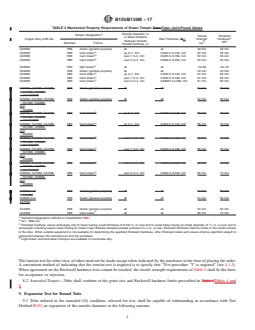
- Mechanical Testing: Tubes must meet specific tensile strength and Rockwell hardness requirements based on alloy and temper. Expansion tests, as well as nondestructive tests like eddy-current, hydrostatic, and pneumatic testing, verify tube strength and integrity.
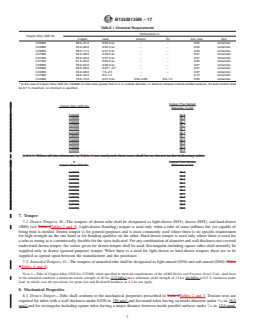
- Chemical Composition: The document specifies strict compositions and limits on copper, zinc, lead, and tin content for each alloy, supporting consistency and performance.
- Dimensional Tolerances: Dimensions and permissible variations in wall thickness, diameter, length, straightness, and squareness are defined, ensuring product uniformity.
- Safety Considerations: Includes cautions regarding mercury exposure in certain testing and applicability of regulatory and environmental practices.
Applications
Seamless brass tubes produced in accordance with ASTM B135/B135M-17 are utilized in a variety of industries, including:
- Plumbing and HVAC: Used in heat exchangers, water distribution, gas lines, and air conditioning systems thanks to their corrosion resistance and formability.
- Industrial Manufacturing: Employed in fabrication of precision components, fittings, and instrumentation where tight dimensional and performance tolerances are required.
- Electronics and Telecommunications: Implemented for shielding, connectors, and pneumatic/voice tube systems due to their electrical conductivity and workability.
- Architectural and Decorative Purposes: Chosen for their aesthetic appearance and ease of finishing in handrails, fixtures, and trim.
- Marine and Automotive: Suitable for fuel lines and hydraulic systems where reliability and resistance to environmental influences are critical.
The comprehensive requirements support manufacturers and end-users in selecting brass tubes fit for high-performance and safety-critical environments.
Related Standards
A number of ASTM and federal standards are referenced and often used in conjunction with ASTM B135/B135M-17, including:
- ASTM B153: Test Method for Expansion (Pin Test) of Copper and Copper-Alloy Pipe and Tubing
- ASTM B154: Mercurous Nitrate Test for Copper Alloys
- ASTM B251/B251M: General Requirements for Wrought Seamless Copper and Copper-Alloy Tube
- ASTM B601: Classification for Temper Designations for Copper and Copper Alloys
- ASTM E243: Electromagnetic (Eddy Current) Examination of Copper and Copper-Alloy Tubes
- ASTM B968/B968M: Test Method for Flattening of Copper and Copper-Alloy Pipe and Tube
- ASTM B846: Terminology for Copper and Copper Alloys
- ASTM B900: Packaging of Copper and Copper Alloy Mill Products for Government Agencies
Manufacturers, specifiers, and procurement professionals should be aware of these related standards to ensure comprehensive compliance and optimal product performance when sourcing or producing seamless brass tube.
Relations
- Effective Date
- 16-Nov-2017
- Effective Date
- 01-Oct-2017
- Effective Date
- 01-Aug-2019
- Effective Date
- 01-Jan-2019
- Effective Date
- 01-Oct-2018
- Effective Date
- 01-Jun-2018
- Effective Date
- 01-Mar-2018
- Effective Date
- 01-Mar-2018
- Effective Date
- 01-Oct-2016
- Effective Date
- 01-Dec-2013
- Effective Date
- 01-Oct-2012
- Effective Date
- 01-Oct-2012
- Effective Date
- 01-Oct-2012
- Effective Date
- 01-Apr-2012
- Effective Date
- 01-Jun-2011
Get Certified
Connect with accredited certification bodies for this standard

Institut za varilstvo d.o.o. (Welding Institute)
Slovenia's leading welding institute since 1952. ISO 3834, EN 1090, pressure equipment certification, NDT personnel, welder qualification. Only IIW Au
Sponsored listings
Frequently Asked Questions
ASTM B135/B135M-17 is a technical specification published by ASTM International. Its full title is "Standard Specification for Seamless Brass Tube". This standard covers: ABSTRACT This specification covers seamless round and rectangular including square copper alloy tube in straight lengths. The following copper alloys are specified and classified according to their nominal compositions: UNS No. C22000, UNS No. C23000, UNS No. C26000, UNS No. C27000, UNS No. C27200, UNS No. C27400, UNS No. C28000, UNS No. C33000, UNS No. C33200, UNS No. C37000, and UNS No. C44300. The tempers of drawn tube shall be designated as light-drawn (H55), drawn (H58), and hard-drawn (H80). Light-drawn (bending) temper is used only when a tube of some stiffness but yet capable of being bent is needed. Drawn temper is for general purposes and is most commonly used where there is no specific requirement for high strength on the one hand or for bending qualities on the other. Hard-drawn temper is used only where there is need for a tube as strong as is commercially feasible for the sizes indicated. For any combination of diameter and wall thickness not covered under hard-drawn temper, the values given for drawn temper shall be used. The tempers of annealed tube shall be designated as light anneal (O50) and soft anneal (O60). The tubes shall undergo mechanical tests such as tension test, Rockwell hardness test, and expansion test in order to determine certain properties such as tensile strength and hardness. A mercury nitrate test shall be done to detect and remove mercury vapor. Nondestructive tests such as eddy-current test, hydrostatic test, and pneumatic test shall be done as well. SCOPE 1.1 This specification covers seamless round and rectangular including square copper alloy tube in straight lengths. Ten alloys are specified having the following nominal compositions: Copper Previously Nominal Composition, % Alloy Used UNS No.2 DesignationA Copper Zinc Lead Tin C22000 7 90.0 10.0 ... ... C23000 1 85.0 15.0 ... ... C26000 2 70.0 30.0 ... ... C27000 9 65.0 35.0 ... ... C27200 8 63.0 37.0 ... ... C27400 ... 62.5 37.5 ... ... C28000 5 60.0 40.0 ... ... C33000 3 66.0 33.5 0.5 ... C33200 4 66.0 32.4 1.6 ... C37000 6 60.0 39.0 1.0 ... C44300 ... 71.5 27.5 ... 1.00(A) Alloy Designations of Specification B135 – 63, which was published in the 1966 Book of ASTM Standards, Part 5. 1.2 The values stated in either SI units or inch-pound units are to be regarded separately as standard. The values stated in each system may not be exact equivalents; therefore, each system shall be used independently of the other. Combining values from the two systems may result in non-conformance with the standard. 1.3 Warning—Mercury has been designated by many regulatory agencies as a hazardous substance that can cause serious medical issues. Mercury, or its vapor, has been demonstrated to be hazardous to health and corrosive to materials. Caution should be taken when handling mercury and mercury containing products. See the applicable product Safety Data Sheet (SDS) for additional information. Users should be aware that selling mercury and/or mercury containing products into your state or country may be prohibited by law. (See 10.1.)2 1.4 This standard does not purport to address all of the safety concerns, if any, associated with its use. It is the responsibility of the user of this standard to establish appropriate safety, health, and environmental practices and determine the applicability of regulatory limitations prior to use. 1.5 This international standard was developed in accordance with internationally recognized principles on standardization established in the Decision on Principles for the Development of International Standards, Guides and Recommendations issued by the World Trade Organization Technical Bar...
ABSTRACT This specification covers seamless round and rectangular including square copper alloy tube in straight lengths. The following copper alloys are specified and classified according to their nominal compositions: UNS No. C22000, UNS No. C23000, UNS No. C26000, UNS No. C27000, UNS No. C27200, UNS No. C27400, UNS No. C28000, UNS No. C33000, UNS No. C33200, UNS No. C37000, and UNS No. C44300. The tempers of drawn tube shall be designated as light-drawn (H55), drawn (H58), and hard-drawn (H80). Light-drawn (bending) temper is used only when a tube of some stiffness but yet capable of being bent is needed. Drawn temper is for general purposes and is most commonly used where there is no specific requirement for high strength on the one hand or for bending qualities on the other. Hard-drawn temper is used only where there is need for a tube as strong as is commercially feasible for the sizes indicated. For any combination of diameter and wall thickness not covered under hard-drawn temper, the values given for drawn temper shall be used. The tempers of annealed tube shall be designated as light anneal (O50) and soft anneal (O60). The tubes shall undergo mechanical tests such as tension test, Rockwell hardness test, and expansion test in order to determine certain properties such as tensile strength and hardness. A mercury nitrate test shall be done to detect and remove mercury vapor. Nondestructive tests such as eddy-current test, hydrostatic test, and pneumatic test shall be done as well. SCOPE 1.1 This specification covers seamless round and rectangular including square copper alloy tube in straight lengths. Ten alloys are specified having the following nominal compositions: Copper Previously Nominal Composition, % Alloy Used UNS No.2 DesignationA Copper Zinc Lead Tin C22000 7 90.0 10.0 ... ... C23000 1 85.0 15.0 ... ... C26000 2 70.0 30.0 ... ... C27000 9 65.0 35.0 ... ... C27200 8 63.0 37.0 ... ... C27400 ... 62.5 37.5 ... ... C28000 5 60.0 40.0 ... ... C33000 3 66.0 33.5 0.5 ... C33200 4 66.0 32.4 1.6 ... C37000 6 60.0 39.0 1.0 ... C44300 ... 71.5 27.5 ... 1.00(A) Alloy Designations of Specification B135 – 63, which was published in the 1966 Book of ASTM Standards, Part 5. 1.2 The values stated in either SI units or inch-pound units are to be regarded separately as standard. The values stated in each system may not be exact equivalents; therefore, each system shall be used independently of the other. Combining values from the two systems may result in non-conformance with the standard. 1.3 Warning—Mercury has been designated by many regulatory agencies as a hazardous substance that can cause serious medical issues. Mercury, or its vapor, has been demonstrated to be hazardous to health and corrosive to materials. Caution should be taken when handling mercury and mercury containing products. See the applicable product Safety Data Sheet (SDS) for additional information. Users should be aware that selling mercury and/or mercury containing products into your state or country may be prohibited by law. (See 10.1.)2 1.4 This standard does not purport to address all of the safety concerns, if any, associated with its use. It is the responsibility of the user of this standard to establish appropriate safety, health, and environmental practices and determine the applicability of regulatory limitations prior to use. 1.5 This international standard was developed in accordance with internationally recognized principles on standardization established in the Decision on Principles for the Development of International Standards, Guides and Recommendations issued by the World Trade Organization Technical Bar...
ASTM B135/B135M-17 is classified under the following ICS (International Classification for Standards) categories: 23.040.15 - Non-ferrous metal pipes. The ICS classification helps identify the subject area and facilitates finding related standards.
ASTM B135/B135M-17 has the following relationships with other standards: It is inter standard links to ASTM B135M-10, ASTM B135-10, ASTM B846-19a, ASTM B846-19, ASTM B601-18a, ASTM E243-18, ASTM B601-18, ASTM B858-06(2018), ASTM B601-16, ASTM E243-13, ASTM B601-12, ASTM B154-12e1, ASTM B154-12, ASTM B858-06(2012), ASTM B846-11a. Understanding these relationships helps ensure you are using the most current and applicable version of the standard.
ASTM B135/B135M-17 is available in PDF format for immediate download after purchase. The document can be added to your cart and obtained through the secure checkout process. Digital delivery ensures instant access to the complete standard document.
Standards Content (Sample)
This international standard was developed in accordance with internationally recognized principles on standardization established in the Decision on Principles for the
Development of International Standards, Guides and Recommendations issued by the World Trade Organization Technical Barriers to Trade (TBT) Committee.
Designation:B135/B135M −17
Standard Specification for
Seamless Brass Tube
This standard is issued under the fixed designation B135/B135M; the number immediately following the designation indicates the year
of original adoption or, in the case of revision, the year of last revision. A number in parentheses indicates the year of last reapproval.
A superscript epsilon (´) indicates an editorial change since the last revision or reapproval.
This standard has been approved for use by agencies of the U.S. Department of Defense.
1. Scope* selling mercury and/or mercury containing products into your
state or country may be prohibited by law. (See 10.1.)
1.1 This specification covers seamless round and rectangu-
1.4 This standard does not purport to address all of the
lar including square copper alloy tube in straight lengths. Ten
safety concerns, if any, associated with its use. It is the
alloys are specified having the following nominal composi-
responsibility of the user of this standard to establish appro-
tions:
priate safety, health, and environmental practices and deter-
Copper Previously Nominal Composition, %
Alloy Used mine the applicability of regulatory limitations prior to use.
2 A
UNS No. Designation Copper Zinc Lead Tin
1.5 This international standard was developed in accor-
dance with internationally recognized principles on standard-
C22000 7 90.0 10.0 . .
C23000 1 85.0 15.0 . . ization established in the Decision on Principles for the
C26000 2 70.0 30.0 . .
Development of International Standards, Guides and Recom-
C27000 9 65.0 35.0 . .
mendations issued by the World Trade Organization Technical
C27200 8 63.0 37.0 . .
C27400 . 62.5 37.5 . .
Barriers to Trade (TBT) Committee.
C28000 5 60.0 40.0 . .
C33000 3 66.0 33.5 0.5 .
2. Referenced Documents
C33200 4 66.0 32.4 1.6 .
C37000 6 60.0 39.0 1.0 .
2.1 ASTM Standards:
C44300 . 71.5 27.5 . 1.00
B153 Test Method for Expansion (Pin Test) of Copper and
Copper-Alloy Pipe and Tubing
A
Alloy Designations of Specification B135 – 63, which was published in the 1966
B154 Test Method for Mercurous Nitrate Test for Copper
Book of ASTM Standards, Part 5.
Alloys
1.2 The values stated in either SI units or inch-pound units
B251/B251M Specification for General Requirements for
are to be regarded separately as standard. The values stated in
Wrought Seamless Copper and Copper-Alloy Tube
each system may not be exact equivalents; therefore, each
B601 Classification forTemper Designations for Copper and
system shall be used independently of the other. Combining
Copper Alloys—Wrought and Cast
values from the two systems may result in non-conformance
B846 Terminology for Copper and Copper Alloys
with the standard.
B858 Test Method forAmmoniaVaporTest for Determining
1.3 Warning—Mercury has been designated by many regu-
Susceptibility to Stress Corrosion Cracking in Copper
latory agencies as a hazardous substance that can cause serious
Alloys
medical issues. Mercury, or its vapor, has been demonstrated to
B968/B968M Test Method for Flattening of Copper and
be hazardous to health and corrosive to materials. Caution
Copper-Alloy Pipe and Tube
should be taken when handling mercury and mercury contain-
E243 Practice for Electromagnetic (Eddy Current) Examina-
ing products. See the applicable product Safety Data Sheet
tion of Copper and Copper-Alloy Tubes
(SDS) for additional information. Users should be aware that
E527 Practice for Numbering Metals and Alloys in the
Unified Numbering System (UNS)
ThisspecificationisunderthejurisdictionofASTMCommitteeB05onCopper
3. Terminology
and CopperAlloys and is the direct responsibility of Subcommittee B05.04 on Pipe
3.1 For terms related to copper and copper alloys, refer to
and Tube.
Current edition approved Oct. 1, 2017. Published November 2017. Originally
Terminology B846.
approved in 1940. Last previous edition approved in 2010 as B135 – 10. DOI:
10.1520/B0135_B0135M-17.
2 3
The UNS system for copper and copper alloys (see Practice E527) is a simple For referenced ASTM standards, visit the ASTM website, www.astm.org, or
expansion of the former standard designation system accomplished by the addition contact ASTM Customer Service at service@astm.org. For Annual Book of ASTM
of a prefix “C” and a suffix “00.” The suffix can be used to accommodate Standards volume information, refer to the standard’s Document Summary page on
composition variations of the base alloy. the ASTM website.
*A Summary of Changes section appears at the end of this standard
Copyright © ASTM International, 100 Barr Harbor Drive, PO Box C700, West Conshohocken, PA 19428-2959. United States
B135/B135M−17
4. Ordering Information 6.2.1 Foralloysinwhichzincislistedas“remainder,”either
copper or zinc may be taken as the difference between the sum
4.1 Orders for material under the specification shall include
ofresultsofallotherelementsdeterminedand100%.Whenall
the following information:
elements in Table 1 are determined, the sum of the results shall
4.1.1 Alloy (Section 1),
be as shown in the following table:
4.1.2 Temper (Section 7),
Copper Plus Named
4.1.3 Whether tension tests are required (for drawn tempers
Copper Alloy UNS No.
Elements, % min
only (see 8.1)),
4.1.4 Dimensions: diameter or distance between parallel C22000 99.8
C23000 99.8
surfaces and wall thickness (see 11.2 and 11.3),
C26000 99.7
4.1.5 Length (see 12.4),
C27000 99.7
4.1.6 Stress Corrosion Resistance Testing, if required (Sec-
C27200 99.7
C27400 99.7
tion 10),
C28000 99.7
4.1.7 Total length of each size,
C33000 99.6
4.1.8 Hydrostatic pressure test, when specified, and C33200 99.6
C37000 99.6
4.1.9 Pneumatic test, when specified.
C44300 99.6
5. General Requirements
7. Temper
5.1 Material furnished under this specification shall con-
7.1 DrawnTempers,H—Thetempersofdrawntubeshallbe
form to the applicable requirements of the current edition of
designatedaslight-drawn(H55),drawn(H58),andhard-drawn
Specification B251/B251M.
(H80) (see Tables 2 and 3). Light-drawn (bending) temper is
5.2 The following sections of Specification B251/B251M
used only when a tube of some stiffness but yet capable of
constitute a part of this specification:
beingbentisneeded.Drawntemperisforgeneralpurposesand
5.2.1 Terminology
is most commonly used where there is no specific requirement
5.2.2 Materials and Manufacture
for high strength on the one hand or for bending qualities on
5.2.3 Dimensions and Permissible Variations
the other. Hard-drawn temper is used only where there is need
5.2.4 Sampling
for a tube as strong as is commercially feasible for the sizes
5.2.5 Number of Tests and Retests
indicated. For any combination of diameter and wall thickness
5.2.6 Specimen Preparation
not covered under hard-drawn temper, the values given for
5.2.7 Certification
drawn temper shall be used. Rectangular including square
5.2.8 Test Reports
tubes shall normally be supplied only in drawn (general-
5.3 In addition, when a section with a title identical to that
purpose) temper. When there is a need for light-drawn or
referenced in 5.1, above, appears in this specification, it
hard-drawn tempers these are to be supplied as agreed upon
contains additional requirements which supplement those ap-
between the manufacturer and the purchaser.
pearing in Specification B251/B251M.
7.2 Annealed Tempers, O—The tempers of annealed tube
6. Chemical Composition shall be designated as light anneal (O50) and soft anneal (O60)
(Tables 4 and 5).
6.1 Thematerialshallconformtothechemicalrequirements
specified in Table 1.
NOTE 1—Tube of Copper Alloy UNS No. C23000, when specified to
meettherequirementsoftheASMEBoilerandPressureVesselCode,shall
6.2 These specification limits do not preclude the presence
have in the annealed condition a minimum tensile strength of 40 ksi
of other elements. Limits for unnamed elements are to be
[275 MPa] and a minimum yield strength of 12 ksi [80 MPa] at 0.5 %
established by agreement between manufacturer or supplier
extension under load, in which case the provisions for grain size and
and purchaser. Rockwell hardness in 8.2 do not apply.
TABLE 1 Chemical Requirements
Composition,%
Copper Alloy UNS No.
Copper Lead Arsenic Tin Iron, max Zinc
C22000 89.0–91.0 0.05 max . . 0.05 remainder
C23000 84.0–86.0 0.05 max . . 0.05 remainder
C26000 68.5–71.5 0.07 max . . 0.05 remainder
C27000 63.0–68.5 0.09 max . . 0.07 remainder
C27200 62.0–65.0 0.07 max . . 0.07 remainder
C27400 61.0–64.0 0.09 max . . 0.05 remainder
C28000 59.0–63.0 0.09 max . . 0.07 remainder
A
C33000 65.0–68.0 0.25 –0.7 . . 0.07 remainder
C33200 65.0–68.0 1.5–2.5 . . 0.07 remainder
C37000 59.0–62.0 0.9–1.4 . . 0.15 remainder
C44300 70.0–73.0 0.07 max 0.02–0.06 0.9–1.2 0.06 remainder
A
In the case of CopperAlloy UNS No. C33000 on tube sizes greater than 5 in. in outside diameter, or distance between outside parallel surfaces, the lead content shall
be 0.7 % maximum, no minimum is specified.
B135/B135M−17
TABLE 2 Mechanical Property Requirements of Drawn Temper Tube—Inch-Pound Values
Outside Diameter, in.
A
Temper Designation
Tensile
Rockwell
or Major Distance
C
Copper Alloy UNS No. Wall Thickness, in. Strength Hardness
Between Outside
B
30T
ksi
Standard Former
Parallel Surfaces, in.
C22000 H58 drawn (general purpose) all all 40 min 38 min
D
C22000 H80 hard drawn up to 1, incl 0.020 to 0.120, incl 52 min 55 min
D
C22000 H80 hard drawn over 1 to 2, incl 0.035 to 0.180, incl 52 min 55 min
D
C22000 H80 hard drawn over 2 to 4, incl 0.060 to 0.250, incl 52 min 55 min
D
C23000 H55 light drawn all all 44–58 43–75
C23000 H58 drawn (general purpose) all all 44 min 43 min
D
C23000 H80 hard drawn up to 1, incl 0.020 to 0.120, incl 57 min 65 min
D
C23000 H80 hard drawn over 1 to 2, incl 0.035 to 0.180, incl 57 min 65 min
D
C23000 H80 hard drawn over 2 to 4, incl 0.0605 to 0.250, incl 57 min 65 min
C26000, C27000, C27200, H58 drawn (general purpose) all all 54 min 53 min
C27400, C33000, and
C33200
D
C26000, C27000, C27200, H80 hard drawn up to 1, incl 0.020 to 0.120, incl 66 min 70 min
C27400, C33000, and
C33200
D
C26000, C27000, C27200, H80 hard drawn over 1 to 2, incl 0.035 to 0.180, incl 66 min 70 min
C27400, C33000, and
C33200
D
C26000, C27000, C27200, H80 hard drawn over 2 to 4, incl 0.060 to 0.250, incl 66 min 70 min
C27400, C33000, and
C33200
C28000 and C37000 H58 drawn (general purpose) all all 54 min 55 min
C44300 H58 drawn (general purpose) all all 54 min 53 min
D
C44300 H80 hard drawn all all 66 min 70 min
A
Standard designations defined in Classification B601.
B
ksi = 1000 psi.
C
Rockwell hardness values shall apply only to tubes having a wall thickness of 0.012 in. or over and to round tubes having an inside diameter of ⁄16 in. or over and to
rectangular including square tubes having an inside major distance between parallel surfaces of ⁄16 in. or over. Rockwell hardness shall be made on the inside surface
of the tube. When suitable equipment is not available for determining the specified Rockwell hardness, other Rockwell scales and values shall be specified subject to
agreement between the manufacturer and the purchaser.
D
Light-drawn and hard-drawn tempers are available in round-tube only.
8. Mechanical Properties
Expansion of Outside
Outside Diameter, in.
Diameter, %
8.1 Drawn Temper—Tube shall conform to the mechanical
⁄4 and under 20
properties prescribed in Tables 2 and 3. Tension tests are
Over ⁄4 15
required for tubes with a wall thickness under 0.020 in.
The expanded tube shall show no cracking or rupture visible
[50 mm] and for round tubes having an inside diameter under
to the unaided eye. Tube ordered in the drawn (H) condition is
⁄16 in. [8.0 mm] and for rectangular including square tubes
not subject to this test.
having a major distance between inside parallel surfaces under
⁄16 in. [5.0 mm]. The tension test for other sizes of tubes need NOTE 2—The term “unaided eye,” as used herein, permits the use of
corrective spectacles necessary to obtain normal vision.
notbemadeexceptwhenindicatedbythepurchaseratthetime
ofplacingtheorder.Aconvenientmethodofindicatingthatthe 9.2 As an alternative to the expansion test for tube over 4 in.
tension test is required is to specify that “Test procedure ’T’ is
[100 mm] in diameter in the annealed condition shall be Test
required” (see 4.1.3). When agreement on the Rockwell Method B968/B968M.
hardness tests cannot be reached, the tensile strength require-
9.3 Drawn temper tube shall not be required to withstand
ments of Table 2 shall be the basis for acceptance or rejection.
these tests.
8.2 Annealed Temper—Tube shall conform to the grain size
10. Mercurous Nitrate Test
and Rockwell hardness limits prescribed in Tables 4 and 5.
10.1 Warning—Mercury is a definite health hazard. Use
9. Expansion Test for Round Tube
equipment for the detection and removal of mercury vapor.
Wear rubber gloves when conducting the test.
9.1 Tube ordered in the annealed (O) condition, selected for
test, shall be capable of withstanding in accordance with Test 10.2 When specifically required, test specimens 6 in.
Method B153 an expansion of the outside diameter in the
[150 mm] in length of both annealed and drawn tempers shall
following amount: withstand, after proper cleaning, an immersion for 30 min
B135/B135M−17
TABLE 3 Mechanical Property Requirements of Drawn Temper Tube—SI Values
Outside Diameter, mm
A
Temper Designation
Tensile
Rockwell
or Major Distance
B
Copper Alloy UNS No. Wall Thickness, mm Strength, Hardness
Between Outside
30T
MPa
Standard Former
Parallel Surfaces, mm
C22000 H58 drawn (general purpose) all all 275 min 38 min
C
C22000 H80 hard drawn up to 25, incl 0.050 to 3.0, incl 360 min 55 min
C
C22000 H80 hard drawn over 25 to 40, incl 0.090 to 5.50, incl 360 min 55 min
C
C22000 H80 hard drawn over 50 to 100, incl 1.5 to 6.0, incl 360 min 55 min
C
C23000 H55 light drawn all all 305–400 43–75
C23000 H58 drawn (general purpose) all all 305 min 43 min
C
C23000 H80 hard drawn up to 25, incl 0.050 to 3.0, incl 395 min 65 min
C
C23000 H80 hard drawn over 25 to 50, incl 0.090 to 5.0, incl 395 min 65 min
C
C23000 H80 hard drawn over 50 to 100, incl 1.5 to 6.0, incl 395 min 65 min
C26000, C27000, C27200, H58 drawn (general purpose) all all 370 min 53 mm
C27400, C33000, and
C33200
C
C26000, C27000, C27200, H80 hard drawn up to 25, incl 0.050 to 3.0, incl 455 min 70 min
C27400, C33000, and
C33200
C
C26000, C27000, C27200, H80 hard drawn over 25 to 50, incl 0.090 to 5.0, incl 455 min 70 min
C27400, C33000, and
C33200
C
C26000, C27000, C27200, H80 hard drawn over 50 to 100, incl 1.5 to 6.0, incl 455 min 70 min
C27400, C33000, and
C33200
C28000 and C37000 H58 drawn (general purpose) all all 370 min 55 min
C44300 H58 drawn (general purpose) all all 370 min 53 min
C
C44300 H80 hard drawn all all 455 min 70 min
A
Standard designations defined in Classification B601.
B
Rockwell hardness values shall apply only to tubes having a wall thickness of 0.30 mm or over and to round tubes having an inside diameter of 8.0 mm or over and to
rectangular including square tubes having an inside major distance between parallel surfaces of 5.0 mm or over. Rockwell hardness shall be made on the inside surface
of the tube. When suitable equipment is not available for determining t
...
This document is not an ASTM standard and is intended only to provide the user of an ASTM standard an indication of what changes have been made to the previous version. Because
it may not be technically possible to adequately depict all changes accurately, ASTM recommends that users consult prior editions as appropriate. In all cases only the current version
of the standard as published by ASTM is to be considered the official document.
Designation: B135 − 10 B135/B135M − 17
Standard Specification for
Seamless Brass Tube
This standard is issued under the fixed designation B135;B135/B135M; the number immediately following the designation indicates the
year of original adoption or, in the case of revision, the year of last revision. A number in parentheses indicates the year of last
reapproval. A superscript epsilon (´) indicates an editorial change since the last revision or reapproval.
This standard has been approved for use by agencies of the U.S. Department of Defense.
1. Scope*
1.1 This specification covers seamless round and rectangular including square copper alloy tube in straight lengths. Ten alloys
are specified having the following nominal compositions:
Copper Previously Nominal Composition, %
Alloy Used
UNS Designa-
2 A
No. tion Copper Zinc Lead Tin
2 A
UNS No. Designation Copper Zinc Lead Tin
C22000 7 90.0 10.0 . .
C23000 1 85.0 15.0 . .
C26000 2 70.0 30.0 . .
C27000 9 65.0 35.0 . .
C27200 8 63.0 37.0 . .
C27400 . 62.5 37.5 . .
C28000 5 60.0 40.0 . .
C33000 3 66.0 33.5 0.5 .
C33200 4 66.0 32.4 1.6 .
C37000 6 60.0 39.0 1.0 .
C44300 . 71.5 27.5 . 1.00
A
Alloy Designations of Specification B135 – 63, which was published in the 1966 Book of ASTM Standards, Part 5.
1.2 This specification is the inch-pound companion to SpecificationThe values stated in either SI units or inch-pound units are
to be B135M; therefore, no SI equivalents are presented in the specification.regarded separately as standard. The values stated in
each system may not be exact equivalents; therefore, each system shall be used independently of the other. Combining values from
the two systems may result in non-conformance with the standard.
1.3 Warning—Mercury has been designated by EPA and many stateregulatory agencies as a hazardous materialsubstance that
can cause central nervous system, kidney, and liver damage. serious medical issues. Mercury, or its vapor, may has been
demonstrated to be hazardous to health and corrosive to materials. Caution should be taken when handling mercury and
mercury-containing mercury containing products. See the applicable product Material Safety Data Sheet (MSDS) for details and
EPA’s website (http://www.epa.gov/mercury/faq.htm) for (SDS) for additional information. Users should be aware that selling
mercury or mercury-containing products, or both, in your state and/or mercury containing products into your state or country may
be prohibited by state law. (See 10.1.)
1.4 This standard does not purport to address all of the safety concerns, if any, associated with its use. It is the responsibility
of the user of this standard to establish appropriate safety safety, health, and healthenvironmental practices and determine the
applicability of regulatory limitations prior to use.
1.5 This international standard was developed in accordance with internationally recognized principles on standardization
established in the Decision on Principles for the Development of International Standards, Guides and Recommendations issued
by the World Trade Organization Technical Barriers to Trade (TBT) Committee.
This specification is under the jurisdiction of ASTM Committee B05 on Copper and Copper Alloys and is the direct responsibility of Subcommittee B05.04 on Pipe and
Tube.
Current edition approved Oct. 1, 2010Oct. 1, 2017. Published November 2010November 2017. Originally approved in 1940. Last previous edition approved in 20082010
as B135 – 08a.B135 – 10. DOI: 10.1520/B0135-10.10.1520/B0135_B0135M-17.
The UNS system for copper and copper alloys (see Practice E527) is a simple expansion of the former standard designation system accomplished by the addition of a
prefix “C” and a suffix “00.” The suffix can be used to accommodate composition variations of the base alloy.
*A Summary of Changes section appears at the end of this standard
Copyright © ASTM International, 100 Barr Harbor Drive, PO Box C700, West Conshohocken, PA 19428-2959. United States
B135/B135M − 17
2. Referenced Documents
2.1 ASTM Standards:
B153 Test Method for Expansion (Pin Test) of Copper and Copper-Alloy Pipe and Tubing
B154 Test Method for Mercurous Nitrate Test for Copper Alloys
B251B251/B251M Specification for General Requirements for Wrought Seamless Copper and Copper-Alloy Tube (Metric)
B0251_B0251M
B601 Classification for Temper Designations for Copper and Copper Alloys—Wrought and Cast
B846 Terminology for Copper and Copper Alloys
B858 Test Method for Ammonia Vapor Test for Determining Susceptibility to Stress Corrosion Cracking in Copper Alloys
B968/B968M Test Method for Flattening of Copper and Copper-Alloy Pipe and Tube
E243 Practice for Electromagnetic (Eddy Current) Examination of Copper and Copper-Alloy Tubes
E527 Practice for Numbering Metals and Alloys in the Unified Numbering System (UNS)
3. Terminology
3.1 Definitions of Terms Specific to This Standard:
3.1.1 capable of—the test need not be performed by the producer of the material. However, if subsequent testing by the
purchaser establishes that the material does not meet these requirements, the material shall be subject to rejection.
3.1 For terms related to copper and copper alloys, refer to Terminology B846.
4. Ordering Information
4.1 Orders for material under the specification shall include the following information:
4.1.1 Alloy (Section 1),
4.1.2 Temper (Section 7),
4.1.3 Whether tension tests are required (for drawn tempers only (see 8.1)),
4.1.4 Dimensions: diameter or distance between parallel surfaces and wall thickness (see 11.2 and 11.3),
4.1.5 Length (see 12.4),
4.1.6 Mercurous nitrate test, Stress Corrosion Resistance Testing, if required (Section 10),
4.1.7 Total length of each size,
4.1.8 Hydrostatic pressure test, when specified, and
4.1.9 Pneumatic test, when specified.
5. General Requirements
5.1 Material furnished under this specification shall conform to the applicable requirements of the current edition of
Specification B251B251/B251M.
5.2 The following sections of Specification B251/B251M constitute a part of this specification:
5.2.1 Terminology
5.2.2 Materials and Manufacture
5.2.3 Dimensions and Permissible Variations
5.2.4 Sampling
5.2.5 Number of Tests and Retests
5.2.6 Specimen Preparation
5.2.7 Certification
5.2.8 Test Reports
5.3 In addition, when a section with a title identical to that referenced in 5.1, above, appears in this specification, it contains
additional requirements which supplement those appearing in Specification B251/B251M.
6. Chemical Composition
6.1 The material shall conform to the chemical requirements specified in Table 1.
6.2 These specification limits do not preclude the presence of other elements. Limits for unnamed elements are to be established
by agreement between manufacturer or supplier and purchaser.
6.2.1 For copper alloys in which zinc is specifiedlisted as the remainder, “remainder,” either copper or zinc shallmay be taken
as the difference between the sum of all results of all other elements determined and 100 %. When all elements in Table 1the
elements analyzed and 100 %. are determined, the sum of the results shall be as shown in the following table:
For referenced ASTM standards, visit the ASTM website, www.astm.org, or contact ASTM Customer Service at service@astm.org. For Annual Book of ASTM Standards
volume information, refer to the standard’sstandard’s Document Summary page on the ASTM website.
B135/B135M − 17
TABLE 1 Chemical Requirements
Composition,%
Copper Alloy UNS No.
Copper Lead Arsenic Tin Iron, max Zinc
C22000 89.0–91.0 0.05 max . . 0.05 remainder
C23000 84.0–86.0 0.05 max . . 0.05 remainder
C26000 68.5–71.5 0.07 max . . 0.05 remainder
C27000 63.0–68.5 0.09 max . . 0.07 remainder
C27200 62.0–65.0 0.07 max . . 0.07 remainder
C27400 61.0–64.0 0.09 max . . 0.05 remainder
C28000 59.0–63.0 0.09 max . . 0.07 remainder
A
C33000 65.0–68.0 0.25 –0.7 . . 0.07 remainder
C33200 65.0–68.0 1.5–2.5 . . 0.07 remainder
C37000 59.0–62.0 0.9–1.4 . . 0.15 remainder
C44300 70.0–73.0 0.07 max 0.02–0.06 0.9–1.2 0.06 remainder
A
In the case of Copper Alloy UNS No. C33000 on tube sizes greater than 5 in. in outside diameter, or distance between outside parallel surfaces, the lead content shall
be 0.7 % maximum, no minimum is specified.
Copper Plus Named
Copper Alloy UNS No.
Elements, % min
C22000 99.8
C23000 99.8
C26000 99.7
C27000 99.7
C27200 99.7
C27400 99.7
C28000 99.7
C33000 99.6
C33200 99.6
C37000 99.6
C44300 99.6
6.2.1.1 When all the elements in Table 1 are analyzed, their sum shall be as shown in the following table.
Copper Plus Named
Copper Alloy UNS No. Elements, % min
C22000 99.8
C23000 99.8
C26000 99.7
C27000 99.7
C27200 99.7
C27400 99.7
C28000 99.7
C33000 99.6
C33200 99.6
C37000 99.6
C44300 99.6
7. Temper
7.1 Drawn Tempers, H—The tempers of drawn tube shall be designated as light-drawn (H55), drawn (H58), and hard-drawn
(H80) (see Table 2Tables 2 and 3). Light-drawn (bending) temper is used only when a tube of some stiffness but yet capable of
being bent is needed. Drawn temper is for general purposes and is most commonly used where there is no specific requirement
for high strength on the one hand or for bending qualities on the other. Hard-drawn temper is used only where there is need for
a tube as strong as is commercially feasible for the sizes indicated. For any combination of diameter and wall thickness not covered
under hard-drawn temper, the values given for drawn temper shall be used. Rectangular including square tubes shall normally be
supplied only in drawn (general-purpose) temper. When there is a need for light-drawn or hard-drawn tempers these are to be
supplied as agreed upon between the manufacturer and the purchaser.
7.2 Annealed Tempers, O—The tempers of annealed tube shall be designated as light anneal (O50) and soft anneal (O60) (Table
3Tables 4 and 5).
NOTE 1—Tube of Copper Alloy UNS No. C23000, when specified to meet the requirements of the ASME Boiler and Pressure Vessel Code, shall have
in the annealed condition a minimum tensile strength of 40 ksi [275 MPa] and a minimum yield strength of 12 ksi [80 MPa] at 0.5 % extension under
load, in which case the provisions for grain size and Rockwell hardness in 8.2 do not apply.
8. Mechanical Properties
8.1 Drawn Temper—Tube shall conform to the mechanical properties prescribed in Table 2Tables 2 and 3. Tension tests are
required for tubes with a wall thickness under 0.020 in. [50 mm] and for round tubes having an inside diameter under ⁄16 in. [8.0
mm] and for rectangular including square tubes having a major distance between inside parallel surfaces under ⁄16 in. [5.0 mm].
B135/B135M − 17
TABLE 2 Mechanical Property Requirements of Drawn Temper Tube Tube—Inch-Pound Values
Outside Diameter, in.
A
Temper Designation
Tensile
Rockwell
or Major Distance
C
Copper Alloy UNS No. Wall Thickness, inin. Strength Hardness
Between Outside
B
30T
ksi
Standard Former
Parallel Surfaces, in.
C22000 H58 drawn (general purpose) all all 40 min 38 min
D
C22000 H80 hard drawn up to 1, incl 0.020 to 0.120, incl 52 min 55 min
D
C22000 H80 hard drawn over 1 to 2, incl 0.035 to 0.180, incl 52 min 55 min
D
C22000 H80 hard drawn over 2 to 4, incl 0.060 to 0.250, incl 52 min 55 min
D
C23000 H55 light drawn all all 44–58 43–75
C23000 H58 drawn (general purpose) all all 44 min 43 min
D
C23000 H80 hard drawn up to 1, incl 0.020 to 0.120, incl 57 min 65 min
D
C23000 H80 hard drawn over 1 to 2, incl 0.035 to 0.180, incl 57 min 65 min
D
C23000 H80 hard drawn over 2 to 4, incl 0.0605 to 0.250, incl 57 min 65 min
C26000, C27000, C27200, H58 drawn (general purpose) all all 54 min 53 min
C27400, C33000,
and C33200
C26000, C27000, C27200, H58 drawn (general purpose) all all 54 min 53 min
C27400, C33000,
and
C33200
D
C26000, C27000, C27200, H80 hard drawn up to 1, incl 0.020 to 0.120, incl 66 min 70 min
C27400, C33000,
and C33200
D
C26000, C27000, C27200, H80 hard drawn up to 1, incl 0.020 to 0.120, incl 66 min 70 min
C27400, C33000,
and
C33200
D
C26000, C27000, C27200, H80 hard drawn over 1 to 2, incl 0.035 to 0.180, incl 66 min 70 min
C27400, C33000,
and C33200
D
C26000, C27000, C27200, H80 hard drawn over 1 to 2, incl 0.035 to 0.180, incl 66 min 70 min
C27400, C33000,
and
C33200
D
C26000, C27000, C27200, H80 hard drawn over 2 to 4, incl 0.060 to 0.250, incl 66 min 70 min
C27400, C33000,
and C33200
D
C26000, C27000, C27200, H80 hard drawn over 2 to 4, incl 0.060 to 0.250, incl 66 min 70 min
C27400, C33000,
and
C33200
C28000 and H58 drawn (general purpose) all all 54 min 55 min
C37000
C28000 and H58 drawn (general purpose) all all 54 min 55 min
C37000
C44300 H58 drawn (general purpose) all all 54 min 53 min
D
C44300 H80 hard drawn all all 66 min 70 min
A
Standard designations defined in Classification B601.
B
ksi = 1000 psi.
C
Rockwell hardness values shall apply only to tubes having a wall thickness of 0.012 in. or over and to round tubes having an inside diameter of ⁄16 in. or over and to
rectangular including square tubes having an inside major distance between parallel surfaces of ⁄16 in. or over. Rockwell hardness shall be made on the inside surface
of the tube. When suitable equipment is not available for determining the specified Rockwell hardness, other Rockwell scales and values shall be specified subject to
agreement between the manufacturer and the purchaser.
D
Light-drawn and hard-drawn tempers are available in round-tube only.
The tension test for other sizes of tubes need not be made except when indicated by the purchaser at the time of placing the order.
A convenient method of indicating that the tension test is required is to specify that “Test procedure ’T’ is required” (see 4.1.3).
When agreement on the Rockwell hardness tests cannot be reached, the tensile strength requirements of Table 2 shall be the basis
for acceptance or rejection.
8.2 Annealed Temper—Tube shall conform to the grain size and Rockwell hardness limits prescribed in Table 3Tables 4 and
5.
9. Expansion Test for Round Tube
9.1 Tube ordered in the annealed (O) condition, selected for test, shall be capable of withstanding in accordance with Test
Method B153 an expansion of the outside diameter in the following amount:
B135/B135M − 17
TABLE 3 Mechanical Property Requirements of Drawn Temper Tube—SI Values
Outside Diameter, mm
A
Temper Designation
Tensile
Rockwell
or Major Distance
B
Copper Alloy UNS No. Wall Thickness, mm Strength, Hardness
Between Outside
30T
MPa
Standard Former
Parallel Surfaces, mm
C22000 H58 drawn (general purpose) all all 275 min 38 min
C
C22000 H80 hard drawn up to 25, incl 0.050 to 3.0, incl 360 min 55 min
C
C22000 H80 hard drawn over 25 to 40, incl 0.090 to 5.50, incl 360 min 55 min
C
C22000 H80 hard drawn over 50 to 100, incl 1.5 to 6.0, incl 360 min 55 min
C
C23000 H55 light drawn all all 305–400 43–75
C23000 H58 drawn (general purpose) all all 305 min 43 min
C
C23000 H80 hard drawn up to 25, incl 0.050 to 3.0, incl 395 min 65 min
C
C23000 H80 hard drawn over 25 to 50, incl 0.090 to 5.0, incl 395 min 65 min
C
C23000 H80 hard drawn over 50 to 100, incl 1.5 to 6.0, incl 395 min 65 min
C26000, C27000, C27200, H58 drawn (general purpose) all all 370 min 53 mm
C27400, C33000, and
C33200
C
C26000, C27000, C27200, H80 hard drawn up to 25, incl 0.050 to 3.0, incl 455 min 70 min
C27400, C33000, and
C33200
C
C26000, C27000, C27200, H80 hard drawn over 25 to 50, incl 0.090 to 5.0, incl 455 min 70 min
C27400, C33000, and
C33200
C
C26000, C27000, C27200, H80 hard drawn over 50 to 100, incl 1.5 to 6.0, incl 455 min 70 min
C27400, C33000, and
C33200
C28000 and C37000 H58 drawn (general purpose) all all 370 min 55 min
C44300 H58 drawn (general purpose) all all 370 min 53 min
C
C44300 H80 hard drawn all all 455 min 70 min
A
Standard designations defined in Classification B601.
B
Rockwell hardness values shall apply only to tubes having a wall thickness of 0.30 mm or over and to round tubes having an inside diameter of 8.0 mm or over and to
rectangular including square tubes having an inside major distance between parallel surfaces of 5.0 mm or over. Rockwell hardness shall be made on the inside surface
of the tube. When suitable equipment is not available for determining the specified Rockwell hardness, other Rockwell scales and values shall be specified.
C
Light-drawn and hard-drawn tempers are available in round tube only.
Expansion of Outside
Outside Diameter, in.
Diameter, %
⁄4 and under 20
Over ⁄4 15
The expanded tube shall show no cracking or rupture visible to the unaided eye. Tube ordered in the drawn (H) condition is not
subject to this test.
NOTE 2—The term “unaided eye,” as used herein, permits the use of corrective spectacles necessary to obtain normal vision.
9.2 As an alternative to the expansion test for tube over 4 in. [100 mm] in diameter in the annealed condition, a 4 in. in length
shall be cut fromcondition shall be Test Method B968/B968Mthe end of one of the lengths for a flattening test. This 4-in. test
specimen shall be flattened so that a gage set at three times the wall thickness will pass over the tube freely throughout the flattened
part. The tube so tested shall develop no cracks or flaws visible to the unaided eye (.Note 2) as a result of this test. In making the
flattening test the elements shall be slowly flattened by one stroke of the press.
9.3 Drawn temper tube shall not be required to withstand these tests.
10. Mercurous Nitrate Test
10.1 Warning—Mercury is a definite health hazard. Use equipment for the detection and removal of mercury vapor. Wear
rubber gloves when conducting the test.
10.2 When specifically required, test specime
...