

ASTM E1040-10(2020)
(Specification)Standard Specification for Physical Characteristics of Nonconcentrator Terrestrial Photovoltaic Reference Cells
General Information
- Abstract
ABSTRACT
This specification describes the physical requirements for primary and secondary nonconcentrator terrestrial phorovoltaic reference cells based on small-cell package design and module-package design. These requirements include those for product marking, reference cell material, window, configuration, electrical connectors, and temperature sensor.
SCOPE
1.1 This specification describes the physical requirements for primary and secondary terrestrial nonconcentrator photovoltaic reference cells. A reference cell is defined as a device that meets the requirements of this specification and is calibrated in accordance with Test Method E1125 or Test Method E1362.
1.2 Reference cells are used in the determination of the electrical performance of photovoltaic devices, as stated in Test Methods E948 and E1036.
1.3 Two reference cell physical specifications are described:
1.3.1 Small-Cell Package Design—A small, durable package with a low thermal mass, wide optical field-of-view, and standardized dimensions intended for photovoltaic devices up to 20 by 20 mm, and
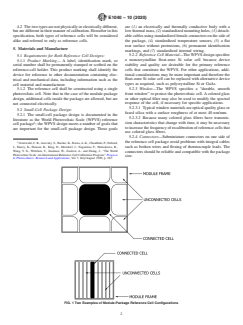
1.3.2 Module-Package Design—A package intended to simulate the optical and thermal properties of a photovoltaic module design, but electric connections are made to only one photovoltaic cell in order to eliminate problems with calibrating series and parallel connections of cells. Physical dimensions are not standardized.
1.4 The values stated in SI units are to be regarded as standard. No other units of measurement are included in this standard.
1.5 This standard does not purport to address all of the safety concerns, if any, associated with its use. It is the responsibility of the user of this standard to establish appropriate safety, health, and environmental practices and determine the applicability of regulatory limitations prior to use.
1.6 This international standard was developed in accordance with internationally recognized principles on standardization established in the Decision on Principles for the Development of International Standards, Guides and Recommendations issued by the World Trade Organization Technical Barriers to Trade (TBT) Committee.
- Status
- Published
- Publication Date
- 31-May-2020
- Technical Committee
- E44 - Solar, Geothermal and Other Alternative Energy Sources
- Drafting Committee
- E44.09 - Photovoltaic Electric Power Conversion


Overview
ASTM E1040-10(2020): Standard Specification for Physical Characteristics of Nonconcentrator Terrestrial Photovoltaic Reference Cells establishes the physical requirements for both primary and secondary reference cells used in nonconcentrator terrestrial photovoltaic (PV) applications. Developed by ASTM International, this standard ensures consistency, reliability, and comparability in performance evaluation and calibration of PV cells and modules. Covering key aspects such as product marking, cell materials, window construction, configuration, electrical connectors, and temperature sensors, the standard is vital for those involved in solar energy testing, calibration, and quality control.
Key Topics
Reference Cell Types
- Primary Reference Cells: Calibrated directly in sunlight using established test methods.
- Secondary Reference Cells: Calibrated using a primary reference cell as a reference.
Package Designs
- Small-Cell Package: Designed for PV devices up to 20 x 20 mm, featuring standardized dimensions and low thermal mass.
- Module-Package: Simulates the thermal and optical properties of actual PV modules, with a focus on replicating module conditions while connecting only one cell electrically.
Construction Requirements
- Permanent identification markings for traceability
- Use of monocrystalline silicon is typical, with allowance for other technologies as needed.
- Durable, smooth front window (glass or fused silica) that can incorporate spectral filters.
- Standardized, detachable connectors for reliable electrical connections.
- Reliable mounting and robust temperature sensors ensuring accurate operational data.
Documentation
- Reference cells must be accompanied by detailed records on calibration constants, physical and electrical characteristics, materials used, and relevant manufacturing data.
Applications
ASTM E1040-10(2020) is critical to the solar energy sector, particularly in:
PV Cell and Module Calibration
Reference cells defined by this standard are essential for calibrating and comparing the performance of photovoltaic cells and arrays, enabling precise characterization of electrical output under standardized test conditions.Quality Assurance and Research
Manufacturers, test laboratories, and researchers rely on standardized reference cells for consistent quality control, product development, and performance benchmarking.Performance Testing
Used in conjunction with ASTM test methods (such as E948 and E1036), these reference cells ensure accurate determination of electrical characteristics like current-voltage response under simulated or actual sunlight.Compliance and Traceability
Compliance with this standard supports orderly market transactions, regulatory requirements, and international trade by assuring consistency in reference cell design and reporting.
Related Standards
- ASTM E948: Test Method for Electrical Performance of Photovoltaic Cells Using Reference Cells Under Simulated Sunlight
- ASTM E1036: Test Methods for Electrical Performance of Nonconcentrator Terrestrial Photovoltaic Modules and Arrays
- ASTM E1125: Test Method for Calibration of Primary Nonconcentrator Terrestrial Photovoltaic Reference Cells
- ASTM E1362: Test Methods for Calibration of Nonconcentrator Photovoltaic Non-Primary Reference Cells
- ASTM E772: Terminology of Solar Energy Conversion
- Military Specification MS3106C: Connector requirements for module-package designs
Practical Value
Adhering to ASTM E1040-10(2020) ensures that photovoltaic reference cells are constructed, identified, and documented with precision-promoting global consistency in solar energy measurements. These guidelines support reliable data for PV system designers, improve product quality, and help align manufacturers with international best practices in photovoltaic technology and solar energy standardization.
Keywords: photovoltaic reference cells, nonconcentrator, ASTM E1040, solar energy, calibration, PV module, physical characteristics, electrical performance, standardization, quality control
Relations
- Effective Date
- 01-Jun-2020
- Effective Date
- 01-Jun-2020
- Effective Date
- 01-Apr-2019
- Effective Date
- 01-Apr-2019
- Effective Date
- 01-Nov-2016
- Effective Date
- 01-Jul-2016
- Effective Date
- 01-Dec-2015
- Effective Date
- 01-Mar-2015
- Effective Date
- 01-Feb-2015
- Effective Date
- 01-Feb-2015
- Effective Date
- 01-Sep-2013
- Effective Date
- 01-Dec-2012
- Effective Date
- 01-Sep-2011
- Effective Date
- 01-Jun-2010
- Effective Date
- 01-Jan-2010
Get Certified
Connect with accredited certification bodies for this standard

DNV
DNV is an independent assurance and risk management provider.

Lloyd's Register
Lloyd's Register is a global professional services organisation specialising in engineering and technology.
DNV Energy Systems
Energy and renewable energy certification.
Sponsored listings
Frequently Asked Questions
ASTM E1040-10(2020) is a technical specification published by ASTM International. Its full title is "Standard Specification for Physical Characteristics of Nonconcentrator Terrestrial Photovoltaic Reference Cells". This standard covers: ABSTRACT This specification describes the physical requirements for primary and secondary nonconcentrator terrestrial phorovoltaic reference cells based on small-cell package design and module-package design. These requirements include those for product marking, reference cell material, window, configuration, electrical connectors, and temperature sensor. SCOPE 1.1 This specification describes the physical requirements for primary and secondary terrestrial nonconcentrator photovoltaic reference cells. A reference cell is defined as a device that meets the requirements of this specification and is calibrated in accordance with Test Method E1125 or Test Method E1362. 1.2 Reference cells are used in the determination of the electrical performance of photovoltaic devices, as stated in Test Methods E948 and E1036. 1.3 Two reference cell physical specifications are described: 1.3.1 Small-Cell Package Design—A small, durable package with a low thermal mass, wide optical field-of-view, and standardized dimensions intended for photovoltaic devices up to 20 by 20 mm, and 1.3.2 Module-Package Design—A package intended to simulate the optical and thermal properties of a photovoltaic module design, but electric connections are made to only one photovoltaic cell in order to eliminate problems with calibrating series and parallel connections of cells. Physical dimensions are not standardized. 1.4 The values stated in SI units are to be regarded as standard. No other units of measurement are included in this standard. 1.5 This standard does not purport to address all of the safety concerns, if any, associated with its use. It is the responsibility of the user of this standard to establish appropriate safety, health, and environmental practices and determine the applicability of regulatory limitations prior to use. 1.6 This international standard was developed in accordance with internationally recognized principles on standardization established in the Decision on Principles for the Development of International Standards, Guides and Recommendations issued by the World Trade Organization Technical Barriers to Trade (TBT) Committee.
ABSTRACT This specification describes the physical requirements for primary and secondary nonconcentrator terrestrial phorovoltaic reference cells based on small-cell package design and module-package design. These requirements include those for product marking, reference cell material, window, configuration, electrical connectors, and temperature sensor. SCOPE 1.1 This specification describes the physical requirements for primary and secondary terrestrial nonconcentrator photovoltaic reference cells. A reference cell is defined as a device that meets the requirements of this specification and is calibrated in accordance with Test Method E1125 or Test Method E1362. 1.2 Reference cells are used in the determination of the electrical performance of photovoltaic devices, as stated in Test Methods E948 and E1036. 1.3 Two reference cell physical specifications are described: 1.3.1 Small-Cell Package Design—A small, durable package with a low thermal mass, wide optical field-of-view, and standardized dimensions intended for photovoltaic devices up to 20 by 20 mm, and 1.3.2 Module-Package Design—A package intended to simulate the optical and thermal properties of a photovoltaic module design, but electric connections are made to only one photovoltaic cell in order to eliminate problems with calibrating series and parallel connections of cells. Physical dimensions are not standardized. 1.4 The values stated in SI units are to be regarded as standard. No other units of measurement are included in this standard. 1.5 This standard does not purport to address all of the safety concerns, if any, associated with its use. It is the responsibility of the user of this standard to establish appropriate safety, health, and environmental practices and determine the applicability of regulatory limitations prior to use. 1.6 This international standard was developed in accordance with internationally recognized principles on standardization established in the Decision on Principles for the Development of International Standards, Guides and Recommendations issued by the World Trade Organization Technical Barriers to Trade (TBT) Committee.
ASTM E1040-10(2020) is classified under the following ICS (International Classification for Standards) categories: 27.160 - Solar energy engineering. The ICS classification helps identify the subject area and facilitates finding related standards.
ASTM E1040-10(2020) has the following relationships with other standards: It is inter standard links to ASTM E1040-10(2016), ASTM E948-16(2020), ASTM E1362-15(2019), ASTM E1036-15(2019), ASTM E948-16, ASTM E1125-16, ASTM E1362-15, ASTM E1125-10(2015), ASTM E1036-15, ASTM E948-15, ASTM E772-13, ASTM E1036-12, ASTM E772-11, ASTM E1125-10, ASTM E1362-10. Understanding these relationships helps ensure you are using the most current and applicable version of the standard.
ASTM E1040-10(2020) is available in PDF format for immediate download after purchase. The document can be added to your cart and obtained through the secure checkout process. Digital delivery ensures instant access to the complete standard document.
Standards Content (Sample)
This international standard was developed in accordance with internationally recognized principles on standardization established in the Decision on Principles for the
Development of International Standards, Guides and Recommendations issued by the World Trade Organization Technical Barriers to Trade (TBT) Committee.
Designation: E1040 −10 (Reapproved 2020) An American National Standard
Standard Specification for
Physical Characteristics of Nonconcentrator Terrestrial
Photovoltaic Reference Cells
This standard is issued under the fixed designation E1040; the number immediately following the designation indicates the year of
original adoption or, in the case of revision, the year of last revision. A number in parentheses indicates the year of last reapproval. A
superscript epsilon (´) indicates an editorial change since the last revision or reapproval.
1. Scope 2. Referenced Documents
1.1 This specification describes the physical requirements 2.1 ASTM Standards:
for primary and secondary terrestrial nonconcentrator photo- E772 Terminology of Solar Energy Conversion
voltaic reference cells. A reference cell is defined as a device E948 Test Method for Electrical Performance of Photovol-
that meets the requirements of this specification and is cali- taic Cells Using Reference Cells Under Simulated Sun-
brated in accordance with Test Method E1125 or Test Method light
E1362. E1036 Test Methods for Electrical Performance of Noncon-
centrator Terrestrial Photovoltaic Modules and Arrays
1.2 Reference cells are used in the determination of the
Using Reference Cells
electricalperformanceofphotovoltaicdevices,asstatedinTest
E1125 Test Method for Calibration of Primary Non-
Methods E948 and E1036.
Concentrator Terrestrial Photovoltaic Reference Cells Us-
1.3 Two reference cell physical specifications are described:
ing a Tabular Spectrum
1.3.1 Small-Cell Package Design—A small, durable pack-
E1328 Terminology Relating to Photovoltaic Solar Energy
age with a low thermal mass, wide optical field-of-view, and
Conversion (Withdrawn 2012)
standardized dimensions intended for photovoltaic devices up
E1362 Test Methods for Calibration of Non-Concentrator
to 20 by 20 mm, and
Photovoltaic Non-Primary Reference Cells
1.3.2 Module-Package Design—A package intended to
2.2 Military Specification Sheet:
simulate the optical and thermal properties of a photovoltaic
MS3106C Connector, Plug, Electric, Straight, Solder
module design, but electric connections are made to only one
Contracts, AN Type
photovoltaic cell in order to eliminate problems with calibrat-
ing series and parallel connections of cells. Physical dimen-
3. Terminology
sions are not standardized.
3.1 Definitions—For definitions of terms used in this
1.4 The values stated in SI units are to be regarded as
specification, see Terminologies E772 and E1328.
standard. No other units of measurement are included in this
standard.
4. Classification
1.5 This standard does not purport to address all of the
4.1 Two types of reference cells are used in the evaluation
safety concerns, if any, associated with its use. It is the
of the electrical performance of photovoltaic terrestrial de-
responsibility of the user of this standard to establish appro-
vices:
priate safety, health, and environmental practices and deter-
4.1.1 Primary Reference Cells—Reference cells calibrated
mine the applicability of regulatory limitations prior to use.
directly in sunlight in accordance with Test Method E1125.
1.6 This international standard was developed in accor-
4.1.2 Secondary Reference Cells—Reference cells cali-
dance with internationally recognized principles on standard-
brated against a primary reference cell in accordance with Test
ization established in the Decision on Principles for the
Method E1362.
Development of International Standards, Guides and Recom-
mendations issued by the World Trade Organization Technical
Barriers to Trade (TBT) Committee.
For referenced ASTM standards, visit the ASTM website, www.astm.org, or
contact ASTM Customer Service at service@astm.org. For Annual Book of ASTM
This specification is under the jurisdiction of ASTM Committee E44 on Solar, Standards volume information, refer to the standard’s Document Summary page on
Geothermal and OtherAlternative Energy Sources and is the direct responsibility of the ASTM website.
Subcommittee E44.09 on Photovoltaic Electric Power Conversion. The last approved version of this historical standard is referenced on
CurrenteditionapprovedJune1,2020.PublishedJuly2020.Originallyapproved www.astm.org.
in 1984. Last previous edition approved in 2016 as E1040 – 10 (2016). DOI: Available from Superintendent of Documents, U.S. Government Printing
10.1520/E1040-10R20. Office, N. Capital and H Streets, NW, Washington, DC 20401.
Copyright © ASTM International, 100 Barr Harbor Drive, PO Box C700, West Conshohocken, PA 19428-2959. United States
E1040 − 10 (2020)
4.2 Thetwotypesarenotphysicallyorelectricallydifferent, are (1) an electrically and thermally conductive body with a
butaredifferentintheirmannerofcalibration.Hereafterinthis lowthermalmass, (2)standardizedmountingholes, (3)detach-
specification, both types of reference cells will be considered ablecablesusingstandardizedfemaleconnectorsonthesideof
alike and referred to only as reference cells. the package, (4) standardized temperature sensors, (5) a flat
rear surface without protrusions, (6) permanent identification
5. Materials and Manufacture
markings, and (7) standardized internal wiring.
5.2.2 Reference Cell Material—The WPVS design specifies
5.1 Requirements for Both Reference Cell Designs:
a monocrystalline float-zone Si solar cell because device
5.1.1 Product Marking— A label, identification mark, or
stability and quality are desirable for the primary reference
serial number shall be permanently stamped or scribed on the
cells that constitute the WPVS. For other applications, addi-
reference-cell holder. This product marking shall identify the
tional considerations may be more important and therefore the
device for reference to other documentation containing elec-
float-zone Si solar cell can be replaced with alternative device
trical and mechanical data, including information such as the
types as required, such as polycrystalline Si or GaAs.
cell material and manufacturer.
5.2.3 Window—The WPVS specifies a “durable, sm
...