

ASTM E822-92(2023)
(Practice)Standard Practice for Determining Resistance of Solar Collector Covers to Hail by Impact with Propelled Ice Balls
General Information
- Abstract
SIGNIFICANCE AND USE
2.1 In many geographic areas there is concern about the effect of falling hail upon solar collector covers. This practice may be used to determine the ability of flat-plate solar collector covers to withstand the impact forces of hailstones. In this practice, the ability of a solar collector cover plate to withstand hail impact is related to its tested ability to withstand impact from ice balls. The effects of the impact on the material are highly variable and dependent upon the material.
2.2 This practice describes a standard procedure for mounting the test specimen, conducting the impact test, and reporting the effects.
2.2.1 The procedures for mounting cover plate materials and collectors are provided to ensure that they are tested in a configuration that relates to their use in a solar collector.
2.2.2 The corner locations of the four impacts are chosen to represent vulnerable sites on the cover plate. Impacts near corner supports are more critical than impacts elsewhere. Only a single impact is specified at each of the impact locations. For test control purposes, multiple impacts in a single location are not permitted because a subcritical impact may still cause damage that would alter the response to subsequent impacts.
2.2.3 Resultant velocity is used to simulate the velocity that may be reached by hail accompanied by wind. The resultant velocity used in this practice is determined by vector addition of a 20 m/s (45 mph) horizontal velocity to the vertical terminal velocity.
2.2.4 Ice balls are used in this practice to simulate hailstones because natural hailstones are not readily available to use, and ice balls closely approximate hailstones. However, no direct relationship has been established between the effect of impact of ice balls and hailstones. Hailstones are highly variable in properties such as shape, density, and frangibility.2 These properties affect factors such as the kinetic energy delivered to the cover plate, the period during ...
SCOPE
1.1 This practice covers a procedure for determining the ability of cover plates for flat-plate solar collectors to withstand impact forces of falling hail. Propelled ice balls are used to simulate falling hailstones. This practice is not intended to apply to photovoltaic cells or arrays.
1.2 This practice defines two types of test specimens, describes methods for mounting specimens, specifies impact locations on each test specimen, provides an equation for determining the velocity of any size ice ball, provides a method for impacting the test specimens with ice balls, and specifies parameters that must be recorded and reported.
1.3 This practice does not establish pass or fail levels. The determination of acceptable or unacceptable levels of ice-ball impact resistance is beyond the scope of this practice.
1.4 The size of ice ball to be used in conducting this test is not specified in this practice. This practice can be used with various sizes of ice balls.
1.5 The categories of solar collector cover plate materials to which this practice may be applied cover the range of:
1.5.1 Brittle sheet, such as glass,
1.5.2 Semirigid sheet, such as plastic, and
1.5.3 Flexible membrane, such as plastic film.
1.6 Solar collector cover materials should be tested as:
1.6.1 Part of an assembled collector (Type 1 specimen), or
1.6.2 Mounted on a separate test frame cover plate holder (Type 2 specimen).
1.7 The values stated in SI units are to be regarded as the standard. The values given in parentheses are for information only.
1.8 This standard does not purport to address all of the safety concerns, if any, associated with its use. It is the responsibility of the user of this standard to establish appropriate safety, health, and environmental practices and determine the applicability of regulatory limitations prior to use.
1.9 This international standard was developed in accordance with internatio...
- Status
- Published
- Publication Date
- 30-Apr-2023
- Technical Committee
- E44 - Solar, Geothermal and Other Alternative Energy Sources
- Drafting Committee
- E44.20 - Optical Materials for Solar Applications
Overview
ASTM E822-92(2023) is the internationally recognized standard practice for determining the resistance of solar collector covers to hail impact using propelled ice balls. Developed by ASTM International, this standard is integral for manufacturers, testing laboratories, and users of flat-plate solar collectors in regions prone to hailstorms. It offers a controlled test method to simulate the effects of natural hail by using ice balls as surrogates, evaluating the durability and performance of various solar collector cover materials under impact conditions.
Key Topics
Scope and Purpose
- Defines a procedure to assess the impact resistance of flat-plate solar collector covers against simulated hail.
- Applicable to a broad range of cover materials, including brittle glass, semi-rigid plastics, and flexible membranes.
- Specifies mounting types: testing as part of an assembled collector (Type 1) or as a material sample in a frame (Type 2).
Test Method Summary
- The procedure uses ice balls, manufactured to specified diameters, launched at test specimens to replicate the energy of natural hailstones.
- Four impact points are selected, typically near the corners of the cover plate, representing areas most vulnerable to hail damage.
- Velocity of the ice balls is calculated to simulate real-world hail accompanied by high winds, ensuring tests are stringent and relevant.
Reporting and Evaluation
- Outlines precise requirements for documenting specimen details, test setup, ice ball characteristics, and observable damage.
- The standard does not prescribe pass/fail criteria or specific thresholds; results must be interpreted comparatively or as part of a broader design validation.
Safety Considerations
- Emphasizes the need for protective equipment and safe operating procedures due to risks associated with high-velocity projectiles and material breakage during testing.
Applications
- Solar Collector Product Qualification
- Used by manufacturers to validate the hail resistance of new solar collector designs before market release, supporting product claims and enhancing customer confidence.
- Performance Comparison
- Enables objective comparison across different cover materials and configurations, helping users select suitable options for specific climates and hail-exposure risks.
- Material Development and R&D
- Valuable for research and development, allowing material engineers to assess the effects of design changes or new materials on hail impact resistance.
- Geographic Suitability Assessment
- Assists in determining whether a collector cover is appropriate for deployment in geographic regions with known hailstorm frequency and size.
Related Standards
- ASTM E1038 - Standard Test Method for Determining Resistance of Materials to Hail Impact Using Impact with Propelled Ice Balls
- IEC 61215 - Terrestrial photovoltaic (PV) modules - Design qualification and type approval (includes hail testing for PV modules)
- UL 1703 - Standard for Flat-Plate Photovoltaic Modules and Panels (contains related impact resistance tests)
- ISO 9806 - Solar energy - Solar thermal collectors - Test methods (addresses durability including impact resistance)
These standards complement ASTM E822 by providing similar procedures for other solar technologies, additional material types, or integrating performance thresholds.
Keywords: ASTM E822, hail resistance, solar collector cover, impact test, propelled ice balls, flat-plate solar collector, standard practice, material durability, renewable energy, impact resistance testing, solar energy system standards.
Get Certified
Connect with accredited certification bodies for this standard

DNV
DNV is an independent assurance and risk management provider.

Lloyd's Register
Lloyd's Register is a global professional services organisation specialising in engineering and technology.
DNV Energy Systems
Energy and renewable energy certification.
Sponsored listings
Frequently Asked Questions
ASTM E822-92(2023) is a standard published by ASTM International. Its full title is "Standard Practice for Determining Resistance of Solar Collector Covers to Hail by Impact with Propelled Ice Balls". This standard covers: SIGNIFICANCE AND USE 2.1 In many geographic areas there is concern about the effect of falling hail upon solar collector covers. This practice may be used to determine the ability of flat-plate solar collector covers to withstand the impact forces of hailstones. In this practice, the ability of a solar collector cover plate to withstand hail impact is related to its tested ability to withstand impact from ice balls. The effects of the impact on the material are highly variable and dependent upon the material. 2.2 This practice describes a standard procedure for mounting the test specimen, conducting the impact test, and reporting the effects. 2.2.1 The procedures for mounting cover plate materials and collectors are provided to ensure that they are tested in a configuration that relates to their use in a solar collector. 2.2.2 The corner locations of the four impacts are chosen to represent vulnerable sites on the cover plate. Impacts near corner supports are more critical than impacts elsewhere. Only a single impact is specified at each of the impact locations. For test control purposes, multiple impacts in a single location are not permitted because a subcritical impact may still cause damage that would alter the response to subsequent impacts. 2.2.3 Resultant velocity is used to simulate the velocity that may be reached by hail accompanied by wind. The resultant velocity used in this practice is determined by vector addition of a 20 m/s (45 mph) horizontal velocity to the vertical terminal velocity. 2.2.4 Ice balls are used in this practice to simulate hailstones because natural hailstones are not readily available to use, and ice balls closely approximate hailstones. However, no direct relationship has been established between the effect of impact of ice balls and hailstones. Hailstones are highly variable in properties such as shape, density, and frangibility.2 These properties affect factors such as the kinetic energy delivered to the cover plate, the period during ... SCOPE 1.1 This practice covers a procedure for determining the ability of cover plates for flat-plate solar collectors to withstand impact forces of falling hail. Propelled ice balls are used to simulate falling hailstones. This practice is not intended to apply to photovoltaic cells or arrays. 1.2 This practice defines two types of test specimens, describes methods for mounting specimens, specifies impact locations on each test specimen, provides an equation for determining the velocity of any size ice ball, provides a method for impacting the test specimens with ice balls, and specifies parameters that must be recorded and reported. 1.3 This practice does not establish pass or fail levels. The determination of acceptable or unacceptable levels of ice-ball impact resistance is beyond the scope of this practice. 1.4 The size of ice ball to be used in conducting this test is not specified in this practice. This practice can be used with various sizes of ice balls. 1.5 The categories of solar collector cover plate materials to which this practice may be applied cover the range of: 1.5.1 Brittle sheet, such as glass, 1.5.2 Semirigid sheet, such as plastic, and 1.5.3 Flexible membrane, such as plastic film. 1.6 Solar collector cover materials should be tested as: 1.6.1 Part of an assembled collector (Type 1 specimen), or 1.6.2 Mounted on a separate test frame cover plate holder (Type 2 specimen). 1.7 The values stated in SI units are to be regarded as the standard. The values given in parentheses are for information only. 1.8 This standard does not purport to address all of the safety concerns, if any, associated with its use. It is the responsibility of the user of this standard to establish appropriate safety, health, and environmental practices and determine the applicability of regulatory limitations prior to use. 1.9 This international standard was developed in accordance with internatio...
SIGNIFICANCE AND USE 2.1 In many geographic areas there is concern about the effect of falling hail upon solar collector covers. This practice may be used to determine the ability of flat-plate solar collector covers to withstand the impact forces of hailstones. In this practice, the ability of a solar collector cover plate to withstand hail impact is related to its tested ability to withstand impact from ice balls. The effects of the impact on the material are highly variable and dependent upon the material. 2.2 This practice describes a standard procedure for mounting the test specimen, conducting the impact test, and reporting the effects. 2.2.1 The procedures for mounting cover plate materials and collectors are provided to ensure that they are tested in a configuration that relates to their use in a solar collector. 2.2.2 The corner locations of the four impacts are chosen to represent vulnerable sites on the cover plate. Impacts near corner supports are more critical than impacts elsewhere. Only a single impact is specified at each of the impact locations. For test control purposes, multiple impacts in a single location are not permitted because a subcritical impact may still cause damage that would alter the response to subsequent impacts. 2.2.3 Resultant velocity is used to simulate the velocity that may be reached by hail accompanied by wind. The resultant velocity used in this practice is determined by vector addition of a 20 m/s (45 mph) horizontal velocity to the vertical terminal velocity. 2.2.4 Ice balls are used in this practice to simulate hailstones because natural hailstones are not readily available to use, and ice balls closely approximate hailstones. However, no direct relationship has been established between the effect of impact of ice balls and hailstones. Hailstones are highly variable in properties such as shape, density, and frangibility.2 These properties affect factors such as the kinetic energy delivered to the cover plate, the period during ... SCOPE 1.1 This practice covers a procedure for determining the ability of cover plates for flat-plate solar collectors to withstand impact forces of falling hail. Propelled ice balls are used to simulate falling hailstones. This practice is not intended to apply to photovoltaic cells or arrays. 1.2 This practice defines two types of test specimens, describes methods for mounting specimens, specifies impact locations on each test specimen, provides an equation for determining the velocity of any size ice ball, provides a method for impacting the test specimens with ice balls, and specifies parameters that must be recorded and reported. 1.3 This practice does not establish pass or fail levels. The determination of acceptable or unacceptable levels of ice-ball impact resistance is beyond the scope of this practice. 1.4 The size of ice ball to be used in conducting this test is not specified in this practice. This practice can be used with various sizes of ice balls. 1.5 The categories of solar collector cover plate materials to which this practice may be applied cover the range of: 1.5.1 Brittle sheet, such as glass, 1.5.2 Semirigid sheet, such as plastic, and 1.5.3 Flexible membrane, such as plastic film. 1.6 Solar collector cover materials should be tested as: 1.6.1 Part of an assembled collector (Type 1 specimen), or 1.6.2 Mounted on a separate test frame cover plate holder (Type 2 specimen). 1.7 The values stated in SI units are to be regarded as the standard. The values given in parentheses are for information only. 1.8 This standard does not purport to address all of the safety concerns, if any, associated with its use. It is the responsibility of the user of this standard to establish appropriate safety, health, and environmental practices and determine the applicability of regulatory limitations prior to use. 1.9 This international standard was developed in accordance with internatio...
ASTM E822-92(2023) is classified under the following ICS (International Classification for Standards) categories: 27.160 - Solar energy engineering. The ICS classification helps identify the subject area and facilitates finding related standards.
ASTM E822-92(2023) is available in PDF format for immediate download after purchase. The document can be added to your cart and obtained through the secure checkout process. Digital delivery ensures instant access to the complete standard document.
Standards Content (Sample)
This international standard was developed in accordance with internationally recognized principles on standardization established in the Decision on Principles for the
Development of International Standards, Guides and Recommendations issued by the World Trade Organization Technical Barriers to Trade (TBT) Committee.
Designation: E822 − 92 (Reapproved 2023)
Standard Practice for
Determining Resistance of Solar Collector Covers to Hail by
Impact with Propelled Ice Balls
This standard is issued under the fixed designation E822; the number immediately following the designation indicates the year of
original adoption or, in the case of revision, the year of last revision. A number in parentheses indicates the year of last reapproval. A
superscript epsilon (´) indicates an editorial change since the last revision or reapproval.
This standard has been approved for use by agencies of the U.S. Department of Defense.
1. Scope responsibility of the user of this standard to establish appro-
priate safety, health, and environmental practices and deter-
1.1 This practice covers a procedure for determining the
mine the applicability of regulatory limitations prior to use.
ability of cover plates for flat-plate solar collectors to withstand
1.9 This international standard was developed in accor-
impact forces of falling hail. Propelled ice balls are used to
dance with internationally recognized principles on standard-
simulate falling hailstones. This practice is not intended to
ization established in the Decision on Principles for the
apply to photovoltaic cells or arrays.
Development of International Standards, Guides and Recom-
1.2 This practice defines two types of test specimens,
mendations issued by the World Trade Organization Technical
describes methods for mounting specimens, specifies impact
Barriers to Trade (TBT) Committee.
locations on each test specimen, provides an equation for
determining the velocity of any size ice ball, provides a method
2. Significance and Use
for impacting the test specimens with ice balls, and specifies
2.1 In many geographic areas there is concern about the
parameters that must be recorded and reported.
effect of falling hail upon solar collector covers. This practice
1.3 This practice does not establish pass or fail levels. The
may be used to determine the ability of flat-plate solar collector
determination of acceptable or unacceptable levels of ice-ball
covers to withstand the impact forces of hailstones. In this
impact resistance is beyond the scope of this practice.
practice, the ability of a solar collector cover plate to withstand
hail impact is related to its tested ability to withstand impact
1.4 The size of ice ball to be used in conducting this test is
from ice balls. The effects of the impact on the material are
not specified in this practice. This practice can be used with
highly variable and dependent upon the material.
various sizes of ice balls.
2.2 This practice describes a standard procedure for mount-
1.5 The categories of solar collector cover plate materials to
ing the test specimen, conducting the impact test, and reporting
which this practice may be applied cover the range of:
the effects.
1.5.1 Brittle sheet, such as glass,
2.2.1 The procedures for mounting cover plate materials
1.5.2 Semirigid sheet, such as plastic, and
and collectors are provided to ensure that they are tested in a
1.5.3 Flexible membrane, such as plastic film.
configuration that relates to their use in a solar collector.
1.6 Solar collector cover materials should be tested as:
2.2.2 The corner locations of the four impacts are chosen to
1.6.1 Part of an assembled collector (Type 1 specimen), or
represent vulnerable sites on the cover plate. Impacts near
1.6.2 Mounted on a separate test frame cover plate holder
corner supports are more critical than impacts elsewhere. Only
(Type 2 specimen).
a single impact is specified at each of the impact locations. For
1.7 The values stated in SI units are to be regarded as the
test control purposes, multiple impacts in a single location are
standard. The values given in parentheses are for information
not permitted because a subcritical impact may still cause
only.
damage that would alter the response to subsequent impacts.
2.2.3 Resultant velocity is used to simulate the velocity that
1.8 This standard does not purport to address all of the
may be reached by hail accompanied by wind. The resultant
safety concerns, if any, associated with its use. It is the
velocity used in this practice is determined by vector addition
of a 20 m/s (45 mph) horizontal velocity to the vertical terminal
velocity.
This practice is under the jurisdiction of ASTM Committee E44 on Solar,
Geothermal and Other Alternative Energy Sources and is the direct responsibility of
2.2.4 Ice balls are used in this practice to simulate hailstones
Subcommittee E44.20 on Optical Materials for Solar Applications.
because natural hailstones are not readily available to use, and
Current edition approved May 1, 2023. Published May 2023. Originally
ice balls closely approximate hailstones. However, no direct
approved in 1981. Last previous edition approved in 2015 as E822 – 92 (2015).
DOI: 10.1520/E0822-92R23. relationship has been established between the effect of impact
Copyright © ASTM International, 100 Barr Harbor Drive, PO Box C700, West Conshohocken, PA 19428-2959. United States
E822 − 92 (2023)
of ice balls and hailstones. Hailstones are highly variable in
properties such as shape, density, and frangibility. These
properties affect factors such as the kinetic energy delivered to
the cover plate, the period during which energy is delivered,
and the area over which the energy is distributed. Ice balls,
with a density, frangibility, and terminal velocity near the range
of hailstones, are the nearest hailstone approximation known at
this time. Perhaps the major difference between ice balls and
hailstones is that hailstones are much more variable than ice
balls. However, ice balls can be uniformly and repeatedly
manufactured to ensure a projectile with known properties.
2.2.5 A wide range of observable effects may be produced
by impacting the various types of cover plate materials. The
effects may vary from no effect to total destruction. Some
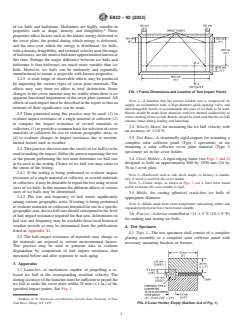
FIG. 1 Frame Dimensions and Location of Test Impact Points
changes in the cover material may be visible when there is no
apparent functional impairment of the cover plate material. All
NOTE 1—A launcher that has proven suitable uses a compressed air
effects of each impact must be described in the report so that an
supply, an accumulator tank, a large-diameter quick-opening valve, and
estimate of their significance can be made.
interchangeable barrels to accommodate the sizes of ice balls to be used.
Barrels should be made from materials with low thermal conductivity to
2.3 Data generated using this practice may be used: (1) to
reduce melting of the ice ball. Barrels should be sized such that the ice ball
evaluate impact resistance of a single material or collector, (2)
remains intact during loading and launching.
to compare the impact resistance of several materials or
3.2 Velocity Meter, for measuring the ice ball velocity with
collectors, (3) to provide a common basis for selection of cover
an accuracy of 62.0 %.
materials or collectors for use in various geographic areas, or
3.3 Test Base—A structurally rigid support for mounting a
(4) to evaluate changes in impact resistance due to environ-
complete solar collector panel (Type 1 specimen), or for
mental factors such as weather.
mounting a solar collector cover plate material (Type 2
2.4 This practice does not state the size(s) of ice ball(s) to be
specimen) set in the cover holder.
used in making the impact. Either the person requesting the test
3.4 Cover Holder—A rigid edging frame (see Figs. 1 and 2)
or the person performing the test must determine ice ball size
designed to hold an approximately 860 by 1930-mm (34 by
to be used in the testing. Choice of ice ball size may relate to
76-in.) cover plate.
the intent of the testing.
2.4.1 If the testing is being performed to evaluate impact
NOTE 2—Hardwood, such as oak, birch, maple, or hickory, is manda-
resistance of a single material or collector, or several materials
tory if wood is used for the cover holder.
or collectors, it may be desirable to repeat the test using several NOTE 3—Corner straps, as shown in Figs. 3 and 4, have been found
useful to ensure the cover holder is rigid.
sizes of ice balls. In this manner the different effects of various
sizes of ice balls may be determined.
3.5 Molds, for casting spherical crack-free ice balls of
2.4.2 The size and frequency of hail varies significantly
appropriate diameter.
among various geographic areas. If testing is being performed
NOTE 4—Molds made from room temperature vulcanizing rubber and
to evaluate materials or collectors intended for use in a specific
expanded polystyrene have been found suitable.
geographic area, the ice ball size should correspond to the level
3.6 Freezer—A device controlled at −12 6 5 °C (10 6 9 °F)
of hail impact resistance required for that area. Information on
for making and storing ice balls.
hail size and frequency may be available from local historical
weather records or may be determined from the publications
4. Test Specimen
listed in Appendix X1.
4.1 Type 1—The test specimen shall consist of a complete
2.5 The hail impact resistance of materials may change as
glazing assembly or a complete solar collector panel with
the materials are exposed to various environmental factors.
necessary mounting brackets or fixtures.
This practice may be used to generate data to evaluate
degradation by comparison of hail impact resistance data
measured before and after exposure to such aging.
3. Apparatus
3.1 Launcher—A mechanism capable of propelling a se-
lected ice ball at the corresponding resultant velocity. The
aiming accuracy of the launcher must be sufficient to propel the
ice ball to strike the cover plate within 25 mm (61 in.) of the
specified impact points. See Fig. 1.
Gokhale, N. R., Hailstorms and Hailstone Growth, State University of New
York Press, Albany, NY, 1975. FIG. 2 Cover Holder, Empty (Section A-A of Fig. 1)
E822 − 92 (2023)
5. Mounting
5.1 Type 1—Position and support the test specimen on a
suitable test base using necessary mounting brackets or
fixtures, or both. Do not obstruct the specified impact points by
the mounting fixtures.
5.2 Type 2—Secure the test specimen in the cover holder, as
shown in Fig. 2 and Fig. 5, and mount the cover holder (with
the cover) on a suitable test base. Provide sufficient clearance
on the side opposite the impact surface to permit unobstructed
deflection of the cover material.
5.2.1 Lay brittle sheet cover materials, approximately 860
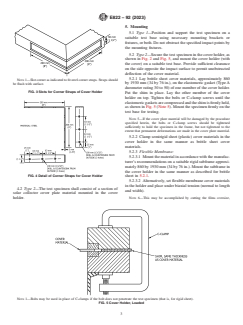
NOTE 1—Slot corner as indicated to fit steel corner straps. Straps should
by 1930 mm (34 by 76 in.), on the elastomeric gasket (Type A
be flush with surface.
durometer rating 30 to 50) of one member of the cover holder.
FIG. 3 Slots for Corner Straps of Cover Holder
Put the shim in place. Lay the other member of the cover
holder on top. Tighten the bolts or C-clamp screws until the
elastomeric gaskets are compressed and the shim is firmly held,
as shown in Fig. 5 (Note 5). Mount the specimen firmly on the
test base for testing.
NOTE 5—If the cover plate material will be damaged by the procedure
specified herein, the bolts or C-clamp screws should be tightened
sufficiently to hold the specimen in the frame, but not tightened to the
extent that permanent deformations are made
...