

ASTM E948-16(2020)
(Test Method)Standard Test Method for Electrical Performance of Photovoltaic Cells Using Reference Cells Under Simulated Sunlight
General Information
- Abstract
SIGNIFICANCE AND USE
5.1 This test method provides a procedure for testing and reporting the electrical performance of photovoltaic cells.
5.2 The test results may be used for comparison of cells among a group of similar cells or to compare diverse designs, such as different manufacturers' products. Repeated measurements of the same cell may be used to study changes in device performance.
5.3 This test method determines the electrical performance of a photovoltaic cell at a single instant of time and the results do no imply any past or future performance.
5.4 This test method requires a linear reference cell calibrated with respect to an appropriate reference spectral irradiance distribution, such as Tables E490, or G173. It is the responsibility of the user to determine which reference spectral irradiance distribution is appropriate for a particular application.
SCOPE
1.1 This test method covers the determination of the electrical performance of a photovoltaic cell under simulated sunlight by means of a calibrated reference cell procedure.
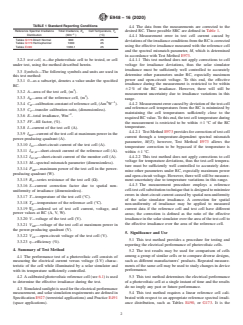
1.2 Electrical performance measurements are reported with respect to a select set of standard reporting conditions (SRC) (see Table 1) or to user-specified reporting conditions. In either case, the chosen reporting conditions are abbreviated as RC.
1.2.1 The RC include the cell temperature, the total irradiance, and the reference spectral irradiance distribution.
1.3 This test method is applicable only to photovoltaic cells with a linear short-circuit current versus total irradiance response up to and including the total irradiance used in the measurement.
1.4 The cell parameters determined by this test method apply only at the time of test, and imply no past or future performance level.
1.5 The values stated in SI units are to be regarded as standard. No other units of measurement are included in this standard.
1.6 This standard does not purport to address all of the safety concerns, if any, associated with its use. It is the responsibility of the user of this standard to establish appropriate safety, health, and environmental practices and determine the applicability of regulatory limitations prior to use.
1.7 This international standard was developed in accordance with internationally recognized principles on standardization established in the Decision on Principles for the Development of International Standards, Guides and Recommendations issued by the World Trade Organization Technical Barriers to Trade (TBT) Committee.
- Status
- Published
- Publication Date
- 31-May-2020
- Technical Committee
- E44 - Solar, Geothermal and Other Alternative Energy Sources
- Drafting Committee
- E44.09 - Photovoltaic Electric Power Conversion
Overview
ASTM E948-16(2020) - Standard Test Method for Electrical Performance of Photovoltaic Cells Using Reference Cells Under Simulated Sunlight provides a comprehensive methodology for determining the electrical performance of photovoltaic (PV) cells under controlled laboratory conditions. Developed by ASTM International, this standard ensures consistent, repeatable, and comparable testing of PV cells by using calibrated reference cells and simulated sunlight that replicates solar irradiance.
The standard defines procedures and equipment for measuring current-voltage (I-V) characteristics of PV cells, applying strict reporting conditions covering irradiance, temperature, and spectral distribution. With its focus on standardized reporting and correction methods, ASTM E948 is widely used in quality assurance, research and development, and comparative product evaluations in the solar energy industry.
Key Topics
Test Methodology
Specifies procedures for testing PV cells using a calibrated reference cell and a solar simulator, ensuring that temperature and irradiance conditions are tightly controlled during performance measurements.Standard Reporting Conditions (SRC)
Measurements are conducted and reported with respect to defined reporting conditions, including cell temperature, total irradiance, and reference spectral irradiance distribution. This enables accurate comparison across different cells or manufacturers.Reference Cell Calibration
Requires the use of a linear photovoltaic reference cell calibrated to an appropriate spectral irradiance standard (e.g., ASTM E490 or G173). Users must determine the correct reference for their specific application.Applicability
The method applies only to PV cells with a linear short-circuit current versus total irradiance response, ensuring reliable performance data for qualifying devices.Measurement Corrections and Uncertainty
Details correction techniques for spatial irradiance non-uniformity, spectral mismatch, and temperature variations to ensure data consistency. Emphasizes the importance of precise instrumentation and repeatable procedures to minimize measurement uncertainty.Data Reporting and Precision
Outlines mandatory data to report, including identification and physical description of both test and reference cells, test conditions, I-V data, open-circuit voltage, short-circuit current, maximum power, and calculated efficiency.
Applications
Product Comparison and Quality Control
Enables manufacturers, laboratories, and procurement agencies to compare electrical performance metrics of different photovoltaic cells and modules under standardized conditions.Research and Development
Assists R&D teams in assessing new cell designs, tracking performance changes over time, and benchmarking prototype cells against industry norms.Certification and Compliance
Widely adopted for compliance and certification testing, supporting market entry and product validation for solar devices.Performance Monitoring
Facilitates regular assessments of PV device performance to detect degradation, damage, or manufacturing inconsistencies in both production and operational environments.International Trade and Standardization
Supports fair trade and mutual recognition by aligning with internationally recognized principles such as those from the World Trade Organization Technical Barriers to Trade (TBT) Committee.
Related Standards
ASTM E948-16(2020) references and complements several other important standards in the field of photovoltaic testing and solar simulation, including:
- ASTM E490: Standard Solar Constant and Zero Air Mass Solar Spectral Irradiance Tables
- ASTM G173: Reference Solar Spectral Irradiances: Direct Normal and Hemispherical on 37° Tilted Surface
- ASTM E927: Classification for Solar Simulators for Electrical Performance Testing of Photovoltaic Devices
- ASTM E973: Test Method for Determination of the Spectral Mismatch Parameter Between a Photovoltaic Device and a Photovoltaic Reference Cell
- ASTM E1125 & E1362: Calibration Methods for Primary and Non-Primary PV Reference Cells
- ASTM E691: Practice for Conducting an Interlaboratory Study to Determine the Precision of a Test Method
Keywords: photovoltaic cell testing, electrical performance, reference cell calibration, solar simulator, simulated sunlight, standard reporting conditions, ASTM E948, solar energy standards, PV module comparison, spectral irradiance, I-V measurement.
Relations
- Effective Date
- 01-Jun-2020
- Effective Date
- 01-Apr-2019
- Effective Date
- 01-Feb-2019
- Effective Date
- 01-Jul-2016
- Effective Date
- 01-Jul-2016
- Effective Date
- 01-Dec-2015
- Effective Date
- 01-Dec-2015
- Effective Date
- 01-Nov-2015
- Effective Date
- 01-Mar-2015
- Effective Date
- 01-Mar-2015
- Effective Date
- 01-Sep-2013
- Effective Date
- 01-May-2013
- Effective Date
- 01-Nov-2011
- Effective Date
- 01-Sep-2011
- Refers
ASTM E927-10 - Standard Specification for Solar Simulation for Terrestrial Photovoltaic Testing - Effective Date
- 01-Jun-2010
Get Certified
Connect with accredited certification bodies for this standard

DNV
DNV is an independent assurance and risk management provider.

Lloyd's Register
Lloyd's Register is a global professional services organisation specialising in engineering and technology.
DNV Energy Systems
Energy and renewable energy certification.
Sponsored listings
Frequently Asked Questions
ASTM E948-16(2020) is a standard published by ASTM International. Its full title is "Standard Test Method for Electrical Performance of Photovoltaic Cells Using Reference Cells Under Simulated Sunlight". This standard covers: SIGNIFICANCE AND USE 5.1 This test method provides a procedure for testing and reporting the electrical performance of photovoltaic cells. 5.2 The test results may be used for comparison of cells among a group of similar cells or to compare diverse designs, such as different manufacturers' products. Repeated measurements of the same cell may be used to study changes in device performance. 5.3 This test method determines the electrical performance of a photovoltaic cell at a single instant of time and the results do no imply any past or future performance. 5.4 This test method requires a linear reference cell calibrated with respect to an appropriate reference spectral irradiance distribution, such as Tables E490, or G173. It is the responsibility of the user to determine which reference spectral irradiance distribution is appropriate for a particular application. SCOPE 1.1 This test method covers the determination of the electrical performance of a photovoltaic cell under simulated sunlight by means of a calibrated reference cell procedure. 1.2 Electrical performance measurements are reported with respect to a select set of standard reporting conditions (SRC) (see Table 1) or to user-specified reporting conditions. In either case, the chosen reporting conditions are abbreviated as RC. 1.2.1 The RC include the cell temperature, the total irradiance, and the reference spectral irradiance distribution. 1.3 This test method is applicable only to photovoltaic cells with a linear short-circuit current versus total irradiance response up to and including the total irradiance used in the measurement. 1.4 The cell parameters determined by this test method apply only at the time of test, and imply no past or future performance level. 1.5 The values stated in SI units are to be regarded as standard. No other units of measurement are included in this standard. 1.6 This standard does not purport to address all of the safety concerns, if any, associated with its use. It is the responsibility of the user of this standard to establish appropriate safety, health, and environmental practices and determine the applicability of regulatory limitations prior to use. 1.7 This international standard was developed in accordance with internationally recognized principles on standardization established in the Decision on Principles for the Development of International Standards, Guides and Recommendations issued by the World Trade Organization Technical Barriers to Trade (TBT) Committee.
SIGNIFICANCE AND USE 5.1 This test method provides a procedure for testing and reporting the electrical performance of photovoltaic cells. 5.2 The test results may be used for comparison of cells among a group of similar cells or to compare diverse designs, such as different manufacturers' products. Repeated measurements of the same cell may be used to study changes in device performance. 5.3 This test method determines the electrical performance of a photovoltaic cell at a single instant of time and the results do no imply any past or future performance. 5.4 This test method requires a linear reference cell calibrated with respect to an appropriate reference spectral irradiance distribution, such as Tables E490, or G173. It is the responsibility of the user to determine which reference spectral irradiance distribution is appropriate for a particular application. SCOPE 1.1 This test method covers the determination of the electrical performance of a photovoltaic cell under simulated sunlight by means of a calibrated reference cell procedure. 1.2 Electrical performance measurements are reported with respect to a select set of standard reporting conditions (SRC) (see Table 1) or to user-specified reporting conditions. In either case, the chosen reporting conditions are abbreviated as RC. 1.2.1 The RC include the cell temperature, the total irradiance, and the reference spectral irradiance distribution. 1.3 This test method is applicable only to photovoltaic cells with a linear short-circuit current versus total irradiance response up to and including the total irradiance used in the measurement. 1.4 The cell parameters determined by this test method apply only at the time of test, and imply no past or future performance level. 1.5 The values stated in SI units are to be regarded as standard. No other units of measurement are included in this standard. 1.6 This standard does not purport to address all of the safety concerns, if any, associated with its use. It is the responsibility of the user of this standard to establish appropriate safety, health, and environmental practices and determine the applicability of regulatory limitations prior to use. 1.7 This international standard was developed in accordance with internationally recognized principles on standardization established in the Decision on Principles for the Development of International Standards, Guides and Recommendations issued by the World Trade Organization Technical Barriers to Trade (TBT) Committee.
ASTM E948-16(2020) is classified under the following ICS (International Classification for Standards) categories: 27.160 - Solar energy engineering. The ICS classification helps identify the subject area and facilitates finding related standards.
ASTM E948-16(2020) has the following relationships with other standards: It is inter standard links to ASTM E948-16, ASTM E1362-15(2019), ASTM E927-19, ASTM E973-16, ASTM E1125-16, ASTM E973-15, ASTM E1362-15, ASTM E927-10(2015), ASTM E973-10(2015), ASTM E1125-10(2015), ASTM E772-13, ASTM E691-13, ASTM E691-11, ASTM E772-11, ASTM E927-10. Understanding these relationships helps ensure you are using the most current and applicable version of the standard.
ASTM E948-16(2020) is available in PDF format for immediate download after purchase. The document can be added to your cart and obtained through the secure checkout process. Digital delivery ensures instant access to the complete standard document.
Standards Content (Sample)
This international standard was developed in accordance with internationally recognized principles on standardization established in the Decision on Principles for the
Development of International Standards, Guides and Recommendations issued by the World Trade Organization Technical Barriers to Trade (TBT) Committee.
Designation: E948 − 16 (Reapproved 2020) An American National Standard
Standard Test Method for
Electrical Performance of Photovoltaic Cells Using
Reference Cells Under Simulated Sunlight
This standard is issued under the fixed designation E948; the number immediately following the designation indicates the year of
original adoption or, in the case of revision, the year of last revision.Anumber in parentheses indicates the year of last reapproval.A
superscript epsilon (´) indicates an editorial change since the last revision or reapproval.
1. Scope 2. Referenced Documents
2.1 ASTM Standards:
1.1 This test method covers the determination of the elec-
E490Standard Solar Constant and Zero Air Mass Solar
trical performance of a photovoltaic cell under simulated
Spectral Irradiance Tables
sunlight by means of a calibrated reference cell procedure.
E491Practice for Solar Simulation for Thermal Balance
1.2 Electrical performance measurements are reported with
Testing of Spacecraft
respect to a select set of standard reporting conditions (SRC)
E691Practice for Conducting an Interlaboratory Study to
(seeTable1)ortouser-specifiedreportingconditions.Ineither Determine the Precision of a Test Method
case, the chosen reporting conditions are abbreviated as RC. E772Terminology of Solar Energy Conversion
E927Classification for Solar Simulators for Electrical Per-
1.2.1 The RC include the cell temperature, the total
formance Testing of Photovoltaic Devices
irradiance, and the reference spectral irradiance distribution.
E973Test Method for Determination of the Spectral Mis-
1.3 This test method is applicable only to photovoltaic cells
match Parameter Between a Photovoltaic Device and a
with a linear short-circuit current versus total irradiance
Photovoltaic Reference Cell
response up to and including the total irradiance used in the
E1125 Test Method for Calibration of Primary Non-
measurement. ConcentratorTerrestrial Photovoltaic Reference Cells Us-
ing a Tabular Spectrum
1.4 The cell parameters determined by this test method
E1362Test Methods for Calibration of Non-Concentrator
apply only at the time of test, and imply no past or future
Photovoltaic Non-Primary Reference Cells
performance level.
G173TablesforReferenceSolarSpectralIrradiances:Direct
Normal and Hemispherical on 37° Tilted Surface
1.5 The values stated in SI units are to be regarded as
standard. No other units of measurement are included in this
3. Terminology
standard.
3.1 Definitions—Definitions of terms used in this test
1.6 This standard does not purport to address all of the
method may be found in Terminology E772 and in Specifica-
safety concerns, if any, associated with its use. It is the
tion E927.
responsibility of the user of this standard to establish appro-
3.2 Definitions of Terms Specific to This Standard:
priate safety, health, and environmental practices and deter- 3.2.1 effective irradiance, n—the irradiance that a solar
mine the applicability of regulatory limitations prior to use. simulatorproducesasmeasuredbyacell’sshort-circuitcurrent
relative to a reference value for the cell’s short-circuit current
1.7 This international standard was developed in accor-
at a particular RC.
dance with internationally recognized principles on standard-
3.2.1.1 Discussion—This reference value typically corre-
ization established in the Decision on Principles for the
sponds to a different spectral irradiance distribution than the
Development of International Standards, Guides and Recom-
solar simulator.
mendations issued by the World Trade Organization Technical
3.2.2 reporting conditions, RC, n—the reference spectral
Barriers to Trade (TBT) Committee.
irradiance distribution, total irradiance, and cell temperature to
which the photovoltaic current-voltage performance is mea-
sured and corrected.
This test method is under the jurisdiction of ASTM Committee E44 on Solar,
GeothermalandOtherAlternativeEnergySourcesandisthedirectresponsibilityof
Subcommittee E44.09 on Photovoltaic Electric Power Conversion. For referenced ASTM standards, visit the ASTM website, www.astm.org, or
CurrenteditionapprovedJune1,2020.PublishedJuly2020.Originallyapproved contact ASTM Customer Service at service@astm.org. For Annual Book of ASTM
in 1993. Last previous edition approved in 2016 as E948–16. DOI: 10.1520/ Standards volume information, refer to the standard’s Document Summary page on
E0948-16R20. the ASTM website.
Copyright © ASTM International, 100 Barr Harbor Drive, PO Box C700, West Conshohocken, PA 19428-2959. United States
E948 − 16 (2020)
TABLE 1 Standard Reporting Conditions
4.4 The data from the measurements are corrected to the
Reference Spectral Irradiance Total Irradiance, E Cell Temperature, T desired RC. Three possible SRC are defined in Table 1.
0 0
−2
Distribution (Wm ) (°C)
4.4.1 Measurement error in test cell current caused by
Tables G173 Direct Normal 900 25
deviationsoftheirradianceconditionsfromtheRCiscorrected
Tables G173 Hemispherical 1000 25
using the effective irradiance measured with the reference cell
Tables E490 1366.1 25
and the spectral mismatch parameter, M, which is determined
in accordance with Test Method E973.
3.2.3 test cell, n—the photovoltaic cell to be tested, or cell 4.4.1.1 This test method does not apply corrections to cell
under test, using the method described herein. voltage for irradiance deviations, thus the solar simulator
irradiance must be sufficiently well controlled to accurately
3.3 Symbols—The following symbols and units are used in
determine other parameters under RC, especially maximum
this test method:
power and open-circuit voltage. To this end, the effective
3.3.1 0—as a subscript, denotes a value under the specified
irradiance during the measurement is restricted to be within
RC.
62% of the RC irradiance. However, there will still be
3.3.2 A—area of the test cell, (m ).
measurement uncertainty due to irradiance variations in this
3.3.3 A —area of the reference cell, (m ).
range.
R
2 −1
4.4.2 Measurementerrorcausedbydeviationofthetest-cell
3.3.4 C —calibration constant of reference cell, (Am W ).
R
and reference-cell temperatures from the RC is minimized by
3.3.5 C —transfer calibration ratio, (dimensionless).
T
maintaining the cell temperatures sufficiently close to the
−2
3.3.6 E—total irradiance, Wm .
requiredRCvalue.Tothisend,thetestcelltemperatureduring
3.3.7 FF—fill factor, (%).
the measurement is restricted to be within 61°CoftheRC
temperature.
3.3.8 I—current of the test cell (A).
4.4.2.1 TestMethodE973providesforcorrectionoftestcell
3.3.9 I —current of the test cell at maximum power in the
MP
current through a temperature-dependent spectral mismatch
power-producing quadrant (A).
parameter, M(T); however, Test Method E973 allows the
3.3.10 I —short-circuit current of the test cell (A).
SC
temperature correction to be bypassed if the temperature is
3.3.11 I —short-circuit current of the reference cell (A).
within 61 °C.
SC,R
4.4.2.2 This test method does not apply corrections to cell
3.3.12 I —short-circuit current of the monitor cell (A).
SC,M
voltage for temperature deviations, thus the test-cell tempera-
3.3.13 M—spectral mismatch parameter (dimensionless).
ture must be sufficiently well controlled to accurately deter-
3.3.14 P —maximum power of the test cell in the power-
MP
mine other parameters under RC, especially maximum power
producing quadrant (W).
and open-circuit voltage. However, there will still be measure-
3.3.15 R —series resistance of the test cell (Ω).
ment uncertainty due to temperature variations in this range.
S
4.4.3 The measurement procedure employs a reference
3.3.16 S—current correction factor due to spatial non-
cell-testcellsubstitutiontechniquethatisdesignedtominimize
uniformity of irradiance (dimensionless).
errors in short-circuit current caused by spatial non-uniformity
3.3.17 T—temperature of the test cell (°C).
of the solar simulator irradiance. A correction for spatial
3.3.18 T —temperature of the reference cell (°C).
R
non-uniformity of irradiance may be applied to measured
3.3.19 U —ordered set of test cell current, voltage, and
current data if the reference cell and test cell have different
power values at RC (A, V, W).
areas; the correction is defined as the ratio of the effective
irradianceinthesolarsimulatorovertheareaofthetestcellto
3.3.20 V—voltage of the test cell (V).
the effective irradiance over the area of the reference cell.
3.3.21 V —voltage of the test cell at maximum power in
MP
the power-producing quadrant (V).
5. Significance and Use
3.3.22 V —open-circuit voltage of the test cell (V).
OC
5.1 This test method provides a procedure for testing and
3.3.23 η—efficiency (%).
reporting the electrical performance of photovoltaic cells.
4. Summary of Test Method
5.2 The test results may be used for comparison of cells
among a group of similar cells or to compare diverse designs,
4.1 The performance test of a photovoltaic cell consists of
such as different manufacturers’ products. Repeated measure-
measuring the electrical current versus voltage (I-V) charac-
ments of the same cell may be used to study changes in device
teristic of the cell while illuminated by a solar simulator and
performance.
with its temperature sufficiently controlled.
5.3 This test method determines the electrical performance
4.2 Acalibratedphotovoltaicreferencecell(see6.1)isused
to determine the effective irradiance during the test. of a photovoltaic cell at a single instant of time and the results
do no imply any past or future performance.
4.3 Simulatedsunlightisusedfortheelectricalperformance
measurement, and solar simulation requirements are defined in 5.4 This test method requires a linear reference cell cali-
Specification E927 (terrestrial applications) and Practice E491 brated with respect to an appropriate reference spectral irradi-
(space applications). ance distribution, such as Tables E490,or G173.Itisthe
E948 − 16 (2020)
responsibilityoftheusertodeterminewhichreferencespectral
irradiance distribution is appropriate for a particular applica-
tion.
6. Apparatus
6.1 Reference Cell—A linear, calibrated, photovoltaic solar
cell used to determine the total irradiance during the electrical
performance measurement.
6.1.1 Reference cells may be calibrated in accordance with
TestMethodsE1125orE1362,asisappropriateforaparticular
application.
NOTE 1—No reference cell calibration standards presently exist for
space applications, although procedures using high-altitude balloon and
low-earth orbit flights are being used to calibrate such reference cells.
6.1.2 Thecalibrationconstant, C ,ofthereferencecellshall
R
be with respect to the reference spectral irradiance distribution
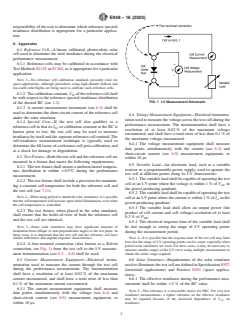
FIG. 1 I-V Measurement Schematic
of the desired RC (see 1.2).
6.1.3 A current measurement instrument (see 6.3) shall be
used to determine the short-circuit current of the reference cell
6.4 Voltage Measurement Equipment—Electricalinstrumen-
under the solar simulator.
tationusedtomeasurethevoltageacrossthetestcellduringthe
6.1.4 Special Case—If the test cell also qualifies as a
performance measurement. The instrumentation shall have a
reference cell in that its I or calibration constant at the RC is
SC
resolution of at least 0.02 % of the maximum voltage
known prior to test, the test cell may be used to measure
encountered, and shall have a total error of less than 0.1% of
irradiancebyitselfandtheseparatereferencecellomitted.The
the maximum voltage encountered.
self-irradiance measurement technique is typically used to
6.4.1 The voltage measurement equipment shall measure
determinethefillfactorofareferencecellpost-calibration,and
data points simultaneously with the current (see 6.3) and
as a check for damage or degradation.
short-circuit current (see 6.9) measurement equipment, to
6.2 Test Fixture—Boththetestcellandthereferencecellare
within 10 µs.
mounted in a fixture that meets the following requirements:
6.5 Variable Load—An electronic load, such as a variable
6.2.1 Thetestfixtureshallensureauniformlateraltempera-
resistor or a programmable power supply, used to operate the
ture distribution to within 60.5°C during the performance
test cell at different points along its I-V characteristic.
measurement.
6.5.1 Thevariableloadshallbecapableofoperatingthetest
6.2.2 The test fixture shall include a provision for maintain-
cell at an I-V point where the voltage is within 1% of V in
OC
ing a constant cell temperature for both the reference cell and
the power-producing quadrant.
the test cell (see 7.11).
6.5.2 Thevariableloadshallbecapableofoperatingthetest
NOTE2—Whenusingpulsedorshutteredsolarsimulators,itispossible
cellatanI-Vpointwherethecurrentiswithin1%of I inthe
sc
thatthecelltemperaturewillincreaseuponinitialillumination,evenwhen
power-producing quadrant.
the cell temperature is controlled.
6.5.3 The variable load shall allow an output power (the
6.2.3 The test fixture, when placed in the solar simulator,
product of cell current and cell voltage) resolution of at least
shall ensure that the fields-of-view of both the reference cell
0.2% of P .
MP
and the test cell are identical.
6.5.4 The electrical response time of the variable load shall
NOTE 3—Some solar simulators may have significant amounts of be fast enough to sweep the range of I-V operating points
irradiation from oblique or non-perpendicular angles to the test plane. In
during the measurement period.
these cases, it is important that the test cell and the reference cell have
similar reflectance and angular-response characteristics. NOTE 4—It is possible that the response time of the test cell may limit
how fast the range of I-V operating points can be swept, especially when
6.2.4 A four-terminal connection (also known as a Kelvin
pulsed solar simulators are used. For these cases, it may be necessary to
connection, see Fig. 1) from the test cell to the I-V measure-
measure smaller ranges of the I-V curve using multiple measurements to
ment instrumentation (see 6.3 – 6.5) shall be used.
obtain the entire range required.
6.3 Current Measurement Equipment—Electrical instru-
6.6 Solar Simulator—Requirements of the solar simulator
mentation used to measure the current through the test cell
usedtoilluminatethetestcellaredefinedinSpecificationE927
during the performance measurement. The instrumentation
(terrestrial applications) and Practice E491 (space applica-
shall have a resolution of at least 0.02% of the maximum
tions).
current encountered, and shall have a total error of less than
6.6.1 The effective irradiance during the performance mea-
0.1% of the maximum current encountered.
surement shall be within 62 % of the RC value.
6.3.1 The current measurement equipment shall measure
NOTE 5—This tolerance is a reasonable choice for SRC. For very low
data points simultaneously with the voltage (see 6.4) and
irradiance measurements, a tighter tolerance on the effective irradiance
short-circuit current (see 6.9) measurement equipment, to
may be required because of the increased dependence of V on
OC
within 10 µs. irradiance.
E948 − 16 (2020)
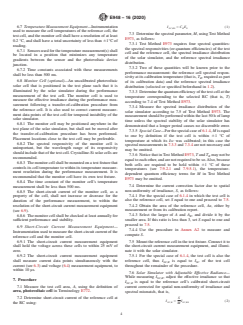
6.7 Temperature Measurement Equipment—Instrumentation I 5 C E (1)
SC,R0 R 0
used to measure the cell temperatures of the reference cell, the
7.3 Determinethespectralparameter, M,usingTestMethod
test cell, and the monitor cell shall have a resolution of at least
E973, as follows:
0.2 °C, and shall have a total uncertainty of less than 61°C of
7.3.1 Test Method E973 requires four spectral quantities:
reading.
the spectral responsivities (or quantum efficiencies) of the test
6.7.1 Sensorsusedforthetemperaturemeasurement(s)shall
cell and the reference cell, the spectral irradiance distribution
be located in a position that minimizes any temperature
of the solar simulator, and the reference spectral irradiance
gradients between the sensor and the photovoltaic device
distribution.
junction.
7.3.2 Two of these quantities will be known prior to the
6.7.2 Time constants associated with these measurements
performance measurement: the reference cell spectral respon-
shall be less than 500 ms.
sivityatitscalibrationtemperature(thatis, T ,requiredaspart
R
6.8 Monitor Cell (optional)—An uncalibrated photovoltaic
of its calibration data) and the reference spectral irradiance
solar cell that is positioned in the test plane such that it is
distribution (selected or specified beforehand in 1.2).
illuminated by the solar simulator during the performance
7.3.3 Determinethequantumefficiencyofthetestcellatthe
measurement of the test cell. The monitor cell is used to
temperature corresponding to the selected RC (that is, T)
measure the effective irradiance during the performance mea-
according to 7.4 of Test Method E973.
surement following a transfer-of-calibration procedure from
7.3.4 Measure the spectral irradiance distribution of the
the reference cell. It is also used to correct current measure-
solar simulator according to 7.5 of Test Method E973. The
ment data points of the test cell for temporal instability of the
measurementshouldbeperformedwithinthelast50hoflamp
solar simulator.
time unless the spectral stability of the solar simulator has
6.8.1 The monitor cell may be positioned anywhere in the
demonstrated that a longer period causes no discernible error.
test plane of the solar simulator, but shall not be moved after
7.3.5 Special Case—Forthespecialcaseof6.1.4, Misequal
the transfer-of-calibration procedure has been performed.
to one by definition if the test cell is within 61°Cof
Placement locations close to the test cell may be preferable.
temperature at which its I was calibrated; in this case the
SC
6.8.2 The spectral responsivity of the monitor cell is
spectralmeasurementsin7.3.3and7.3.4arenotnecessaryand
unimportant, but the wavelength range of its responsivity
may be omitted.
shouldincludethatofthetestcell.Crystalline-Sisolarcellsare
7.3.6 NoticethatinTestMethodE973, Tand T maynotbe
R
recommended.
equaltoeachother,andarenotrequiredtobeso.Also,because
6.8.3 Themonitorcellshallbemountedonatestfixturethat
both cells are required to be held within 61 °C of these
controlsitscelltemperaturetowithinitstemperaturemeasure-
temperatures (see 7.9.2.1 and 7.9.5.1), the temperature-
ment resolution during the performance measurement. It is
dependent quantum efficiency terms for M in Test Method
recommended that the monitor cell have its own test fixture.
E973 may be omitted.
6.8.4 The time constant of the monitor cell’s temperature
7.4 Determine the current correction factor due to spatial
measurement shall be less than 500 ms.
non-uniformity of irradiance, S, as follows:
6.8.5 The short-circuit current of the monitor cell
...