

ASTM D3375-18
(Test Method)Standard Test Method for Column Capacity of Particulate Mixed Bed IonExchange Materials
General Information
- Abstract
SIGNIFICANCE AND USE
5.1 This test method can be used to evaluate unused mixed bed ion exchange materials for conformance to specifications. When a representative sample of the mixed bed can be obtained from an operating unit, this test method can be used to evaluate the regeneration efficiency by comparison with the same data obtained with new material from the same manufactured lots, or retained samples of the in-place products.
5.2 This test method provides for the calculation of capacity in terms of the volume of water treated to a conductivity end point.
5.3 The test method as written assumes that the cation exchange material has been regenerated to the hydrogen form with acid and the anion exchange material has been regenerated with alkali to the hydroxide or free-base form. In certain applications a cation exchange material in the potassium, ammonium, or other monovalent form may be encountered. Such materials may be tested following this procedure using Test Water A (Test Methods D1782) as the influent and substituting the hardness end point (Test Methods D1782) for the end points prescribed herein.
5.4 In most cases the product tested will be properly mixed and will contain the correct proportions of anion and cation exchange materials. However, if the pH as well as the conductivity of the effluent is measured, the test method will indicate which of the components is present in excess; an acid effluent at breakthrough indicating an excess of regenerated cation exchange groups and an alkaline effluent an excess of regenerated anion exchange groups. In such cases the volumes of the two components obtained in the final backwash will indicate whether this imbalance arises from improper regeneration or from an improper ratio of the two components. It should be noted, however, that not all units are charged with a balanced ratio of anion-exchanging and cation-exchanging groups. Hence, wherever possible, a field sample should be evaluated in comparison with a retained sample ...
SCOPE
1.1 This test method covers the determination of the performance of particulate mixed bed ion exchange materials in the regenerated form when used for deionization. It is intended for use in testing unused mixed bed materials and samples of regenerated mixed beds from operating units.
1.2 The values stated in SI units are to be regarded as standard. The values given in parentheses are mathematical conversions to inch-pound units that are provided for information only and are not considered standard.
1.3 This standard does not purport to address all of the safety concerns, if any, associated with its use. It is the responsibility of the user of this standard to establish appropriate safety, health, and environmental practices and determine the applicability of regulatory limitations prior to use.
1.4 This international standard was developed in accordance with internationally recognized principles on standardization established in the Decision on Principles for the Development of International Standards, Guides and Recommendations issued by the World Trade Organization Technical Barriers to Trade (TBT) Committee.
- Status
- Published
- Publication Date
- 30-Apr-2018
- Technical Committee
- D19 - Water
- Drafting Committee
- D19.08 - Membranes and Ion Exchange Materials
Buy Documents
ASTM D3375-18 - Standard Test Method for Column Capacity of Particulate Mixed Bed Ion<brk/>Exchange Materials
REDLINE ASTM D3375-18 - Standard Test Method for Column Capacity of Particulate Mixed Bed Ion<brk/>Exchange Materials
Overview
ASTM D3375-18: Standard Test Method for Column Capacity of Particulate Mixed Bed Ion Exchange Materials is an internationally recognized method developed by ASTM International. This standard outlines procedures for determining the performance of particulate mixed bed ion exchange materials, specifically their column capacity when regenerated, as used in water deionization processes. Capable of evaluating both unused and regenerated mixed bed resin samples, it is a key tool for quality control and specification conformance in water treatment and ion exchange applications.
Key Topics
Column Capacity Determination
The standard provides a method for exhausting a column of regenerated mixed bed ion exchange material with a known influent solution. Measurements focus on parameters such as the volume of water treated to a specific conductivity or pH endpoint, allowing calculation of capacity on a wet weight or volume basis.Mixed Bed Ion Exchange Material Evaluation
The test evaluates both new and operated resin beds, making it valuable for comparing the regeneration efficiency and assessing long-term resin performance.Significance of Conductivity and pH End Points
By monitoring changes in conductivity and pH of the effluent water, the method helps ascertain whether the ion exchange bed has the correct balance and regeneration of cation and anion resins.Sampling and Quality Control
Guidance is provided for representative sampling, especially critical when assessing material uniformity across multiple containers or batches. Statistical precision and repeatability are discussed to ensure confidence in results.Safety and Regulatory Compliance
Users are responsible for following safe laboratory practices and ensuring compliance with local regulatory requirements.
Applications
ASTM D3375-18 is widely used across industries involved in water treatment and purification, including:
Water Treatment Facilities:
Quality assurance of ion exchange resins is critical in deionization units producing ultrapure water for power generation, pharmaceuticals, microelectronics, and laboratories.Resin Manufacturers and Distributors:
The standard supports product certification for new mixed bed ion exchange materials, enabling comparison of manufacturing lots and ensuring material meets contractual specifications.Industrial Maintenance and Operations:
For facilities with ongoing water purification systems, the method provides a reliable approach for periodic assessment of resin regeneration efficiency, helping to optimize operational costs and system performance.Research and Development:
Laboratory studies on the performance of novel ion exchange materials or process optimization rely on standardized testing for reproducibility and benchmarking.
Related Standards
For broader context and supporting procedures, reference these associated ASTM standards:
ASTM D1125: Test Methods for Electrical Conductivity and Resistivity of Water
Essential for measuring effluent conductivity during column exhaustion.ASTM D1129: Terminology Relating to Water
Provides standardized definitions for terms used in water treatment.ASTM D1193: Specification for Reagent Water
Specifies the purity requirements for water used in testing procedures.ASTM D1293: Test Methods for pH of Water
Methods for pH measurement, critical when assessing effluent from the column.ASTM D1782: Test Methods for Operating Performance of Particulate Cation-Exchange Materials
Relevant for cases using cation resin in alternative ionic forms.ASTM D2687: Practices for Sampling Particulate Ion-Exchange Materials
Outlines representative sampling protocols.
Practical Value
Adoption of ASTM D3375-18 enhances reliable, accurate determination of mixed bed resin performance, supports regulatory compliance, and fosters consistent water quality in high-purity applications. Utilizing this standard ensures robust process control and material verification, helping industries maintain efficiency and product integrity.
Keywords: ASTM D3375-18, column capacity, mixed bed ion exchange, water deionization, resin regeneration, water treatment, conductivity, effluent pH, ASTM standards
Relations
- Effective Date
- 01-Apr-2024
- Effective Date
- 01-May-2020
- Effective Date
- 01-Aug-2017
- Effective Date
- 15-May-2016
- Effective Date
- 01-Jan-2012
- Effective Date
- 01-Mar-2010
- Effective Date
- 01-May-2009
- Effective Date
- 01-Dec-2007
- Effective Date
- 01-Dec-2007
- Effective Date
- 01-Sep-2006
- Effective Date
- 01-Sep-2006
- Effective Date
- 01-Mar-2006
- Effective Date
- 15-Feb-2006
- Refers
ASTM D1125-95(2005) - Standard Test Methods for Electrical Conductivity and Resistivity of Water - Effective Date
- 01-Apr-2005
- Effective Date
- 01-Jan-2005
Buy Documents
ASTM D3375-18 - Standard Test Method for Column Capacity of Particulate Mixed Bed Ion<brk/>Exchange Materials
REDLINE ASTM D3375-18 - Standard Test Method for Column Capacity of Particulate Mixed Bed Ion<brk/>Exchange Materials
Get Certified
Connect with accredited certification bodies for this standard

ECOCERT
Organic and sustainability certification.

Eurofins Food Testing Global
Global leader in food, environment, and pharmaceutical product testing.

Intertek Bangladesh
Intertek certification and testing services in Bangladesh.
Sponsored listings
Frequently Asked Questions
ASTM D3375-18 is a standard published by ASTM International. Its full title is "Standard Test Method for Column Capacity of Particulate Mixed Bed Ion<brk/>Exchange Materials". This standard covers: SIGNIFICANCE AND USE 5.1 This test method can be used to evaluate unused mixed bed ion exchange materials for conformance to specifications. When a representative sample of the mixed bed can be obtained from an operating unit, this test method can be used to evaluate the regeneration efficiency by comparison with the same data obtained with new material from the same manufactured lots, or retained samples of the in-place products. 5.2 This test method provides for the calculation of capacity in terms of the volume of water treated to a conductivity end point. 5.3 The test method as written assumes that the cation exchange material has been regenerated to the hydrogen form with acid and the anion exchange material has been regenerated with alkali to the hydroxide or free-base form. In certain applications a cation exchange material in the potassium, ammonium, or other monovalent form may be encountered. Such materials may be tested following this procedure using Test Water A (Test Methods D1782) as the influent and substituting the hardness end point (Test Methods D1782) for the end points prescribed herein. 5.4 In most cases the product tested will be properly mixed and will contain the correct proportions of anion and cation exchange materials. However, if the pH as well as the conductivity of the effluent is measured, the test method will indicate which of the components is present in excess; an acid effluent at breakthrough indicating an excess of regenerated cation exchange groups and an alkaline effluent an excess of regenerated anion exchange groups. In such cases the volumes of the two components obtained in the final backwash will indicate whether this imbalance arises from improper regeneration or from an improper ratio of the two components. It should be noted, however, that not all units are charged with a balanced ratio of anion-exchanging and cation-exchanging groups. Hence, wherever possible, a field sample should be evaluated in comparison with a retained sample ... SCOPE 1.1 This test method covers the determination of the performance of particulate mixed bed ion exchange materials in the regenerated form when used for deionization. It is intended for use in testing unused mixed bed materials and samples of regenerated mixed beds from operating units. 1.2 The values stated in SI units are to be regarded as standard. The values given in parentheses are mathematical conversions to inch-pound units that are provided for information only and are not considered standard. 1.3 This standard does not purport to address all of the safety concerns, if any, associated with its use. It is the responsibility of the user of this standard to establish appropriate safety, health, and environmental practices and determine the applicability of regulatory limitations prior to use. 1.4 This international standard was developed in accordance with internationally recognized principles on standardization established in the Decision on Principles for the Development of International Standards, Guides and Recommendations issued by the World Trade Organization Technical Barriers to Trade (TBT) Committee.
SIGNIFICANCE AND USE 5.1 This test method can be used to evaluate unused mixed bed ion exchange materials for conformance to specifications. When a representative sample of the mixed bed can be obtained from an operating unit, this test method can be used to evaluate the regeneration efficiency by comparison with the same data obtained with new material from the same manufactured lots, or retained samples of the in-place products. 5.2 This test method provides for the calculation of capacity in terms of the volume of water treated to a conductivity end point. 5.3 The test method as written assumes that the cation exchange material has been regenerated to the hydrogen form with acid and the anion exchange material has been regenerated with alkali to the hydroxide or free-base form. In certain applications a cation exchange material in the potassium, ammonium, or other monovalent form may be encountered. Such materials may be tested following this procedure using Test Water A (Test Methods D1782) as the influent and substituting the hardness end point (Test Methods D1782) for the end points prescribed herein. 5.4 In most cases the product tested will be properly mixed and will contain the correct proportions of anion and cation exchange materials. However, if the pH as well as the conductivity of the effluent is measured, the test method will indicate which of the components is present in excess; an acid effluent at breakthrough indicating an excess of regenerated cation exchange groups and an alkaline effluent an excess of regenerated anion exchange groups. In such cases the volumes of the two components obtained in the final backwash will indicate whether this imbalance arises from improper regeneration or from an improper ratio of the two components. It should be noted, however, that not all units are charged with a balanced ratio of anion-exchanging and cation-exchanging groups. Hence, wherever possible, a field sample should be evaluated in comparison with a retained sample ... SCOPE 1.1 This test method covers the determination of the performance of particulate mixed bed ion exchange materials in the regenerated form when used for deionization. It is intended for use in testing unused mixed bed materials and samples of regenerated mixed beds from operating units. 1.2 The values stated in SI units are to be regarded as standard. The values given in parentheses are mathematical conversions to inch-pound units that are provided for information only and are not considered standard. 1.3 This standard does not purport to address all of the safety concerns, if any, associated with its use. It is the responsibility of the user of this standard to establish appropriate safety, health, and environmental practices and determine the applicability of regulatory limitations prior to use. 1.4 This international standard was developed in accordance with internationally recognized principles on standardization established in the Decision on Principles for the Development of International Standards, Guides and Recommendations issued by the World Trade Organization Technical Barriers to Trade (TBT) Committee.
ASTM D3375-18 is classified under the following ICS (International Classification for Standards) categories: 71.100.40 - Surface active agents. The ICS classification helps identify the subject area and facilitates finding related standards.
ASTM D3375-18 has the following relationships with other standards: It is inter standard links to ASTM D2687-95(2024), ASTM D1129-13(2020)e2, ASTM D1782-17, ASTM D2687-95(2016), ASTM D1293-12, ASTM D1129-10, ASTM D1782-95(2009), ASTM D2687-95(2007)e1, ASTM D1782-95(2007), ASTM D1129-06a, ASTM D1129-06ae1, ASTM D1193-06, ASTM D1129-06, ASTM D1125-95(2005), ASTM D1293-99(2005). Understanding these relationships helps ensure you are using the most current and applicable version of the standard.
ASTM D3375-18 is available in PDF format for immediate download after purchase. The document can be added to your cart and obtained through the secure checkout process. Digital delivery ensures instant access to the complete standard document.
Standards Content (Sample)
This international standard was developed in accordance with internationally recognized principles on standardization established in the Decision on Principles for the
Development of International Standards, Guides and Recommendations issued by the World Trade Organization Technical Barriers to Trade (TBT) Committee.
Designation: D3375 − 18
Standard Test Method for
Column Capacity of Particulate Mixed Bed Ion Exchange
Materials
This standard is issued under the fixed designation D3375; the number immediately following the designation indicates the year of
original adoption or, in the case of revision, the year of last revision. A number in parentheses indicates the year of last reapproval. A
superscript epsilon (´) indicates an editorial change since the last revision or reapproval.
1. Scope late Cation-Exchange Materials
D2687 Practices for Sampling Particulate Ion-Exchange Ma-
1.1 This test method covers the determination of the perfor-
terials
mance of particulate mixed bed ion exchange materials in the
regenerated form when used for deionization. It is intended for
3. Terminology
use in testing unused mixed bed materials and samples of
regenerated mixed beds from operating units. 3.1 Definitions—For definitions of terms related to water,
refer to Terminology D1129.
1.2 The values stated in SI units are to be regarded as
standard. The values given in parentheses are mathematical
4. Summary of Test Method
conversions to inch-pound units that are provided for informa-
4.1 This test method consists of exhausting a column of
tion only and are not considered standard.
regenerated mixed bed ion exchange material to a specific end
1.3 This standard does not purport to address all of the
point with an influent solution of known composition and
safety concerns, if any, associated with its use. It is the
volume.
responsibility of the user of this standard to establish appro-
priate safety, health, and environmental practices and deter-
5. Significance and Use
mine the applicability of regulatory limitations prior to use.
5.1 This test method can be used to evaluate unused mixed
1.4 This international standard was developed in accor-
bed ion exchange materials for conformance to specifications.
dance with internationally recognized principles on standard-
When a representative sample of the mixed bed can be
ization established in the Decision on Principles for the
obtained from an operating unit, this test method can be used
Development of International Standards, Guides and Recom-
to evaluate the regeneration efficiency by comparison with the
mendations issued by the World Trade Organization Technical
Barriers to Trade (TBT) Committee. same data obtained with new material from the same manu-
factured lots, or retained samples of the in-place products.
2. Referenced Documents
5.2 This test method provides for the calculation of capacity
2.1 ASTM Standards: in terms of the volume of water treated to a conductivity end
D1125 Test Methods for Electrical Conductivity and Resis- point.
tivity of Water (Withdrawn 2023)
5.3 The test method as written assumes that the cation
D1129 Terminology Relating to Water
exchange material has been regenerated to the hydrogen form
D1193 Specification for Reagent Water
with acid and the anion exchange material has been regener-
D1293 Test Methods for pH of Water
ated with alkali to the hydroxide or free-base form. In certain
D1782 Test Methods for Operating Performance of Particu-
applications a cation exchange material in the potassium,
ammonium, or other monovalent form may be encountered.
Such materials may be tested following this procedure using
This test method is under the jurisdiction of ASTM Committee D19 on Water
Test Water A (Test Methods D1782) as the influent and
and is the direct responsibility of Subcommittee D19.08 on Membranes and Ion
substituting the hardness end point (Test Methods D1782) for
Exchange Materials.
the end points prescribed herein.
Current edition approved May 1, 2018. Published May 2018. Originally
approved in 1975. Last previous edition approved in 2016 as D3375 – 16. DOI:
5.4 In most cases the product tested will be properly mixed
10.1520/D3375-18.
and will contain the correct proportions of anion and cation
For referenced ASTM standards, visit the ASTM website, www.astm.org, or
contact ASTM Customer Service at service@astm.org. For Annual Book of ASTM
exchange materials. However, if the pH as well as the
Standards volume information, refer to the standard’s Document Summary page on
conductivity of the effluent is measured, the test method will
the ASTM website.
indicate which of the components is present in excess; an acid
The last approved version of this historical standard is referenced on
www.astm.org. effluent at breakthrough indicating an excess of regenerated
Copyright © ASTM International, 100 Barr Harbor Drive, PO Box C700, West Conshohocken, PA 19428-2959. United States
D3375 − 18
cation exchange groups and an alkaline effluent an excess of frequency of sampling must be varied to compensate for the
regenerated anion exchange groups. In such cases the volumes approximate volume of resin in the test sample. The test as
of the two components obtained in the final backwash will written assumes a resin volume of approximately 330 mL.
indicate whether this imbalance arises from improper regen-
eration or from an improper ratio of the two components. It
6. Apparatus
should be noted, however, that not all units are charged with a
6.1 Test Assembly (Fig. 1), consisting of the following:
balanced ratio of anion-exchanging and cation-exchanging
6.1.1 Column, transparent supported 2.5 6 0.25-cm (1 6
groups. Hence, wherever possible, a field sample should be
0.1-in.) inside diameter and approximately 150 cm (60 in.)
evaluated in comparison with a retained sample of the original
long. The bottom of the column shall be closed and provided
charge.
with an outlet of about 6-mm inside diameter. Connections
5.5 This test method provides for the calculation of capacity
shall be provided at the top and the bottom for the admission
on either a wet weight basis or a volume basis. Although such
and removal of the exhausting solution as described in 7.4.
materials are normally bought and sold in terms of cubic feet,
Adequate means of regulating and measuring flow shall be
they are actually packaged in wet pounds. Therefore, it is the
provided. Support for the sample shall be provided so that the
capacity on a wet weight basis that is directly correlatable to
distance from the sample to the column outlet is at least 5 cm.
the amount of material in a given shipment.
Calibrate the column in such a manner that the volume
5.6 Calculation of a volume capacity is based on the
readings required by the test method can be made. Make all
exhausted, separated volume of the components after back-
calibration measurements at 25 6 5°C.
washing and resettling the bed. This volume is chosen because
6.1.2 Sample Support, so designed that the distance from the
it is difficult, if not impossible, to pack a sample of regenerated
sample to the column outlet is at least 5 cm. A suggested
mixed bed material in a small-diameter column reproducibly.
supporting bed utilizes quartz, gravel, glass beads, or other
5.7 This test method may be used to test mixed bed resin material 1.5 to 3.5 mm in diameter, insoluble in the reagents
cartridges. In such cases the flow rate of test water and the used, and retained on a corrosion-resistant screen.
FIG. 1 Typical Arrangement of Apparatus for Performance Testing of Ion Exchange Materials
D3375 − 18
required, it is usually made up semi-quantitatively in large batches and
6.2 Measuring circuit and in-line conductivity cells as
then standardized per the above procedure. If desired, it is acceptable to
described in Test Methods D1125. A continuous recorder is
prepare this reagent quantitatively (as for a primary standard) and then
recommended.
eliminate the above standardization.
6.3 pH Meter, with associated electrodes as described in
7.5 Methyl Orange Indicator Solution (1.0 g/L)—Dissolve
Test Methods D1293. A continuous recorder is recommended.
0.10 g of methyl orange in water and dilute to 100 mL with
water.
7. Reagents
7.6 Nitric Acid (1+9)—Pour one volume of nitric acid
7.1 Purity of Reagents—Reagent grade chemicals shall be
(HNO , sp gr 1.42) into nine volumes of water and mix
used in all tests. Unless otherwise indicated, it is intended that
thoroughly.
all reagents shall conform to the specifications of the Commit-
tee on Analytical Reagents of the American Chemical Society, 7.7 Phenolphthalein Indicator Solution (10.0 g/L)—
Dissolve 1.0 g of phenolphthalein in 100 mL of 95 % ethanol.
where such specifications are available. Other grades may be
used, provided it is first ascertained that the reagent is of
NOTE 2—In most cases certain denatured alcohols such as specially
sufficiently high purity to permit its use without lessening the
denatured Formula Nos. 3A, 30, or 2B may be substituted for ethanol.
accuracy of the determination.
7.8 Potassium Chromate Solution (50 g/L)—Dissolve 5.0 g
7.2 Purity of Water—All reference to water in this test
of potassium chromate (K CrO ) in 50 mL of water. Dilute to
2 4
method shall be understood to mean Reagent Water Type I or
100 mL with water.
II conforming to Specification D1193, with the additional
7.9 Silver Nitrate Solution, Standard (0.10 N)—Dry crys-
requirement that the silica concentration is less than 0.1 mg/L.
talline silver nitrate (AgNO ) at 105°C for 1 h and cool in a
7.3 Ammonium Hydroxide Solution (1+19)—Carefully pour
desiccator. Weigh out 17 6 0.05
...
This document is not an ASTM standard and is intended only to provide the user of an ASTM standard an indication of what changes have been made to the previous version. Because
it may not be technically possible to adequately depict all changes accurately, ASTM recommends that users consult prior editions as appropriate. In all cases only the current version
of the standard as published by ASTM is to be considered the official document.
Designation: D3375 − 16 D3375 − 18
Standard Test Method for
Column Capacity of Particulate Mixed Bed Ion
Exchange Materials
This standard is issued under the fixed designation D3375; the number immediately following the designation indicates the year of
original adoption or, in the case of revision, the year of last revision. A number in parentheses indicates the year of last reapproval. A
superscript epsilon (´) indicates an editorial change since the last revision or reapproval.
1. Scope
1.1 This test method covers the determination of the performance of particulate mixed bed ion exchange materials in the
regenerated form when used for deionization. It is intended for use in testing unused mixed bed materials and samples of
regenerated mixed beds from operating units.
1.2 The values stated in SI units are to be regarded as standard. The values given in parentheses are mathematical conversions
to inch-pound units that are provided for information only and are not considered standard.
1.3 This standard does not purport to address all of the safety concerns, if any, associated with its use. It is the responsibility
of the user of this standard to establish appropriate safety safety, health, and healthenvironmental practices and determine the
applicability of regulatory limitations prior to use.
1.4 This international standard was developed in accordance with internationally recognized principles on standardization
established in the Decision on Principles for the Development of International Standards, Guides and Recommendations issued
by the World Trade Organization Technical Barriers to Trade (TBT) Committee.
2. Referenced Documents
2.1 ASTM Standards:
D1125 Test Methods for Electrical Conductivity and Resistivity of Water
D1129 Terminology Relating to Water
D1193 Specification for Reagent Water
D1293 Test Methods for pH of Water
D1782 Test Methods for Operating Performance of Particulate Cation-Exchange Materials
D2687 Practices for Sampling Particulate Ion-Exchange Materials
3. Terminology
3.1 Definitions—For definitions of terms related to water, refer to Terminology D1129.
4. Summary of Test Method
4.1 This test method consists of exhausting a column of regenerated mixed bed ion exchange material to a specific end point
with an influent solution of known composition and volume.
5. Significance and Use
5.1 This test method can be used to evaluate unused mixed bed ion exchange materials for conformance to specifications. When
a representative sample of the mixed bed can be obtained from an operating unit, this test method can be used to evaluate the
regeneration efficiency by comparison with the same data obtained with new material from the same manufactured lots, or retained
samples of the in-place products.
5.2 This test method provides for the calculation of capacity in terms of the volume of water treated to a conductivity end point.
This test method is under the jurisdiction of ASTM Committee D19 on Water and is the direct responsibility of Subcommittee D19.08 on Membranes and Ion Exchange
Materials.
Current edition approved July 1, 2016May 1, 2018. Published July 2016May 2018. Originally approved in 1975. Last previous edition approved in 20072016 as
D3375 – 95a (2007).D3375 – 16. DOI: 10.1520/D3375-16.10.1520/D3375-18.
For referenced ASTM standards, visit the ASTM website, www.astm.org, or contact ASTM Customer Service at service@astm.org. For Annual Book of ASTM Standards
volume information, refer to the standard’s Document Summary page on the ASTM website.
Copyright © ASTM International, 100 Barr Harbor Drive, PO Box C700, West Conshohocken, PA 19428-2959. United States
D3375 − 18
5.3 The test method as written assumes that the cation exchange material has been regenerated to the hydrogen form with acid
and the anion exchange material has been regenerated with alkali to the hydroxide or free-base form. In certain applications a
cation exchange material in the potassium, ammonium, or other monovalent form may be encountered. Such materials may be
tested following this procedure using Test Water A (Test Methods D1782) as the influent and substituting the hardness end point
(Test Methods D1782) for the end points prescribed herein.
5.4 In most cases the product tested will be properly mixed and will contain the correct proportions of anion and cation
exchange materials. However, if the pH as well as the conductivity of the effluent is measured, the test method will indicate which
of the components is present in excess; an acid effluent at breakthrough indicating an excess of regenerated cation exchange groups
and an alkaline effluent an excess of regenerated anion exchange groups. In such cases the volumes of the two components obtained
in the final backwash will indicate whether this imbalance arises from improper regeneration or from an improper ratio of the two
components. It should be noted, however, that not all units are charged with a balanced ratio of anion-exchanging and
cation-exchanging groups. Hence, wherever possible, a field sample should be evaluated in comparison with a retained sample of
the original charge.
5.5 This test method provides for the calculation of capacity on either a wet weight basis or a volume basis. Although such
materials are normally bought and sold in terms of cubic feet, they are actually packaged in wet pounds. Therefore, it is the capacity
on a wet weight basis that is directly correlatable to the amount of material in a given shipment.
5.6 Calculation of a volume capacity is based on the exhausted, separated volume of the components after backwashing and
resettling the bed. This volume is chosen because it is difficult, if not impossible, to pack a sample of regenerated mixed bed
material in a small-diameter column reproducibly.
5.7 This test method may be used to test mixed bed resin cartridges. In such cases the flow rate of test water and the frequency
of sampling must be varied to compensate for the approximate volume of resin in the test sample. The test as written assumes a
resin volume of approximately 330 mL.
6. Apparatus
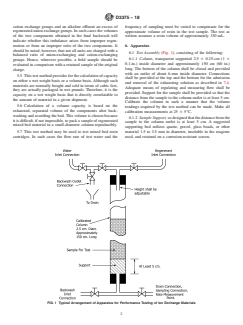
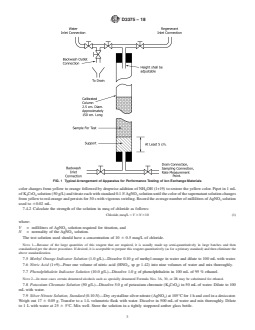
6.1 Test Assembly (Fig. 1), consisting of the following:
6.1.1 Column, transparent supported 2.5 6 0.25-cm (1 6 0.1-in.) inside diameter and approximately 150 cm (60 in.) long. The
bottom of the column shall be closed and provided with an outlet of about 6-mm inside diameter. Connections shall be provided
at the top and the bottom for the admission and removal of the exhausting solution as described in 7.4. Adequate means of
regulating and measuring flow shall be provided. Support for the sample shall be provided so that the distance from the sample
to the column outlet is at least 5 cm. Calibrate the column in such a manner that the volume readings required by the test method
can be made. Make all calibration measurements at 25 6 5°C.
6.1.2 Sample Support, so designed that the distance from the sample to the column outlet is at least 5 cm. A suggested supporting
bed utilizes quartz, gravel, glass beads, or other material 1.5 to 3.5 mm in diameter, insoluble in the reagents used, and retained
on a corrosion-resistant screen.
6.2 Measuring circuit and in-line conductivity cells as described in Test Methods D1125. A continuous recorder is
recommended.
6.3 pH Meter, with associated electrodes as described in Test Methods D1293. A continuous recorder is recommended.
7. Reagents
7.1 Purity of Reagents—Reagent grade chemicals shall be used in all tests. Unless otherwise indicated, it is intended that all
reagents shall conform to the specifications of the Committee on Analytical Reagents of the American Chemical Society, where
such specifications are available. Other grades may be used, provided it is first ascertained that the reagent is of sufficiently high
purity to permit its use without lessening the accuracy of the determination.
7.2 Purity of Water—All reference to water in this test method shall be understood to mean Reagent Water Type I or II
conforming to Specification D1193, with the additional requirement that the silica concentration is less than 0.1 mg/L.
7.3 Ammonium Hydroxide Solution (1+19)—Carefully pour 50 mL of concentrated ammonium hydroxide (NH OH, sp gr 0.90)
into 500 mL of water, stirring constantly. Cool to 25 6 5°C and dilute to 1 L with water. Mix well.
7.4 Ion Exchange Test Water D (10 meq/L)—Prepare a test water containing, in each litre, 0.585 g of oven-dried (105°C) sodium
chloride (NaCl). Approximately 25 L of this solution are required for a single test.
7.4.1 To standardize for chloride content, pipet three 100-mL portions. Add one drop of methyl orange indicator solution and
one drop of phenolphthalein indicator solution to each and neutralize, if required, by dropwise addition of HNO (1+9) until the
Reagent Chemicals, American Chemical Society Specifications, American Chemical Society, Washington, DC. For suggestions on the testing of reagents not listed by
the American Chemical Society, see Analar Standards for Laboratory Chemicals, BDH Ltd., Poole, Dorset, U.K., and the United States Pharmacopeia and National
Formulary, U.S. Pharmaceutical Convention, Inc. (USPC), Rockville, MD.
D3375 − 18
FIG. 1 Typical Arrangement of Apparatus for Performance Testing of Ion Exchange Materials
c
...