

ASTM D5217-17
(Guide)Standard Guide for Detection of Fouling and Degradation of Particulate Ion Exchange Materials
General Information
- Abstract
SIGNIFICANCE AND USE
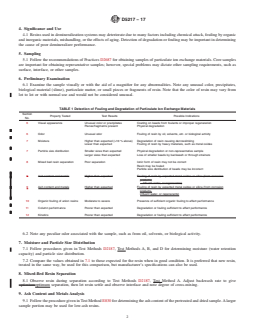
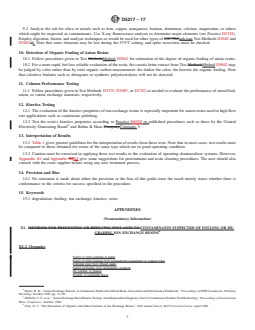
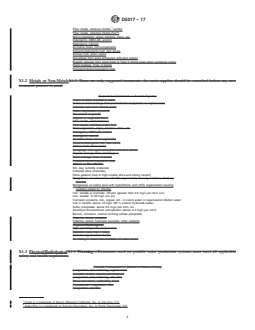
4.1 Resins used in demineralization systems may deteriorate due to many factors including chemical attack, fouling by organic and inorganic materials, mishandling, or the effects of aging. Detection of degradation or fouling may be important in determining the cause of poor demineralizer performance.
SCOPE
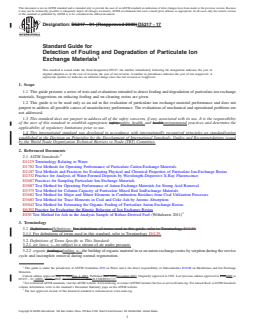
1.1 This guide presents a series of tests and evaluations intended to detect fouling and degradation of particulate ion exchange materials. Suggestions on reducing fouling and on cleaning resins are given.
1.2 This guide is to be used only as an aid in the evaluation of particulate ion exchange material performance and does not purport to address all possible causes of unsatisfactory performance. The evaluations of mechanical and operational problems are not addressed.
1.3 This standard does not purport to address all of the safety concerns, if any, associated with its use. It is the responsibility of the user of this standard to establish appropriate safety, health, and environmental practices and determine the applicability of regulatory limitations prior to use.
1.4 This international standard was developed in accordance with internationally recognized principles on standardization established in the Decision on Principles for the Development of International Standards, Guides and Recommendations issued by the World Trade Organization Technical Barriers to Trade (TBT) Committee.
- Status
- Published
- Publication Date
- 31-Oct-2017
- Technical Committee
- D19 - Water
- Drafting Committee
- D19.08 - Membranes and Ion Exchange Materials
Buy Documents
ASTM D5217-17 - Standard Guide for Detection of Fouling and Degradation of Particulate Ion Exchange Materials
REDLINE ASTM D5217-17 - Standard Guide for Detection of Fouling and Degradation of Particulate Ion Exchange Materials
Overview
ASTM D5217-17: Standard Guide for Detection of Fouling and Degradation of Particulate Ion Exchange Materials offers essential guidance for evaluating the health and effectiveness of ion exchange resins commonly used in demineralization and water treatment systems. As resin materials age or are exposed to various contaminants-including chemicals, organics, metals, and physical stresses-they may lose efficiency due to fouling or degradation. This guide presents a series of tests and evaluations to detect issues impacting resin performance, alongside suggestions on minimizing fouling and maintaining resin health.
Key Topics
- Resin Fouling and Degradation: The standard describes a variety of visual and analytical tests to identify organic and inorganic fouling, chemical or physical degradation, and contamination by metals or biologics.
- Performance Assessment: Evaluations cover moisture content, particle size distribution, mixed-bed resin separation quality, ash content and metals analysis, organic fouling, and kinetics testing.
- Sampling Procedures: Emphasis is placed on representative resin sampling techniques, as proper sampling (e.g., core samples) is crucial for accurate assessment.
- Preventive and Cleaning Recommendations: Practical guidance is provided for reducing fouling and cleaning resin beds, emphasizing pretreatment, appropriate chemical agents, and operational best practices.
- Interpretation of Results: The guide highlights the importance of comparing test results to those from resins in known good condition for reliable diagnosis.
Applications
ASTM D5217-17 is widely applicable for those managing or operating water treatment systems, particularly where high-purity water is required. Principal users include:
- Power Generation: Condensate polishing and demineralized water production to ensure turbine and boiler protection.
- Industrial Process Water: Ensuring effective deionization and purity for sensitive manufacturing operations such as pharmaceuticals, microelectronics, and chemical processing.
- Municipal Water Treatment: Supporting potable water production and wastewater treatment plants that rely on ion exchange technology.
- System Maintenance and Troubleshooting: Facilitating root cause investigations for reduced system performance through systematic resin testing.
By implementing the recommendations and procedures of this standard, operators can:
- Detect early signs of resin fouling and degradation
- Maintain high operational efficiency of demineralization systems
- Extend the useful life of ion exchange resins
- Minimize costly downtime caused by unexpected resin failure
Related Standards
ASTM D5217-17 references numerous related standards to provide a comprehensive evaluation framework, including:
- ASTM D1129: Terminology Relating to Water
- ASTM D1782: Test Methods for Operating Performance of Particulate Cation-Exchange Materials
- ASTM D2187: Methods for Evaluating Physical and Chemical Properties of Particulate Ion-Exchange Resins
- ASTM D2332: Analysis of Water-Formed Deposits by Wavelength-Dispersive X-Ray Fluorescence
- ASTM D2687: Practices for Sampling Particulate Ion-Exchange Materials
- ASTM D5042: Estimating the Organic Fouling of Particulate Anion Exchange Resins
- ASTM D6302: Evaluating the Kinetic Behavior of Ion Exchange Resins
Practical Value
Applying ASTM D5217-17 enables organizations to achieve:
- Early Detection: Identifying and resolving fouling or degradation before system performance is compromised.
- Consistent Water Quality: Supporting sustainable operation of water purification systems.
- Regulatory Compliance: Encouraging adherence to international best practices and safety standards.
By utilizing these guidelines, industries ensure optimal resin performance, protect critical assets, and deliver reliable, high-quality water-making ASTM D5217-17 a vital resource for water treatment professionals.
Relations
- Effective Date
- 01-Nov-2017
- Effective Date
- 01-Apr-2024
- Effective Date
- 01-May-2020
- Effective Date
- 01-Aug-2017
- Effective Date
- 01-Aug-2017
- Effective Date
- 01-Jun-2017
- Refers
ASTM D6302-98(2017) - Standard Practice for Evaluating the Kinetic Behavior of Ion Exchange Resins - Effective Date
- 01-Jun-2017
- Effective Date
- 01-Jul-2016
- Effective Date
- 15-May-2016
- Effective Date
- 01-Apr-2011
- Effective Date
- 01-Mar-2010
- Effective Date
- 01-May-2009
- Refers
ASTM D6302-98(2009) - Standard Practice for Evaluating the Kinetic Behavior of Ion Exchange Resins - Effective Date
- 01-May-2009
- Effective Date
- 01-May-2009
- Effective Date
- 01-May-2009
Buy Documents
ASTM D5217-17 - Standard Guide for Detection of Fouling and Degradation of Particulate Ion Exchange Materials
REDLINE ASTM D5217-17 - Standard Guide for Detection of Fouling and Degradation of Particulate Ion Exchange Materials
Get Certified
Connect with accredited certification bodies for this standard

ECOCERT
Organic and sustainability certification.

Eurofins Food Testing Global
Global leader in food, environment, and pharmaceutical product testing.

Intertek Bangladesh
Intertek certification and testing services in Bangladesh.
Sponsored listings
Frequently Asked Questions
ASTM D5217-17 is a guide published by ASTM International. Its full title is "Standard Guide for Detection of Fouling and Degradation of Particulate Ion Exchange Materials". This standard covers: SIGNIFICANCE AND USE 4.1 Resins used in demineralization systems may deteriorate due to many factors including chemical attack, fouling by organic and inorganic materials, mishandling, or the effects of aging. Detection of degradation or fouling may be important in determining the cause of poor demineralizer performance. SCOPE 1.1 This guide presents a series of tests and evaluations intended to detect fouling and degradation of particulate ion exchange materials. Suggestions on reducing fouling and on cleaning resins are given. 1.2 This guide is to be used only as an aid in the evaluation of particulate ion exchange material performance and does not purport to address all possible causes of unsatisfactory performance. The evaluations of mechanical and operational problems are not addressed. 1.3 This standard does not purport to address all of the safety concerns, if any, associated with its use. It is the responsibility of the user of this standard to establish appropriate safety, health, and environmental practices and determine the applicability of regulatory limitations prior to use. 1.4 This international standard was developed in accordance with internationally recognized principles on standardization established in the Decision on Principles for the Development of International Standards, Guides and Recommendations issued by the World Trade Organization Technical Barriers to Trade (TBT) Committee.
SIGNIFICANCE AND USE 4.1 Resins used in demineralization systems may deteriorate due to many factors including chemical attack, fouling by organic and inorganic materials, mishandling, or the effects of aging. Detection of degradation or fouling may be important in determining the cause of poor demineralizer performance. SCOPE 1.1 This guide presents a series of tests and evaluations intended to detect fouling and degradation of particulate ion exchange materials. Suggestions on reducing fouling and on cleaning resins are given. 1.2 This guide is to be used only as an aid in the evaluation of particulate ion exchange material performance and does not purport to address all possible causes of unsatisfactory performance. The evaluations of mechanical and operational problems are not addressed. 1.3 This standard does not purport to address all of the safety concerns, if any, associated with its use. It is the responsibility of the user of this standard to establish appropriate safety, health, and environmental practices and determine the applicability of regulatory limitations prior to use. 1.4 This international standard was developed in accordance with internationally recognized principles on standardization established in the Decision on Principles for the Development of International Standards, Guides and Recommendations issued by the World Trade Organization Technical Barriers to Trade (TBT) Committee.
ASTM D5217-17 is classified under the following ICS (International Classification for Standards) categories: 71.100.40 - Surface active agents. The ICS classification helps identify the subject area and facilitates finding related standards.
ASTM D5217-17 has the following relationships with other standards: It is inter standard links to ASTM D5217-91(2009), ASTM D2687-95(2024), ASTM D1129-13(2020)e2, ASTM D1782-17, ASTM D2187-17, ASTM D3087-17, ASTM D6302-98(2017), ASTM D3375-16, ASTM D2687-95(2016), ASTM D3683-11, ASTM D1129-10, ASTM D3087-91(2009), ASTM D6302-98(2009), ASTM D5042-90(2009), ASTM D1782-95(2009). Understanding these relationships helps ensure you are using the most current and applicable version of the standard.
ASTM D5217-17 is available in PDF format for immediate download after purchase. The document can be added to your cart and obtained through the secure checkout process. Digital delivery ensures instant access to the complete standard document.
Standards Content (Sample)
This international standard was developed in accordance with internationally recognized principles on standardization established in the Decision on Principles for the
Development of International Standards, Guides and Recommendations issued by the World Trade Organization Technical Barriers to Trade (TBT) Committee.
Designation: D5217 − 17
Standard Guide for
Detection of Fouling and Degradation of Particulate Ion
Exchange Materials
This standard is issued under the fixed designation D5217; the number immediately following the designation indicates the year of
original adoption or, in the case of revision, the year of last revision. A number in parentheses indicates the year of last reapproval. A
superscript epsilon (´) indicates an editorial change since the last revision or reapproval.
1. Scope D2687 PracticesforSamplingParticulateIon-ExchangeMa-
terials
1.1 This guide presents a series of tests and evaluations
D3087 Test Method for Operating Performance of Anion-
intended to detect fouling and degradation of particulate ion
Exchange Materials for Strong Acid Removal
exchange materials. Suggestions on reducing fouling and on
D3375 Test Method for Column Capacity of Particulate
cleaning resins are given.
Mixed Bed IonExchange Materials
1.2 This guide is to be used only as an aid in the evaluation
D3682 Test Method for Major and Minor Elements in
of particulate ion exchange material performance and does not
Combustion Residues from Coal Utilization Processes
purport to address all possible causes of unsatisfactory perfor-
D3683 Test Method for Trace Elements in Coal and Coke
mance. The evaluations of mechanical and operational prob-
Ash by Atomic Absorption
lems are not addressed.
D5042 Test Method for Estimating the Organic Fouling of
1.3 This standard does not purport to address all of the Particulate Anion Exchange Resins
safety concerns, if any, associated with its use. It is the
D6302 Practice for Evaluating the Kinetic Behavior of Ion
responsibility of the user of this standard to establish appro- Exchange Resins
priate safety, health, and environmental practices and deter-
E830 Test Method for Ash in the Analysis Sample of
mine the applicability of regulatory limitations prior to use. Refuse-Derived Fuel (Withdrawn 2011)
1.4 This international standard was developed in accor-
3. Terminology
dance with internationally recognized principles on standard-
ization established in the Decision on Principles for the
3.1 Definitions:
Development of International Standards, Guides and Recom-
3.1.1 For definitions of terms used in this standard, refer to
mendations issued by the World Trade Organization Technical
Terminology D1129.
Barriers to Trade (TBT) Committee.
3.2 Definitions of Terms Specific to This Standard:
3.2.1 air lance, v—to subject to a stream of air under
2. Referenced Documents
pressure.
2.1 ASTM Standards:
3.2.2 organic fouling, n—the buildup of organic material in
D1129 Terminology Relating to Water
or on anion exchange resins by sorption during the service
D1782 Test Methods for Operating Performance of Particu-
cycle and incomplete removal during normal regeneration.
late Cation-Exchange Materials
D2187 Test Methods and Practices for Evaluating Physical
4. Significance and Use
and Chemical Properties of Particulate Ion-Exchange
4.1 Resinsusedindemineralizationsystemsmaydeteriorate
Resins
due to many factors including chemical attack, fouling by
D2332 Practice for Analysis of Water-Formed Deposits by
organic and inorganic materials, mishandling, or the effects of
Wavelength-Dispersive X-Ray Fluorescence
aging. Detection of degradation or fouling may be important in
determining the cause of poor demineralizer performance.
This guide is under the jurisdiction of ASTM Committee D19 on Water and is
5. Sampling
the direct responsibility of Subcommittee D19.08 on Membranes and Ion Exchange
Materials.
5.1 Follow the recommendations of Practices D2687 for
Current edition approved Nov. 1, 2017. Published November 2017. Originally
obtaining samples of particulate ion exchange materials. Core
approved in 1991. Last previous edition approved in 2009 as D5217 – 91 (2009).
DOI: 10.1520/D5217-17. samples are important for obtaining representative samples;
For referenced ASTM standards, visit the ASTM website, www.astm.org, or
contact ASTM Customer Service at service@astm.org. For Annual Book of ASTM
Standards volume information, refer to the standard’s Document Summary page on The last approved version of this historical standard is referenced on
the ASTM website. www.astm.org.
Copyright © ASTM International, 100 Barr Harbor Drive, PO Box C700, West Conshohocken, PA 19428-2959. United States
D5217 − 17
however, special problems may dictate other sampling cence analysis to determine major elements (see Practice
requirements, such as surface, interface, or other samples. D2332). Employ digestion, fusion, and analysis techniques as
would be used for other types of ash (see Test Methods D3682
6. Preliminary Examination
and D3683). Note that some elements may be lost during the
575°C ashing, and spike recoveries must be checked.
6.1 Examine the sample visually or with the aid of a
magnifier for any abnormalities. Note any unusual color,
10. Detection of Organic Fouling of Anion Resins
precipitates, biological material (slime), particulate matter, or
small pieces or fragments of resin. Note that the color of resin 10.1 Follow procedures given in Test Method D5042 for
may vary from lot to lot or with normal use and would not be estimation of the degree of organic fouling of anion resins.
considered unusual.
10.2 For a more rapid, but less reliable evaluation of the
6.2 Note any peculiar odor associated with the sample, such resin, the caustic-brine extract from Test Method D5042 may
as from oil, solvents, or biological activity. be judged by color rather than by total organic carbon
measurement: the darker the color, the heavier the organic
7. Moisture and Particle Size Distribution
fouling. Note that colorless foulants such as detergents or
synthetic polyelectrolytes will not be detected.
7.1 Follow procedures given in Test Methods D2187, Test
MethodsA,B,andDfordeterminingmoisture(waterretention
11. Column Performance Testing
capacity) and particle size distribution.
11.1 Follow procedures given in Test Methods D3375,
7.2 Comparethevaluesobtainedin7.1tothoseexpectedfor
D3087,or D1782 as needed to evaluate the performance of
the resin when in good condition. It is preferred that new resin,
mixed bed, anion, or cation exchange materials, respectively.
treated in the same way, be used for this comparison, but
manufacturer’s specifications can also be used.
12. Kinetics Testing
8. Mixed-Bed Resin Separation 12.1 The evaluation of the kinetics properties of ion-
exchange resins is especially important for anion resins used in
8.1 Observe resin during separation according toTest Meth-
high flow rate applications such as condensate polishing.
ods D2187, Test Method A. Adjust backwash rate to give
optimum separation, then let resin settle and observe interface 12.2 Test the resin’s kinetics properties according to Prac-
and note degree of cross-mixing. tice D6302 or published procedures such as those by the
Central Electricity Generating Board and Rohm & Haas
9. Ash Content and Metals Analysis
Company.
9.1 Follow the procedure given in Test Method E830 for
determining the ash content of the pretreated and dried sample.
Harris, R. R., “Anion Exchange Kinetics in Condensate Purification Mixed
A larger sample portion may be used for low-ash resins.
Beds-Assessment and Performance Prediction,” Proceedings of EPRI Condensate
Polishing Workshop, October 1985, pp. 31–40.
9.2 Analyze the ash for silica or metals such as iron, copper,
McNulty, J. T., et al., “Anion Exchange Resin Kinetic Testing: An Indispens-
manganese, barium, aluminum, calcium, magnesium, or others
able Diagnostic Tool for Condensate Polisher Troubleshooting,” Proceedings of
which might be suspected as contaminants. Use X-ray fluores- International Water Conference, October, 1986.
TABLE 1 Detection of Fouling and Degradation of Particulate Ion Exchange Materials
Section
Property Tested Test Results Possible Indications
No.
6 Visual appearance Unusual color or precipitates Coating on beads from foulants or improper regeneration
Pieces/fragments present Physical degradation
6 Odor Unusual odor Fouling of resin by oil, solvents, etc. or biological activity
7 Moisture Higher than expected (>10 % above) Degradation of resin causing decrosslinking
Lower than expected Fouling of resin by heavy materials, such as metal oxides
7 Particle size distribution Smaller sizes than expected Physical degradation or non-representative sample
Larger sizes than expected Loss of smaller beads by backwash or through strainers
8 Mixed bed resin separation Poor separation Ionic form of resin may not be correct
Resin may be fouled
Particle size distribution of beads may be incorrect
9 Ash content and metals Higher than expected Fouling of resin by expected metal oxides or silica (from corrosion
products, influent water, or regenerants)
10 Organic fouling of anion resins Moderate to severe Presence of sufficient organic fouling to affect performance
11 Column performance Poorer than expected Degradation or fouling sufficient to affect performance
12 Kinetics Poorer than expected Degradation or fouling sufficient to affect performance
D5217 − 17
13. Interpretation of Results 14. Precision and Bias
13.1 Table 1 gives general guidelines for the interpretation
14.1 No statement is made about either the precision or the
of results from these tests. Note that in most cases, test results
bias of this guide since the result merely states whether there is
must be compared to those obtained for resins of the same type
conformance to the criteria for success specified in the proce-
which are in good operating condition.
dure.
13.2 Cautionmustbeexe
...
This document is not an ASTM standard and is intended only to provide the user of an ASTM standard an indication of what changes have been made to the previous version. Because
it may not be technically possible to adequately depict all changes accurately, ASTM recommends that users consult prior editions as appropriate. In all cases only the current version
of the standard as published by ASTM is to be considered the official document.
Designation: D5217 − 91 (Reapproved 2009) D5217 − 17
Standard Guide for
Detection of Fouling and Degradation of Particulate Ion
Exchange Materials
This standard is issued under the fixed designation D5217; the number immediately following the designation indicates the year of
original adoption or, in the case of revision, the year of last revision. A number in parentheses indicates the year of last reapproval. A
superscript epsilon (´) indicates an editorial change since the last revision or reapproval.
1. Scope
1.1 This guide presents a series of tests and evaluations intended to detect fouling and degradation of particulate ion exchange
materials. Suggestions on reducing fouling and on cleaning resins are given.
1.2 This guide is to be used only as an aid in the evaluation of particulate ion exchange material performance and does not
purport to address all possible causes of unsatisfactory performance. The evaluations of mechanical and operational problems are
not addressed.
1.3 This standard does not purport to address all of the safety concerns, if any, associated with its use. It is the responsibility
of the user of this standard to establish appropriate safety safety, health, and healthenvironmental practices and determine the
applicability of regulatory limitations prior to use.
1.4 This international standard was developed in accordance with internationally recognized principles on standardization
established in the Decision on Principles for the Development of International Standards, Guides and Recommendations issued
by the World Trade Organization Technical Barriers to Trade (TBT) Committee.
2. Referenced Documents
2.1 ASTM Standards:
D1129 Terminology Relating to Water
D1782 Test Methods for Operating Performance of Particulate Cation-Exchange Materials
D2187 Test Methods and Practices for Evaluating Physical and Chemical Properties of Particulate Ion-Exchange Resins
D2332 Practice for Analysis of Water-Formed Deposits by Wavelength-Dispersive X-Ray Fluorescence
D2687 Practices for Sampling Particulate Ion-Exchange Materials
D3087 Test Method for Operating Performance of Anion-Exchange Materials for Strong Acid Removal
D3375 Test Method for Column Capacity of Particulate Mixed Bed IonExchange Materials
D3682 Test Method for Major and Minor Elements in Combustion Residues from Coal Utilization Processes
D3683 Test Method for Trace Elements in Coal and Coke Ash by Atomic Absorption
D5042 Test Method for Estimating the Organic Fouling of Particulate Anion Exchange Resins
D6302 Practice for Evaluating the Kinetic Behavior of Ion Exchange Resins
E830 Test Method for Ash in the Analysis Sample of Refuse-Derived Fuel (Withdrawn 2011)
3. Terminology
3.1 Definitions—Definitions: For definitions of terms used in this guide, refer to Terminology D1129.
3.1.1 For definitions of terms used in this standard, refer to Terminology D1129.
3.2 Definitions of Terms Specific to This Standard:
3.2.1 air lance, v—to subject to a stream of air under pressure.
3.2.2 organic fouling—fouling, n—the buildup of organic material in or on anion exchange resins by sorption during the service
cycle and incomplete removal during normal regeneration.
This guide is under the jurisdiction of ASTM Committee D19 on Water and is the direct responsibility of Subcommittee D19.08 on Membranes and Ion Exchange
Materials.
Current edition approved May 1, 2009Nov. 1, 2017. Published June 2009November 2017. Originally approved in 1991. Last previous edition approved in 20042009 as
D5217 – 91 (2009). (2004). DOI: 10.1520/D5217-91R09.10.1520/D5217-17.
For referenced ASTM standards, visit the ASTM website, www.astm.org, or contact ASTM Customer Service at service@astm.org. For Annual Book of ASTM Standards
volume information, refer to the standard’s Document Summary page on the ASTM website.
The last approved version of this historical standard is referenced on www.astm.org.
Copyright © ASTM International, 100 Barr Harbor Drive, PO Box C700, West Conshohocken, PA 19428-2959. United States
D5217 − 17
4. Significance and Use
4.1 Resins used in demineralization systems may deteriorate due to many factors including chemical attack, fouling by organic
and inorganic materials, mishandling, or the effects of aging. Detection of degradation or fouling may be important in determining
the cause of poor demineralizer performance.
5. Sampling
5.1 Follow the recommendations of Practices D2687 for obtaining samples of particulate ion exchange materials. Core samples
are important for obtaining representative samples; however, special problems may dictate other sampling requirements, such as
surface, interface, or other samples.
6. Preliminary Examination
6.1 Examine the sample visually or with the aid of a magnifier for any abnormalities. Note any unusual color, precipitates,
biological material (slime), particulate matter, or small pieces or fragments of resin. Note that the color of resin may vary from
lot to lot or with normal use and would not be considered unusual.
TABLE 1 Detection of Fouling and Degradation of Particulate Ion Exchange Materials
Section
Property Tested Test Results Possible Indications
No.
6 Visual appearance Unusual color or precipitates Coating on beads from foulants or improper regeneration
Pieces/fragments present Physical degradation
6 Odor Unusual odor Fouling of resin by oil, solvents, etc. or biological activity
7 Moisture Higher than expected (>10 % above) Degradation of resin causing decrosslinking
Lower than expected Fouling of resin by heavy materials, such as metal oxides
7 Particle size distribution Smaller sizes than expected Physical degradation or non-representative sample
Larger sizes than expected Loss of smaller beads by backwash or through strainers
8 Mixed bed resin separation Poor separation Ionic form of resin may not be correct
Resin may be fouled
Particle size distribution of beads may be incorrect
9 Ash content and metals Higher than expected Fouling of resin by expected metal oxides or silica (from corrosion
products,
influent water, or regenerants)
9 Ash content and metals Higher than expected Fouling of resin by expected metal oxides or silica (from corrosion
products,
influent water, or regenerants)
10 Organic fouling of anion resins Moderate to severe Presence of sufficient organic fouling to affect performance
11 Column performance Poorer than expected Degradation or fouling sufficient to affect performance
12 Kinetics Poorer than expected Degradation or fouling sufficient to affect performance
6.2 Note any peculiar odor associated with the sample, such as from oil, solvents, or biological activity.
7. Moisture and Particle Size Distribution
7.1 Follow procedures given in Test Methods D2187, Test Methods A, B, and D for determining moisture (water retention
capacity) and particle size distribution.
7.2 Compare the values obtained in 7.1 to those expected for the resin when in good condition. It is preferred that new resin,
treated in the same way, be used for this comparison, but manufacturer’s specifications can also be used.
8. Mixed-Bed Resin Separation
8.1 Observe resin during separation according to Test Methods D2187, Test Method A. Adjust backwash rate to give
optimiumoptimum separation, then let resin settle and observe interface and note degree of cross-mixing.
9. Ash Content and Metals Analysis
9.1 Follow the procedure given in Test Method E830 for determining the ash content of the pretreated and dried sample. A larger
sample portion may be used for low-ash resins.
D5217 − 17
9.2 Analyze the ash for silica or metals such as iron, copper, manganese, barium, aluminum, calcium, magnesium, or others
which might be suspected as contaminants. Use X-ray fluorescence analysis to determine major elements (see Practice D2332).
Employ digestion, fusion, and analysis techniques as would be used for other types of ash. (Seeash (see Test Methods D3682 and
D3683.)). Note that some elements may be lost during the 575°C ashing, and spike recoveries must be checked.
10. Detection of Organic Fouling of Anion Resins
10.1 Follow procedures given in Test MethodsMethod D5042 for estimation of the degree of organic fouling of anion resins.
10.2 For a more rapid, but less reliable evaluation of the resin, the caustic-brine extract from Test MethodsMethod D5042 may
be judged by color rather than by total organic carbon measurement: the darker the color, the heavier the organic fouling. Note
that colorless foulants such as detergents or synthetic polyelectrolytes will not be detected.
11. Column Performance Testing
11.1 Follow procedures given in Test Methods D3375, D3087, or D1782 as needed to evaluate the performance of mixed bed,
anion, or cation exchange materials, respectively.
12. Kinetics Testing
12.1 The evaluation of the kinetics properties of ion-exchange resins is especially important for anion resins used in high flow
rate applications such as condensate polishing.
12.2 Test the resin’s kinetics properties according to Practice D6302 or published procedures such as those by the Central
4 5
Electricity Generating Board and Rohm & Haas CompanyCompany. .
13. Interpretation of Results
13.1 Table 1 gives general guidelines for the interpretation of results from these tests. Note that in most cases, test results must
be compared to those obtained for resins of the same type which are in good operating condition.
13.2 Caution must be exercised in applying these test results to the evaluation of operating demineralizer systems. However,
Appendix X1 and Appendix X2X3 give some suggestions for pretreatment and resin cleaning procedures. The user should also
consult with the resin supplier before using any new treatment process.
14. Precision and Bias
14.1 No statement is made about either the precision or the bias of this guide since the result merely states whether there is
conformance to the criteria for success specified in the procedure.
15. Keywords
15.1 degradation; fouling; ion exchange; kinetics; resin
APPENDIXES
(Nonmandatory Information)
X1. METHODS FOR PREVENTING OR REDUCING FOULANTS TO CONTAMINANTS SUSPECTED OF FOULING OR DE-
GRADING ION EXCHANGE RESINS
X1.1 Organics
Humic or fulvic solubles in water
Humic or fulvic leakage from pretreatment-coagulation or organic traps
Colloidal color from influent water
Cation exchange resin degradation products
Oil, soluble, or grease
Organic or vegetable fibers
Harris, R. R., “Anion Exchange Kinetics in Condensate Purification Mixed Beds-Assessment and Performance Prediction,” Proceedings of EPRI Condensate Polishing
Workshop, October 1985, pp. 31–40.
McNulty, J. T., et al., “Anion Exchange Resin Kinetic Testing: An Indispensable Diagnostic Tool for Condensate Polisher Troubleshooting,” Proceedings of International
Water Conference, October, 1986.
Crits, G. J., “The Prevention of Organics and Other Foulants in Ion Exchange Resins,” 24th Annual Liberty Bell Corrosion Course, April 1986.
D5217 − 17
Filter media, siliceous (Celite, perlite)
Filter media, cellulose (Solka-Floc )
Micro-organisms, algae, bacteria, slime, etc.
Detergents, ABS/LAS, anionic
Detergents, cationic
Air-borne dusts, micro-organisms
Solvents/detergents from new resins
Amines from anion resins
Sloughage from aged exhausted activated carbon
Organic leakage from weak base or Type II strong base anion exchange resins
Resin leakage, fines or beads
Polyelectrolytes/coagulation aids
X1.2 Metals or Non-MetalsX1.2 These are only suggested treatments; the resin supplier should be consulted before any new
treatment process is used.
Suspected Contaminant or Foulant Organics
Humic or fulvic solubles in water
Humic or fulvic leakage from pretreatment-coagulation or organic traps
Colloidal color from influent water
Cation degradation products
Oil, soluble or grease
Organic or vegetable fibers
Filter media, celite/siliceous
Filter media, cellulose (solka floc)
Micro-organisms, algae, bacteria, slime, etc.
Detergents, ABS/LAS, anionic
Detergents, cationic
Air-borne dusts, micro-organisms
Solvents/detergents from new resins
Amines from anion resins
Sloughage from aged exhausted activated carbon
Organic leakage from weak/Type II
Resin leakage, fines or beads
Polyelectrolytes/coagulation aids
Metals or Non-Metals:
Silt, clay, turbidity (colloidal)
Colloidal silica (insoluble)
Silica gelation (due to high soluble silica and strong caustic)
Manganese on cation resin with HCl regeneration causing oxidative attack by
chlorine
Manganese on cation resin with hydrochloric acid (HCl) regeneration causing
oxidative attack by chlorine
Iron, soluble or insoluble, influent (greater than 0.5 mg/L per 24-h run)
Iron, soluble, to 30 mg/L (no air)
Corrosion products, iron, copper, etc., in cation water or regeneration dilution water
Iron in caustic, above 10 mg/L (50 % sodium hydroxide basis)
Sulfur precipitate, above 0.5 mg/L per 24-h run
Aluminum floc/aluminum precipitation (above 0.3 mg/L per 24 h)
Barium, strontium, calcium forming sulfate precipitate
Chlorine, ozone, oxidation
Chlorine, ozone, hydrogen peroxide, other oxidants
Physical/Radiological:
High operating water temperature
Radiation (less than 1 r/day)
Osmotic regeneration shocks
Air mixing in mixed beds/oxidation of cation resins
X1.
...