

ASTM C1684-18(2023)
(Test Method)Standard Test Method for Flexural Strength of Advanced Ceramics at Ambient Temperature-Cylindrical Rod Strength
General Information
- Abstract
SIGNIFICANCE AND USE
4.1 This test method may be used for material development, quality control, characterization, and design data generation purposes. This test method is intended to be used with ceramics whose strength is 50 MPa (~7 ksi) or greater. The test method may also be used with glass test specimens, although Test Methods C158 is specifically designed to be used for glasses. This test method may be used with machined, drawn, extruded, and as-fired round specimens. This test method may be used with specimens that have elliptical cross section geometries.
4.2 The flexure strength is computed based on simple beam theory with assumptions that the material is isotropic and homogeneous, the moduli of elasticity in tension and compression are identical, and the material is linearly elastic. The average grain size should be no greater than one-fiftieth of the rod diameter. The homogeneity and isotropy assumptions in the standard rule out the use of this test for continuous fiber-reinforced ceramics.
4.3 Flexural strength of a group of test specimens is influenced by several parameters associated with the test procedure. Such factors include the loading rate, test environment, specimen size, specimen preparation, and test fixtures (1-3).3 This method includes specific specimen-fixture size combinations, but permits alternative configurations within specified limits. These combinations were chosen to be practical, to minimize experimental error, and permit easy comparison of cylindrical rod strengths with data for other configurations. Equations for the Weibull effective volume and Weibull effective surface are included.
4.4 The flexural strength of a ceramic material is dependent on both its inherent resistance to fracture and the size and severity of flaws in the material. Flaws in rods may be intrinsically volume-distributed throughout the bulk. Some of these flaws by chance may be located at or near the outer surface. Flaws may alternatively be intrinsically surface-distrib...
SCOPE
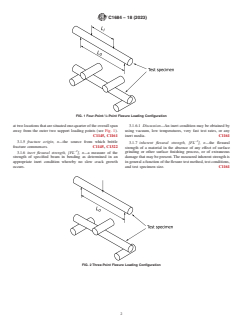
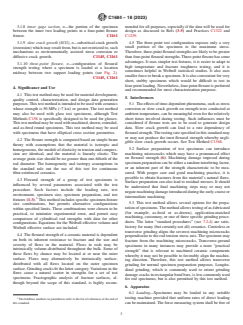
1.1 This test method is for the determination of flexural strength of rod-shaped specimens of advanced ceramic materials at ambient temperature. In many instances it is preferable to test round specimens rather than rectangular bend specimens, especially if the material is fabricated in rod form. This method permits testing of machined, drawn, or as-fired rod-shaped specimens. It allows some latitude in the rod sizes and cross section shape uniformity. Rod diameters between 1.5 and 8 mm and lengths from 25 to 85 mm are recommended, but other sizes are permitted. Four-point-1/4-point as shown in Fig. 1 is the preferred testing configuration. Three-point loading is permitted. This method describes the apparatus, specimen requirements, test procedure, calculations, and reporting requirements. The method is applicable to monolithic or particulate- or whisker-reinforced ceramics. It may also be used for glasses. It is not applicable to continuous fiber-reinforced ceramic composites.
FIG. 1 Four-Point-1/4-Point Flexure Loading Configuration
1.2 The values stated in SI units are to be regarded as the standard. The values given in parentheses are for information only.
1.3 This standard does not purport to address all of the safety concerns, if any, associated with its use. It is the responsibility of the user of this standard to establish appropriate safety, health, and environmental practices and determine the applicability of regulatory limitations prior to use.
1.4 This international standard was developed in accordance with internationally recognized principles on standardization established in the Decision on Principles for the Development of International Standards, Guides and Recommendations issued by the World Trade Organization Technical Barriers to Trade (TBT) Committee.
- Status
- Published
- Publication Date
- 31-Dec-2022
- Technical Committee
- C28 - Advanced Ceramics
- Drafting Committee
- C28.01 - Mechanical Properties and Performance
Overview
ASTM C1684-18(2023), Standard Test Method for Flexural Strength of Advanced Ceramics at Ambient Temperature-Cylindrical Rod Strength, establishes procedures for determining the flexural (bend) strength of advanced ceramic and glass materials in rod shape at room temperature. This method is widely used for the development, characterization, quality control, and data generation necessary for the design and evaluation of ceramic components, especially when materials are fabricated in cylindrical forms.
This standard is applicable to advanced ceramics with a strength of 50 MPa (~7 ksi) or greater and accommodates test specimens that are machined, drawn, extruded, or as-fired, including both round and elliptical cross sections. It is not intended for continuous fiber-reinforced ceramic composites.
Key Topics
- Flexural Strength Determination: Specifies methods and apparatus for measuring the mechanical strength of ceramic rods under flexural loading, both in four-point (preferred) and three-point configurations.
- Specimen Requirements: Outlines acceptable size ranges (1.5–8 mm diameter, 25–85 mm length recommended, others permitted) and cross-section tolerance, allowing some flexibility to suit component-like shapes.
- Test Configurations: Four-point-1/4-point bending is preferred for comprehensive characterization, but three-point bending is permitted, particularly for short or stubby specimens.
- Material Assumptions: Assumes the ceramics are isotropic, homogeneous, and exhibit identical elastic properties in tension and compression.
- Influential Factors: Notes that loading rate, test environment, specimen size, specimen preparation (especially surface finish and grinding), and fixture design can significantly influence measured strength.
- Surface Preparation: Discusses machining and grinding protocols, recognizing that preparation can introduce surface flaws affecting measured values.
- Data Analysis: Includes equations for Weibull effective volume and surface area for statistical analysis of strength distributions.
- Limitations: Not recommended for continuous fiber-reinforced ceramics; not a substitute for other glass-specific standards (e.g., ASTM C158).
Applications
- Material Development: Enables comparison of new ceramic formulations and processing techniques by providing reliable strength measurements.
- Quality Control: Assures manufacturers and users of ceramics that materials meet specified mechanical thresholds before further application or integration into assemblies.
- Component Design: Supplies essential flexural strength data for engineers calculating safe design limits in structural or functional ceramic parts, such as rods in industrial equipment, medical devices, or electronics.
- Research & Characterization: Supports academic and industrial researchers in studying the effects of microstructural features (like flaws and grain size), machining methods, or environmental exposure on ceramic strength.
- Comparative Evaluation: Facilitates benchmarking between different ceramic materials, geometries, and fabrication processes, thanks to standardized procedures and reporting.
Related Standards
For comprehensive ceramic strength testing and material specification, reference these related ASTM standards:
- ASTM C1161 – Flexural Strength of Advanced Ceramics at Ambient Temperature (rectangular specimens)
- ASTM C158 – Strength of Glass by Flexure
- ASTM C1145 – Terminology of Advanced Ceramics
- ASTM C1239 – Reporting Uniaxial Strength Data and Estimating Weibull Distribution Parameters for Advanced Ceramics
- ASTM C1322 – Fractography and Characterization of Fracture Origins in Advanced Ceramics
- ASTM C1368 – Determination of Slow Crack Growth Parameters by Constant Stress Rate Strength Testing
- ASTM E4 – Force Calibration and Verification of Testing Machines
- ASTM E337 – Measuring Humidity with a Psychrometer
Keywords: ASTM C1684, flexural strength, advanced ceramics, cylindrical rods, ceramic strength testing, four-point bending, three-point bending, ceramic quality control, Weibull analysis, surface preparation, ceramic component design.
Relations
- Effective Date
- 01-Nov-2023
- Effective Date
- 01-Jul-2019
- Effective Date
- 01-Jul-2019
- Effective Date
- 01-Jul-2018
- Effective Date
- 01-Jan-2018
- Effective Date
- 01-Nov-2017
- Effective Date
- 01-Feb-2017
- Effective Date
- 01-Jul-2015
- Effective Date
- 01-Jun-2014
- Effective Date
- 01-Aug-2013
- Effective Date
- 01-Aug-2013
- Effective Date
- 01-Feb-2013
- Effective Date
- 01-Feb-2013
- Effective Date
- 01-Oct-2012
- Effective Date
- 01-Dec-2010
Frequently Asked Questions
ASTM C1684-18(2023) is a standard published by ASTM International. Its full title is "Standard Test Method for Flexural Strength of Advanced Ceramics at Ambient Temperature-Cylindrical Rod Strength". This standard covers: SIGNIFICANCE AND USE 4.1 This test method may be used for material development, quality control, characterization, and design data generation purposes. This test method is intended to be used with ceramics whose strength is 50 MPa (~7 ksi) or greater. The test method may also be used with glass test specimens, although Test Methods C158 is specifically designed to be used for glasses. This test method may be used with machined, drawn, extruded, and as-fired round specimens. This test method may be used with specimens that have elliptical cross section geometries. 4.2 The flexure strength is computed based on simple beam theory with assumptions that the material is isotropic and homogeneous, the moduli of elasticity in tension and compression are identical, and the material is linearly elastic. The average grain size should be no greater than one-fiftieth of the rod diameter. The homogeneity and isotropy assumptions in the standard rule out the use of this test for continuous fiber-reinforced ceramics. 4.3 Flexural strength of a group of test specimens is influenced by several parameters associated with the test procedure. Such factors include the loading rate, test environment, specimen size, specimen preparation, and test fixtures (1-3).3 This method includes specific specimen-fixture size combinations, but permits alternative configurations within specified limits. These combinations were chosen to be practical, to minimize experimental error, and permit easy comparison of cylindrical rod strengths with data for other configurations. Equations for the Weibull effective volume and Weibull effective surface are included. 4.4 The flexural strength of a ceramic material is dependent on both its inherent resistance to fracture and the size and severity of flaws in the material. Flaws in rods may be intrinsically volume-distributed throughout the bulk. Some of these flaws by chance may be located at or near the outer surface. Flaws may alternatively be intrinsically surface-distrib... SCOPE 1.1 This test method is for the determination of flexural strength of rod-shaped specimens of advanced ceramic materials at ambient temperature. In many instances it is preferable to test round specimens rather than rectangular bend specimens, especially if the material is fabricated in rod form. This method permits testing of machined, drawn, or as-fired rod-shaped specimens. It allows some latitude in the rod sizes and cross section shape uniformity. Rod diameters between 1.5 and 8 mm and lengths from 25 to 85 mm are recommended, but other sizes are permitted. Four-point-1/4-point as shown in Fig. 1 is the preferred testing configuration. Three-point loading is permitted. This method describes the apparatus, specimen requirements, test procedure, calculations, and reporting requirements. The method is applicable to monolithic or particulate- or whisker-reinforced ceramics. It may also be used for glasses. It is not applicable to continuous fiber-reinforced ceramic composites. FIG. 1 Four-Point-1/4-Point Flexure Loading Configuration 1.2 The values stated in SI units are to be regarded as the standard. The values given in parentheses are for information only. 1.3 This standard does not purport to address all of the safety concerns, if any, associated with its use. It is the responsibility of the user of this standard to establish appropriate safety, health, and environmental practices and determine the applicability of regulatory limitations prior to use. 1.4 This international standard was developed in accordance with internationally recognized principles on standardization established in the Decision on Principles for the Development of International Standards, Guides and Recommendations issued by the World Trade Organization Technical Barriers to Trade (TBT) Committee.
SIGNIFICANCE AND USE 4.1 This test method may be used for material development, quality control, characterization, and design data generation purposes. This test method is intended to be used with ceramics whose strength is 50 MPa (~7 ksi) or greater. The test method may also be used with glass test specimens, although Test Methods C158 is specifically designed to be used for glasses. This test method may be used with machined, drawn, extruded, and as-fired round specimens. This test method may be used with specimens that have elliptical cross section geometries. 4.2 The flexure strength is computed based on simple beam theory with assumptions that the material is isotropic and homogeneous, the moduli of elasticity in tension and compression are identical, and the material is linearly elastic. The average grain size should be no greater than one-fiftieth of the rod diameter. The homogeneity and isotropy assumptions in the standard rule out the use of this test for continuous fiber-reinforced ceramics. 4.3 Flexural strength of a group of test specimens is influenced by several parameters associated with the test procedure. Such factors include the loading rate, test environment, specimen size, specimen preparation, and test fixtures (1-3).3 This method includes specific specimen-fixture size combinations, but permits alternative configurations within specified limits. These combinations were chosen to be practical, to minimize experimental error, and permit easy comparison of cylindrical rod strengths with data for other configurations. Equations for the Weibull effective volume and Weibull effective surface are included. 4.4 The flexural strength of a ceramic material is dependent on both its inherent resistance to fracture and the size and severity of flaws in the material. Flaws in rods may be intrinsically volume-distributed throughout the bulk. Some of these flaws by chance may be located at or near the outer surface. Flaws may alternatively be intrinsically surface-distrib... SCOPE 1.1 This test method is for the determination of flexural strength of rod-shaped specimens of advanced ceramic materials at ambient temperature. In many instances it is preferable to test round specimens rather than rectangular bend specimens, especially if the material is fabricated in rod form. This method permits testing of machined, drawn, or as-fired rod-shaped specimens. It allows some latitude in the rod sizes and cross section shape uniformity. Rod diameters between 1.5 and 8 mm and lengths from 25 to 85 mm are recommended, but other sizes are permitted. Four-point-1/4-point as shown in Fig. 1 is the preferred testing configuration. Three-point loading is permitted. This method describes the apparatus, specimen requirements, test procedure, calculations, and reporting requirements. The method is applicable to monolithic or particulate- or whisker-reinforced ceramics. It may also be used for glasses. It is not applicable to continuous fiber-reinforced ceramic composites. FIG. 1 Four-Point-1/4-Point Flexure Loading Configuration 1.2 The values stated in SI units are to be regarded as the standard. The values given in parentheses are for information only. 1.3 This standard does not purport to address all of the safety concerns, if any, associated with its use. It is the responsibility of the user of this standard to establish appropriate safety, health, and environmental practices and determine the applicability of regulatory limitations prior to use. 1.4 This international standard was developed in accordance with internationally recognized principles on standardization established in the Decision on Principles for the Development of International Standards, Guides and Recommendations issued by the World Trade Organization Technical Barriers to Trade (TBT) Committee.
ASTM C1684-18(2023) is classified under the following ICS (International Classification for Standards) categories: 81.060.30 - Advanced ceramics. The ICS classification helps identify the subject area and facilitates finding related standards.
ASTM C1684-18(2023) has the following relationships with other standards: It is inter standard links to ASTM C158-23, ASTM C1145-19, ASTM C1322-15(2019), ASTM C1239-13(2018), ASTM C1368-18, ASTM C158-02(2017), ASTM C1368-10(2017), ASTM C1322-15, ASTM E4-14, ASTM C1161-13, ASTM C1239-13, ASTM C1145-06(2013)e1, ASTM C1145-06(2013), ASTM C158-02(2012), ASTM C1368-10. Understanding these relationships helps ensure you are using the most current and applicable version of the standard.
ASTM C1684-18(2023) is available in PDF format for immediate download after purchase. The document can be added to your cart and obtained through the secure checkout process. Digital delivery ensures instant access to the complete standard document.
Standards Content (Sample)
This international standard was developed in accordance with internationally recognized principles on standardization established in the Decision on Principles for the
Development of International Standards, Guides and Recommendations issued by the World Trade Organization Technical Barriers to Trade (TBT) Committee.
Designation: C1684 − 18 (Reapproved 2023)
Standard Test Method for
Flexural Strength of Advanced Ceramics at Ambient
Temperature—Cylindrical Rod Strength
This standard is issued under the fixed designation C1684; the number immediately following the designation indicates the year of
original adoption or, in the case of revision, the year of last revision. A number in parentheses indicates the year of last reapproval. A
superscript epsilon (´) indicates an editorial change since the last revision or reapproval.
1. Scope 2. Referenced Documents
2.1 ASTM Standards:
1.1 This test method is for the determination of flexural
C158 Test Methods for Strength of Glass by Flexure (De-
strength of rod-shaped specimens of advanced ceramic mate-
termination of Modulus of Rupture)
rials at ambient temperature. In many instances it is preferable
C1145 Terminology of Advanced Ceramics
to test round specimens rather than rectangular bend
C1161 Test Method for Flexural Strength of Advanced
specimens, especially if the material is fabricated in rod form.
Ceramics at Ambient Temperature
This method permits testing of machined, drawn, or as-fired
C1239 Practice for Reporting Uniaxial Strength Data and
rod-shaped specimens. It allows some latitude in the rod sizes
Estimating Weibull Distribution Parameters for Advanced
and cross section shape uniformity. Rod diameters between 1.5
Ceramics
and 8 mm and lengths from 25 to 85 mm are recommended, but
other sizes are permitted. Four-point- ⁄4-point as shown in Fig. C1322 Practice for Fractography and Characterization of
Fracture Origins in Advanced Ceramics
1 is the preferred testing configuration. Three-point loading is
permitted. This method describes the apparatus, specimen C1368 Test Method for Determination of Slow Crack
Growth Parameters of Advanced Ceramics by Constant
requirements, test procedure, calculations, and reporting re-
quirements. The method is applicable to monolithic or Stress Rate Strength Testing at Ambient Temperature
E4 Practices for Force Calibration and Verification of Test-
particulate- or whisker-reinforced ceramics. It may also be
used for glasses. It is not applicable to continuous fiber- ing Machines
E337 Test Method for Measuring Humidity with a Psy-
reinforced ceramic composites.
chrometer (the Measurement of Wet- and Dry-Bulb Tem-
1.2 The values stated in SI units are to be regarded as the
peratures)
standard. The values given in parentheses are for information
only.
3. Terminology
1.3 This standard does not purport to address all of the
3.1 Definitions:
safety concerns, if any, associated with its use. It is the
3.1.1 complete gage section, n—the portion of the specimen
responsibility of the user of this standard to establish appro-
between the two outer loading points in four-point flexure and
priate safety, health, and environmental practices and deter-
three-point flexure fixtures. C1161
mine the applicability of regulatory limitations prior to use.
3.1.2 flaw, n—a structural discontinuity in an advanced
1.4 This international standard was developed in accor-
ceramic body that acts as a highly localized stress raiser.
dance with internationally recognized principles on standard-
3.1.2.1 Discussion—The presence of such discontinuities
ization established in the Decision on Principles for the
does not necessarily imply that the ceramic has been prepared
Development of International Standards, Guides and Recom-
C1322
improperly or is faulty.
mendations issued by the World Trade Organization Technical
–2
3.1.3 flexural strength, [FL ], n—a measure of the ultimate
Barriers to Trade (TBT) Committee.
strength of a specified beam in bending. C1145, C1161
3.1.4 four-point- ⁄4-point flexure, n—configuration of flex-
ural strength testing where a specimen is symmetrically loaded
This test method is under the jurisdiction of ASTM Committee C28 on
Advanced Ceramics and is the direct responsibility of Subcommittee C28.01 on
Mechanical Properties and Performance. For referenced ASTM standards, visit the ASTM website, www.astm.org, or
Current edition approved Jan. 1, 2023. Published February 2023. Originally contact ASTM Customer Service at service@astm.org. For Annual Book of ASTM
approved in 2008. Last previous edition approved in 2018 as C1684 – 18. DOI: Standards volume information, refer to the standard’s Document Summary page on
10.1520/C1684-18R23. the ASTM website.
Copyright © ASTM International, 100 Barr Harbor Drive, PO Box C700, West Conshohocken, PA 19428-2959. United States
C1684 − 18 (2023)
FIG. 1 Four-Point- ⁄4-Point Flexure Loading Configuration
at two locations that are situated one-quarter of the overall span 3.1.6.1 Discussion—An inert condition may be obtained by
away from the outer two support loading points (see Fig. 1). using vacuum, low temperatures, very fast test rates, or any
C1145, C1161
inert media. C1161
–2
3.1.5 fracture origin, n—the source from which brittle
3.1.7 inherent flexural strength, [FL ], n—the flexural
fracture commences. C1145, C1322
strength of a material in the absence of any effect of surface
–2
3.1.6 inert flexural strength, [FL ], n—a measure of the grinding or other surface finishing process, or of extraneous
strength of specified beam in bending as determined in an damage that may be present. The measured inherent strength is
appropriate inert condition whereby no slow crack growth in general a function of the flexure test method, test conditions,
occurs. and test specimen size. C1161
FIG. 2 Three-Point Flexure Loading Configuration
C1684 − 18 (2023)
3.1.8 inner gage section, n—the portion of the specimen mended for all purposes, especially if the data will be used for
between the inner two loading points in a four-point flexure design as discussed in Refs (3-5) and Practices C1322 and
fixture. C1161 C1239.
3.1.9 slow crack growth (SCG), n—subcritical crack growth 4.5 The three-point test configuration exposes only a very
small portion of the specimen to the maximum stress.
(extension) which may result from, but is not restricted to, such
mechanisms as environmentally assisted stress corrosion or Therefore, three-point flexural strengths are likely to be greater
diffusive crack growth. C1145, C1161 than four-point flexural strengths. Three-point flexure has some
advantages. It uses simpler test fixtures, it is easier to adapt to
3.1.10 three-point flexure, n—configuration of flexural
high temperature and fracture toughness testing, and it is
strength testing where a specimen is loaded at a location
sometimes helpful in Weibull statistical studies. It also uses
midway between two support loading points (see Fig. 2).
smaller force to break a specimen. It is also convenient for very
C1145, C1161
short, stubby specimens which would be difficult to test in
four-point loading. Nevertheless, four-point flexure is preferred
4. Significance and Use
and recommended for most characterization purposes.
4.1 This test method may be used for material development,
5. Interferences
quality control, characterization, and design data generation
purposes. This test method is intended to be used with ceramics 5.1 The effects of time-dependent phenomena, such as stress
whose strength is 50 MPa (~7 ksi) or greater. The test method corrosion or slow crack growth on strength tests conducted at
may also be used with glass test specimens, although Test ambient temperature, can be meaningful even for the relatively
Methods C158 is specifically designed to be used for glasses. short times involved during testing. Such influences must be
This test method may be used with machined, drawn, extruded, considered if flexure tests are to be used to generate design
and as-fired round specimens. This test method may be used data. Slow crack growth can lead to a rate dependency of
with specimens that have elliptical cross section geometries. flexural strength. The testing rate specified in this standard may
or may not produce the inert flexural strength whereby negli-
4.2 The flexure strength is computed based on simple beam
gible slow crack growth occurs. See Test Method C1368.
theory with assumptions that the material is isotropic and
5.2 Surface preparation of test specimens can introduce
homogeneous, the moduli of elasticity in tension and compres-
machining microcracks which may have a pronounced effect
sion are identical, and the material is linearly elastic. The
on flexural strength (6). Machining damage imposed during
average grain size should be no greater than one-fiftieth of the
specimen preparation can be either a random interfering factor,
rod diameter. The homogeneity and isotropy assumptions in
or an inherent part of the strength characteristic to be mea-
the standard rule out the use of this test for continuous
sured. With proper care and good machining practice, it is
fiber-reinforced ceramics.
possible to obtain fractures from the material’s natural flaws.
4.3 Flexural strength of a group of test specimens is
Surface preparation can also lead to residual stresses. It should
influenced by several parameters associated with the test
be understood that final machining steps may or may not
procedure. Such factors include the loading rate, test
negate machining damage introduced during the early coarse or
environment, specimen size, specimen preparation, and test
intermediate machining.
fixtures (1-3). This method includes specific specimen-fixture
5.3 This test method allows several options for the prepa-
size combinations, but permits alternative configurations
ration of specimens. The method allows testing of as-fabricated
within specified limits. These combinations were chosen to be
(for example, as-fired or as-drawn), application-matched
practical, to minimize experimental error, and permit easy
machining, customary, or one of three specific grinding proce-
comparison of cylindrical rod strengths with data for other
dures. The latter “standard procedures” (see 7.2.4) are satis-
configurations. Equations for the Weibull effective volume and
factory for many (but certainly not all) ceramics. Centerless or
Weibull effective surface are included.
transverse grinding aligns the severest machining microcracks
4.4 The flexural strength of a ceramic material is dependent
perpendicular to the rod tension stress axis. The specimen may
on both its inherent resistance to fracture and the size and
fracture from the machining microcracks. Transverse-ground
severity of flaws in the material. Flaws in rods may be
specimens in many instances may provide a more “practical
intrinsically volume-distributed throughout the bulk. Some of
strength” that is relevant to machined ceramic components
these flaws by chance may be located at or near the outer
whereby it may not be possible to favorably align the machin-
surface. Flaws may alternatively be intrinsically surface-
ing direction. Therefore, this test method allows transverse
distributed with all flaws located on the outer specimen
grinding for normal specimen preparation purposes. Longitu-
surface. Grinding cracks fit the latter category. Variations in the
dinal grinding, which is commonly used to orient grinding
flaws cause a natural scatter in strengths for a set of test
damage cracks in rectangular bend bars, is less commonly used
specimens. Fractographic analysis of fracture surfaces, al-
for rod specimens, but is also permitted by this test method.
though beyond the scope of this standard, is highly recom-
6. Apparatus
6.1 Loading—Specimens may be loaded in any suitable
testing machine provided that uniform rates of direct loading
The boldface numbers in parentheses refer to the list of references at the end of
this standard. can be maintained. The force measuring system shall be free of
C1684 − 18 (2023)
initial lag at the loading rates used and shall be equipped with configuration. The lower the material’s fracture toughness and
a means for retaining read-out of the maximum force applied to the higher the elastic modulus, the more likely that contact
the specimen. The accuracy of the testing machine shall be in cracks will cause premature fracture. The larger the test
accordance with Practices E4. specimen diameter for a given test span, the more likely that
contact fracture will occur since larger forces are applied to
6.2 Four-Point Flexure—Four-point- ⁄4-point fixtures are
break them. In other words, short, stubby rod specimens are
the preferred configuration. When possible, use one of the
more likely to have problems than long, slender rods. This test
outer support and inner loading span combinations listed in
method allows considerable latitude in the selection of speci-
Table 1. Other span sizes may be used if these sizes are not
men sizes and testing geometries. If specimens break prema-
suitable for a specific round part. The ratio of the fixture outer
turely from contact cracks, the user shall either reduce the test
span length to the specimen diameter shall not be less than 3.0.
specimen diameter, use longer rod specimens with longer span
6.3 Three-Point Flexure—Three-point flexure may be used
test fixtures, use fixtures with cradles (see 6.5), or shift to
if four-point is not satisfactory, such as if the specimens are
three-point loading.
very short and stubby and consequently require very large
6.4.4 The rollers shall be free to rotate or roll to minimize
breaking forces in four-point loading. When possible, use one
frictional constraint as the specimen stretches or contracts
of the support spans listed in Table 1 for three-point loading.
during loading. The sole exception is the middle load roller in
Other span sizes may be used if these sizes are not suitable for
three-point flexure which need not rotate. Note that the outer
a specific round part. The outer fixture span length to specimen
support rollers roll outward and the inner loading rollers roll
diameter ratio shall not be less than 3.0.
inward. The rollers may roll on a fixture base as shown in Fig.
6.4 Loading Rollers—Force shall be applied to the test 3 or alternatively, they may be mounted in roller assemblies
pieces directly by rollers as described in this section (6.4) or
that allow them to rotate. Cradle inserts such as shown in Fig.
alternatively by rollers with cradles as described in 6.5. 4 may be used in conjunction with loading rollers if necessary
6.4.1 This test method permits direct contact of rod speci-
to eliminate fractures at the loading points induced by severe
mens with loading and support rollers. Direct contact may contact loading stresses associated with a round specimen in
cause two problems, however. The crossed cylinder arrange-
contact with round loading rollers.
ment creates intense contact stresses in both the loading roller
NOTE 1—Fixtures suitable for Test Method C1161 for rectangular cross
and the test specimen due to the very small contact footprint.
section specimens may be used with rod specimens. Fully articulating
The magnitude of the contact stresses depends upon the applied
fixtures as defined in Test Method C1161 are not required for rod
forces, the roller and test specimen diameters, and their elastic specimens due to ease of applying force to a cylindrical specimen.
Semi-articulating fixtures as defined in Test Method C1161 are satisfac-
properties.
tory for four-point loading of rods. No articulation is needed for
6.4.2 Paragraph 6.4.5 provides guidance on how to mini-
three-point loading. Loading rollers were referred to as “bearings” in Test
mize or eliminate permanent deformation that may occur in the
Method C1161.
loading rollers due to contact stresses.
6.4.5 The load application rollers shall be made of hardened
6.4.3 Direct loading by rollers onto the rod test specimens
steel or a dense, strong ceramic. The portions of the test fixture
may cause premature test specimen fracture invalidating the
that support the rollers may need to be hardened to prevent
test. Examples are shown in Annex A1. Contact stresses may
permanent deformation. The roller length shall be at least three
generate shallow Hertzian cone cracks in the test specimen.
times the specimen diameter. The range of specimen sizes,
Minor cracking at an inner loading point (on the compression-
fixture sizes, and materials permitted by this standard for rod
loaded side of the test rod) usually is harmless since it does not
specimens is so broad that it is difficult to specify a single
cause specimen breakage and forces are transmitted through
hardness requirement. Therefore it is recommended that hard-
the crack faces. In extreme conditions, however, such as
ened steel dowel rollers with hardness of HRC 60 or greater be
loading of short, stubby specimens in three-point or four-point
used as the loading and support rollers. These should be
loading, the magnitude of the forces and contact stresses may
checked after breaking a few specimens and if there is evidence
be great enough to drive a Hertzian crack deep into the test
of permanent deformation, then harder rollers should be
specimen cross section. Contact cracks at the outer support
substituted or cradles used as per 6.5. Minor scuff marks,
rollers may be deleterious and cause an undesirable fracture of
scratches, or small nicks on the rollers do not require the rollers
the specimen, even though these locations are far away from
to be replaced.
the inner span in four-point loading or the middle in three-point
6.4.6 The roller diameter should be 0.75 to 1.5 times the
loading. Examples of such deleterious contact cracks are
diameter of the test specimen size. Table 2 lists some suggested
shown in Annex A1. The propensity for fracture from contact
sizes. Other sizes are permitted if necessary for unusually sized
cracks depends upon the test material properties and the testing
test specimens. Smaller diameter rollers may cause excessive
contact stresses. Larger diameter rollers may cause stress errors
TABLE 1 Preferred Fixture Spans
due to contact point tangency shift as the specimen deflects
under load. All rollers shall be straight and uniform in diameter
Support Outer Span Loading Inner Span
Configuration
(L ), mm (L ), mm
o i
and have the same diameter to within 60.025 mm.
A 20 10
6.4.7 The rollers shall be carefully positioned such that the
B 40 20
spans are accurate to within 60.10 mm. The load application
C 80 40
rollers for the three-point configurations shall be positioned
C1684 − 18 (2023)
NOTE 1—The loading and support rollers are free to roll to relieve frictional constraints. The outer rollers roll outward and the inner rollers roll inward.
Either the upper (shown in (a)) or the lower support piece (shown in (b)) should be free to pivot or “articulate” to ensure even loading on the left and
right rollers. The curved arrows show this action. Such pivoting or “articulation” is not necessary for three-point loading. Rubber bands, magnets, or low
stiffness springs may hold the rollers up against the positioning shoulders.
FIG. 3 Four-Point Fixture Schematic
NOTE 1—Cradles may be used between the rollers and the specimen. See Annex A2 for more information about cradles.
FIG. 4 Four-Point Fixture with Cradles Schematic
TABLE 2 Suggested Nominal Roller Diameters
6.4.8 All rollers should be approximately parallel to each
Configuration Diameter, mm other.
A 1.0 – 3.0
NOTE 2—The rollers do not need be as precisely parallel as specified in
B 2.2 – 6.0
Test Method C1161 for fixtures intended to be used for rectangular flexure
C 4.5 – 12.0
specimens. Unlike rectangular specimens, round rods are much less
susceptible to twisting errors. In general, any fixture suitable for rectan-
gular specimens will have rollers that are sufficiently parallel for round
rods.
midway between the support rollers within 60.10 mm. The
load application (inner) rollers for the four-point configurations 6.5 Cradles—If direct contact of loading rollers on the
shall be centered with respect to the support (outer) rollers specimen causes fractures at the loading points, then cradle
within 60.10 mm. inserts may be used between the test specimen and the rollers
C1684 − 18 (2023)
as shown in Fig. 4 and in Annex A2. The cradles will relieve finishing preparation is required. The rods do not need to be
most of the contact stresses and eliminate contact crack perfectly round. This method permits the use of elliptical cross
fractures. A cradle shall not be used for the middle loading section specimens.
point in three-point loading. 7.2.2 Application-Matched Machining—The specimen shall
have the same surface preparation as that given to a compo-
6.6 The fixture shall be stiffer than the specimen, so that
nent. Unless the process is proprietary, the report shall be
most of the crosshead travel is imposed onto the specimen.
specific about the stages of material removal, wheel grits,
Fixture compliance should be measured. An oversized block or
wheel bonding, and the amount of material removed per pass.
rod may be inserted into the fixture and force applied up to the
7.2.3 Customary Procedures—In instances where a custom-
levels expected for a test series. The load-displacement record
ary machining procedure has been developed that is completely
can be used to compute the system stiffness or compliance.
satisfactory for a class of materials (that is, it induces no
6.7 Micrometer—A micrometer with a resolution of
unwanted surface damage or residual stresses), this procedure
0.002 mm (or 0.0001 in.) or smaller should be used to measure
shall be used.
the test piece dimensions. The micrometer shall have flat anvil
7.2.4 Standard Procedures—In the instances where 7.2.1 –
faces. The micrometer shall not have a ball tip or sharp tip
7.2.3 are not appropriate, then 7.2.4 shall apply. Three alter-
since these might damage the test piece if the specimen
native grinding modes may be used. Machining may be in the
dimensions are measured prior to fracture. Alternative dimen-
centerless grinding, transverse grinding, or longitudinal grind-
sion measuring instruments may be used provided that they
ing modes. The procedures below shall serve as minimum
have a resolution of 0.002 mm (or 0.0001 in.) or finer and do
requirements and more stringent procedures may be necessary.
no harm to the specimen.
All grinding shall be done with an ample supply of appropriate
filtered coolant to keep work piece and wheel constantly
7. Sampling, Test Specimens, and Test Units
flooded and particles flushed. Grinding shall be in two or three
7.1 Test Specimen Size—Recommended and allowed test
stages, ranging from coarse to fine rates of material removal.
specimen dimensions are given in Table 3. The fixture span
The choice of bond system (resin, vitrified), diamond type
length (L ) to specimen diameter (D) ratio shall not be less than
o (natural or synthetic, coated or uncoated, friability, shape, etc.)
3.0.
and concentration (percent of diamond in the wheel) is at the
discretion of the user. The two end faces do not require special
NOTE 3—A range of test specimen diameters is allowed by this
machining.
standard, unlike Test Method C1161 for rectangular beams which specifies
fixed sizes. Rods are more likely to be related to some component shape
NOTE 6—These procedures have been demonstrated to be effective in
and some flexibility in specimen size is desirable, albeit at some loss of
minimizing or eliminating grinding cracks as strength-limiting flaws in
ease in comparing strength data for different rod sizes.
silicon nitride (6).
NOTE 4—Some caution should be exercised in the choice of test
NOTE 7—The sound of the grinding wheel during the grinding process
specimen diameter. The fixture span length to specimen diameter ratio (L /
o
may be a useful indicator of whether the grinding wheel condition and
D) limitation of >3.0 is intended to ensure that stress distribution is
material removal conditions are appropriate. It is beyond the scope of this
correct. However, some materials may be susceptible to contact damage
standard to specify the auditory responses, however.
for low L /D ratios that causes premature fracture that invalidates the test.
o
See 6.4.3. Whenever possible, use fixture spans with larger L /D ratios.
o 7.2.4.1 Transverse Centerless Grinding:
(1) Coarse grinding shall be by a diamond wheel that is
7.2 Specimen Preparation—Depending upon the intended
between 180 grit to 320 grit. The in-feed (wheel depth of cut)
application of the flexural strength data, use one of the
shall not exceed 0.050 mm (0.002 in.) per pass (for a 0.050 mm
following four test specimen preparation procedures:
diameter change) to a diameter that is oversized by 0.050 mm
NOTE 5—This test method does not specify a test piece surface finish.
(0.002 in.) to 0.100 mm (0.004 in.). The wheel surface speed
Surface finish may be very misleading since a ground, lapped, or even
should be between 15 and 40 m/s.
polished surface may conceal hidden (beneath the surface) cracking
damage from rough or intermediate grinding. (a) Note—This procedure is similar to that of transverse
cylindrical grinding in 7.2.4.2, but the allowed in-feeds are
7.2.1 As-Fabricated—The flexural specimen shall simulate
greater due to the nature of the centerless grinding set up.
the surface condition of an application where no machining is
(2) Intermediate grinding, if used, shall be by a diamond
to be used; for example, drawn, extruded, injection-molded,
wheel that is between 200 and 400 grit. The in-feed shall not
cast, and sintered parts. No additional grinding or surface
exceed 0.050 mm/pass to a diameter that is oversized by at
least 0.050 mm (0.002 in.). The wheel surface speed should be
between 15 and 40 m/s.
TABLE 3 Recommended and Allowable Specimen Sizes
(3) Finish grinding shall be with a 600-grit diamond wheel.
Recommended Allowable
The in-feed shall not exceed 0.005 mm (0.0002 in.). Final
Support Specimen
Fixture Specimen Specimen
Span Length
grinding shall remove no less than 0.050 mm (0.002 in.) from
Configuration Diameter Diameter
(L ) (L ), min, mm
o A T
(D), mm (D), mm the diameter. The wheel surface speed should be between 15
A
A 20 1.5 – 2 1 – 6.7 25
and 40 m/s.
A
B 40 3 – 4 2 – 13.3 45
7.2.4.2 Transverse Cylindrical Grinding:
A
C 80 6 – 8 4 – 27 85
(1) Coarse grinding shall be by a diamond wheel that is
A
Caution: Large-diameter specimens may fracture from contact damage that
between 180 grit to 320 grit. The in-feed (wheel depth of cut)
invalidates the test. See 6.4.3.
shall not exceed 0.025 mm (0.001 in.) per pass (for a 0.050 mm
C1684 − 18 (2023)
NOTE 9—Practice C1239 may be consulted for additional guidance
diameter change) to a diameter that is oversized by 0.050 mm
particularly if confidence intervals for estimates of Weibull parameters are
(0.002 in.) to 0.100 mm (0.004 in.). The wheel surface speed
of concern.
should be between 15 and 40 m/s.
(a) Note—This procedure is similar to that of transverse
8. Procedure
centerless grinding in 7.2.4.1, but the allowed in-feeds are less
8.1 Test specimen dimensions may be measured before
due to the nature of the cylindrical grinding setup.
testing, but it is simpler and preferable to measure round test
(2) Intermediate grinding, if used, shall be with a diamond
specimens after fracture. See 8.12. If the test specimens are
wheel that is between 200 and 400 grit. The in-feed shall not
noticeably elliptical and the minor and major diameters differ
exceed 0.025 mm/pass to a diameter that is oversized by at
by more than 5 %, the major and minor dimensions should be
least 0.050 mm (0.002 in.). The wheel surface speed should be
checked before testing so that the specimens can be inserted
between 15 and 40 m/s.
into the test fixture correctly as specified in 8.5.1. See 8.12 for
(3) Finish grinding shall be with a 600-grit diamond wheel.
the procedure to measure specimen dimensions.
The in-feed shall not exceed 0.005 mm (0.0002 in.). Final
grinding shall remove no less than 0.050 mm (0.002 in.) from
8.2 Test specimens on the appropriate fixture. Test size A
the diameter. The wheel surface speed should be between 15
specimens on either the four-point A fixture or the three-point
and 40 m/s.
A fixture. Similarly, test B specimens on B fixtures, and C
7.2.4.3 Longitudinal Centerless Ground: specimens on C fixtures. Four-point loading is preferred.
(1) Coarse and intermediate grinding may be centerless or
Three-point loading may be used if the rods have a large
transverse grinding as specified in 7.2.4.1 or 7.2.4.2 to a diameter and require large break forces to fracture.
diameter that is oversized by at least 0.050 mm (0.002 in.).
8.3 Carefully place each test specimen into the test fixture to
(2) Finish longitudinal grinding shall be with a diamond
preclude possible damage and to ensure alignment of the
wheel that is between 320 and 600 grit. The in-feed (wheel
specimen in the fixture. Position the specimen so that there is
depth of cut) shall not exceed 0.005 mm (0.0002 in.). Remove
an approximately equal amount of overhang of the test
no less than 0.050 mm (0.002 in.) from the diameter.
specimen beyond the outer rollers on each side. Position the
7.2.4.4 Materials with low fracture toughness and a greater
specimen (in a front-to-back sense) so that the test specimen is
susceptibility to grinding damage may require finer grinding
directly centered below the axis of the applied load.
wheels at very low removal rates.
8.4 Slowly apply the force at right angles to the fixture. The
7.2.4.5 Very deep skip marks or very deep single striations
maximum permissible stress in the test specimen due to initial
(which may occur due to a poor-quality grinding wheel or due
force (preload) shall not exceed 25 % of the mean strength. For
to a failure to true, dress, or balance a wheel) are not
four-point loading, make sure the fixture pivots or articulates so
acceptable.
that all four loading rollers are in contact with the test
7.2.5 Handling Precautions and Scratch Inspection—
specimen. A lamp or flashlight held behind the fixture can aid
Exercise care in storing and handling of specimens to avoid the
this examination.
introduction of random and severe flaws, such as might occur
8.5 Once preloaded, mark the front of the test specimen to
if specimens were allowed to impact or scratch each other. If
identify the points of load application. Also mark the rod
required by the user, inspect the surfaces as required for
orientation so that the tensile and compression regions can be
evidence of grinding chatter, scratches, or other extraneous
distinguished. Carefully drawn pencil or felt-tip permanent
damage. A 5× to 10× hand loupe or a low-power stereo
marker pen marks will suffice. These marks assist in post-
binocular microscope may be used to aid the examination.
fracture interpretation and analysis.
Mark the s
...