

ASTM E1023-23
(Guide)Standard Guide for Assessing the Hazard of a Material to Aquatic Organisms and Their Uses
General Information
- Abstract
SIGNIFICANCE AND USE
5.1 Adverse effects on natural populations of aquatic organisms and their uses have demonstrated the need to assess the hazards of many new, and some presently used, materials. The process described herein will help producers, users, regulatory agencies, and others to efficiently and adequately compare alternative materials, completely assess a final candidate material, or reassess the hazard of a material already in use.
5.2 Sequential assessment and feedback allow appropriate judgments concerning efficient use of resources, thereby minimizing unnecessary testing and focusing effort on the information most pertinent to each material. For different materials and situations, assessment of hazard will appropriately be based on substantially different amounts and kinds of biological, chemical, physical, and toxicological data.
5.3 Assessment of the hazard of a material to aquatic organisms and their uses should never be considered complete for all time. Reassessment should be considered if the amount of production, use, or disposal increases, new uses are discovered, or new information on biological, chemical, physical, or toxicological properties becomes available. Periodic review will help assure that new circumstances and information receive prompt appropriate attention.
5.4 If there is substantial transformation to another material, the hazard of both materials may need to be assessed.
5.5 In many cases, consideration of adverse effects should not end with completion of the hazard assessment. Additional steps should often include risk assessment, decisions concerning acceptability of identified hazards and risks, and mitigative actions.
5.6 Because this practice deals mostly with adverse effects on aquatic organisms and their uses, it is important that mitigative actions, such as improved treatment of aqueous effluents, not result in unacceptable effects on non-aquatic organisms. Thus, this standard should be used with other information in order to a...
SCOPE
1.1 This guide describes a stepwise process for using information concerning the biological, chemical, physical, and toxicological properties of a material to identify adverse effects likely to occur to aquatic organisms and their uses as a result of release of the material to the environment. The material will usually be a specific chemical, although it might be a group of chemicals that have very similar biological, chemical, physical, and toxicological properties and are usually produced, used, and discarded together.
1.2 The hazard assessment process is complex and requires decisions at a number of points; thus, the validity of a hazard assessment depends on the soundness of those decisions, as well as the accuracy of the information used. All decisions should be based on reasonable worst-case analyses so that an appropriate assessment can be completed for the least cost that is consistent with scientific validity.
1.3 This guide assumes that the reader is knowledgeable in aquatic toxicology and related pertinent areas. A list of general references is provided (1).2
1.4 This guide does not describe or reference detailed procedures for estimating or measuring environmental concentrations, or procedures for determining the maximum concentration of test material that is acceptable in the food of predators of aquatic life. However, this guide does describe how such information should be used when assessing the hazard of a material to aquatic organisms and their uses.
1.5 Because assessment of hazard to aquatic organisms and their uses is a relatively new activity within aquatic toxicology, most of the guidance provided herein is qualitative rather than quantitative. When possible, confidence limits should be calculated and taken into account.
1.6 This guide provides guidance for assessing hazard but does not provide guidance on how to take into account social considerations in order to judge the acceptabil...
- Status
- Published
- Publication Date
- 31-Dec-2022
- Technical Committee
- E50 - Environmental Assessment, Risk Management and Corrective Action
- Drafting Committee
- E50.47 - Biological Effects and Environmental Fate
Buy Documents
ASTM E1023-23 - Standard Guide for Assessing the Hazard of a Material to Aquatic Organisms and Their Uses
REDLINE ASTM E1023-23 - Standard Guide for Assessing the Hazard of a Material to Aquatic Organisms and Their Uses
Overview
ASTM E1023-23: Standard Guide for Assessing the Hazard of a Material to Aquatic Organisms and Their Uses is an international standard developed by ASTM Committee E50.47. This guide describes a systematic, stepwise process for evaluating the potential adverse effects of chemical materials on aquatic organisms and the benefits derived from aquatic environments. It enables producers, users, regulatory agencies, and environmental professionals to comprehensively compare alternative materials, fully assess candidate materials, or reassess substances already in use. By emphasizing iterative assessment and the efficient use of resources, this standard is critical for supporting responsible environmental management and regulatory compliance related to aquatic toxicology and chemical hazard assessment.
Key Topics
- Stepwise Hazard Assessment: The standard offers a phased, iterative approach to hazard assessment, progressing from low-cost use of existing data, to medium-cost targeted testing, and finally to high-cost, in-depth environmental and toxicological analysis as needed.
- Data Integration: The process synthesizes biological, chemical, physical, and toxicological data to estimate environmental concentrations and predict possible effects on aquatic organisms.
- Iterative Decision-Making: At each phase, decisions are made regarding whether the hazard is minimal, potentially excessive, or uncertain, prompting further investigation only when necessary.
- Continuous Reassessment: Hazards must be periodically reviewed and reassessed in light of new information, changes in production or usage, or the discovery of new environmental or toxicological impacts.
- Application Scope: While the standard primarily addresses effects on aquatic organisms, it also recommends considering potential impacts on non-aquatic species and encourages integration with broader ecological hazard and risk assessment frameworks.
Applications
The practical value of ASTM E1023-23 lies in its flexibility and comprehensive guidance, making it suitable for a range of applications, including:
- Regulatory Compliance: Companies can demonstrate due diligence in assessing environmental hazards, supporting compliance with local, national, and international regulations regarding chemical management and environmental protection.
- Product and Material Evaluation: Producers and users can evaluate new or existing chemicals before, during, and after commercialization to ensure minimal hazard to aquatic systems.
- Risk Management: The guide supports robust environmental risk assessments by identifying when additional data collection or risk mitigation measures are warranted.
- Environmental Impact Assessments: Environmental consultants and researchers can use the standard for developing or updating site-specific or regional aquatic hazard assessments.
- Resource Optimization: By using existing information and deploying higher-cost resources only when required, organizations can manage testing costs while maintaining scientific integrity.
- Periodic Reassessment: Ongoing monitoring and reassessment help organizations respond rapidly to new data or changes in production, use, or disposal practices that may alter the hazard profile.
Related Standards
ASTM E1023-23 is complemented by several other ASTM standards that provide terminology, detailed test methods, and specific procedures for evaluating toxicity and environmental fate in aquatic systems, including:
- ASTM D1129: Terminology Relating to Water
- ASTM E724: Conducting Static Short-Term Chronic Toxicity Tests with Saltwater Bivalve Molluscs
- ASTM E729: Conducting Acute Toxicity Tests with Fishes, Macroinvertebrates, and Amphibians
- ASTM E1022: Conducting Bioconcentration Tests with Fishes and Saltwater Bivalve Molluscs
- ASTM E1191, E1193, E1218, E1241, E1415: Additional guides for life-cycle and toxicity testing across various aquatic species
- ASTM E1706: Measuring Toxicity of Sediment-Associated Contaminants with Freshwater Invertebrates
By integrating ASTM E1023-23 with these related standards, organizations can build comprehensive, scientifically-sound approaches to aquatic hazard assessment, ensuring environmental protection and regulatory compliance.
Relations
- Effective Date
- 01-May-2020
- Effective Date
- 01-Apr-2019
- Effective Date
- 01-Sep-2010
- Effective Date
- 01-Mar-2010
- Effective Date
- 01-Mar-2008
- Refers
ASTM E1191-03a(2008) - Standard Guide for Conducting Life-Cycle Toxicity Tests with Saltwater Mysids - Effective Date
- 01-Feb-2008
- Effective Date
- 01-Oct-2007
- Effective Date
- 01-Sep-2006
- Effective Date
- 01-Sep-2006
- Effective Date
- 15-Feb-2006
- Effective Date
- 01-Mar-2004
- Effective Date
- 01-Mar-2004
- Effective Date
- 10-Aug-2003
- Effective Date
- 10-Mar-2003
- Effective Date
- 10-Jul-2002
Buy Documents
ASTM E1023-23 - Standard Guide for Assessing the Hazard of a Material to Aquatic Organisms and Their Uses
REDLINE ASTM E1023-23 - Standard Guide for Assessing the Hazard of a Material to Aquatic Organisms and Their Uses
Frequently Asked Questions
ASTM E1023-23 is a guide published by ASTM International. Its full title is "Standard Guide for Assessing the Hazard of a Material to Aquatic Organisms and Their Uses". This standard covers: SIGNIFICANCE AND USE 5.1 Adverse effects on natural populations of aquatic organisms and their uses have demonstrated the need to assess the hazards of many new, and some presently used, materials. The process described herein will help producers, users, regulatory agencies, and others to efficiently and adequately compare alternative materials, completely assess a final candidate material, or reassess the hazard of a material already in use. 5.2 Sequential assessment and feedback allow appropriate judgments concerning efficient use of resources, thereby minimizing unnecessary testing and focusing effort on the information most pertinent to each material. For different materials and situations, assessment of hazard will appropriately be based on substantially different amounts and kinds of biological, chemical, physical, and toxicological data. 5.3 Assessment of the hazard of a material to aquatic organisms and their uses should never be considered complete for all time. Reassessment should be considered if the amount of production, use, or disposal increases, new uses are discovered, or new information on biological, chemical, physical, or toxicological properties becomes available. Periodic review will help assure that new circumstances and information receive prompt appropriate attention. 5.4 If there is substantial transformation to another material, the hazard of both materials may need to be assessed. 5.5 In many cases, consideration of adverse effects should not end with completion of the hazard assessment. Additional steps should often include risk assessment, decisions concerning acceptability of identified hazards and risks, and mitigative actions. 5.6 Because this practice deals mostly with adverse effects on aquatic organisms and their uses, it is important that mitigative actions, such as improved treatment of aqueous effluents, not result in unacceptable effects on non-aquatic organisms. Thus, this standard should be used with other information in order to a... SCOPE 1.1 This guide describes a stepwise process for using information concerning the biological, chemical, physical, and toxicological properties of a material to identify adverse effects likely to occur to aquatic organisms and their uses as a result of release of the material to the environment. The material will usually be a specific chemical, although it might be a group of chemicals that have very similar biological, chemical, physical, and toxicological properties and are usually produced, used, and discarded together. 1.2 The hazard assessment process is complex and requires decisions at a number of points; thus, the validity of a hazard assessment depends on the soundness of those decisions, as well as the accuracy of the information used. All decisions should be based on reasonable worst-case analyses so that an appropriate assessment can be completed for the least cost that is consistent with scientific validity. 1.3 This guide assumes that the reader is knowledgeable in aquatic toxicology and related pertinent areas. A list of general references is provided (1).2 1.4 This guide does not describe or reference detailed procedures for estimating or measuring environmental concentrations, or procedures for determining the maximum concentration of test material that is acceptable in the food of predators of aquatic life. However, this guide does describe how such information should be used when assessing the hazard of a material to aquatic organisms and their uses. 1.5 Because assessment of hazard to aquatic organisms and their uses is a relatively new activity within aquatic toxicology, most of the guidance provided herein is qualitative rather than quantitative. When possible, confidence limits should be calculated and taken into account. 1.6 This guide provides guidance for assessing hazard but does not provide guidance on how to take into account social considerations in order to judge the acceptabil...
SIGNIFICANCE AND USE 5.1 Adverse effects on natural populations of aquatic organisms and their uses have demonstrated the need to assess the hazards of many new, and some presently used, materials. The process described herein will help producers, users, regulatory agencies, and others to efficiently and adequately compare alternative materials, completely assess a final candidate material, or reassess the hazard of a material already in use. 5.2 Sequential assessment and feedback allow appropriate judgments concerning efficient use of resources, thereby minimizing unnecessary testing and focusing effort on the information most pertinent to each material. For different materials and situations, assessment of hazard will appropriately be based on substantially different amounts and kinds of biological, chemical, physical, and toxicological data. 5.3 Assessment of the hazard of a material to aquatic organisms and their uses should never be considered complete for all time. Reassessment should be considered if the amount of production, use, or disposal increases, new uses are discovered, or new information on biological, chemical, physical, or toxicological properties becomes available. Periodic review will help assure that new circumstances and information receive prompt appropriate attention. 5.4 If there is substantial transformation to another material, the hazard of both materials may need to be assessed. 5.5 In many cases, consideration of adverse effects should not end with completion of the hazard assessment. Additional steps should often include risk assessment, decisions concerning acceptability of identified hazards and risks, and mitigative actions. 5.6 Because this practice deals mostly with adverse effects on aquatic organisms and their uses, it is important that mitigative actions, such as improved treatment of aqueous effluents, not result in unacceptable effects on non-aquatic organisms. Thus, this standard should be used with other information in order to a... SCOPE 1.1 This guide describes a stepwise process for using information concerning the biological, chemical, physical, and toxicological properties of a material to identify adverse effects likely to occur to aquatic organisms and their uses as a result of release of the material to the environment. The material will usually be a specific chemical, although it might be a group of chemicals that have very similar biological, chemical, physical, and toxicological properties and are usually produced, used, and discarded together. 1.2 The hazard assessment process is complex and requires decisions at a number of points; thus, the validity of a hazard assessment depends on the soundness of those decisions, as well as the accuracy of the information used. All decisions should be based on reasonable worst-case analyses so that an appropriate assessment can be completed for the least cost that is consistent with scientific validity. 1.3 This guide assumes that the reader is knowledgeable in aquatic toxicology and related pertinent areas. A list of general references is provided (1).2 1.4 This guide does not describe or reference detailed procedures for estimating or measuring environmental concentrations, or procedures for determining the maximum concentration of test material that is acceptable in the food of predators of aquatic life. However, this guide does describe how such information should be used when assessing the hazard of a material to aquatic organisms and their uses. 1.5 Because assessment of hazard to aquatic organisms and their uses is a relatively new activity within aquatic toxicology, most of the guidance provided herein is qualitative rather than quantitative. When possible, confidence limits should be calculated and taken into account. 1.6 This guide provides guidance for assessing hazard but does not provide guidance on how to take into account social considerations in order to judge the acceptabil...
ASTM E1023-23 is classified under the following ICS (International Classification for Standards) categories: 07.100.20 - Microbiology of water. The ICS classification helps identify the subject area and facilitates finding related standards.
ASTM E1023-23 has the following relationships with other standards: It is inter standard links to ASTM D1129-13(2020)e2, ASTM E1706-19, ASTM E1706-05(2010), ASTM D1129-10, ASTM E943-08, ASTM E1191-03a(2008), ASTM E729-96(2007), ASTM D1129-06ae1, ASTM D1129-06a, ASTM D1129-06, ASTM D1129-04e1, ASTM D1129-04, ASTM D1129-03a, ASTM D1129-03, ASTM D1129-01. Understanding these relationships helps ensure you are using the most current and applicable version of the standard.
ASTM E1023-23 is available in PDF format for immediate download after purchase. The document can be added to your cart and obtained through the secure checkout process. Digital delivery ensures instant access to the complete standard document.
Standards Content (Sample)
This international standard was developed in accordance with internationally recognized principles on standardization established in the Decision on Principles for the
Development of International Standards, Guides and Recommendations issued by the World Trade Organization Technical Barriers to Trade (TBT) Committee.
Designation: E1023 − 23
Standard Guide for
Assessing the Hazard of a Material to Aquatic Organisms
and Their Uses
This standard is issued under the fixed designation E1023; the number immediately following the designation indicates the year of
original adoption or, in the case of revision, the year of last revision. A number in parentheses indicates the year of last reapproval. A
superscript epsilon (´) indicates an editorial change since the last revision or reapproval.
1. Scope quantitative. When possible, confidence limits should be cal-
culated and taken into account.
1.1 This guide describes a stepwise process for using
1.6 This guide provides guidance for assessing hazard but
information concerning the biological, chemical, physical, and
does not provide guidance on how to take into account social
toxicological properties of a material to identify adverse effects
considerations in order to judge the acceptability of the hazard.
likely to occur to aquatic organisms and their uses as a result of
Judgments concerning acceptability are social as well as
release of the material to the environment. The material will
scientific, and are outside the scope of this guide.
usually be a specific chemical, although it might be a group of
chemicals that have very similar biological, chemical, physical,
1.7 This guide is arranged as follows:
and toxicological properties and are usually produced, used,
Section
and discarded together.
Referenced Documents 2
Descriptions of Terms Specific to This Standard 3
1.2 The hazard assessment process is complex and requires
Summary of Guide 4
decisions at a number of points; thus, the validity of a hazard Significance and Use 5
Four Basic Concepts 6
assessment depends on the soundness of those decisions, as
The Iteration 6.1
well as the accuracy of the information used. All decisions
The Two Elements 6.2
The Possible Decisions 6.3
should be based on reasonable worst-case analyses so that an
The Phased Approach 6.4
appropriate assessment can be completed for the least cost that
Phase I—Use of Low-Cost (Existing) Information 7
is consistent with scientific validity.
Collection of Available Data 7.1
Initial Estimates of Environmental Concentrations 7.2
1.3 This guide assumes that the reader is knowledgeable in
Initial Estimate of Toxicity to Aquatic Organisms 7.3
aquatic toxicology and related pertinent areas. A list of general
Initial Estimate of Bioaccumulation by Aquatic Organ-
isms 7.4
references is provided (1).
Phase I Hazard Assessment 7.5
1.4 This guide does not describe or reference detailed Phase II—Use of Medium-Cost Information 8
Improved Estimates of Environmental Concentrations 8.2
procedures for estimating or measuring environmental
Acute Toxicity to Aquatic Animals 8.3
concentrations, or procedures for determining the maximum
Toxicity to Algae 8.4
Expansion of Short-Term Testing 8.5
concentration of test material that is acceptable in the food of
Bioaccumulation 8.6
predators of aquatic life. However, this guide does describe
Phase II Hazard Assessment 8.7
how such information should be used when assessing the
Phase III—Use of High-Cost Information 9
hazard of a material to aquatic organisms and their uses. Refined Estimates of Environmental Concentrations 9.2
Chronic Toxicity to Aquatic Animals 9.3
1.5 Because assessment of hazard to aquatic organisms and
Use of Acute-Chronic Ratios 9.4
Toxicity to Aquatic Plants 9.5
their uses is a relatively new activity within aquatic toxicology,
Bioconcentration 9.6
most of the guidance provided herein is qualitative rather than
Bioaccumulation from Food 9.7
Phase III Hazard Assessment 9.8
Appendixes
Appendix X1 Production, Use, Disposal, and Other Release
This guide is under the jurisdiction of ASTM Committee E50 on Environmental Appendix X2 Biological Considerations
Appendix X3 Chemical Considerations
Assessment, Risk Management and Corrective Action and is the direct responsibil-
Appendix X4 Physical Considerations
ity of Subcommittee E50.47 on Biological Effects and Environmental Fate.
Appendix X5 Toxicological Considerations
Current edition approved Jan. 1, 2023. Published February 2023. Originally
Appendix X6 Estimating Environmental Concentrations
approved in 1984. Last previous edition approved in 2014 as E1023-84(2014). DOI:
Appendix X7 Selection of Test Species
10.1520/E1023-23.
Appendix X8 Long-Term Toxicity Tests
Boldface numbers in parentheses refer to the list of references at the end of this
standard.
Copyright © ASTM International, 100 Barr Harbor Drive, PO Box C700, West Conshohocken, PA 19428-2959. United States
E1023 − 23
1.8 This standard does not purport to address all of the 3.1.3 bioconcentration factor (BCF), n—a ration of the net
safety concerns, if any, associated with its use. It is the accumulation of a substance by an aquatic organism to the
responsibility of the user of this standard to establish appro- concentraiton in solution.
priate safety, health, and environmental practices and deter-
3.1.4 environmental concentration (EnC), n—the
mine the applicability of regulatory limitations prior to use.
concentration, duration, form, and location of a material in
1.9 This international standard was developed in accor-
environmental waters, sediments, or the food of aquatic organ-
dance with internationally recognized principles on standard-
isms.
ization established in the Decision on Principles for the
3.1.5 hazard assessment, n—the identification of the adverse
Development of International Standards, Guides and Recom-
effects likely to result from specified releases(s) of a material.
mendations issued by the World Trade Organization Technical
3.1.6 maximum acceptable toxicant concentration (MATC),
Barriers to Trade (TBT) Committee.
n—the highest concentration of a material that would have no
statistically significant observed adverse effect on the survival,
2. Referenced Documents
growth, or reproduction of the test species during continuous
2.1 ASTM Standards:
exposure throughout a life-cycle or partial life-cycle toxicity
D1129 Terminology Relating to Water
test. Such tests usually indicate that the MATC is between two
E724 Guide for Conducting Static Short-Term Chronic Tox-
tested concentrations.
icity Tests Starting with Embryos of Four Species of
3.1.7 no-observed-effect concentration (NOEC), n—the
Saltwater Bivalve Molluscs
highest tested concentration of a material at which the mea-
E729 Guide for Conducting Acute Toxicity Tests on Test
sured parameters of a specific population of test organisms
Materials with Fishes, Macroinvertebrates, and Amphib-
under test conditions show no statistically significant adverse
ians
difference from the control treatment. When derived from a
E943 Terminology Relating to Biological Effects and Envi-
life-cycle or partial life-cycle test, it is the same as the lower
ronmental Fate (Withdrawn 2023)
limit on the MATC.
E1022 Guide for Conducting Bioconcentration Tests with
3.1.8 safety factor, n—the quotient of a toxicologically
Fishes and Saltwater Bivalve Mollusks
significant concentration divided by an appropriate EnC.
E1191 Guide for Conducting Life-Cycle Toxicity Tests with
Saltwater Mysids 3.2 For definitions of other terms used in this guide, refer to
E1193 Guide for Conducting Daphnia magna Life-Cycle
Terminology E943 and D1129, Guides E724, E729, and
Toxicity Tests E1022. For an explanation of units and symbols, refer to
E1218 Guide for Conducting Static Toxicity Tests with
IEEE/ASTM SI 10.
Microalgae
4. Summary of Guide
E1241 Guide for Conducting Early Life-Stage Toxicity Tests
with Fishes
4.1 This guide describes an iterative process for assessing
E1415 Guide for Conducting Static Toxicity Tests With
the hazard of a material to aquatic organisms and their uses by
Lemna gibba G3
considering the relationship between the material’s measured
E1706 Test Method for Measuring the Toxicity of Sediment-
or estimated environmental concentration(s) and the adverse
Associated Contaminants with Freshwater Invertebrates
effects that may to result, with an understanding that laboratory
IEEE/ASTM SI 10 American National Standard for Use of
testing results may differ from effects that occur in the
the International System of Units (SI): The Modern Metric
environment where conditions affecting toxicity may differ.
System
Necessary information concerning environmental concentra-
tions and adverse effects is obtained through a stepwise
3. Terminology program that starts with more general and economical infor-
mation and progresses to expensive more intensive (and
3.1 Definitions of Terms Specific to This Standard:
potentially more costly) information, as needed to meet spe-
3.1.1 acute-chronic ratio, n—the quotient of an appropriate
cific project or investigative goals. At the end of each iteration
measure of the acute toxicity (for example, the 96 h LC50) of
the estimated or measured environmental concentration(s) are
a material to a species divided by the result of a life-cycle,
compared with information on possible adverse effects to
partial life-cycle, or early life-stage test in the same water on
determine the adequacy of the available data for assessing
the same material with the same species.
hazard. If it is not possible to conclude that hazard is either
3.1.2 bioaccumulation, n—the net uptake of a material from
minimal or potentially excessive, the available data are judged
water and from food.
inadequate to characterize the hazard. If desired, appropriate
additional information is identified and obtained, so that hazard
can be further assessed. The process is repeated until the hazard
is adequately characterized.
For referenced ASTM standards, visit the ASTM website, www.astm.org, or
contact ASTM Customer Service at service@astm.org. For Annual Book of ASTM
Standards volume information, refer to the standard’s Document Summary page on 5. Significance and Use
the ASTM website.
5.1 Adverse effects on natural populations of aquatic organ-
The last approved version of this historical standard is referenced on www.ast-
m.org. isms and their uses have demonstrated the need to assess the
E1023 − 23
hazards of many new, and some presently used, materials. The 6. Four Basic Concepts
process described herein will help producers, users, regulatory
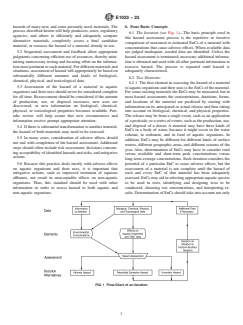
6.1 The Iteration (see Fig. 1)—The basic principle used in
agencies, and others to efficiently and adequately compare
this hazard assessment process is the repetitive or iterative
alternative materials, completely assess a final candidate
comparison of measured or estimated EnCs of a material with
material, or reassess the hazard of a material already in use.
concentrations that cause adverse effects. When available data
5.2 Sequential assessment and feedback allow appropriate are judged inadequate, needed data are identified. Unless the
judgments concerning efficient use of resources, thereby mini- hazard assessment is terminated, necessary additional informa-
mizing unnecessary testing and focusing effort on the informa- tion is obtained and used with all other pertinent information to
tion most pertinent to each material. For different materials and reassess hazard. The process is repeated until hazard is
situations, assessment of hazard will appropriately be based on adequately characterized.
substantially different amounts and kinds of biological,
6.2 Two Elements:
chemical, physical, and toxicological data.
6.2.1 The first element in assessing the hazard of a material
5.3 Assessment of the hazard of a material to aquatic
to aquatic organisms and their uses is the EnCs of the material.
organisms and their uses should never be considered complete
For some existing materials the EnCs may be measured, but in
for all time. Reassessment should be considered if the amount most hazard assessments the concentrations, durations, forms,
of production, use, or disposal increases, new uses are
and locations of the material are predicted by starting with
discovered, or new information on biological, chemical, information on its anticipated or actual release and then taking
physical, or toxicological properties becomes available. Peri-
into account its biological, chemical, and physical properties.
odic review will help assure that new circumstances and The release may be from a single event, such as an application
information receive prompt appropriate attention.
of a pesticide, or a series of events, such as the production, use,
and disposal of a deicer. A material may have three kinds of
5.4 If there is substantial transformation to another material,
EnCs in a body of water, because it might occur in the water
the hazard of both materials may need to be assessed.
column, in sediment, and in food of aquatic organisms. In
5.5 In many cases, consideration of adverse effects should
addition, EnCs may be different for different kinds of surface
not end with completion of the hazard assessment. Additional
waters, different geographic areas, and different seasons of the
steps should often include risk assessment, decisions concern-
year. Also, determination of EnCs may have to consider total
ing acceptability of identified hazards and risks, and mitigative
versus available and short-term peak concentrations versus
actions.
long-term average concentrations. Each iteration considers the
5.6 Because this practice deals mostly with adverse effects potential of a particular EnC to cause adverse effects, but the
on aquatic organisms and their uses, it is important that assessment of a material is not complete until the hazard of
mitigative actions, such as improved treatment of aqueous each and every EnC of that material has been adequately
effluents, not result in unacceptable effects on non-aquatic assessed. EnCs may aid in selecting appropriate aquatic species
organisms. Thus, this standard should be used with other to be used in tests, identifying and designing tests to be
information in order to assess hazard to both aquatic and conducted, choosing test concentrations, and interpreting re-
non-aquatic organisms. sults. Determination of EnCs should take into account not only
FIG. 1 Flow-Chart of an Iteration
E1023 − 23
all pertinent probable means of release, but also dilution, 6.3.2.6 Any episodic non-planned exposure of aquatic or-
transport and transformations, sinks and concentrating ganisms to toxic concentrations resulting from spills or other
accidents would probably be temporary and limited in geo-
mechanisms, and degradation and degradation products.
graphical scope.
6.2.2 If there is a potential for biological organisms of
6.3.2.7 No long-term environmental sinks are expected
concern to be exposed EnCs, then the second element essential
where the material might be concentrated and cause a delayed
to assessing hazard is the possible adverse effects on aquatic
and perhaps difficult-to-reverse problem.
organisms and their uses. For convenience, such effects can be
6.3.2.8 The possibility of exacerbating factors is small. For
placed in four categories:
example, could transformation products or synergism cause
6.2.2.1 Acute and chronic toxicity to aquatic animals,
problems? Could an estimated EnC, acute-chronic ratio, or
6.2.2.2 Effects on uses of aquatic organisms, including such
bioconcentration factor (BCF) be too low?
effects as flavor impairment and accumulation of unacceptable
6.3.3 The hazard of an EnC is considered potentially exces-
residues,
sive if the safety factor is so low, for example, below 1, that the
6.2.2.3 Effects on aquatic plants, including toxicity and
EnC is expected to cause one or more unacceptable effects.
stimulation, and
Before hazard is judged potentially excessive, available data
6.2.2.4 Other effects on aquatic animals, such as avoidance.
should be critically reviewed and thorough consideration
should be given to possible mitigating factors such as the
6.3 Possible Decisions:
following:
6.3.1 In each iteration, information concerning possible
6.3.3.1 Could the EnC have been estimated to be higher
adverse effects is used to decide whether the hazard due to a
than it occurs in the environment because degradation or
particular EnC is minimal, potentially excessive, or uncertain.
partitioning were not adequately considered?
If the safety factor is large, that is, if the unacceptable
6.3.3.2 Could toxicity have been caused by an impurity in
concentration is much greater than the EnC, hazard should be
the material that could be removed or would not persist in the
judged minimal. If the safety factor is low, for example, if the
environment?
unacceptable concentration is below the EnC and therefore the
6.3.3.3 Could the availability of the material in the environ-
safety factor is less than 1, the hazard should be judged
ment be lower than in the test?
potentially excessive because it is likely that the EnC will
6.3.3.4 Could restriction on the amount, type, time, or
cause an unacceptable effect on aquatic organisms or their
location of release realistically reduce an EnC that is too high?
users. If hazard cannot be judged either minimal or potentially
Could spatial or temporal limitations on use preclude long-term
excessive, it is uncertain. The necessary minimum size of the
toxicity or bioaccumulation (2)?
safety factor for judging the hazard of an EnC to be minimal
6.3.3.5 Are the tested species appropriate for the respective
will vary from iteration to iteration because it will depend on
EnCs?
(a) the amount, quality, and kind of data available concerning
6.3.3.6 Could a BCF estimated from chemical or physical
the EnC and possible adverse effects and (b) the degree of
properties be higher than the actual value?
confidence in the validity of any extrapolations and assump-
6.3.3.7 Could an estimated MATC be too low because the
tions that were used. The necessary minimum safety factor will
acute-chronic ratio used was too high?
especially depend on the appropriateness, range, and number of
6.3.3.8 Would the limiting adverse effects observed in
aquatic species for which data are available. For this hazard
toxicity tests be meaningful in the environment?
assessment process to produce valid results, it is particularly
6.3.4 If hazard is judged either potentially excessive or
important that EnCs and adverse effects not be underestimated
uncertain and there is continuing interest in the material,
(see 6.4.5).
additional information should be selectively obtained to answer
6.3.2 A decision of minimal hazard should account for the
the most critical question for the least cost that is consistent
following considerations:
with good science. An appropriate balance should be main-
6.3.2.1 The specified releases of the material will not result
tained between consideration of EnCs and adverse effects.
in concentrations that are acutely toxic to appropriate and
6.4 The Phased Approach—This hazard assessment process
sensitive aquatic animals that will be exposed.
is divided into three phases, which differ mainly with respect to
6.3.2.2 Any expected long-term concentrations of the ma-
the cost of obtaining necessary information. As many iterations
terial in surface waters will not be chronically toxic to
as necessary are used within each phase to help make the best
appropriate and sensitive aquatic animals.
decision concerning whether to stop the hazard assessment or
6.3.2.3 Unacceptable effects on aquatic plants will probably
to proceed to the next phase. If all of the information needed
not occur.
concerning EnCs and effects is already available, the cost of
6.3.2.4 There is no indication that bioaccumulation will
that phase is negligible. The purpose of a cost-effective hazard
result in concentrations in aquatic organisms that would
assessment process is to ensure that all hazards receive
adversely affect users of the organism.
adequate consideration for the least cost.
6.3.2.5 The material, its impurities, and any environmental 6.4.1 The purpose of Phase I is to make an initial assessment
transformation products are well enough understood that “eco-
of hazard using available information concerning release and
logical surprises” are unlikely. biological, chemical, physical, and toxicological properties. It
E1023 − 23
may be possible to determine that hazard is minimal. If not and that hazard is minimal as early (and inexpensively) as possible
there is continuing interest in the material, Phase II is neces- for as many materials as possible, but the more refined (and
sary.
costly) consideration of EnCs and effects can be avoided only
6.4.2 Depending upon data available in Phase I, Phase II
if the less costly approaches definitely do not underestimate
may require additional time and effort to obtain specific
hazard. The sequential use of iterations and phases is also
information to provide better information concerning EnCs or
designed to ensure that hazard is not judged potentially
effects, or both. The necessary additional information will
excessive because estimates of EnCs and effects are unneces-
differ widely depending on the available data and the properties
sarily high.
of the material. Depending upon the EnCs for water and
6.4.6 Appropriate estimates of EnCs, toxicity, and bioaccu-
sediment, it may be necessary to conduct short-term toxicity
mulation usually have to be based on incomplete data. Two
tests with species representative of different trophic levels and
techniques for attempting to ensure that such estimates are not
habitats. The relationships of the EnCs to toxic concentrations
too low are to perform a worst-case analysis or to make a best
are the important factors in deciding whether short-term testing
estimate and apply an uncertainty factor. Estimates used herein
is adequate to determine that hazard is minimal. If not and
are based on reasonable worst-case analyses.
there is continuing interest in the material, the assessment
should proceed to Phase III.
7. Phase I—Use of Low-Cost (Existing) Information (see
6.4.3 Phase III may require extensive time and effort to
Fig. 2)
obtain needed additional information on release, long-term
toxicity, or bioaccumulation. Because of the high cost of 7.1 Collection of Available Data—The initial step in assess-
additional information needed in this phase, it is particularly
ment of the hazard of a material to aquatic organisms and their
important that each new piece of information initiate the
uses is to assemble all available pertinent information concern-
iterative review and assessment process.
ing the following:
6.4.4 A decision on hazard to aquatic organisms can usually
7.1.1 Temporal and geographical patterns and amounts of
be based on information developed by using this three-phase
planned release, from such things as production, use and
laboratory testing process. For some materials, however, field
disposal, and the potential for accidental release (see Appendix
testing or monitoring may be needed to confirm the assess-
X1).
ment.
7.1.2 Biological properties concerning effects of organisms
6.4.5 Because of the nature of this phased hazard assess-
on the material, especially concerning degradation, uptake,
ment process, it is extremely important that neither EnCs nor
transfer, and storage (see Appendix X2).
effects be underestimated in any phase. The estimates may be
7.1.3 Structure, characterization, and chemical reactions of
high by factors of 10 or 100, but they must not be too low. A
the test material, with emphasis on those chemical properties
material can only be judged to have minimal hazard in Phases
likely to affect testing procedures, EnCs, and effects (see
I or II without the high-cost consideration of EnCs and effects
Appendix X3).
in Phase III, if care was taken to assure that neither EnCs nor
effects were underestimated in Phases I and II. The intent of 7.1.4 Physical properties, with particular emphasis on
this phased approach is to allow a scientifically valid judgment solubility, sorption, and volatility (see Appendix X4).
FIG. 2 Phase I—Use of Low-Cost (Existing) Information
E1023 − 23
7.1.5 Toxicity of the material or similar materials to aquatic 7.5.1.4 The material decomposes rapidly, for example, in 1
organisms, target organisms, and consumers of aquatic organ- h or less, in water to materials of known low toxicity and
isms (see Appendix X5). bioaccumulation.
7.5.1.5 Toxicity is known for materials of similar structure,
7.2 Initial Estimates of Environmental Concentrations—
and together with structure-toxicity correlations, a reasonable
Based on available information on actual or planned release
estimate of the toxicity of the material can be made. Also,
and biological, chemical, and physical properties, an initial
concentrations expected to cause long-term toxicity are sub-
estimate should be made of the concentrations likely to be
stantially above EnCs, and concern about bioaccumulation is
found in surface water(s), sediment(s), and food(s) of aquatic
low because of the material’s properties or because the EnC is
organisms (see Appendix X6). In Phase I, it is usually
low or both. Hazard due to bioaccumulation can usually be
appropriate to assume that degradation and deactivation are
considered minimal if chemical or physical properties indicate
negligible.
that the BCF is low, for example, less than 100.
7.3 Initial Estimate of Toxicity to Aquatic Organisms—
7.5.1.6 Generally, if any one of these conditions is satisfied,
Based on chemical structure, information on similar materials,
and review of the items in 6.3.2 is reassuring, hazard may be
and available data on toxicity to aquatic plants and animals, an
judged minimal because the safety factor will be high.
initial assessment should be made as to whether the material is
7.5.2 Potentially Excessive Hazard—A decision of poten-
biologically inactive or presents special concerns. In some
tially excessive hazard is usually appropriate if (a) EnCs
cases enough data on the acute toxicity of the material or very
exceed concentrations that cause acute toxicity or (b) Bioac-
similar materials may be available to allow a good estimate of
cumulation will probably result in adverse effects on important
concentrations likely to adversely affect aquatic organisms.
consumers of aquatic organisms. Before hazard is judged to be
7.4 Initial Estimate of Bioaccumulation by Aquatic potentially excessive, the items listed in 6.3.3 should be
reviewed. If there is continuing interest in the material, Phase
Organisms—For an organic material its structure, or its solu-
bility in water and organic solvents, will allow a first estimate II must be considered.
7.5.3 Uncertain Hazard—For most new materials, available
of bioaccumulation (see Appendix X4).
information will not be adequate to allow a conclusion of
7.5 Phase I Hazard Assessment—By using the information
minimal or potentially excessive hazard, and so hazard will
on EnCs and effects, hazard should be assessed as either
have to be judged uncertain. If there is continuing interest in
minimal, potentially excessive, or uncertain.
the material, Phase II must be considered.
7.5.1 Minimal Hazard—Hazard to aquatic organisms can
usually be judged minimal if any one of the following
8. Phase II—Use of Medium-Cost Information (see Fig.
conditions exists:
3)
7.5.1.1 Only research quantities of the material are antici-
pated. 8.1 Whereas Phase I involves collection and analysis of data
7.5.1.2 Release patterns are such that substantial aquatic already available Phase II will probably require at least some
exposure is very unlikely.
medium-cost efforts to obtain better information on EnCs and
7.5.1.3 Existing evidence indicates that the material and its effects. It is usually prudent to review all available toxicologi-
degradation products are toxicologically inactive to plants and
cal information (see Appendix X5) and to obtain some estimate
animals. of toxicity to humans before undertaking tests with aquatic
FIG. 3 Phase II—Use of Medium-Cost Information
E1023 − 23
organisms. An initial review of Phase II should indicate the rather than a fish, as the initial saltwater species is usually
most cost-effective place to start. This initial review might also appropriate because these invertebrates are often more sensi-
indicate that the hazard assessment should be terminated tive and represent important species. Further, the release
because the necessary testing program will probably be more pattern may make higher exposure concentrations of test
costly than can be justified by the possible utility of the material more likely for saltwater invertebrates than saltwater
material. fishes. Mysids are often preferred because life-cycle tests,
which may be necessary in Phase III, are easier to conduct with
8.2 Improved Estimates of Environmental Concentrations—
them than with grass shrimp (see Appendix X8).
The EnCs used in Phase I may have been obtained with only
8.3.2.1 When EnCs in salt water may be significant, an
minimal information on release, and little or no information on
acute test with bivalve mollusc embryos and larvae (see
biological, chemical, and physical properties that determine
Practice E724) is probably desirable because these are sensitive
environmental fate (see Appendix X6). In Phase II, inexpen-
life stages of commercially and recreationally important spe-
sive appropriate tests should be undertaken to obtain important
cies.
data on biological, chemical, and physical properties that are
8.3.2.2 When exposure in salt water is critical or when
not already available. Tests of biodegradation, hydrolysis,
interaction of the test material with salt water is suspected, an
oxidation, reduction, photodegradation, volatility, and sorption
acute test with a saltwater fish may also be desirable.
may be appropriate and allow improved estimates of EnCs. If
8.3.3 For most materials, the initial acute test is a static test.
degradation is substantial, degradation products and their
For some materials, a flow-through toxicity test should be
properties should be considered. Although sorption may reduce
conducted in addition to, or as an alternative to, the static test,
the concentration in the water column, it will probably increase
particularly when an exposure longer than 96 h is desired or
the concentration in sediment, and thus tests with benthic
when sorption, degradation, hydrolysis, oxidation, reduction,
species may be desirable. Assumptions and data used to derive
volatilization, or oxygen demand make the static test question-
EnCs should be carefully examined to determine the confi-
able. Obvious advantages of the flow-through test are replen-
dence that should be placed in them. If the material is already
ishment of test material, continual supply of oxygenated water,
in use, some environmental monitoring may be appropriate.
and removal of wastes.
8.3 Acute Toxicity to Aquatic Animals—Unless appropriate
8.4 Toxicity to Algae—Herbicides and materials with sus-
data are already available, some acute aquatic toxicity tests will
pected phytotoxicity that are expected in water at substantial
normally be necessary for materials likely to reach water in a
concentrations should be tested initially with a representative
substantial quantity. Initial toxicity results are often necessary
freshwater or saltwater, or both, algal species (see Guide
to estimate the scope of the assessment process. Unless data are
E1218).
already available, it is prudent to determine chemical and
physical properties of the test material in water (see Appendix
8.5 Expansion of Short-Term Testing—Depending upon the
X3 and Appendix X4) in order to select appropriate test
relation between the results of the initial test(s), the EnCs, and
methods and conditions. Selection of the initial acute aquatic
the nature of the material, the need for additional short-term
toxicity test will depend upon the nature of the material,
toxicity tests should be considered. If short-term toxicity
expected exposure locations, and any available indications of
occurs at or below a water-column EnC, hazard is potentially
the relative sensitivities of species.
excessive. For some materials, acute toxicity may only occur at
8.3.1 Acute Toxicity Test in Fresh Water—For most materi-
concentrations so far above the EnC that additional short-term
als production, use, and disposal results in higher concentra-
tests are not necessary. For most materials, however, Table 1
tions in fresh than in salt water, and fishes are almost always
and Appendix X3, Appendix X4 and Appendix X8 should be
more commercially and recreationally important than inverte-
consulted for additional considerations. In addition, observed
brates in fresh water. Thus, the initial acute toxicity test on a
physiological or behavioral changes should be reviewed for
material is usually with a freshwater fish. Use of a standardized
their significance. The relation between time and toxicity
test (see Practice E729) with a commonly used species allows
should be noted because it may influence decisions to extend
comparison of results with a substantial amount of data on
test duration or perform long-term tests. The need to include
other materials.
other species or phyla should be based on the toxicological
8.3.1.1 When an acute test with an aquatic invertebrate is
data, the likelihood of special species sensitivity, and the
needed, a static test with a daphnid should be considered in
probability of exposure. High-volume materials that will reach
most situations because of the ready availability of daphnids
surface waters on an extensive and continuing basis should be
from laboratory cultures. Use of a daphnid instead of a fish in
tested with more than the minimum number of species.
the initial acute test can be particularly appropriate for
8.6 Bioaccumulation—If the Phase I estimate of bioaccu-
insecticides, metals, and other classes of materials to which
mulation was based solely on chemical structure or solubility
daphnids are often sensitive.
in water, an improved estimate is probably necessary if the
8.3.2 Acute Toxicity Test in Salt Water—When the test
material is lipophilic, persistent, or highly toxic. For organic
material can be expected to reach estuarine or near-shore ocean
materials, calculation of a BCF from an estimated or measured
areas in quantities that could reasonably be of concern, aquatic
octanol-water partition coefficient usually will be sufficient in
species representing these ecosystems should be either in-
this phase (see Appendix X4).
cluded or substituted in the acute toxicity testing program at an
early stage. Use of a grass shrimp, penaeid shrimp, or mysid, 8.7 Phase II Hazard Assessment:
E1023 − 23
TABLE 1 Factors Affecting Design of Expanded Short-Term Toxicity Testing Program
Factor Implication for Testing
A) Depletion of Concentrations in Static Tests:
Volatility, sorption, or solubility losses may be significant; material may exert Flow-through test needed with the same species used in static tests.
significant oxygen depletion; degradation may reduce test concentrations.
B) Static and Flow-Through Results Differ Significantly:
1) Flow-through test gives lower acute value. 1) Use flow-through for other species. Chemically monitor test concentrations.
Determine if factor decreasing toxicity in static tests has environmental
significance (that is, degradation, sorption).
2) Flow-through test gives higher acute value. 2) Determine if factor increasing toxicity is material related (that is, more toxic
degradation product) or test related (that is, low D.O.).
C) Relationship of LC50 to Environmental Concentration (EnC):
1) All available LC50s are more than 100 000 times the EnC. 1) Additional acute tests probably unnecessary.
2) At least one LC50 is less than 100 000 times the EnC. 2) Additional acute tests may be necessary depending on the nature of the test
material, the taxonomic range of the species tested, the range of the acute
values, and differences between the acute values and the EnC (see
8.7.1.2).
D) Differences in Response Between Species:
1) No unreasonable differences between taxa. 1) Additional acute tests unnecessary with particular genera.
2) Unreasonable or unexpected differences between taxa. 2) Conduct tests with other species in sensitive families.
E) Chemical and Physical Properties of Test Material:
1) Material non-ionic and water soluble. 1) No special test conditions necessary.
2) Hardness may reduce solubility. 2) Test in harder water.
3) Material has limited solubility under “standard” test conditions. 3) Test at higher temperature; check effect of solubilizing.
4) Material causes excessive pH change at test concentrations. 4) Test in buffered water.
5) Degradation appears to alter toxicity substantially. 5) Test effect of delaying introduction of test organisms and monitor, control, or
renew test solutions.
6) Solubility or sorption indicates association with solids or sediments. 6) Conduct test(s) with benthic species.
F) Location Considerations:
1) Unusual or important species of unknown sensitivity may be exposed to 1) Conduct test(s) with relevant species if available.
significant concentrations.
2) Valuable fishery or other valued ecosystem services may be exposed to 2) Conduct test(s) with relevant species or best surrogate.
concentrations above which adverse effects may occur.
G) Special Toxicological Information:
1) Material is effective pesticide. 1) Conduct test(s) with a non-target species related to target
species.
8.7.1 Hazard may be judged minimal if most of the follow- 8.7.1.6 Available data strongly indicate that bioaccumula-
ing are supported, and none are contradicted, by available data: tion will not be a problem, either because the EnC is low, the
8.7.1.1 Similar materials are generally accepted as biologi- BCF is low, for example, below 100, or because the material
cally innocuous at estimated or measured EnCs. has low toxicity to consumers of aquatic life.
8.7.1.2 LC50s and EC50s are sufficiently above the water- 8.7.1.7 Toxicological data obtained from human safety test-
column EnCs. For some materials, some species are more than ing are reassuring.
1000 times more sensitive than others (3), and some acute- 8.7.1.8 A review of the items in 6.3.2 is reassuring.
chronic ratios are above 100 (4). Both the acute-chronic ratios 8.7.2 The hazard should be judged potentially excessive if
and ranges of sensitivities seem to be less for non-pesticide any of the following are true:
organic chemicals (5). Therefore, unless the material is a 8.7.2.1 Acute toxicity occurs to important or other appro-
nonpesticide organic chemical, if an acute test has been priate species at concentrations near or below the water-
conducted with only one species and the relative sensitivity of column EnCs.
that species to the test material is unknown, hazard should be 8.7.2.2 Acute-chronic ratios, indications of cumulative tox-
judged minimal only if the LC50 or EC50 is more than 100 000 icity during acute tests, or sublethal effects make unacceptable
times the EnC. The greater the variety of species with which chronic effects likely at EnCs.
acute tests have been conducted, the smaller the factor can be 8.7.2.3 EnCs are likely to cause unacceptable effects on
(6, 7). Except possibly for nonpesticide organic chemicals, an aquatic plants.
acute–chronic ratio less than 100 should not be used unless it 8.7.2.4 Partitioning data indicate that bioconcentration will
has been experimentally determined, especially if the material probably occur to a degree likely to be detrimental to uses or
takes more than a few days to reach steady-state in a biocon- consumers of aquatic organisms.
centration test or has a low depuration rate. 8.7.2.5 If any of the above are true, the items listed in 6.3.3
8.7.1.3 Aquatic species do not show any unusual symptoms, should be reviewed. If there is continuing interest in the
patterns of sensitivity, concentration-effect curves, or time- material, Phase III is necessary.
effect curves. 8.7.3 Hazard should be judged uncertain if some of the
8.7.1.4 Water-column EnCs are below concentrations that following are true:
are known to cause chronic toxicity. 8.7.3.1 Concentrations that are acutely toxic to aquatic
8.7.1.5 EnCs are unlikely to affect aquatic plants unaccept- animals are less than 100 000 times the water-column EnCs
ably. (but see 8.7.1.2).
E1023 − 23
8.7.3.2 Experience with similar materials is limited or similar material is already in use, field monitoring should be
mixed, so that definitive input from this source is lacking. used to validate the model.
8.7.3.3 Efficacy studies or human safety evaluations show
9.3 Chronic Toxicity to Aquatic Animals—The more fre-
developmental or unusual biological activity.
quently recommended or considered types of long-term tests
8.7.3.4 Release pattern and stability of the material indicates
are listed in Appendix X8. Selection of the most appropriate
probable long-term exposure.
test(s) should take into account several factors:
8.7.3.5 Partitioning data indicate that bioaccumulation
9.3.1 Stability of Material—If biological or chemical stabil-
might result in concentrations in aquatic organisms that are
ity of the test material is marginal, but a chronic test with an
toxic to predators.
animal species is necessary, practical considerations usually
8.7.3.6 If hazard is judged uncertain and there is continuing
dictate conducting the shorter early life-stage test. Even with
interest in the material, Phase III is necessary.
high flow rates, maintenance of concentrations of unstable
materials in test chambers is often impractical over extended
9. Phase III—Use of High-Cost Information (see Fig. 4)
periods. Reassuringly, metabolic and other degradation pro-
9.1 Because of the substantial increase in time, effort, and
cesses generally limit the concentration, extent, and duration of
money required for tests considered in Phase III, it is particu-
such unstable materials in the environment.
larly important in this phase that the hazard assessment
9.3.2 Species Sensitivity—If acute toxicity data indicate
program be tailored to the individual material in order to obtain
unusual sensitivity of a particular trophic level, family, or
the most useful information in the least expensive, scientifi-
species to the test material, a test should be conducted with the
cally sound manner. If tests are conducted, a representative and
phylogenetically closest species for which a chronic test
well-characterized sample of test material is essential (see
method exists.
Appendix X3). Careful consideration of biological, chemical,
and physical properties is required so that: 9.3.3 Target Species Toxicity—If the material is a pesticide,
a test should be conducted with the species most closely related
9.1.1 Stock solutions, flow rates, dilution water, etc., allow
maintenance of desired test concentrations, to the target species for which a chronic test method exists.
9.1.2 Analytical monitoring will adequately describe
9.3.4 Environmental Exposure Areas—If saltwater areas are
exposure, and
of concern, species representative of such waters should be
9.1.3 Appropriate interpretation and extrapolation of test
used in chronic tests. Similarly, if EnCs in cold, clean waters
results to environmental conditions is possible.
pose a major concern about salmonid populations, salmonids
deserve serious consideration because they are sensitive to
9.2 Refined Estimates of Environmental Concentrations—
many materials, and they can be used in early life-stage tests.
Unless it has already been done, a thorough modelling effort of
the fate of the material should be performed using stability and 9.3.5 Acute Toxicity Divergence by Species—If results of
rate constants and partition coefficients (see Appendix X6). It acute toxicity tests present an unusual pattern or show large
is especially important to predict peak concentrations, concen- differences in sensitivity between species, chronic testing
trating mechanisms, and sinks. If the material of concern or a should probably include more than one species. The species
FIG. 4 Phase III—Use of High-Cost Information
E1023 − 23
used will depend on the hypothesis used to explai
...
This document is not an ASTM standard and is intended only to provide the user of an ASTM standard an indication of what changes have been made to the previous version. Because
it may not be technically possible to adequately depict all changes accurately, ASTM recommends that users consult prior editions as appropriate. In all cases only the current version
of the standard as published by ASTM is to be considered the official document.
Designation: E1023 − 84 (Reapproved 2014) E1023 − 23
Standard Guide for
Assessing the Hazard of a Material to Aquatic Organisms
and Their Uses
This standard is issued under the fixed designation E1023; the number immediately following the designation indicates the year of
original adoption or, in the case of revision, the year of last revision. A number in parentheses indicates the year of last reapproval. A
superscript epsilon (´) indicates an editorial change since the last revision or reapproval.
1. Scope
1.1 This guide describes a stepwise process for using information concerning the biological, chemical, physical, and toxicological
properties of a material to identify adverse effects likely to occur to aquatic organisms and their uses as a result of release of the
material to the environment. The material will usually be a specific chemical, although it might be a group of chemicals that have
very similar biological, chemical, physical, and toxicological properties and are usually produced, used, and discarded together.
1.2 The hazard assessment process is complex and requires decisions at a number of points; thus, the validity of a hazard
assessment depends on the soundness of those decisions, as well as the accuracy of the information used. All decisions should be
based on reasonable worst-case analyses so that an appropriate assessment can be completed for the least cost that is consistent
with scientific validity.
1.3 This guide assumes that the reader is knowledgeable in aquatic toxicology and related pertinent areas. A list of general
references is provided (1).
1.4 This guide does not describe or reference detailed procedures for estimating or measuring environmental concentrations, or
procedures for determining the maximum concentration of test material that is acceptable in the food of predators of aquatic life.
However, this guide does describe how such information should be used when assessing the hazard of a material to aquatic
organisms and their uses.
1.5 Because assessment of hazard to aquatic organisms and their uses is a relatively new activity within aquatic toxicology, most
of the guidance provided herein is qualitative rather than quantitative. When possible, confidence limits should be calculated and
taken into account.
1.6 This guide provides guidance for assessing hazard but does not provide guidance on how to take into account social
considerations in order to judge the acceptability of the hazard. Judgments concerning acceptability are social as well as scientific,
and are outside the scope of this guide.
1.7 This guide is arranged as follows:
This guide is under the jurisdiction of ASTM Committee E50 on Environmental Assessment, Risk Management and Corrective Action and is the direct responsibility
of Subcommittee E50.47 on Biological Effects and Environmental Fate.
Current edition approved Oct. 1, 2014Jan. 1, 2023. Published December 2014February 2023. Originally approved in 1984. Last previous edition approved in 20072014
as E1023-84(2007).E1023-84(2014). DOI: 10.1520/E1023-84R14.10.1520/E1023-23.
Boldface numbers in parentheses refer to the list of references at the end of this standard.
Copyright © ASTM International, 100 Barr Harbor Drive, PO Box C700, West Conshohocken, PA 19428-2959. United States
E1023 − 23
Section
Referenced Documents 2
Descriptions of Terms Specific to This Standard 3
Summary of Guide 4
Significance and Use 5
Four Basic Concepts 6
The Iteration 6.1
The Two Elements 6.2
The Possible Decisions 6.3
The Phased Approach 6.4
Phase I—Use of Low-Cost (Existing) Information 7
Collection of Available Data 7.1
Initial Estimates of Environmental Concentrations 7.2
Initial Estimate of Toxicity to Aquatic Organisms 7.3
Initial Estimate of Bioaccumulation by Aquatic Organ-
isms 7.4
Phase I Hazard Assessment 7.5
Phase II—Use of Medium-Cost Information 8
Improved Estimates of Environmental Concentrations 8.2
Acute Toxicity to Aquatic Animals 8.3
Toxicity to Algae 8.4
Expansion of Short-Term Testing 8.5
Bioaccumulation 8.6
Phase II Hazard Assessment 8.7
Phase III—Use of High-Cost Information 9
Refined Estimates of Environmental Concentrations 9.2
Chronic Toxicity to Aquatic Animals 9.3
Use of Acute-Chronic Ratios 9.4
Toxicity to Aquatic Plants 9.5
Bioconcentration 9.6
Bioaccumulation from Food 9.7
Phase III Hazard Assessment 9.8
Appendixes
Appendix X1 Production, Use, Disposal, and Other Release
Appendix X2 Biological Considerations
Appendix X3 Chemical Considerations
Appendix X4 Physical Considerations
Appendix X5 Toxicological Considerations
Appendix X6 Estimating Environmental Concentrations
Appendix X7 Selection of Test Species
Appendix X8 Long-Term Toxicity Tests
E1023 − 23
1.8 This standard does not purport to address all of the safety concerns, if any, associated with its use. It is the responsibility
of the user of this standard to establish appropriate safety and healthsafety, health, and environmental practices and determine
the applicability of regulatory limitations prior to use.
1.9 This international standard was developed in accordance with internationally recognized principles on standardization
established in the Decision on Principles for the Development of International Standards, Guides and Recommendations issued
by the World Trade Organization Technical Barriers to Trade (TBT) Committee.
2. Referenced Documents
2.1 ASTM Standards:
D1129 Terminology Relating to Water
E724 Guide for Conducting Static Short-Term Chronic Toxicity Tests Starting with Embryos of Four Species of Saltwater
Bivalve Molluscs
E729 Guide for Conducting Acute Toxicity Tests on Test Materials with Fishes, Macroinvertebrates, and Amphibians
E943 Terminology Relating to Biological Effects and Environmental Fate (Withdrawn 2023)
E1022 Guide for Conducting Bioconcentration Tests with Fishes and Saltwater Bivalve Mollusks
E1191 Guide for Conducting Life-Cycle Toxicity Tests with Saltwater Mysids
E1193 Guide for Conducting Daphnia magna Life-Cycle Toxicity Tests
E1218 Guide for Conducting Static Toxicity Tests with Microalgae
E1241 Guide for Conducting Early Life-Stage Toxicity Tests with Fishes
E1415 Guide for Conducting Static Toxicity Tests With Lemna gibba G3
E1706 Test Method for Measuring the Toxicity of Sediment-Associated Contaminants with Freshwater Invertebrates
IEEE/SI IEEE/ASTM SI 10 American National Standard for Use of the International System of Units (SI): The Modern Metric
System
3. Terminology
3.1 Definitions of Terms Specific to This Standard:
3.1.1 acute-chronic ratio—ratio, n—the quotient of an appropriate measure of the acute toxicity (usually the 96-h(for example,
the 96 h LC50) of a material to a species divided by the result of a life-cycle, partial life-cycle, or early life-stage test in the same
water on the same material with the same species.
3.1.2 bioaccumulation—bioaccumulation, n—the net uptake of a material from water and from food.
3.1.3 bioconcentration factor (BCF), n—a ration of the net accumulation of a substance by an aquatic organism to the
concentraiton in solution.
3.1.4 environmental concentration (EnC)—(EnC), n—the concentration, duration, form, and location of a material in environ-
mental waters, sediments, or the food of aquatic organisms.
3.1.5 hazard assessment—assessment, n—the identification of the adverse effects likely to result from specified releases(s) of a
material.
3.1.6 maximum acceptable toxicant concentration (MATC)—(MATC), n—the highest concentration of a material that would have
no statistically significant observed adverse effect on the survival, growth, or reproduction of the test species during continuous
exposure throughout a life-cycle or partial life-cycle toxicity test. Such tests usually indicate that the MATC is between two tested
concentrations.
3.1.7 no-observed-effect concentration (NOEC)—(NOEC), n—the highest tested concentration of a material at which the measured
parameters of a specific population of test organisms under test conditions show no statistically significant adverse difference from
the control treatment. When derived from a life-cycle or partial life-cycle test, it is the same as the lower limit on the MATC.
3.1.8 safety factor—factor, n—the quotient of a toxicologically significant concentration divided by an appropriate EnC.
For referenced ASTM standards, visit the ASTM website, www.astm.org, or contact ASTM Customer Service at service@astm.org. For Annual Book of ASTM Standards
volume information, refer to the standard’s Document Summary page on the ASTM website.
The last approved version of this historical standard is referenced on www.astm.org.
E1023 − 23
3.2 For definitions of other terms used in this guide, refer to Terminology E943 and D1129, Guides E724 and , E729, and Practice
E1022. For an explanation of units and symbols, refer to IEEE/SI IEEE/ASTM SI 10.
4. Summary of Guide
4.1 This guide describes an iterative process for assessing the hazard of a material to aquatic organisms and their uses by
considering the relationship between the material’s measured or estimated environmental concentration(s) and the adverse effects
likely to result. Unavailable necessary that may to result, with an understanding that laboratory testing results may differ from
effects that occur in the environment where conditions affecting toxicity may differ. Necessary information concerning
environmental concentrations and adverse effects is obtained through a stepwise program that starts with inexpensive more general
and economical information and progresses to expensive information if necessary. more intensive (and potentially more costly)
information, as needed to meet specific project or investigative goals. At the end of each iteration the estimated or measured
environmental concentration(s) are compared with information on possible adverse effects to determine the adequacy of the
available data for assessing hazard. If it is not possible to conclude that hazard is either minimal or potentially excessive, the
available data are judged inadequate to characterize the hazard. If desired, appropriate additional information is identified and
obtained, so that hazard can be reassessed. further assessed. The process is repeated until the hazard is adequately characterized.
5. Significance and Use
5.1 Adverse effects on natural populations of aquatic organisms and their uses have demonstrated the need to assess the hazards
of many new, and some presently used, materials. The process described herein will help producers, users, regulatory agencies,
and others to efficiently and adequately compare alternative materials, completely assess a final candidate material, or reassess the
hazard of a material already in use.
5.2 Sequential assessment and feedback allow appropriate judgments concerning efficient use of resources, thereby minimizing
unnecessary testing and focusing effort on the information most pertinent to each material. For different materials and situations,
assessment of hazard will appropriately be based on substantially different amounts and kinds of biological, chemical, physical,
and toxicological data.
5.3 Assessment of the hazard of a material to aquatic organisms and their uses should never be considered complete for all time.
Reassessment should be considered if the amount of production, use, or disposal increases, new uses are discovered, or new
information on biological, chemical, physical, or toxicological properties becomes available. Periodic review will help assure that
new circumstances and information receive prompt appropriate attention.
5.4 If there is substantial transformation to another material, the hazard of both materials may need to be assessed.
5.5 In many cases, consideration of adverse effects should not end with completion of the hazard assessment. Additional steps
should often include risk assessment, decisions concerning acceptability of identified hazards and risks, and mitigative actions.
5.6 Because this practice deals mostly with adverse effects on aquatic organisms and their uses, it is important that mitigative
actions, such as improved treatment of aqueous effluents, not result in unacceptable effects on non-aquatic organisms. Thus, this
standard should be used with other information in order to assess hazard to both aquatic and non-aquatic organisms.
6. Four Basic Concepts
6.1 The Iteration (see Fig. 1)—The basic principle used in this hazard assessment process is the repetitive or iterative comparison
of measured or estimated EnCs of a material with concentrations that cause adverse effects. When available data are judged
inadequate, needed data are identified. Unless the hazard assessment is terminated, necessary additional information is obtained
and used with all other pertinent information to reassess hazard. The process is repeated until hazard is adequately characterized.
6.2 Two Elements:
6.2.1 The first element in assessing the hazard of a material to aquatic organisms and their uses is the EnCs of the material. For
some existing materials the EnCs may be measured, but in most hazard assessments the concentrations, durations, forms, and
locations of the material are predicted by starting with information on its anticipated or actual release and then taking into account
E1023 − 23
FIG. 1 Flow-Chart of an Iteration
its biological, chemical, and physical properties. The release may be from a single event, such as an application of a pesticide, or
a series of events, such as the production, use, and disposal of a deicer. A material may have three kinds of EnCs in a body of water,
because it might occur in the water column, in sediment, and in food of aquatic organisms. In addition, EnCs may be different for
different kinds of surface waters, different geographic areas, and different seasons of the year. Also, determination of EnCs may
have to consider total versus available and short-term peak concentrations versus long-term average concentrations. Each iteration
considers the potential of a particular EnC to cause adverse effects, but the assessment of a material is not complete until the hazard
of each and every EnC of that material has been adequately assessed. EnCs may aid in selecting appropriate aquatic species to be
used in tests, identifying and designing tests to be conducted, choosing test concentrations, and interpreting results. Determination
of EnCs should take into account not only all pertinent probable means of release, but also dilution, transport and transformations,
sinks and concentrating mechanisms, and degradation and degradation products.
6.2.2 The If there is a potential for biological organisms of concern to be exposed EnCs, then the second element essential to
assessing hazard is the possible adverse effects on aquatic organisms and their uses. For convenience, such effects can be placed
in four categories:
6.2.2.1 Acute and chronic toxicity to aquatic animals,
6.2.2.2 Effects on uses of aquatic organisms, including such effects as flavor impairment and accumulation of unacceptable
residues,
6.2.2.3 Effects on aquatic plants, including toxicity and stimulation, and
6.2.2.4 Other effects on aquatic animals, such as avoidance.
6.3 Possible Decisions:
6.3.1 In each iteration, information concerning possible adverse effects is used to decide whether the hazard due to a particular
EnC is minimal, potentially excessive, or uncertain. If the safety factor is large, that is, if the unacceptable concentration is much
greater than the EnC, hazard should be judged minimal. If the safety factor is low, for example, if the unacceptable concentration
is below the EnC and therefore the safety factor is less than 1, the hazard should be judged potentially excessive because it is likely
that the EnC will cause an unacceptable effect on aquatic organisms or their users. If hazard cannot be judged either minimal or
potentially excessive, it is uncertain. The necessary minimum size of the safety factor for judging the hazard of an EnC to be
minimal will vary from iteration to iteration because it will depend on (a) the amount, quality, and kind of data available
concerning the EnC and possible adverse effects and (b) the degree of confidence in the validity of any extrapolations and
assumptions that were used. The necessary minimum safety factor will especially depend on the appropriateness, range, and
number of aquatic species for which data are available. For this hazard assessment process to produce valid results, it is particularly
important that EnCs and adverse effects not be underestimated (see 6.4.5).
6.3.2 A decision of minimal hazard should account for the following considerations:
E1023 − 23
6.3.2.1 The specified releases of the material will not result in concentrations that are acutely toxic to appropriate and sensitive
aquatic animals that will be exposed.
6.3.2.2 Any expected long-term concentrations of the material in surface waters will not be chronically toxic to appropriate and
sensitive aquatic animals.
6.3.2.3 Unacceptable effects on aquatic plants will probably not occur.
6.3.2.4 There is no indication that bioaccumulation will result in concentrations in aquatic organisms that would adversely affect
users of the organism.
6.3.2.5 The material, its impurities, and any environmental transformation products are well enough understood that “ecological
surprises” are unlikely.
6.3.2.6 Any episodic non-planned exposure of aquatic organisms to toxic concentrations resulting from spills or other accidents
would probably be temporary and limited in geographical scope.
6.3.2.7 No long-term environmental sinks are expected where the material might be concentrated and cause a delayed and perhaps
difficult-to-reverse problem.
6.3.2.8 The possibility of exacerbating factors is small. For example, could transformation products or synergism cause problems?
Could an estimated EnC, acute-chronic ratio, or bioconcentration factor (BCF) be too low?
6.3.3 The hazard of an EnC is considered potentially excessive if the safety factor is so low, for example, below 1, that the EnC
is expected to cause one or more unacceptable effects. Before hazard is judged potentially excessive, available data should be
critically reviewed and thorough consideration should be given to possible mitigating factors such as the following:
6.3.3.1 Could the EnC be too high have been estimated to be higher than it occurs in the environment because degradation or
partitioning were not adequately considered?
6.3.3.2 Could toxicity have been caused by an impurity in the material that could be removed or would not persist in the
environment?
6.3.3.3 Could the availability of the material in the environment be lower than in the test?
6.3.3.4 Could restriction on the amount, type, time, or location of release realistically reduce an EnC that is too high? Could spatial
or temporal limitations on use preclude long-term toxicity or bioaccumulation (2)?
6.3.3.5 Are the tested species appropriate for the respective EnCs?
6.3.3.6 Could a BCF estimated from chemical or physical properties be higher than the actual value?
6.3.3.7 Could an estimated MATC be too low because the acute-chronic ratio used was too high?
6.3.3.8 Would the limiting adverse effects observed in toxicity tests be meaningful in the environment?
6.3.4 If hazard is judged either potentially excessive or uncertain and there is continuing interest in the material, additional
information should be selectively obtained to answer the most critical question for the least cost that is consistent with good
science. An appropriate balance should be maintained between consideration of EnCs and adverse effects.
6.4 The Phased Approach—This hazard assessment process is divided into three phases, which differ mainly with respect to the
cost of obtaining necessary information. As many iterations as necessary are used within each phase to help make the best decision
concerning whether to stop the hazard assessment or to proceed to the next phase. If all of the information needed concerning EnCs
and effects is already available, the cost of that phase is negligible. The purpose of a cost-effective hazard assessment process is
to ensure that all hazards receive adequate consideration for the least cost.
6.4.1 The purpose of Phase I is to make an initial assessment of hazard using available information concerning release and
E1023 − 23
biological, chemical, physical, and toxicological properties. It may be possible to determine that hazard is minimal. If not and there
is continuing interest in the material, Phase II is necessary.
6.4.2 Depending upon data available in Phase I, Phase II may require additional time and effort to obtain specific information to
provide better information concerning EnCs or effects, or both. The necessary additional information will differ widely depending
on the available data and the properties of the material. Depending upon the EnCs for water and sediment, it may be necessary
to conduct short-term toxicity tests with species representative of different trophic levels and habitats. The relationships of the
EnCs to toxic concentrations are the important factors in deciding whether short-term testing is adequate to determine that hazard
is minimal. If not and there is continuing interest in the material, the assessment should proceed to Phase III.
6.4.3 Phase III may require extensive time and effort to obtain needed additional information on release, long-term toxicity, or
bioaccumulation. Because of the high cost of additional information needed in this phase, it is particularly important that each new
piece of information initiate the iterative review and assessment process.
6.4.4 A decision on hazard to aquatic organisms can usually be based on information developed by using this three-phase
laboratory testing process. For some materials, however, field testing or monitoring may be needed to confirm the assessment.
6.4.5 Because of the nature of this phased hazard assessment process, it is extremely important that neither EnCs nor effects be
underestimated in any phase. The estimates may be high by factors of 10 or 100, but they must not be too low. A material can only
be judged to have minimal hazard in Phases I or II without the high-cost consideration of EnCs and effects in Phase III, if care
was taken to assure that neither EnCs nor effects were underestimated in Phases I and II. The intent of this phased approach is to
allow a scientifically valid judgment that hazard is minimal as early (and inexpensively) as possible for as many materials as
possible, but the more refined (and costly) consideration of EnCs and effects can be avoided only if the less costly approaches
definitely do not underestimate hazard. The sequential use of iterations and phases is also designed to ensure that hazard is not
judged potentially excessive because estimates of EnCs and effects are unnecessarily high.
6.4.6 Appropriate estimates of EnCs, toxicity, and bioaccumulation usually have to be based on incomplete data. Two techniques
for attempting to ensure that such estimates are not too low are to perform a worst-case analysis or to make a best estimate and
apply an uncertainty factor. Estimates used herein are based on reasonable worst-case analyses.
7. Phase I—Use of Low-Cost (Existing) Information (see Fig. 2)
7.1 Collection of Available Data—The initial step in assessment of the hazard of a material to acquaticaquatic organisms and their
uses is to assemble all available pertinent information concerning the following:
7.1.1 Temporal and geographical patterns and amounts of planned release, from such things as production, use and disposal, and
the potential for accidental release (see Appendix X1).
FIG. 2 Phase I—Use of Low-Cost (Existing) Information
E1023 − 23
7.1.2 Biological properties concerning effects of organisms on the material, especially concerning degradation, uptake, transfer,
and storage (see Appendix X2).
7.1.3 Structure, characterization, and chemical reactions of the test material, with emphasis on those chemical properties likely to
affect testing procedures, EnCs, and effects (see Appendix X3).
7.1.4 Physical properties, with particular emphasis on solubility, sorption, and volatility (see Appendix X4).
7.1.5 Toxicity of the material or similar materials to aquatic organisms, target organisms, and consumers of aquatic organisms (see
Appendix X5).
7.2 Initial Estimates of Environmental Concentrations—Based on available information on actual or planned release and
biological, chemical, and physical properties, an initial estimate should be made of the concentrations likely to be found in surface
water(s), sediment(s), and food(s) of aquatic organisms (see Appendix X6). In Phase I, it is usually appropriate to assume that
degradation and deactivation are negligible.
7.3 Initial Estimate of Toxicity to Aquatic Organisms—Based on chemical structure, information on similar materials, and
available data on toxicity to aquatic plants and animals, an initial assessment should be made as to whether the material is
biologically inactive or presents special concerns. In some cases enough data on the acute toxicity of the material or very similar
materials may be available to allow a good estimate of concentrations likely to adversely affect aquatic organisms.
7.4 Initial Estimate of Bioaccumulation by Aquatic Organisms—For an organic material its structure, or its solubility in water and
organic solvents, will allow a first estimate of bioaccumulation (see Appendix X4).
7.5 Phase I Hazard Assessment—By using the information on EnCs and effects, hazard should be assessed as either minimal,
potentially excessive, or uncertain.
7.5.1 Minimal Hazard—Hazard to aquatic organisms can usually be judged minimal if any one of the following conditions exists:
7.5.1.1 Only research quantities of the material are anticipated.
7.5.1.2 Release patterns are such that substantial aquatic exposure is very unlikely.
7.5.1.3 Existing evidence indicates that the material and its degradation products are toxicologically inactive to plants and animals.
7.5.1.4 The material decomposes rapidly, for example, in 1 h or less, in water to materials of known low toxicity and
bioaccumulation.
7.5.1.5 Toxicity is known for materials of similar structure, and together with structure-toxicity correlations, a reasonable estimate
of the toxicity of the material can be made. Also, concentrations expected to cause long-term toxicity are substantially above EnCs,
and concern about bioaccumulation is low because of the material’s properties or because the EnC is low or both. Hazard due to
bioaccumulation can usually be considered minimal if chemical or physical properties indicate that the BCF is low, for example,
less than 100.
7.5.1.6 Generally, if any one of these conditions is satisfied, and review of the items in 6.3.2 is reassuring, hazard may be judged
minimal because the safety factor will be high.
7.5.2 Potentially Excessive Hazard—A decision of potentially excessive hazard is usually appropriate if (a) EnCs exceed
concentrations that cause acute toxicity or (b) Bioaccumulation will probably result in adverse effects on important consumers of
aquatic organisms. Before hazard is judged to be potentially excessive, the items listed in 6.3.3 should be reviewed. If there is
continuing interest in the material, Phase II must be considered.
7.5.3 Uncertain Hazard—For most new materials, available information will not be adequate to allow a conclusion of minimal
or potentially excessive hazard, and so hazard will have to be judged uncertain. If there is continuing interest in the material, Phase
II must be considered.
E1023 − 23
8. Phase II—Use of Medium-Cost Information (see Fig. 3)
8.1 Whereas Phase I involves collection and analysis of data already available Phase II will probably require at least some
medium-cost efforts to obtain better information on EnCs and effects. It is usually prudent to review all available toxicological
information (see Appendix X5) and to obtain some estimate of toxicity to humans before undertaking tests with aquatic organisms.
An initial review of Phase II should indicate the most cost-effective place to start. This initial review might also indicate that the
hazard assessment should be terminated because the necessary testing program will probably be more costly than can be justified
by the possible utility of the material.
8.2 Improved Estimates of Environmental Concentrations—The EnCs used in Phase I may have been obtained with only minimal
information on release, and little or no information on biological, chemical, and physical properties that determine environmental
fate (see Appendix X6). In Phase II, inexpensive appropriate tests should be undertaken to obtain important data on biological,
chemical, and physical properties that are not already available. Tests of biodegradation, hydrolysis, oxidation, reduction,
photodegradation, volatility, and sorption may be appropriate and allow improved estimates of EnCs. If degradation is substantial,
degradation products and their properties should be considered. Although sorption may reduce the concentration in the water
column, it will probably increase the concentration in sediment, and thus tests with benthic species may be desirable. Assumptions
and data used to derive EnCs should be carefully examined to determine the confidence that should be placed in them. If the
material is already in use, some environmental monitoring may be appropriate.
8.3 Acute Toxicity to Aquatic Animals—Unless appropriate data are already available, some acute aquatic toxicity tests will
normally be necessary for materials likely to reach water in a substantial quantity. Initial toxicity results are often necessary to
estimate the scope of the assessment process. Unless data are already available, it is prudent to determine chemical and physical
properties of the test material in water (see Appendix X3 and Appendix X4) in order to select appropriate test methods and
conditions. Selection of the initial acute aquatic toxicity test will depend upon the nature of the material, expected exposure
locations, and any available indications of the relative sensitivities of species.
8.3.1 Acute Toxicity Test in Fresh Water—For most materials production, use, and disposal results in higher concentrations in fresh
than in salt water, and fishes are almost always more commercially and recreationally important than invertebrates in fresh water.
Thus, the initial acute toxicity test on a material is usually with a freshwater fish. Use of a standardized test (see Practice E729)
with a commonly used species allows comparison of results with a substantial amount of data on other materials.
8.3.1.1 When an acute test with an aquatic invertebrate is needed, a static test with a daphnid should be considered in most
situations because of the ready availability of daphnids from laboratory cultures. Use of a daphnid instead of a fish in the initial
acute test can be particularly appropriate for insecticides, metals, and other classes of materials to which daphnids are often
sensitive.
8.3.2 Acute Toxicity Test in Salt Water—When the test material can be expected to reach estuarine or near-shore ocean areas in
FIG. 3 Phase II—Use of Medium-Cost Information
E1023 − 23
quantities that could reasonably be of concern, aquatic species representing these ecosystems should be either included or
substituted in the acute toxicity testing program at an early stage. Use of a grass shrimp, penaeid shrimp, or mysid, rather than a
fish, as the initial saltwater species is usually appropriate because these invertebrates are often more sensitive and represent
important species. Further, the release pattern may make higher exposure concentrations of test material more likely for saltwater
invertebrates than saltwater fishes. Mysids are often preferred because life-cycle tests, which may be necessary in Phase III, are
easier to conduct with them than with grass shrimp (see Appendix X8).
8.3.2.1 When EnCs in salt water may be significant, an acute test with bivalve mollusc embryos and larvae (see Practice E724)
is probably desirable because these are sensitive life stages of commercially and recreationally important species.
8.3.2.2 When exposure in salt water is critical or when interaction of the test material with salt water is suspected, an acute test
with a saltwater fish may also be desirable.
8.3.3 For most materials, the initial acute test is a static test. For some materials, a flow-through toxicity test should be conducted
in addition to, or as an alternative to, the static test, particularly when an exposure longer than 96 h is desired or when sorption,
degradation, hydrolysis, oxidation, reduction, volatilization, or oxygen demand make the static test questionable. Obvious
advantages of the flow-through test are replenishment of test material, continual supply of oxygenated water, and removal of
wastes.
8.4 Toxicity to Algae—Herbicides and materials with suspected phytotoxicity that are expected in water at substantial
concentrations should be tested initially with a representative freshwater or saltwater, or both, algal species ((see3 Guide E1218).
8.5 Expansion of Short-Term Testing—Depending upon the relation between the results of the initial test(s), the EnCs, and the
nature of the material, the need for additional short-term toxicity tests should be considered. If short-term toxicity occurs at or
below a water-column EnC, hazard is potentially excessive. For some materials, acute toxicity may only occur at concentrations
so far above the EnC that additional short-term tests are not necessary. For most materials, however, Table 1 and Appendix X3,
Appendix X4 and Appendix X8 should be consulted for additional considerations. In addition, observed physiological or
behavioral changes should be reviewed for their significance. The relation between time and toxicity should be noted because it
may influence decisions to extend test duration or perform long-term tests. The need to include other species or phyla should be
based on the toxicological data, the likelihood of special species sensitivity, and the probability of exposure. High-volume materials
that will reach surface waters on an extensive and continuing basis should be tested with more than the minimum number of
species.
8.6 Bioaccumulation—If the Phase I estimate of bioaccumulation was based solely on chemical structure or solubility in water,
an improved estimate is probably necessary if the material is lipophilic, persistent, or highly toxic. For organic materials,
calculation of a BCF from an estimated or measured octanol-water partition coefficient usually will be sufficient in this phase (see
Appendix X4).
8.7 Phase II Hazard Assessment:
8.7.1 Hazard may be judged minimal if most of the following are supported, and none are contradicted, by available data:
8.7.1.1 Similar materials are generally accepted as biologically innocuous at estimated or measured EnCs.
8.7.1.2 LC50s and EC50s are sufficiently above the water-column EnCs. For some materials, some species are more than 1000
times more sensitive than others (43), and some acute-chronic ratios are above 100 (54). Both the acute-chronic ratios and ranges
of sensitivities seem to be less for nonpesticidenon-pesticide organic chemicals (65). Therefore, unless the material is a
nonpesticide organic chemical, if an acute test has been conducted with only one species and the relative sensitivity of that species
to the test material is unknown, hazard should be judged minimal only if the LC50 or EC50 is more than 100 000 times the EnC.
The greater the variety of species with which acute tests have been conducted, the smaller the factor can be (76, 87). Except
possibly for nonpesticide organic chemicals, an acute–chronic ratio less than 100 should not be used unless it has been
experimentally determined, especially if the material takes more than a few days to reach steady-state in a bioconcentration test
or has a low depuration rate.
8.7.1.3 Aquatic species do not show any unusual symptoms, patterns of sensitivity, concentration-effect curves, or time-effect
curves.
E1023 − 23
TABLE 1 Factors Affecting Design of Expanded Short-Term Toxicity Testing Program
Factor Implication for Testing
A) Depletion of Concentrations in Static Tests:
Volatility, sorption, or solubility losses may be significant; material may exert Flow-through test needed with the same species used in static tests.
significant oxygen depletion; degradation may reduce test concentrations.
B) Static and Flow-Through Results Differ Significantly:
1) Flow-through test gives lower acute value. 1) Use flow-through for other species. Chemically monitor test concentrations.
Determine if factor decreasing toxicity in static tests has environmental
significance (that is, degradation, sorption).
2) Flow-through test gives higher acute value. 2) Determine if factor increasing toxicity is material related (that is, more toxic
degradation product) or test related (that is, low D.O.).
C) Relationship of LC50 to Environmental Concentration (EnC):
1) All available LC50s are more than 100 000 times the EnC. 1) Additional acute tests probably unnecessary.
1) All available LC50s are more than 100 000 times the EnC. 1) Additional acute tests probably unnecessary.
2) At least one LC50 is less than 100 000 times the EnC. 2) Additional acute tests may be necessary depending on the nature of the test
material, the taxonomic range of the species tested, the range of the acute
values, and differences between the acute values and the EnC (see
8.7.1.2).
2) At least one LC50 is less than 100 000 times the EnC. 2) Additional acute tests may be necessary depending on the nature of the test
material, the taxonomic range of the species tested, the range of the acute
values, and differences between the acute values and the EnC (see
8.7.1.2).
D) Differences in Response Between Species:
1) No unreasonable differences between taxa. 1) Additional acute tests unnecessary with particular genera.
2) Unreasonable or unexpected differences between taxa. 2) Conduct tests with other species in sensitive families.
E) Chemical and Physical Properties of Test Material:
1) Material non-ionic and water soluble. 1) No special test conditions necessary.
2) Hardness may reduce solubility. 2) Test in harder water.
3) Material has limited solubility under “standard” test conditions. 3) Test at higher temperature; check effect of solubilizing.
4) Material causes excessive pH change at test concentrations. 4) Test in buffered water.
5) Degradation appears to alter toxicity substantially. 5) Test effect of delaying introduction of test organisms and monitor, control, or
renew test solutions.
6) Solubility or sorption indicates association with solids or sediments. 6) Conduct test(s) with benthic species.
F) Location Considerations:
1) Unusual species or important ones of unknown sensitivity may be exposed 1) Conduct test(s) with this special species if important and available.
to significant concentrations.
1) Unusual or important species of unknown sensitivity may be exposed to 1) Conduct test(s) with relevant species if available.
significant concentrations.
2) Valuable fishery may be exposed to significant concentrations. 2) Conduct test(s) with important species or best representatives.
2) Valuable fishery or other valued ecosystem services may be exposed to 2) Conduct test(s) with relevant species or best surrogate.
concentrations above which adverse effects may occur.
G) Special Toxicological Information:
1) Material is effective pesticide. 1) Conduct test(s) with a non-target species phylogenetically related to target
species.
1) Material is effective pesticide. 1) Conduct test(s) with a non-target species related to target
species.
8.7.1.4 Water-column EnCs are below concentrations that are known to cause chronic toxicity.
8.7.1.5 EnCs are unlikely to affect aquatic plants unacceptably.
8.7.1.6 Available data strongly indicate that bioaccumulation will not be a problem, either because the EnC is low, the BCF is low,
for example, below 100, or because the material has low toxicity to consumers of aquatic life.
8.7.1.7 Toxicological data obtained from human safety testing are reassuring.
8.7.1.8 A review of the items in 6.3.2 is reassuring.
8.7.2 The hazard should be judged potentially excessive if any of the following are true:
8.7.2.1 Acute toxicity occurs to important or other appropriate species at concentrations near or below the water-column EnCs.
8.7.2.2 Acute-chronic ratios, indications of cumulative toxicity during acute tests, or sublethal effects make unacceptable chronic
effects likely at EnCs.
8.7.2.3 EnCs are likely to cause unacceptable effects on aquatic plants.
E1023 − 23
8.7.2.4 Partitioning data indicate that bioconcentration will probably occur to a degree likely to be detrimental to uses or
consumers of aquatic organisms.
8.7.2.5 If any of the above are true, the items listed in 6.3.3 should be reviewed. If there is continuing interest in the material, Phase
III is necessary.
8.7.3 Hazard should be judged uncertain if some of the following are true:
8.7.3.1 Concentrations that are acutely toxic to aquatic animals are less than 100 000 times the water-column EnCs (but see
8.7.1.2).
8.7.3.2 Experience with similar materials is limited or mixed, so that definitive input from this source is lacking.
8.7.3.3 Efficacy studies or human safety evaluations show developmental or unusual biological activity.
8.7.3.4 Release pattern and stability of the material indicates probable long-term exposure.
8.7.3.5 Partitioning data indicate that bioaccumulation might result in concentrations in aquatic organisms that are toxic to
predators.
8.7.3.6 If hazard is judged uncertain and there is continuing interest in the material, Phase III is necessary.
9. Phase III—Use of High-Cost Information (see Fig. 4)
9.1 Because of the substantial increase in time, effort, and money required for tests considered in Phase III, it is particularly
important in this phase that the hazard assessment program be tailored to the individual material in order to obtain the most useful
information in the least expensive, scientifically sound manner. If tests are conducted, a representative and well-characterized
sample of test material is essential (see Appendix X3). Careful consideration of biological, chemical, and physical properties is
required so that:
9.1.1 Stock solutions, flow rates, dilution water, etc., allow maintenance of desired test concentrations,
9.1.2 Analytical monitoring will adequately describe exposure, and
9.1.3 Appropriate interpretation and extrapolation of test results to environmental conditions is possible.
FIG. 4 Phase III—Use of High-Cost Information
E1023 − 23
9.2 Refined Estimates of Environmental Concentrations—Unless it has already been done, a thorough modelling effort of the fate
of the material should be performed using stability and rate constants and partition coefficients (see Appendix X6). It is especially
important to predict peak concentrations, concentrating mechanisms, and sinks. If the material of concern or a similar material is
already in use, field monitoring should be used to validate the model.
9.3 Chronic Toxicity to Aquatic Animals—The more frequently recommended or considered types of long-term tests are listed in
Appendix X8. Selection of the most appropriate test(s) should take into account several factors:
9.3.1 Stability of Material—If biological or chemical stability of the test material is marginal, but a chronic test with an animal
species is necessary, practical considerations usually dictate conducting the shorter early life-stage test. Even with high flow rates,
...