

ASTM D3038-93(2018)
(Test Method)Standard Test Method for Drop Shatter Test for Coke
General Information
- Abstract
SIGNIFICANCE AND USE
3.1 The values determined in this test, when evaluated in terms of pertinent experience with other cokes, may be used as indications of the extent to which a given coke will break in conventional transit and handling beyond the point of sampling.
SCOPE
1.1 This test method covers the application of two procedures for the determination of the property of coke of withstanding breakage when dropped under specified test conditions.
1.2 Procedure A, used when the coke sample contains 50 % or less of 100 mm (4 in.) after removal of coke smaller than 50 mm (2 in.). Procedure A appears in Sections 6 – 9.
1.3 Procedure B, used when the coke sample contains more than 50 % 100 mm (4 in.) after removal of coke smaller than 50 mm (2 in.). Procedure B appears in Sections 10 – 13.
1.4 The values stated in SI units are to be regarded as standard. The values given in parentheses are for information only.
1.5 This standard does not purport to address all of the safety concerns, if any, associated with its use. It is the responsibility of the user of this standard to establish appropriate safety, health, and environmental practices and determine the applicability of regulatory limitations prior to use.
1.6 This international standard was developed in accordance with internationally recognized principles on standardization established in the Decision on Principles for the Development of International Standards, Guides and Recommendations issued by the World Trade Organization Technical Barriers to Trade (TBT) Committee.
- Status
- Published
- Publication Date
- 31-May-2018
- Technical Committee
- D05 - Coal and Coke
- Drafting Committee
- D05.15 - Metallurgical Properties of Coal and Coke
Overview
ASTM D3038-93(2018), Standard Test Method for Drop Shatter Test for Coke, published by ASTM International, provides a standardized procedure for determining the resistance of coke to breakage when subjected to drops from a specified height. This method is particularly useful for evaluating the durability and handling characteristics of coke, which is critical for various industrial processes, including metallurgical uses and fuel handling. This standard test helps determine how likely a given coke sample is to fracture during conventional transportation and handling, beyond the sampling stage.
Key Topics
- Test Procedures: The standard outlines two distinct procedures based on coke particle size distribution:
- Procedure A: Applied when a coke sample contains 50% or less material above 100 mm (4 in.), after removing pieces smaller than 50 mm (2 in.).
- Procedure B: Used when a coke sample contains more than 50% above 100 mm (4 in.), after removing pieces smaller than 50 mm (2 in.).
- Sample Collection: Guidelines ensure that representative samples are taken close to the point of interest, maintaining proportional representation of all particle sizes and following ASTM Practice D346.
- Sample Preparation: Specific sieving and reconstitution requirements guarantee consistency in the fractions used for the drop shatter test.
- Test Apparatus: Defines equipment specifications, including the drop box, base plate, support frame, collection containers, sieves as per ASTM E11, and weighing scales.
- Test Execution: Details how samples must be dropped four times from a height of 1.83 meters (6 feet) and subsequently analyzed using sieve analysis.
- Reporting: Requires results to be presented as cumulative percentages retained on specific sieve sizes, and instructs to perform multiple replicate tests to ensure statistical reliability.
- Significance: Results from this test method, when referenced against pertinent experience with other cokes, serve as indicators of how likely coke is to degrade during conventional handling or transit.
Applications
The Drop Shatter Test for Coke is widely applied in:
- Metallurgical Industry: Assessing the suitability of coke for use in blast furnaces and other metallurgical applications where consistent size and strength are critical to performance.
- Fuel Transportation and Storage: Evaluating coke’s ability to withstand mechanical handling and transportation, which can impact fuel efficiency and safety.
- Quality Control: Used by suppliers and purchasers to verify compliance with specification requirements and ensure product reliability throughout the supply chain.
- Comparative Assessment: Providing a basis for comparing the handling durability of different coke batches and sources.
By following ASTM D3038, organizations ensure consistent, reliable assessment of coke breakage characteristics, supporting better decision-making regarding sourcing, processing, and handling.
Related Standards
Several related ASTM standards complement the application of ASTM D3038-93(2018):
- ASTM D121: Terminology of Coal and Coke - Standard definitions to ensure consistent understanding.
- ASTM D293: Test Method for Sieve Analysis of Coke - Essential for the size fraction analysis required in the drop shatter test.
- ASTM D346: Practice for Collection and Preparation of Coke Samples for Laboratory Analysis - Details best practices for sampling.
- ASTM E11: Specification for Woven Wire Test Sieve Cloth and Test Sieves - Sieve specifications referenced by the drop shatter method.
- ASTM E323: Specification for Perforated-Plate Sieves for Testing Purposes - Additional sieve reference.
- Withdrawn ASTM D4621: Guide for Quality Management in Organizations That Sample or Test Coal and Coke.
Practical Value
Implementing ASTM D3038-93(2018) provides organizations with a reliable framework for measuring coke durability, improving handling efficiencies, and minimizing material loss during storage and transport. Consistent application promotes product quality, operational reliability, and regulatory compliance across the coal and coke industry.
Keywords: ASTM D3038, drop shatter test, coke durability, coke breakage, coke handling, metallurgical coke, fuel transport, coke quality control, sieve analysis, standard test method.
Relations
- Effective Date
- 01-Jun-2018
- Effective Date
- 01-Mar-2024
- Effective Date
- 01-Sep-2015
- Effective Date
- 01-Oct-2013
- Effective Date
- 15-Nov-2011
- Effective Date
- 01-May-2010
- Effective Date
- 01-May-2010
- Effective Date
- 01-Nov-2009
- Effective Date
- 01-Oct-2009
- Effective Date
- 01-May-2009
- Effective Date
- 01-Feb-2009
- Effective Date
- 15-Feb-2008
- Effective Date
- 01-May-2007
- Effective Date
- 01-May-2005
- Effective Date
- 01-Oct-2004
Get Certified
Connect with accredited certification bodies for this standard

Element Materials Technology
Materials testing and product certification.

ABS Group Brazil
ABS Group certification services in Brazil.

ABS Quality Evaluations Inc.
American Bureau of Shipping quality certification.
Sponsored listings
Frequently Asked Questions
ASTM D3038-93(2018) is a standard published by ASTM International. Its full title is "Standard Test Method for Drop Shatter Test for Coke". This standard covers: SIGNIFICANCE AND USE 3.1 The values determined in this test, when evaluated in terms of pertinent experience with other cokes, may be used as indications of the extent to which a given coke will break in conventional transit and handling beyond the point of sampling. SCOPE 1.1 This test method covers the application of two procedures for the determination of the property of coke of withstanding breakage when dropped under specified test conditions. 1.2 Procedure A, used when the coke sample contains 50 % or less of 100 mm (4 in.) after removal of coke smaller than 50 mm (2 in.). Procedure A appears in Sections 6 – 9. 1.3 Procedure B, used when the coke sample contains more than 50 % 100 mm (4 in.) after removal of coke smaller than 50 mm (2 in.). Procedure B appears in Sections 10 – 13. 1.4 The values stated in SI units are to be regarded as standard. The values given in parentheses are for information only. 1.5 This standard does not purport to address all of the safety concerns, if any, associated with its use. It is the responsibility of the user of this standard to establish appropriate safety, health, and environmental practices and determine the applicability of regulatory limitations prior to use. 1.6 This international standard was developed in accordance with internationally recognized principles on standardization established in the Decision on Principles for the Development of International Standards, Guides and Recommendations issued by the World Trade Organization Technical Barriers to Trade (TBT) Committee.
SIGNIFICANCE AND USE 3.1 The values determined in this test, when evaluated in terms of pertinent experience with other cokes, may be used as indications of the extent to which a given coke will break in conventional transit and handling beyond the point of sampling. SCOPE 1.1 This test method covers the application of two procedures for the determination of the property of coke of withstanding breakage when dropped under specified test conditions. 1.2 Procedure A, used when the coke sample contains 50 % or less of 100 mm (4 in.) after removal of coke smaller than 50 mm (2 in.). Procedure A appears in Sections 6 – 9. 1.3 Procedure B, used when the coke sample contains more than 50 % 100 mm (4 in.) after removal of coke smaller than 50 mm (2 in.). Procedure B appears in Sections 10 – 13. 1.4 The values stated in SI units are to be regarded as standard. The values given in parentheses are for information only. 1.5 This standard does not purport to address all of the safety concerns, if any, associated with its use. It is the responsibility of the user of this standard to establish appropriate safety, health, and environmental practices and determine the applicability of regulatory limitations prior to use. 1.6 This international standard was developed in accordance with internationally recognized principles on standardization established in the Decision on Principles for the Development of International Standards, Guides and Recommendations issued by the World Trade Organization Technical Barriers to Trade (TBT) Committee.
ASTM D3038-93(2018) is classified under the following ICS (International Classification for Standards) categories: 75.160.10 - Solid fuels. The ICS classification helps identify the subject area and facilitates finding related standards.
ASTM D3038-93(2018) has the following relationships with other standards: It is inter standard links to ASTM D3038-93(2010), ASTM D121-15(2024), ASTM D121-15, ASTM E11-13, ASTM E323-11, ASTM D293-93(2010), ASTM D346-04(2010), ASTM E323-09, ASTM D121-09a, ASTM E11-09e1, ASTM D121-09, ASTM D121-08, ASTM D121-07, ASTM D121-05, ASTM D121-04a. Understanding these relationships helps ensure you are using the most current and applicable version of the standard.
ASTM D3038-93(2018) is available in PDF format for immediate download after purchase. The document can be added to your cart and obtained through the secure checkout process. Digital delivery ensures instant access to the complete standard document.
Standards Content (Sample)
This international standard was developed in accordance with internationally recognized principles on standardization established in the Decision on Principles for the
Development of International Standards, Guides and Recommendations issued by the World Trade Organization Technical Barriers to Trade (TBT) Committee.
Designation: D3038 − 93 (Reapproved 2018)
Standard Test Method for
Drop Shatter Test for Coke
This standard is issued under the fixed designation D3038; the number immediately following the designation indicates the year of
original adoption or, in the case of revision, the year of last revision. A number in parentheses indicates the year of last reapproval. A
superscript epsilon (´) indicates an editorial change since the last revision or reapproval.
1. Scope D4621 Guide for Quality Management in an Organization
That Samples or Tests Coal and Coke (Withdrawn 2010)
1.1 This test method covers the application of two proce-
E11 Specification for Woven Wire Test Sieve Cloth and Test
dures for the determination of the property of coke of with-
Sieves
standing breakage when dropped under specified test condi-
E323 Specification for Perforated-Plate Sieves for Testing
tions.
Purposes
1.2 Procedure A, used when the coke sample contains 50 %
or less of 100 mm (4 in.) after removal of coke smaller than 50
3. Significance and Use
mm (2 in.). Procedure A appears in Sections6–9.
3.1 The values determined in this test, when evaluated in
1.3 Procedure B, used when the coke sample contains more
terms of pertinent experience with other cokes, may be used as
than 50 % 100 mm (4 in.) after removal of coke smaller than
indications of the extent to which a given coke will break in
50 mm (2 in.). Procedure B appears in Sections10–13.
conventional transit and handling beyond the point of sam-
pling.
1.4 The values stated in SI units are to be regarded as
standard. The values given in parentheses are for information
4. Apparatus
only.
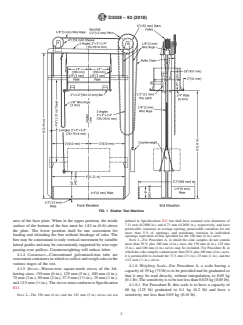
4.1 Shatter Apparatus, including (1) box, (2) base plate, (3)
1.5 This standard does not purport to address all of the
support frame, (4) containers, (5) sieves, and (6) weighing
safety concerns, if any, associated with its use. It is the
scales (see Fig. 1).
responsibility of the user of this standard to establish appro-
4.1.1 Box, 455 mm (18 in.) in width, 710 mm (28 in.) in
priate safety, health, and environmental practices and deter-
length, and 380 mm (15 in.) in depth. The bottom of the box
mine the applicability of regulatory limitations prior to use.
shall consist of two doors, hinged lengthwise and provided
1.6 This international standard was developed in accor-
with a trip latch for rapid opening. The doors are of 6-mm
dance with internationally recognized principles on standard-
( ⁄4-in.) plate and are mounted on freely working hinges so that
ization established in the Decision on Principles for the
they swing open rapidly and do not impede the fall of the coke.
Development of International Standards, Guides and Recom-
The sides of the box are made of plate at least 3 mm ( ⁄8 in.)
mendations issued by the World Trade Organization Technical
thick.
Barriers to Trade (TBT) Committee.
4.1.2 Base Plate—Steel plate, 1.22 m (48 in.) in length, 965
mm (38 in.) in width, and not less than 13 mm ( ⁄2 in.) thick.
2. Referenced Documents
Vertical plates at least 200 mm (8 in.) high are placed on all
2.1 ASTM Standards:
four sides to form a shallow box and to prevent loss of coke
D121 Terminology of Coal and Coke
during the test. The back plate and side plates are rigidly fixed
D293 Test Method for the Sieve Analysis of Coke
while the front plate is made removable to facilitate shovelling
D346 Practice for Collection and Preparation of Coke
the coke from the base plate into the box after each drop. It is
Samples for Laboratory Analysis
important that the base plate be supported rigidly.
NOTE 1—Mounting the base plate solidly on concrete is satisfactory.
4.1.3 Support Frame—A support frame and other appropri-
This test method is under the jurisdiction of ASTM Committee D05 on Coal
ate mechanism are provided so the box may be readily raised
and Coke and is the direct responsibility of Subcommittee D05.15 on Metallurgical
Properties of Coal and Coke.
andloweredtofixedorreproducibleupperandlowerpositions.
Current edition approved June 1, 2018. Published June 2018. Originally
No part of the supporting frame is to impede the free fall of
approved in 1972. Last previous edition approved in 2010 as D3038 – 93 (2010).
coke nor protrude into the 1.22 m by 0.965 m (48 in. by 38 in.)
DOI: 10.1520/D3038-93R10.
For referenced ASTM standards, visit the ASTM website, www.astm.org, or
contact ASTM Customer Service at service@astm.org. For Annual Book of ASTM
Standards volume information, refer to the standard’s Document Summary page on The last approved version of this historical standard is referenced on
the ASTM website. www.astm.org.
Copyright © ASTM International, 100 Barr Harbor Drive, PO Box C700, West Conshohocken, PA 19428-2959. United States
D3038 − 93 (2018)
FIG. 1 Shatter Test Machine
defined in Specifications E11 but shall have nominal wire diameters of
area of the base plate. When in the upper position, the inside
7.11 mm (0.2800 in.) and 6.73 mm (0.2650 in.), respectively, and have
surface of the bottom of the box must be 1.83 m (6 ft) above
permissible variations in average opening, permissible variations for not
the plate. The lower position shall be one convenient for
more than 5 % of openings, and maximum variation in individual
loading and reloading the box without breakage of coke. The
openings equivalent to that specified for the 100 mm (4 in.) sieve.
box may be constrained to only vertical movement by suitable NOTE 3—For Procedure A, in which the coke samples do not contain
more than 50 % plus 100 mm (4 in.) sizes, the 150 mm (6 in.), 125 mm
lateral guides and may be conveniently supported by wire rope
(5 in.), and 100 mm (4 in.) sieves may be excluded. For Procedure B, in
passing over pulleys. Counterweighting will reduce labor.
whichthecokesamplescontainmorethan50 %plus100mm(4in.)sizes,
4.1.4 Containers—Conventional galvanized-iron tubs are
it is permissible to exclude the 37.5 mm (1 ⁄2 in.), 25 mm (1 in.), and the
convenientcontainersinwhichtocollectandweighcokeinthe
12.5 mm ( ⁄2 in.) sieves.
various stages of the test.
4.1.6 Weighing Scale—For Procedure A, a scale having a
4.1.5 Sieves—Woven-wire square-mesh sieves of the fol-
capacity of 35 kg (75 lb) is to be provided and be graduated so
lowing sizes: 150 mm (6 in.), 125 mm (5 in.), 100 mm (4 in.),
that it may be read directly, without interpolation, to 0.05 kg
75 mm (3 in.), 50 mm (2 in.), 37.5 mm (1 ⁄2 in.), 25 mm (1 in.),
(0.1lb).Thesensitivityistobenotlessthan0.025kg(0.05lb).
and12.5mm( ⁄2in.).ThesievesmustconformtoSpecification
4.1.6.1 For Procedure B, this scale is to have a capacity of
E11.
60 kg (125 lb) graduated to 0.1 kg (0.2 lb) and have a
NOTE 2—The 150 mm (6 in.) and the 125 mm (5 in.) sieves are not sensitivity not less than 0.05 kg (0.10 lb).
D3038 − 93 (2018)
5. Sampling 7. Preparation of Test Samples
7.1 The coke used for the shatter test is only that portion
5.1 The gross sample of coke must be taken as close as
which is over 50 mm (2 in.) in size, but the distribution of sizes
possible to the point of interest, include all sizes, and be
in the portion tested is to be in the same proportions as in the
collected in such a way as to be representative of the total lot
plus 50-mm (2-in.) part of the gross sample as found in a
or quantity in question, in accordance with Practice D346.
preliminary size analysis to which the whole of the gross
5.2 For ProcedureA, the minimum size of the gross sample
sample is subjected.
must be such as to yield 68 to 75 kg (150 to 165 lb) of coke
7.2 This preliminary size analysis is carried out, mainly, by
retained on 50-mm (2-in.) sieve when processed according to
hand placing, a process in which each piece of coke is handled
the procedure set forth in Section 7.
and counted as undersize if it will, in some position and
5.2.1 For Procedure B, this sample must be such as to yield
withoutforcing,passthroughthesieve.Proceedinginthisway,
at least 140 kg (300 lb) of coke retained on 75 mm (3 in.) sieve
andtakingcareinalloperationstoavoidbreakage,separatethe
when processed in accordance with the procedure set forth in
gross sample into the following fractions which are segregated
Section 11.
appropriately in tubs:
5.2.2 If experience shows that more than three tests are
Passing Retained on Percent
usually necessary, the quantity of gross sample will need to be
increased appropriately.
__________________ 100 mm (4 in.) sieve ________
100 mm (4 in.) sieve 75 mm (3 in) sieve ________
5.3 The gross sample is to be assembled from increments
75 mm (3 in.) sieve 50 mm (2 in.) sieve ________
50 mm (2 in.) sieve ________
regularly and systematically collected, so that the entire quan-
tity of coke sampled will be represented proportionately in the
7.3 Make appropriate weighings so that the percentage of
gross sample, and with such frequency that a gross sample of
each size in the portion of the original gross sample retained on
at least the minimum required amount is collected.
a 50.8 mm (2 in.) sieve can be calculated.
5.4 Increments may be collected from a stopped conveyor
7.4 Reconstitute each sample for testing, 23 to 25 kg (50 to
belt or by interposing a collecting container into a moving
55 lb), from the segregated sizes above 50 mm (2 in.). Select
stream while the coke is being loaded or unloaded or otherwise
pieces at random from the total amount of each size, the
transported. The increment collected from a stopped belt must
quantity of each size fraction taken being based on the data of
be all the coke on the belt between parallel planes separated by
the preliminary size analysis.
a distance 2.5 times the nominal top size of the coke. In the
7.5 If the coke contains 5 % of moisture or less, test the
same way, when collecting from a moving stream, the collect-
sample as is. Wetter coke is to be dried to 5 % or less before
ing container must be as wide as the stream, or be moved
testing.
uniformly through its whole width and have a mouth opening
2.5 times the nominal top size of the coke. The nominal top
8. Procedure
size, for t
...