

ASTM C24-09(2022)
(Test Method)Standard Test Method for Pyrometric Cone Equivalent (PCE) of Fireclay and High-Alumina Refractory Materials
General Information
- Abstract
SIGNIFICANCE AND USE
5.1 The deformation and end point of a cone corresponds to a certain heat-work condition due to the effects of time, temperature, and atmosphere.
5.2 The precision of this test method is subject to many variables that are difficult to control. Therefore, an experienced operator may be necessary where PCE values are being utilized for specification purposes.
5.3 PCE values are used to classify fireclay and high-alumina refractories.
5.4 This is an effective method of identifying fireclay variations, mining control, and developing raw material specifications.
5.5 Although not recommended, this test method is sometimes applied to materials other than fireclay and high alumina. Such practice should be limited to in-house laboratories and never be used for specification purposes.
SCOPE
1.1 This test method covers the determination of the pyrometric cone equivalent (PCE) of fire clay, fireclay brick, high-alumina brick, and silica fire clay refractory mortar by comparison of test cones with standard pyrometric cones under the conditions prescribed in this test method.
1.2 Units—The values stated in inch-pound units are to be regarded as standard. The values given in parentheses are mathematical conversions to SI units that are provided for information only and are not considered standard.
1.2.1 Exceptions—Certain weights are in SI units with inch-pound in parentheses. Also, certain figures have SI units without parentheses. These SI units are to be regarded as standard.
1.3 This standard does not purport to address all of the safety concerns, if any, associated with its use. It is the responsibility of the user of this standard to establish appropriate safety, health, and environmental practices and determine the applicability of regulatory limitations prior to use.
1.4 This international standard was developed in accordance with internationally recognized principles on standardization established in the Decision on Principles for the Development of International Standards, Guides and Recommendations issued by the World Trade Organization Technical Barriers to Trade (TBT) Committee.
- Status
- Published
- Publication Date
- 31-Oct-2022
- Technical Committee
- C08 - Refractories
- Drafting Committee
- C08.02 - Thermal Properties

Overview
ASTM C24-09(2022), titled Standard Test Method for Pyrometric Cone Equivalent (PCE) of Fireclay and High-Alumina Refractory Materials, is an internationally recognized ASTM standard specifying methods to determine the Pyrometric Cone Equivalent (PCE) of fireclay, fireclay bricks, high-alumina bricks, and silica fire clay refractory mortars. PCE measurement is crucial for assessing the refractoriness-or heat resistance-of these materials, which are commonly used in high-temperature industrial processes. This test method plays a key role in material classification, quality assurance, and specification development for refractories.
Key Topics
- Pyrometric Cone Equivalent (PCE): A measure that determines the heat-work resistance of refractory materials by observing the deformation point of a test cone compared to standard pyrometric cones.
- Material Suitability: The standard covers fireclay, high-alumina refractories, and silica fire clay mortar. Although sometimes applied to other materials, such practices should be restricted to in-house laboratory testing and not for specification purposes.
- Test Methodology: Involves preparing and shaping materials into cones, mounting them on refractory plaques, and subjecting them to controlled heating. The endpoint is when the test cone bends and touches the plaque, indicating its PCE value.
- Operator Expertise: Due to the sensitivity of results to variables such as time, temperature, and atmosphere, experienced operators are recommended especially when PCE values influence specification or classification.
- Classification and Quality Assurance: PCE values are widely used to classify refractories and to identify fireclay variations, monitor mining quality, and develop raw material specifications.
Applications
The ASTM C24-09(2022) test method provides several practical applications in industrial and quality control settings:
- Refractory Material Classification: Organizations use PCE results to categorize fireclay and high-alumina products based on their refractoriness, ensuring suitable material selection for specific high-temperature environments.
- Raw Material Evaluation: Mining and processing operations rely on this method to detect variations in fireclay, supporting mining control and consistent product quality.
- Specification Development: Manufacturers develop and validate raw material specifications using PCE values, which aids in achieving reliable, high-quality refractory products.
- Industrial Process Assurance: In high-temperature industries such as steelmaking, ceramics, and glass production, PCE values help assure that refractory linings and components will perform effectively under expected thermal loads.
- In-House Research: While PCE testing is standardized for fireclay and high-alumina refractories, it may be used for other materials internally to support research, though not for external specification compliance.
Related Standards
Several ASTM and international standards are referenced alongside or relevant to ASTM C24-09(2022) for comprehensive refractory testing:
- ASTM C71: Terminology Relating to Refractories, providing essential definitions for consistency.
- ASTM E11: Specification for Woven Wire Test Sieve Cloth and Test Sieves, relevant for particle size requirements in sample preparation.
- ASTM E220: Test Method for Calibration of Thermocouples By Comparison Techniques, used for accurate temperature control during testing.
- ASTM E691: Practice for Conducting an Interlaboratory Study to Determine the Precision of a Test Method, supporting method validation.
- World Trade Organization TBT Committee Guidelines: The development of ASTM C24-09(2022) aligns with international principles for standardization, ensuring broad acceptance.
Summary
ASTM C24-09(2022) serves as an essential standard for laboratories and manufacturers working with fireclay and high-alumina refractory materials. It provides a methodology for determining the Pyrometric Cone Equivalent, supporting classification, quality assurance, and industry specification compliance. The rigorous approach outlined in this standard ensures high reliability when used by skilled operators, making it a critical reference in the refractory materials sector.
Relations
- Effective Date
- 01-Oct-2018
- Effective Date
- 01-Nov-2013
- Effective Date
- 01-Oct-2013
- Effective Date
- 01-May-2013
- Effective Date
- 01-Apr-2012
- Effective Date
- 01-Nov-2011
- Effective Date
- 01-May-2009
- Effective Date
- 01-Oct-2008
- Effective Date
- 01-Apr-2008
- Effective Date
- 15-Dec-2007
- Refers
ASTM E220-07a - Standard Test Method for Calibration of Thermocouples By Comparison Techniques - Effective Date
- 01-Nov-2007
- Effective Date
- 01-May-2007
- Refers
ASTM E220-07e1 - Standard Test Method for Calibration of Thermocouples By Comparison Techniques - Effective Date
- 01-May-2007
- Effective Date
- 01-Nov-2005
- Effective Date
- 01-May-2004
Frequently Asked Questions
ASTM C24-09(2022) is a standard published by ASTM International. Its full title is "Standard Test Method for Pyrometric Cone Equivalent (PCE) of Fireclay and High-Alumina Refractory Materials". This standard covers: SIGNIFICANCE AND USE 5.1 The deformation and end point of a cone corresponds to a certain heat-work condition due to the effects of time, temperature, and atmosphere. 5.2 The precision of this test method is subject to many variables that are difficult to control. Therefore, an experienced operator may be necessary where PCE values are being utilized for specification purposes. 5.3 PCE values are used to classify fireclay and high-alumina refractories. 5.4 This is an effective method of identifying fireclay variations, mining control, and developing raw material specifications. 5.5 Although not recommended, this test method is sometimes applied to materials other than fireclay and high alumina. Such practice should be limited to in-house laboratories and never be used for specification purposes. SCOPE 1.1 This test method covers the determination of the pyrometric cone equivalent (PCE) of fire clay, fireclay brick, high-alumina brick, and silica fire clay refractory mortar by comparison of test cones with standard pyrometric cones under the conditions prescribed in this test method. 1.2 Units—The values stated in inch-pound units are to be regarded as standard. The values given in parentheses are mathematical conversions to SI units that are provided for information only and are not considered standard. 1.2.1 Exceptions—Certain weights are in SI units with inch-pound in parentheses. Also, certain figures have SI units without parentheses. These SI units are to be regarded as standard. 1.3 This standard does not purport to address all of the safety concerns, if any, associated with its use. It is the responsibility of the user of this standard to establish appropriate safety, health, and environmental practices and determine the applicability of regulatory limitations prior to use. 1.4 This international standard was developed in accordance with internationally recognized principles on standardization established in the Decision on Principles for the Development of International Standards, Guides and Recommendations issued by the World Trade Organization Technical Barriers to Trade (TBT) Committee.
SIGNIFICANCE AND USE 5.1 The deformation and end point of a cone corresponds to a certain heat-work condition due to the effects of time, temperature, and atmosphere. 5.2 The precision of this test method is subject to many variables that are difficult to control. Therefore, an experienced operator may be necessary where PCE values are being utilized for specification purposes. 5.3 PCE values are used to classify fireclay and high-alumina refractories. 5.4 This is an effective method of identifying fireclay variations, mining control, and developing raw material specifications. 5.5 Although not recommended, this test method is sometimes applied to materials other than fireclay and high alumina. Such practice should be limited to in-house laboratories and never be used for specification purposes. SCOPE 1.1 This test method covers the determination of the pyrometric cone equivalent (PCE) of fire clay, fireclay brick, high-alumina brick, and silica fire clay refractory mortar by comparison of test cones with standard pyrometric cones under the conditions prescribed in this test method. 1.2 Units—The values stated in inch-pound units are to be regarded as standard. The values given in parentheses are mathematical conversions to SI units that are provided for information only and are not considered standard. 1.2.1 Exceptions—Certain weights are in SI units with inch-pound in parentheses. Also, certain figures have SI units without parentheses. These SI units are to be regarded as standard. 1.3 This standard does not purport to address all of the safety concerns, if any, associated with its use. It is the responsibility of the user of this standard to establish appropriate safety, health, and environmental practices and determine the applicability of regulatory limitations prior to use. 1.4 This international standard was developed in accordance with internationally recognized principles on standardization established in the Decision on Principles for the Development of International Standards, Guides and Recommendations issued by the World Trade Organization Technical Barriers to Trade (TBT) Committee.
ASTM C24-09(2022) is classified under the following ICS (International Classification for Standards) categories: 81.080 - Refractories. The ICS classification helps identify the subject area and facilitates finding related standards.
ASTM C24-09(2022) has the following relationships with other standards: It is inter standard links to ASTM C71-12(2018), ASTM E220-13, ASTM E11-13, ASTM E691-13, ASTM C71-12, ASTM E691-11, ASTM E11-09e1, ASTM E691-08, ASTM C71-08, ASTM C71-07, ASTM E220-07a, ASTM E220-07, ASTM E220-07e1, ASTM E691-05, ASTM E11-04. Understanding these relationships helps ensure you are using the most current and applicable version of the standard.
ASTM C24-09(2022) is available in PDF format for immediate download after purchase. The document can be added to your cart and obtained through the secure checkout process. Digital delivery ensures instant access to the complete standard document.
Standards Content (Sample)
This international standard was developed in accordance with internationally recognized principles on standardization established in the Decision on Principles for the
Development of International Standards, Guides and Recommendations issued by the World Trade Organization Technical Barriers to Trade (TBT) Committee.
Designation: C24 − 09 (Reapproved 2022)
Standard Test Method for
Pyrometric Cone Equivalent (PCE) of Fireclay and High-
Alumina Refractory Materials
This standard is issued under the fixed designation C24; the number immediately following the designation indicates the year of original
adoption or, in the case of revision, the year of last revision.Anumber in parentheses indicates the year of last reapproval.Asuperscript
epsilon (´) indicates an editorial change since the last revision or reapproval.
This standard has been approved for use by agencies of the U.S. Department of Defense.
1. Scope E220 Test Method for Calibration of Thermocouples By
Comparison Techniques
1.1 This test method covers the determination of the pyro-
E691 Practice for Conducting an Interlaboratory Study to
metric cone equivalent (PCE) of fire clay, fireclay brick,
Determine the Precision of a Test Method
high-alumina brick, and silica fire clay refractory mortar by
comparison of test cones with standard pyrometric cones under
3. Terminology
the conditions prescribed in this test method.
3.1 Definitions—For definitions of terms used in this test
1.2 Units—The values stated in inch-pound units are to be
method, see Terminology C71.
regarded as standard. The values given in parentheses are
mathematical conversions to SI units that are provided for
4. Summary of Test Method
information only and are not considered standard.
4.1 This test method consists of preparing a test cone from
1.2.1 Exceptions—Certain weights are in SI units with
a refractory material and comparing its deformation end point
inch-pound in parentheses. Also, certain figures have SI units
to that of a standard pyrometric cone. The resultant PCE value
without parentheses. These SI units are to be regarded as
is a measure of the refractoriness of the material.
standard.
4.2 Temperature equivalent tables for the standard cones
1.3 This standard does not purport to address all of the
have been determined by the National Institute of Standards
safety concerns, if any, associated with its use. It is the
andTechnology when subjected to both slow and rapid heating
responsibility of the user of this standard to establish appro-
rates.
priate safety, health, and environmental practices and deter-
mine the applicability of regulatory limitations prior to use.
5. Significance and Use
1.4 This international standard was developed in accor-
dance with internationally recognized principles on standard-
5.1 The deformation and end point of a cone corresponds to
ization established in the Decision on Principles for the a certain heat-work condition due to the effects of time,
Development of International Standards, Guides and Recom-
temperature, and atmosphere.
mendations issued by the World Trade Organization Technical
5.2 The precision of this test method is subject to many
Barriers to Trade (TBT) Committee.
variables that are difficult to control.Therefore, an experienced
operatormaybenecessarywherePCEvaluesarebeingutilized
2. Referenced Documents
for specification purposes.
2.1 ASTM Standards:
5.3 PCE values are used to classify fireclay and high-
C71 Terminology Relating to Refractories
alumina refractories.
E11 Specification for Woven Wire Test Sieve Cloth and Test
Sieves 5.4 This is an effective method of identifying fireclay
variations, mining control, and developing raw material speci-
fications.
This test method is under the jurisdiction of ASTM Committee C08 on
Refractories and is the direct responsibility of Subcommittee C08.02 on Thermal
5.5 Although not recommended, this test method is some-
Properties.
times applied to materials other than fireclay and high alumina.
Current edition approved Nov. 1, 2022. Published November 2022. Originally
Such practice should be limited to in-house laboratories and
approved in 1919. Last previous edition approved in 2018 as C24 – 09 (2018). DOI:
never be used for specification purposes.
10.1520/C0024-09R22.
For referenced ASTM standards, visit the ASTM website, www.astm.org, or
contact ASTM Customer Service at service@astm.org. For Annual Book of ASTM
6. Procedure
Standards volume information, refer to the standard’s Document Summary page on
the ASTM website. 6.1 Preparation of Sample:
Copyright © ASTM International, 100 Barr Harbor Drive, PO Box C700, West Conshohocken, PA 19428-2959. United States
C24 − 09 (2022)
6.1.1 Clay or Brick—Crush the entire sample of fire clay or
fireclay brick, in case the amount is small, by means of rolls or
a jaw crusher to produce a particle size not larger than ⁄4 in.
(6 mm). If the amount is large, treat a representative sample
obtained by approved methods. Then mix the sample thor-
oughly and reduce the amount to about 250 g (0.5 lb) by
quartering (see Note 1). Then grind this portion in an agate,
porcelain, or hard steel mortar and reduce the amount again by
quartering. The final size of the sample shall be 50 g and the
fineness capable of passing anASTM No. 70 (212-µm) sieve .
(equivalent to a 65-mesh Tyler Standard Series). In order to
avoid excessive reduction to fines, remove them frequently
during the process of reduction by throwing the sample on the
sieve and continuing the grinding of the coarser particles until
all the sample passes through the sieve (see Note 2). Take
precautions to prevent contamination of the sample by steel
particles from the sampling equipment during crushing or
grinding.
NOTE 1—Take care during the crushing and grinding of the sample to
prevent the introduction of magnetic material.
NOTE 2—The requirement to grind the coarser particles is particularly
important for highly siliceous products; excessively fine grinding may
reduce their PCE by as much as two cones.
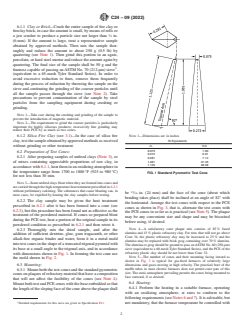
NOTE 1—Dimensions are in inches.
6.1.2 Silica Fire Clay (see 3.1)—In the case of silica fire
clay, test the sample obtained by approved methods as received SI Equivalents
without grinding or other treatment. in. mm
0.075 1.90
6.2 Preparation of Test Cones:
0.272 6.91
6.2.1 After preparing samples of unfired clays (Note 3), or
0.281 7.14
1.081 27.46
of mixes containing appreciable proportions of raw clay, in
1.125 28.58
accordance with 6.1.1, heat them in an oxidizing atmosphere in
the temperature range from 1700 to 1800 °F (925 to 980 °C)
FIG. 1 Standard Pyrometric Test Cone
for not less than 30 min.
NOTE3—Someunfiredclaysbloatwhentheyareformedintoconesand
arecarriedthroughthehigh-temperatureheattreatmentprescribedin6.2.1
without preliminary calcining. The substances that cause bloating can, in
be ⁄16 in. (24 mm) and the face of the cone (about which
most cases, be expelled by heating the clay samples before testing.
bending takes place) shall be inclined at an angle of 82° with
6.2.2 The clay sample may be given the heat treatment
the horizontal. Arrange the test cones with respect to the PCE
prescribed in 6.2.1 after it has been formed into a cone (see
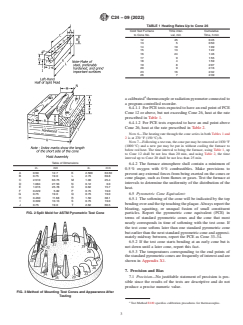
cones as shown in Fig. 3, that is, alternate the test cones with
6.2.3), but this procedure has been found not as effective as the
the PCE cones in so far as is practical (see Note 5). The plaque
treatment of the powdered material. If cones so prepared bloat
may be any convenient size and shape and may be biscuited
during the PCE test, heat a portion of the original sample in its
before using, if desired.
powdered condition as prescribed in 6.2.1 and then retest it.
NOTE 4—A satisfactory cone plaque mix consists of 85 % fused
6.2.3 Thoroughly mix the dried sample, and after the
alumina and 15 % plastic refractory clay. For tests that will not go above
addition of sufficient dextrine, glue, gum tragacanth, or other
Cone 34, the plastic refractory clay may be increased to 25 % and the
alkali-free organic binder and water, form it in a metal mold
alumina may be replaced with brick grog containing over 70 % alumina.
intotestconesintheshapeofatruncatedtrigonalpyrami
...