

ASTM C987-10(2023)
(Test Method)Standard Test Method for Vapor Attack on Refractories for Furnace Superstructures
General Information
- Abstract
SIGNIFICANCE AND USE
2.1 This test method provides a guide for evaluating the resistance of refractories in glass-melting furnace superstructures to vapor attack. This test method may also be useful for evaluating refractories in other applications where vapor attack occurs.
2.2 An electric-heated furnace is recommended. Water vapor and other atmospheric components in a gas- or fuel-fired furnace may participate in the chemical and physical reactions being studied. Results may differ, therefore, depending upon the nature and type of firing employed.
2.3 The degree of correlation between this test method and service performance is not fully determinable. This is intended to be an accelerated test method that generates a substantial degree of reaction in a relatively short amount of time. This acceleration may be accomplished by changing the composition and/or concentration of the reactants, increasing temperatures, or by performing the test in an isothermal environment.
2.4 Since the test method may not accurately simulate the service environment, observed results of this test method may not be representative of those found in service. It is imperative that the user understand and consider how the results of this test method may differ from those encountered in service. This is particularly likely if the reaction products, their nature, or their degree differ from those normally found in the actual service environment.
2.5 It is incumbent upon the user to understand that this is an aggressive, accelerated test method and to be careful in interpreting the results. If, for example, the reaction species have never been found in a real-world furnace, then this test method should not necessarily be considered valid to evaluate the refractory in question.
SCOPE
1.1 This test method covers a procedure for comparing the behavior of refractories in contact with vapors under conditions intended to simulate the environment within a glass-melting or other type of furnace when refractories are exposed to vapors from raw batch, molten glass, fuel, fuel contaminants, or other sources. This procedure is intended to accelerate service conditions for the purpose of determining in a relatively short time the interval resistance to fluxing, bloating, shrinkage, expansion, mineral conversion, disintegration, or other physical changes that may occur.
1.2 The values stated in SI units are to be regarded as standard. No other units of measurement are included in this standard.
1.3 This standard does not purport to address all of the safety concerns, if any, associated with its use. It is the responsibility of the user of this standard to establish appropriate safety, health, and environmental practices and determine the applicability of regulatory limitations prior to use.
1.4 This international standard was developed in accordance with internationally recognized principles on standardization established in the Decision on Principles for the Development of International Standards, Guides and Recommendations issued by the World Trade Organization Technical Barriers to Trade (TBT) Committee.
- Status
- Published
- Publication Date
- 31-Jul-2023
- Technical Committee
- C08 - Refractories
- Drafting Committee
- C08.10 - Refractories for Glass


Overview
ASTM C987-10(2023): Standard Test Method for Vapor Attack on Refractories for Furnace Superstructures is an internationally recognized test method developed by ASTM International. This standard provides a procedure to evaluate and compare the resistance of refractory materials used in glass-melting furnace superstructures against vapor-induced corrosion and degradation. The method is designed to simulate service environments where refractories are exposed to vapors generated from raw batch materials, molten glass, fuel, and other sources. Its main purpose is to enable rapid, comparative assessments of how these materials withstand fluxing, bloating, shrinkage, expansion, mineral conversion, and other physical changes under accelerated conditions.
Key Topics
- Vapor Attack on Refractories: The test method focuses on how vapors interact with and impact the physical integrity of refractory materials commonly used in furnace superstructures, especially in glass production.
- Accelerated Testing: By varying the reactant composition, concentration, and furnace conditions such as temperature (usually in an electric-heated furnace), the test quickly generates measurable changes, making it possible to observe significant vapor attack effects in a short period.
- Specimen Preparation and Procedure: Test samples must meet specified dimensional criteria and be free of obvious defects. Three specimens per refractory brand are used, subjected to a controlled environment with specific reactants to closely simulate service vapors.
- Reactants and Test Conditions: Typical reactants include carbonates, sulfates, borates, and halides. Test temperatures and reactant levels are chosen to best reflect real service conditions without direct contact between reagents and specimens.
- Interpretation of Results: Users are cautioned that results may differ from real-world performance due to the test’s accelerated nature and potential differences in reaction products. Proper interpretation and context are crucial for practical use.
- Reporting and Documentation: Test reports should include complete details of specimens, test temperatures, reactant types and amounts, and observed material changes such as cracking or mineral transformation.
Applications
- Glass Industry: The primary application is in the selection and quality control of refractories used in glass-melting furnaces, ensuring resistance to vapor attack and long-term service performance.
- Comparative Evaluation: Manufacturers and users can compare different refractory brands and compositions to identify materials with superior resistance to chemical vapor corrosion.
- Research and Development: Useful for laboratories conducting research into new refractory materials designed to withstand harsh service conditions.
- Quality Assurance: Organizations seeking to maintain or improve furnace reliability can utilize this test method as part of their material verification processes.
- Broader Furnace Applications: While tailored for glass melting, this method is also suitable wherever vapor attack is a concern in high-temperature furnace environments.
Related Standards
For comprehensive evaluation and compliance, consider referencing related ASTM standards in the field of refractories and high-temperature materials testing:
- ASTM C71 - Standard Terminology Relating to Refractories
- ASTM C704 - Standard Test Method for Abrasion Resistance of Refractory Materials at Room Temperature
- ASTM C113 - Standard Test Method for Reheat Change of Refractory Brick
- ASTM C133 - Standard Test Methods for Cold Crushing Strength and Modulus of Rupture of Refractories
- ASTM C20 - Standard Test Methods for Apparent Porosity, Water Absorption, Apparent Specific Gravity, and Bulk Density of Burned Refractory Brick and Shapes
Keywords: vapor attack, refractories, furnace superstructures, glass industry, corrosion resistance, ASTM C987, accelerated test method, high-temperature materials, comparative evaluation, refractory standards.
Adhering to ASTM C987-10(2023) helps ensure materials selected for critical high-temperature applications meet the necessary standards for safety, reliability, and performance in challenging vapor-rich operating environments.
Frequently Asked Questions
ASTM C987-10(2023) is a standard published by ASTM International. Its full title is "Standard Test Method for Vapor Attack on Refractories for Furnace Superstructures". This standard covers: SIGNIFICANCE AND USE 2.1 This test method provides a guide for evaluating the resistance of refractories in glass-melting furnace superstructures to vapor attack. This test method may also be useful for evaluating refractories in other applications where vapor attack occurs. 2.2 An electric-heated furnace is recommended. Water vapor and other atmospheric components in a gas- or fuel-fired furnace may participate in the chemical and physical reactions being studied. Results may differ, therefore, depending upon the nature and type of firing employed. 2.3 The degree of correlation between this test method and service performance is not fully determinable. This is intended to be an accelerated test method that generates a substantial degree of reaction in a relatively short amount of time. This acceleration may be accomplished by changing the composition and/or concentration of the reactants, increasing temperatures, or by performing the test in an isothermal environment. 2.4 Since the test method may not accurately simulate the service environment, observed results of this test method may not be representative of those found in service. It is imperative that the user understand and consider how the results of this test method may differ from those encountered in service. This is particularly likely if the reaction products, their nature, or their degree differ from those normally found in the actual service environment. 2.5 It is incumbent upon the user to understand that this is an aggressive, accelerated test method and to be careful in interpreting the results. If, for example, the reaction species have never been found in a real-world furnace, then this test method should not necessarily be considered valid to evaluate the refractory in question. SCOPE 1.1 This test method covers a procedure for comparing the behavior of refractories in contact with vapors under conditions intended to simulate the environment within a glass-melting or other type of furnace when refractories are exposed to vapors from raw batch, molten glass, fuel, fuel contaminants, or other sources. This procedure is intended to accelerate service conditions for the purpose of determining in a relatively short time the interval resistance to fluxing, bloating, shrinkage, expansion, mineral conversion, disintegration, or other physical changes that may occur. 1.2 The values stated in SI units are to be regarded as standard. No other units of measurement are included in this standard. 1.3 This standard does not purport to address all of the safety concerns, if any, associated with its use. It is the responsibility of the user of this standard to establish appropriate safety, health, and environmental practices and determine the applicability of regulatory limitations prior to use. 1.4 This international standard was developed in accordance with internationally recognized principles on standardization established in the Decision on Principles for the Development of International Standards, Guides and Recommendations issued by the World Trade Organization Technical Barriers to Trade (TBT) Committee.
SIGNIFICANCE AND USE 2.1 This test method provides a guide for evaluating the resistance of refractories in glass-melting furnace superstructures to vapor attack. This test method may also be useful for evaluating refractories in other applications where vapor attack occurs. 2.2 An electric-heated furnace is recommended. Water vapor and other atmospheric components in a gas- or fuel-fired furnace may participate in the chemical and physical reactions being studied. Results may differ, therefore, depending upon the nature and type of firing employed. 2.3 The degree of correlation between this test method and service performance is not fully determinable. This is intended to be an accelerated test method that generates a substantial degree of reaction in a relatively short amount of time. This acceleration may be accomplished by changing the composition and/or concentration of the reactants, increasing temperatures, or by performing the test in an isothermal environment. 2.4 Since the test method may not accurately simulate the service environment, observed results of this test method may not be representative of those found in service. It is imperative that the user understand and consider how the results of this test method may differ from those encountered in service. This is particularly likely if the reaction products, their nature, or their degree differ from those normally found in the actual service environment. 2.5 It is incumbent upon the user to understand that this is an aggressive, accelerated test method and to be careful in interpreting the results. If, for example, the reaction species have never been found in a real-world furnace, then this test method should not necessarily be considered valid to evaluate the refractory in question. SCOPE 1.1 This test method covers a procedure for comparing the behavior of refractories in contact with vapors under conditions intended to simulate the environment within a glass-melting or other type of furnace when refractories are exposed to vapors from raw batch, molten glass, fuel, fuel contaminants, or other sources. This procedure is intended to accelerate service conditions for the purpose of determining in a relatively short time the interval resistance to fluxing, bloating, shrinkage, expansion, mineral conversion, disintegration, or other physical changes that may occur. 1.2 The values stated in SI units are to be regarded as standard. No other units of measurement are included in this standard. 1.3 This standard does not purport to address all of the safety concerns, if any, associated with its use. It is the responsibility of the user of this standard to establish appropriate safety, health, and environmental practices and determine the applicability of regulatory limitations prior to use. 1.4 This international standard was developed in accordance with internationally recognized principles on standardization established in the Decision on Principles for the Development of International Standards, Guides and Recommendations issued by the World Trade Organization Technical Barriers to Trade (TBT) Committee.
ASTM C987-10(2023) is classified under the following ICS (International Classification for Standards) categories: 81.080 - Refractories. The ICS classification helps identify the subject area and facilitates finding related standards.
ASTM C987-10(2023) is available in PDF format for immediate download after purchase. The document can be added to your cart and obtained through the secure checkout process. Digital delivery ensures instant access to the complete standard document.
Standards Content (Sample)
This international standard was developed in accordance with internationally recognized principles on standardization established in the Decision on Principles for the
Development of International Standards, Guides and Recommendations issued by the World Trade Organization Technical Barriers to Trade (TBT) Committee.
Designation: C987 − 10 (Reapproved 2023)
Standard Test Method for
Vapor Attack on Refractories for Furnace Superstructures
This standard is issued under the fixed designation C987; the number immediately following the designation indicates the year of
original adoption or, in the case of revision, the year of last revision. A number in parentheses indicates the year of last reapproval. A
superscript epsilon (´) indicates an editorial change since the last revision or reapproval.
1. Scope 2.3 The degree of correlation between this test method and
service performance is not fully determinable. This is intended
1.1 This test method covers a procedure for comparing the
to be an accelerated test method that generates a substantial
behavior of refractories in contact with vapors under conditions
degree of reaction in a relatively short amount of time. This
intended to simulate the environment within a glass-melting or
acceleration may be accomplished by changing the composi-
other type of furnace when refractories are exposed to vapors
tion and/or concentration of the reactants, increasing
from raw batch, molten glass, fuel, fuel contaminants, or other
temperatures, or by performing the test in an isothermal
sources. This procedure is intended to accelerate service
environment.
conditions for the purpose of determining in a relatively short
time the interval resistance to fluxing, bloating, shrinkage, 2.4 Since the test method may not accurately simulate the
expansion, mineral conversion, disintegration, or other physi- service environment, observed results of this test method may
cal changes that may occur. not be representative of those found in service. It is imperative
that the user understand and consider how the results of this
1.2 The values stated in SI units are to be regarded as
test method may differ from those encountered in service. This
standard. No other units of measurement are included in this
is particularly likely if the reaction products, their nature, or
standard.
their degree differ from those normally found in the actual
1.3 This standard does not purport to address all of the
service environment.
safety concerns, if any, associated with its use. It is the
2.5 It is incumbent upon the user to understand that this is
responsibility of the user of this standard to establish appro-
an aggressive, accelerated test method and to be careful in
priate safety, health, and environmental practices and deter-
interpreting the results. If, for example, the reaction species
mine the applicability of regulatory limitations prior to use.
have never been found in a real-world furnace, then this test
1.4 This international standard was developed in accor-
method should not necessarily be considered valid to evaluate
dance with internationally recognized principles on standard-
the refractory in question.
ization established in the Decision on Principles for the
Development of International Standards, Guides and Recom-
3. Apparatus
mendations issued by the World Trade Organization Technical
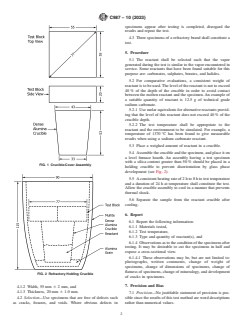
3.1 The crucible for containing the reactant shall be a dense
Barriers to Trade (TBT) Committee.
alumina or platinum crucible of conical shape with dimensions
2. Significance and Use
of 43 mm in diameter at top, 33 mm in diameter at bottom, and
53 mm high.
2.1 This test method provides a guide for evaluating the
resistance of refractories in glass-melting furnace superstruc-
3.2 The crucible-cover assembly (Fig. 1) may be supported
tures to vapor attack. This test method may also be useful for
within a suitable refractory holding crucible (Fig. 2) such as
evaluating refractories in other applications where vapor attack
mullite to maintain the position of the cover, if an excessive
occurs.
amount of glass phase reaction product is anticipated.
2.2 An electric-heated furnace is recommended. Water va-
3.3 The electric heating chamber shall be of sufficient size
por and other atmospheric components in a gas- or fuel-fired
to accommodate at least three assemblies for comparative
furnace may participate in the chemical and physical reactions
evaluation. The temperature control system shall be capable of
being studied. Results may differ, therefore, depending upon
maintaining a desired holding temperature with a tolerance of
the nature and type of firing employed.
63 °C.
4. Specimen Preparation
This test method is under the jurisdiction of ASTM Committee C08 on
Refractories and is the direct responsibility of Subcommittee C08.10 on Refractories
4.1 The test specimen shall conform to the following
for Glass.
dimensions with major faces cut or ground parallel and flat to
Current editio
...