

ASTM C604-18(2023)
(Test Method)Standard Test Method for True Specific Gravity of Refractory Materials by Gas-Comparison Pycnometer
General Information
- Abstract
SIGNIFICANCE AND USE
4.1 The true specific gravity of a material is the ratio of its true density, determined at a specific temperature, to the true density of water, determined at a specific temperature. Thus, the true specific gravity of a material is a primary property which is related to chemical and mineralogical composition.
4.2 This test method is particularly useful for hydratable materials that are not suitable for test with Test Method C135.
4.3 For refractory raw materials and products, the true specific gravity is a useful value for: classification, detecting differences in chemical composition between supposedly like samples, indicating mineralogical phases or phase changes, calculating total porosity when the bulk density is known, and for any other test method that requires this value for the calculation of results.
4.4 This test method is a primary standard method which is suitable for use in specifications, quality control, and research and development. It can also serve as a referee test method in purchasing contracts or agreements.
4.5 Fundamental assumptions inherent in this test method are the following:
4.5.1 The sample is representative of the material in general,
4.5.2 The total sample has been reduced to the particle size specified,
4.5.3 No contamination has been introduced during processing of the sample,
4.5.4 The ignition of the sample has eliminated all free or combined water without inducing sintering or alteration,
4.5.5 An inert gas (helium) has been used in the test, and
4.5.6 The test method has been conducted in a meticulous manner.
4.5.7 Deviation from any of these assumptions negates the usefulness of the results.
4.6 In interpreting the results of this test method, it must be recognized that the specified sample particle size is significantly finer than specified for Test Method C135. Even this finer particle size for the sample does not preclude the presence of some closed pores, and the amount of residual close...
SCOPE
1.1 This test method covers the determination of the true specific gravity of solid materials, and is particularly useful for materials that easily hydrate which are not suitable for test with Test Method C135. This test method may be used as an alternate for Test Methods C135, C128, and C188 for determining true specific gravity.
1.2 Units—The values stated in SI units are to be regarded as standard. No other units of measurement are included in this standard.
1.2.1 Exception—In 7.3, the equivalent SI unit is expressed in parentheses.
1.3 This standard does not purport to address all of the safety concerns, if any, associated with its use. It is the responsibility of the user of this standard to establish appropriate safety, health, and environmental practices and determine the applicability of regulatory limitations prior to use.
1.4 This international standard was developed in accordance with internationally recognized principles on standardization established in the Decision on Principles for the Development of International Standards, Guides and Recommendations issued by the World Trade Organization Technical Barriers to Trade (TBT) Committee.
- Status
- Published
- Publication Date
- 31-Jul-2023
- Technical Committee
- C08 - Refractories
- Drafting Committee
- C08.03 - Physical Properties


Overview
ASTM C604-18(2023): Standard Test Method for True Specific Gravity of Refractory Materials by Gas-Comparison Pycnometer establishes an internationally recognized method for determining the true specific gravity of solid materials, particularly refractory materials and those that are hydratable. This test method utilizes a gas-comparison pycnometer to measure the volume and density of finely powdered samples, enabling an accurate assessment of their true specific gravity relative to water at a specified temperature.
This method is especially valuable for materials that readily absorb moisture and therefore cannot be accurately tested by conventional water immersion methods, such as ASTM C135. Following the guidelines of ASTM Committee C08 on Refractories, the standard provides a reliable approach for use in product classifications, quality control, and research.
Key Topics
True Specific Gravity Measurement
Measures the ratio of the true density of a refractory material to the true density of water, both at specified temperatures.Gas-Comparison Pycnometer
The technique employs a gas-comparison pycnometer, typically using helium as an inert gas, to precisely measure the volume of a finely powdered sample.Sample Preparation
Requires samples to be ground to a fine particle size (passing a No. 325 [45 μm] sieve), ignited to remove all free and combined water, and cooled in a desiccator to avoid contamination and hydration.Significance for Hydratable Materials
Provides a primary method for refractory materials that absorb water, where standard water immersion techniques are unsuitable.Assumptions and Limitations
Assumes samples are representative, free from contamination, properly processed, and that the method is executed meticulously. The presence of some closed porosity can affect the results, making close sample matching important for comparative purposes.
Applications
This standard plays a vital role in various practical areas involving refractory materials and hydratable solids:
Material Classification
Assists in classifying refractory raw materials and fabricated products based on true specific gravity, providing insights into their composition and suitability for specific applications.Quality Control and Assurance
Used in routine testing to ensure consistency of incoming materials and finished products, supporting manufacturing compliance with technical specifications.Research and Development
Employed in laboratories to detect differences in chemical or mineralogical composition, monitor phase changes, and correlate physical properties.Porosity Calculation
Facilitates the calculation of total porosity when paired with bulk density measurements, essential for understanding insulation and thermal properties.Purchasing and Referee Testing
Serves as a referee method for contract verifications, ensuring that supplied materials meet agreed-upon standards in procurement contexts.
Related Standards
- ASTM C135 – Test Method for True Specific Gravity of Refractory Materials by Water Immersion (used for non-hydratable materials)
- ASTM C128 – Test Method for Relative Density (Specific Gravity) and Absorption of Fine Aggregate
- ASTM C188 – Test Method for Density of Hydraulic Cement
- ASTM E11 – Specification for Woven Wire Test Sieve Cloth and Test Sieves
- ASTM E177 – Practice for Use of the Terms Precision and Bias in ASTM Test Methods
- ASTM E691 – Practice for Conducting an Interlaboratory Study to Determine the Precision of a Test Method
By adhering to ASTM C604-18(2023), industry professionals and laboratories can obtain consistent, reliable, and internationally recognized results when testing the true specific gravity of refractory and hydratable materials using the gas-comparison pycnometer method. This standard supports material classification, quality assurance, and research applications, contributing to the advancement of materials science and industrial manufacturing.
Relations
- Effective Date
- 15-Dec-2016
- Effective Date
- 01-Oct-2015
- Effective Date
- 01-Jul-2014
- Effective Date
- 01-May-2014
- Effective Date
- 01-Oct-2013
- Effective Date
- 01-May-2013
- Effective Date
- 01-May-2013
- Effective Date
- 01-Apr-2012
- Effective Date
- 01-Nov-2011
- Effective Date
- 01-Oct-2010
- Effective Date
- 01-Dec-2009
- Effective Date
- 01-May-2009
- Effective Date
- 01-Oct-2008
- Effective Date
- 01-Oct-2008
- Effective Date
- 01-Aug-2007
Frequently Asked Questions
ASTM C604-18(2023) is a standard published by ASTM International. Its full title is "Standard Test Method for True Specific Gravity of Refractory Materials by Gas-Comparison Pycnometer". This standard covers: SIGNIFICANCE AND USE 4.1 The true specific gravity of a material is the ratio of its true density, determined at a specific temperature, to the true density of water, determined at a specific temperature. Thus, the true specific gravity of a material is a primary property which is related to chemical and mineralogical composition. 4.2 This test method is particularly useful for hydratable materials that are not suitable for test with Test Method C135. 4.3 For refractory raw materials and products, the true specific gravity is a useful value for: classification, detecting differences in chemical composition between supposedly like samples, indicating mineralogical phases or phase changes, calculating total porosity when the bulk density is known, and for any other test method that requires this value for the calculation of results. 4.4 This test method is a primary standard method which is suitable for use in specifications, quality control, and research and development. It can also serve as a referee test method in purchasing contracts or agreements. 4.5 Fundamental assumptions inherent in this test method are the following: 4.5.1 The sample is representative of the material in general, 4.5.2 The total sample has been reduced to the particle size specified, 4.5.3 No contamination has been introduced during processing of the sample, 4.5.4 The ignition of the sample has eliminated all free or combined water without inducing sintering or alteration, 4.5.5 An inert gas (helium) has been used in the test, and 4.5.6 The test method has been conducted in a meticulous manner. 4.5.7 Deviation from any of these assumptions negates the usefulness of the results. 4.6 In interpreting the results of this test method, it must be recognized that the specified sample particle size is significantly finer than specified for Test Method C135. Even this finer particle size for the sample does not preclude the presence of some closed pores, and the amount of residual close... SCOPE 1.1 This test method covers the determination of the true specific gravity of solid materials, and is particularly useful for materials that easily hydrate which are not suitable for test with Test Method C135. This test method may be used as an alternate for Test Methods C135, C128, and C188 for determining true specific gravity. 1.2 Units—The values stated in SI units are to be regarded as standard. No other units of measurement are included in this standard. 1.2.1 Exception—In 7.3, the equivalent SI unit is expressed in parentheses. 1.3 This standard does not purport to address all of the safety concerns, if any, associated with its use. It is the responsibility of the user of this standard to establish appropriate safety, health, and environmental practices and determine the applicability of regulatory limitations prior to use. 1.4 This international standard was developed in accordance with internationally recognized principles on standardization established in the Decision on Principles for the Development of International Standards, Guides and Recommendations issued by the World Trade Organization Technical Barriers to Trade (TBT) Committee.
SIGNIFICANCE AND USE 4.1 The true specific gravity of a material is the ratio of its true density, determined at a specific temperature, to the true density of water, determined at a specific temperature. Thus, the true specific gravity of a material is a primary property which is related to chemical and mineralogical composition. 4.2 This test method is particularly useful for hydratable materials that are not suitable for test with Test Method C135. 4.3 For refractory raw materials and products, the true specific gravity is a useful value for: classification, detecting differences in chemical composition between supposedly like samples, indicating mineralogical phases or phase changes, calculating total porosity when the bulk density is known, and for any other test method that requires this value for the calculation of results. 4.4 This test method is a primary standard method which is suitable for use in specifications, quality control, and research and development. It can also serve as a referee test method in purchasing contracts or agreements. 4.5 Fundamental assumptions inherent in this test method are the following: 4.5.1 The sample is representative of the material in general, 4.5.2 The total sample has been reduced to the particle size specified, 4.5.3 No contamination has been introduced during processing of the sample, 4.5.4 The ignition of the sample has eliminated all free or combined water without inducing sintering or alteration, 4.5.5 An inert gas (helium) has been used in the test, and 4.5.6 The test method has been conducted in a meticulous manner. 4.5.7 Deviation from any of these assumptions negates the usefulness of the results. 4.6 In interpreting the results of this test method, it must be recognized that the specified sample particle size is significantly finer than specified for Test Method C135. Even this finer particle size for the sample does not preclude the presence of some closed pores, and the amount of residual close... SCOPE 1.1 This test method covers the determination of the true specific gravity of solid materials, and is particularly useful for materials that easily hydrate which are not suitable for test with Test Method C135. This test method may be used as an alternate for Test Methods C135, C128, and C188 for determining true specific gravity. 1.2 Units—The values stated in SI units are to be regarded as standard. No other units of measurement are included in this standard. 1.2.1 Exception—In 7.3, the equivalent SI unit is expressed in parentheses. 1.3 This standard does not purport to address all of the safety concerns, if any, associated with its use. It is the responsibility of the user of this standard to establish appropriate safety, health, and environmental practices and determine the applicability of regulatory limitations prior to use. 1.4 This international standard was developed in accordance with internationally recognized principles on standardization established in the Decision on Principles for the Development of International Standards, Guides and Recommendations issued by the World Trade Organization Technical Barriers to Trade (TBT) Committee.
ASTM C604-18(2023) is classified under the following ICS (International Classification for Standards) categories: 81.080 - Refractories. The ICS classification helps identify the subject area and facilitates finding related standards.
ASTM C604-18(2023) has the following relationships with other standards: It is inter standard links to ASTM C188-16, ASTM C188-15, ASTM C188-14, ASTM E177-14, ASTM E11-13, ASTM E177-13, ASTM E691-13, ASTM C128-12, ASTM E691-11, ASTM E177-10, ASTM C188-09, ASTM E11-09e1, ASTM E177-08, ASTM E691-08, ASTM C128-07a. Understanding these relationships helps ensure you are using the most current and applicable version of the standard.
ASTM C604-18(2023) is available in PDF format for immediate download after purchase. The document can be added to your cart and obtained through the secure checkout process. Digital delivery ensures instant access to the complete standard document.
Standards Content (Sample)
This international standard was developed in accordance with internationally recognized principles on standardization established in the Decision on Principles for the
Development of International Standards, Guides and Recommendations issued by the World Trade Organization Technical Barriers to Trade (TBT) Committee.
Designation: C604 − 18 (Reapproved 2023)
Standard Test Method for
True Specific Gravity of Refractory Materials by Gas-
Comparison Pycnometer
This standard is issued under the fixed designation C604; the number immediately following the designation indicates the year of
original adoption or, in the case of revision, the year of last revision. A number in parentheses indicates the year of last reapproval. A
superscript epsilon (´) indicates an editorial change since the last revision or reapproval.
1. Scope E177 Practice for Use of the Terms Precision and Bias in
ASTM Test Methods
1.1 This test method covers the determination of the true
E691 Practice for Conducting an Interlaboratory Study to
specific gravity of solid materials, and is particularly useful for
Determine the Precision of a Test Method
materials that easily hydrate which are not suitable for test with
Test Method C135. This test method may be used as an
3. Summary of Test Method
alternate for Test Methods C135, C128, and C188 for deter-
3.1 The sample is powdered to ensure permeation of gas
mining true specific gravity.
into all pores. For practical purposes, this is assumed to be true
1.2 Units—The values stated in SI units are to be regarded
when the sample passes a No. 325 (45 μm) U.S. sieve as
as standard. No other units of measurement are included in this
specified in Specification E11. The volume of a carefully
standard.
weighed powdered sample, which has first been heated to drive
1.2.1 Exception—In 7.3, the equivalent SI unit is expressed
off moisture and undesired combined water, is measured by the
in parentheses.
gas-comparison pycnometer. Density is calculated from the
1.3 This standard does not purport to address all of the
sample weight in grams divided by its volume in cubic
safety concerns, if any, associated with its use. It is the
centimetres. This is also the specific gravity of the sample at
responsibility of the user of this standard to establish appro-
room temperature compared to water at 4 °C.
priate safety, health, and environmental practices and deter-
3.2 The principle of the gas-comparison pycnometer is as
mine the applicability of regulatory limitations prior to use.
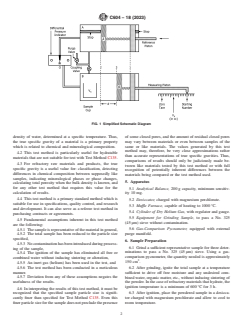
follows: There are two chambers and two pistons as sketched
1.4 This international standard was developed in accor-
in Fig. 1. For purposes of illustration, the chambers are
dance with internationally recognized principles on standard-
assumed to be equal in volume, and there is no sample in either
ization established in the Decision on Principles for the
cylinder. Under these conditions, with the coupling valve
Development of International Standards, Guides and Recom-
closed, any change in the position of one piston must be
mendations issued by the World Trade Organization Technical
duplicated by an identical stroke in the other in order to
Barriers to Trade (TBT) Committee.
maintain the same pressure on each side of the differential
2. Referenced Documents pressure indicator.
3.3 If a sample, V , is inserted into chamber B, the coupling
2.1 ASTM Standards:
x
C128 Test Method for Relative Density (Specific Gravity) valve closed and both pistons advanced the same amount from
position 1 to position 2, the pressures will not remain the same.
and Absorption of Fine Aggregate
C135 Test Method for True Specific Gravity of Refractory However, the pressures can be maintained equal if piston B
instead is moved only to position 3. Then the remaining
Materials by Water Immersion
C188 Test Method for Density of Hydraulic Cement displacement d , from position 3 to position 2, is equal to the
x
volume of the sample, V . If piston A always is advanced
E11 Specification for Woven Wire Test Sieve Cloth and Test
x
exactly the same distance each time a measurement is made,
Sieves
the distance that piston B differs from position 2, when the
pressures in both cylinders are equal, will always be propor-
This test method is under the jurisdiction of ASTM Committee C08 on
Refractories and is the direct responsibility of Subcommittee C08.03 on Physical
tional to the volume, V . The distance (d ) between positions 2
x x
Properties.
and 3 can be calibrated and made to read directly in terms of
Current edition approved Aug. 1, 2023. Published August 2023. Originally
cubic centimetres, employing a digital counter.
approved in 1967. Last previous edition approved in 2018 as C604 – 18. DOI:
10.1520/C0604-18R23.
For referenced ASTM standards, visit the ASTM website, www.astm.org, or 4. Significance and Use
contact ASTM Customer Service at service@astm.org. For Annual Book of ASTM
4.1 The true specific gravity of a material is the ratio of its
Standards volume information, refer to the standard’s Document Summary page on
the ASTM website. true density, determined at a specific temperature, to the true
Copyright © ASTM International, 100 Barr Harbor Drive, PO Box C700, West Conshohocken, PA 19428-2959. United States
C604 − 18 (2023)
FIG. 1 Simplified Schematic Diagram
density of water, determined at a specific temperature. Thus, of some closed pores, and the amount of residual closed pores
the true specific gravity of a material is a primary property may vary between materials or even between samples of the
which is related to chemical and mineralogical composition. same or like materials. The values generated by this test
method may, therefore, be very close approximations rather
4.2 This test method is particularly useful for hydratable
than accurate representations of true specific gravities. Thus,
materials that are not suitable for test with Test Method C135.
comparisons of results should only be judiciously made be-
4.3 For refractory raw materials and products, the true
tween like materials tested by this test method or with full
specific gravity is a useful value for: classification, detecting
recognition of potentially inherent differences between the
differences in chemical composition between supposedly like
materials being compared or the test method used.
samples, indicating mineralogical phases or phase changes,
5. Apparatus
calculating total porosity when the bulk density is known, and
for any other test method that requires this value for the
5.1 Analytical Balance, 200 g capacity, minimum sensitiv-
calculation of results.
ity 10 mg.
4.4 This test method is a primary standard method which is
5.2 Desiccator, charged with magnesium perchlorate.
suitable for use in specifications, quality control, and research
5.3 Muffle Furnace, capable of heating to 1000 °C.
and development. It can also serve as a referee test method in
5.4 Cylinder of Dry Helium Gas, with regulator and gauge.
purchasing contracts or agreements.
5.5 Equipment for Gri
...