

ASTM D1719-11(2019)
(Specification)Standard Specification for Isobutyl Alcohol,
General Information
- Abstract
ABSTRACT
This specification covers isobutyl alcohol for use in paint, varnish, lacquer, and related products. Isobutyl alcohol shall be tested for apparent specific gravity, color, distillation range, nonvolatile matter, water, and acidity, and shall conform to the requirements of the specification. Test methods shall be in accordance with ASTM standard methods.
SCOPE
1.1 This specification covers isobutyl alcohol for use in paint, varnish, lacquer, and related products.
1.2 The values stated in SI units are to be regarded as standard. No other units of measurement are included in this standard.
1.3 The following applies to all specified limits in this standard: for purposes of determining conformance with this standard, an observed value or a calculated value shall be rounded off “to the nearest unit” in the last right-hand digit used in expressing the specification limit, in accordance with the rounding-off method of Practice E29.
1.4 For specific hazard information and guidance, see the supplier's Material Safety Data Sheets for materials listed in this specification.
1.5 This international standard was developed in accordance with internationally recognized principles on standardization established in the Decision on Principles for the Development of International Standards, Guides and Recommendations issued by the World Trade Organization Technical Barriers to Trade (TBT) Committee.
- Status
- Published
- Publication Date
- 31-Mar-2019
- Technical Committee
- D01 - Paint and Related Coatings, Materials, and Applications
- Drafting Committee
- D01.35 - Solvents, Plasticizers, and Chemical Intermediates


Overview
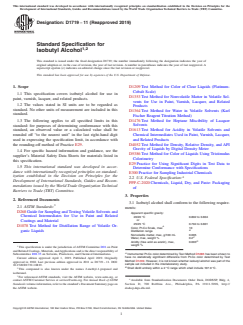
ASTM D1719-11(2019), published by ASTM International, establishes the standard specification for isobutyl alcohol (2-methyl-1-propanol, isobutanol) intended for use in paint, varnish, lacquer, and related products. The standard ensures that isobutyl alcohol used in these applications meets requirements for quality, safety, and consistency. It details strict assessment methods for properties such as apparent specific gravity, color, distillation range, nonvolatile residue, water content, and free acidity. Its adoption is supported by regulatory authorities and aligns with globally recognized principles on standardization.
Key Topics
- Product Scope: Focused on isobutyl alcohol utilized as a solvent or ingredient in paints, coatings, varnishes, and lacquers.
- Quality Criteria: Specifies essential test properties, including:
- Apparent specific gravity at 20/20 °C or 25/25 °C
- Color measurement using Pt-Co scale
- Distillation range for purity assessment
- Limits for nonvolatile matter and water content
- Acidity limits as free acid content
- Testing Methods: References ASTM-approved methods for each property, ensuring repeatability and accuracy.
- Sampling and Packaging: Requires conformance to ASTM and relevant federal specifications for chemical sampling, packaging, and marking.
- Measurement Units: Designates the exclusive use of SI units for all values and limits.
Applications
ASTM D1719-11(2019) is widely used across industries that manufacture or utilize paints, varnishes, lacquers, and specialty coatings. Key practical applications include:
- Formulation of Paints and Coatings: Ensures isobutyl alcohol used as a solvent or diluent meets strict quality requirements, contributing to optimal product performance and durability.
- Quality Control in Production: Enables producers and buyers to verify the composition and purity of purchased isobutyl alcohol, reducing contamination risks and variability in end products.
- Procurement and Supply Chain Assurance: Provides a common specification for purchasers and suppliers, reducing disputes and facilitating compliance with regional and international trade requirements.
- Regulatory Compliance: Supports safety and environmental evaluations by enforcing limits on impurities, residual water, and acidity that might influence user health or product stability.
- Product Performance Enhancement: By maintaining tight control over specified properties, the standard helps manufacturers achieve consistent application properties such as drying time, film formation, and color stability.
Related Standards
ASTM D1719-11(2019) references several complementary standards that support reliable testing, handling, and use of isobutyl alcohol:
- ASTM D1078 - Distillation Range of Volatile Organic Liquids
- ASTM D1209 / D5386 - Color Measurement of Clear Liquids
- ASTM D1353 - Determination of Nonvolatile Matter
- ASTM D1364 - Water Content (Karl Fischer)
- ASTM D1476 - Heptane Miscibility Testing
- ASTM D1613 - Acidity Determination in Volatile Solvents
- ASTM D268 / E300 - Sampling and Testing of Solvents and Industrial Chemicals
- ASTM D4052 - Density Determination via Digital Density Meter
- Federal Specification PPP-C-2020 - Packaging of Chemicals
Conclusion
Adhering to ASTM D1719-11(2019) supports consistent, high-quality use of isobutyl alcohol in the coatings industry, enhancing product performance and facilitating compliance with quality and safety requirements. The standard's focus on rigorous testing, traceable sampling, and international measurement protocols makes it essential for manufacturers, suppliers, and quality assurance professionals in the field of paints, varnishes, and industrial coatings.
Keywords: ASTM D1719, isobutyl alcohol standard, isobutanol specification, paint solvent, lacquer ingredient, coating quality control, industrial chemicals standard, ASTM solvents.
Relations
- Effective Date
- 01-Apr-2019
- Effective Date
- 01-Jun-2012
- Effective Date
- 15-Nov-2011
- Effective Date
- 01-Jan-2010
- Effective Date
- 01-Jun-2009
- Effective Date
- 01-Oct-2008
- Effective Date
- 01-Jun-2007
- Effective Date
- 01-Jun-2007
- Effective Date
- 01-Jun-2007
- Effective Date
- 15-Nov-2006
- Effective Date
- 15-Sep-2006
- Effective Date
- 01-May-2006
- Effective Date
- 01-Apr-2006
- Effective Date
- 15-Oct-2005
- Effective Date
- 15-May-2005
Get Certified
Connect with accredited certification bodies for this standard

ECOCERT
Organic and sustainability certification.

Eurofins Food Testing Global
Global leader in food, environment, and pharmaceutical product testing.

Intertek Bangladesh
Intertek certification and testing services in Bangladesh.
Sponsored listings
Frequently Asked Questions
ASTM D1719-11(2019) is a technical specification published by ASTM International. Its full title is "Standard Specification for Isobutyl Alcohol<sup>,</sup>". This standard covers: ABSTRACT This specification covers isobutyl alcohol for use in paint, varnish, lacquer, and related products. Isobutyl alcohol shall be tested for apparent specific gravity, color, distillation range, nonvolatile matter, water, and acidity, and shall conform to the requirements of the specification. Test methods shall be in accordance with ASTM standard methods. SCOPE 1.1 This specification covers isobutyl alcohol for use in paint, varnish, lacquer, and related products. 1.2 The values stated in SI units are to be regarded as standard. No other units of measurement are included in this standard. 1.3 The following applies to all specified limits in this standard: for purposes of determining conformance with this standard, an observed value or a calculated value shall be rounded off “to the nearest unit” in the last right-hand digit used in expressing the specification limit, in accordance with the rounding-off method of Practice E29. 1.4 For specific hazard information and guidance, see the supplier's Material Safety Data Sheets for materials listed in this specification. 1.5 This international standard was developed in accordance with internationally recognized principles on standardization established in the Decision on Principles for the Development of International Standards, Guides and Recommendations issued by the World Trade Organization Technical Barriers to Trade (TBT) Committee.
ABSTRACT This specification covers isobutyl alcohol for use in paint, varnish, lacquer, and related products. Isobutyl alcohol shall be tested for apparent specific gravity, color, distillation range, nonvolatile matter, water, and acidity, and shall conform to the requirements of the specification. Test methods shall be in accordance with ASTM standard methods. SCOPE 1.1 This specification covers isobutyl alcohol for use in paint, varnish, lacquer, and related products. 1.2 The values stated in SI units are to be regarded as standard. No other units of measurement are included in this standard. 1.3 The following applies to all specified limits in this standard: for purposes of determining conformance with this standard, an observed value or a calculated value shall be rounded off “to the nearest unit” in the last right-hand digit used in expressing the specification limit, in accordance with the rounding-off method of Practice E29. 1.4 For specific hazard information and guidance, see the supplier's Material Safety Data Sheets for materials listed in this specification. 1.5 This international standard was developed in accordance with internationally recognized principles on standardization established in the Decision on Principles for the Development of International Standards, Guides and Recommendations issued by the World Trade Organization Technical Barriers to Trade (TBT) Committee.
ASTM D1719-11(2019) is classified under the following ICS (International Classification for Standards) categories: 71.080.60 - Alcohols. Ethers. The ICS classification helps identify the subject area and facilitates finding related standards.
ASTM D1719-11(2019) has the following relationships with other standards: It is inter standard links to ASTM D1719-11, ASTM D1613-06(2012), ASTM D1078-11, ASTM D5386-10, ASTM D1353-09, ASTM E29-08, ASTM D1476-02(2007), ASTM D1364-02(2007), ASTM D268-01(2007), ASTM E29-06b, ASTM E29-06a, ASTM E29-06, ASTM D1613-06, ASTM D5386-05, ASTM D1209-05. Understanding these relationships helps ensure you are using the most current and applicable version of the standard.
ASTM D1719-11(2019) is available in PDF format for immediate download after purchase. The document can be added to your cart and obtained through the secure checkout process. Digital delivery ensures instant access to the complete standard document.
Standards Content (Sample)
This international standard was developed in accordance with internationally recognized principles on standardization established in the Decision on Principles for the
Development of International Standards, Guides and Recommendations issued by the World Trade Organization Technical Barriers to Trade (TBT) Committee.
Designation: D1719 −11 (Reapproved 2019)
Standard Specification for
1,2
Isobutyl Alcohol
This standard is issued under the fixed designation D1719; the number immediately following the designation indicates the year of
original adoption or, in the case of revision, the year of last revision. A number in parentheses indicates the year of last reapproval. A
superscript epsilon (´) indicates an editorial change since the last revision or reapproval.
This standard has been approved for use by agencies of the U.S. Department of Defense.
1. Scope D1209 Test Method for Color of Clear Liquids (Platinum-
Cobalt Scale)
1.1 This specification covers isobutyl alcohol for use in
D1353 Test Method for Nonvolatile Matter in Volatile Sol-
paint, varnish, lacquer, and related products.
vents for Use in Paint, Varnish, Lacquer, and Related
1.2 The values stated in SI units are to be regarded as
Products
standard. No other units of measurement are included in this
D1364 Test Method for Water in Volatile Solvents (Karl
standard.
Fischer Reagent Titration Method)
D1476 Test Method for Heptane Miscibility of Lacquer
1.3 The following applies to all specified limits in this
standard: for purposes of determining conformance with this Solvents
D1613 Test Method for Acidity in Volatile Solvents and
standard, an observed value or a calculated value shall be
rounded off “to the nearest unit” in the last right-hand digit Chemical Intermediates Used in Paint, Varnish, Lacquer,
and Related Products
used in expressing the specification limit, in accordance with
the rounding-off method of Practice E29. D4052 Test Method for Density, Relative Density, and API
Gravity of Liquids by Digital Density Meter
1.4 For specific hazard information and guidance, see the
D5386 Test Method for Color of Liquids Using Tristimulus
supplier’s Material Safety Data Sheets for materials listed in
Colorimetry
this specification.
E29 Practice for Using Significant Digits in Test Data to
1.5 This international standard was developed in accor-
Determine Conformance with Specifications
dance with internationally recognized principles on standard-
E300 Practice for Sampling Industrial Chemicals
ization established in the Decision on Principles for the
2.2 U.S. Federal Specification:
Development of International Standards, Guides and Recom-
PPP-C-2020 Chemicals, Liquid, Dry, and Paste: Packaging
mendations issued by the World Trade Organization Technical
of
Barriers to Trade (TBT) Committee.
3. Properties
2. Referenced Documents
3.1 Isobutyl alcohol shall conform to the following require-
2.1 ASTM Standards:
ments:
D268 Guide for Sampling and Testing Volatile Solvents and
Apparent specific gravity:
Chemical Intermediates for Use in Paint and Related
20/20 °C 0.802 to 0.804
or
Coatings and Material
25/25 °C 0.794 to 0.801
D1078 Test Method for Distillation Range of Volatile Or-
A
Color, Pt-Co Scale, max 10
B
ganic Liquids
Distillation range
Nonvolatile matter, max, g/100 mL 0.005
C
Water, max, weight % 0.2
D
Acidity (free acid as acetic), max, 0.003
weight %
This specification is under the jurisdiction of ASTM Committee D01 on Paint
and Related Coatings, Materials, andApplications and is the direct responsibility of
A
Instrumental Pt-Co color determined by Test Method D5386 has been shown to
Subcommittee D01.35 on Solvents, Plasticizers, and Chemical Intermediates.
have no statistically significant difference from Pt-Co color determined by Test
Current edition approved April 1, 2019. Published Apri
...