

ASTM D3437-15(2022)
(Practice)Standard Practice for Sampling and Handling Liquid Cyclic Products
General Information
- Abstract
SIGNIFICANCE AND USE
3.1 This practice is issued to provide information useful in establishing sampling and handling procedures. It is expected that this information will only be utilized in conjunction with an existing health and safety program and consultation with the appropriate SDS. The information provided herein cannot be used as a substitute for expert safety and medical advice, but rather as a supplement to such advice.
SCOPE
1.1 This practice covers procedures for sampling and handling several liquid cyclic products. These specifically cover liquids at ambient temperature and include benzene, toluene, xylenes, cyclohexane, styrene, pyridine, ethylbenzene, isopropylbenzene, and alpha-methylstyrene in a manner which represents and preserves product quality.
1.2 Any person sampling or handling these products should consult the applicable Safety Data Sheet (SDS) for specific first aid instructions and information on the proper equipment to have available for use in the event of personal contact or exposure.
1.3 The values stated in SI units are to be regarded as standard. No other units of measurement are included in this standard.
1.4 This standard does not purport to address all of the safety concerns, if any, associated with its use. It is the responsibility of the user of this standard to establish appropriate safety, health, and environmental practices and determine the applicability of regulatory limitations prior to use. For specific hazard statements, see Sections 3, 4, 5, 6 and 7 and an appropriate SDS.
1.5 This international standard was developed in accordance with internationally recognized principles on standardization established in the Decision on Principles for the Development of International Standards, Guides and Recommendations issued by the World Trade Organization Technical Barriers to Trade (TBT) Committee.
- Status
- Published
- Publication Date
- 30-Jun-2022
- Technical Committee
- D16 - Aromatic, Industrial, Specialty and Related Chemicals
- Drafting Committee
- D16.08 - Handling and Sampling Aromatic and Cyclic Hydrocarbons
Overview
ASTM D3437-15(2022) - Standard Practice for Sampling and Handling Liquid Cyclic Products is a key international guidance document developed by ASTM International. This standard establishes recognized methods for the safe, accurate sampling and handling of liquid cyclic chemical products such as benzene, toluene, xylenes, cyclohexane, styrene, pyridine, ethylbenzene, isopropylbenzene, and alpha-methylstyrene at ambient temperature. Its procedures aid in preserving product quality and ensuring representative sampling while emphasizing adherence to health, safety, and regulatory protocols.
This standard should be used in conjunction with an established health and safety program and consultation of relevant Safety Data Sheets (SDS). It does not replace medical or expert safety advice but provides supplemental procedures for those involved in chemical operations.
Key Topics
- Sampling Procedures: Best practices for obtaining representative samples from tanks, drums, trucks, barges, ships, and process streams, with emphasis on cleanliness, proper labeling, and avoidance of contamination.
- Handling Methods: Steps to safely unload and transfer liquid cyclic products, including precautions for venting, bonding for static electricity prevention, and avoidance of open flames or spark sources.
- Safety Precautions: Comprehensive guidance on personal protective equipment, employee training, emergency response, and first aid measures in accordance with OSHA and other regulatory requirements.
- Compliance and Labeling: Directions for proper labeling of samples, use of suitable containers (such as "Boston Round" and amber bottles for photosensitive products), and maintaining sample integrity.
- Regulatory Alignment: Procedures that respect U.S. Department of Transportation (DOT), Occupational Safety and Health Administration (OSHA), Environmental Protection Agency (EPA), and international transportation regulations.
- Sampling for Analysis: Specific methods for collecting samples for laboratory testing and online analyzers, ensuring that physical and chemical properties of samples are preserved until analysis.
Applications
- Chemical Manufacturing and Processing: Ensures that handling and sampling of bulk and specialty chemicals like aromatics are performed safely and efficiently, preserving quality for downstream applications.
- Quality Control Laboratories: Provides reliable sampling methods to obtain representative test samples from production or storage, ensuring compliance with industry standards.
- Logistics and Transportation: Offers protocols vital for companies transporting hazardous liquid cyclic chemicals by road, rail, water, or air, ensuring conformity with regulatory requirements and minimizing risk.
- Health, Safety, and Environment (HSE) Programs: Serves as a procedural reference for training employees, implementing safe work practices, and responding to spills or exposure during loading, unloading, and sample collection.
- On-site and Process Monitoring: Guides installation and use of sample taps and inline analyzers to monitor process streams, aiding in process optimization and regulatory compliance.
Related Standards
- ASTM D56 - Test Method for Flash Point by Tag Closed Cup Tester
- ASTM D850 - Test Method for Distillation of Industrial Aromatic Hydrocarbons and Related Materials
- ASTM D3505 - Test Method for Density or Relative Density of Pure Liquid Chemicals
- ASTM E300 - Practice for Sampling Industrial Chemicals
- ANSI Z 288.1 - Flammable and Combustible Liquids Code
- API RP-500A - Classification of Locations for Electrical Installations in Petroleum Refineries
- OSHA Regulations (29 CFR 1910.1000, 1910.1028, 1910.2000) - Occupational exposure standards including the Benzene Standard
- U.S. DOT and USCG Regulations (49 CFR Parts 171-180 and 46 CFR Subchapter O, Part 151) - Transport and shipping requirements for hazardous materials
Keywords: liquid cyclic products, aromatic sampling, chemical handling, flammable liquids, safety procedures, process stream sampling, ASTM D3437, quality control, benzene handling, regulatory compliance
Relations
- Effective Date
- 01-Jun-2016
- Effective Date
- 01-Jun-2008
- Refers
ASTM D3505-96(2006) - Standard Test Method for Density or Relative Density of Pure Liquid Chemicals - Effective Date
- 01-Jan-2006
- Effective Date
- 01-May-2005
- Effective Date
- 10-Jan-2003
- Effective Date
- 10-Dec-2002
- Effective Date
- 10-Jun-2002
- Effective Date
- 10-Feb-2002
- Effective Date
- 10-Feb-2002
- Effective Date
- 10-Feb-2002
- Effective Date
- 10-Aug-2000
- Effective Date
- 10-Aug-2000
- Refers
ASTM D3505-96(2000) - Standard Test Method for Density or Relative Density of Pure Liquid Chemicals - Effective Date
- 01-Jan-2000
- Effective Date
- 01-Jan-2000
Get Certified
Connect with accredited certification bodies for this standard

ECOCERT
Organic and sustainability certification.

Eurofins Food Testing Global
Global leader in food, environment, and pharmaceutical product testing.

Intertek Bangladesh
Intertek certification and testing services in Bangladesh.
Sponsored listings
Frequently Asked Questions
ASTM D3437-15(2022) is a standard published by ASTM International. Its full title is "Standard Practice for Sampling and Handling Liquid Cyclic Products". This standard covers: SIGNIFICANCE AND USE 3.1 This practice is issued to provide information useful in establishing sampling and handling procedures. It is expected that this information will only be utilized in conjunction with an existing health and safety program and consultation with the appropriate SDS. The information provided herein cannot be used as a substitute for expert safety and medical advice, but rather as a supplement to such advice. SCOPE 1.1 This practice covers procedures for sampling and handling several liquid cyclic products. These specifically cover liquids at ambient temperature and include benzene, toluene, xylenes, cyclohexane, styrene, pyridine, ethylbenzene, isopropylbenzene, and alpha-methylstyrene in a manner which represents and preserves product quality. 1.2 Any person sampling or handling these products should consult the applicable Safety Data Sheet (SDS) for specific first aid instructions and information on the proper equipment to have available for use in the event of personal contact or exposure. 1.3 The values stated in SI units are to be regarded as standard. No other units of measurement are included in this standard. 1.4 This standard does not purport to address all of the safety concerns, if any, associated with its use. It is the responsibility of the user of this standard to establish appropriate safety, health, and environmental practices and determine the applicability of regulatory limitations prior to use. For specific hazard statements, see Sections 3, 4, 5, 6 and 7 and an appropriate SDS. 1.5 This international standard was developed in accordance with internationally recognized principles on standardization established in the Decision on Principles for the Development of International Standards, Guides and Recommendations issued by the World Trade Organization Technical Barriers to Trade (TBT) Committee.
SIGNIFICANCE AND USE 3.1 This practice is issued to provide information useful in establishing sampling and handling procedures. It is expected that this information will only be utilized in conjunction with an existing health and safety program and consultation with the appropriate SDS. The information provided herein cannot be used as a substitute for expert safety and medical advice, but rather as a supplement to such advice. SCOPE 1.1 This practice covers procedures for sampling and handling several liquid cyclic products. These specifically cover liquids at ambient temperature and include benzene, toluene, xylenes, cyclohexane, styrene, pyridine, ethylbenzene, isopropylbenzene, and alpha-methylstyrene in a manner which represents and preserves product quality. 1.2 Any person sampling or handling these products should consult the applicable Safety Data Sheet (SDS) for specific first aid instructions and information on the proper equipment to have available for use in the event of personal contact or exposure. 1.3 The values stated in SI units are to be regarded as standard. No other units of measurement are included in this standard. 1.4 This standard does not purport to address all of the safety concerns, if any, associated with its use. It is the responsibility of the user of this standard to establish appropriate safety, health, and environmental practices and determine the applicability of regulatory limitations prior to use. For specific hazard statements, see Sections 3, 4, 5, 6 and 7 and an appropriate SDS. 1.5 This international standard was developed in accordance with internationally recognized principles on standardization established in the Decision on Principles for the Development of International Standards, Guides and Recommendations issued by the World Trade Organization Technical Barriers to Trade (TBT) Committee.
ASTM D3437-15(2022) is classified under the following ICS (International Classification for Standards) categories: 71.080.15 - Aromatic hydrocarbons. The ICS classification helps identify the subject area and facilitates finding related standards.
ASTM D3437-15(2022) has the following relationships with other standards: It is inter standard links to ASTM D56-16, ASTM D850-03(2008)e1, ASTM D3505-96(2006), ASTM D56-05, ASTM D850-03, ASTM D56-02a, ASTM D56-02, ASTM D850-02e1, ASTM D850-00, ASTM D850-99A, ASTM D56-01, ASTM D56-00, ASTM D3505-96(2000), ASTM D3505-96. Understanding these relationships helps ensure you are using the most current and applicable version of the standard.
ASTM D3437-15(2022) is available in PDF format for immediate download after purchase. The document can be added to your cart and obtained through the secure checkout process. Digital delivery ensures instant access to the complete standard document.
Standards Content (Sample)
This international standard was developed in accordance with internationally recognized principles on standardization established in the Decision on Principles for the
Development of International Standards, Guides and Recommendations issued by the World Trade Organization Technical Barriers to Trade (TBT) Committee.
Designation: D3437 − 15 (Reapproved 2022)
Standard Practice for
Sampling and Handling Liquid Cyclic Products
This standard is issued under the fixed designation D3437; the number immediately following the designation indicates the year of
original adoption or, in the case of revision, the year of last revision. A number in parentheses indicates the year of last reapproval. A
superscript epsilon (´) indicates an editorial change since the last revision or reapproval.
1. Scope D850 Test Method for Distillation of Industrial Aromatic
Hydrocarbons and Related Materials
1.1 This practice covers procedures for sampling and han-
D3505 Test Method for Density or Relative Density of Pure
dling several liquid cyclic products. These specifically cover
Liquid Chemicals
liquids at ambient temperature and include benzene, toluene,
E300 Practice for Sampling Industrial Chemicals
xylenes, cyclohexane, styrene, pyridine, ethylbenzene,
2.2 American National Standards Institute Standard:
isopropylbenzene, and alpha-methylstyrene in a manner which
Z 288.1 Flammable and Combustible Liquids Code
represents and preserves product quality.
2.3 API Document:
1.2 Any person sampling or handling these products should
RP-500A Classification of Locations for Electrical Installa-
consulttheapplicableSafetyDataSheet(SDS)forspecificfirst
tions in Petroleum Refineries
aid instructions and information on the proper equipment to
2.4 Other Documents:
have available for use in the event of personal contact or
OSHA Regulations, 29 CFR paragraphs 1910.1000 and
exposure.
1910.2000
1.3 The values stated in SI units are to be regarded as
OSHA Benzene Standard, 29 CFR 1910.1028
standard. No other units of measurement are included in this
U.S. DOT Regulations, 49 CFR Transportation Subchapter
standard.
C, Parts 171-180
1.4 This standard does not purport to address all of the DOT/USCG 46 CFR Subchapter O, Part 171
safety concerns, if any, associated with its use. It is the
3. Significance and Use
responsibility of the user of this standard to establish appro-
priate safety, health, and environmental practices and deter-
3.1 This practice is issued to provide information useful in
mine the applicability of regulatory limitations prior to use.
establishing sampling and handling procedures. It is expected
Forspecifichazardstatements,seeSections3,4,5,6and7and
that this information will only be utilized in conjunction with
an appropriate SDS.
anexistinghealthandsafetyprogramandconsultationwiththe
1.5 This international standard was developed in accor-
appropriate SDS. The information provided herein cannot be
dance with internationally recognized principles on standard-
used as a substitute for expert safety and medical advice, but
ization established in the Decision on Principles for the
rather as a supplement to such advice.
Development of International Standards, Guides and Recom-
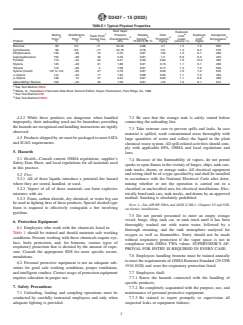
mendations issued by the World Trade Organization Technical 4. Description of Products (See Table 1)
Barriers to Trade (TBT) Committee.
4.1 These liquids are marketed in different grades of purity
so the physical properties may vary slightly.
2. Referenced Documents
4.2 The products listed in Table 1 are classified by the
2.1 ASTM Standards:
Department of Transportation as flammable liquids, and con-
D56 Test Method for Flash Point by Tag Closed Cup Tester
tainers must bear flammable liquid labels.Trucks and tank cars
must have flammable liquid placards.
4.2.1 These products are ordinarily transported in steel
This practice is under the jurisdiction of ASTM Committee D16 on Aromatic,
drums, tank cars, tank trucks, barges and ships.
Industrial, Specialty and Related Chemicals and is the direct responsibility of
Subcommittee D16.08 on Handling and Sampling Aromatic and Cyclic Hydrocar-
bons.
Current edition approved July 1, 2022. Published July 2022. Originally approved Available fromAmerican National Standards Institute (ANSI), 25 W. 43rd St.,
in 1978. Last previous edition approved in 2015 as D3437 – 15. DOI: 10.1520/ 4th Floor, New York, NY 10036, http://www.ansi.org.
D3437-15R22. Available from American Petroleum Institute (API), 1220 L. St., NW,
For referenced ASTM standards, visit the ASTM website, www.astm.org, or Washington, DC 20005-4070, http://www.api.org.
contact ASTM Customer Service at service@astm.org. For Annual Book of ASTM AvailablefromU.S.GovernmentPrintingOfficeSuperintendentofDocuments,
Standards volume information, refer to the standard’s Document Summary page on 732 N. Capitol St., NW, Mail Stop: SDE, Washington, DC 20401, http://
the ASTM website. www.ecfr.gov.
Copyright © ASTM International, 100 Barr Harbor Drive, PO Box C700, West Conshohocken, PA 19428-2959. United States
D3437 − 15 (2022)
TABLE 1 Typical Physical Properties
Reid Vapor
Explosion
C B
Boiling Solidification Pressure Relative Odor Explosion Autoignition
Flash Point Limit
A B B D B B B
Point, Point, Closed Cup, Characteristics, Density, Threshold, Lower Limit Temperature
Product °C °C °C kPa 15.56/15.56 °C mg/kg (volume %) Higher °C
Benzene 80 5.5 −11 22.20 0.88 4.7 1.3 7.9 592
Cyclohexane 80 6.6 −17 22.75 0.78 2.5 1.3 8.4 270
Ethylbenzene 136 −95 15 2.76 0.87 140 1.0 6.7 460
Isopropylbenzene 152 −96 46 3.45 0.87 1.2 0.9 6.5 425
Pyridine 115 −42 20 5.31 0.99 0.02 1.8 12.4 482
Styrene 145 −30 31 1.86 0.91 0.15 1.1 6.1 490
Toluene 110 −95 4 7.58 0.87 0.17 1.3 7.0 536
Xylene (mixed) 137 to 144 −65 27 2.76 0.87 0.05 1.0 7.0 525
o−Xylene 144 −25 17 1.93 0.88 0.05 1.1 7.0 465
p−Xylene 138 13 27 2.34 0.87 0.05 1.1 6.6 466
alpha-Methyl Styrene 165 −23 45 1.59 0.91 <10 1.9 6.1 574
A
See Test Method D850.
B
Weiss, G., Hazardous Chemicals Data Book, Second Edition, Noyes Publications, Park Ridge, NJ, 1986.
C
See Test Method D56.
D
See Test Method D3505.
4.2.2 While these products are dangerous when handled 7.2 Be sure that the storage tank is safely vented before
improperly, their unloading need not be hazardous providing connecting the unloading line.
thehazardsarerecognizedandhandlinginstructionsarerigidly
7.3 Take extreme care to prevent spills and leaks. In case
observed.
material is spilled, wash contaminated areas thoroughly with
4.3 Products shipped by air must be packaged to meet IATA
large quantities of water and collect the liquid in the plant
and ICAO requirements.
chemical waste system.All spill-related activities should com-
ply with applicable EPA, OSHA and local regulations and
5. Hazards
laws.
5.1 Health—Consult current OSHA regulations, supplier’s
7.4 Because of the flammability of vapors, do not permit
Safety Data Sheet, and local regulations for all materials used
sparksoropenflamesinthevicinityofbarges,ships,tankcars,
in this practice.
tank trucks, drums, or storage tanks. All electrical equipment
5.2 Fire: and wiring shall be of a type specified by and shall be installed
in accordance with the National Electrical Code after deter-
5.2.1 All of these liquids introduce a potential fire hazard
mining whether or not the operation is carried out in a
where they are stored, handled, or used.
5.2.2 Vapors of all of these materials can form explosive classified or unclassified area for electrical installations. Elec-
trically bond tank cars, tank trucks, and drums by an approved
mixtures with air.
5.2.3 Foam, carbon dioxide, dry chemical, or water fog can method. Smoking is absolutely prohibited.
be used in fighting fires of these products. Special alcohol-type
NOTE 1—See API RP-500A and ANSI Z 288.1, Chapters VI and VIII,
foam is required to effectively extinguish a fire involving
on electric installations.
pyridine.
7.5 Do not permit personnel to enter an empty storage
vessel, barge, ship, tank car, or tank truck until it has been
6. Protection Equipment
thoroughly washed out with warm water, followed by a
6.1 Employees who work with the chemicals listed in
thorough steaming, and the tank atmosphere analyzed for
Table 1 should be trained and should maintain safe working
oxygen as well as flammables. Entry should not be made
conditions. Persons working with these chemicals require eye,
without respiratory protection if the vapor space is not in
face, body protection, and, for benzene, various types of
compliance with OSHA TWA values. SUPERVISOR’S AP-
respiratory protection that is dictated by the amount of expo-
PROVAL FOR ENTRY IS REQUIRED IN EVERY CASE.
sure. Consult the appropriate SDS for more specific recom-
7.6 Employees handling benzene must be trained annually
mendations.
to meet the requirements of OSHABenzene Standard (29 CFR
6.2 Personal protective equipment is not an adequate sub-
1910.1028) and wear the respiratory protection listed.
stitute for good safe working conditions, proper ventilation,
7.7 Employees shall:
and intelligent conduct. Correct usage of protection equipment
requires education in proper use. 7.7.1 Know the hazards connected with the handling of
specific products;
7. Safety Precautions
7.7.2 Be completely acquainted with the purpose, use, and
maintenance of personal protective equipment;
7.1 Unloading, loading and sampling operations must be
conducted by carefully instructed employees and only when 7.7.3 Be trained to report promptly to supervision all
adequate lighting is provided. suspected leaks or equipment failures;
D3437 − 15 (2022)
7.7.4 Be trained to recognize and report any symptoms of to which is attached a light metal chain. Lower the bottle to
systemicpoisoningorskincontact;bethoroughlytrainedinthe near the bottom of the tank and pull out the stopper with a
proper procedures for administering first aid and for obtaining sharp jerk of the chain. Raise it at such a rate that it is about
professional medical help; three fourths full when it emerges from the liquid. Stopper the
bottle before attempting to rinse the material from the outside.
7.7.5 Know and routinely practice the accepted methods of
samplingandhandlingthesematerialsinordertoavoidspilling Label the sample bottle according to OSHA Regulations.
8.2.2 Label the sample container to indicate, as a minimum,
or splashing, leaks, skin contact, vapor or mist inhalation, or
ingestion; the date and time, source of the sample, type of material,
quantity, hazards, purpose of the sample and the name of the
7.7.6 Becompletelyfamiliarwiththelocationandoperation
of safety showers, eye baths, hose lines, and all other first aid samples.
8.2.3 Emphasis should be placed on cleanliness and dry-
equipment; and
ness. Both the sample bottle and its holder must be CLEAN
7.7.7 Know the importance of personal cleanliness and the
AND DRY.Transfer the sample to another bottle for storage.A
necessityforimmediateremovalofclothingcontaminatedwith
suitablebottleforstoringthesampleisoneknownasa“Boston
these products.
Round.”Theclosureshouldbeascrewcapwithpoly-sealoran
aluminum foil liner.
8. Unloading and Sampling of Tank Cars
8.2.4 If new bottles are used, first rinse them thoroughly
8.1 Unloading:
with acetone or methanol and then dry in an explosive-proof
8.1.1 Because of the flammable properties of these
hot-air oven. Hold in a desiccator while cooling to ambient
materials, the unloading of tank cars containing chemicals is a
temperature.Protectthemfromdirtormoisturebyenclosurein
hazardous operation. Carefully read and follow all shipper’s
a polyethylene bag. Rinse used bottles very thoroughly with
instructions and all caution markings on both sides of the tank
water, detergents, and solvents and then treat as new bottles.
and dome.
NOTE 3—Brown bottles are recommended for sampling and storing
8.1.2 Before removing the manhole cover or outlet valve
photo-sensitive products.
cap, relieve the tank car of all internal pressure by venting the
8.3 Return Precautions:
tank. This can be ac
...