

ASTM C1346-19
(Practice)Standard Practice for Dissolution of UF6 from P-10 Tubes
General Information
- Abstract
SIGNIFICANCE AND USE
5.1 Uranium hexafluoride is a basic material used to prepare nuclear reactor fuel. To be suitable for this purpose the material must meet criteria for uranium content, isotopic composition and metallic impurities in Specification C787 and C996. This practice results in the complete dissolution of the sample for uranium and impurities analysis, and determination of isotopic distribution by mass spectrometry as described in, for example, Test Methods C761.
SCOPE
1.1 This practice covers the dissolution of UF6 from a P-10 tube to provide solutions for analysis.
1.2 The values stated in SI units are to be regarded as standard. No other units of measurement are included in this standard.
1.3 This standard does not purport to address all of the safety concerns, if any, associated with its use. It is the responsibility of the user of this standard to establish appropriate safety, health, and environmental practices and determine the applicability of regulatory limitations prior to use. For specific safeguard and safety precaution statements, see Section 9.
1.4 This international standard was developed in accordance with internationally recognized principles on standardization established in the Decision on Principles for the Development of International Standards, Guides and Recommendations issued by the World Trade Organization Technical Barriers to Trade (TBT) Committee.
- Status
- Published
- Publication Date
- 31-Jan-2019
- Technical Committee
- C26 - Nuclear Fuel Cycle
- Drafting Committee
- C26.05 - Methods of Test


Overview
ASTM C1346-19: Standard Practice for Dissolution of UF6 from P-10 Tubes establishes standardized procedures for dissolving uranium hexafluoride (UF6) samples contained in P-10 tubes. This essential practice supports accurate analysis of uranium content, impurities, and isotopic distribution necessary for nuclear fuel production and compliance with specifications such as ASTM C787 and C996. Laboratories and nuclear facility operators rely on this method to ensure that uranium hexafluoride samples are appropriately prepared for subsequent chemical, spectrometric, and radiochemical analysis.
Key Topics
- UF6 Dissolution Methodology: Guidance on completely dissolving UF6 from P-10 (polychlorotrifluoroethylene) tubes to prepare the sample for further analysis.
- Sample Handling and Safety: Emphasis on the chemical hazards associated with UF6, including reactivity, toxicity, radioactivity, and the dangers presented by hydrofluoric acid.
- Equipment and Reagents: Specifies necessary apparatus (such as Dewar flasks, balances, vacuum ovens, and forceps), and reagents (e.g., reagent grade water, ethanol, liquid nitrogen).
- Measurement and Calculation: Procedure for weighing, accounting for buoyancy corrections, and preparing the analytical solution.
- Analytical Quality: Supports accurate determination of uranium and trace impurities, critical for compliance and nuclear material accountability.
Applications
ASTM C1346-19 is applied across various stages in the nuclear fuel cycle, particularly in:
- Nuclear Fuel Preparation: Ensuring uranium hexafluoride meets chemical and isotopic specifications before enrichment or reactor fuel fabrication.
- Quality Control Laboratories: Preparing analytical solutions from UF6 samples for chemical assay, impurity determination, and isotopic analysis via methods such as mass spectrometry.
- Regulatory Compliance: Supporting adherence to ASTM criteria for uranium content, isotopic composition, and impurity limits, as set out in ASTM C787 and C996.
- Nuclear Material Accountability: Accurate dissolution of UF6 is crucial for international safeguards, inventory verification, and reporting.
- Safe Sample Handling: Specifies protocols that minimize risks from radioactive, toxic, and corrosive nature of UF6 and associated reagents, protecting laboratory personnel and the environment.
Related Standards
Users of ASTM C1346-19 often reference these related standards:
- ASTM C761 - Test Methods for Chemical, Mass Spectrometric, Spectrochemical, Nuclear, and Radiochemical Analysis of Uranium Hexafluoride.
- ASTM C787 - Specification for Uranium Hexafluoride for Enrichment.
- ASTM C996 - Specification for Uranium Hexafluoride Enriched to Less Than 5% U-235.
- ASTM C859 - Terminology Relating to Nuclear Materials.
- ASTM D1193 - Specification for Reagent Water.
These references ensure compatibility and consistency throughout all stages of testing, analysis, and reporting within the nuclear industry.
Keywords: ASTM C1346-19, UF6 dissolution, P-10 tubes, uranium hexafluoride, nuclear fuel analysis, uranium assay, isotopic analysis, nuclear quality control, laboratory safety, uranium impurities, ASTM standards
Relations
- Effective Date
- 01-Feb-2019
- Effective Date
- 01-Jan-2024
- Effective Date
- 01-Mar-2020
- Effective Date
- 01-Mar-2020
- Effective Date
- 01-Feb-2018
- Effective Date
- 01-Jul-2015
- Effective Date
- 01-Jul-2015
- Effective Date
- 15-Jun-2014
- Effective Date
- 15-Jan-2014
- Effective Date
- 01-Jun-2013
- Effective Date
- 01-May-2013
- Effective Date
- 01-Jun-2011
- Effective Date
- 15-May-2011
- Effective Date
- 01-Nov-2010
- Effective Date
- 01-Oct-2010
Get Certified
Connect with accredited certification bodies for this standard

DNV
DNV is an independent assurance and risk management provider.

Lloyd's Register
Lloyd's Register is a global professional services organisation specialising in engineering and technology.
DNV Energy Systems
Energy and renewable energy certification.
Sponsored listings
Frequently Asked Questions
ASTM C1346-19 is a standard published by ASTM International. Its full title is "Standard Practice for Dissolution of UF<inf>6</inf> from P-10 Tubes". This standard covers: SIGNIFICANCE AND USE 5.1 Uranium hexafluoride is a basic material used to prepare nuclear reactor fuel. To be suitable for this purpose the material must meet criteria for uranium content, isotopic composition and metallic impurities in Specification C787 and C996. This practice results in the complete dissolution of the sample for uranium and impurities analysis, and determination of isotopic distribution by mass spectrometry as described in, for example, Test Methods C761. SCOPE 1.1 This practice covers the dissolution of UF6 from a P-10 tube to provide solutions for analysis. 1.2 The values stated in SI units are to be regarded as standard. No other units of measurement are included in this standard. 1.3 This standard does not purport to address all of the safety concerns, if any, associated with its use. It is the responsibility of the user of this standard to establish appropriate safety, health, and environmental practices and determine the applicability of regulatory limitations prior to use. For specific safeguard and safety precaution statements, see Section 9. 1.4 This international standard was developed in accordance with internationally recognized principles on standardization established in the Decision on Principles for the Development of International Standards, Guides and Recommendations issued by the World Trade Organization Technical Barriers to Trade (TBT) Committee.
SIGNIFICANCE AND USE 5.1 Uranium hexafluoride is a basic material used to prepare nuclear reactor fuel. To be suitable for this purpose the material must meet criteria for uranium content, isotopic composition and metallic impurities in Specification C787 and C996. This practice results in the complete dissolution of the sample for uranium and impurities analysis, and determination of isotopic distribution by mass spectrometry as described in, for example, Test Methods C761. SCOPE 1.1 This practice covers the dissolution of UF6 from a P-10 tube to provide solutions for analysis. 1.2 The values stated in SI units are to be regarded as standard. No other units of measurement are included in this standard. 1.3 This standard does not purport to address all of the safety concerns, if any, associated with its use. It is the responsibility of the user of this standard to establish appropriate safety, health, and environmental practices and determine the applicability of regulatory limitations prior to use. For specific safeguard and safety precaution statements, see Section 9. 1.4 This international standard was developed in accordance with internationally recognized principles on standardization established in the Decision on Principles for the Development of International Standards, Guides and Recommendations issued by the World Trade Organization Technical Barriers to Trade (TBT) Committee.
ASTM C1346-19 is classified under the following ICS (International Classification for Standards) categories: 27.120.30 - Fissile materials and nuclear fuel technology. The ICS classification helps identify the subject area and facilitates finding related standards.
ASTM C1346-19 has the following relationships with other standards: It is inter standard links to ASTM C1346-08(2014), ASTM C859-24, ASTM C787-20, ASTM C996-20, ASTM C761-18, ASTM C996-15, ASTM C787-15, ASTM C859-14a, ASTM C859-14, ASTM C859-13a, ASTM C859-13, ASTM C787-11, ASTM C761-11, ASTM C859-10b, ASTM C996-10. Understanding these relationships helps ensure you are using the most current and applicable version of the standard.
ASTM C1346-19 is available in PDF format for immediate download after purchase. The document can be added to your cart and obtained through the secure checkout process. Digital delivery ensures instant access to the complete standard document.
Standards Content (Sample)
This international standard was developed in accordance with internationally recognized principles on standardization established in the Decision on Principles for the
Development of International Standards, Guides and Recommendations issued by the World Trade Organization Technical Barriers to Trade (TBT) Committee.
Designation: C1346 − 19
Standard Practice for
1,2
Dissolution of UF from P-10 Tubes
This standard is issued under the fixed designation C1346; the number immediately following the designation indicates the year of
original adoption or, in the case of revision, the year of last revision.Anumber in parentheses indicates the year of last reapproval.A
superscript epsilon (´) indicates an editorial change since the last revision or reapproval.
1. Scope C996Specification for Uranium Hexafluoride Enriched to
Less Than 5% U
1.1 This practice covers the dissolution of UF from a P-10
D1193Specification for Reagent Water
tube to provide solutions for analysis.
1.2 The values stated in SI units are to be regarded as
3. Terminology
standard. No other units of measurement are included in this
3.1 Definitions:
standard.
3.1.1 For definitions of terms relating to the nuclear fuel
1.3 This standard does not purport to address all of the
cycle, refer to Terminology C859.
safety concerns, if any, associated with its use. It is the
responsibility of the user of this standard to establish appro- 4. Summary of Practice
priate safety, health, and environmental practices and deter-
4.1 UF samples intended for analysis are packaged in P-10
mine the applicability of regulatory limitations prior to use.
tubes to prevent sublimation and reaction with moisture in the
For specific safeguard and safety precaution statements, see
air. The P-10 tube assembly (Fig. 1) consists of a Polychloro-
Section 9.
trifluoroethylene (PCTFE) tube containing the UF , a PCTFE
1.4 This international standard was developed in accor-
gasket to cover the tube’s opening, and a nut and plug (Monel
dance with internationally recognized principles on standard-
or SS) to seal the gasket to the tube.
ization established in the Decision on Principles for the
4.2 The UF tube is weighed, cooled in liquid nitrogen, and
Development of International Standards, Guides and Recom-
quickly opened and immersed in water for dissolution. The
mendations issued by the World Trade Organization Technical
pieces of the tube’s assembly are removed from the resulting
Barriers to Trade (TBT) Committee.
solution,rinsed,dried,reassembled,andweighed.Thesolution
is dried for gravimetric conversion to U O , or diluted to an
3 8
2. Referenced Documents
appropriate concentration for dispensing into aliquots for
2.1 ASTM Standards:
subsequent analysis.
C761Test Methods for Chemical, Mass Spectrometric,
Spectrochemical,Nuclear,andRadiochemicalAnalysisof
5. Significance and Use
Uranium Hexafluoride
5.1 Uraniumhexafluorideisabasicmaterialusedtoprepare
C787Specification for Uranium Hexafluoride for Enrich-
nuclearreactorfuel.Tobesuitableforthispurposethematerial
ment
must meet criteria for uranium content, isotopic composition
C859Terminology Relating to Nuclear Materials
and metallic impurities in Specification C787 and C996. This
practice results in the complete dissolution of the sample for
uranium and impurities analysis, and determination of isotopic
This practice is under the jurisdiction of ASTM Committee C26 on Nuclear
distributionbymassspectrometryasdescribedin,forexample,
Fuel Cycle and is the direct responsibility of Subcommittee C26.05 on Methods of
Test Methods C761.
Test.
Current edition approved Feb. 1, 2019. Published February 2019. Originally
6. Apparatus
approved in 1996. Last previous edition approved in 2014 as C1346–08 (2014).
DOI: 10.1520/C1346-19.
6.1 Steam bath, in a hood, if optional step 10.2.13 is used.
Polychlorotrifluoroethylene P-10 tubes are widely accepted by the industry for
subsample collection and subsequent UF quality analyses or dispatch to the
6.2 Vacuum oven, if option 2 of 10.2.14 is used. The oven
customer. The procedure for subsample collection and dissolution can also be used
should be adjustable to 80°C at an absolute pressure of 3 ×10
for other types of subsample tubes, for example, P-20, P-80 or P-100, in that case
Pa.
the amount of water has to be adjusted to ensure complete hydrolisation of UF and
avoid excessive heat evolution.
6.3 Dewar flask, wide-mouth.
For referenced ASTM standards, visit the ASTM website, www.astm.org, or
contact ASTM Customer Service at service@astm.org. For Annual Book of ASTM
6.4 Vise, small lab-bench model or similar type of holder.
Standards volume information, refer to the standard’s Document Summary page on
the ASTM website. 6.5 Wrench, ⁄16 in.
Copyright © ASTM International, 100 Barr Harbor Drive, PO Box C700, West Conshohocken, PA 19428-2959. United States
C1346 − 19
such specifications are available. Other grades of reagents
may be used, provided it is first ascertained that the reagent is
of sufficiently high purity to permit its use without lessening
the accuracy of the determination.
8.2 Liquid nitrogen.
8.3 Deionized distilled water in accordance with Specifica-
tion D1193, approximately 50 to 100 cm per sample.
8.4 Ethanol or other suitable, volatile organic solvent.
9. Hazards
9.1 Uranium hexafluoride (UF ) is radioactive, toxic, and
highly reactive especially with reducing substances and mois-
ture. Appropriate laboratory facilities, materials of
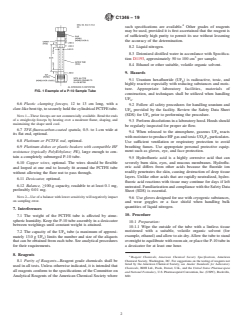
FIG. 1 Example of a P-10 Sample Tube
construction, and techniques shall be utilized when handling
UF .
6.6 Plastic clamping forceps, 12 to 13 cm long, with a
9.2 Follow all safety procedures for handling uranium and
claw-likebenttip,tosecurelyholdthecylindricalPCTFEtube.
UF provided by the facility. Review the Safety Data Sheet
(SDS) for UF prior to performing the procedure.
NOTE 1—These forceps are not commercially available. Bend the ends 6
of a straight-tip forceps by heating over a moderate flame, shaping, and
9.3 Performdissolutionsinalaboratoryhood.Hoodsshould
maintaining the shape until cool.
be regularly inspected for proper air flow.
6.7 TFE-fluorocarbon-coated spatula, 0.5- to 1-cm wide at
9.4 When released to the atmosphere, gaseous UF reacts
its flat end, optional.
withmoisturetoproduceHFgasandtoxicUO F particulates.
2 2
6.8 Platinum or PCTFE rod, optional.
Use sufficient ventilation or respiratory protection to avoid
breathing fumes. Use appropriate personal protective equip-
6.9 Platinum dishes or plastic beakers with compatible HF
ment such as gloves, eye, and face protection.
resistance (typically PolyEthylene; PE), large enough to con-
tain a completely submerged P-10 tube.
9.5 Hydrofluoric acid is a highly corrosive acid that can
severely burn skin, eyes, and mucous membranes. Hydroflu-
6.10 Copper wires, optional. The wires should be flexible
oric acid differs from other acids because the fluoride ion
and looped at one end to loosely fit around the PCTFE tube
readily penetrates the skin, causing destruction of deep tissue
without allowing the flare nut to pass through.
layers. Unlike other acids that are rapidly neutralized, hydro-
6.11 Desiccator, optional.
fluoric acid reactions with tissue may continue for days if left
6.12 Balance, ≥100-g capacity, readable to at least 0.1 mg,
untreated.FamiliarizationandcompliancewiththeSafetyData
preferably 0.01 mg.
Sheet (SDS) is essential.
NOTE2—Useofabalancewithlowersensitivitywillnegativelyimpact 9.6 Use gloves designed for use with cryogenic substances,
on sampling error.
and wear goggles or a face shield when handling bulk
quantities of liquid nitrogen.
7. Interferences
10. Procedure
7.1 The weight of the PCTFE tube is affected by atmo-
spheric humidity. Keep the P-10 tube assembly in a desiccator
10.1 Preparation:
between weighings until constant weight is attained.
10.1.1 Wipe the outside of the tube with a lintless tissue
moistened with a suitable, volatile organic solvent (for
7.2 The capacity of the UF tube (a maximum of approxi-
example, ethanol) and allow to air-dry.Allow the tube to stand
mately 13.0 g UF ) limits the number and size of the aliquots
overnighttoequilibratewithroomair,orplacetheP-10tubein
that can be obtained fr
...
This document is not an ASTM standard and is intended only to provide the user of an ASTM standard an indication of what changes have been made to the previous version. Because
it may not be technically possible to adequately depict all changes accurately, ASTM recommends that users consult prior editions as appropriate. In all cases only the current version
of the standard as published by ASTM is to be considered the official document.
Designation: C1346 − 08 (Reapproved 2014) C1346 − 19
Standard Practice for
1,2
Dissolution of UF from P-10 Tubes
This standard is issued under the fixed designation C1346; the number immediately following the designation indicates the year of
original adoption or, in the case of revision, the year of last revision. A number in parentheses indicates the year of last reapproval. A
superscript epsilon (´) indicates an editorial change since the last revision or reapproval.
1. Scope
1.1 This practice covers the dissolution of UF from a P-10 tube to provide solutions for analysis.
1.2 The values stated in SI units are to be regarded as standard. No other units of measurement are included in this standard.
1.3 This standard does not purport to address all of the safety concerns, if any, associated with its use. It is the responsibility
of the user of this standard to establish appropriate safety safety, health, and healthenvironmental practices and determine the
applicability of regulatory limitations prior to use. For specific safeguard and safety precaution statements, see Section 89.
1.4 This international standard was developed in accordance with internationally recognized principles on standardization
established in the Decision on Principles for the Development of International Standards, Guides and Recommendations issued
by the World Trade Organization Technical Barriers to Trade (TBT) Committee.
2. Referenced Documents
2.1 ASTM Standards:
C761 Test Methods for Chemical, Mass Spectrometric, Spectrochemical, Nuclear, and Radiochemical Analysis of Uranium
Hexafluoride
C787 Specification for Uranium Hexafluoride for Enrichment
C859 Terminology Relating to Nuclear Materials
C996 Specification for Uranium Hexafluoride Enriched to Less Than 5 % U
D1193 Specification for Reagent Water
3. Terminology
3.1 Definitions:
3.1.1 For definitions of terms relating to the nuclear fuel cycle, refer to Terminology C859.
4. Summary of Practice
4.1 UF samples intended for analysis are packaged in P-10 tubes to prevent sublimation and reaction with moisture in the air.
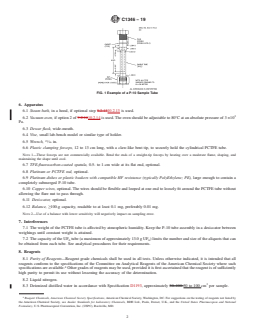
The P-10 tube assembly (Fig. 1) consists of a Polychlorotrifluoroethylene (PCTFE) tube containing the UF , a PCTFE gasket to
cover the tube’s opening, and a nut and plug (Monel or SS) to seal the gasket to the tube.
4.2 The UF tube is weighed, cooled in liquid nitrogen, and quickly opened and immersed in water for dissolution. The pieces
of the tube’s assembly are removed from the resulting solution, rinsed, dried, reassembled, and weighed. The solution is dried for
gravimetric conversion to U O , or diluted to an appropriate concentration for dispensing into aliquots for subsequent analysis.
3 8
5. Significance and Use
5.1 Uranium hexafluoride is a basic material used to prepare nuclear reactor fuel. To be suitable for this purpose the material
must meet criteria for uranium content, isotopic composition and metallic impurities in Specification C787 and C996. This practice
results in the complete dissolution of the sample for uranium and impurities analysis, and determination of isotopic distribution
by mass spectrometry as described in, for example, Test Methods C761.
This practice is under the jurisdiction of ASTM Committee C26 on Nuclear Fuel Cycle and is the direct responsibility of Subcommittee C26.05 on Methods of Test.
Current edition approved Jan. 1, 2014Feb. 1, 2019. Published February 2014February 2019. Originally approved in 1996. Last previous edition approved in 20082014
as C1346 – 08.C1346 – 08 (2014). DOI: 10.1520/C1346-08R14.10.1520/C1346-19.
Polychlorotrifluoroethylene P-10 tubes are widely accepted by the industry for subsample collection and subsequent UF quality analyses or dispatch to the customer.
The procedure for subsample collection and dissolution can also be used for other types of subsample tubes, for example, P-20, P-80 or P-100 , P-100, in that case the amount
of water has to be adjusted to ensure complete hydrolisation of UF and avoid excessive heat evolution.
For referenced ASTM standards, visit the ASTM website, www.astm.org, or contact ASTM Customer Service at service@astm.org. For Annual Book of ASTM Standards
volume information, refer to the standard’s Document Summary page on the ASTM website.
Copyright © ASTM International, 100 Barr Harbor Drive, PO Box C700, West Conshohocken, PA 19428-2959. United States
C1346 − 19
FIG. 1 Example of a P-10 Sample Tube
6. Apparatus
6.1 Steam bath, in a hood, if optional step 9.2.1310.2.13 is used.
6.2 Vacuum oven, if option 2 of 9.2.1410.2.14 is used. The oven should be adjustable to 80°C at an absolute pressure of 3 ×10
Pa.
6.3 Dewar flask, wide-mouth.
6.4 Vise, small lab-bench model or similar type of holder.
6.5 Wrench, ⁄16 in.
6.6 Plastic clamping forceps, 12 to 13 cm long, with a claw-like bent tip, to securely hold the cylindrical PCTFE tube.
NOTE 1—These forceps are not commercially available. Bend the ends of a straight-tip forceps by heating over a moderate flame, shaping, and
maintaining the shape until cool.
6.7 TFE-fluorocarbon-coated spatula, 0.5- to 1-cm wide at its flat end, optional.
6.8 Platinum or PCTFE rod, optional.
6.9 Platinum dishes or plastic beakers with compatible HF resistance (typically PolyEthylene; PE), large enough to contain a
completely submerged P-10 tube.
6.10 Copper wires, optional. The wires should be flexible and looped at one end to loosely fit around the PCTFE tube without
allowing the flare nut to pass through.
6.11 Desiccator, optional.
6.12 Balance, ≥100-g capacity, readable to at least 0.1 mg, preferably 0.01 mg.
NOTE 2—Use of a balance with lower sensitivity will negatively impact on sampling error.
7. Interferences
7.1 The weight of the PCTFE tube is affected by atmospheric humidity. Keep the P-10 tube assembly in a desiccator between
weighings until constant weight is attained.
7.2 The capacity of the UF tube (a maximum of approximately 13.0 g UF ) limits the number and size of the aliquots that can
6 6
be obtained from each tube. See analytical procedures for their requirements.
8. Reagents
8.1 Purity of Reagents—Reagent grade chemicals shall be used in all tests. Unless otherwise indicated, it is intended that all
reagents conform to the specifications of the Committee on Analytical Reagents of the American Chemical Society where such
specifications are available. Other grades of reagents may be used, provided it is first ascertained that the reagent is of sufficiently
high purity to permit its use without lessening the accuracy of the determination.
8.2 Liquid nitrogen.
8.3 Deionized distilled water in accordance with Specification D1193, approximately 50–100 50 to 100 cm per sample.
Reagent Chemicals, American Chemical Society Specifications, American Chemical Society, Washington, DC. For suggestions on the testing of reagents not listed by
the American Chemical Society, see Analar Standards for Laboratory Chemicals, BDH Ltd., Poole, Dorset, U.K., and the United States Pharmacopeia and National
Formulary, U.S. Pharmacopeial Convention, Inc. (USPC), Rockville, MD.
C1346 − 19
8.4 Ethanol or other suitable, volatile organic solvent.
9. Hazards
9.1 Since UFUranium hexafluoride materials(UF are) is radioactive, toxic, and highly reactive,reactive especially with
6 6
reducing substances and moisture, adequate laboratory facilities and fume hoods along with safe techniques must be used in
handling samples containing these materials. A detailed discussion of all necessary precautions is beyond the scope of this practice.
However, personnel who handle radioactive materials should be familiar with the safe handling practices moisture. Appropriate
laboratory facilities, materials of construction, and techniques shall be utilized when handling UF of the facility.
9.2 Follow all safety procedures for handling uranium and UF provided by the facility. Review the Material Safety Data Sheet
(MSDS)(SDS) for UF prior to performing the procedure.
9.3 Perform dissolutions in a laboratory hood. Hoods should be regularly inspected for proper air flow.
9.4 Gaseous UFWhen released , when released to the atmosphere, to the atmosphere, gaseous UF reacts with moisture to
6 6
formproduce HF gas and toxic UO F particulate (a white amorphous solid that settles on all surfaces). Release of UFparticulates.
2 2
Use sufficient ventilation to the atmosphere is readily visible as a white cloud
...