

ASTM F1116-21
(Test Method)Standard Test Method for Determining Dielectric Strength of Dielectric Footwear
General Information
- Abstract
SIGNIFICANCE AND USE
4.1 Electrical contact injuries to workers may involve a current path through the feet of the worker. The footwear covered by this specification is dielectrically rated to provide additional insulation and isolation to the wearer. This test method will determine that dielectric footwear has dielectric integrity at the time of the test.
SCOPE
1.1 This test method covers testing to determine the “Dielectric Strength” of dielectric overfoot and overshoe footwear. Testing is done over the maximum possible area of the dielectric footwear without permitting flashover between electrodes.
1.2 The use and maintenance of dielectric footwear is beyond the scope of this test method.
1.3 This standard does not purport to address all of the safety concerns, if any, associated with its use. It is the responsibility of the user of this standard to establish appropriate safety, health, and environmental practices and determine the applicability of regulatory limitations prior to use. Specific hazard statements appear in 5.2.
1.4 This international standard was developed in accordance with internationally recognized principles on standardization established in the Decision on Principles for the Development of International Standards, Guides and Recommendations issued by the World Trade Organization Technical Barriers to Trade (TBT) Committee.
- Status
- Published
- Publication Date
- 30-Apr-2021
- Technical Committee
- F18 - Electrical Protective Equipment for Workers
- Drafting Committee
- F18.15 - Worker Personal Equipment
Buy Documents


ASTM F1116-21 - Standard Test Method for Determining Dielectric Strength of Dielectric Footwear
REDLINE ASTM F1116-21 - Standard Test Method for Determining Dielectric Strength of Dielectric Footwear
Overview
ASTM F1116-21 is an internationally recognized standard developed by ASTM International for testing the dielectric strength of dielectric footwear. This test method is crucial for ensuring worker safety in environments where exposure to electrical hazards is a concern. Dielectric footwear, including both overfoot and overshoe designs, provides essential insulation and isolation to prevent electrical current from passing through a worker's feet. The ASTM F1116-21 standard evaluates the dielectric integrity of this footwear at the time of testing, using methods that ensure maximum surface coverage without allowing electrical flashover.
Key Topics
- Dielectric Strength Testing: The standard outlines procedures for assessing the dielectric-or electrical insulating-capabilities of footwear designed for use in electrically hazardous environments. Both AC and DC test methods are included.
- Test Apparatus and Procedures:
- Footwear is tested by immersing it in a conductive medium, typically water, to simulate real-world exposure.
- Specific guidelines ensure no flashover occurs between the electrodes during testing.
- Detailed criteria are provided for electrical test equipment, voltage application, and proper measurement techniques.
- Safety and Precautions:
- Operators are urged to use test apparatus that offer extensive protection and reliable de-energization and grounding capabilities.
- The accuracy and maintenance of test equipment are emphasized, with annual inspection recommendations to ensure test reliability.
- Product Marking and Record-Keeping:
- Each piece of dielectric footwear must be clearly marked with manufacturer information, ASTM F1117, size, and AC voltage rating.
- Facilities must keep records of test voltages and test or retest dates, with any rejected footwear clearly identified to prohibit use in electrical service.
Applications
ASTM F1116-21 is widely applied in industries and sectors where electrical hazards are prevalent, including:
- Utility and Power Generation: Ensures that workers who may be exposed to live equipment have reliable protective footwear.
- Construction and Maintenance: Mitigates the risk of electrical injuries on jobsites with active electrical systems.
- Manufacturing: Used in environments where high-voltage machinery or equipment could pose a hazard.
- Safety Compliance and Quality Assurance: Manufacturers of dielectric footwear use this standard to verify the safety and effectiveness of their products before market release.
By adhering to ASTM F1116-21, employers, safety officers, and footwear manufacturers support compliance with occupational safety regulations and enhance worker protection against electrical hazards.
Related Standards
For comprehensive evaluation and performance, ASTM F1116-21 references other essential standards:
- ASTM D149: Test Method for Dielectric Breakdown Voltage and Dielectric Strength of Solid Electrical Insulating Materials at Commercial Power Frequencies.
- ASTM F1117: Specification for Dielectric Footwear, addressing criteria for labeling, classification, and performance requirements.
These related ASTM standards work in conjunction to offer a robust framework for electrical protective equipment, supporting best practices in industrial safety and product integrity.
Keywords: ASTM F1116-21, dielectric footwear, dielectric strength, electrical safety, electrical hazard protection, overfoot footwear, overshoe footwear, dielectric strength testing, worker safety standards, ASTM International.
Relations
- Effective Date
- 01-Jan-2020
- Effective Date
- 01-Sep-2019
- Effective Date
- 01-Sep-2013
- Effective Date
- 01-Apr-2008
- Effective Date
- 01-Mar-2004
- Effective Date
- 01-Nov-2003
- Effective Date
- 10-Jan-1998
- Effective Date
- 01-Jan-1997
Buy Documents
ASTM F1116-21 - Standard Test Method for Determining Dielectric Strength of Dielectric Footwear
REDLINE ASTM F1116-21 - Standard Test Method for Determining Dielectric Strength of Dielectric Footwear
Get Certified
Connect with accredited certification bodies for this standard

CIS Institut d.o.o.
Personal Protective Equipment (PPE) certification body. Notified Body NB-2890 for EU Regulation 2016/425 PPE.

Kiwa BDA Testing
Building and construction product certification.
Kmetijski inštitut Slovenije
Agricultural Institute of Slovenia. Soil testing, plant health, agricultural product analysis.
Sponsored listings
Frequently Asked Questions
ASTM F1116-21 is a standard published by ASTM International. Its full title is "Standard Test Method for Determining Dielectric Strength of Dielectric Footwear". This standard covers: SIGNIFICANCE AND USE 4.1 Electrical contact injuries to workers may involve a current path through the feet of the worker. The footwear covered by this specification is dielectrically rated to provide additional insulation and isolation to the wearer. This test method will determine that dielectric footwear has dielectric integrity at the time of the test. SCOPE 1.1 This test method covers testing to determine the “Dielectric Strength” of dielectric overfoot and overshoe footwear. Testing is done over the maximum possible area of the dielectric footwear without permitting flashover between electrodes. 1.2 The use and maintenance of dielectric footwear is beyond the scope of this test method. 1.3 This standard does not purport to address all of the safety concerns, if any, associated with its use. It is the responsibility of the user of this standard to establish appropriate safety, health, and environmental practices and determine the applicability of regulatory limitations prior to use. Specific hazard statements appear in 5.2. 1.4 This international standard was developed in accordance with internationally recognized principles on standardization established in the Decision on Principles for the Development of International Standards, Guides and Recommendations issued by the World Trade Organization Technical Barriers to Trade (TBT) Committee.
SIGNIFICANCE AND USE 4.1 Electrical contact injuries to workers may involve a current path through the feet of the worker. The footwear covered by this specification is dielectrically rated to provide additional insulation and isolation to the wearer. This test method will determine that dielectric footwear has dielectric integrity at the time of the test. SCOPE 1.1 This test method covers testing to determine the “Dielectric Strength” of dielectric overfoot and overshoe footwear. Testing is done over the maximum possible area of the dielectric footwear without permitting flashover between electrodes. 1.2 The use and maintenance of dielectric footwear is beyond the scope of this test method. 1.3 This standard does not purport to address all of the safety concerns, if any, associated with its use. It is the responsibility of the user of this standard to establish appropriate safety, health, and environmental practices and determine the applicability of regulatory limitations prior to use. Specific hazard statements appear in 5.2. 1.4 This international standard was developed in accordance with internationally recognized principles on standardization established in the Decision on Principles for the Development of International Standards, Guides and Recommendations issued by the World Trade Organization Technical Barriers to Trade (TBT) Committee.
ASTM F1116-21 is classified under the following ICS (International Classification for Standards) categories: 13.260 - Protection against electric shock. Live working. The ICS classification helps identify the subject area and facilitates finding related standards.
ASTM F1116-21 has the following relationships with other standards: It is inter standard links to ASTM D149-20, ASTM F1117-03(2019), ASTM F1117-03(2013), ASTM F1117-03(2008), ASTM D149-97a(2004), ASTM F1117-03, ASTM F1117-93(1998), ASTM D149-97a. Understanding these relationships helps ensure you are using the most current and applicable version of the standard.
ASTM F1116-21 is available in PDF format for immediate download after purchase. The document can be added to your cart and obtained through the secure checkout process. Digital delivery ensures instant access to the complete standard document.
Standards Content (Sample)
This international standard was developed in accordance with internationally recognized principles on standardization established in the Decision on Principles for the
Development of International Standards, Guides and Recommendations issued by the World Trade Organization Technical Barriers to Trade (TBT) Committee.
Designation: F1116 − 21
Standard Test Method for
Determining Dielectric Strength of Dielectric Footwear
This standard is issued under the fixed designation F1116; the number immediately following the designation indicates the year of
original adoption or, in the case of revision, the year of last revision. A number in parentheses indicates the year of last reapproval. A
superscript epsilon (´) indicates an editorial change since the last revision or reapproval.
1. Scope 3.1.2 overfoot footwear—footwear designed to be worn
directly over the feet as the only source of foot covering.
1.1 This test method covers testing to determine the “Di-
3.1.3 overshoe footwear—footwear designed to be worn
electric Strength” of dielectric overfoot and overshoe footwear.
over existing footwear.
Testing is done over the maximum possible area of the
dielectric footwear without permitting flashover between elec-
4. Significance and Use
trodes.
4.1 Electrical contact injuries to workers may involve a
1.2 The use and maintenance of dielectric footwear is
current path through the feet of the worker. The footwear
beyond the scope of this test method.
covered by this specification is dielectrically rated to provide
1.3 This standard does not purport to address all of the
additional insulation and isolation to the wearer. This test
safety concerns, if any, associated with its use. It is the
method will determine that dielectric footwear has dielectric
responsibility of the user of this standard to establish appro-
integrity at the time of the test.
priate safety, health, and environmental practices and deter-
mine the applicability of regulatory limitations prior to use. 5. Apparatus
Specific hazard statements appear in 5.2.
5.1 Electrical Test Criteria:
1.4 This international standard was developed in accor-
5.1.1 Test Procedure—The footwear shall be immersed in
dance with internationally recognized principles on standard-
water or other conducting media to a depth where the flashover
ization established in the Decision on Principles for the
clearance is consistent with the proof test voltage as listed in
Development of International Standards, Guides and Recom-
Table 1. Since the water or other conducting media inside the
mendations issued by the World Trade Organization Technical
footwear forms one test electrode and the water or the other
Barriers to Trade (TBT) Committee.
conducting media in the container outside the footwear forms
the other electrode, 152 mm or 6 in. of clearance between
2. Referenced Documents
electrodes consists of 76 mm or 3 in. of clearance from the top
2.1 ASTM Standards:
of the footwear to the top of the water or other conducting
D149 Test Method for Dielectric Breakdown Voltage and
media both inside and outside of the footwear. Water is
Dielectric Strength of Solid Electrical Insulating Materials
recommended as the medium for the electrodes to ensure
at Commercial Power Frequencies
complete coverage of the surfaces of the footwear. Water may
F1117 Specification for Dielectric Footwear
wick up the inner lining on certain brands of footwear. To
overcome the wicking effect care needs to be taken to keep the
3. Terminology
inner area above the water dry and conduct the tests promptly
after placing the water inside the footwear. The water or other
3.1 Descriptions of Terms Specific to This Standard:
conducting media inside the footwear forms one test electrode
3.1.1 user—as used in 1.3, the entity employing the actual
and shall be connected to one terminal of the voltage source by
worker utilizing the equipment; if no separate employer, then
means of a metal chain or sliding rod that dips into the
the individual.
electrode.Thewaterorotherconductingmediainthecontainer
outside the footwear forms the other electrode and shall be
This test method is under the jurisdiction of ASTM Committee F18 on
connected directly to the other terminal of the voltage source.
Electrical Protective Equipment for Workers and is the direct responsibility of
Due to the weight of water or other types of electrode media,
Subcommittee F18.15 on Worker Personal Equipment.
support racks are needed to secure footwear being tested. The
Current edition approved May 1, 2021. Published May 2021. Originally
maximum protective area of the footwear shall be tested. Care
approved in 1988. Last previous edition approved in 2014 as F1116–14a. DOI:
10.1520/F1116-21.
must be taken to thoroughly dry the inside of the footwear
For referenced ASTM standards, visit the ASTM website, www.astm.org, or
following the test and prior to storage. See Fig. 1 and Fig. 2 for
contact ASTM Customer Service at service@astm.org. For Annual Book of ASTM
typicaltestarrangementsfordielectrictestofrubbersandboots
Standards volume information, refer to the standard’s Document Summary page on
the ASTM website. using water electrodes.
Copyright © ASTM International, 100 Barr Harbor Drive, PO Box C700, West Conshohocken, PA 19428-2959. United States
F1116 − 21
TABLE 1 Test Voltages and Flashover Clearances Between
high-voltage type resistors across the high-voltage circuit. An
Electrodes
electrostatic voltmeter of proper range may be used in place of
AC Test DC Test
the dc meter-resistor combination. The accuracy of the voltage
Voltage (rms mm (in.) Voltage (avg mm (in.)
measuring circuit shall be within 61 kV of test voltage.
value) value)
15 000 127 (5) 45 000 152 (6)
6. Conditioning
20 000 152 (6) 60 000 178 (7)
6.1 Perform all electrical tests at room temperature. The
exposed portion both inside and outside of the footwear that is
5.1.1.1 Water used as electrodes shall have a minimum not in direct contact with an electrode shall be as dry as
practicable in each tes
...
This document is not an ASTM standard and is intended only to provide the user of an ASTM standard an indication of what changes have been made to the previous version. Because
it may not be technically possible to adequately depict all changes accurately, ASTM recommends that users consult prior editions as appropriate. In all cases only the current version
of the standard as published by ASTM is to be considered the official document.
Designation: F1116 − 14a F1116 − 21
Standard Test Method for
Determining Dielectric Strength of Dielectric Footwear
This standard is issued under the fixed designation F1116; the number immediately following the designation indicates the year of
original adoption or, in the case of revision, the year of last revision. A number in parentheses indicates the year of last reapproval. A
superscript epsilon (´) indicates an editorial change since the last revision or reapproval.
1. Scope
1.1 This test method covers testing to determine the “Dielectric Strength” of dielectric overfoot and overshoe footwear. Testing
is done over the maximum possible area of the dielectric footwear without permitting flashover between electrodes.
1.2 The use and maintenance of dielectric footwear is beyond the scope of this test method.
1.3 This standard does not purport to address all of the safety concerns, if any, associated with its use. It is the responsibility
of the user of this standard to establish appropriate safety safety, health, and healthenvironmental practices and determine the
applicability of regulatory limitations prior to use. Specific hazard statements appear in 5.2.
1.4 This international standard was developed in accordance with internationally recognized principles on standardization
established in the Decision on Principles for the Development of International Standards, Guides and Recommendations issued
by the World Trade Organization Technical Barriers to Trade (TBT) Committee.
2. Referenced Documents
2.1 ASTM Standards:
D149 Test Method for Dielectric Breakdown Voltage and Dielectric Strength of Solid Electrical Insulating Materials at
Commercial Power Frequencies
F1117 Specification for Dielectric Footwear
3. Terminology
3.1 Descriptions of Terms Specific to This Standard:
3.1.1 user—as used in 1.3, the entity employing the actual worker utilizing the equipment; if no separate employer, then the
individual.
3.1.2 overfoot footwear—footwear designed to be worn directly over the feet as the only source of foot covering.
3.1.3 overshoe footwear—footwear designed to be worn over existing footwear.
4. Significance and Use
4.1 Electrical contact injuries to workers may involve a current path through the feet of the worker. The footwear covered by this
This test method is under the jurisdiction of ASTM Committee F18 on Electrical Protective Equipment for Workers and is the direct responsibility of Subcommittee
F18.15 on Worker Personal Equipment.
Current edition approved Aug. 1, 2014May 1, 2021. Published September 2014May 2021. Originally approved in 1988. Last previous edition approved in 2014 as
F1116–14.–14a. DOI: 10.1520/F1116-14A.10.1520/F1116-21.
For referenced ASTM standards, visit the ASTM website, www.astm.org, or contact ASTM Customer Service at service@astm.org. For Annual Book of ASTM Standards
volume information, refer to the standard’s Document Summary page on the ASTM website.
Copyright © ASTM International, 100 Barr Harbor Drive, PO Box C700, West Conshohocken, PA 19428-2959. United States
F1116 − 21
specification is dielectrically rated to provide additional insulation and isolation to the wearer. This test method will determine that
dielectric footwear has dielectric integrity at the time of the test.
5. Apparatus
5.1 Electrical Test Criteria:
5.1.1 Test Procedure—The footwear shall be immersed in water or other conducting media to a depth where the flashover
clearance is consistent with the proof test voltage as listed in Table 1. Since the water or other conducting media inside the footwear
forms one test electrode and the water or the other conducting media in the container outside the footwear forms the other
electrode, 152 mm or 6 in. of clearance between electrodes consists of 76 mm or 3 in. of clearance from the top of the footwear
to the top of the water or other conducting media both inside and outside of the footwear. Water is recommended as the medium
for the electrodes to ensure complete coverage of the surfaces of the footwear. Water may wick up the inner lining on certain brands
of footwear. To overcome the wicking effect care needs to be taken to keep the inner area above the water dry and conduct the
tests promptly after placing the water inside the footwear. The water or other conducting media inside the footwear forms one test
electrode and shall be connected to one terminal of the voltage source by means of a metal chain or sliding rod that dips into the
electrode. The water or other conducting media in the container outside the footwear forms the other electrode and shall be
connected directly to the other terminal of the voltage source. Due to the weight of water or other types of electrode media, support
racks are needed to secure footwear being tested. The maximum protective area of the footwear shall be tested. Care must be taken
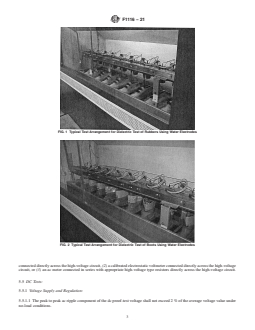
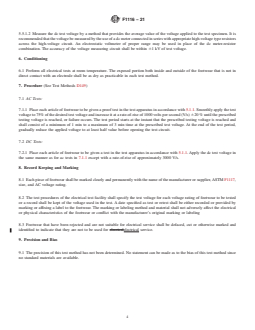
to thoroughly dry the inside of the footwear following the test and prior to storage. See Fig. 1 and Fig. 2 for typical test
arrangements for dielectric test of rubbers and boots using water electrodes.
5.1.1.1 Water used as electrodes shall have a minimum conductance of 100 μS/cm.
NOTE 1—Water used as electrodes should have a minimum conductance of 0.25 mho.
5.2 Precautions—ItWarning—It is recommended that the test apparatus be designed to afford the operator full protection in
performance of his duties. Reliable means of de-energizing and grounding the high-voltage circuit shall be provided. It is
particularly important to incorporate a positive means of grounding the high-voltage section of the dc test apparatus due to the
likely presence of high-voltage capacitance charges at the conclusion of the test.
5.3 Electrical Test Equipment:
5.3.1 The test equipment used in the dielectric strength or proof tests shall be capable of supplying an essentially stepless a
...