

ASTM D120-22
(Specification)Standard Specification for Rubber Insulating Gloves
General Information
- Abstract
ABSTRACT
This specification covers manufacturing and testing of rubber insulating gloves for protection of workers from electrical shock. Two types of gloves are provided and are designated as Type I, non-resistant to ozone, and Type II, resistant to ozone. Six classes of gloves, differing in electrical characteristics, are provided and are designated as Class 00, Class 0, Class 1, Class 2, Class 3, and Class 4. The following tests shall be performed: ac proof test; ac breakdown test; ac moisture absorption/proof test; dc proof test; dc breakdown test; ozone resistance test; chemical tests; tensile strength; tear resistance test; and puncture resistance test.
SCOPE
1.1 This specification covers manufacturing and testing of rubber insulating gloves for protection of workers from electrical shock.
1.2 Two types of gloves are provided and are designated as Type I, non-resistant to ozone, and Type II, resistant to ozone.
1.3 Six classes of gloves, differing in electrical characteristics, are provided and are designated as Class 00, Class 0, Class 1, Class 2, Class 3, and Class 4.
1.4 The values stated in SI units are to be regarded as standard. The values given in parentheses after SI units are provided for information only and are not considered standard. See IEEE/ASTM SI 10.
1.5 The following safety hazards caveat pertains only to the test method portion, Sections 16, 17, 18, and 19, of this specification: This standard does not purport to address all of the safety concerns, if any, associated with its use. It is the responsibility of the user of this standard to establish appropriate safety, health, and environmental practices and determine the applicability of regulatory limitations prior to use. For a specific warning statement, see 18.2.
1.6 This international standard was developed in accordance with internationally recognized principles on standardization established in the Decision on Principles for the Development of International Standards, Guides and Recommendations issued by the World Trade Organization Technical Barriers to Trade (TBT) Committee.
- Status
- Published
- Publication Date
- 31-Jan-2022
- Technical Committee
- F18 - Electrical Protective Equipment for Workers
- Drafting Committee
- F18.15 - Worker Personal Equipment
Overview
ASTM D120-22 is the internationally recognized standard specification for rubber insulating gloves, published by ASTM International. This standard outlines the manufacturing and testing requirements to ensure the electrical, chemical, and physical properties of rubber insulating gloves designed to protect workers from electrical shock hazards. The standard includes specific requirements for glove types and classes, as well as evaluation procedures to verify performance and safety.
The specification applies to two types of gloves: Type I (not ozone resistant) and Type II (ozone resistant). It defines six voltage classes (Class 00 through Class 4), allowing organizations to select appropriate gloves based on the electrical hazards present in their environment.
Key Topics
- Glove Types
- Type I: Non-resistant to ozone, typically made from natural or synthetic cis-1,4-polyisoprene rubber.
- Type II: Resistant to ozone, made from various elastomeric compounds or blends.
- Voltage Classes
- Class 00: Up to 500 V AC / 750 V DC
- Class 0: Up to 1,000 V AC / 1,500 V DC
- Class 1: Up to 7,500 V AC / 11,250 V DC
- Class 2: Up to 17,000 V AC / 25,500 V DC
- Class 3: Up to 26,500 V AC / 39,750 V DC
- Class 4: Up to 36,000 V AC / 54,000 V DC
- Testing and Inspection
- AC and DC proof and breakdown tests
- Moisture absorption/proof tests
- Ozone resistance (for Type II)
- Chemical, tensile, tear, and puncture resistance tests
- Dimensional verification (size and thickness)
- Requirements
- Seamless construction for durability and electrical integrity
- Manufacturer’s marking with type, class, size, and labeling according to color code
- Individual packaging for product protection and traceability
- Quality Assurance
- Sampling and rejection criteria for lot inspections
- Replacement guarantee for unused gloves under specified conditions
Applications
Rubber insulating gloves specified by ASTM D120-22 are essential personal protective equipment (PPE) for:
- Electrical utility workers
- Electrical contractors and linemen
- Maintenance personnel working with energized systems
- Industrial electricians
- Workers in environments where contact with live electrical equipment is possible
These gloves are crucial for preventing electrical shock in operations involving installation, maintenance, repair, and testing of electrical systems. Selection of glove type and class should match the anticipated voltage exposure to ensure adequate protection and compliance with occupational safety regulations.
Proper use of ASTM D120-compliant gloves supports workplace safety programs, reduces electrical accident risks, and aligns with best practices in hazard mitigation.
Related Standards
Professionals specifying, using, or testing rubber insulating gloves should be aware of these related documents:
- ASTM D297: Test Methods for Rubber Products–Chemical Analysis
- ASTM D412: Test Methods for Vulcanized Rubber and Thermoplastic Elastomers–Tension
- ASTM D624: Test Method for Tear Strength of Conventional Vulcanized Rubber and Thermoplastic Elastomers
- ASTM D1415 / D2240: Test Methods for Rubber Property–International Hardness and Durometer Hardness
- IEEE/ASTM SI 10: American National Standard for Metric Practice
- ASTM F819: Terminology Relating to Electrical Protective Equipment for Workers
Complying with ASTM D120-22 ensures high-quality, reliable electrical insulating gloves for worker protection-an essential consideration in any electrical safety program or compliance strategy.
Relations
- Effective Date
- 01-Apr-2010
- Effective Date
- 15-May-2008
- Effective Date
- 15-Nov-2006
- Effective Date
- 01-Jan-2005
- Effective Date
- 01-Dec-2004
- Effective Date
- 01-Nov-2004
- Effective Date
- 10-May-2000
Get Certified
Connect with accredited certification bodies for this standard

CIS Institut d.o.o.
Personal Protective Equipment (PPE) certification body. Notified Body NB-2890 for EU Regulation 2016/425 PPE.

Kiwa BDA Testing
Building and construction product certification.
Kmetijski inštitut Slovenije
Agricultural Institute of Slovenia. Soil testing, plant health, agricultural product analysis.
Sponsored listings
Frequently Asked Questions
ASTM D120-22 is a technical specification published by ASTM International. Its full title is "Standard Specification for Rubber Insulating Gloves". This standard covers: ABSTRACT This specification covers manufacturing and testing of rubber insulating gloves for protection of workers from electrical shock. Two types of gloves are provided and are designated as Type I, non-resistant to ozone, and Type II, resistant to ozone. Six classes of gloves, differing in electrical characteristics, are provided and are designated as Class 00, Class 0, Class 1, Class 2, Class 3, and Class 4. The following tests shall be performed: ac proof test; ac breakdown test; ac moisture absorption/proof test; dc proof test; dc breakdown test; ozone resistance test; chemical tests; tensile strength; tear resistance test; and puncture resistance test. SCOPE 1.1 This specification covers manufacturing and testing of rubber insulating gloves for protection of workers from electrical shock. 1.2 Two types of gloves are provided and are designated as Type I, non-resistant to ozone, and Type II, resistant to ozone. 1.3 Six classes of gloves, differing in electrical characteristics, are provided and are designated as Class 00, Class 0, Class 1, Class 2, Class 3, and Class 4. 1.4 The values stated in SI units are to be regarded as standard. The values given in parentheses after SI units are provided for information only and are not considered standard. See IEEE/ASTM SI 10. 1.5 The following safety hazards caveat pertains only to the test method portion, Sections 16, 17, 18, and 19, of this specification: This standard does not purport to address all of the safety concerns, if any, associated with its use. It is the responsibility of the user of this standard to establish appropriate safety, health, and environmental practices and determine the applicability of regulatory limitations prior to use. For a specific warning statement, see 18.2. 1.6 This international standard was developed in accordance with internationally recognized principles on standardization established in the Decision on Principles for the Development of International Standards, Guides and Recommendations issued by the World Trade Organization Technical Barriers to Trade (TBT) Committee.
ABSTRACT This specification covers manufacturing and testing of rubber insulating gloves for protection of workers from electrical shock. Two types of gloves are provided and are designated as Type I, non-resistant to ozone, and Type II, resistant to ozone. Six classes of gloves, differing in electrical characteristics, are provided and are designated as Class 00, Class 0, Class 1, Class 2, Class 3, and Class 4. The following tests shall be performed: ac proof test; ac breakdown test; ac moisture absorption/proof test; dc proof test; dc breakdown test; ozone resistance test; chemical tests; tensile strength; tear resistance test; and puncture resistance test. SCOPE 1.1 This specification covers manufacturing and testing of rubber insulating gloves for protection of workers from electrical shock. 1.2 Two types of gloves are provided and are designated as Type I, non-resistant to ozone, and Type II, resistant to ozone. 1.3 Six classes of gloves, differing in electrical characteristics, are provided and are designated as Class 00, Class 0, Class 1, Class 2, Class 3, and Class 4. 1.4 The values stated in SI units are to be regarded as standard. The values given in parentheses after SI units are provided for information only and are not considered standard. See IEEE/ASTM SI 10. 1.5 The following safety hazards caveat pertains only to the test method portion, Sections 16, 17, 18, and 19, of this specification: This standard does not purport to address all of the safety concerns, if any, associated with its use. It is the responsibility of the user of this standard to establish appropriate safety, health, and environmental practices and determine the applicability of regulatory limitations prior to use. For a specific warning statement, see 18.2. 1.6 This international standard was developed in accordance with internationally recognized principles on standardization established in the Decision on Principles for the Development of International Standards, Guides and Recommendations issued by the World Trade Organization Technical Barriers to Trade (TBT) Committee.
ASTM D120-22 is classified under the following ICS (International Classification for Standards) categories: 13.260 - Protection against electric shock. Live working. The ICS classification helps identify the subject area and facilitates finding related standards.
ASTM D120-22 has the following relationships with other standards: It is inter standard links to ASTM F819-10, ASTM F819-08, ASTM F819-06, ASTM F819-05, ASTM F819-04a, ASTM F819-04, ASTM F819-00e1. Understanding these relationships helps ensure you are using the most current and applicable version of the standard.
ASTM D120-22 is available in PDF format for immediate download after purchase. The document can be added to your cart and obtained through the secure checkout process. Digital delivery ensures instant access to the complete standard document.
Standards Content (Sample)
This international standard was developed in accordance with internationally recognized principles on standardization established in the Decision on Principles for the
Development of International Standards, Guides and Recommendations issued by the World Trade Organization Technical Barriers to Trade (TBT) Committee.
Designation:D120 −22
Standard Specification for
Rubber Insulating Gloves
This standard is issued under the fixed designation D120; the number immediately following the designation indicates the year of
original adoption or, in the case of revision, the year of last revision. A number in parentheses indicates the year of last reapproval. A
superscript epsilon (´) indicates an editorial change since the last revision or reapproval.
This standard has been approved for use by agencies of the U.S. Department of Defense.
1. Scope D297 Test Methods for Rubber Products—Chemical Analy-
sis
1.1 This specification covers manufacturing and testing of
D412 Test Methods forVulcanized Rubber andThermoplas-
rubber insulating gloves for protection of workers from elec-
tic Elastomers—Tension
trical shock.
D573 Test Method for Rubber—Deterioration in an Air
1.2 Two types of gloves are provided and are designated as
Oven
Type I, non-resistant to ozone, and Type II, resistant to ozone.
D624 Test Method for Tear Strength of Conventional Vul-
canized Rubber and Thermoplastic Elastomers
1.3 Six classes of gloves, differing in electrical
characteristics, are provided and are designated as Class 00, D1415 Test Method for Rubber Property—International
Hardness
Class 0, Class 1, Class 2, Class 3, and Class 4.
D2240 Test Method for Rubber Property—Durometer Hard-
1.4 The values stated in SI units are to be regarded as
ness
standard. The values given in parentheses after SI units are
F819 Terminology Relating to Electrical Protective Equip-
provided for information only and are not considered standard.
ment for Workers
See IEEE/ASTM SI 10.
IEEE/ASTM SI 10 American National Standard for Metric
1.5 The following safety hazards caveat pertains only to the
Practice
test method portion, Sections 16, 17, 18, and 19, of this
specification: This standard does not purport to address all of
3. Terminology
the safety concerns, if any, associated with its use. It is the
3.1 Definitions:
responsibility of the user of this standard to establish appro-
3.1.1 color splash—a splash, smear, or streak of contrasting
priate safety, health, and environmental practices and deter-
color evident on the inside or outside surface of the gloves that
mine the applicability of regulatory limitations prior to use.
was deposited during the dipping operation and is vulcanized
For a specific warning statement, see 18.2.
into the glove as part of the homogenous compound.
1.6 This international standard was developed in accor-
dance with internationally recognized principles on standard-
3.1.2 glove cuff roll—the roll or reinforced edge of an
ization established in the Decision on Principles for the
insulating glove at the cuff.
Development of International Standards, Guides and Recom-
3.1.3 halogenation treatment—exposure of the entire glove
mendations issued by the World Trade Organization Technical
surface area to a halogen for the purpose of reducing surface
Barriers to Trade (TBT) Committee.
friction.
2. Referenced Documents
3.1.4 ozone—a very active form of oxygen that may be
produced by corona, arcing, or ultraviolet rays.
2.1 ASTM Standards:
3.1.5 user—the employer or entity purchasing the equip-
ment to be utilized by workers for their protection; in the
This specification is under the jurisdiction of ASTM Committee F18 on absence of such an employer or entity, the individual purchas-
Electrical Protective Equipment for Workers and is the direct responsibility of
ing and utilizing the protective equipment.
Subcommittee F18.15 on Worker Personal Equipment.This standard replacesANSI
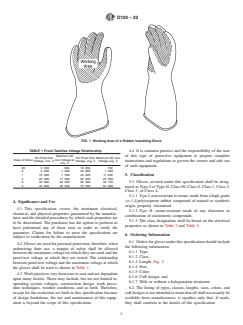
Standard J 6.6, which is no longer available. 3.1.6 working area—all finger and thumb crotches, the palm
Current edition approved Feb. 1, 2022. Published March 2022. Originally
(area between the wrist and the base of the finger and thumb)
approved in 1921. Last previous edition approved in 2021 as D120 – 21. DOI:
and the area of the finger and thumb facing the palm not
10.1520/D0120-22.
extending beyond the center line of the crotch. See Fig. 1.
For referenced ASTM standards, visit the ASTM website, www.astm.org, or
contact ASTM Customer Service at service@astm.org. For Annual Book of ASTM
3.1.7 For definitions of other terms, refer to Terminology
Standardsvolume information, refer to the standard’s Document Summary page on
the ASTM website. F819.
Copyright © ASTM International, 100 Barr Harbor Drive, PO Box C700, West Conshohocken, PA 19428-2959. United States
D120−22
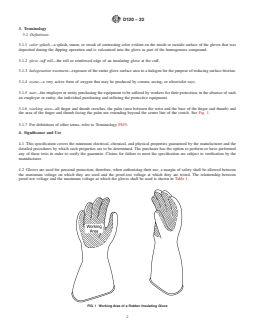
FIG. 1 Working Area of a Rubber Insulating Glove
TABLE 1 Proof-Test/Use Voltage Relationship
4.4 It is common practice and the responsibility of the user
Maximum AC of this type of protective equipment to prepare complete
AC Proof-Test DC Proof-Test Maximum DC Use
Class of Glove Use Voltage ac
instructions and regulations to govern the correct and safe use
Voltage, rms, V Voltage, avg, V Voltage avg, V
rms, V
of such equipment.
00 2 500 500 10 000 750
0 5 000 1 000 20 000 1 500
1 10 000 7 500 40 000 11 250
5. Classification
2 20 000 17 000 50 000 25 500
3 30 000 26 500 60 000 39 750 5.1 Gloves covered under this specification shall be desig-
4 40 000 36 000 70 000 54 000
nated as Type I or Type II; Class 00, Class 0, Class 1, Class 2,
Class 3, or Class 4.
5.1.1 Type I,non-resistanttoozone,madefromahigh-grade
cis-1,4-polyisoprene rubber compound of natural or synthetic
4. Significance and Use
origin, properly vulcanized.
4.1 This specification covers the minimum electrical,
5.1.2 Type II, ozone-resistant made of any elastomer or
chemical, and physical properties guaranteed by the manufac-
combination of elastomeric compounds.
turer and the detailed procedures by which such properties are
5.1.3 The class designation shall be based on the electrical
to be determined. The purchaser has the option to perform or
properties as shown in Table 2 and Table 3.
have performed any of these tests in order to verify the
guarantee. Claims for failure to meet the specification are
6. Ordering Information
subject to verification by the manufacturer.
6.1 Ordersforglovesunderthisspecificationshouldinclude
4.2 Gloves are used for personal protection; therefore, when
the following information:
authorizing their use, a margin of safety shall be allowed
6.1.1 Type,
between the maximum voltage on which they are used and the
6.1.2 Class,
proof-test voltage at which they are tested. The relationship
6.1.3 Length, Fig. 2
between proof-test voltage and the maximum voltage at which
6.1.4 Size,
the gloves shall be used is shown in Table 1.
6.1.5 Color,
4.3 Work practices vary from user to user and are dependent
6.1.6 Cuff design, and
upon many factors. These may include, but are not limited to,
6.1.7 With or without a halogenation treatment.
operating system voltages, construction design, work proce-
dure techniques, weather conditions, and so forth. Therefore, 6.2 The listing of types, classes, lengths, sizes, colors, and
except for the restriction set forth in this specification because cuffdesignsisnotintendedtomeanthatallshallnecessarilybe
of design limitations, the use and maintenance of this equip- available from manufacturers; it signifies only that, if made,
ment is beyond the scope of this specification. they shall conform to the details of this specification.
D120−22
A
TABLE 2 AC Voltage Requirement Proof Test Currents
Minimum Maximum Proof-Test Current, mA
Proof-Test
Class of Breakdown
Voltage,
280 mm 360 mm 410 mm 460 mm
Glove Voltage,
rms, V
(11-in.) Glove (14-in.) Glove (16-in.) Glove (18-in.) Glove
rms, V
50 Hz 60 Hz 50 Hz 60 Hz 50 Hz 60 Hz 50 Hz 60 HZ
BBBB
00 2 500 4 000 6.7 8 10 12
0 5 000 6 000 6.7 8 10 12 11.7 14 13.3 16
1 10 000 20 000 . . 11.7 14 13.3 16 15 18
2 20 000 30 000 . . 13.3 16 15 18 16.7 20
3 30 000 40 000 . . 15 18 16.7 20 18.3 22
4 40 000 50 000 . . . . 18.3 22 20 24
A
Proof test current shall be measured to an accuracy of ±1 mA.
B
Not applicable.
TABLE 3 DC Voltage Requirements
8.3.1 Standard lengths for Class 00 gloves are 280 mm (11
Proof-Test Minimum Breakdown in.), and 360 mm (14 in.). The permissible variations shall be
Class of Glove
Voltage avg V Voltage avg V 1
613 mm (6 ⁄2 in.).
00 10 000 13 000
8.3.2 Standard lengths for Class 0 gloves are 280 mm (11
0 20 000 35 000
in.), 360 mm (14 in.), 410 mm (16 in.), and 460 mm (18 in.).
1 40 000 60 000
2 50 000 70 000
The permissible variations shall be 613 mm (6 ⁄2 in.).
3 60 000 80 000
8.3.3 Standard lengths for Class 1, 2, and 3 gloves are 360
4 70 000 90 000
mm (14 in.), 410 mm (16 in.), and 460 mm (18 in.). The
permissible variation shall be 613 mm (6 ⁄2 in.).
8.3.4 Standard lengths for Class 4 gloves are 410 mm (16
7. Manufacture and Marking
in.) and 460 mm (18 in.). The permissible variation shall be
7.1 The gloves shall be produced by a seamless process.
613 mm (6 ⁄2 in.).
7.2 The gloves shall have a smooth finish and the cuff edges
shall be finished with a roll or a reinforcing strip of rubber,
9. Workmanship and Finish
unless otherwise specified.
9.1 Gloves shall be free on both inner and outer surface of
7.3 Each glove shall be marked clearly and permanently
harmfulphysicalirregularitiesthatcanbedetectedbythorough
with the name of the manufacturer or supplier, ASTM D120,
test and inspection.
type, class, and size.All such marking shall be confined to the
9.1.1 Harmful physical irregularities may be defined as any
cuff portion of the glove and shall be nonconducting and
feature that disrupts the uniform, smooth surface contour and
applied in such a manner as to not impair the required
represents a potential hazard to the user, such as pinholes,
properties of the glove.
cracks, blisters, cuts, conductive embedded foreign matter,
7.3.1 Each glove shall be marked with a label that gives the
creases, pinch marks, voids (entrapped air), prominent ripples,
information specified in 7.3. This label shall be the color
and prominent mold marks.
specified for each voltage class: Class 00—beige, Class
9.2 Nonharmful physical irregularities may be defined as
0—red, Class 1—white, Class 2—yellow, Class 3—green, and
surface irregularities present on the inner and outer surfaces of
Class 4—orange.
the rubber glove due to imperfections on forms or molds and
7.4 At the request of the user, the gloves may be given a
inherentdifficultiesinthemanufacturingprocess.Theseirregu-
halogenation treatment to reduce surface friction. This treat-
larities may appear as mold marks that look like cuts even
ment shall have no detrimental effect on the electrical,
though they are actually a raised ridge of rubber, indentations,
chemical, or physical properties of the gloves.
protuberances, embedded foreign material, or color splashes
that are acceptable provided that:
8. Dimensions and Permissible Variations
9.2.1 The indentations, protuberance or mold marks tend to
8.1 Sample gloves selected in accordance with 13.2 shall
blend into a smooth slope upon stretching of the material.
fall within the thickness limits specified in Table 4, when
9.2.2 The rubber thickness at any irregularity conforms to
determined in accordance with 17.1.
the thickness requirements.
8.2 Sample gloves selected in accordance with 13.2 shall
9.2.3 Foreign material remains in place when the glove is
conform to standard sizes when determined in accordance with
folded and stretched with the material surrounding it.
17.2. Standard sizes are 203 mm (8 in.), 216 mm (8 ⁄2 in.), 229
9.2.4 Color splashes are no larger than 1 mm in any
1 1
mm (9 in.), 241 mm (9 ⁄2 in.), 254 mm (10 in.), 267 mm (10 ⁄2
direction on the inner surface of the work area.
in.), 279 mm (11 in.), 292 mm (11 ⁄2 in.), and 305 mm (12 in.).
9.2.4.1 The working area is defined as all finger and thumb
The permissible variation in size shall be 613 mm (6 ⁄2 in.).
crotches, the palm (area between the wrist and the base of the
8.3 Sample gloves selected in accordance with 13.2 shall finger and thumb) and the area of the finger and thumb facing
conform to standard lengths when measured in accordance the palm not extending beyond the center line of the crotch.
with 17.3. See Fig. 1.
D120−22
FIG. 2 Length and Contour Measurements on Contour Cuff Gloves
TABLE 4 Thickness Measurements
11. Electrical Requirements
Minimum Thickness
11.1 Each glove shall be given a proof test and shall
Maximum Thickness
Class of
In Crotch Other Than Crotch
Glove withstand the 50-Hz or 60–Hz AC proof-test voltage (rms
mm in. mm in. mm in.
value) or the dc proof-test voltage (average value) specified in
00 0.20 0.008 0.25 0.010 0.75 0.030
Table 2 or Table 3. The proof test shall be performed in
0 0.46 0.018 0.51 0.020 1.02 0.040
accordance with Section 18. The test voltage shall be applied
1 0.63 0.025 0.76 0.030 1.52 0.060
2 1.02 0.040 1.27 0.050 2.29 0.090
continuously for 3 min.
3 1.52 0.060 1.90 0.075 2.92 0.115
11.1.1 When the ac proof test is used, the 60-Hz proof-test
4 2.03 0.080 2.54 0.100 3.56 0.140
current shall not exceed the values specified in Table 2 at any
time during the test period. (Note 1).
11.2 Sample gloves selected in accordance with 13.2 shall
10. Chemical and Physical Requirements
not break down at voltages below those specified in Table 2 or
10.1 Glove test material taken from sample gloves selected
Table 3 when tested in accordance with Section 18.
inaccordancewith13.3shallconformtophysicalrequirements
11.2.1 Gloves that have been subjected to a minimum
in Table 5 and the accelerated aging in 19.2.6.
breakdownvoltagetestshallnotbeusedforelectricprotection.
10.2 Intheeventofadispute,theidentificationoftherubber
Proof test current shall be measured to an accuracy of 61 mA.
polymer in Type I gloves shall be performed in accordance
11.3 Sample gloves selected in accordance with 13.2 shall
with 19.1.
be subjected to a 50-Hz or 60–Hz AC moisture absorption/
10.3 Type II glove test material taken from sample gloves
proof test in accordance with Section 18.
selected in accordance with 13.3 shall show no visible effects
11.3.1 The 50-Hz or 60–Hz AC proof test current shall not
of ozone when tested in accordance with 18.6. Any visible
exceed the values specified in Table 2 by more than 2 mA.
signs of ozone deterioration of the glove material, such as
NOTE 1—A proof-test current is an indication of the validity of the
checking, cracking, breaks, pitting, and so forth, shall be
glove make-up, the dielectric constant of the type of material used, the
considered as evidence of failure to meet the requirements of
thickness, and the total contact area under test.
Type II gloves.
12. Guarantee
TABLE 5 Physical Requirements
12.1 The manufacturer or supplier shall replace, without
Property Type I Type II
charge to the purchaser, unused gloves which, at any time
Tensile strength, min, Die C, MPa (psi) 17.2 (2500) 10.3 (1500)
within a period of nine (9) months from date of initial delivery
Tensile stress at 200 %, max, MPa (psi) 2.1 (300) 2.1 (300)
of shipment to the purchaser or his designee, fail to pass the
Ultimate elongation, min, % 600 500
Tension set, max at 400, % 25 25 tests in this specification.This guarantee will be binding on the
Tear resistance, min, kN/m (lbf/in.) 21 (120) 14 (80)
manufacturer or supplier only if the gloves have been properly
Puncture resistance, min, kN/m (lbf/in.) 18 (100) 18 (100)
stored and have not been subjected to more than an original
Hardness, max, shore A 47 47
acceptance test and one retest.
D120−22
12.2 Any acceptance test made by the purchaser, or the been furnished, the manufacturer or supplier may request that
purchaser’s designee, shall be performed within the first two his representative witness the testing of additional gloves from
(2) months of the guarantee period unless otherwise specified. the shipment.
14.5 Theentirelotorshipmentmayberejectedattheoption
NOTE 2—Proper storage means that gloves are stored right side out, not
of the purchaser if two specimens of the first sample and one
distorted and not stored directly above or in proximity to steam pipes,
radiators, or other sources of artificial heat, or exposed to direct sunlight
ofthesecondsample,selectedinaccordancewith13.3,failany
or other sources of ozone. It is desirable that the ambient storage
of the separate requirements outlined in Section 10.
temperature shall not exceed 35 °C (95 °F).
14.6 The entire lot or shipment of gloves may be rejected at
the option of the purchaser if 25 % of the gloves in the lot or
13. Sampling
shipment fail to meet the requirements of Section 8 or 9.
13.1 Each glove in a lot or shipment shall be subjected to
14.7 All rejected material shall be returned as directed by
inspection and test to meet the requirements of Sections 7,
the manufacturer, at his or the supplier’s request, without being
11.1, 9, and 15.
defaced by rubber stamp or other permanent marking.
13.2 An original sample of 1 % of the lot or shipment or not
However, those gloves punctured when tested in accordance
less than two gloves, whichever is greater, shall be selected at
with 11.1, 11.2, and 11.3 shall be stamped, punched, or cut
random from the lot or shipment for the test requirements of
prior to being returned to the supplier to indicate that they are
11.2, 11.3 and Section 8. Where a failure occurs in the first
unfit for electrical use.
sample, a second sample of the same quantity shall be selected
and tested.
15. Packaging and Package Marking
13.3 An original sample of 0.1 % of the lot or shipment or
15.1 Each pair of gloves shall be packaged in an individual
not less than two gloves, whichever is greater, shall be selected container of sufficient strength to properly protect the gloves
at random from the lot or shipment for the test requirements of
from damage in transit. The end of the container shall be
Sections 10.1 and 10.3. marked with the name of the manufacturer or supplier, type,
class, length, size, color, and cuff design.
14. Rejection
TEST METHODS
14.1 Individual gloves shall be rejected if they fail to meet
the requirements of Sections 7, 9 and 11.1 and the minimum
16. Sequence of Testing
thickness requirements of 8.1.
16.1 The following order of procedure is suggested for
14.2 Individual gloves may be rejected at the option of the testing rubber insulating gloves:
purchaser if they fail to meet the requirements of Sections 8 16.1.1 Inspection of the surfaces in accordance with Section
and 15. 9.
16.1.2 The dimensions in accordance with Section 17.
14.3 The entire lot or shipment of gloves shall be rejected
16.1.3 Electrical proof tests in accordance with 18.4.2 or
under any of the following conditions:
18.5.2.
14.3.1 If 5 % or more, but not less than two gloves, in a lot
16.1.4 AC moisture absorption/proof test in accordance
or shipment fail to meet
...
This document is not an ASTM standard and is intended only to provide the user of an ASTM standard an indication of what changes have been made to the previous version. Because
it may not be technically possible to adequately depict all changes accurately, ASTM recommends that users consult prior editions as appropriate. In all cases only the current version
of the standard as published by ASTM is to be considered the official document.
Designation: D120 − 21 D120 − 22
Standard Specification for
Rubber Insulating Gloves
This standard is issued under the fixed designation D120; the number immediately following the designation indicates the year of
original adoption or, in the case of revision, the year of last revision. A number in parentheses indicates the year of last reapproval. A
superscript epsilon (´) indicates an editorial change since the last revision or reapproval.
This standard has been approved for use by agencies of the U.S. Department of Defense.
1. Scope
1.1 This specification covers manufacturing and testing of rubber insulating gloves for protection of workers from electrical shock.
1.2 Two types of gloves are provided and are designated as Type I, non-resistant to ozone, and Type II, resistant to ozone.
1.3 Six classes of gloves, differing in electrical characteristics, are provided and are designated as Class 00, Class 0, Class 1, Class
2, Class 3, and Class 4.
1.4 The values stated in SI units are to be regarded as standard. The values given in parentheses after SI units are provided for
information only and are not considered standard. See IEEE/ASTM SI 10.
1.5 The following safety hazards caveat pertains only to the test method portion, Sections 16, 17, 18, and 19, of this
specification: This standard does not purport to address all of the safety concerns, if any, associated with its use. It is the
responsibility of the user of this standard to establish appropriate safety, health, and environmental practices and determine the
applicability of regulatory limitations prior to use. For a specific warning statement, see 18.2.
1.6 This international standard was developed in accordance with internationally recognized principles on standardization
established in the Decision on Principles for the Development of International Standards, Guides and Recommendations issued
by the World Trade Organization Technical Barriers to Trade (TBT) Committee.
2. Referenced Documents
2.1 ASTM Standards:
D297 Test Methods for Rubber Products—Chemical Analysis
D412 Test Methods for Vulcanized Rubber and Thermoplastic Elastomers—Tension
D573 Test Method for Rubber—Deterioration in an Air Oven
D624 Test Method for Tear Strength of Conventional Vulcanized Rubber and Thermoplastic Elastomers
D1415 Test Method for Rubber Property—International Hardness
D2240 Test Method for Rubber Property—Durometer Hardness
F819 Terminology Relating to Electrical Protective Equipment for Workers
IEEE/ASTM SI 10 American National Standard for Metric Practice
This specification is under the jurisdiction of ASTM Committee F18 on Electrical Protective Equipment for Workers and is the direct responsibility of Subcommittee
F18.15 on Worker Personal Equipment. This standard replaces ANSI Standard J 6.6, which is no longer available.
Current edition approved May 1, 2021Feb. 1, 2022. Published May 2021March 2022. Originally approved in 1921. Last previous edition approved in 20142021 as
D120 – 14a.D120 – 21. DOI: 10.1520/D0120-21.10.1520/D0120-22.
For referenced ASTM standards, visit the ASTM website, www.astm.org, or contact ASTM Customer Service at service@astm.org. For Annual Book of ASTM
Standardsvolume information, refer to the standard’s Document Summary page on the ASTM website.
Copyright © ASTM International, 100 Barr Harbor Drive, PO Box C700, West Conshohocken, PA 19428-2959. United States
D120 − 22
3. Terminology
3.1 Definitions:
3.1.1 color splash—a splash, smear, or streak of contrasting color evident on the inside or outside surface of the gloves that was
deposited during the dipping operation and is vulcanized into the glove as part of the homogenous compound.
3.1.2 glove cuff roll—the roll or reinforced edge of an insulating glove at the cuff.
3.1.3 halogenation treatment—exposure of the entire glove surface area to a halogen for the purpose of reducing surface friction.
3.1.4 ozone—a very active form of oxygen that may be produced by corona, arcing, or ultraviolet rays.
3.1.5 user—the employer or entity purchasing the equipment to be utilized by workers for their protection; in the absence of such
an employer or entity, the individual purchasing and utilizing the protective equipment.
3.1.6 working area—all finger and thumb crotches, the palm (area between the wrist and the base of the finger and thumb) and
the area of the finger and thumb facing the palm not extending beyond the center line of the crotch. See Fig. 1.
3.1.7 For definitions of other terms, refer to Terminology F819.
4. Significance and Use
4.1 This specification covers the minimum electrical, chemical, and physical properties guaranteed by the manufacturer and the
detailed procedures by which such properties are to be determined. The purchaser has the option to perform or have performed
any of these tests in order to verify the guarantee. Claims for failure to meet the specification are subject to verification by the
manufacturer.
4.2 Gloves are used for personal protection; therefore, when authorizing their use, a margin of safety shall be allowed between
the maximum voltage on which they are used and the proof-test voltage at which they are tested. The relationship between
proof-test voltage and the maximum voltage at which the gloves shall be used is shown in Table 1.
FIG. 1 Working Area of a Rubber Insulating Glove
D120 − 22
TABLE 1 Proof-Test/Use Voltage Relationship
Maximum AC
AC Proof-Test DC Proof-Test Maximum DC Use
Class of Glove Use Voltage ac
Voltage, rms, V Voltage, avg, V Voltage avg, V
rms, V
00 2 500 500 10 000 750
0 5 000 1 000 20 000 1 500
1 10 000 7 500 40 000 11 250
2 20 000 17 000 50 000 25 500
3 30 000 26 500 60 000 39 750
4 40 000 36 000 70 000 54 000
4.3 Work practices vary from user to user and are dependent upon many factors. These may include, but are not limited to,
operating system voltages, construction design, work procedure techniques, weather conditions, and so forth. Therefore, except for
the restriction set forth in this specification because of design limitations, the use and maintenance of this equipment is beyond
the scope of this specification.
4.4 It is common practice and the responsibility of the user of this type of protective equipment to prepare complete instructions
and regulations to govern the correct and safe use of such equipment.
5. Classification
5.1 Gloves covered under this specification shall be designated as Type I or Type II; Class 00, Class 0, Class 1, Class 2, Class 3,
or Class 4.
5.1.1 Type I, non-resistant to ozone, made from a high-grade cis-1,4-polyisoprene rubber compound of natural or synthetic origin,
properly vulcanized.
5.1.2 Type II, ozone-resistant made of any elastomer or combination of elastomeric compounds.
5.1.3 The class designation shall be based on the electrical properties as shown in Table 2 and Table 3.
6. Ordering Information
6.1 Orders for gloves under this specification should include the following information:
6.1.1 Type,
6.1.2 Class,
6.1.3 Length, Fig. 2
6.1.4 Size,
6.1.5 Color,
A
TABLE 2 AC Voltage Requirement Proof Test Currents
Minimum Maximum Proof-Test Current, mA
Proof-Test
Class of Breakdown
Voltage,
280-mm280 mm 360-mm360 mm 410-mm410 mm 460-mm460 mm
Glove Voltage,
rms, V
(11-in.) Glove (14-in.) Glove (16-in.) Glove (18-in.) Glove
rms, V
50 Hz 60 Hz 50 Hz 60 Hz 50 Hz 60 Hz 50 Hz 60 HZ
B B B B
00 2 500 4 000 6.7 8 10 12
0 5 000 6 000 6.7 8 10 12 11.7 14 13.3 16
1 10 000 20 000 . . 11.7 14 13.3 16 15 18
2 20 000 30 000 . . 13.3 16 15 18 16.7 20
3 30 000 40 000 . . 15 18 16.7 20 18.3 22
4 40 000 50 000 . . . . 18.3 22 20 24
A
Proof test current shall be measured to an accuracy of ±1 mA.
B
Not applicable.
D120 − 22
TABLE 3 DC Voltage Requirements
Proof-Test Minimum Breakdown
Class of Glove
Voltage avg V Voltage avg V
00 10 000 13 000
0 20 000 35 000
1 40 000 60 000
2 50 000 70 000
3 60 000 80 000
4 70 000 90 000
6.1.6 Cuff design, and
6.1.7 With or without a halogenation treatment.
6.2 The listing of types, classes, lengths, sizes, colors, and cuff designs is not intended to mean that all shall necessarily be
available from manufacturers; it signifies only that, if made, they shall conform to the details of this specification.
7. Manufacture and Marking
7.1 The gloves shall be produced by a seamless process.
7.2 The gloves shall have a smooth finish and the cuff edges shall be finished with a roll or a reinforcing strip of rubber, unless
otherwise specified.
7.3 Each glove shall be marked clearly and permanently with the name of the manufacturer or supplier, ASTM D120, type, class,
and size. All such marking shall be confined to the cuff portion of the glove and shall be nonconducting and applied in such a
manner as to not impair the required properties of the glove.
7.3.1 Each glove shall be marked with a label that gives the information specified in 7.3. This label shall be the color specified
for each voltage class: Class 00—beige, Class 0—red, Class 1—white, Class 2—yellow, Class 3—green, and Class 4—orange.
7.4 At the request of the user, the gloves may be given a halogenation treatment to reduce surface friction. This treatment shall
have no detrimental effect on the electrical, chemical, or physical properties of the gloves.
8. Dimensions and Permissible Variations
8.1 Sample gloves selected in accordance with 13.2 shall fall within the thickness limits specified in Table 4, when determined
in accordance with 17.1.
8.2 Sample gloves selected in accordance with 13.2 shall conform to standard sizes when determined in accordance with 17.2.
1 1 1
Standard sizes are 203 mm (8 in.), 216 mm (8 ⁄2 in.), 229 mm (9 in.), 241 mm (9 ⁄2 in.), 254 mm (10 in.), 267 mm (10 ⁄2 in.), 279
1 1
mm (11 in.), 292 mm (11 ⁄2 in.), and 305 mm (12 in.). The permissible variation in size shall be 613 mm (6 ⁄2 in.).
8.3 Sample gloves selected in accordance with 13.2 shall conform to standard lengths when measured in accordance with 17.3.
8.3.1 Standard lengths for Class 00 gloves are 280 mm (11 in.), and 360 mm (14 in.). The permissible variations shall be 613
mm (6 ⁄2 in.).
8.3.2 Standard lengths for Class 0 gloves are 280 mm (11 in.), 360 mm (14 in.), 410 mm (16 in.), and 460 mm (18 in.). The
permissible variations shall be 613 mm (6 ⁄2 in.).
8.3.3 Standard lengths for Class 1, 2, and 3 gloves are 360 mm (14 in.), 410 mm (16 in.), and 460 mm (18 in.). The permissible
variation shall be 613 mm (6 ⁄2 in.).
8.3.4 Standard lengths for Class 4 gloves are 410 mm (16 in.) and 460 mm (18 in.). The permissible variation shall be 613 mm
(6 ⁄2 in.).
D120 − 22
FIG. 2 Length and Contour Measurements on Contour Cuff Gloves
TABLE 4 Thickness Measurements
Minimum Thickness
Maximum Thickness
Class of
In Crotch Other Than Crotch
Glove
mm in. mm in. mm in.
00 0.20 0.008 0.25 0.010 0.75 0.030
0 0.46 0.018 0.51 0.020 1.02 0.040
1 0.63 0.025 0.76 0.030 1.52 0.060
2 1.02 0.040 1.27 0.050 2.29 0.090
3 1.52 0.060 1.90 0.075 2.92 0.115
4 2.03 0.080 2.54 0.100 3.56 0.140
9. Workmanship and Finish
9.1 Gloves shall be free on both inner and outer surface of harmful physical irregularities that can be detected by thorough test
and inspection.
9.1.1 Harmful physical irregularities may be defined as any feature that disrupts the uniform, smooth surface contour and
represents a potential hazard to the user, such as pinholes, cracks, blisters, cuts, conductive embedded foreign matter, creases, pinch
marks, voids (entrapped air), prominent ripples, and prominent mold marks.
9.2 Nonharmful physical irregularities may be defined as surface irregularities present on the inner and outer surfaces of the rubber
glove due to imperfections on forms or molds and inherent difficulties in the manufacturing process. These irregularities may
appear as mold marks that look like cuts even though they are actually a raised ridge of rubber, indentations, protuberances,
embedded foreign material, or color splashes that are acceptable provided that:
9.2.1 The indentations, protuberance or mold marks tend to blend into a smooth slope upon stretching of the material.
9.2.2 The rubber thickness at any irregularity conforms to the thickness requirements.
9.2.3 Foreign material remains in place when the glove is folded and stretched with the material surrounding it.
9.2.4 Color splashes are no larger than 1 mm in any direction on the inner surface of the work area.
9.2.4.1 The working area is defined as all finger and thumb crotches, the palm (area between the wrist and the base of the finger
and thumb) and the area of the finger and thumb facing the palm not extending beyond the center line of the crotch. See Fig. 1.
D120 − 22
10. Chemical and Physical Requirements
10.1 Glove test material taken from sample gloves selected in accordance with 13.3 shall conform to physical requirements in
Table 5 and the accelerated aging in 19.2.6.
10.2 In the event of a dispute, the identification of the rubber polymer in Type I gloves shall be performed in accordance with 19.1.
10.3 Type II glove test material taken from sample gloves selected in accordance with 13.3 shall show no visible effects of ozone
when tested in accordance with 18.6. Any visible signs of ozone deterioration of the glove material, such as checking, cracking,
breaks, pitting, and so forth, shall be considered as evidence of failure to meet the requirements of Type II gloves.
11. Electrical Requirements
11.1 Each glove shall be given a proof test and shall withstand the 50-Hz or 60–Hz AC proof-test voltage (rms value) or the dc
proof-test voltage (average value) specified in Table 2 or Table 3. The proof test shall be performed in accordance with Section
18. The test voltage shall be applied continuously for 3 min.
11.1.1 When the ac proof test is used, the 60-Hz proof-test current shall not exceed the values specified in Table 2 at any time
during the test period. (Note 1).
11.2 Sample gloves selected in accordance with 13.2 shall not break down at voltages below those specified in Table 2 or Table
3 when tested in accordance with Section 18.
11.2.1 Gloves that have been subjected to a minimum breakdown voltage test shall not be used for electric protection. Proof test
current shall be measured to an accuracy of 61 mA.
11.3 Sample gloves selected in accordance with 13.2 shall be subjected to a 50-Hz or 60–Hz AC moisture absorption/proof test
in accordance with Section 18.
11.3.1 The 50-Hz or 60–Hz AC proof test current shall not exceed the values specified in Table 2 by more than 2 mA.
NOTE 1—A proof-test current is an indication of the validity of the glove make-up, the dielectric constant of the type of material used, the thickness, and
the total contact area under test.
12. Guarantee
12.1 The manufacturer or supplier shall replace, without charge to the purchaser, unused gloves which, at any time within a period
of nine (9) months from date of initial delivery of shipment to the purchaser or his designee, fail to pass the tests in this
specification. This guarantee will be binding on the manufacturer or supplier only if the gloves have been properly stored and have
not been subjected to more than an original acceptance test and one retest.
12.2 Any acceptance test made by the purchaser, or the purchaser’s designee, shall be performed within the first two (2) months
of the guarantee period unless otherwise specified.
NOTE 2—Proper storage means that gloves are stored right side out, not distorted and not stored directly above or in proximity to steam pipes, radiators,
or other sources of artificial heat, or exposed to direct sunlight or other sources of ozone. It is desirable that the ambient storage temperature shall not
exceed 35 °C (95 °F).
TABLE 5 Physical Requirements
Property Type I Type II
Tensile strength, min, Die C, MPa (psi) 17.2 (2500) 10.3 (1500)
Tensile stress at 200 %, max, MPa (psi) 2.1 (300) 2.1 (300)
Ultimate elongation, min, % 600 500
Tension set, max at 400, % 25 25
Tear resistance, min, kN/m (lbf/in.) 21 (120) 14 (80)
Puncture resistance, min, kN/m (lbf/in.) 18 (100) 18 (100)
Hardness, max, shore A 47 47
D120 − 22
13. Sampling
13.1 Each glove in a lot or shipment shall be subjected to inspection and test to meet the requirements of Sections 7, 11.1, 9, and
15.
13.2 An original sample of 1 % of the lot or shipment or not less than two gloves, whichever is greater, shall be selected at random
from the lot or shipment for the test requirements of 11.2, 11.3 and Section 8. Where a failure occurs in the first sample, a second
sample of the same quantity shall be selected and tested.
13.3 An original sample of 0.1 % of the lot or shipment or not less than two gloves, whichever is greater, shall be selected at
random from the lot or shipment for the test requirements of Sections 10.1 and 10.3.
14. Rejection
14.1 Individual gloves shall be rejected if they fail to meet the requirements of Sections 7, 9 and 11.1 and the minimum thickness
requirements of 8.1.
14.2 Individual gloves may be rejected at the option of the purchaser if they fail to meet the requirements of Sections 8 and 15.
14.3 The entire lot or shipment of gloves shall be rejected under any of the following conditions:
14.3.1 If 5 % or more, but not less than two gloves, in a lot or shipment fail to meet the requirements of 11.1.
14.3.2 If two gloves in the first sample fail to meet the requirements of 11.2.
14.3.3 If one glove in the original sample and one or more gloves in the second sample fail to meet the requirements of 11.2.
14.3.4 If the sample of Type II gloves, using the sampling methods of 13.3, fails to meet the requirements of 10.3.
14.3.5 If the proof test current on two gloves in the first sample do not meet the requirements of 11.3.
14.3.6 If the proof test current on one glove in the original sample and the proof test current on one or more gloves in the second
sample fail to meet the requirements of 11.3.
14.4 The testing shall be terminated and the manufacturer or supplier notified if, during the course of testing, the gloves in a lot
or shipment fail to meet the requirements of 10.3, 11.1, 11.2, or 11.3 as determined by the rejection criteria of 14.3.1, 14.3.2,
14.3.314.3.4, 14.3.5, or 14.3.6. The manufacturer or supplier may in such a case require the purchaser to submit proof that the test
procedure and equipment conform to the appropriate paragraphs of Section 18. When such proof has been furnished, the
manufacturer or supplier may request that his representative witness the testing of additional gloves from the shipment.
14.5 The entire lot or shipment may be rejected at the option of the purchaser if two specimens of the first sample and one of the
second sample, selected in accordance with 13.3, fail any of the separate requirements outlined in Section 10.
14.6 The entire lot or shipment of gloves may be rejected at the option of the purchaser if 25 % of the gloves in t
...