

ASTM F2621/F2621M-22
(Practice)Standard Practice for Evaluating Response Characteristics of Safety Products in an Electric Arc Exposure
General Information
- Abstract
SIGNIFICANCE AND USE
5.1 This practice can be used for a range of purposes including incident replication, development of improved arc rated protective products, and the determination of the response characteristics and design integrity of new or used arc rated finished products intended for use as protection for workers exposed to electric arcs.
5.1.1 In-service garments can have very different wash and wear histories. Caution must be used when applying test results from a particular used garment. Factors to consider include the garments’ wear histories, work environments, and tasks for which the garments were worn; the methods and facilities for garment maintenance; the number of launderings or processings the garments have been subjected to; and other factors that could impact the protective performance of different garments. Test results from specific used garments should be considered only an approximation of results that might be obtained from other used garments of the same type.
5.1.2 When using the practice for evaluating flame resistance, great care should be taken since ignition by electric arc is a statistical phenomenon. An exposure of 20 cal/cm2 has been consistently shown to evaluate most ignitable materials but some may require higher energy to reach the breakopen point of the fabric depending on coatings or specific fiber types. Consider using a vertical flame test such as Test Method D6413 to evaluate for ignition and use this practice for illustration.
5.2 This practice maintains the specimen in a static, vertical position and does not involve movement except that resulting from the exposure.
SCOPE
1.1 This practice identifies protocols for use in conducting arc testing on finished products intended for use as thermal protection by workers who may be exposed to electric arc hazards.
1.1.1 The practice is also used for other components which can be exposed to electric arc, but which do not require an arc rating.
1.1.1.1 If items are tested and they do not meet the appropriate standard, it is the responsibility of the specimen submitter to provide this information for indication in the test report.
1.2 Arc Rated protective items are typically tested using this practice to evaluate the performance of the interface area between the product and the other arc flash PPE or to evaluate zippers and other findings.
1.3 This practice does not establish an arc rating for any product. Other ASTM test methods are to be used when applicable such as ASTM F1959/F1959M, F2178, and F2675.
1.4 This practice is not intended to produce an arc rating and does not replicate in all types of arc exposures.
1.5 This practice is used with the following standards:
1.5.1 Protective fabric materials receive arc ratings from Test Method F1959/F1959M.
1.5.2 Face protective products receive arc ratings from Test Method F2178.
1.5.3 Gloves receive arc ratings from Test Method F2675.
1.5.4 Rainwear materials, findings and closures are specified by Specification F1891.
1.5.5 Garments are specified by Specification F1506.
1.6 The test specimens used in this practice are typically in the form of arc-rated finished products. These arc-rated finished products may include, but are not limited to, single layer garments, multi-layer garments or ensembles, cooling vests, gloves, sleeves, chaps, rainwear, balaclavas, faceshields, and hood assemblies with hood shield windows. Non-arc rated finished products may be included when part of a flame-resistant system, or for evaluating heat transmission through the finished product for incident reenactment, or for evaluation of products needed but not available as arc rated (such as respirators, etc.)
1.7 The arc rated finished product specimens are new products as sold or products which have been used for the intended purpose for a designated time.
1.8 This practice is used to determine the response characteristics or design integrity of arc-ra...
- Status
- Published
- Publication Date
- 31-Mar-2022
- Technical Committee
- F18 - Electrical Protective Equipment for Workers
- Drafting Committee
- F18.65 - Wearing Apparel
Buy Documents
ASTM F2621/F2621M-22 - Standard Practice for Evaluating Response Characteristics of Safety Products in an Electric Arc Exposure
REDLINE ASTM F2621/F2621M-22 - Standard Practice for Evaluating Response Characteristics of Safety Products in an Electric Arc Exposure
Overview
ASTM F2621/F2621M-22 is the Standard Practice developed by ASTM International for evaluating the response characteristics and design integrity of safety products, notably finished arc rated garments and other protective equipment, in the presence of electric arc exposure. This standard provides protocols for conducting controlled laboratory arc testing on finished products intended to offer thermal protection for workers exposed to electric arc hazards. These guidelines support improved product development, incident replication, and provide valuable data on the performance of both new and in-service items under exposure to radiant and convective energy generated by electric arcs.
Key Topics
- Arc Exposure Testing Procedures: Details comprehensive test setup and protocols for evaluating finished arc rated products, including the use of mannequins equipped with calorimeter sensors to measure heat energy transfer during arc exposures.
- Response Characteristics: Documents observed outcomes such as afterflame time, melting, deformation, charring, shrinkage, and ignition following arc testing, allowing manufacturers and safety professionals to assess damage and failure modes.
- Design Integrity Verification: Evaluates specific product features and interface areas-such as closures, zippers, and overlaps between different PPE items-to ensure sustained protection across all components.
- Incident Replication: Can replicate real-world arc flash incidents using test parameters based on incident data, supporting investigations and validation of current or proposed PPE configurations.
- Applicability to New and Used Products: The standard is flexible in that it allows for the testing of both newly manufactured and used (laundered and possibly worn) arc rated products, reflecting field performance.
- Limitations: ASTM F2621/F2621M-22 does not establish arc ratings; these require referred standards (e.g., ASTM F1959/F1959M for fabric, F2178 for face protection). It cannot simulate all types of arc exposures and does not appraise fire hazards under real fire conditions.
Applications
ASTM F2621/F2621M-22 is critically relevant to:
- Manufacturers of Arc Rated PPE: Enables development, quality control, and enhancement of garments, gloves, face protection, rainwear, and system-level assemblies designed to protect against electrical arc hazards in industries such as utilities, oil and gas, electrical contracting, and manufacturing.
- Workplace Safety Professionals: Facilitates evidence-based assessment of current personal protective equipment (PPE), aids in documenting conformance to safety protocols, and informs the selection of appropriate gear for worker protection.
- Testing Laboratories: Provides a uniform protocol for conducting static arc exposure tests on finished products, ensuring reliable and repeatable results that can be compared across different products and test facilities.
- Incident Investigators: Assists in incident reenactment and analysis, leveraging controlled laboratory exposures to replicate field accidents and validate injury causation and PPE performance.
Key products and components tested under this practice include single and multi-layer garments, gloves, cooling vests, balaclavas, sleeves, chaps, faceshields, hood assemblies, rainwear, and even non-arc-rated items when evaluated as part of a flame-resistant system.
Related Standards
ASTM F2621/F2621M-22 is commonly used alongside several related standards to provide a comprehensive PPE safety assessment:
- ASTM F1959/F1959M: Test Method for Determining the Arc Rating of Materials for Clothing
- ASTM F2178: Test Method for Determining the Arc Rating of Eye or Face Protective Products
- ASTM F2675: Test Method for Determining Arc Ratings of Hand Protective Products
- ASTM F1506: Performance Specification for Flame Resistant and Electric Arc Rated Protective Clothing
- ASTM F1891: Specification for Arc and Flame Resistant Rainwear
- ASTM D6413: Test Method for Flame Resistance of Textiles (Vertical Test)
- IEC 61482-1-2: Live working-Protective clothing against the thermal hazards of an electric arc
By following ASTM F2621/F2621M-22, organizations can verify the integrity, performance, and safety of arc rated garments and protective products, contributing to improved occupational safety for workers in high-risk electrical environments.
Relations
- Effective Date
- 01-Mar-2024
- Refers
ASTM F1959/F1959M-24 - Standard Test Method for Determining the Arc Rating of Materials for Clothing - Effective Date
- 01-Jan-2024
- Effective Date
- 01-Dec-2023
- Refers
ASTM F1959/F1959M-23 - Standard Test Method for Determining the Arc Rating of Materials for Clothing - Effective Date
- 01-Oct-2023
- Effective Date
- 01-Dec-2019
- Effective Date
- 01-Aug-2019
- Effective Date
- 01-Jan-2019
- Effective Date
- 01-May-2018
- Effective Date
- 15-Apr-2018
- Effective Date
- 15-Nov-2017
- Effective Date
- 15-Nov-2017
- Effective Date
- 01-Oct-2017
- Effective Date
- 01-Oct-2017
- Effective Date
- 01-Sep-2017
- Effective Date
- 01-Jul-2017
Buy Documents
ASTM F2621/F2621M-22 - Standard Practice for Evaluating Response Characteristics of Safety Products in an Electric Arc Exposure
REDLINE ASTM F2621/F2621M-22 - Standard Practice for Evaluating Response Characteristics of Safety Products in an Electric Arc Exposure
Get Certified
Connect with accredited certification bodies for this standard

CIS Institut d.o.o.
Personal Protective Equipment (PPE) certification body. Notified Body NB-2890 for EU Regulation 2016/425 PPE.

Kiwa BDA Testing
Building and construction product certification.
Kmetijski inštitut Slovenije
Agricultural Institute of Slovenia. Soil testing, plant health, agricultural product analysis.
Sponsored listings
Frequently Asked Questions
ASTM F2621/F2621M-22 is a standard published by ASTM International. Its full title is "Standard Practice for Evaluating Response Characteristics of Safety Products in an Electric Arc Exposure". This standard covers: SIGNIFICANCE AND USE 5.1 This practice can be used for a range of purposes including incident replication, development of improved arc rated protective products, and the determination of the response characteristics and design integrity of new or used arc rated finished products intended for use as protection for workers exposed to electric arcs. 5.1.1 In-service garments can have very different wash and wear histories. Caution must be used when applying test results from a particular used garment. Factors to consider include the garments’ wear histories, work environments, and tasks for which the garments were worn; the methods and facilities for garment maintenance; the number of launderings or processings the garments have been subjected to; and other factors that could impact the protective performance of different garments. Test results from specific used garments should be considered only an approximation of results that might be obtained from other used garments of the same type. 5.1.2 When using the practice for evaluating flame resistance, great care should be taken since ignition by electric arc is a statistical phenomenon. An exposure of 20 cal/cm2 has been consistently shown to evaluate most ignitable materials but some may require higher energy to reach the breakopen point of the fabric depending on coatings or specific fiber types. Consider using a vertical flame test such as Test Method D6413 to evaluate for ignition and use this practice for illustration. 5.2 This practice maintains the specimen in a static, vertical position and does not involve movement except that resulting from the exposure. SCOPE 1.1 This practice identifies protocols for use in conducting arc testing on finished products intended for use as thermal protection by workers who may be exposed to electric arc hazards. 1.1.1 The practice is also used for other components which can be exposed to electric arc, but which do not require an arc rating. 1.1.1.1 If items are tested and they do not meet the appropriate standard, it is the responsibility of the specimen submitter to provide this information for indication in the test report. 1.2 Arc Rated protective items are typically tested using this practice to evaluate the performance of the interface area between the product and the other arc flash PPE or to evaluate zippers and other findings. 1.3 This practice does not establish an arc rating for any product. Other ASTM test methods are to be used when applicable such as ASTM F1959/F1959M, F2178, and F2675. 1.4 This practice is not intended to produce an arc rating and does not replicate in all types of arc exposures. 1.5 This practice is used with the following standards: 1.5.1 Protective fabric materials receive arc ratings from Test Method F1959/F1959M. 1.5.2 Face protective products receive arc ratings from Test Method F2178. 1.5.3 Gloves receive arc ratings from Test Method F2675. 1.5.4 Rainwear materials, findings and closures are specified by Specification F1891. 1.5.5 Garments are specified by Specification F1506. 1.6 The test specimens used in this practice are typically in the form of arc-rated finished products. These arc-rated finished products may include, but are not limited to, single layer garments, multi-layer garments or ensembles, cooling vests, gloves, sleeves, chaps, rainwear, balaclavas, faceshields, and hood assemblies with hood shield windows. Non-arc rated finished products may be included when part of a flame-resistant system, or for evaluating heat transmission through the finished product for incident reenactment, or for evaluation of products needed but not available as arc rated (such as respirators, etc.) 1.7 The arc rated finished product specimens are new products as sold or products which have been used for the intended purpose for a designated time. 1.8 This practice is used to determine the response characteristics or design integrity of arc-ra...
SIGNIFICANCE AND USE 5.1 This practice can be used for a range of purposes including incident replication, development of improved arc rated protective products, and the determination of the response characteristics and design integrity of new or used arc rated finished products intended for use as protection for workers exposed to electric arcs. 5.1.1 In-service garments can have very different wash and wear histories. Caution must be used when applying test results from a particular used garment. Factors to consider include the garments’ wear histories, work environments, and tasks for which the garments were worn; the methods and facilities for garment maintenance; the number of launderings or processings the garments have been subjected to; and other factors that could impact the protective performance of different garments. Test results from specific used garments should be considered only an approximation of results that might be obtained from other used garments of the same type. 5.1.2 When using the practice for evaluating flame resistance, great care should be taken since ignition by electric arc is a statistical phenomenon. An exposure of 20 cal/cm2 has been consistently shown to evaluate most ignitable materials but some may require higher energy to reach the breakopen point of the fabric depending on coatings or specific fiber types. Consider using a vertical flame test such as Test Method D6413 to evaluate for ignition and use this practice for illustration. 5.2 This practice maintains the specimen in a static, vertical position and does not involve movement except that resulting from the exposure. SCOPE 1.1 This practice identifies protocols for use in conducting arc testing on finished products intended for use as thermal protection by workers who may be exposed to electric arc hazards. 1.1.1 The practice is also used for other components which can be exposed to electric arc, but which do not require an arc rating. 1.1.1.1 If items are tested and they do not meet the appropriate standard, it is the responsibility of the specimen submitter to provide this information for indication in the test report. 1.2 Arc Rated protective items are typically tested using this practice to evaluate the performance of the interface area between the product and the other arc flash PPE or to evaluate zippers and other findings. 1.3 This practice does not establish an arc rating for any product. Other ASTM test methods are to be used when applicable such as ASTM F1959/F1959M, F2178, and F2675. 1.4 This practice is not intended to produce an arc rating and does not replicate in all types of arc exposures. 1.5 This practice is used with the following standards: 1.5.1 Protective fabric materials receive arc ratings from Test Method F1959/F1959M. 1.5.2 Face protective products receive arc ratings from Test Method F2178. 1.5.3 Gloves receive arc ratings from Test Method F2675. 1.5.4 Rainwear materials, findings and closures are specified by Specification F1891. 1.5.5 Garments are specified by Specification F1506. 1.6 The test specimens used in this practice are typically in the form of arc-rated finished products. These arc-rated finished products may include, but are not limited to, single layer garments, multi-layer garments or ensembles, cooling vests, gloves, sleeves, chaps, rainwear, balaclavas, faceshields, and hood assemblies with hood shield windows. Non-arc rated finished products may be included when part of a flame-resistant system, or for evaluating heat transmission through the finished product for incident reenactment, or for evaluation of products needed but not available as arc rated (such as respirators, etc.) 1.7 The arc rated finished product specimens are new products as sold or products which have been used for the intended purpose for a designated time. 1.8 This practice is used to determine the response characteristics or design integrity of arc-ra...
ASTM F2621/F2621M-22 is classified under the following ICS (International Classification for Standards) categories: 13.260 - Protection against electric shock. Live working. The ICS classification helps identify the subject area and facilitates finding related standards.
ASTM F2621/F2621M-22 has the following relationships with other standards: It is inter standard links to ASTM F1959/F1959M-24a, ASTM F1959/F1959M-24, ASTM F1959/F1959M-23a, ASTM F1959/F1959M-23, ASTM F1506-19a, ASTM F1506-19, ASTM F1891-19, ASTM D4391-18, ASTM F1506-18, ASTM F1506-17be1, ASTM F1506-17b, ASTM F1506-17a, ASTM F2178-17b, ASTM F2178-17a, ASTM F2178-17. Understanding these relationships helps ensure you are using the most current and applicable version of the standard.
ASTM F2621/F2621M-22 is available in PDF format for immediate download after purchase. The document can be added to your cart and obtained through the secure checkout process. Digital delivery ensures instant access to the complete standard document.
Standards Content (Sample)
This international standard was developed in accordance with internationally recognized principles on standardization established in the Decision on Principles for the
Development of International Standards, Guides and Recommendations issued by the World Trade Organization Technical Barriers to Trade (TBT) Committee.
Designation: F2621/F2621M − 22
Standard Practice for
Evaluating Response Characteristics of Safety Products in
an Electric Arc Exposure
ThisstandardisissuedunderthefixeddesignationF2621/F2621M;thenumberimmediatelyfollowingthedesignationindicatestheyear
of original adoption or, in the case of revision, the year of last revision. A number in parentheses indicates the year of last reapproval.
A superscript epsilon (´) indicates an editorial change since the last revision or reapproval.
1. Scope hood assemblies with hood shield windows. Non-arc rated
finished products may be included when part of a flame-
1.1 This practice identifies protocols for use in conducting
resistant system, or for evaluating heat transmission through
arc testing on finished products intended for use as thermal
the finished product for incident reenactment, or for evaluation
protection by workers who may be exposed to electric arc
of products needed but not available as arc rated (such as
hazards.
respirators, etc.)
1.1.1 The practice is also used for other components which
can be exposed to electric arc, but which do not require an arc
1.7 The arc rated finished product specimens are new
rating.
products as sold or products which have been used for the
1.1.1.1 If items are tested and they do not meet the appro-
intended purpose for a designated time.
priate standard, it is the responsibility of the specimen submit-
1.8 This practice is used to determine the response charac-
ter to provide this information for indication in the test report.
teristics or design integrity of arc-rated materials, products, or
1.2 ArcRatedprotectiveitemsaretypicallytestedusingthis
assemblies in the form of finished products when exposed to
practice to evaluate the performance of the interface area
radiant and convective energy generated by an electric arc
between the product and the other arc flash PPE or to evaluate
under controlled laboratory conditions.
zippers and other findings.
1.9 This practice can be used to determine the integrity of
1.3 This practice does not establish an arc rating for any
closures and seams in arc exposures, the protective perfor-
product. Other ASTM test methods are to be used when
mance of arc-rated products in areas where garment overlap
applicable such as ASTM F1959/F1959M, F2178, and F2675.
occursorwhereheraldryreflectivetrimorotheritemsareused,
and response characteristics such as afterflame time, melting,
1.4 Thispracticeisnotintendedtoproduceanarcratingand
dripping, deformation, shrinkage, ignition, or other damage, or
does not replicate in all types of arc exposures.
combination thereof, of fabrics, systems of fabrics, flammable
1.5 This practice is used with the following standards:
undergarments when included as part of a system, sewing
1.5.1 Protective fabric materials receive arc ratings from
thread, findings, and closures.
Test Method F1959/F1959M.
1.10 This practice can be used for incident reenactment,
1.5.2 Face protective products receive arc ratings from Test
Method F2178. training demonstrations, and material/design comparisons.
1.5.3 Gloves receive arc ratings from Test Method F2675.
1.11 The values stated in either SI units or inch-pound units
1.5.4 Rainwear materials, findings and closures are speci-
are to be regarded separately as standard. The values stated in
fied by Specification F1891.
each system are not necessarily exact equivalents; therefore, to
1.5.5 Garments are specified by Specification F1506.
ensure conformance with the standard, each system shall be
1.6 The test specimens used in this practice are typically in used independently of the other, and values from the two
the form of arc-rated finished products. These arc-rated fin- systems shall not be combined.
ished products may include, but are not limited to, single layer
1.12 This standard shall not be used to describe or appraise
garments, multi-layer garments or ensembles, cooling vests,
the fire hazard or fire risk of materials, products, or assemblies
gloves, sleeves, chaps, rainwear, balaclavas, faceshields, and
under actual fire conditions. However, results of this test may
be used as elements of a fire assessment, which takes into
account all of the factors, which are pertinent to an assessment
This practice is under the jurisdiction of ASTM Committee F18 on Electrical
of the fire hazard of a particular end use.
Protective Equipment for Workers and is the direct responsibility of Subcommittee
F18.65 on Wearing Apparel.
1.13 This standard does not purport to describe or appraise
Current edition approved April 1, 2022. Published May 2022. Originally
the effect of the electric arc fragmentation explosion and
approved in 2006. Last previous edition approved in 2021 as F2621 – 21. DOI:
10.1520/F2621_F2621M-22. subsequent molten metal splatter, which involves the pressure
Copyright © ASTM International, 100 Barr Harbor Drive, PO Box C700, West Conshohocken, PA 19428-2959. United States
F2621/F2621M − 22
wavecontainingmoltenmetalsandpossiblefragmentsofother 3.1.5 arc gap, n—distance between the arc electrodes, cm
materials except to the extent that evidence of projectile [in.].
damage is assessed and reported.
3.1.6 arc rated finished product, n—a commercial product
1.14 This standard does not purport to address all of the
used for arc flash protection in the form as it is sold and used.
safety concerns, if any, associated with its use. It is the
3.1.7 arc rating, n—value attributed to materials that de-
responsibility of the user of this standard to establish appro-
scribes their performance to exposure to an electric arc
priate safety, health, and environmental practices and deter-
2 2
discharge, J/cm (cal/cm ).
mine the applicability of regulatory limitations prior to use.
3.1.7.1 Discussion—The arc rating is expressed in cal/cm
For specific precautions, see Section 7.
and is derived from the determined value of ATPV or E
BT
1.15 This international standard was developed in accor-
(should a material system exhibit a breakopen response below
dance with internationally recognized principles on standard-
the ATPV value).
ization established in the Decision on Principles for the
3.1.8 arc thermal performance value (ATPV), n—in arc
Development of International Standards, Guides and Recom-
testing, the incident energy of a fabric or material that results
mendations issued by the World Trade Organization Technical
in 50 % probability that sufficient heat transfer through the
Barriers to Trade (TBT) Committee.
specimen is predicted to cause the onset of a second-degree
2. Referenced Documents
skin burn injury based on the Stoll curve.
2.1 ASTM Standards:
3.1.9 arc voltage, n—voltage across the gap caused by the
D123 Terminology Relating to Textiles
current flowing through the resistance created by the arc gap,
D4391 Terminology Relating to The Burning Behavior of
V.
Textiles
3.1.10 asymmetrical arc current, n—the total arc current
D6413 Test Method for Flame Resistance of Textiles (Ver-
produced during closure; it includes a direct component and a
tical Test)
symmetrical component, A.
F1494 Terminology Relating to Protective Clothing
3.1.11 blowout, n—the extinguishing of the arc caused by a
F1506 Performance Specification for Flame Resistant and
magnetic field.
Electric Arc Rated Protective Clothing Worn by Workers
Exposed to Flames and Electric Arcs
3.1.12 breakopen, n—in electric arc testing, a material
F1891 Specification for Arc and Flame Resistant Rainwear
response evidenced by the formation of one or more holes in
F1959/F1959M TestMethodforDeterminingtheArcRating
the material which may allow thermal energy to pass through
of Materials for Clothing
material.
F2178 Specification for Arc Rated Eye or Face Protective
3.1.12.1 Discussion—The specimen is considered to exhibit
Products 2 2
breakopen when any hole is at least 1.6 cm [0.5 in. ] in area
F2675 Test Method for Determining Arc Ratings of Hand
or at least 2.5 cm [1.0 in.] in any dimension. Single threads
Protective Products Developed and Used for Electrical
acrosstheopeningorholedonotreducethesizeoftheholefor
Arc Flash Protection
the purpose of this practice. In multiple layer finished product
2.2 IEC Standards:
specimens of flame resistant materials, all the layers must
IEC 61482-1-2 Live working--Protective clothing against
exhibit breakopen in order to meet the definition.
thethermalhazardsofanelectricarc,Part2Requirements
3.1.13 breakopen threshold energy (E ), n—the incident
BT
energy on a fabric or material that results in a 50 % probability
3. Terminology
of breakopen.
3.1 Definitions:
2 2
3.1.13.1 Discussion—This is the value in J/cm [cal/cm ]
3.1.1 afterflame,n—persistentflamingofamaterialafterthe
determined by use of logistic regression analysis representing
ignition source has been removed.
the energy at which breakopen of the layer occurred.
3.1.2 afterflame time, n—the length of time for which a
3.1.14 calorimeter, n—a device used in which the heat
material continues to flame after the ignition source has been
measured causes a change in state.
removed.
3.1.14.1 Discussion—The determination of heat energy, as a
3.1.3 arc duration, n—time duration of the arc, s.
consequence of an electrical arc exposure, is made in this
3.1.4 arc energy, n—sum of the instantaneous arc voltage
procedure by measuring the change in temperature of an
values multiplied by the instantaneous arc current values
exposed copper slug of specific geometry and mass during
multiplied by the incremental time values during the arc, J.
finite time intervals.
3.1.15 charring, n—formation of carbonaceous residue as
For referenced ASTM standards, visit the ASTM website, www.astm.org, or the result of pyrolysis or incomplete combustion.
contact ASTM Customer Service at service@astm.org. For Annual Book of ASTM
3.1.16 closure, n—the point on supply current wave from
Standards volume information, refer to the standard’s Document Summary page on
the ASTM website. where arc is initiated.
Available from International Electrotechnical Commission (IEC), 3, rue de
3.1.17 deformation, n—for electric arc testing of finished
Varembé, 1st floor, P.O. Box 131, CH-1211, Geneva 20, Switzerland, https://
www.iec.ch. products, the sagging of material greater than 3 in. or melting
F2621/F2621M − 22
in any manner that the faceshield, hood window, or other closures, the faceshield window polymer, or any other compo-
melted material touches any part of the body. nent of the finished product.
3.1.18 dripping, n—in electric arc testing, a material re-
3.1.29 peak arc current, n—maximum value of the ac arc
sponse evidenced by flowing of a polymer and droplets
current, A.
separating from the material.
3.1.30 RMS arc current, n—root mean square of theAC arc
3.1.18.1 Discussion—For finished product protective cloth-
current, A.
ing and equipment, dripping can involve the fiber polymer,
3.1.31 shrinkage, n—in testing finished products, a material
coatings,findings,thefaceshieldwindowmaterial,oranyother
responseevidencedbyreductioninspecimensizeofthefabric,
component of the finished product.
finding, closure, or the faceshield window.
3.1.19 garment closure, n—in a finished product or
3.1.32 Stoll curve, n—curve produced from data on human
garment, the area in which two parts are joined with a
tissue tolerance to heat and used to predict the onset of
mechanical device.
second-degree burn injury.
3.1.19.1 Discussion—Examples of closures are zippers,
snaps, buttons or hook & loop fasteners on the front of a coat,
3.1.33 X/R ratio, n—the ratio of system inductive reactance
a shirt or a pair of pants.
to resistance.
3.1.33.1 Discussion—It is proportional to the L/R ratio of
3.1.20 heat flux, n—the thermal intensity indicated by the
amount of energy transmitted per area and time, cal/cm s time constant, and is, therefore, indicative of the rate of decay
of any dc offset. A large X/R ratio corresponds to a large time
(W/m ).
2 constant and a slow rate of decay.
3.1.21 i t, n—sum of the instantaneous arc current values
squared multiplied by the incremental time values during the
3.2 For definitions of other textile terms used in this
arc, A /s.
practice, refer to Terminology standards D123, D4391, and
F1494.
3.1.22 heraldry, n—relating to finished products, an infor-
mational symbol or logo on a finished product.
4. Summary of Practice
3.1.22.1 Discussion—The logo or symbol is embroidered
onto the finished product, or the logo or symbol is on a label
4.1 This practice identifies procedures for determining the
which is affixed to the finished product.
response characteristics and design integrity of materials,
products, or assemblies in the form of finished garments or
3.1.23 incident energy monitoring sensors, n—sensors
otherfinishedproductswhenexposedtoconvectiveandradiant
mounted on each side of the torso and on each side of the head,
energy generated by an electric arc under controlled laboratory
using calorimeters, not covered by specimens, used to measure
conditions.
incident energy.
4.1.1 When evaluating the design integrity or protective
3.1.24 incident exposure energy (E), n—in arc testing, the
i
performance of arc rated finished products, the electric arc heat
total incident energy delivered to monitor calorimeter sensors
exposure level should be set to be at least equivalent to the arc
as a result of the arc exposure, cal/cm .
rating of the finished product being evaluated in cal/cm .
3.1.24.1 Discussion—In an arc test exposure, incident ex-
4.1.2 When using this practice for incident reenactment,
posure energy for a specimen is determined from the average
expose the test specimen to an electric arc heat exposure level
ofthemeasuredincidentenergyfromalltherespectivemonitor
similar to that determined from the incident criteria.Additional
sensors adjacent to the test specimen.
parameters may be used for evaluation such as a box con-
3.1.25 indicator undergarment, n—in finished product arc
strained arc such as in IEC 61482-1-2 or other types of
exposure, a light-weight undergarment used to subjectively
exposures which represent the incident being investigated.
detect heat transfer through a finished product and heat leakage
Thesewouldbeconsiderednon-standardandrequiredocumen-
through closures or interface areas of a finished product
tation of parameters. This may include different currents and
garment.
clearing times and different exposure distances and angles.
3.1.26 interface area, n—in arc testing, the areas of the
4.1.2.1 Garments used in an incident reenactment should be
body at which finished product specimens overlap but are
chosen to represent the approximate cleaning and wear levels
discontinuous.
of the incident garment.
3.1.26.1 Discussion—The waist and mid-torso area of the
4.2 Finished product specimens are mounted on the stan-
body at which a coat overlaps a bib overall is an example of an
dardmannequinillustratedinthispracticeorfromTestMethod
interface area, and the neck and upper torso area of the body is
F2178(usedforheadprotectiveproducts).Mannequinlegscan
an example of an interface area.
beaddedifexposurestothelowertorsoandlegsareofinterest.
3.1.27 material response, n—material response to an elec-
The mannequin is typically in a standing position with arms
tric arc is indicated by the following terms: breakopen,
down to the sides of the torso. The mannequin may be
charring, melting, dripping, deformation, afterflame time,
equipped with copper slug calorimeters in the neck and head
shrinkage, and ignition.
positions as specified in Test Method F2178. During this
3.1.28 melting, n—in testing finished products, a material procedure, the amount of heat energy transmitted through the
response evidenced by softening of the fiber polymer, findings, finished product specimens can be measured during and after
F2621/F2621M − 22
exposuretoanelectricarcwiththesensorsspecifiedintheTest ingsthegarmentshavebeensubjectedto;andotherfactorsthat
Method or can be evaluated using an indicator garment. could impact the protective performance of different garments.
Test results from specific used garments should be considered
4.2.1 The mannequin can be positioned in other positions,
for example, in incident reenactment the mannequin can be in only an approximation of results that might be obtained from
other used garments of the same type.
a sitting position or with the arms extending horizontally
toward the arc exposure to simulate the conditions of the 5.1.2 When using the practice for evaluating flame
resistance, great care should be taken since ignition by electric
incident. Indicate modifications to the mannequin position in
the test report. arc is a statistical phenomenon.An exposure of 20 cal/cm has
been consistently shown to evaluate most ignitable materials
4.2.2 The mannequin can also be equipped with additional
calorimeter sensors in other parts of the body, for example, the but some may require higher energy to reach the breakopen
point of the fabric depending on coatings or specific fiber
legs, groin, and arms. Any additional sensors used will be
indicated in the test report. types. Consider using a vertical flame test such as Test Method
D6413 to evaluate for ignition and use this practice for
4.2.2.1 When additional sensors are used, the sensor re-
illustration.
sponses relative to the monitor sensor responses will not
provide a valid determination of burn injury unless the addi-
5.2 This practice maintains the specimen in a static, vertical
tional sensors are positioned at the same distance and orienta-
position and does not involve movement except that resulting
tion as the monitor sensors.
from the exposure.
4.2.3 Lightweight “indicator garments” have been shown to
be useful in evaluating energy transfer. The standard indicator 6. Apparatus
garments are a white jersey-knit cotton brief 170 g/m [5.0
6.1 General Arrangement for Using Mannequins and Moni-
oz/yd ] 6 10 %, or a white jersey knit, cotton crew-neck
tor Sensors—The test apparatus shall consist of supply bus, arc
T-shirt 155 [4.6 oz/yd ] 6 10 %, or both.
controller, recorder, arc electrodes, mannequins, and incident
4.2.3.1 If another indicator is chosen, report what is used
energy monitoring sensors. The arc exposure shall be moni-
and document the material response.
tored with two incident energy monitoring sensors for each
4.2.3.2 If other heat indicator approaches are used such as
mannequin.
selective placement of panels of 100 % untreated cotton fabric
6.1.1 Arrangement of the Mannequin(s)—Mannequins with
or PVC sheets, these will be described in detail and included in
two monitoring sensors each shall be used for each test.
the test report.
Position monitor sensors on each side of the mannequins as
shown in Fig. 1.
4.3 The thermal energy exposure is measured with copper
6.1.1.1 Additional mannequins with monitoring sensors
slug calorimeters. The change in temperature versus time is
may be placed around the arc as shown in Fig. 2 to evaluate
used, along with the known thermo-physical properties of
multiple samples of the same materials at the same distance
copper to determine the respective heat energies delivered to
from the arc. Each mannequin shall be visually observed for
and through the specimen(s).
ignition.
4.3.1 The heat transfer response and heat leakage of the
finished product specimen(s) may be estimated by evidence of
thermal changes to the “indicator” undergarment fabric.
4.4 This practice incorporates incident energy monitoring
sensors used to determine the heat exposure on the finished
product specimen.
4.5 Finishedproductspecimenresponsecharacteristicsshall
be further described by recording the observed effects of the
electric arc exposure on the specimens using the terms in the
Report.
5. Significance and Use
5.1 This practice can be used for a range of purposes
including incident replication, development of improved arc
rated protective products, and the determination of the re-
sponse characteristics and design integrity of new or used arc
rated finished products intended for use as protection for
workers exposed to electric arcs.
5.1.1 In-service garments can have very different wash and
wearhistories.Cautionmustbeusedwhenapplyingtestresults
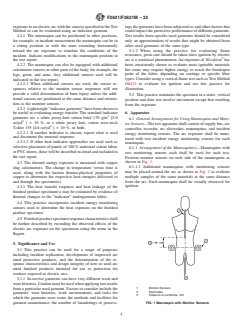
1 Monitor Sensors
from a particular used garment. Factors to consider include the
2 Electrodes
garments’ wear histories, work environments, and tasks for
3 Distance to centerline, mm
which the garments were worn; the methods and facilities for
garment maintenance; the number of launderings or process- FIG. 1 Mannequin with Monitor Sensors
F2621/F2621M − 22
1 120° typical
2 Monitor Sensors (monitor sensors move back for higher energy levels)
3 Mannequin positions (optional 1–3)
FIG. 2 Optional Arrangement of Three Mannequins Showing Relative Sensor and Mannequin Placement
Methods F1959/F1959M or F2178, specify this in the report.
6.1.2 Mannequin—Use a male mannequin torso, size large,
made from non-conductive fiberglass construction. The man-
6.1.4 Video Cameras—One or more
...
This document is not an ASTM standard and is intended only to provide the user of an ASTM standard an indication of what changes have been made to the previous version. Because
it may not be technically possible to adequately depict all changes accurately, ASTM recommends that users consult prior editions as appropriate. In all cases only the current version
of the standard as published by ASTM is to be considered the official document.
Designation: F2621/F2621M − 21 F2621/F2621M − 22
Standard Practice for
DeterminingEvaluating Response Characteristics and
Design Integrity of Arc Rated Finished Products and
Evaluating other Products of Safety Products in an Electric
Arc Exposure
This standard is issued under the fixed designation F2621/F2621M; the number immediately following the designation indicates the year
of original adoption or, in the case of revision, the year of last revision. A number in parentheses indicates the year of last reapproval.
A superscript epsilon (´) indicates an editorial change since the last revision or reapproval.
1. Scope
1.1 This practice identifies protocols for use in conducting arc testing on finished products intended for use as thermal protection
by workers who may be exposed to electric arc hazards.
1.1.1 The practice is also used for other components which can be exposed to electric arc, but which do not require an arc rating.
1.1.1.1 If items are tested and they do not meet the appropriate standard, it is the responsibility of the specimen submitter to
provide this information for indication in the test report.
1.2 Arc Rated protective items are typically tested using this practice to evaluate the performance of the interface area between
the product and the other arc flash PPE or to evaluate zippers and other findings.
1.3 When evaluating arc rated PPE with non-arc rated PPE for due diligence (such as respirators, etc.), this This practice does not
result in establish an arc rating for non-arc rated components or products shall be clearly indicated as havingany product. Other
ASTM test methods are to be used when applicable such as ASTM F1959/F1959Mno, F2178arc rating., and F2675.
1.4 This practice is not intended to produce an arc rating and does not replicate in all types of arc exposures.
1.5 This practice is used with the following standards:
1.5.1 Protective fabric materials receive arc ratings from Test Method F1959/F1959M.
1.5.2 Face protective products receive arc ratings from Test Method F2178.
1.5.3 Gloves receive arc ratings from Test Method F2675.
1.5.4 Rainwear materials, findings and closures are specified by Specification F1891.
1.5.5 Garments are specified by Specification F1506.
This practice is under the jurisdiction of ASTM Committee F18 on Electrical Protective Equipment for Workers and is the direct responsibility of Subcommittee F18.65
on Wearing Apparel.
Current edition approved Nov. 1, 2021April 1, 2022. Published December 2021May 2022. Originally approved in 2006. Last previous edition approved in 20192021 as
F2621 – 19.F2621 – 21. DOI: 10.1520/F2621_F2621M-21.10.1520/F2621_F2621M-22.
Copyright © ASTM International, 100 Barr Harbor Drive, PO Box C700, West Conshohocken, PA 19428-2959. United States
F2621/F2621M − 22
1.6 The test specimens used in this practice are typically in the form of arc-rated finished products. These arc-rated finished
products may include, but are not limited to, single layer garments, multi-layer garments or ensembles, cooling vests, gloves,
sleeves, chaps, rainwear, balaclavas, faceshields, and hood assemblies with hood shield windows. Non-arc rated finished products
may be included when part of a flame-resistant system, or for evaluating heat transmission through the finished product for incident
reenactment, or for evaluation of products needed but not available as arc rated (such as respirators, etc.)
1.7 The arc rated finished product specimens are new products as sold or products which have been used for the intended purpose
for a designated time.
1.8 This practice is used to determine the response characteristics or design integrity of arc-rated materials, products, or assemblies
in the form of finished products when exposed to radiant and convective energy generated by an electric arc under controlled
laboratory conditions.
1.9 This practice can be used to determine the integrity of closures and seams in arc exposures, the protective performance of
arc-rated products in areas where garment overlap occurs or where heraldry reflective trim or other items are used, and response
characteristics such as afterflame time, melting, dripping, deformation, shrinkage, ignition, or other damage, or combination
thereof, of fabrics, systems of fabrics, flammable undergarments when included as part of a system, sewing thread, findings, and
closures.
1.10 This practice can be used for incident reenactment, training demonstrations, and material/design comparisons.
1.11 The values stated in either SI units or inch-pound units are to be regarded separately as standard. The values stated in each
system are not necessarily exact equivalents; therefore, to ensure conformance with the standard, each system shall be used
independently of the other, and values from the two systems shall not be combined.
1.12 This standard shall not be used to describe or appraise the fire hazard or fire risk of materials, products, or assemblies under
actual fire conditions. However, results of this test may be used as elements of a fire assessment, which takes into account all of
the factors, which are pertinent to an assessment of the fire hazard of a particular end use.
1.13 This standard does not purport to describe or appraise the effect of the electric arc fragmentation explosion and subsequent
molten metal splatter, which involves the pressure wave containing molten metals and possible fragments of other materials except
to the extent that evidence of projectile damage is assessed and reported.
1.14 This standard does not purport to address all of the safety concerns, if any, associated with its use. It is the responsibility
of the user of this standard to establish appropriate safety, health, and environmental practices and determine the applicability of
regulatory limitations prior to use. For specific precautions, see Section 7.
1.15 This international standard was developed in accordance with internationally recognized principles on standardization
established in the Decision on Principles for the Development of International Standards, Guides and Recommendations issued
by the World Trade Organization Technical Barriers to Trade (TBT) Committee.
2. Referenced Documents
2.1 ASTM Standards:
D123 Terminology Relating to Textiles
D4391 Terminology Relating to The Burning Behavior of Textiles
D6413 Test Method for Flame Resistance of Textiles (Vertical Test)
F1494 Terminology Relating to Protective Clothing
F1506 Performance Specification for Flame Resistant and Electric Arc Rated Protective Clothing Worn by Workers Exposed to
Flames and Electric Arcs
F1891 Specification for Arc and Flame Resistant Rainwear
F1959/F1959M Test Method for Determining the Arc Rating of Materials for Clothing
F2178 Specification for Arc Rated Eye or Face Protective Products
For referenced ASTM standards, visit the ASTM website, www.astm.org, or contact ASTM Customer Service at service@astm.org. For Annual Book of ASTM Standards
volume information, refer to the standard’s Document Summary page on the ASTM website.
F2621/F2621M − 22
F2675 Test Method for Determining Arc Ratings of Hand Protective Products Developed and Used for Electrical Arc Flash
Protection
2.2 IEC Standards:
IEC 61482-1-2 Live working--Protective clothing against the thermal hazards of an electric arc, Part 2 Requirements
3. Terminology
3.1 Definitions:
3.1.1 afterflame, n—persistent flaming of a material after the ignition source has been removed.
3.1.2 afterflame time, n—the length of time for which a material continues to flame after the ignition source has been removed.
3.1.3 arc duration, n—time duration of the arc, s.
3.1.4 arc energy, n—sum of the instantaneous arc voltage values multiplied by the instantaneous arc current values multiplied by
the incremental time values during the arc, J.
3.1.5 arc gap, n—distance between the arc electrodes, cm [in.].
3.1.6 arc rated finished product, n—a commercial product used for arc flash protection in the form as it is sold and used.
3.1.7 arc rating, n—value attributed to materials that describes their performance to exposure to an electric arc discharge, J/cm
(cal/cm ).
3.1.7.1 Discussion—
The arc rating is expressed in cal/cm and is derived from the determined value of ATPV or E (should a material system exhibit
BT
a breakopen response below the ATPV value).
3.1.8 arc thermal performance value (ATPV), n—in arc testing, the incident energy of a fabric or material that results in 50 %
probability that sufficient heat transfer through the specimen is predicted to cause the onset of a second-degree skin burn injury
based on the Stoll curve.
3.1.9 arc voltage, n—voltage across the gap caused by the current flowing through the resistance created by the arc gap, V.
3.1.10 asymmetrical arc current, n—the total arc current produced during closure; it includes a direct component and a
symmetrical component, A.
3.1.11 blowout, n—the extinguishing of the arc caused by a magnetic field.
3.1.12 breakopen, n—in electric arc testing, a material response evidenced by the formation of one or more holes in the material
which may allow thermal energy to pass through material.
3.1.12.1 Discussion—
2 2
The specimen is considered to exhibit breakopen when any hole is at least 1.6 cm [0.5 in. ] in area or at least 2.5 cm [1.0 in.]
in any dimension. Single threads across the opening or hole do not reduce the size of the hole for the purpose of this practice. In
multiple layer finished product specimens of flame resistant materials, all the layers must exhibit breakopen in order to meet the
definition.
3.1.13 breakopen threshold energy (E ), n—the incident energy on a fabric or material that results in a 50 % probability of
BT
breakopen.
3.1.13.1 Discussion—
2 2
This is the value in J/cm [cal/cm ] determined by use of logistic regression analysis representing the energy at which breakopen
of the layer occurred.
3.1.14 calorimeter, n—a device used in which the heat measured causes a change in state.
Available from International Electrotechnical Commission (IEC), 3, rue de Varembé, 1st floor, P.O. Box 131, CH-1211, Geneva 20, Switzerland, https://www.iec.ch.
F2621/F2621M − 22
3.1.14.1 Discussion—
The determination of heat energy, as a consequence of an electrical arc exposure, is made in this procedure by measuring the
change in temperature of an exposed copper slug of specific geometry and mass during finite time intervals.
3.1.15 charring, n—formation of carbonaceous residue as the result of pyrolysis or incomplete combustion.
3.1.16 closure, n—the point on supply current wave from where arc is initiated.
3.1.17 deformation, n—for electric arc testing of finished products, the sagging of material greater than 3 in. or melting in any
manner that the faceshield, hood window, or other melted material touches any part of the body.
3.1.18 dripping, n—in electric arc testing, a material response evidenced by flowing of a polymer and droplets separating from
the material.
3.1.18.1 Discussion—
For finished product protective clothing and equipment, dripping can involve the fiber polymer, coatings, findings, the faceshield
window material, or any other component of the finished product.
3.1.19 garment closure, n—in a finished product or garment, the area in which two parts are joined with a mechanical device.
3.1.19.1 Discussion—
Examples of closures are zippers, snaps, buttons or hook & loop fasteners on the front of a coat, a shirt or a pair of pants.
2 2
3.1.20 heat flux, n—the thermal intensity indicated by the amount of energy transmitted per area and time, cal/cm s (W/m ).
2 2
3.1.21 i t,n—sum of the instantaneous arc current values squared multiplied by the incremental time values during the arc, A /s.
3.1.22 heraldry, n—relating to finished products, an informational symbol or logo on a finished product.
3.1.22.1 Discussion—
The logo or symbol is embroidered onto the finished product, or the logo or symbol is on a label which is affixed to the finished
product.
3.1.23 incident energy monitoring sensors, n—sensors mounted on each side of the torso and on each side of the head, using
calorimeters, not covered by specimens, used to measure incident energy.
3.1.24 incident exposure energy (E ), n—in arc testing, the total incident energy delivered to monitor calorimeter sensors as a result
i
of the arc exposure, cal/cm .
3.1.24.1 Discussion—
In an arc test exposure, incident exposure energy for a specimen is determined from the average of the measured incident energy
from all the respective monitor sensors adjacent to the test specimen.
3.1.25 indicator undergarment, n—in finished product arc exposure, a light-weight undergarment used to subjectively detect heat
transfer through a finished product and heat leakage through closures or interface areas of a finished product garment.
3.1.26 interface area, n—in arc testing, the areas of the body at which finished product specimens overlap but are discontinuous.
3.1.26.1 Discussion—
The waist and mid-torso area of the body at which a coat overlaps a bib overall is an example of an interface area, and the neck
and upper torso area of the body is an example of an interface area.
3.1.27 material response, n—material response to an electric arc is indicated by the following terms: breakopen, charring, melting,
dripping, deformation, afterflame time, shrinkage, and ignition.
3.1.28 melting, n—in testing finished products, a material response evidenced by softening of the fiber polymer, findings, closures,
the faceshield window polymer, or any other component of the finished product.
3.1.29 peak arc current, n—maximum value of the ac arc current, A.
F2621/F2621M − 22
3.1.30 RMS arc current, n—root mean square of the AC arc current, A.
3.1.31 shrinkage, n—in testing finished products, a material response evidenced by reduction in specimen size of the fabric,
finding, closure, or the faceshield window.
3.1.32 Stoll curve, n—curve produced from data on human tissue tolerance to heat and used to predict the onset of second-degree
burn injury.
3.1.33 X/R ratio, n—the ratio of system inductive reactance to resistance.
3.1.33.1 Discussion—
It is proportional to the L/R ratio of time constant, and is, therefore, indicative of the rate of decay of any dc offset. A large X/R
ratio corresponds to a large time constant and a slow rate of decay.
3.2 For definitions of other textile terms used in this practice, refer to Terminology standards D123, D4391, and F1494.
4. Summary of Practice
4.1 This practice identifies procedures for determining the response characteristics and design integrity of materials, products, or
assemblies in the form of finished garments or other finished products when exposed to convective and radiant energy generated
by an electric arc under controlled laboratory conditions.
4.1.1 When evaluating the design integrity or protective performance of arc rated finished products, the electric arc heat exposure
level should be set to be at least equivalent to the arc rating of the finished product being evaluated in cal/cm .
4.1.2 When using this practice for incident reenactment, expose the test specimen to an electric arc heat exposure level similar
to that determined from the incident criteria. Additional parameters may be used for evaluation such as a box constrained arc such
as in IEC 61482-1-2 or other types of exposures which represent the incident being investigated. These would be considered
non-standard and require documentation of parameters. This may include different currents and clearing times and different
exposure distances and angles.
4.1.2.1 Garments used in an incident reenactment should be chosen to represent the approximate cleaning and wear levels of the
incident garment.
4.2 Finished product specimens are mounted on the standard mannequin illustrated in this practice or from Test Method F2178
(used for head protective products). Mannequin legs can be added if exposures to the lower torso and legs are of interest. The
mannequin is typically in a standing position with arms down to the sides of the torso. The mannequin may be equipped with
copper slug calorimeters in the neck and head positions as specified in Test Method F2178. During this procedure, the amount of
heat energy transmitted through the finished product specimens can be measured during and after exposure to an electric arc with
the sensors specified in the Test Method or can be evaluated using an indicator garment.
4.2.1 The mannequin can be positioned in other positions, for example, in incident reenactment the mannequin can be in a sitting
position or with the arms extending horizontally toward the arc exposure to simulate the conditions of the incident. Indicate
modifications to the mannequin position in the test report.
4.2.2 The mannequin can also be equipped with additional calorimeter sensors in other parts of the body, for example, the legs,
groin, and arms. Any additional sensors used will be indicated in the test report.
4.2.2.1 When additional sensors are used, the sensor responses relative to the monitor sensor responses will not provide a valid
determination of burn injury unless the additional sensors are positioned at the same distance and orientation as the monitor
sensors.
4.2.3 A light-weight “indicator undergarment” hasLightweight “indicator garments” have been shown to be useful in evaluating
energy transfer. The standard indicator garment isgarments are a white jersey-knit cotton briefs (t-shirt or briefs) brief 170 g/m
2 2 2
[5.0 oz/yd ] 6 5 %, and 140 g/m10 %, or a white [4.1 jersey knit, cotton crew-neck T-shirt 155 [4.6 oz/yd ] 6 5 % white jersey
knit, cotton crew-neck T-shirt.10 %, or both.
F2621/F2621M − 22
4.2.3.1 If another indicator is chosen, report what is used and document the material response.
4.2.3.2 If other heat indicator approaches are used such as selective placement of panels of 100 % untreated cotton fabric or PVC
sheets, these will be described in detail and included in the test report.
4.3 The thermal energy exposure is measured with copper slug calorimeters. The change in temperature versus time is used, along
with the known thermo-physical properties of copper to determine the respective heat energies delivered to and through the
specimen(s).
4.3.1 The heat transfer response and heat leakage of the finished product specimen(s) may be estimated by evidence of thermal
changes to the “indicator” undergarment fabric.
4.4 This practice incorporates incident energy monitoring sensors used to determine the heat exposure on the finished product
specimen.
4.5 Finished product specimen response characteristics shall be further described by recording the observed effects of the electric
arc exposure on the specimens using the terms in the Report.
5. Significance and Use
5.1 This practice can be used for a range of purposes including incident replication, development of improved arc rated protective
products, and the determination of the response characteristics and design integrity of new or used arc rated finished products
intended for use as protection for workers exposed to electric arcs.
5.1.1 In-service garments can have very different wash and wear histories. Caution must be used when applying test results from
a particular used garment. Factors to consider include the garments’ wear histories, work environments, and tasks for which the
garments were worn; the methods and facilities for garment maintenance; the number of launderings or processings the garments
have been subjected to; and other factors that could impact the protective performance of different garments. Test results from
specific used garments should be considered only an approximation of results that might be obtained from other used garments
of the same type.
5.1.2 When using the practice for evaluating flame resistance, great care should be taken since ignition by electric arc is a
statistical phenomenon. An exposure of 20 cal/cm has been consistently shown to evaluate most ignitable materials but some may
require higher energy to reach the breakopen point of the fabric depending on coatings or specific fiber types. Consider using a
vertical flame test such as Test Method D6413 to evaluate for ignition and use this practice for illustration.
5.2 This practice maintains the specimen in a static, vertical position and does not involve movement except that resulting from
the exposure.
6. Apparatus
6.1 General Arrangement for Using Mannequins and Monitor Sensors—The test apparatus shall consist of supply bus, arc
controller, recorder, arc electrodes, mannequins, and incident energy monitoring sensors. The arc exposure shall be monitored with
two incident energy monitoring sensors for each mannequin.
6.1.1 Arrangement of the Mannequin(s)—Mannequins with two monitoring sensors each shall be used for each test. Position
monitor sensors on each side of the mannequins as shown in Fig. 1.
6.1.1.1 Additional mannequins with monitoring sensors may be placed around the arc as shown in Fig. 2 to evaluate multiple
samples of the same materials at the same distance from the arc. Each mannequin shall be visually observed for ignition.
6.1.2 Mannequin—Use a male mannequin torso, size large, made from non-conductive fiberglass construction. The mannequin
may be constructed in an erect posture. The mannequin head may be removable. The mannequins typically have detachable arms
that are straight and mount in a vertical position to allow the test specimen at the chest to be the closest point to the centerline
F2621/F2621M − 22
1 Monitor Sensors
2 Electrodes
3 Distance to centerline, mm
...