

ASTM D3911-16(2021)
(Test Method)Standard Test Method for Evaluating Coatings Used in Light-Water Nuclear Power Plants at Simulated Design Basis Accident (DBA) Conditions
General Information
- Abstract
SIGNIFICANCE AND USE
4.1 This test method is designed to provide a uniform test to determine the suitability of Coating Service Level 1 coatings used inside primary containment of light-water nuclear facilities under simulated DBA conditions. This test method is intended only to demonstrate that under DBA conditions, the coatings will remain intact and not form debris which could unacceptably compromise the operability of engineered safety systems. Deviations in actual surface preparation and in application and curing of the coating materials from qualification test parameters require an engineering evaluation to determine if additional testing is required.
4.2 Since different plants have different tolerance levels for coating conditions, the definition of appropriate acceptance criteria is to be developed by the license holder based on individual plant engineered safety systems operability considerations.
4.3 Use of this standard is predicated on the testing facility having a quality assurance program acceptable to the licensee.
SCOPE
1.1 This test method establishes procedures for evaluating protective coating systems test specimens under simulated DBA conditions. Included are a description of conditions and apparatus for temperature-pressure testing, and requirements for preparing, irradiating, testing, examining, evaluating, and documenting the samples.
1.2 Consideration should be given to testing using worst case conditions (for example, surface preparation, temperature and pressure profile, irradiation, spray chemistry, chemical resistance, etc.) in an effort to reduce the number of tests required by changing plant accident calculations, changes in coating selection, etc.
1.3 The values stated in inch-pound units are to be regarded as standard. The values given in parentheses are mathematical conversions to SI units that are provided for information only and are not considered standard.
1.4 This standard does not purport to address all of the safety concerns, if any, associated with its use. It is the responsibility of the user of this standard to establish appropriate safety, health, and environmental practices and determine the applicability of regulatory limitations prior to use.
1.5 This international standard was developed in accordance with internationally recognized principles on standardization established in the Decision on Principles for the Development of International Standards, Guides and Recommendations issued by the World Trade Organization Technical Barriers to Trade (TBT) Committee.
- Status
- Published
- Publication Date
- 31-Jan-2021
- Technical Committee
- D33 - Protective Coating and Lining Work for Power Generation Facilities
- Drafting Committee
- D33.02 - Service and Material Parameters

Overview
ASTM D3911-16(2021), "Standard Test Method for Evaluating Coatings Used in Light-Water Nuclear Power Plants at Simulated Design Basis Accident (DBA) Conditions," is a crucial standard established by ASTM International. This test method provides uniform procedures for assessing the suitability and durability of protective coatings-specifically Coating Service Level 1 coatings-applied inside the primary containment of light-water nuclear facilities in the event of a simulated Design Basis Accident. The standard is instrumental in ensuring that these coatings remain intact, do not degrade into debris, and do not compromise the operability of engineered safety systems during extreme accident conditions typical in nuclear power plants.
Key Topics
- Coating Evaluation under Simulated DBA Conditions: The standard specifies methods for preparing test specimens, irradiating, exposing, evaluating, and documenting coatings under controlled conditions that mimic those of a severe nuclear plant accident.
- Temperature and Pressure Testing: Procedures are outlined for subjecting coatings to temperature, pressure, and environmental profiles representative of DBA scenarios, ensuring a realistic assessment of coating behavior.
- Spray Solution Chemistry: The test incorporates exposure to various spray solutions, including water and chemical additives, replicating containment spray activities during an accident.
- Examination and Documentation: Guidelines are provided for the detailed examination and photo documentation of test samples, including the identification and evaluation of defects like blistering, delamination, and cracking.
- Acceptance Criteria & Plant-Specific Considerations: Since nuclear plants may have different operational tolerances, acceptance criteria for coatings are developed by the license holder, accounting for the specific safety system requirements of each facility.
- Quality Assurance Requirements: The testing must be conducted in facilities that adhere to strict quality assurance programs, ensuring the reliability and reproducibility of results.
Applications
The practical value of ASTM D3911-16(2021) lies in its application throughout the nuclear power industry, particularly in:
- Primary Containment Coatings Evaluation: The standard is used to qualify and verify Service Level 1 coatings before they are applied, or after repairs, within nuclear plant containment structures.
- Regulatory Compliance and Risk Reduction: Following this standard helps nuclear facility operators meet regulatory and safety requirements by demonstrating that coatings will not adversely affect the performance of safety systems during a Design Basis Accident, such as a Loss of Coolant Accident (LOCA).
- Coatings Selection and Maintenance: The method guides the selection of coatings with proven stability under accident conditions, minimizing operational risks associated with coating failure or debris generation.
- Aging and Condition Monitoring: The standard provides a framework for ongoing monitoring of in-service coatings, including the use of witness panels for aging studies.
- Engineering Evaluation: Deviations in coating application or curing from tested parameters are assessed through engineering evaluations, ensuring any changes maintain safety margins.
Related Standards
For comprehensive coatings assessment and regulatory alignment, ASTM D3911-16(2021) references and is complemented by several related ASTM standards:
- ASTM D714 - Test Method for Evaluating Degree of Blistering of Paints
- ASTM D4082 - Test Method for Effects of Gamma Radiation on Coatings for Use in Nuclear Power Plants
- ASTM D4538 - Terminology Relating to Protective Coating and Lining Work for Power Generation Facilities
- ASTM D5139 - Specification for Sample Preparation for Qualification Testing of Coatings to be Used in Nuclear Power Plants
These related standards ensure thorough evaluation, terminology consistency, and methodological integrity in protective coatings testing for nuclear applications.
Keywords: ASTM D3911-16(2021), coatings evaluation, nuclear power plant coatings, Design Basis Accident, light-water reactor, containment coatings, safety system operability, LOCA, coating debris, protective coatings, nuclear standards, ASTM International.
Relations
- Effective Date
- 01-Jun-2019
- Effective Date
- 01-Nov-2013
- Effective Date
- 01-Jul-2012
- Effective Date
- 15-May-2010
- Effective Date
- 15-Apr-2010
- Effective Date
- 01-Jul-2009
- Effective Date
- 01-Dec-2006
- Effective Date
- 01-Dec-2005
- Effective Date
- 01-Jan-2004
- Effective Date
- 10-Dec-2002
- Effective Date
- 10-Dec-2002
- Effective Date
- 10-Jan-2002
- Effective Date
- 10-Jan-2002
- Effective Date
- 01-Jan-2001
- Effective Date
- 01-Jan-2001
Frequently Asked Questions
ASTM D3911-16(2021) is a standard published by ASTM International. Its full title is "Standard Test Method for Evaluating Coatings Used in Light-Water Nuclear Power Plants at Simulated Design Basis Accident (DBA) Conditions". This standard covers: SIGNIFICANCE AND USE 4.1 This test method is designed to provide a uniform test to determine the suitability of Coating Service Level 1 coatings used inside primary containment of light-water nuclear facilities under simulated DBA conditions. This test method is intended only to demonstrate that under DBA conditions, the coatings will remain intact and not form debris which could unacceptably compromise the operability of engineered safety systems. Deviations in actual surface preparation and in application and curing of the coating materials from qualification test parameters require an engineering evaluation to determine if additional testing is required. 4.2 Since different plants have different tolerance levels for coating conditions, the definition of appropriate acceptance criteria is to be developed by the license holder based on individual plant engineered safety systems operability considerations. 4.3 Use of this standard is predicated on the testing facility having a quality assurance program acceptable to the licensee. SCOPE 1.1 This test method establishes procedures for evaluating protective coating systems test specimens under simulated DBA conditions. Included are a description of conditions and apparatus for temperature-pressure testing, and requirements for preparing, irradiating, testing, examining, evaluating, and documenting the samples. 1.2 Consideration should be given to testing using worst case conditions (for example, surface preparation, temperature and pressure profile, irradiation, spray chemistry, chemical resistance, etc.) in an effort to reduce the number of tests required by changing plant accident calculations, changes in coating selection, etc. 1.3 The values stated in inch-pound units are to be regarded as standard. The values given in parentheses are mathematical conversions to SI units that are provided for information only and are not considered standard. 1.4 This standard does not purport to address all of the safety concerns, if any, associated with its use. It is the responsibility of the user of this standard to establish appropriate safety, health, and environmental practices and determine the applicability of regulatory limitations prior to use. 1.5 This international standard was developed in accordance with internationally recognized principles on standardization established in the Decision on Principles for the Development of International Standards, Guides and Recommendations issued by the World Trade Organization Technical Barriers to Trade (TBT) Committee.
SIGNIFICANCE AND USE 4.1 This test method is designed to provide a uniform test to determine the suitability of Coating Service Level 1 coatings used inside primary containment of light-water nuclear facilities under simulated DBA conditions. This test method is intended only to demonstrate that under DBA conditions, the coatings will remain intact and not form debris which could unacceptably compromise the operability of engineered safety systems. Deviations in actual surface preparation and in application and curing of the coating materials from qualification test parameters require an engineering evaluation to determine if additional testing is required. 4.2 Since different plants have different tolerance levels for coating conditions, the definition of appropriate acceptance criteria is to be developed by the license holder based on individual plant engineered safety systems operability considerations. 4.3 Use of this standard is predicated on the testing facility having a quality assurance program acceptable to the licensee. SCOPE 1.1 This test method establishes procedures for evaluating protective coating systems test specimens under simulated DBA conditions. Included are a description of conditions and apparatus for temperature-pressure testing, and requirements for preparing, irradiating, testing, examining, evaluating, and documenting the samples. 1.2 Consideration should be given to testing using worst case conditions (for example, surface preparation, temperature and pressure profile, irradiation, spray chemistry, chemical resistance, etc.) in an effort to reduce the number of tests required by changing plant accident calculations, changes in coating selection, etc. 1.3 The values stated in inch-pound units are to be regarded as standard. The values given in parentheses are mathematical conversions to SI units that are provided for information only and are not considered standard. 1.4 This standard does not purport to address all of the safety concerns, if any, associated with its use. It is the responsibility of the user of this standard to establish appropriate safety, health, and environmental practices and determine the applicability of regulatory limitations prior to use. 1.5 This international standard was developed in accordance with internationally recognized principles on standardization established in the Decision on Principles for the Development of International Standards, Guides and Recommendations issued by the World Trade Organization Technical Barriers to Trade (TBT) Committee.
ASTM D3911-16(2021) is classified under the following ICS (International Classification for Standards) categories: 87.040 - Paints and varnishes. The ICS classification helps identify the subject area and facilitates finding related standards.
ASTM D3911-16(2021) has the following relationships with other standards: It is inter standard links to ASTM D5139-19, ASTM D4538-13, ASTM D5139-12, ASTM D4082-10, ASTM D5139-10, ASTM D714-02(2009), ASTM D4538-05e1, ASTM D4538-05, ASTM D4538-95(2004), ASTM D714-02e1, ASTM D714-02, ASTM D4082-95, ASTM D4082-02, ASTM D5139-90(2001), ASTM D5139-90(1996). Understanding these relationships helps ensure you are using the most current and applicable version of the standard.
ASTM D3911-16(2021) is available in PDF format for immediate download after purchase. The document can be added to your cart and obtained through the secure checkout process. Digital delivery ensures instant access to the complete standard document.
Standards Content (Sample)
This international standard was developed in accordance with internationally recognized principles on standardization established in the Decision on Principles for the
Development of International Standards, Guides and Recommendations issued by the World Trade Organization Technical Barriers to Trade (TBT) Committee.
Designation: D3911 − 16 (Reapproved 2021)
Standard Test Method for
Evaluating Coatings Used in Light-Water Nuclear Power
Plants at Simulated Design Basis Accident (DBA)
Conditions
This standard is issued under the fixed designation D3911; the number immediately following the designation indicates the year of
original adoption or, in the case of revision, the year of last revision. A number in parentheses indicates the year of last reapproval. A
superscript epsilon (´) indicates an editorial change since the last revision or reapproval.
INTRODUCTION
During a DBAin nuclear power plants, conditions in the reactor containment will be characterized
by elevated temperature and pressure, as well as the presence of a radiation environment. Water
sprays, with or without chemical additives, may be used in the primary containment to suppress the
consequences of the event, to scavenge radioactive products, and to return the containment to
near-ambient pressure and temperature conditions.
1. Scope mendations issued by the World Trade Organization Technical
Barriers to Trade (TBT) Committee.
1.1 This test method establishes procedures for evaluating
protective coating systems test specimens under simulated
2. Referenced Documents
DBA conditions. Included are a description of conditions and
2.1 ASTM Standards:
apparatus for temperature-pressure testing, and requirements
D714 Test Method for Evaluating Degree of Blistering of
for preparing, irradiating, testing, examining, evaluating, and
Paints
documenting the samples.
D4082 Test Method for Effects of Gamma Radiation on
1.2 Consideration should be given to testing using worst
Coatings for Use in Nuclear Power Plants
case conditions (for example, surface preparation, temperature
D4538 Terminology Relating to Protective Coating and
and pressure profile, irradiation, spray chemistry, chemical
Lining Work for Power Generation Facilities
resistance, etc.) in an effort to reduce the number of tests
D5139 Specification for Sample Preparation for Qualifica-
required by changing plant accident calculations, changes in
tion Testing of Coatings to be Used in Nuclear Power
coating selection, etc.
Plants
1.3 The values stated in inch-pound units are to be regarded
3. Terminology
as standard. The values given in parentheses are mathematical
conversions to SI units that are provided for information only
3.1 Definitions—Definitions for use with this standard are
and are not considered standard.
shown in Terminology D4538 or other applicable standards.
1.4 This standard does not purport to address all of the
4. Significance and Use
safety concerns, if any, associated with its use. It is the
responsibility of the user of this standard to establish appro-
4.1 This test method is designed to provide a uniform test to
priate safety, health, and environmental practices and deter-
determine the suitability of Coating Service Level 1 coatings
mine the applicability of regulatory limitations prior to use.
used inside primary containment of light-water nuclear facili-
1.5 This international standard was developed in accor-
ties under simulated DBA conditions. This test method is
dance with internationally recognized principles on standard-
intended only to demonstrate that under DBA conditions, the
ization established in the Decision on Principles for the
coatings will remain intact and not form debris which could
Development of International Standards, Guides and Recom-
unacceptably compromise the operability of engineered safety
systems. Deviations in actual surface preparation and in
This test method is under the jurisdiction of ASTM Committee D33 on
ProtectiveCoatingandLiningWorkforPowerGenerationFacilitiesandisthedirect
responsibility of Subcommittee D33.02 on Service and Material Parameters. For referenced ASTM standards, visit the ASTM website, www.astm.org, or
Current edition approved Feb. 1, 2021. Published February 2021. Originally contact ASTM Customer Service at service@astm.org. For Annual Book of ASTM
approved in 1980. Last previous edition approved in 2016 as D3911 – 16. DOI: Standards volume information, refer to the standard’s Document Summary page on
10.1520/D3911-16R21. the ASTM website.
Copyright © ASTM International, 100 Barr Harbor Drive, PO Box C700, West Conshohocken, PA 19428-2959. United States
D3911 − 16 (2021)
application and curing of the coating materials from qualifica- of a given coating system on a given substrate, with two of the
tion test parameters require an engineering evaluation to remaining four samples being irradiated prior to testing in
determine if additional testing is required. accordance with Test Method D4082. Typical laboratory test
samples are 2 by 4 by ⁄8 in. (5.1 by 10.2 by 0.32 cm) for steel
4.2 Since different plants have different tolerance levels for
panels and 2 by 2 by 4 in. (5.1 by 5.1 by 10.2 cm) for concrete
coating conditions, the definition of appropriate acceptance
blocks.
criteria is to be developed by the license holder based on
6.1.1 Steel Panels—Prepare in accordance with Specifica-
individual plant engineered safety systems operability consid-
tion D5139 or as specified by the licensee. Ensure that all
erations.
surfaces, including edges, are coated.
4.3 Use of this standard is predicated on the testing facility
6.1.2 Concrete Blocks—Prepare in accordance with Speci-
having a quality assurance program acceptable to the licensee.
fication D5139 or as specified by the licensee.
6.2 Document the sample preparation for metallic and
5. Apparatus
non-metallic substrates in accordance with the requirements of
5.1 Environmental Test System, Test Sample Hangers, and
Specification D5139.
Test Sample Identification Tags, constructed of materials that
6.3 Document the appearance of the test samples (both
are corrosion-resistant to the test solutions.
original and maintenance coating systems, if applicable) prior
5.2 The test system shall be capable of reproducing and
to testing by photo documentation or equivalent methods in
continuouslyrecordingthetemperatureandpressureprofilesof
order to provide a basis for post-test comparison. The testing
the DBA conditions.
requirements should indicate if this assessment will be done
5.3 Asufficient number of thermocouples shall be located in
prior to shipping to the test facility.
the test chamber to assure conformity to the test curve, and so
7. Procedure
that both the temperature of the vapor phase and, if required, of
the liquid phase (if present) can be recorded.
7.1 Test Parameters:
7.1.1 Test coatings using the applicable time-temperature-
5.4 The thermocouples and test samples shall be positioned
pressure curves identified by the plant design basis. Examples
to avoid direct steam and spray impingement.
of time-temperature-pressure test curves that have been used to
5.5 The test system shall be capable of allowing test
simulate primary containment atmospheres during a DBA are
samples to be exposed, as specified by the licensee, to total
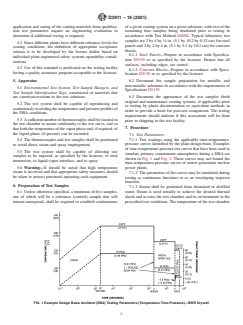
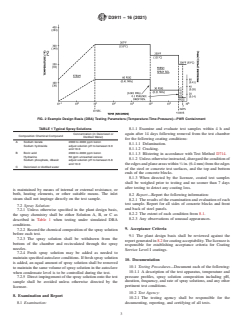
shown in Fig. 1 and Fig. 2. These curves may not bound the
immersion, to liquid-vapor interface, and to spray.
time-temperature-pressure curves of newer generation nuclear
5.6 Warning—It should be noted that high temperature
power plants.
steam is involved and that appropriate safety measures should
7.1.2 The parameters of the curves may be simulated during
be taken to protect personnel operating such equipment.
testing as continuous functions or as an enveloping stepwise
function.
6. Preparation of Test Samples
7.1.3 Steam shall be generated from deionized or distilled
6.1 Unless otherwise specified, a minimum of five samples, water. Steam is u
...