

ASTM D858-17
(Test Method)Standard Test Methods for Manganese in Water
General Information
- Abstract
SIGNIFICANCE AND USE
4.1 Elemental constituents in potable water, receiving water, and wastewater need to be identified for support of effective pollution control programs. Test Methods A, B, and C provide the techniques necessary to make such measurements.
4.2 Although inhaled manganese dusts have been reported to be toxic to humans, manganese normally is ingested as a trace nutrient in both food and water. Because it is considered to be relatively nontoxic to man, as well as aquatic life, a limit of 50 μg/L has been established in the EPA National Secondary Drinking Water Regulations. This limit is based primarily on its ability to stain laundry and produce objectionable tastes in beverages.
4.3 Manganese does not occur naturally as a metal but is found in various salts and minerals, frequently in association with iron compounds. Manganese is not mined in the United States except when manganese is contained in iron ores that are deliberately used to form ferro-manganese alloys. Manganese salts are used as fertilizer additives and are commonly found in surface and ground waters.
4.4 ICP-MS or ICP-AES may also be appropriate but at a higher instrument cost. See Test Methods D5673 and D1976.
SCOPE
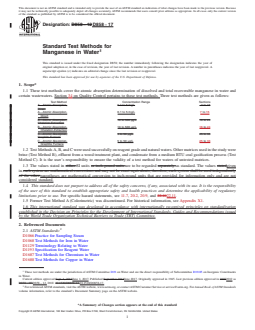
1.1 These test methods cover the atomic absorption determination of dissolved and total recoverable manganese in water and certain wastewaters. Section 34 on Quality Control pertains to these test methods. Three test methods are given as follows:
Test Method
Concentration Range
Sections
A—Atomic Absorption,
Direct
0.1 to 5 mg/L
7 to 15
B—Atomic Absorption,
Chelation-Extraction
10 to 500 μg/L
16 to 24
C—Atomic Absorption,
Graphite Furnace
5 to 50 μg/L
25 to 33
1.2 Test Methods A, B, and C were used successfully on reagent grade and natural waters. Other matrices used in the study were brine (Test Method B), effluent from a wood treatment plant, and condensate from a medium BTU coal gasification process (Test Method C). It is the user's responsibility to ensure the validity of a test method for waters of untested matrices.
1.3 The values stated in SI units are to be regarded as standard. The values given in parentheses are mathematical conversion to inch-pound units that are provided for information only and are not considered standard.
1.4 This standard does not purport to address all of the safety concerns, if any, associated with its use. It is the responsibility of the user of this standard to establish appropriate safety and health practices and determine the applicability of regulatory limitations prior to use. For specific hazard statements, see 11.7, 20.2, 20.9, and 22.11.
1.5 Former Test Method A (Colorimetric) was discontinued. For historical information, see Appendix X1.
1.6 This international standard was developed in accordance with internationally recognized principles on standardization established in the Decision on Principles for the Development of International Standards, Guides and Recommendations issued by the World Trade Organization Technical Barriers to Trade (TBT) Committee.
- Status
- Published
- Publication Date
- 31-May-2017
- Technical Committee
- D19 - Water
- Drafting Committee
- D19.05 - Inorganic Constituents in Water
Overview
ASTM D858-17 - Standard Test Methods for Manganese in Water is an internationally recognized standard published by ASTM International. It details laboratory procedures for the quantitative determination of dissolved and total recoverable manganese in a wide range of water matrices, including potable (drinking) water, surface water, and wastewater. Measuring manganese concentrations is essential in supporting effective pollution control and water quality monitoring programs, as elevated manganese levels can affect both aesthetic and regulatory aspects of water supply.
Key Topics
- Test Methods: ASTM D858-17 provides three specific atomic absorption spectrophotometry (AAS) methods:
- Method A: Direct Atomic Absorption (0.1 – 5 mg/L)
- Method B: Chelation-Extraction Atomic Absorption (10 – 500 μg/L)
- Method C: Graphite Furnace Atomic Absorption (5 – 50 μg/L)
- Regulatory Relevance: The standard supports compliance with the U.S. EPA's National Secondary Drinking Water Regulations, which enforce a secondary maximum contaminant level of 50 μg/L for manganese to minimize taste, odor, and staining problems.
- Water Matrices: These methods are applicable to a diversity of water types, such as reagent-grade water, natural waters, brines, industrial effluents, and condensate from coal gasification processes.
- Quality Control: The standard emphasizes stringent quality control, calibration, and verification steps to ensure result accuracy and reproducibility.
- Sample Handling: Guidance is given for sample collection, preservation (acidification), and holding times to maintain analytical integrity.
Applications
- Drinking Water Compliance: Facilities use ASTM D858-17 to monitor manganese concentrations, ensuring water supplies remain within regulatory limits and do not cause staining or taste issues in household use.
- Environmental Monitoring: Environmental agencies and laboratories employ these test methods to assess manganese pollution in rivers, lakes, and industrial discharges, supporting pollution prevention and remediation strategies.
- Wastewater Treatment: Treatment plants analyze both influent and effluent streams to track manganese removal efficiencies and support permit requirements.
- Industrial and Agricultural Settings: Industries that use or discharge water-such as mining, fertilizer production, and metallurgy-benefit from these methods for process control and regulatory reporting.
- Research and Academic Studies: The standard is widely utilized in research addressing trace metal contamination, geochemical cycling, and ecological effects of manganese in aquatic systems.
Related Standards
For comprehensive water quality assessment and laboratory best practices, consider the following ASTM standards:
- ASTM D1068: Test Methods for Iron in Water
- ASTM D1691: Test Methods for Zinc in Water
- ASTM D1886: Test Methods for Nickel in Water
- ASTM D1976: Test Method for Elements in Water by Inductively-Coupled Plasma Atomic Emission Spectroscopy (ICP-AES)
- ASTM D5673: Test Method for Elements in Water by Inductively Coupled Plasma-Mass Spectrometry (ICP-MS)
- ASTM D3370: Practices for Sampling Water from Closed Conduits
- ASTM D1129: Terminology Relating to Water
Practical Value
ASTM D858-17 enables laboratories and water utilities to:
- Ensure compliance with regulatory manganese limits
- Detect and address sources of manganese pollution
- Protect infrastructure and water quality by preventing manganese-induced staining and taste issues
- Enhance public health and consumer acceptance of water supplies
Using the standard helps maintain data comparability and reliability across projects, states, and countries, which is critical for environmental reporting and public communication regarding water safety.
Relations
- Effective Date
- 01-Dec-2023
- Effective Date
- 01-May-2020
- Effective Date
- 01-May-2020
- Effective Date
- 01-Aug-2018
- Effective Date
- 01-Aug-2018
- Effective Date
- 01-Jul-2018
- Effective Date
- 01-Jun-2017
- Effective Date
- 01-Jun-2017
- Effective Date
- 01-Jun-2017
- Effective Date
- 01-Jul-2015
- Effective Date
- 01-Jun-2015
- Effective Date
- 01-Feb-2015
- Effective Date
- 01-Jan-2013
- Effective Date
- 01-Jan-2013
- Effective Date
- 01-Sep-2012
Get Certified
Connect with accredited certification bodies for this standard

CIS Institut d.o.o.
Personal Protective Equipment (PPE) certification body. Notified Body NB-2890 for EU Regulation 2016/425 PPE.

Kiwa BDA Testing
Building and construction product certification.
Kmetijski inštitut Slovenije
Agricultural Institute of Slovenia. Soil testing, plant health, agricultural product analysis.
Sponsored listings
Frequently Asked Questions
ASTM D858-17 is a standard published by ASTM International. Its full title is "Standard Test Methods for Manganese in Water". This standard covers: SIGNIFICANCE AND USE 4.1 Elemental constituents in potable water, receiving water, and wastewater need to be identified for support of effective pollution control programs. Test Methods A, B, and C provide the techniques necessary to make such measurements. 4.2 Although inhaled manganese dusts have been reported to be toxic to humans, manganese normally is ingested as a trace nutrient in both food and water. Because it is considered to be relatively nontoxic to man, as well as aquatic life, a limit of 50 μg/L has been established in the EPA National Secondary Drinking Water Regulations. This limit is based primarily on its ability to stain laundry and produce objectionable tastes in beverages. 4.3 Manganese does not occur naturally as a metal but is found in various salts and minerals, frequently in association with iron compounds. Manganese is not mined in the United States except when manganese is contained in iron ores that are deliberately used to form ferro-manganese alloys. Manganese salts are used as fertilizer additives and are commonly found in surface and ground waters. 4.4 ICP-MS or ICP-AES may also be appropriate but at a higher instrument cost. See Test Methods D5673 and D1976. SCOPE 1.1 These test methods cover the atomic absorption determination of dissolved and total recoverable manganese in water and certain wastewaters. Section 34 on Quality Control pertains to these test methods. Three test methods are given as follows: Test Method Concentration Range Sections A—Atomic Absorption, Direct 0.1 to 5 mg/L 7 to 15 B—Atomic Absorption, Chelation-Extraction 10 to 500 μg/L 16 to 24 C—Atomic Absorption, Graphite Furnace 5 to 50 μg/L 25 to 33 1.2 Test Methods A, B, and C were used successfully on reagent grade and natural waters. Other matrices used in the study were brine (Test Method B), effluent from a wood treatment plant, and condensate from a medium BTU coal gasification process (Test Method C). It is the user's responsibility to ensure the validity of a test method for waters of untested matrices. 1.3 The values stated in SI units are to be regarded as standard. The values given in parentheses are mathematical conversion to inch-pound units that are provided for information only and are not considered standard. 1.4 This standard does not purport to address all of the safety concerns, if any, associated with its use. It is the responsibility of the user of this standard to establish appropriate safety and health practices and determine the applicability of regulatory limitations prior to use. For specific hazard statements, see 11.7, 20.2, 20.9, and 22.11. 1.5 Former Test Method A (Colorimetric) was discontinued. For historical information, see Appendix X1. 1.6 This international standard was developed in accordance with internationally recognized principles on standardization established in the Decision on Principles for the Development of International Standards, Guides and Recommendations issued by the World Trade Organization Technical Barriers to Trade (TBT) Committee.
SIGNIFICANCE AND USE 4.1 Elemental constituents in potable water, receiving water, and wastewater need to be identified for support of effective pollution control programs. Test Methods A, B, and C provide the techniques necessary to make such measurements. 4.2 Although inhaled manganese dusts have been reported to be toxic to humans, manganese normally is ingested as a trace nutrient in both food and water. Because it is considered to be relatively nontoxic to man, as well as aquatic life, a limit of 50 μg/L has been established in the EPA National Secondary Drinking Water Regulations. This limit is based primarily on its ability to stain laundry and produce objectionable tastes in beverages. 4.3 Manganese does not occur naturally as a metal but is found in various salts and minerals, frequently in association with iron compounds. Manganese is not mined in the United States except when manganese is contained in iron ores that are deliberately used to form ferro-manganese alloys. Manganese salts are used as fertilizer additives and are commonly found in surface and ground waters. 4.4 ICP-MS or ICP-AES may also be appropriate but at a higher instrument cost. See Test Methods D5673 and D1976. SCOPE 1.1 These test methods cover the atomic absorption determination of dissolved and total recoverable manganese in water and certain wastewaters. Section 34 on Quality Control pertains to these test methods. Three test methods are given as follows: Test Method Concentration Range Sections A—Atomic Absorption, Direct 0.1 to 5 mg/L 7 to 15 B—Atomic Absorption, Chelation-Extraction 10 to 500 μg/L 16 to 24 C—Atomic Absorption, Graphite Furnace 5 to 50 μg/L 25 to 33 1.2 Test Methods A, B, and C were used successfully on reagent grade and natural waters. Other matrices used in the study were brine (Test Method B), effluent from a wood treatment plant, and condensate from a medium BTU coal gasification process (Test Method C). It is the user's responsibility to ensure the validity of a test method for waters of untested matrices. 1.3 The values stated in SI units are to be regarded as standard. The values given in parentheses are mathematical conversion to inch-pound units that are provided for information only and are not considered standard. 1.4 This standard does not purport to address all of the safety concerns, if any, associated with its use. It is the responsibility of the user of this standard to establish appropriate safety and health practices and determine the applicability of regulatory limitations prior to use. For specific hazard statements, see 11.7, 20.2, 20.9, and 22.11. 1.5 Former Test Method A (Colorimetric) was discontinued. For historical information, see Appendix X1. 1.6 This international standard was developed in accordance with internationally recognized principles on standardization established in the Decision on Principles for the Development of International Standards, Guides and Recommendations issued by the World Trade Organization Technical Barriers to Trade (TBT) Committee.
ASTM D858-17 is classified under the following ICS (International Classification for Standards) categories: 13.060.50 - Examination of water for chemical substances. The ICS classification helps identify the subject area and facilitates finding related standards.
ASTM D858-17 has the following relationships with other standards: It is inter standard links to ASTM D3558-15(2023), ASTM D1129-13(2020)e2, ASTM D1976-20, ASTM D1066-18e1, ASTM D1066-18, ASTM D1976-18, ASTM D1687-17, ASTM D1691-17, ASTM D3557-17, ASTM D5673-15, ASTM D3559-15, ASTM D3558-15, ASTM D4841-88(2013), ASTM D4841-88(2013)e1, ASTM D1691-12. Understanding these relationships helps ensure you are using the most current and applicable version of the standard.
ASTM D858-17 is available in PDF format for immediate download after purchase. The document can be added to your cart and obtained through the secure checkout process. Digital delivery ensures instant access to the complete standard document.
Standards Content (Sample)
This international standard was developed in accordance with internationally recognized principles on standardization established in the Decision on Principles for the
Development of International Standards, Guides and Recommendations issued by the World Trade Organization Technical Barriers to Trade (TBT) Committee.
Designation: D858 − 17
Standard Test Methods for
Manganese in Water
This standard is issued under the fixed designation D858; the number immediately following the designation indicates the year of
original adoption or, in the case of revision, the year of last revision. A number in parentheses indicates the year of last reapproval. A
superscript epsilon (´) indicates an editorial change since the last revision or reapproval.
This standard has been approved for use by agencies of the U.S. Department of Defense.
1. Scope* Development of International Standards, Guides and Recom-
mendations issued by the World Trade Organization Technical
1.1 These test methods cover the atomic absorption deter-
Barriers to Trade (TBT) Committee.
mination of dissolved and total recoverable manganese in
water and certain wastewaters. Section 34 on Quality Control
2. Referenced Documents
pertains to these test methods. Three test methods are given as
2.1 ASTM Standards:
follows:
D1066 Practice for Sampling Steam
Test Method Concentration Range Sections
D1068 Test Methods for Iron in Water
A—Atomic Absorption, 0.1 to 5 mg/L 7 to 15
Direct
D1129 Terminology Relating to Water
B—Atomic Absorption, 10 to 500 µg/L 16 to 24
D1193 Specification for Reagent Water
Chelation-Extraction
D1687 Test Methods for Chromium in Water
C—Atomic Absorption, 5to50µg/L 25 to 33
Graphite Furnace
D1688 Test Methods for Copper in Water
D1691 Test Methods for Zinc in Water
1.2 Test Methods A, B, and C were used successfully on
reagent grade and natural waters. Other matrices used in the D1886 Test Methods for Nickel in Water
D1976 Test Method for Elements in Water by Inductively-
study were brine (Test Method B), effluent from a wood
treatment plant, and condensate from a medium BTU coal Coupled Argon Plasma Atomic Emission Spectroscopy
D2777 Practice for Determination of Precision and Bias of
gasification process (Test Method C). It is the user’s responsi-
bility to ensure the validity of a test method for waters of Applicable Test Methods of Committee D19 on Water
untested matrices. D3370 Practices for Sampling Water from Closed Conduits
D3557 Test Methods for Cadmium in Water
1.3 The values stated in SI units are to be regarded as
D3558 Test Methods for Cobalt in Water
standard. The values given in parentheses are mathematical
D3559 Test Methods for Lead in Water
conversion to inch-pound units that are provided for informa-
D3919 Practice for Measuring Trace Elements in Water by
tion only and are not considered standard.
Graphite Furnace Atomic Absorption Spectrophotometry
1.4 This standard does not purport to address all of the
D4841 Practice for Estimation of Holding Time for Water
safety concerns, if any, associated with its use. It is the
Samples Containing Organic and Inorganic Constituents
responsibility of the user of this standard to establish appro-
D5673 Test Method for Elements in Water by Inductively
priate safety and health practices and determine the applica-
Coupled Plasma—Mass Spectrometry
bility of regulatory limitations prior to use. For specific hazard
D5810 Guide for Spiking into Aqueous Samples
statements, see 11.7, 20.2, 20.9, and 22.11.
D5847 Practice for Writing Quality Control Specifications
1.5 FormerTest MethodA(Colorimetric) was discontinued.
for Standard Test Methods for Water Analysis
For historical information, see Appendix X1.
3. Terminology
1.6 This international standard was developed in accor-
dance with internationally recognized principles on standard-
3.1 Definitions:
ization established in the Decision on Principles for the
3.1.1 For definitions of terms used in this standard, refer to
Terminology D1129.
These test methods are under the jurisdiction of ASTM Committee D19 on
Water and are the direct responsibility of Subcommittee D19.05 on Inorganic
Constituents in Water. For referenced ASTM standards, visit the ASTM website, www.astm.org, or
Current edition approved June 1, 2017. Published June 2017. Originally contact ASTM Customer Service at service@astm.org. For Annual Book of ASTM
approved in 1945. Last previous edition approved in 2012 as D858 – 12. DOI: Standards volume information, refer to the standard’s Document Summary page on
10.1520/D0858-17. the ASTM website.
*A Summary of Changes section appears at the end of this standard
Copyright © ASTM International, 100 Barr Harbor Drive, PO Box C700, West Conshohocken, PA 19428-2959. United States
D858 − 17
3.2 Definitions of Terms Specific to This Standard: bias and precision of the determination. Type II water was
3.2.1 continuing calibration blank, n—a solution contain- specified at the time of round-robin testing of this test method.
ing no analytes (of interest) which is used to verify blank
6. Sampling
response and freedom from carryover.
6.1 Collect the sample in accordance with Practice D1066,
3.2.2 continuing calibration verification, n—a solution (or
or Practices D3370 as applicable.
setofsolutions)ofknownconcentrationusedtoverifyfreedom
from excessive instrumental drift; the concentration is to cover
6.2 Samples shall be preserved with HNO (sp gr 1.42),
the range of calibration curve.
normally about 2 mL/L, to a pH of 2 or less immediately at the
time of collection. If only dissolved manganese is to be
3.2.3 total recoverable manganese, n—a descriptive term
determined,thesampleshallbefilteredthrougha0.45-µm(No.
relating to the forms of manganese recovered in the acid
325) membrane filter (11.8) before acidification. The holding
digestion procedure specified in this test standard.
timeforsamplesmaybecalculatedinaccordancewithPractice
D4841.
4. Significance and Use
NOTE 1—Alternatively, the pH may be adjusted in the laboratory within
4.1 Elementalconstituentsinpotablewater,receivingwater,
14 days of collection. However, acid must be added at least 24 hours
and wastewater need to be identified for support of effective
before analysis to dissolve any metals that adsorb to the container walls.
This could reduce hazards of working with acids in the field when
pollution control programs. Test MethodsA, B, and C provide
appropriate.
the techniques necessary to make such measurements.
4.2 Although inhaled manganese dusts have been reported
TEST METHOD A—ATOMIC ABSORPTION, DIRECT
to be toxic to humans, manganese normally is ingested as a
7. Scope
trace nutrient in both food and water. Because it is considered
to be relatively nontoxic to man, as well as aquatic life, a limit
7.1 This test method covers the determination of dissolved
of 50 µg/Lhas been established in the EPANational Secondary
and total recoverable manganese and has been used success-
Drinking Water Regulations. This limit is based primarily on
fully with reagent and natural water. It is the analyst’s
its ability to stain laundry and produce objectionable tastes in
responsibility to ensure the validity of the method in a
beverages.
particular matrix.
4.3 Manganese does not occur naturally as a metal but is
7.2 This test method is applicable in the range from 0.1 to 5
found in various salts and minerals, frequently in association
mg/L of manganese. The range may be extended to concentra-
with iron compounds. Manganese is not mined in the United
tions greater than 5 mg/L by dilution of the sample.
Statesexceptwhenmanganeseiscontainedinironoresthatare
8. Summary of Test Method
deliberately used to form ferro-manganese alloys. Manganese
salts are used as fertilizer additives and are commonly found in
8.1 Manganese is determined by atomic absorption spectro-
surface and ground waters.
photometry. Dissolved manganese is determined by atomizing
a filtered sample directly with no pretreatment. Total recover-
4.4 ICP-MS or ICP-AES may also be appropriate but at a
able manganese in the sample is determined in a portion of the
higher instrument cost. See Test Methods D5673 and D1976.
filtrate obtained after a hydrochloric-nitric acid digestion of the
sample. The same digestion procedure is used to determine
5. Purity of Reagents
total recoverable cadmium (Test Methods D3557), chromium
5.1 Reagent grade chemicals shall be used in all tests.
(Test Methods D1687), cobalt (Test Methods D3558), copper
Unless otherwise indicated, it is intended that all reagents shall
(Test Methods D1688), iron (Test Methods D1068), lead (Test
conform to the specifications of the Committee on Analytical
Methods D3559), nickel (Test Methods D1886), and zinc (Test
Reagents of the American Chemical Society, where such
Methods D1691).
specifications are available. Other grades may be used,
provided it is first ascertained that the reagent is of sufficiently
9. Interferences
high purity to permit its use without lessening the accuracy of
9.1 Magnesium in concentrations greater than 100 mg/L
the determination.
may interfere.
5.2 Purity of Water—Unless otherwise indicated, references
9.2 No interference from SiO in concentrations up to 100
towatershallbeunderstoodtomeanreagentwaterconforming
mg/L has been observed.
to Specification D1193, Type I. Other reagent water types may
9.3 Background correction or chelation-extraction (see Test
be used, provided it is first ascertained that the water is of
sufficiently high purity to permit its use without lessening the Method B) to remove interferences may be necessary to
determine low levels of manganese in some waters.
NOTE 2—Instrument manufacturers’ instructions for use of the specific
correction technique should be followed.
Reagent Chemicals, American Chemical Society Specifications, American
Chemical Society, Washington, DC. For Suggestions on the testing of reagents not
listed by the American Chemical Society, see Annual Standards for Laboratory 10. Apparatus
Chemicals, BDH Ltd., Poole, Dorset, U.K., and the United States Pharmacopeia
10.1 Atomic Absorption Spectrophotometer, for use at 279.5
and National Formulary, U.S. Pharmacopeial Convention, Inc. (USPC), Rockville,
MD. nm.
D858 − 17
NOTE 3—The manufacturer’s instructions should be followed for all
tration range of the samples to be analyzed by diluting the
instrumental parameters. A wavelength other than 279.5 nm may be used
manganesestandardsolutionwithHNO (1 + 499).Preparethe
if it has been determined to be equally suitable.
standards each time the test is to be performed, and select so as
10.1.1 Manganese Light Source—Multielementlamps,elec-
to give zero, middle, and maximum points for an analytical
trodeless discharge lamps, or hollow-cathode lamps have been
curve.
found satisfactory.
NOTE 6—It is recommended that the blank (zero standard) be compared
10.2 Pressure-Reducing Valves—The supplies of fuel and
with reagent grade water to avoid the possibility of using a high blank.
oxidant shall be maintained at pressures somewhat higher than
12.2 When determining total recoverable manganese add
the controlled operating pressure of the instrument by suitable
0.5 mL of HNO (sp gr 1.42) and proceed as directed in 13.3.
valves.
When determining dissolved manganese proceed with 13.6.
12.3 Aspirate the blank and standards and record the instru-
11. Reagents and Materials
ment readings. Aspirate HNO (1 + 499) between each stan-
11.1 Hydrochloric Acid (sp gr 1.19)—Concentrated hydro-
dard.
chloric acid (HCl).
12.4 Read directly in concentration if this capability is
NOTE 4—If a high reagent blank is obtained, distill the HCl or use
provided with the instrument or measure the absorbance of the
spectrograde acid. (Warning—When HCl is distilled, an azeotropic
standards and prepare an analytical curve by plotting the
mixture is obtained (approximately 6 NHCl.) Therefore, whenever con-
absorbance of each standard versus its concentration on linear
centrated HCl is specified in the preparation of a reagent or in the
procedure, use double the amount specified if distilled acid is used.) graph paper.
11.2 Manganese Solution, Stock (1.0 mL = 1.0 mg Mn)—
13. Procedure
Dissolve 3.076 g of manganous sulfate monohydrate
13.1 An effective way to clean all glassware to be used for
(MnSO ·H O) in a mixture of 10 mLof HNO (sp gr 1.42) and
4 2 3
preparation of standard solutions or in the digestion step, or
100 mL of water. Dilute to 1 L with water. A purchased
both, is by soaking the glassware overnight with HNO3 (1 + 1)
manganese stock solution of appropriate known purity is also
and then rinse with reagent.
acceptable.
13.2 Measure 100.0 mL of a well-mixed acidified sample
11.3 Manganese Solution, Standard (1.0 mL = 0.1 mg
into a 125-mL beaker or flask.
Mn)—Dilute100.0mLofmanganesestocksolutionto1Lwith
NOTE 7—If only dissolved manganese is to be determined, start with
water.
13.6.
11.4 Nitric Acid (sp gr 1.42)—Concentrated nitric acid
13.3 Add 5 mL of HCl (sp gr 1.19) to each sample.
(HNO ).
13.4 Heat the samples (between 65°C to 95°C) on a steam
NOTE 5—If a high reagent blank is obtained, distill the HNO or use
bath or hot plate below boiling in a well-ventilated hood until
spectrograde acid.
the volume has been reduced to 15 or 20 mL, making certain
11.5 Nitric Acid (1 + 499)—Add 1 volume of HNO (sp gr
that the samples do not boil.
1.42) to 499 volumes of water.
NOTE 8—For brines and samples with high levels of suspended matter,
11.6 Oxidant:
the amount of reduction in volume is left to the discretion of the analyst.
11.6.1 Air, which has been passed through a suitable filter to
NOTE 9—Many laboratories have found block digestion systems a
useful way to digest samples for trace metals analysis. Systems typically
remove oil, water, and other foreign substances, is the usual
consist of either a metal or graphite block with wells to hold digestion
oxidant.
tubes. The block temperature controller must be able to maintain unifor-
11.7 Fuel: Acetylene—standard, commercially available mity of temperature across all positions of the block. The digestion block
must be capable of maintaining a temperature between 65°C to 95°C. For
acetylene is the usual fuel. Acetone, always present in acety-
trace metals analysis, the digestion tubes should be constructed of
lenecylinders,canaffectanalyticalresults.Thecylindershould
polypropylene and have a volume accuracy of at least 0.5 %. All lots of
be replaced at 345 kPa (50 psi). (Warning—“Purified” grade
tubes should come with a certificate of analysis to demonstrate suitability
acetylene containing a special proprietary solvent other than
for their intended purpose.
acetone should not be used with poly(vinyl chloride) tubing as
13.5 Cool and filter the samples through a suitable filter
weakening of the tubing walls can cause a potentially hazard-
paper, such as fine-textured, acid-washed, ashless paper into
ous situation.)
100-mL volumetric flasks. Wash the filter paper two or three
11.8 Filter Paper—Purchase suitable filter paper. Typically
times with water and adjust to volume.
the filter papers have a pore size of 0.45-µm membrane.
13.6 Set the instrument to zero using reagent blank (zero
Material such as fine-textured, acid-washed, ashless paper, or
standard).Aspirate each filtered acidified sample and standard;
glass fiber paper are acceptable. The user must first ascertain
record its absorbance or concentration. Aspirate HNO
that the filter paper is of sufficient purity to use without
(1 + 499) between each sample and standard.
adversely affecting the bias and precision of the test method.
14. Calculation
12. Standardization
14.1 Determine the concentration of manganese in each
12.1 Prepare 100 mL each of a blank and at least four sample, in milligrams per L, using an analytical curve or,
standard solutions to bracket the expected manganese concen- alternatively, read directly in concentration (see 12.4).
D858 − 17
TABLE 1 Precision and Concentration, Direct Aspiration TABLE 2 Determination of Bias, Direct Aspiration
Reagent water: Statistically
¯
Concentration (X), mg/L 0.424 2.034 4.053 Amount Amount Significant
S 0.045 0.177 0.317 Added, Found, Bias, mg/L % Bias (95%
T
S 0.021 0.070 0.151 mg/L mg/L Confidence
O
Natural water: Level)
¯
Concentration (X), mg/L 0.417 2.033 4.076
Reagent water:
S 0.045 0.179 0.305
T
0.4 0.424 +0.024 +6 yes
S 0.037 0.074 0.149
O
2.0 2.034 +0.034 +1.7 no
4.0 4.053 +0.053 +1.3 no
Natural water:
0.4 0.417 +0.017 +4.2 yes
15. Precision and Bias 2.0 2.033 +0.033 +1.7 no
4.0 4.076 +0.076 +1.9 yes
15.1 The supporting data on this collaborative study in-
cludes reagent and natural water matrices. It is the responsi-
bility of the analyst to ensure the validity of the test method in
a particular matrix.
19. Apparatus
15.2 The precision of this test method was tested by eleven
laboratories. Five laboratories reported data for two operators.
19.1 All items of apparatus described in Section 10 are
The precision of this test method is shown in Table 1; the bias
required.
is shown in Table 2.
20. Reagents and Materials
15.3 Precision and bias for this test method conform to
Practice D2777 – 77, which was in place at the time of
20.1 Bromcresol Green Indicator Solution (1 g/L)—
collaborative testing. Under the allowances made in 1.4 of
Dissolve 0.1 g of bromcresol green in 100 mLof 20 % ethanol.
Practice D2777 – 13, these precision and bias data do meet
20.2 Chloroform (CHCl ). (Warning—Use in well-
existing requirements for interlaboratory studies of Committee
ventilated hood.)
D19 test methods.
20.3 Hydrochloric Acid (sp gr 1.19)—Concentrated hydro-
TEST METHOD B—ATOMIC ABSORPTION,
chloric acid (HCl) (see Note 4).
CHELATION-EXTRACTION
20.4 Hydrochloric Acid(1+2)—Add 1 volume of HCl (sp
gr 1.19) to 2 volumes of water (see Note 4).
16. Scope
20.5 Hydrochloric Acid (1 + 49)—Add 1 volume of HCl (sp
16.1 This test method covers the determination of dissolved
gr 1.19) to 49 volumes of water.
and total recoverable manganese and has been used success-
fully with reagent water, tap water, river water, artificial
20.6 Manganese Solution, Stock (1.0 mL = 100 µg Mn)—
seawater and a synthetic (NaCl) brine. It is the user’s respon-
Dissolve 0.3076 g of manganous sulfate monohydrate
sibility to ensure the validity of this test method for waters of
(MnSO ·H O) in water containing 1 mL of HNO (sp gr 1.42)
4 2 3
other matrices.
and dilute to 1 L with water. A purchased stock solution of
appropriate purity is also acceptable.
16.2 This test method is applicable in the range from 10 to
500 µg/L of manganese. The range may be extended to
20.7 Manganese Solution, Standard (1.0 mL = 1.0 µg
concentrations greater than 500 µg/Lby dilution of the sample.
Mn)—Dilute10.0mLofmanganesestocksolutionand1mLof
HNO (sp gr 1.42) to 1 L with water. This standard is used to
17. Summary of Test Method
prepare working standards at the time of analysis.
17.1 Manganese is determined by atomic absorption spec-
20.8 Nitric Acid (sp gr 1.42)—Concentrated nitric acid
trophotometry. The element, either dissolved or total
(HNO ) (see Note 5).
recoverable, is chelated with pyrrolidine dithiocarbamic acid
20.9 Pyrrolidine Dithiocarbamic Acid-Chloroform
and extracted with chloroform. The extract is evaporated to
Reagent—Add 36 mLof pyrrolidine to 1 Lof CHCl . Cool the
dryness, treated with hot HNO to destroy organic matter,
solution and add 30 mL of CS in small portions, swirling
dissolved in HCl, and diluted to a specified volume with water. 2
between additions. Dilute to 2 Lwith CHCl . The reagent can
A portion of the resulting solution is then atomized into the
be used for several months if stored in a cool, dark place.
air-acetylene flame of the spectrophotometer. The digestion
(Warning—All components of this reagent are highly toxic.
procedure summarized in 8.1 is used to determine total
Prepareanduseinawell-ventilatedhood.Avoidinhalationand
recoverable manganese.
direct contact.)
18. Interferences
20.10 Sodium Hydroxide Solution (100 g/L)—Dissolve 100
18.1 See Section 9.
g of sodium hydroxide (NaOH) in water and dilute to 1 L.
20.11 Oxidant—See 11.6.
Supporting data Test Methods A and B have been filed at ASTM International
20.12 Fuel—See 11.7.
Headquarters and may be obtained by requesting Research Report RR:D19-1034.
Contact ASTM Customer Service at service@astm.org. 20.13 pH Paper—See 11.8.
D858 − 17
21. Standardization 22.8 Add 10 mL of pyrrolidine dithiocarbamic acid-
chloroform (20.9) reagent and shake vigorously for 2 min.
21.1 Prepare a blank and sufficient standards containing
22.9 Plug the tip of the separatory funnel with cotton, allow
from 0.0 to 50.0 µg of manganese by diluting 0 to 50.0-mL
portions of manganese standard solution (20.7) to 100 mLwith the phases to separate, and drain the chloroform phase into a
100-mL beaker.
water.
22.10 Repeat the extraction with 10 mL of chloroform
21.2 To determine total recoverable manganese use 125-mL
(20.2) and drain the chloroform layer into the same beakers.
beakers or flasks, add 0.5 mL of HNO (sp gr 1.42) and
proceed as directed in 22.3.To determine dissolved manganese
NOTE 14—If color still remains in the chloroform extract, reextract the
use250-mLseparatoryfunnelsandproceedasdirectedin22.6.
aqueous phase until the chloroform layer is colorless.
21.3 Read directly in concentration if this capability is
22.11 Place the beaker on a hotplate set at low heat or on a
provided with the instrument or construct an analytical curve steambathandevaporatetoneardryness.Removebeakerfrom
by plotting the absorbances of standards versus micrograms of
heat and allow residual solvent to evaporate without further
manganese. heating. (Warning—Perform in a well-ventilated hood.) See
Note 12.
22. Procedure
22.12 Hold the beaker at a 45° angle, and slowly dropwise
add 2 mL of HNO (sp gr 1.42), rotating the beaker to effect
22.1 An effective way to clean all glassware to be used for
thorough contact of the acid with the residue.
preparation of standard solutions or in the digestion step, or
both, is by soaking the glassware overnight with HNO (1+1)
NOTE 15—If acid is added to the beaker in a vertical position, a violent
and then rinse with reagent.
reaction will occur accompanied by high heat and spattering.
22.2 Measure a volume of a well-mixed acidified sample 22.13 Place the beaker on a
...
This document is not an ASTM standard and is intended only to provide the user of an ASTM standard an indication of what changes have been made to the previous version. Because
it may not be technically possible to adequately depict all changes accurately, ASTM recommends that users consult prior editions as appropriate. In all cases only the current version
of the standard as published by ASTM is to be considered the official document.
Designation: D858 − 12 D858 − 17
Standard Test Methods for
Manganese in Water
This standard is issued under the fixed designation D858; the number immediately following the designation indicates the year of
original adoption or, in the case of revision, the year of last revision. A number in parentheses indicates the year of last reapproval. A
superscript epsilon (´) indicates an editorial change since the last revision or reapproval.
This standard has been approved for use by agencies of the U.S. Department of Defense.
1. Scope*
1.1 These test methods cover the atomic absorption determination of dissolved and total recoverable manganese in water and
certain wastewaters. Section 34 on Quality Control pertains to these test methods. Three test methods are given as follows:
Test Method Concentration Range Sections
A—Atomic Absorption, 0.1 to 5 mg/L 7 to 15
Direct
A—Atomic Absorption, 0.1 to 5 mg/L 7 to 15
Direct
B—Atomic Absorption, 10 to 500 μg/L 16 to 24
Chelation-Extraction
B—Atomic Absorption, 10 to 500 μg/L 16 to 24
Chelation-Extraction
C—Atomic Absorption, 5 to 50 μg/L 25 to 33
Graphite Furnace
C—Atomic Absorption, 5 to 50 μg/L 25 to 33
Graphite Furnace
1.2 Test Methods A, B, and C were used successfully on reagent grade and natural waters. Other matrices used in the study were
brine (Test Method B), effluent from a wood treatment plant, and condensate from a medium BTU coal gasification process (Test
Method C). It is the user’s responsibility to ensure the validity of a test method for waters of untested matrices.
1.3 The values stated in either SI units or inch-pound units are to be regarded separately as standard. The values statedgiven
in each system are mathematical conversions and may not be exact equivalents; therefore, each system shall be used independently
of the other.parentheses are mathematical conversion to inch-pound units that are provided for information only and are not
considered standard.
1.4 This standard does not purport to address all of the safety concerns, if any, associated with its use. It is the responsibility
of the user of this standard to establish appropriate safety and health practices and determine the applicability of regulatory
limitations prior to use. For specific hazard statements, see 11.7, 20.2, 20.9, and 22.1022.11.
1.5 Former Test Method A (Colorimetric) was discontinued. For historical information, see Appendix X1.
1.6 This international standard was developed in accordance with internationally recognized principles on standardization
established in the Decision on Principles for the Development of International Standards, Guides and Recommendations issued
by the World Trade Organization Technical Barriers to Trade (TBT) Committee.
2. Referenced Documents
2.1 ASTM Standards:
D1066 Practice for Sampling Steam
D1068 Test Methods for Iron in Water
D1129 Terminology Relating to Water
D1193 Specification for Reagent Water
D1687 Test Methods for Chromium in Water
D1688 Test Methods for Copper in Water
These test methods are under the jurisdiction of ASTM Committee D19 on Water and are the direct responsibility of Subcommittee D19.05 on Inorganic Constituents
in Water.
Current edition approved Sept. 1, 2012June 1, 2017. Published September 2012June 2017. Originally approved in 1945. Last previous edition approved in 20072012 as
D858 – 07.D858 – 12. DOI: 10.1520/D0858-12.10.1520/D0858-17.
For referenced ASTM standards, visit the ASTM website, www.astm.org, or contact ASTM Customer Service at service@astm.org. For Annual Book of ASTM Standards
volume information, refer to the standard’s Document Summary page on the ASTM website.
*A Summary of Changes section appears at the end of this standard
Copyright © ASTM International, 100 Barr Harbor Drive, PO Box C700, West Conshohocken, PA 19428-2959. United States
D858 − 17
D1691 Test Methods for Zinc in Water
D1886 Test Methods for Nickel in Water
D1976 Test Method for Elements in Water by Inductively-Coupled Argon Plasma Atomic Emission Spectroscopy
D2777 Practice for Determination of Precision and Bias of Applicable Test Methods of Committee D19 on Water
D3370 Practices for Sampling Water from Closed Conduits
D3557 Test Methods for Cadmium in Water
D3558 Test Methods for Cobalt in Water
D3559 Test Methods for Lead in Water
D3919 Practice for Measuring Trace Elements in Water by Graphite Furnace Atomic Absorption Spectrophotometry
D4841 Practice for Estimation of Holding Time for Water Samples Containing Organic and Inorganic Constituents
D5673 Test Method for Elements in Water by Inductively Coupled Plasma—Mass Spectrometry
D5810 Guide for Spiking into Aqueous Samples
D5847 Practice for Writing Quality Control Specifications for Standard Test Methods for Water Analysis
3. Terminology
3.1 Definitions:
3.1.1 For definitions of terms used in this standard, refer to Terminology D1129.
D858 − 17
3.2 Definitions of Terms Specific to This Standard:
3.2.1 continuing calibration blank, n—a solution containing no analytes (of interest) which is used to verify blank response and
freedom from carryover.
3.2.2 continuing calibration verification, n—a solution (or set of solutions) of known concentration used to verify freedom from
excessive instrumental drift; the concentration is to cover the range of calibration curve.
3.2.3 total recoverable manganese—manganese, n—an arbitrary analytical a descriptive term relating to the recoverable forms
of manganese that are determinable by the digestion method that is included in the procedure.recovered in the acid digestion
procedure specified in this test standard.
3.2 Definitions:
3.2.1 For definitions of terms used in these test methods, refer to Terminology D1129.
4. Significance and Use
4.1 Elemental constituents in potable water, receiving water, and wastewater need to be identified for support of effective
pollution control programs. Test Methods A, B, and C provide the techniques necessary to make such measurements.
4.2 Although inhaled manganese dusts have been reported to be toxic to humans, manganese normally is ingested as a trace
nutrient in both food and water. Because it is considered to be relatively nontoxic to man, as well as aquatic life, a limit of 50 μg/L
has been established in the EPA National Secondary Drinking Water Regulations. This limit is based primarily on its ability to stain
laundry and produce objectionable tastes in beverages.
4.3 Manganese does not occur naturally as a metal but is found in various salts and minerals, frequently in association with iron
compounds. Manganese is not mined in the United States except when manganese is contained in iron ores that are deliberately
used to form ferro-manganese alloys. Manganese salts are used as fertilizer additives and are commonly found in surface and
ground waters.
4.4 ICP-MS or ICP-AES may also be appropriate but at a higher instrument cost. See Test Methods D5673 and D1976.
5. Purity of Reagents
5.1 Reagent grade chemicals shall be used in all tests. Unless otherwise indicated, it is intended that all reagents shall conform
to the specifications of the Committee on Analytical Reagents of the American Chemical Society, where such specifications are
available. Other grades may be used, provided it is first ascertained that the reagent is of sufficiently high purity to permit its use
without lessening the accuracy of the determination.
5.2 Purity of Water—Unless otherwise indicated, references to water shall be understood to mean reagent water conforming to
Specification D1193, Type I. Other reagent water types may be used, provided it is first ascertained that the water is of sufficiently
high purity to permit its use without lessening the bias and precision of the determination. Type II water was specified at the time
of round-robin testing of this test method.
6. Sampling
6.1 Collect the sample in accordance with Practice D1066, or Practices D3370 as applicable.
6.2 Samples shall be preserved with HNO (sp gr 1.42), normally about 2 mL/L, to a pH of 2 or less immediately at the time
of collection. If only dissolved manganese is to be determined, the sample shall be filtered through a 0.45-μm (No. 325) membrane
filter (11.8) before acidification. The holding time for samples may be calculated in accordance with Practice D4841.
NOTE 1—Alternatively, the pH may be adjusted in the laboratory if the sample is returned within 14 days. within 14 days of collection. However, acid
must be added at least 24 hours before analysis to dissolve any metals that adsorb to the container walls. This could reduce hazards of working with acids
in the field when appropriate.
TEST METHOD A—ATOMIC ABSORPTION, DIRECT
7. Scope
7.1 This test method covers the determination of dissolved and total recoverable manganese and has been used successfully with
reagent and natural water. It is the analyst’s responsibility to ensure the validity of the method in a particular matrix.
7.2 This test method is applicable in the range from 0.1 to 5 mg/L of manganese. The range may be extended to concentrations
greater than 5 mg/L by dilution of the sample.
Reagent Chemicals, American Chemical Society Specifications, American Chemical Society, Washington, DC. For Suggestions on the testing of reagents not listed by
the American Chemical Society, see Annual Standards for Laboratory Chemicals, BDH Ltd., Poole, Dorset, U.K., and the United States Pharmacopeia and National
Formulary, U.S. Pharmacopeial Convention, Inc. (USPC), Rockville, MD.
D858 − 17
7. Scope
7.1 This test method covers the determination of dissolved and total recoverable manganese and has been used successfully with
reagent and natural water. It is the analyst’s responsibility to ensure the validity of the method in a particular matrix.
7.2 This test method is applicable in the range from 0.1 to 5 mg/L of manganese. The range may be extended to concentrations
greater than 5 mg/L by dilution of the sample.
8. Summary of Test Method
8.1 Manganese is determined by atomic absorption spectrophotometry. Dissolved manganese is determined by atomizing a
filtered sample directly with no pretreatment. Total recoverable manganese in the sample is determined in a portion of the filtrate
obtained after a hydrochloric-nitric acid digestion of the sample. The same digestion procedure is used to determine total
recoverable cadmium (Test Methods D3557), chromium (Test Methods D1687), cobalt (Test Methods D3558), copper (Test
Methods D1688), iron (Test Methods D1068), lead (Test Methods D3559), nickel (Test Methods D1886), and zinc (Test Methods
D1691).
9. Interferences
9.1 Magnesium in concentrations greater than 100 mg/L may interfere.
9.2 No interference from SiO in concentrations up to 100 mg/L has been observed.
9.3 Background correction or chelation-extraction (see Test Method B) to remove interferences may be necessary to determine
low levels of manganese in some waters.
NOTE 2—Instrument manufacturers’ instructions for use of the specific correction technique should be followed.
10. Apparatus
10.1 Atomic Absorption Spectrophotometer, for use at 279.5 nm.
NOTE 3—The manufacturer’s instructions should be followed for all instrumental parameters. A wavelength other than 279.5 nm may be used if it has
been determined to be equally suitable.
10.1.1 Manganese Light Source—Multielement lamps, electrodeless discharge lamps, or hollow-cathode lamps have been found
satisfactory.
10.2 Pressure-Reducing Valves—The supplies of fuel and oxidant shall be maintained at pressures somewhat higher than the
controlled operating pressure of the instrument by suitable valves.
11. Reagents and Materials
11.1 Hydrochloric Acid (sp gr 1.19)—Concentrated hydrochloric acid (HCl).
NOTE 4—If a high reagent blank is obtained, distill the HCl or use spectrograde acid. (Warning—When HCl is distilled, an azeotropic mixture is
obtained (approximately 6 NHCl.HCl.) Therefore, whenever concentrated HCl is specified in the preparation of a reagent or in the procedure, use double
the amount specified if distilled acid is used.) Therefore, whenever concentrated HCl is specified in the preparation of a reagent or in the procedure, use
double the amount specified if distilled acid is used.)
11.2 Manganese Solution, Stock (1.0 mL = 1.0 mg Mn)—Dissolve 3.076 g of manganous sulfate monohydrate (MnSO ·H O)
4 2
in a mixture of 10 mL of HNO (sp gr 1.42) and 100 mL of water. Dilute to 1 L with water. A purchased manganese stock solution
of appropriate known purity is also acceptable.
11.3 Manganese Solution, Standard (1.0 mL = 0.1 mg Mn)—Dilute 100.0 mL of manganese stock solution to 1 L with water.
11.4 Nitric Acid (sp gr 1.42)—Concentrated nitric acid (HNO ).
NOTE 5—If a high reagent blank is obtained, distill the HNO or use spectrograde acid.
11.5 Nitric Acid (1 + 499)—Add 1 volume of HNO (sp gr 1.42) to 499 volumes of water.
11.6 Oxidant:
11.6.1 Air, which has been passed through a suitable filter to remove oil, water, and other foreign substances, is the usual
oxidant.
11.7 Fuel: Acetylene—standard, commercially available acetylene is the usual fuel. Acetone, always present in acetylene
cylinders, can affect analytical results. The cylinder should be replaced at 345 kPa (50 psi). (Warning—“Purified” grade acetylene
containing a special proprietary solvent other than acetone should not be used with poly(vinyl chloride) tubing as weakening of
the tubing walls can cause a potentially hazardous situation.)
11.8 Filter Paper—Purchase suitable filter paper. Typically the filter papers have a pore size of 0.45-μm membrane. Material
such as fine-textured, acid-washed, ashless paper, or glass fiber paper are acceptable. The user must first ascertain that the filter
paper is of sufficient purity to use without adversely affecting the bias and precision of the test method.
D858 − 17
TABLE 1 Precision and Concentration, Direct Aspiration
Reagent water:
Concentration (X¯), mg/L 0.424 2.034 4.053
S 0.045 0.177 0.317
T
S 0.021 0.070 0.151
O
Natural water:
Concentration (X¯), mg/L 0.417 2.033 4.076
S 0.045 0.179 0.305
T
S 0.037 0.074 0.149
O
12. Standardization
12.1 Prepare 100 mL each of a blank and at least four standard solutions to bracket the expected manganese concentration range
of the samples to be analyzed by diluting the manganese standard solution with HNO (1 + 499). Prepare the standards each time
the test is to be performed, and select so as to give zero, middle, and maximum points for an analytical curve.
NOTE 6—It is recommended that the blank (zero standard) be compared with reagent grade water to avoid the possibility of using a high blank.
12.2 When determining total recoverable manganese add 0.5 mL of HNO (sp gr 1.42) and proceed as directed in 13.213.3.
When determining dissolved manganese proceed with 13.513.6.
12.3 Aspirate the blank and standards and record the instrument readings. Aspirate HNO (1 + 499) between each standard.
12.4 Prepare Read directly in concentration if this capability is provided with the instrument or measure the absorbance of the
standards and prepare an analytical curve by plotting the absorbance of each standard versus its concentration on linear graph
paper. Alternatively read directly in concentration from the instrument.
13. Procedure
13.1 An effective way to clean all glassware to be used for preparation of standard solutions or in the digestion step, or both,
is by soaking the glassware overnight with HNO3 (1 + 1) and then rinse with reagent.
13.2 Measure 100.0 mL of a well-mixed acidified sample into a 125-mL beaker or flask.
NOTE 7—If only dissolved manganese is to be determined, start with 13.513.6.
13.3 Add 5 mL of HCl (sp gr 1.19) to each sample.
13.4 Heat the samples (between 65°C to 95°C) on a steam bath or hot plate below boiling in a well-ventilated hood until the
volume has been reduced to 15 or 20 mL, making certain that the samples do not boil.
NOTE 8—For brines and samples with high levels of suspended matter, the amount of reduction in volume is left to the discretion of the analyst.
NOTE 9—Many laboratories have found block digestion systems a useful way to digest samples for trace metals analysis. Systems typically consist of
either a metal or graphite block with wells to hold digestion tubes. The block temperature controller must be able to maintain uniformity of temperature
across all positions of the block. The digestion block must be capable of maintaining a temperature between 65°C to 95°C. For trace metals analysis, the
digestion tubes should be constructed of polypropylene and have a volume accuracy of at least 0.5%. 0.5 %. All lots of tubes should come with a certificate
of analysis to demonstrate suitability for their intended purpose.
13.5 Cool and filter the samples through a suitable filter paper, such as fine-textured, acid-washed, ashless paper into 100-mL
volumetric flasks. Wash the filter paper two or three times with water and adjust to volume.
13.6 Set the instrument to zero using reagent blank (zero standard). Aspirate each filtered acidified sample and standard; record
its absorbance or concentration. Aspirate HNO (1 + 499) between each sample and standard.
14. Calculation
14.1 Determine the concentration of manganese in each sample, in milligrams per L, using an analytical curve or, alternatively,
read directly in concentration (see 12.4).
15. Precision and Bias
15.1 The supporting data on this collaborative study includes reagent and natural water matrices. It is the responsibility of the
analyst to ensure the validity of the test method in a particular matrix.
15.2 The precision of this test method was tested by eleven laboratories. Five laboratories reported data for two operators. The
precision of this test method is shown in Table 1; the bias is shown in Table 2.
Supporting data Test Methods A and B have been filed at ASTM International Headquarters and may be obtained by requesting Research Report RR:D19-1034. Contact
ASTM Customer Service at service@astm.org.
D858 − 17
TABLE 2 Determination of Bias, Direct Aspiration
Statistically
Amount Amount Significant
Added, Found, Bias, mg/L % Bias (95%
mg/L mg/L Confidence
Level)
Reagent water:
0.4 0.424 + 0.024 + 6 yes
0.4 0.424 +0.024 +6 yes
2.0 2.034 + 0.034 + 1.7 no
2.0 2.034 +0.034 +1.7 no
4.0 4.053 + 0.053 + 1.3 no
4.0 4.053 +0.053 +1.3 no
Natural water:
0.4 0.417 + 0.017 + 4.2 yes
0.4 0.417 +0.017 +4.2 yes
2.0 2.033 + 0.033 + 1.7 no
2.0 2.033 +0.033 +1.7 no
4.0 4.076 + 0.076 + 1.9 yes
4.0 4.076 +0.076 +1.9 yes
15.3 Precision and bias for this test method conform to Practice D2777 – 77, which was in place at the time of collaborative
testing. Under the allowances made in 1.4 of Practice D2777 – 08,13, these precision and bias data do meet existing requirements
for interlaboratory studies of Committee D19 test methods.
TEST METHOD B—ATOMIC ABSORPTION,
CHELATION-EXTRACTION
16. Scope
16.1 This test method covers the determination of dissolved and total recoverable manganese and has been used successfully
with reagent water, tap water, river water, artificial seawater and a synthetic (NaCl) brine. It is the user’s responsibility to ensure
the validity of this test method for waters of other matrices.
16.2 This test method is applicable in the range from 10 to 500 μg/L of manganese. The range may be extended to
concentrations greater than 500 μg/L by dilution of the sample.
16. Scope
16.1 This test method covers the determination of dissolved and total recoverable manganese and has been used successfully
with reagent water, tap water, river water, artificial seawater and a synthetic (NaCl) brine. It is the user’s responsibility to ensure
the validity of this test method for waters of other matrices.
16.2 This test method is applicable in the range from 10 to 500 μg/L of manganese. The range may be extended to
concentrations greater than 500 μg/L by dilution of the sample.
17. Summary of Test Method
17.1 Manganese is determined by atomic absorption spectrophotometry. The element, either dissolved or total recoverable, is
chelated with pyrrolidine dithiocarbamic acid and extracted with chloroform. The extract is evaporated to dryness, treated with hot
HNO to destroy organic matter, dissolved in HCl, and diluted to a specified volume with water. A portion of the resulting solution
is then atomized into the air-acetylene flame of the spectrophotometer. The digestion procedure summarized in 8.1 is used to
determine total recoverable manganese.
18. Interferences
18.1 See Section 9.
19. Apparatus
19.1 All items of apparatus described in Section 10 are required.
20. Reagents and Materials
20.1 Bromcresol Green Indicator Solution (1 g/L)—Dissolve 0.1 g of bromcresol green in 100 mL of 20 % ethanol.
20.2 Chloroform (CHCl )). (Warning—Use in well-ventilated hood.)
20.3 Hydrochloric Acid (sp gr 1.19)—Concentrated hydrochloric acid (HCl) (see Note 4).
20.4 Hydrochloric Acid (1 + 2)—Add 1 volume of HCl (sp gr 1.19) to 2 volumes of water (see Note 4).
D858 − 17
20.5 Hydrochloric Acid (1 + 49)—Add 1 volume of HCl (sp gr 1.19) to 49 volumes of water.
20.6 Manganese Solution, Stock (1.0 mL = 100 μg Mn)—Dissolve 0.3076 g of manganous sulfate monohydrate (MnSO ·H O)
4 2
in water containing 1 mL of HNO (sp gr 1.42) and dilute to 1 L with water. A purchased stock solution of appropriate purity is
also acceptable.
20.7 Manganese Solution, Standard (1.0 mL = 1.0 μg Mn)—Dilute 10.0 mL of manganese stock solution and 1 mL of HNO
(sp gr 1.42) to 1 L with water. This standard is used to prepare working standards at the time of analysis.
20.8 Nitric Acid (sp gr 1.42)—Concentrated nitric acid (HNO ) (see Note 5).
20.9 Pyrrolidine Dithiocarbamic Acid-Chloroform Reagent—Add 36 mL of pyrrolidine to 1 L of CHCl . Cool the solution and
add 30 mL of CS in small portions, swirling between additions. Dilute to 2 L with CHCl . The reagent can be used for several
2 3
months if stored in a cool, dark place. (Warning—All components of this reagent are highly toxic. Prepare and use in a
well-ventilated hood. Avoid inhalation and direct contact.)
20.10 Sodium Hydroxide Solution (100 g/L)—Dissolve 100 g of sodium hydroxide (NaOH) in water and dilute to 1 L.
20.11 Oxidant—See 11.6.
20.12 Fuel—See 11.7.
20.13 pH Paper—See 11.8.
21. Standardization
21.1 Prepare a blank and sufficient standards containing from 0.0 to 50.0 μg of manganese by diluting 0 to 50.0-mL portions
of manganese standard solution (20.7)(20.7) to 100 mL with water.
21.2 To determine total recoverable manganese use 125-mL beakers or flasks, add 0.5 mL of HNO (sp gr 1.42) and proceed
as directed in 22.222.3. To determine dissolved manganese use 250-mL separatory funnels and proceed as directed in 22.522.6.
21.3 Construct Read directly in concentration if this capability is provided with the instrument or construct an analytical curve
by plotting the absorbances of standards versus micrograms of manganese. Alternatively read directly in concentration from the
instrument.
22. Procedure
22.1 An effective way to clean all glassware to be used for preparation of standard solutions or in the digestion step, or both,
is by soaking the glassware overnight with HNO (1 + 1) and then rinse with reagent.
22.2 Measure a volume of a well-mixed acidified sample containing less than 50.0 μg of manganese (100-mL maximum) into
a 125-mL beaker or flask and adjust the volume to 100 mL with water.
NOTE 10—If only dissolved manganese is to be determined, measure a volume of sample filtered through a 0.45-μm (No. 325) membrane filter (11.8)
and acidified (6.2) containing less than 50.0 μg of manganese (100-mL maximum) into a 250-mL separatory funnel, and start with 22.522.6.
22.3 Add 5 mL of HCl (sp gr 1.19) to each sample.
22.4 Heat the samples (between 65°C and 95°C) on a steam bath or hot plate below boiling until the volume has been reduced
to 15 to 20 mL, making certain that the samples do not boil.
NOTE 11—For brines and samples with high levels of suspended matter, the amount of reduction in volume is left to the discretion of the analyst.
NOTE 12—Many laboratories have found block digestion systems a useful way to digest samples for trace metals analysis. Systems typically consist
of either a metal or graphite block with
...