

ASTM 52303-24
(Guide)Standard Guide for Absorbed-Dose Mapping in Radiation Processing Facilities
General Information
- Abstract
SIGNIFICANCE AND USE
4.1 This guide is one of a set of guides and practices that provide recommendations for properly implementing dosimetry in radiation processing. In order to understand and effectively use this and other dosimetry standards, consider first “Practice for Dosimetry in Radiation Processing,” ASTM/ISO 52628, which describes the basic requirements that apply when making absorbed dose measurements in accordance with the ASTM E61 series of dosimetry standards. In addition, ASTM/ISO 52628 provides guidance on the selection of dosimetry systems and directs the user to other standards that provide information on individual dosimetry systems, calibration methods, uncertainty estimation and radiation processing applications.
4.2 Radiation processing is carried out under fixed path conditions where (a) a process load is automatically moved through the radiation field by mechanical means or (b) a process load is irradiated statically by manually placing product at predetermined positions before the process is started. In both cases the process is controlled in such a manner that the process load position(s) and orientation(s) are reproducible within specified limits.
Note 2: Static irradiation encompasses irradiation of the process load using either manual rotation, no rotation or automated rotation.
4.3 Some radiation processing facilities that utilize a fixed conveyor path for routine processing may also characterize a region within the radiation field for static radiation processing, sometimes referred to as “Off Carrier” processing.
4.4 Many radiation processing applications require a minimum absorbed dose (to achieve a desired effect or to fulfill a legal requirement), and a maximum absorbed dose (to ensure that the product, material or substance still meets functional specifications or to fulfill a legal requirement).
4.5 Information from the dose mapping is used to:
4.5.1 Characterize the radiation process and assess the reproducibility of absorbed-dose va...
SCOPE
1.1 This document provides guidance in determining absorbed-dose distributions (mapping) in products, materials or substances irradiated in gamma, X-ray (bremsstrahlung) and electron beam facilities.
Note 1: For irradiation of food and the radiation sterilization of health care products, specific ISO and ISO/ASTM standards containing dose mapping requirements exist. See ISO/ASTM Practices 51608, 51649, 51702 and 51818 and ISO 11137-1. Regarding the radiation sterilization of health care products, in those areas covered by ISO 11137-1, that standard takes precedence.
1.2 This guide is one of a set of standards that provides recommendations for properly implementing dosimetry in radiation processing. It is intended to be read in conjunction with ISO/ASTM 52628.
1.3 Methods of analyzing the dose map data are described. Examples are provided of statistical methods that may be used to analyze dose map data.
1.4 Dose mapping for bulk flow processing and fluid streams is not discussed.
1.5 Dosimetry is an element of a total quality management system for an irradiation facility. Other controls besides dosimetry may be required for specific applications such as medical device sterilization and food preservation.
1.6 This standard does not purport to address all of the safety concerns, if any, associated with its use. It is the responsibility of the user of this standard to establish appropriate safety, health, and environmental practices and determine the applicability of regulatory limitations prior to use.
1.7 This international standard was developed in accordance with internationally recognized principles on standardization established in the Decision on Principles for the Development of International Standards, Guides and Recommendations issued by the World Trade Organization Technical Barriers to Trade (TBT) Committee.
- Status
- Published
- Publication Date
- 31-Dec-2023
- Technical Committee
- E61 - Radiation Processing
- Drafting Committee
- E61.03 - Dosimetry Application
Overview
ASTM 52303-24: Standard Guide for Absorbed-Dose Mapping in Radiation Processing Facilities provides comprehensive guidance on absorbed-dose distribution mapping in materials processed with ionizing radiation. Applicable to gamma, X-ray (bremsstrahlung), and electron beam irradiation facilities, this guide is an essential reference for quality assurance and process validation in industrial radiation processing.
Dose mapping is a critical element in ensuring that products, such as medical devices, pharmaceuticals, and food items, receive the correct radiation dose for sterilization, preservation, or modification. The standard is intended for use with other related standards, most notably ISO/ASTM 52628, which details general practices for dosimetry in radiation processing.
Key Topics
- Absorbed-Dose Mapping: Techniques for placing dosimeters in products to map one-, two-, or three-dimensional absorbed dose distributions.
- Operational and Performance Qualification (OQ/PQ): Guidelines for validating irradiation facilities and routine processes to ensure consistent, compliant dose delivery.
- Statistical Analysis: Recommendations for analyzing dose map data using statistical methods to determine variability, dose uniformity, and zones of minimum and maximum dose.
- Process Control: Establishing routine monitoring locations, correlating measurements to ensure regulatory compliance and product safety.
- Documentation and Quality Assurance: Requirements for thorough documentation of dosimetry processes, equipment, calibration, and analysis as part of a facility’s quality management system.
- Measurement Uncertainty: Guidance on estimating, documenting, and reporting measurement uncertainty in dose mapping results.
- Special Processing Scenarios: Assessment of dose mapping for unique load configurations, process interruptions, partially filled containers, and changes in process parameters.
Applications
ASTM 52303-24 serves as a key resource for:
- Medical Device Sterilization: Confirming minimum sterilization doses while avoiding overexposure, as required by regulatory agencies.
- Pharmaceuticals and Biotechnology: Ensuring dose uniformity for sterilization or modification of sensitive biologics, packaging, and products.
- Food Irradiation: Supporting validation and routine control of dose delivery in compliance with food safety regulations.
- Material Modification: Used in polymer cross-linking, gemstone color enhancement, and other industrial processes requiring precise radiation dosing.
- Routine Process Monitoring: Establishing monitoring positions and criteria for verifying the ongoing consistent performance of irradiation facilities.
- Facility and Load Qualification: Providing a framework for operational and performance qualification protocols, including scenarios with varying product densities or container configurations.
Related Standards
Organizations implementing ASTM 52303-24 should consult the following complementary and referenced standards for a holistic approach:
- ISO/ASTM 52628: Practice for Dosimetry in Radiation Processing
- ISO 11137-1: Requirements for radiation sterilization of healthcare products
- ISO 14470: Food irradiation - Validation and control of ionizing radiation processes
- ISO/ASTM 51261: Calibration of routine dosimetry systems
- ISO/ASTM 51707: Estimating uncertainties in dosimetry
- ISO/ASTM 51608, 51649, 51702, 51818: Specific dosimetry practices for various irradiation technologies
- ASTM E170, E178, E2232, E3083, E3239, E3270: Terminology, mathematical methods, and process control in dosimetry
Practical Value
By implementing the guidance provided in ASTM 52303-24, radiation processing facilities can:
- Demonstrate regulatory compliance with internationally recognized dosimetry and sterilization requirements.
- Optimize process efficiency by identifying dose distribution patterns and adjusting facility operation, increasing throughput while maintaining product safety.
- Enhance product quality and safety, ensuring each item receives the appropriate dose, minimizing risk of under- or overdosing.
- Facilitate audits and inspections with robust, standardized documentation and transparent quality control measures.
Keywords: absorbed-dose mapping, radiation processing, dosimetry, gamma irradiation, X-ray, electron beam, dose distribution, quality assurance, process validation, sterilization, measurement uncertainty, ASTM 52303-24.
Relations
- Replaces
ASTM ISO/ASTM52303-15 - Standard Guide for Absorbed-Dose Mapping in Radiation Processing Facilities - Effective Date
- 01-Jan-2024
Get Certified
Connect with accredited certification bodies for this standard

CIS Institut d.o.o.
Personal Protective Equipment (PPE) certification body. Notified Body NB-2890 for EU Regulation 2016/425 PPE.

Kiwa BDA Testing
Building and construction product certification.
Kmetijski inštitut Slovenije
Agricultural Institute of Slovenia. Soil testing, plant health, agricultural product analysis.
Sponsored listings
Frequently Asked Questions
ASTM 52303-24 is a guide published by ASTM International. Its full title is "Standard Guide for Absorbed-Dose Mapping in Radiation Processing Facilities". This standard covers: SIGNIFICANCE AND USE 4.1 This guide is one of a set of guides and practices that provide recommendations for properly implementing dosimetry in radiation processing. In order to understand and effectively use this and other dosimetry standards, consider first “Practice for Dosimetry in Radiation Processing,” ASTM/ISO 52628, which describes the basic requirements that apply when making absorbed dose measurements in accordance with the ASTM E61 series of dosimetry standards. In addition, ASTM/ISO 52628 provides guidance on the selection of dosimetry systems and directs the user to other standards that provide information on individual dosimetry systems, calibration methods, uncertainty estimation and radiation processing applications. 4.2 Radiation processing is carried out under fixed path conditions where (a) a process load is automatically moved through the radiation field by mechanical means or (b) a process load is irradiated statically by manually placing product at predetermined positions before the process is started. In both cases the process is controlled in such a manner that the process load position(s) and orientation(s) are reproducible within specified limits. Note 2: Static irradiation encompasses irradiation of the process load using either manual rotation, no rotation or automated rotation. 4.3 Some radiation processing facilities that utilize a fixed conveyor path for routine processing may also characterize a region within the radiation field for static radiation processing, sometimes referred to as “Off Carrier” processing. 4.4 Many radiation processing applications require a minimum absorbed dose (to achieve a desired effect or to fulfill a legal requirement), and a maximum absorbed dose (to ensure that the product, material or substance still meets functional specifications or to fulfill a legal requirement). 4.5 Information from the dose mapping is used to: 4.5.1 Characterize the radiation process and assess the reproducibility of absorbed-dose va... SCOPE 1.1 This document provides guidance in determining absorbed-dose distributions (mapping) in products, materials or substances irradiated in gamma, X-ray (bremsstrahlung) and electron beam facilities. Note 1: For irradiation of food and the radiation sterilization of health care products, specific ISO and ISO/ASTM standards containing dose mapping requirements exist. See ISO/ASTM Practices 51608, 51649, 51702 and 51818 and ISO 11137-1. Regarding the radiation sterilization of health care products, in those areas covered by ISO 11137-1, that standard takes precedence. 1.2 This guide is one of a set of standards that provides recommendations for properly implementing dosimetry in radiation processing. It is intended to be read in conjunction with ISO/ASTM 52628. 1.3 Methods of analyzing the dose map data are described. Examples are provided of statistical methods that may be used to analyze dose map data. 1.4 Dose mapping for bulk flow processing and fluid streams is not discussed. 1.5 Dosimetry is an element of a total quality management system for an irradiation facility. Other controls besides dosimetry may be required for specific applications such as medical device sterilization and food preservation. 1.6 This standard does not purport to address all of the safety concerns, if any, associated with its use. It is the responsibility of the user of this standard to establish appropriate safety, health, and environmental practices and determine the applicability of regulatory limitations prior to use. 1.7 This international standard was developed in accordance with internationally recognized principles on standardization established in the Decision on Principles for the Development of International Standards, Guides and Recommendations issued by the World Trade Organization Technical Barriers to Trade (TBT) Committee.
SIGNIFICANCE AND USE 4.1 This guide is one of a set of guides and practices that provide recommendations for properly implementing dosimetry in radiation processing. In order to understand and effectively use this and other dosimetry standards, consider first “Practice for Dosimetry in Radiation Processing,” ASTM/ISO 52628, which describes the basic requirements that apply when making absorbed dose measurements in accordance with the ASTM E61 series of dosimetry standards. In addition, ASTM/ISO 52628 provides guidance on the selection of dosimetry systems and directs the user to other standards that provide information on individual dosimetry systems, calibration methods, uncertainty estimation and radiation processing applications. 4.2 Radiation processing is carried out under fixed path conditions where (a) a process load is automatically moved through the radiation field by mechanical means or (b) a process load is irradiated statically by manually placing product at predetermined positions before the process is started. In both cases the process is controlled in such a manner that the process load position(s) and orientation(s) are reproducible within specified limits. Note 2: Static irradiation encompasses irradiation of the process load using either manual rotation, no rotation or automated rotation. 4.3 Some radiation processing facilities that utilize a fixed conveyor path for routine processing may also characterize a region within the radiation field for static radiation processing, sometimes referred to as “Off Carrier” processing. 4.4 Many radiation processing applications require a minimum absorbed dose (to achieve a desired effect or to fulfill a legal requirement), and a maximum absorbed dose (to ensure that the product, material or substance still meets functional specifications or to fulfill a legal requirement). 4.5 Information from the dose mapping is used to: 4.5.1 Characterize the radiation process and assess the reproducibility of absorbed-dose va... SCOPE 1.1 This document provides guidance in determining absorbed-dose distributions (mapping) in products, materials or substances irradiated in gamma, X-ray (bremsstrahlung) and electron beam facilities. Note 1: For irradiation of food and the radiation sterilization of health care products, specific ISO and ISO/ASTM standards containing dose mapping requirements exist. See ISO/ASTM Practices 51608, 51649, 51702 and 51818 and ISO 11137-1. Regarding the radiation sterilization of health care products, in those areas covered by ISO 11137-1, that standard takes precedence. 1.2 This guide is one of a set of standards that provides recommendations for properly implementing dosimetry in radiation processing. It is intended to be read in conjunction with ISO/ASTM 52628. 1.3 Methods of analyzing the dose map data are described. Examples are provided of statistical methods that may be used to analyze dose map data. 1.4 Dose mapping for bulk flow processing and fluid streams is not discussed. 1.5 Dosimetry is an element of a total quality management system for an irradiation facility. Other controls besides dosimetry may be required for specific applications such as medical device sterilization and food preservation. 1.6 This standard does not purport to address all of the safety concerns, if any, associated with its use. It is the responsibility of the user of this standard to establish appropriate safety, health, and environmental practices and determine the applicability of regulatory limitations prior to use. 1.7 This international standard was developed in accordance with internationally recognized principles on standardization established in the Decision on Principles for the Development of International Standards, Guides and Recommendations issued by the World Trade Organization Technical Barriers to Trade (TBT) Committee.
ASTM 52303-24 is classified under the following ICS (International Classification for Standards) categories: 13.280 - Radiation protection. The ICS classification helps identify the subject area and facilitates finding related standards.
ASTM 52303-24 has the following relationships with other standards: It is inter standard links to ASTM ISO/ASTM52303-15. Understanding these relationships helps ensure you are using the most current and applicable version of the standard.
ASTM 52303-24 is available in PDF format for immediate download after purchase. The document can be added to your cart and obtained through the secure checkout process. Digital delivery ensures instant access to the complete standard document.
Standards Content (Sample)
This international standard was developed in accordance with internationally recognized principles on standardization established in the Decision on Principles for the
Development of International Standards, Guides and Recommendations issued by the World Trade Organization Technical Barriers to Trade (TBT) Committee.
Designation: 52303 − 24
Standard Guide for
Absorbed-Dose Mapping in Radiation Processing Facilities
This standard is issued under the fixed designation 52303; the number immediately following the designation indicates the year of
original adoption or, in the case of revision, the year of last revision. A number in parentheses indicates the year of last reapproval. A
superscript epsilon (´) indicates an editorial change since the last revision or reapproval.
INTRODUCTION
Historically, this document’s scope includes all dose mapping activities (OQ and PQ) for the three
common forms of radiation utilized in facilities. Ongoing work within E61.03 aims to provide the user
with additional guidance on considerations specific to each radiation source type and absorbed-dose
mapping activities. The intent is to keep this document largely whole while these standards are
published over the upcoming years, updating specific sections to reference further guidance that can
be obtained in external documents. A major revision to this document is planned after the balance of
additional guidance documents are approved at which time this Introduction will be removed.
1. Scope responsibility of the user of this standard to establish appro-
priate safety, health, and environmental practices and deter-
1.1 This document provides guidance in determining
mine the applicability of regulatory limitations prior to use.
absorbed-dose distributions (mapping) in products, materials
1.7 This international standard was developed in accor-
or substances irradiated in gamma, X-ray (bremsstrahlung) and
dance with internationally recognized principles on standard-
electron beam facilities.
ization established in the Decision on Principles for the
NOTE 1—For irradiation of food and the radiation sterilization of health
Development of International Standards, Guides and Recom-
care products, specific ISO and ISO/ASTM standards containing dose
mapping requirements exist. See ISO/ASTM Practices 51608, 51649,
mendations issued by the World Trade Organization Technical
51702 and 51818 and ISO 11137-1. Regarding the radiation sterilization
Barriers to Trade (TBT) Committee.
of health care products, in those areas covered by ISO 11137-1, that
standard takes precedence.
2. Referenced Documents
1.2 This guide is one of a set of standards that provides
2.1 ASTM Standards:
recommendations for properly implementing dosimetry in
E178 Practice for Dealing With Outlying Observations
radiation processing. It is intended to be read in conjunction
E2232 Guide for Selection and Use of Mathematical Meth-
with ISO/ASTM 52628.
ods for Calculating Absorbed Dose in Radiation Process-
1.3 Methods of analyzing the dose map data are described.
ing Applications
Examples are provided of statistical methods that may be used
E3083 Terminology Relating to Radiation Processing: Do-
to analyze dose map data.
simetry and Applications
1.4 Dose mapping for bulk flow processing and fluid E3239 Guide for Using Statistical Process Control Principles
streams is not discussed. for Routine Dosimetry in Radiation Processing
E3270 Guide for Operational Qualification of Gamma Irra-
1.5 Dosimetry is an element of a total quality management
diators
system for an irradiation facility. Other controls besides do-
simetry may be required for specific applications such as
2.2 ISO/ASTM Standards:
medical device sterilization and food preservation. 51261 Practice for Calibration of Routine Dosimetry Sys-
tems for Radiation Processing
1.6 This standard does not purport to address all of the
51608 Practice for Dosimetry in an X-ray (Bremsstrahlung)
safety concerns, if any, associated with its use. It is the
Facility for Radiation Processing
51649 Practice for Dosimetry in an Electron Beam Facility
This guide is under the jurisdiction of ASTM Committee E61 on Radiation
Processing and is the direct responsibility of Subcommittee E61.03 on Dosimetry
Application. Originally developed as a joint ASTM/ISO standard in conjunction
with ISO/TC 85/WG 3. For referenced ASTM and ISO/ASTM standards, visit the ASTM website,
Current edition approved Jan. 1, 2024. Published January 2024. Originally www.astm.org, or contact ASTM Customer Service at service@astm.org. For
approved in 2003. Last previous edition approved in 2015 as ISO/ASTM Annual Book of ASTM Standards volume information, refer to the standard’s
52303–2015(E). DOI:10.1520/52303-24. Document Summary page on the ASTM website.
Copyright © ASTM International, 100 Barr Harbor Drive, PO Box C700, West Conshohocken, PA 19428-2959. United States
52303 − 24
for Radiation Processing at Energies between 300 keV and 3.1.4.1 Discussion—The concept is also referred to as the
25 MeV max/min dose ratio. Product generally refers to the “process
51702 Practice for Dosimetry in a Gamma Irradiation Facil- load.”
ity for Radiation Processing
3.1.5 dose zone—a region or discrete point(s) within a
51707 Guide for Estimating Uncertainties in Dosimetry for
process load that receives the same absorbed dose within the
Radiation Processing
statistical uncertainty of the irradiation process and absorbed-
51818 Practice for Dosimetry in an Electron Beam Facility
dose measurement(s).
for Radiation Processing at Energies between 80 and 300
3.1.6 installation qualification (IQ)—process of obtaining
keV
and documenting evidence that equipment has been provided
52628 Practice for Dosimetry in Radiation Processing
and installed in accordance with its specification.
2.3 International Commission on Radiation Units and Mea-
3.1.7 irradiation container—holder in which process load is
surements Reports:
ICRU Report 85a Fundamental Quantities and Units for transported through the irradiator.
Ionizing Radiation 3.1.7.1 Discussion—“Irradiation container” is often referred
to simply as “container” and can be a carrier, cart, try, product
2.4 International Organization for Standardization:
ISO 11137-1 Sterilization of health care products – Radia- carton, pallet, product package or other holder.
tion – Part 1: Requirements for development, validation,
3.1.8 operational qualification (OQ)—process of obtaining
and routine control of a sterilization process for medical
and documenting evidence that installed equipment operates
devices
within predetermined limits when used in accordance with its
ISO 14470 Food irradiation – Requirements for the
operational procedures.
development, validation and routine control of the process
3.1.9 performance qualification (PQ)—process of obtaining
of irradiation using ionizing radiation for the treatment of
and documenting evidence that the equipment, as installed and
food
operated in accordance with operational procedures, consis-
2.5 Joint Committee for Guides in Metrology (JCGM)
tently performs in accordance with predetermined criteria and
Reports:
thereby yields product meeting its specification.
JCGM 100:2008 GUM 1995, with minor corrections, Evalu-
3.1.10 process load—a volume of material with a specified
ation of measurement data – Guide to the expression of
product loading configuration irradiated as a single entity.
uncertainty in measurement
JCGM 200:2012, VIM International vocabulary of metrol-
3.1.11 processing category—group of different product that
ogy – Basis and general concepts and associated terms
can be processed together.
3.1.11.1 Discussion—Processing categories can be based
3. Terminology
on, for instance, composition, density or dose requirements.
3.1 Definitions:
3.1.12 reference material—homogeneous material of known
3.1.1 absorbed-dose mapping—measurement of absorbed
radiation absorption and scattering properties used to establish
dose within an irradiated product to produce a one-, two- or
characteristics of the irradiation process, such as scan
three-dimensional distribution map of absorbed dose.
uniformity, depth-dose distribution, throughput rate, and repro-
3.1.1.1 Discussion—For a process load, such a dose map is
ducibility of dose delivery.
obtained using dosimeters placed at specified locations within
3.1.13 routine monitoring position—position where ab-
the process load.
sorbed dose is monitored during routine processing to ensure
3.1.2 calibration curve (VIM:2008)—expression of the re-
that the product is receiving the absorbed dose specified for the
lation between indication and corresponding measured quantity
process.
value.
3.1.13.1 Discussion—This position may be a location of
3.1.2.1 Discussion—In radiation processing standards, the
minimum or maximum dose in the process load or it may be an
term “dosimeter response” is generally used for “indication.”
alternate convenient location in, on or near the process load
3.1.3 dose map, dose mapping—see absorbed-dose map-
where the relationship of the dose at this position with the
ping.
minimum and maximum dose has been established.
3.1.4 dose uniformity ratio—ratio of the maximum to the
3.1.14 simulated product—material with absorption and
minimum absorbed dose within the irradiated product.
scattering properties similar to those of the product, material or
substance to be irradiated.
Available from International Commission on Radiation Units and
3.1.14.1 Discussion—Simulated product is used during irra-
Measurements, 7910 Woodmont Ave., Suite 800, Bethesda, MD 20814.
diator characterization as a substitute for the actual product,
Available from International Organization for Standardization (ISO), 1 rue de
material or substance to be irradiated. When used in routine
Varembé, Case postale 56, CH-1211, Geneva 20, Switzerland.
production runs in order to compensate for the absence of
Document produced by Working Group 1 of the Joint Committee for Guides in
Metrology (JCGM/WG 1). Available free of charge at the BIPM website (http://
product, simulated product is sometimes referred to as com-
www.bipm.org).
pensating dummy. When used for absorbed-dose mapping,
Document produced by Working Group 2 of the Joint Committee for Guides in
simulated product is sometimes referred to as phantom mate-
Metrology (JCGM/WG 2). Available free of charge at the BIPM website (http://
www.bipm.org). rial.
52303 − 24
3.2 Definitions of other terms used in this standard that resulting from the transition from one process load to another
pertain to radiation measurement and dosimetry may be found where changes, for example, in product density or product
in Terminology E3083. Definitions in E3083 are compatible loading pattern may occur.
with ICRU Report 85a; that document, therefore, may be used
5. Prerequisites
as an alternative reference.
5.1 Prerequisites to Dose Mapping: Installation Qualifica-
4. Significance and use
tion and Dosimetry System Calibration:
5.1.1 Prior to performing dose mapping for irradiator op-
4.1 This guide is one of a set of guides and practices that
erational qualification (OQ) and performance qualification
provide recommendations for properly implementing dosim-
(PQ), confirm that installation qualification (IQ) is complete.
etry in radiation processing. In order to understand and
5.1.1.1 For electron beam and X-ray irradiation facilities,
effectively use this and other dosimetry standards, consider
IQ includes dosimetric testing to confirm the characteristics of
first “Practice for Dosimetry in Radiation Processing,” ASTM/
the beam (electron energy, average beam current, and if
ISO 52628, which describes the basic requirements that apply
applicable, scan width and scan uniformity). Refer to ISO/
when making absorbed dose measurements in accordance with
ASTM 51608, 51818, 51649 and ISO 11137-1.
the ASTM E61 series of dosimetry standards. In addition,
5.1.1.2 For gamma irradiation facilities, dosimetric testing
ASTM/ISO 52628 provides guidance on the selection of
is not required during IQ; however, the activity of the source
dosimetry systems and directs the user to other standards that
and location of the individual components of the source should
provide information on individual dosimetry systems, calibra-
be confirmed. Refer to ISO/ASTM 51702 and ISO 11137-1.
tion methods, uncertainty estimation and radiation processing
5.1.2 Select an appropriate dosimetry system(s) for the dose
applications.
mapping exercises. See 6.2.4.1 and ISO/ASTM 52628 for
4.2 Radiation processing is carried out under fixed path
guidance.
conditions where (a) a process load is automatically moved
5.2 Calibration of the Dosimetry System:
through the radiation field by mechanical means or (b) a
5.2.1 Prior to use, the dosimetry system, consisting of
process load is irradiated statically by manually placing prod-
dosimeters measurement instruments and their associated ref-
uct at predetermined positions before the process is started. In
erence standards, and procedures for the system’s use, should
both cases the process is controlled in such a manner that the
be calibrated in accordance with the user’s documented pro-
process load position(s) and orientation(s) are reproducible
cedure that specifies details of the calibration process and
within specified limits.
quality assurance requirements. Calibration methods are de-
NOTE 2—Static irradiation encompasses irradiation of the process load
scribed in ISO/ASTM 51261.
using either manual rotation, no rotation or automated rotation.
4.3 Some radiation processing facilities that utilize a fixed
NOTE 3—A dosimetry system calibration obtained using irradiation
conditions different from the conditions of use may be used for relative
conveyor path for routine processing may also characterize a
dose measurement applications. For example, an irradiation facility may
region within the radiation field for static radiation processing,
perform a lab-based calibration with subsequent verification using refer-
sometimes referred to as “Off Carrier” processing.
ence standard dosimeters under the conditions of use. While dose mapping
at the irradiation facility may be performed using dose values from the
4.4 Many radiation processing applications require a mini-
lab-based calibration (prior to completing the verification exercise) to
mum absorbed dose (to achieve a desired effect or to fulfill a
assess the dose distribution and locations of minimum and maximum
legal requirement), and a maximum absorbed dose (to ensure
absorbed dose, these dose measurements would be considered preliminary
that the product, material or substance still meets functional
(i.e. relative) pending the outcome of the verification exercise.
specifications or to fulfill a legal requirement).
5.2.2 For the calibration of the instruments, and for the
4.5 Information from the dose mapping is used to: verification of instrument performance between calibrations,
see ISO/ASTM 51261 or instrument-specific operating
4.5.1 Characterize the radiation process and assess the
reproducibility of absorbed-dose values, which may be used as manuals, or both.
part of operational qualification and performance qualification.
6. Dose mapping
4.5.2 Determine the spatial distribution of absorbed doses
and the zone(s) of maximum and minimum absorbed doses
6.1 Dose Mapping for Operational Qualification of the
throughout a process load, which may consist of an actual or
Irradiation Facility:
simulated product.
6.1.1 As specified in ISO/ASTM Practices 51608, 51649,
4.5.3 Establish the relationship between the dose at a
51702, and ISO 11137-1, perform irradiation facility dose
routine monitoring position and the dose within the minimum
mapping to characterize the irradiator with respect to the dose
and maximum dose zones established for a process load.
distribution and reproducibility of absorbed dose delivery. This
4.5.4 Verify mathematical dose calculation methods. See
should be performed in accordance with a formal validation
ASTM Guide E2232.
program, and should cover the operational range that will be
4.5.5 Determine the effect of process interruptions on the used in the irradiation of products.
distribution of absorbed dose and the magnitude of the mini-
6.1.2 Perform irradiation facility dose mapping by placing
mum and maximum doses. dosimeters in a number of process loads of reference material
4.5.6 Assess the impact on the distribution of absorbed dose that fills the container to its design volume limits or the volume
and the magnitude of the minimum and maximum doses limits based on actual processing conditions. The number of
52303 − 24
process loads to be dose mapped should be large enough (3 or 6.1.2.5 Measure the dose at the same positions in three or
more) to determine the variability of dose. For those irradiation more replicate process loads to determine the variability of the
facilities that vary operating parameters which impact dose
measured absorbed dose and absorbed-dose distribution for
distribution, dose mapping should be carried out over a range
each product path and set of process parameters.
of selected operating parameters which cover the operational
(1) For process loads transported through the irradiation
limits to be used in the irradiation of products.
field, a sufficient number of similar process loads should
6.1.2.1 Specific to Photon-based Facilities (gamma or
precede and follow those being dose mapped to minimize
X-ray)—Material densities should be within the density range
variations on the absorbed-dose distribution in the dose-
for which the irradiator is to be used. When processing multiple
mapped process loads.
densities, dose mapping should be performed for at least two
(2) Depending on the irradiator design, additional dose
densities: one close to the minimum density and one close to
map studies may be needed to determine effects on dose and
the maximum density to assess the impact density has on the
dose distribution associated with changes during processing in
magnitude and distribution of the absorbed dose. A user may
process loading configurations and their density (sometimes
consider dose mapping for additional intermediate densities to
referred to as “phase-in and phase-out” effects). The effect of
gain additional performance information.
density changes on dose and dose distribution can be evaluated
NOTE 4—See ASTM Guide E3270 for more comprehensive guidance
by irradiating two different density process loads sequentially
on performing OQ dose mapping specific to gamma irradiation facilities.
and dose mapping the last process load of the one density and
6.1.2.2 Specific to Electron Beam Facilities—For irradiation
the first process load of the second density and comparing these
facility dose mapping, use one or more reference materials
results against the results obtained from the uniform density
having densities within the density range for which the
dose map described in 6.1.2.5.
irradiator is to be used.
(3) If OQ measurements show that effects of “phase-in/
6.1.2.3 Determine absorbed-dose distribution throughout
phase-out” may exist, then the effect on actual product may
the process load for each product path through the irradiation
also have to be assessed during PQ (see 6.2.5.1).
field and each set of process parameters.
6.1.2.6 Following irradiation, retrieve and measure the re-
NOTE 5—Additional ways to influence the absorbed-dose distribution
sponse of each dosimeter, and evaluate the data in accordance
within a given process load include: performing single- versus double-
with established procedures (see Section 7).
sided irradiation in electron beam and X-ray facilities, or using multiple
source rack(s) or source rack positioning changes in gamma irradiators. 6.1.3 If changes are made to the irradiation system that
could affect the absorbed-dose or absorbed-dose distribution, it
6.1.2.4 For each process load, place a sufficient number of
may be necessary to repeat the dose mapping.
dosimeters in an array to determine the absorbed-dose distri-
bution. Dosimeter strips or sheets may be used to increase the
NOTE 6—ISO 11137-1 provides additional guidance regarding changes
spatial resolution of the dose map. An example of dosimeter
to the irradiation system and recommended post-change qualification
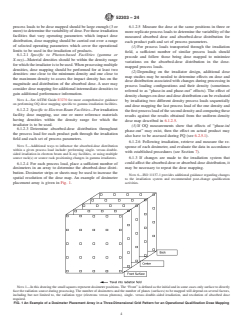
placement array is given in Fig. 1. activities.
NOTE 1—In this drawing the small squares represent dosimeter positions. The “Front” is defined as the initial and in some cases only surface to directly
face the radiation source during processing. The number of dosimeters and the number of planes (surfaces) to be mapped will depend on several factors,
including but not limited to, the radiation type (electrons versus photons), single- versus double-sided irradiation, and resolution of absorbed dose
required.
FIG. 1 An Example of a Dosimeter Placement Array in a Three-Dimensional Grid Pattern for an Operational Qualification Dose Mapping
52303 − 24
6.1.4 The use of mathematical models in determining do- loads to determine the variability of the absorbed-dose delivery
simeter locations for dose mapping or in predicting dose map and measurements. Each process load should contain similar
results may be useful. See Guide E2232 for guidance. materials and dosimeter placements that are configured in the
same way and should be processed under the same operating
6.2 Dose Mapping for Performance Qualification of Pro-
conditions.
cess Loads
6.2.5.1 A sufficient number of process loads should precede
6.2.1 Perform dose mapping for specific products and load
and follow the dose mapped process loads to minimize
configurations to determine the dose distribution expected
phase-in/out effects (see 6.1.2.5, Item 1).
during the routine processing of process loads. Products,
6.2.6 Doses outside of the product dose specification are
materials or substances should be actual product or may be
acceptable for dose mapping purposes. See Note 10 in 7.2.4 for
simulated product of materials with similar density, distribu-
additional discussion.
tions and packaging configuration as the actual products.
6.2.7 Repeat the dose mapping procedure if a change is
6.2.2 If a routine monitoring position is used for process
made to the product or the irradiation facility that may impact
monitoring, the relationships between minimum dose, maxi-
the previously characterized dose distribution.
mum dose and the dose at the routine monitoring position
6.2.8 If measurements done according to 6.1.3 lead to the
should be established.
conclusion that dose or dose distribution has changed, then
6.2.3 Specify a loading pattern that describes the products,
repeat of product dose map is needed.
materials or substances contained within the process load,
6.2.9 Practical considerations for Product Dose Mapping.
including dimensions, mass or density, and if applicable, the
6.2.9.1 Facilities typically irradiate a variety of products and
orientation of the product within the process load as well as the
dose mapping of all products may be impractical. If products
orientation of the process load itself with respect to the
have similar loading configurations and are known to have
radiation field.
densities and radiation absorption characteristics equivalent to
6.2.4 Specify or determine the location of the dosimeters
a product (actual or simulated) that has already been dose
used for the dose map, taking into consideration voids, density
mapped, then it is not necessary to perform dose mapping for
variations or any material interfaces that may cause significant
them, and a processing category can be established consisting
localized dose gradients that could affect the location of
of product that can be irradiated together.
minimum or maximum dose, or both, within the process load.
6.2.9.2 Criteria for including product in processing catego-
6.2.4.1 Use dosimeters capable of measuring any localized
ries shall be documented, and should include:
dose gradients and of a size that does not significantly influence
(1) dimension of the process load
the radiation field or the interpretation of absorbed-dose
(2) weight of the process load
measurements.
(3) density of the process load
6.2.4.2 Process loads containing voids, density variations,
(4) composition of the product
or materials interfaces that could cause localized dose gradients
(5) orientation of the product items with the process load
require dosimeters to be placed directly on the material
(6) number of product items within the process load
surfaces. Selection of the dosimeter positions for dose mapping
(7) the required minimum dose
should include areas of suspected high dose gradients based on
(8) the maximum acceptable dose
a physical assessment of the materials and their composition
6.2.9.3 If facilities irradiate only process loads that can be
that make up the process load being dose mapped. These
demonstrated to have the same dose distribution characteristics
positions may be concentrated in the expected zones of
as those used in the operational qualification (OQ) dose
minimum or maximum dose, or both, known from the irradia-
mapping(s) discussed in 6.1, then it is not necessary to conduct
tor operational qualification (OQ) dose map. Heterogeneous
performance qualification (PQ) dose mapping.
products such as metal implants or certain foods may require
placement of appropriately sized dosimeters positioned at
6.3 Other Dose Mapping Studies—The dynamics of routine
internal locations within the individual products. This may
processing may require additional studies relevant to each
involve cutting open the individual product inside the package
processing path be performed during operational or perfor-
to permit dosimeter positioning and retrieval, or removal of
mance qualification, or both, to further characterize irradiator
dosimeters from their protective packaging to facilitate dosim-
performance and its impact on the magnitude and distribution
eter placement. The latter requires assurances that the dosim-
of absorbed dose. The number of studies required will gener-
eters can be characterized and perform acceptably when used
ally depend on the specific irradiation system; however, se-
without protective packaging.
lected studies common to many irradiation systems, including
process interruption, partially filled irradiation containers, and
NOTE 7—When dosimeters are calibrated in their protective packaging
center-loading of product in irradiation containers, are de-
but used outside the packaging for a specific application, this usage may
alter the calibrated state of the dosimeters. The impact on absorbed-dose
scribed in the following sections.
measurement for this usage should be assessed.
6.3.1 Process Interruption—The result of intentional
...
This document is not an ASTM standard and is intended only to provide the user of an ASTM standard an indication of what changes have been made to the previous version. Because
it may not be technically possible to adequately depict all changes accurately, ASTM recommends that users consult prior editions as appropriate. In all cases only the current version
of the standard as published by ASTM is to be considered the official document.
Designation: ISO/ASTM 52303 − 2015(E) 52303 − 24
Standard Guide for
Absorbed-Dose Mapping in Radiation Processing Facilities
This standard is issued under the fixed designation ISO/ASTM 52303; the number immediately following the designation indicates the
year of original adoption or, in the case of revision, the year of last revision. A number in parentheses indicates the year of last
reapproval. A superscript epsilon (´) indicates an editorial change since the last revision or reapproval.
INTRODUCTION
Historically, this document’s scope includes all dose mapping activities (OQ and PQ) for the three
common forms of radiation utilized in facilities. Ongoing work within E61.03 aims to provide the user
with additional guidance on considerations specific to each radiation source type and absorbed-dose
mapping activities. The intent is to keep this document largely whole while these standards are
published over the upcoming years, updating specific sections to reference further guidance that can
be obtained in external documents. A major revision to this document is planned after the balance of
additional guidance documents are approved at which time this Introduction will be removed.
1. Scope
1.1 This document provides guidance in determining absorbed-dose distributions (mapping) in products, materials or substances
irradiated in gamma, X-ray (bremsstrahlung) and electron beam facilities.
NOTE 1—For irradiation of food and the radiation sterilization of health care products, specific ISO and ISO/ASTM standards containing dose mapping
requirements exist. See ISO/ASTM Practices 51431, 51608, 51649, 51702 and 51818 and ISO 11137-1. Regarding the radiation sterilization of health
care products, in those areas covered by ISO 11137-1, that standard takes precedence.
1.2 This guide is one of a set of standards that provides recommendations for properly implementing dosimetry in radiation
processing. itIt is intended to be read in conjunction with ISO/ASTM 52628.
1.3 Methods of analyzing the dose map data are described. Examples are provided of statistical methods that may be used to
analyze dose map data.
1.4 Dose mapping for bulk flow processing and fluid streams is not discussed.
1.5 Dosimetry is an element of a total quality management system for an irradiation facility. Other controls besides dosimetry may
be required for specific applications such as medical device sterilization and food preservation.
1.6 This standard does not purport to address all of the safety concerns, if any, associated with its use. It is the responsibility
of the user of this standard to establish appropriate safety and healthsafety, health, and environmental practices and determine
the applicability of regulatory requirementslimitations prior to use.
This guide is under the jurisdiction of ASTM Committee E61 on Radiation Processing and is the direct responsibility of Subcommittee E61.03 on Dosimetry Application
and is also under the jurisdiction of . Originally developed as a joint ASTM/ISO standard in conjunction with ISO/TC 85/WG 3.
Current edition approved Feb. 9, 2015Jan. 1, 2024. Published January 2024June 2015. Originally published as ASTM. Originally approved in 2003. E2303–03. Last
ε1
previous ASTM edition E2303–11approved . The present International Standard ISO/ASTM 52303–2015(E) replaces ASTM in 2015 as ISO/ASTM 52303–2015(E).
ε1
DOI:10.1520/52303-24.E2303–11 .
Copyright © ASTM International, 100 Barr Harbor Drive, PO Box C700, West Conshohocken, PA 19428-2959. United States
52303 − 24
1.7 This international standard was developed in accordance with internationally recognized principles on standardization
established in the Decision on Principles for the Development of International Standards, Guides and Recommendations issued
by the World Trade Organization Technical Barriers to Trade (TBT) Committee.
2. Referenced Documents
2.1 ASTM Standards:
E170 Terminology Relating to Radiation Measurements and Dosimetry
E178 Practice for Dealing With Outlying Observations
E2232 Guide for Selection and Use of Mathematical Methods for Calculating Absorbed Dose in Radiation Processing
Applications
E3083 Terminology Relating to Radiation Processing: Dosimetry and Applications
E3239 Guide for Using Statistical Process Control Principles for Routine Dosimetry in Radiation Processing
E3270 Guide for Operational Qualification of Gamma Irradiators
2.2 ISO/ASTM Standards:
51261 Guide for Selection and Practice for Calibration of Routine Dosimetry Systems for Radiation Processing
51431 Practice for Dosimetry in Electron Beam and X-Ray (Bremsstrahlung) Irradiation Facilities for Food Processing
51608 Practice for Dosimetry in an X-ray (Bremsstrahlung) Facility for Radiation Processing
51649 Practice for Dosimetry in an Electron Beam Facility for Radiation Processing at Energies between 300 keV and 25 MeV
51702 Practice for Dosimetry in a Gamma Irradiation Facility for Radiation Processing
51707 Guide for Estimating Uncertainties in Dosimetry for Radiation Processing
51818 Practice for Dosimetry in an Electron Beam Facility for Radiation Processing at Energies between 80 and 300 keV
52628 Practice for Dosimetry in Radiation Processing
2.3 International Commission on Radiation Units and Measurements Reports:
ICRU Report 85a Fundamental Quantities and Units for Ionizing Radiation
2.4 International Organization for Standardization:
ISO 11137-1 Sterilization of health care products – Radiation – Part 1: Requirements for development, validation, and routine
control of a sterilization process for medical devices
ISO 14470 Food irradiation – Requirements for the development, validation and routine control of the process of irradiation
using ionizing radiation for the treatment of food
2.5 Joint Committee for Guides in Metrology (JCGM) Reports:
JCGM 100:2008 GUM 1995, , with minor corrections, Evaluation of measurement data – Guide to the expression of uncertainty
in measurement
JCGM 200:2012, VIM International vocabulary of metrology – Basis and general concepts and associated terms
3. Terminology
3.1 Definitions:
3.1.1 absorbed-dose mapping—measurement of absorbed dose within an irradiated product to produce a one-, two- or
three-dimensional distribution map of absorbed dose.
3.1.1.1 Discussion—
For a process load, such a dose map is obtained using dosimeters placed at specified locations within the process load.
3.1.2 calibration curve (VIM:2008)—expression of the relation between indication and corresponding measured quantity value.
3.1.2.1 Discussion—
In radiation processing standards, the term “dosimeter response” is generally used for “indication.”
3.1.3 dose map, dose mapping—see absorbed-dose mapping.
3.1.4 dose uniformity ratio—ratio of the maximum to the minimum absorbed dose within the irradiated product.
For referenced ASTM and ISO/ASTM standards, visit the ASTM website, www.astm.org, or contact ASTM Customer Service at service@astm.org. For Annual Book
of ASTM Standards volume information, refer to the standard’s Document Summary page on the ASTM website.
Available from International Commission on Radiation Units and Measurements, 7910 Woodmont Ave., Suite 800, Bethesda, MD 20814.
Available from International Organization for Standardization (ISO), 1 rue de Varembé, Case postale 56, CH-1211, Geneva 20, Switzerland.
Document produced by Working Group 1 of the Joint Committee for Guides in Metrology (JCGM/WG 1). Available free of charge at the BIPM website
(http://www.bipm.org).
Document produced by Working Group 2 of the Joint Committee for Guides in Metrology (JCGM/WG 2). Available free of charge at the BIPM website
(http://www.bipm.org).
52303 − 24
3.1.4.1 Discussion—
The concept is also referred to as the max/min dose ratio. Product generally refers to the “process load.”
3.1.5 dose zone—a region or discrete point(s) within a process load that receives the same absorbed dose within the statistical
uncertainty of the irradiation process and absorbed-dose measurement(s).
3.1.6 installation qualification (IQ)—process of obtaining and documenting evidence that equipment has been provided and
installed in accordance with its specification.
3.1.7 irradiation container—holder in which process load is transported through the irradiator.
3.1.7.1 Discussion—
“Irradiation container” is often referred to simply as “container” and can be a carrier, cart, try, product carton, pallet, product
package or other holder.
3.1.8 operational qualification (OQ)—process of obtaining and documenting evidence that installed equipment operates within
predetermined limits when used in accordance with its operational procedures.
3.1.9 performance qualification (PQ)—process of obtaining and documenting evidence that the equipment, as installed and
operated in accordance with operational procedures, consistently performs in accordance with predetermined criteria and thereby
yields product meeting its specification.
3.1.10 process load—a volume of material with a specified product loading configuration irradiated as a single entity.
3.1.11 processing category—group of different product that can be processed together.
3.1.11.1 Discussion—
Processing categories can be based on, for instance, composition, density or dose requirements.
3.1.12 reference material—homogeneous material of known radiation absorption and scattering properties used to establish
characteristics of the irradiation process, such as scan uniformity, depth-dose distribution, throughput rate, and reproducibility of
dose delivery.
3.1.13 routine monitoring position—position where absorbed dose is monitored during routine processing to ensure that the
product is receiving the absorbed dose specified for the process.
3.1.13.1 Discussion—
This position may be a location of minimum or maximum dose in the process load or it may be an alternate convenient location
in, on or near the process load where the relationship of the dose at this position with the minimum and maximum dose has been
established.
3.1.14 simulated product—material with absorption and scattering properties similar to those of the product, material or substance
to be irradiated.
3.1.14.1 Discussion—
Simulated product is used during irradiator characterization as a substitute for the actual product, material or substance to be
irradiated. When used in routine production runs in order to compensate for the absence of product, simulated product is sometimes
referred to as compensating dummy. When used for absorbed-dose mapping, simulated product is sometimes referred to as
phantom material.
3.2 Definitions of other terms used in this standard that pertain to radiation measurement and dosimetry may be found in
Terminology E170E3083. Definitions in E170E3083 are compatible with ICRU Report 60;85a; that document, therefore, may be
used as an alternative reference.
4. Significance and use
4.1 This guide is one of a set of guides and practices that provide recommendations for properly implementing dosimetry in
radiation processing. In order to understand and effectively use this and other dosimetry standards, consider first “Practice for
Dosimetry in Radiation Processing,” ASTM/ISO 52628, which describes the basic requirements that apply when making absorbed
dose measurements in accordance with the ASTM E10.01E61 series of dosimetry standards. In addition, ASTM/ISO 52628
52303 − 24
provides guidance on the selection of dosimetry systems and directs the user to other standards that provide information on
individual dosimetry systems, calibration methods, uncertainty estimation and radiation processing applications.
4.2 Radiation processing is carried out under fixed path conditions where (a) a process load is automatically moved through the
radiation field by mechanical means or (b) a process load is irradiated statically by manually placing product at predetermined
positions before the process is started. In both cases the process is controlled in such a manner that the process load position(s)
and orientation(s) are reproducible within specified limits.
NOTE 2—Static irradiation encompasses irradiation of the process load using either manual rotation, no rotation or automated rotation.
4.3 Some radiation processing facilities that utilize a fixed conveyor path for routine processing may also characterize a region
within the radiation field for static radiation processing, sometimes referred to as “Off Carrier” processing.
4.4 Many radiation processing applications require a minimum absorbed dose (to achieve a desired effect or to fulfill a legal
requirement), and a maximum absorbed dose (to ensure that the product, material or substance still meets functional specifications
or to fulfill a legal requirement).
4.5 Information from the dose mapping is used to:
4.5.1 Characterize the radiation process and assess the reproducibility of absorbed-dose values, which may be used as part of
operational qualification and performance qualification.
4.5.2 Determine the spatial distribution of absorbed doses and the zone(s) of maximum and minimum absorbed doses throughout
a process load, which may consist of an actual or simulated product.
4.5.3 Establish the relationship between the dose at a routine monitoring position and the dose within the minimum and maximum
dose zones established for a process load.
4.5.4 Verify mathematical dose calculation methods. See ASTM Guide E2232.
4.5.5 Determine the effect of process interruptions on the distribution of absorbed dose and the magnitude of the minimum and
maximum doses.
4.5.6 Assess the impact on the distribution of absorbed dose and the magnitude of the minimum and maximum doses resulting
from the transition from one process load to another where changes, for example, in product density or product loading pattern
may occur.
5. Prerequisites
5.1 Prerequisites to Dose Mapping: Installation Qualification and Dosimetry System Calibration:
5.1.1 Prior to performing dose mapping for irradiator operational qualification (OQ) and performance qualification (PQ), confirm
that installation qualification (IQ) is complete.
5.1.1.1 For electron beam and X-ray irradiation facilities, IQ includes dosimetric testing to confirm the characteristics of the beam
(electron energy, average beam current, and if applicable, scan width and scan uniformity). Refer to ISO/ASTM 51431, 51608,
51818, 51649 and ISO 11137-1.
5.1.1.2 For gamma irradiation facilities, dosimetric testing is not required during IQ; however, the activity of the source and
location of the individual components of the source should be confirmed and documented. confirmed. Refer to ISO/ASTM 51702
and ISO 11137-1.
5.1.2 Select an appropriate dosimetry system(s) for the dose mapping exercises. See 6.2.4.1 and ISO/ASTM 52628 for guidance.
5.2 Calibration of the Dosimetry System:
5.2.1 Prior to use, the dosimetry system, consisting of dosimeters measurement instruments and their associated reference
52303 − 24
standards, and procedures for the system’s use, should be calibrated in accordance with the user’s documented procedure that
specifies details of the calibration process and quality assurance requirements. Calibration methods are described in ISO/ASTM
51261.
NOTE 3—A dosimetry system calibration obtained using irradiation conditions different from the conditions of use may be used for relative dose
measurement applications. For example, an irradiation facility may perform a lab-based calibration with subsequent verification using reference standard
dosimeters under the conditions of use. While dose mapping at the irradiation facility may be performed using dose values from the lab-based calibration
(prior to completing the verification exercise) to assess the dose distribution and locations of minimum and maximum absorbed dose, these dose
measurements would be considered preliminary (i.e. relative) pending the outcome of the verification exercise.
5.2.2 For the calibration of the instruments, and for the verification of instrument performance between calibrations, see
ISO/ASTM 51261 or instrument-specific operating manuals, or both.
6. Dose mapping
6.1 Dose Mapping for Operational Qualification of the Irradiation Facility:
6.1.1 As specified in ISO/ASTM Practices 51431, 51608, 51649, 51702, and ISO 11137-1, perform irradiation facility dose
mapping to characterize the irradiator with respect to the dose distribution and reproducibility of absorbed dose delivery. This
should be performed in accordance with a formal validation program, and should cover the operational range that will be used in
the irradiation of products.
6.1.2 Perform irradiation facility dose mapping by placing dosimeters in a number of process loads of reference material that fills
the container to its design volume limits. limits or the volume limits based on actual processing conditions. The number of process
loads to be dose mapped should be large enough (3 or more) to determine the variability of dose. For those irradiation facilities
that vary operating parameters which impact dose distribution, dose mapping should be carried out over a range of selected
operating parameters which cover the operational limits to be used in the irradiation of products.
6.1.2.1 Specific to Photon-based Facilities (gamma or X-ray)—Material densities should be within the density range for which the
irradiator is to be used. When processing multiple densities, dose mapping should be doneperformed for at least two densities
densities: one close to the minimum and maximum density to be processed density and one close to the maximum density to assess
the impact density has on the magnitude and distribution of the absorbed dose. A user may consider dose mapping for additional
intermediate densities to gain additional performance information.
NOTE 4—See ASTM Guide E3270 for more comprehensive guidance on performing OQ dose mapping specific to gamma irradiation facilities.
6.1.2.2 Specific to Electron Beam Facilities—For irradiation facility dose mapping, use one or more reference materials having
densities within the density range for which the irradiator is to be used.
6.1.2.3 Determine absorbed-dose distribution throughout the process load for each product path through the irradiation field and
each set of process parameters.
NOTE 5—Additional ways to influence the absorbed-dose distribution within a given process load include: performing single- versus double-sided
irradiation in electron beam and X-ray facilities, or using multiple source rack(s) or source rack positioning changes in gamma irradiators.
6.1.2.4 For each process load, place a sufficient number of dosimeters in an array to determine the absorbed-dose distribution.
Dosimeter strips or sheets may be used to increase the spatial resolution of the dose map. An example of dosimeter placement array
is given in Fig. 1.
6.1.2.5 Measure the dose at the same positions in three or more replicate process loads to determine the variability of the measured
absorbed dose and absorbed-dose distribution for each product path and set of process parameters.
(1) For process loads transported through the irradiation field, a sufficient number of similar process loads should precede and
follow those being dose mapped to minimize variations on the absorbed-dose distribution in the dose-mapped process loads.
(2) Depending on the irradiator design, additional dose map studies may be needed to determine effects on dose and dose
distribution associated with changes during processing in process loading configurations and their density (sometimes referred to
as “phase-in and phase-out” effects). The effect of density changes on dose and dose distribution can be evaluated by irradiating
52303 − 24
NOTE 1—In this drawing the small squares represent dosimeter positions. The “Front” is defined as the initial and in some cases only surface to directly
face the radiation source during processing. The number of dosimeters and the number of planes (surfaces) to be mapped will depend on several factors,
including but not limited to, the radiation type (electrons versus photons), single- versus double-sided irradiation, and resolution of absorbed dose
required.
FIG. 1 An Example of a Dosimeter Placement Array in a Three-Dimensional Grid Pattern for an Operational Qualification Dose Mapping
two different density process loads sequentially and dose mapping the last process load of the one density and the first process load
of the second density and comparing these results against the results obtained from the uniform density dose map described in
6.1.2.5, (1).
(3) If OQ measurements show that effects of “phase-in/phase-out” may exist, then the effect on actual product may also have
to be assessed during PQ (see 6.2.5.1).
6.1.2.6 Following irradiation, retrieve and measure the response of each dosimeter, and evaluate the data in accordance with
established procedures (see Section 7).
6.1.3 If changes are made to the irradiation system that could affect the absorbed-dose or absorbed-dose distribution, it may be
necessary to repeat the dose mapping.
NOTE 6—ISO 11137-1 provides additional guidance regarding changes to the irradiation system and recommended post-change qualification activities.
6.1.4 The use of mathematical models in determining dosimeter locations for dose mapping or in predicting dose map results may
be useful. See Guide E2232 for guidance.
6.2 Dose Mapping for Performance Qualification of Process Loads
6.2.1 Perform dose mapping for specific products and load configurations to determine the dose distribution expected during the
routine processing of process loads. Products, materials or substances should be actual product or may be simulated product of
materials with similar density, distributions and packaging configuration as the actual products.
6.2.2 If a routine monitoring position is used for process monitoring, the relationships between minimum dose, maximum dose
and the dose at the routine monitoring position should be established.
6.2.3 Specify a loading pattern that describes the products, materials or substances contained within the process load, including
dimensions, mass or density, and if applicable, the orientation of the product within the process load as well as the orientation of
the process load itself with respect to the radiation field.
6.2.4 Specify or determine the location of the dosimeters used for the dose map, taking into consideration voids, density variations
or any material interfaces that may cause significant localized dose gradients that could affect the location of minimum or
maximum dose, or both, within the process load.
52303 − 24
6.2.4.1 Use dosimeters capable of measuring any localized dose gradients and of a size that does not significantly influence the
radiation field or the interpretation of absorbed-dose measurements.
6.2.4.2 Process loads containing voids, density variations, or materials interfaces that could cause localized dose gradients require
that the dosimeters to be placed directly on the material surfaces. Selection of the dosimeter positions for dose mapping should
include areas of suspected high dose gradients based on a physical assessment of the materials and their composition that make
up the process load being dose mapped. These positions may be concentrated in the expected zones of minimum or maximum dose,
or both, known from the irradiator operational qualification (OQ) dose map. Heterogeneous products such as metal implants or
certain foods may require placement of appropriately sized dosimeters positioned at internal locations within the individual
products. This may involve cutting open the individual product inside the package to permit dosimeter positioning and retrieval,
or removal of dosimeters from their protective packaging to facilitate dosimeter placement. The latter requires assurances that the
dosimeters can be characterized and perform acceptably when used without protective packaging.
NOTE 7—When dosimeters are calibrated in their protective packaging but used outside the packaging for a specific application, this usage may alter the
calibrated state of the dosimeters. The impact on absorbed-dose measurement for this usage should be assessed.
6.2.4.3 The use of mathematical models in determining dosimeter locations for dose mapping or in predicting dose map results
may be useful. See Guide E2232 for guidance.
6.2.5 Measure the dose at the same position(s) in the maximum and minimum dose zones in three or more process loads to
determine the variability of the absorbed-dose delivery and measurements. Each process load should contain similar materials and
dosimeter placements that are configured in the same way and should be processed under the same operating conditions.
6.2.5.1 A sufficient number of process loads should precede and follow the dose mapped process loads to minimize phase-in/out
effects (see 6.1.2.5, Item 1).
6.2.6 Doses outside of the product dose specification are acceptable for dose mapping purposes. See Note 910 in 7.2.4 for
additional discussion.
6.2.7 Repeat the dose mapping procedure if a change is made to the product or the irradiation facility that may impact the
previously characterized dose distribution.
6.2.8 If measurements done according to 6.1.3 lead to the conclusion that dose or dose distribution has changed, then repeat of
product dose map is needed.
6.2.9 Practical considerations for Product Dose Mapping (see Mapping.6.2.1).
6.2.9.1 Facilities typically irradiate a variety of products and dose mapping of all products may be impractical. If products have
similar loading configurations and are known to have densities and radiation absorption characteristiccharacteristics equivalent to
a product (actual or simulated) that has already been dose mapped, then it is not necessary to perform dose mapping for them, and
a processing category can be established consisting of product that can be irradiated together.
6.2.9.2 Criteria for including product in processing categories shall be documented, and should include:
(1) dimension of the process load
(2) weight of the process load
(3) density of the process load
(4) composition of the product
(5) orientation of the product items with the process load
(6) number of product items within the process load
(7) the required minimum dose
(8) the maximum acceptable dose
6.2.9.3 If facilities irradiate only process loads that can be demonstrated to have the same dose distribution characteristics as those
used in the operational qualification (OQ) dose mapping(s) discussed in 6.1, then it is not necessary to conduct performance
qualification (PQ) dose mapping.
6.3 Other Dose Mapping Studies—The dynamics of routine processing may require additional studies relevant to each processing
52303 − 24
path be performed during operational or performance qualification, or both, to further characterize irradiator performance and its
impact on the magnitude and distribution of absorbed dose. The number of studies required will generally depend on the specific
irradiation system; however, selected studies common to many irradi
...