

ASTM F3094-14(2022)
(Test Method)Standard Test Method for Determining Protection Provided By X-ray Shielding Garments Used in Medical X-ray Fluoroscopy from Sources of Scattered X-Rays
General Information
- Abstract
SIGNIFICANCE AND USE
5.1 This test method is designed to provide a standardized procedure to ensure comparable results between manufacturers, testing laboratories, and users.
5.2 This test method attempts to realistically quantify the radiation protection provided by radiation protective garments under real-world conditions for workers primarily exposed to scattered radiation in medical fluoroscopy work.
5.3 This test method is designed to simulate exposure conditions to radiation scattered from the body of the patient undergoing fluoroscopy through an angle of 90° from the primary X-ray beam.
5.4 The test method is designed to include contributions of radiation dose to the wearer from secondary radiation emitted from the shielding material.
SCOPE
1.1 This test method establishes a procedure for measuring the relative reduction in the intensity of X-radiation provided by shielding garments to the human user under conditions simulating actual use.
1.2 This test method provides a condition simulating X-rays generated between 60 and 130 kV that are scattered through an angle of 90° by a water equivalent material.
1.3 This test method applies to both leaded and no-leaded radiation protective materials.
1.4 This test method provides a method for inclusion of secondary radiations generated within the protective material into a more realistic evaluation of radiation protection.
1.5 The values given in SI units are to be regarded as standard. No other units of measurement are included in this standard.
1.6 This standard does not purport to address all of the safety concerns, if any, associated with its use. It is the responsibility of the user of this standard to establish appropriate safety, health, and environmental practices and determine the applicability of regulatory limitations prior to use. Some specific hazards statements are given in Section 7.
1.7 This international standard was developed in accordance with internationally recognized principles on standardization established in the Decision on Principles for the Development of International Standards, Guides and Recommendations issued by the World Trade Organization Technical Barriers to Trade (TBT) Committee.
- Status
- Published
- Publication Date
- 30-Nov-2022
- Technical Committee
- F23 - Personal Protective Clothing and Equipment
- Drafting Committee
- F23.70 - Radiological Hazards
Overview
ASTM F3094-14(2022) provides a standardized method to determine the level of protection offered by X-ray shielding garments used in medical X-ray fluoroscopy, specifically from scattered X-rays. Developed by ASTM International, this standard is designed to ensure objective, comparable results for manufacturers, testing laboratories, and healthcare professionals who rely on radiation protective garments. This test method targets real-world use in medical environments, especially for professionals exposed to scattered radiation during fluoroscopic procedures.
The standard details a procedure for measuring the reduction of X-ray intensity (attenuation) delivered by shielding garments-such as aprons and vests-under conditions simulating actual clinical use. It accommodates both leaded and non-leaded protective materials, addresses secondary radiation contributions, and supports compliance with international regulatory guidelines and safety requirements.
Key Topics
- Radiation Attenuation Measurement: Defines procedures to objectively measure how effectively shielding garments reduce X-ray exposure from scattered radiation.
- Simulation of Clinical Conditions: Specifies test conditions that replicate X-rays scattered at a 90° angle from a water-equivalent material, resembling exposure typical during fluoroscopy.
- Consideration of Secondary Radiation: Accounts for secondary radiations, such as fluorescent radiation, generated within the protective material, providing a realistic assessment of wearer protection.
- Applicability to Materials: Covers both traditional lead-based and non-lead alternatives for radiation protective garments.
- Standardized Testing: Outlines requirements for test samples, apparatus calibration, measurement precision, and reporting to support consistent and reliable results across different facilities and applications.
- Use of SI Units: Mandates all results to be reported in SI units, ensuring global consistency.
Applications
ASTM F3094-14(2022) is critical for:
- Healthcare Facilities: Used by hospitals, imaging centers, and clinics to evaluate and select X-ray protective apparel for staff safety in environments using fluoroscopy and other diagnostic imaging procedures.
- Manufacturers and Suppliers: Applied in the product development and quality control of radiation protective garments to ensure compliance with recognized attenuation standards.
- Testing Laboratories: Provides a reference for independent labs carrying out third-party evaluation and certification of protective clothing.
- Regulatory and Compliance Assurance: Supports documentation for meeting safety and occupational health regulations concerning radiological hazards faced by medical workers.
The standard ensures protective garments meet verified criteria for reducing occupational exposure, directly supporting worker safety and health in radiological settings.
Related Standards
To ensure comprehensive protection and aligned testing protocols, ASTM F3094-14(2022) references several key international and ASTM standards:
- ASTM F1494 - Terminology Relating to Protective Clothing
- ASTM F2547 - Test Method for Determining the Attenuation Properties in a Primary X-ray Beam of Materials Used to Protect Against Radiation Generated During the Use of X-ray Equipment
- IEC 61331-1 - Protective Devices Against Diagnostic Medical X-radiation: Part 1-Determination of Attenuation Properties of Materials
These documents collectively cover terminology, reference test methods, and international criteria relevant to the evaluation of radiological protective devices. Aligning with these standards helps organizations establish robust safety programs and make informed procurement decisions for X-ray shielding products.
Keywords: ASTM F3094-14, X-ray shielding garments, medical fluoroscopy, radiation protection, scattered X-rays, radiation protective clothing, attenuation test method, secondary radiation, lead-free shielding, healthcare worker safety, radiological hazards.
Relations
- Effective Date
- 01-Jul-2013
- Effective Date
- 01-Jul-2013
- Effective Date
- 01-Feb-2011
- Effective Date
- 01-Jun-2006
- Effective Date
- 10-Jul-2003
- Effective Date
- 10-Jun-2001
- Effective Date
- 10-Jun-2001
Get Certified
Connect with accredited certification bodies for this standard

CIS Institut d.o.o.
Personal Protective Equipment (PPE) certification body. Notified Body NB-2890 for EU Regulation 2016/425 PPE.

Kiwa BDA Testing
Building and construction product certification.
Kmetijski inštitut Slovenije
Agricultural Institute of Slovenia. Soil testing, plant health, agricultural product analysis.
Sponsored listings
Frequently Asked Questions
ASTM F3094-14(2022) is a standard published by ASTM International. Its full title is "Standard Test Method for Determining Protection Provided By X-ray Shielding Garments Used in Medical X-ray Fluoroscopy from Sources of Scattered X-Rays". This standard covers: SIGNIFICANCE AND USE 5.1 This test method is designed to provide a standardized procedure to ensure comparable results between manufacturers, testing laboratories, and users. 5.2 This test method attempts to realistically quantify the radiation protection provided by radiation protective garments under real-world conditions for workers primarily exposed to scattered radiation in medical fluoroscopy work. 5.3 This test method is designed to simulate exposure conditions to radiation scattered from the body of the patient undergoing fluoroscopy through an angle of 90° from the primary X-ray beam. 5.4 The test method is designed to include contributions of radiation dose to the wearer from secondary radiation emitted from the shielding material. SCOPE 1.1 This test method establishes a procedure for measuring the relative reduction in the intensity of X-radiation provided by shielding garments to the human user under conditions simulating actual use. 1.2 This test method provides a condition simulating X-rays generated between 60 and 130 kV that are scattered through an angle of 90° by a water equivalent material. 1.3 This test method applies to both leaded and no-leaded radiation protective materials. 1.4 This test method provides a method for inclusion of secondary radiations generated within the protective material into a more realistic evaluation of radiation protection. 1.5 The values given in SI units are to be regarded as standard. No other units of measurement are included in this standard. 1.6 This standard does not purport to address all of the safety concerns, if any, associated with its use. It is the responsibility of the user of this standard to establish appropriate safety, health, and environmental practices and determine the applicability of regulatory limitations prior to use. Some specific hazards statements are given in Section 7. 1.7 This international standard was developed in accordance with internationally recognized principles on standardization established in the Decision on Principles for the Development of International Standards, Guides and Recommendations issued by the World Trade Organization Technical Barriers to Trade (TBT) Committee.
SIGNIFICANCE AND USE 5.1 This test method is designed to provide a standardized procedure to ensure comparable results between manufacturers, testing laboratories, and users. 5.2 This test method attempts to realistically quantify the radiation protection provided by radiation protective garments under real-world conditions for workers primarily exposed to scattered radiation in medical fluoroscopy work. 5.3 This test method is designed to simulate exposure conditions to radiation scattered from the body of the patient undergoing fluoroscopy through an angle of 90° from the primary X-ray beam. 5.4 The test method is designed to include contributions of radiation dose to the wearer from secondary radiation emitted from the shielding material. SCOPE 1.1 This test method establishes a procedure for measuring the relative reduction in the intensity of X-radiation provided by shielding garments to the human user under conditions simulating actual use. 1.2 This test method provides a condition simulating X-rays generated between 60 and 130 kV that are scattered through an angle of 90° by a water equivalent material. 1.3 This test method applies to both leaded and no-leaded radiation protective materials. 1.4 This test method provides a method for inclusion of secondary radiations generated within the protective material into a more realistic evaluation of radiation protection. 1.5 The values given in SI units are to be regarded as standard. No other units of measurement are included in this standard. 1.6 This standard does not purport to address all of the safety concerns, if any, associated with its use. It is the responsibility of the user of this standard to establish appropriate safety, health, and environmental practices and determine the applicability of regulatory limitations prior to use. Some specific hazards statements are given in Section 7. 1.7 This international standard was developed in accordance with internationally recognized principles on standardization established in the Decision on Principles for the Development of International Standards, Guides and Recommendations issued by the World Trade Organization Technical Barriers to Trade (TBT) Committee.
ASTM F3094-14(2022) is classified under the following ICS (International Classification for Standards) categories: 13.280 - Radiation protection. The ICS classification helps identify the subject area and facilitates finding related standards.
ASTM F3094-14(2022) has the following relationships with other standards: It is inter standard links to ASTM F2547-06(2013), ASTM F1494-13, ASTM F1494-03(2011), ASTM F2547-06, ASTM F1494-03, ASTM F1494-01, ASTM F1494-99. Understanding these relationships helps ensure you are using the most current and applicable version of the standard.
ASTM F3094-14(2022) is available in PDF format for immediate download after purchase. The document can be added to your cart and obtained through the secure checkout process. Digital delivery ensures instant access to the complete standard document.
Standards Content (Sample)
This international standard was developed in accordance with internationally recognized principles on standardization established in the Decision on Principles for the
Development of International Standards, Guides and Recommendations issued by the World Trade Organization Technical Barriers to Trade (TBT) Committee.
Designation: F3094 − 14 (Reapproved 2022)
Standard Test Method for
Determining Protection Provided By X-ray Shielding
Garments Used in Medical X-ray Fluoroscopy from Sources
of Scattered X-Rays
This standard is issued under the fixed designation F3094; the number immediately following the designation indicates the year of
original adoption or, in the case of revision, the year of last revision.Anumber in parentheses indicates the year of last reapproval.A
superscript epsilon (´) indicates an editorial change since the last revision or reapproval.
1. Scope 2. Referenced Documents
1.1 This test method establishes a procedure for measuring 2.1 ASTM Standards:
the relative reduction in the intensity of X-radiation provided F1494Terminology Relating to Protective Clothing
by shielding garments to the human user under conditions F2547Test Method for Determining the Attenuation Prop-
simulating actual use. erties in a Primary X-ray Beam of Materials Used to
Protect Against Radiation Generated During the Use of
1.2 ThistestmethodprovidesaconditionsimulatingX-rays
X-ray Equipment
generatedbetween60and130kVthatarescatteredthroughan
2.2 IEC Standard:
angle of 90° by a water equivalent material.
IEC 61331-1 Ed. 2.0Protective DevicesAgainst Diagnostic
1.3 This test method applies to both leaded and no-leaded
Medical X-radiation: Part 1—Determination of Attenua-
radiation protective materials.
tion Properties of Materials
1.4 This test method provides a method for inclusion of
3. Terminology
secondary radiations generated within the protective material
into a more realistic evaluation of radiation protection. 3.1 Definitions:
3.1.1 attenuation, n—for radiological protective material,
1.5 The values given in SI units are to be regarded as
the fractional reduction in the intensity of the X-ray beam
standard. No other units of measurement are included in this
resultingfromtheinteractionsbetweentheX-raybeamandthe
standard.
protective material when the X-ray beam passes through the
1.6 This standard does not purport to address all of the
protective material.
safety concerns, if any, associated with its use. It is the
3.1.1.1 Discussion—Itisimportanttonotethatthemeasure-
responsibility of the user of this standard to establish appro-
ment of attenuation (as specified by Test Method F2547)
priate safety, health, and environmental practices and deter-
specifically excludes the contribution of secondary radiation
mine the applicability of regulatory limitations prior to use.
from the measurement. The present standard provides a
Some specific hazards statements are given in Section 7.
method for incorporating those contributions of radiation dose
1.7 This international standard was developed in accor-
to the wearer of protective garments. (See 3.1.10.)
dance with internationally recognized principles on standard-
3.1.2 coeffıcient of variation—the ratio of the standard
ization established in the Decision on Principles for the
deviation of a sample to the sample mean.
Development of International Standards, Guides and Recom-
3.1.3 exposure, n—for radiological purposes the amount of
mendations issued by the World Trade Organization Technical
ionization charge of one sign produced in a defined volume of
Barriers to Trade (TBT) Committee.
dry air at standard temperature and pressure, caused by
1 2
ThistestmethodisunderthejurisdictionofASTMCommitteeF23onPersonal For referenced ASTM standards, visit the ASTM website, www.astm.org, or
ProtectiveClothingandEquipmentandisthedirectresponsibilityofSubcommittee contact ASTM Customer Service at service@astm.org. For Annual Book of ASTM
F23.70 on Radiological Hazards. Standards volume information, refer to the standard’s Document Summary page on
Current edition approved Dec. 1, 2022. Published December 2022. Originally the ASTM website.
approved in 2014. Last previous edition approved in 2014 as F3094–14. DOI: Available from International Electrotechnical Commission (IEC), 3, rue de
10.1520/F3094-14R22. Varembé, P.O. Box 131, CH-1211 Geneva 20, Switzerland, http://www.iec.ch.
Copyright © ASTM International, 100 Barr Harbor Drive, PO Box C700, West Conshohocken, PA 19428-2959. United States
F3094 − 14 (2022)
interaction with X-rays. Exposure is expressed in units of 3.1.10 protection rating, n—forthepurposesofradiological
coulombs/kg of air in SI units. An older unit called the protectioninthistestmethod,thepercentageofexposureatthe
–4
Roentgen (R) is also used, where1R= 2.58 × 10 C/kg. skin surface of the wearer of the protective garment relative to
the exposure on that surface in the absence of the protective
3.1.4 fluorescent radiation, n—a form of secondary radia-
garment, measured under scatter equivalent conditions for a
tion following photoelectric collisions between X-rays and
particular radiation quality.
orbital electrons of heavier elements such as those used in
protectivematerials,whereuponelectronrearrangementsatthe
3.1.11 scatter equivalent conditions—specific primary
atomic level result in the emission of one or more fluorescent X-ray spectra defined in terms of kV and HVL that simulate
photons.
radiation scattered from a water equivalent medium measured
3.1.4.1 Discussion—Measurements to include fluorescent at 90° to the beam incidence on that medium.
radiation are important because they may contribute to the
3.1.11.1 Discussion—Measuring the actual degree of pro-
radiation exposure to the wearer of radiation protective gar-
tection from scattered X-rays provided by radiation protective
ments.
garments under real-world conditions is technically difficult
and subject to large uncertainties.Actual scatter intensities are
3.1.5 half-value layer (HV), n—thethicknessof99.9%pure
too low and measurements have excessively high uncertainties
aluminum in millimetres (commonly designated mm Al) that
when evaluated in practical conditions. The scatter equivalent
reducestheintensityofanX-raybeambyonehalfofitsinitial
conditionsdescribeconditionsthatconservativelyapproximate
value.
the energies of 90° scatter produced when a water medium
3.1.5.1 Discussion—HVL is commonly used to designate
(body of a human or animal) is exposed toTest Method F2547
the penetrating ability of an X-ray beam containing many
beam qualities. Use of the surrogate primary beams provides
X-ray energies (as is the case with standard X-ray sources).A
conditions that are practical to test under field conditions.
highervalueofAlinmmAlwouldindicateamorepenetrating
X-ray beam. Note that HVLmay also be specified in materials
3.1.12 scatter radiation, n—a form of secondary radiation
other than Al, although only Al is used in this document.
where X-radiation is deflected to a changed direction with or
without a loss in energy by collisions between X-ray photons
3.1.6 ionization chamber—a device that measures the elec-
and orbital electrons of atoms in the path of the X-rays;
tricalchargeliberatedduringtheionizationofairmoleculesby
scattering events in medical procedures mainly occur with loss
electromagnetic radiation (X-rays for the purposes of this test
of energy due to the Compton Effect such that the average
method), expressed in units of coulombs per kg of air.
energies of scattered X-rays are less than those of the direct
3.1.6.1 Discussion—The measurement of exposure is de-
primary beam.
fined for an air ionization chamber. The chamber used in this
method must be of a flat, parallel-plate design.
3.1.13 secondary radiation, n—radiation that is produced in
a material by scattering or emission when the material is
3.1.7 kilovolts, or kilovolts peak (kV or kVp), n—for the
exposed to a source of X-rays.
purposes of radiological protection, the maximum electrical
potential across an X-ray tube during exposure. 3.1.13.1 Discussion—Secondary radiation is of importance
because: (1) the hazard to medical X-ray fluoroscopy workers
3.1.7.1 Discussion—The kV or kVp determines the maxi-
mum photon energy in kilo-electron volts (keV) of an X-ray is principally from X-rays scattered from the patient and other
materials within the primary X-ray beam, and (2) fluorescent
beam; standard X-ray beams contain many photon energies
radiation produced within the protective material can contrib-
most of which are less than this maximum value.
ute to the radiation exposure to the wearer of the radiation
3.1.8 lead equivalency—for radiological protective material
protective garments.
the thickness in millimetres (commonly designated mm Pb) of
greaterthan99.9%puritythatprovidesthesameattenuationas 3.1.14 standard sample dimensions—test samples and lead
standardscuttoanareasuitedtothemeasurementsetupinFig.
a given protective material.
3.1.8.1 Discussion—Radiationprotectivematerialsarecom- 1, ideally by using a template.
monly made with little or no lead, thus lead equivalence will 3.1.14.1 Discussion—It may be desired to test finished
vary with X-ray energy and with the composition of the
protective clothing that are not cut to standard sample dimen-
protective material. Lead equivalence should be specified at a sionsusingthistestmethod.Thismaybedone,butmayrequire
specific energy. This test method specifies a method for
a special test jig to support the material in proper orientation
determining the attenuation in pure lead materials but does not andconfigurationtomeetthistestmethod.Suchaprocedureis
require a specific lead equivalence. If lead equivalence is not described in this test method.
specified, it should be specified at a single scatter equivalent
3.1.15 wave form ripple, n—for radiological purposes, the
condition.
peak-to-peak variation in the voltage potential applied to the
3.1.9 primary X-rays, n—the X-rays emitted from the target
X-raytubeduringexposure.Greatervoltageripple(commonin
of an X-ray tube subjected to an accelerating potential suffi-
older X-ray generators) tends to reduce the intensity and
cient to cause X-ray emission.
3.1.9.1 Discussion—Primary X-rays are distinguished from
secondary X-rays emitted from a material exposed to primary
McCaffrey, J. P., Tessier, F., and Shen, H., “Radiation Shielding Materials and
X-rays. Secondary X-rays are generally less penetrating than
RadiationScatterEffectsforInterventionalRadiology(IR)Physicians,” Med. Phys.,
primary X-rays. Vol 39, No. 7, July 2012.
F3094 − 14 (2022)
ments correspond to most common fluoroscopic conditions at
80 kV, a high kV condition for a standard fluoroscope at
100kV, and a condition corresponding to scatter produced
from CT scanning at 130 kV. These scatter equivalent condi-
tions correspond to direct beam measurement at 70, 85, and
105 kV with filtrations adjusted to achieve HVLs of 3.4, 4.0,
and 5.1 mm Al respectively.
5. Significance and Use
5.1 This test method is designed to provide a standardized
procedure to ensure comparable results between
manufacturers, testing laboratories, and users.
5.2 This test method attempts to realistically quantify the
radiation protection provided by radiation protective garments
under real-world conditions for workers primarily exposed to
scattered radiation in medical fluoroscopy work.
1. Diaphragm
5.3 This test method is designed to simulate exposure
2. Beam filtration
conditions to radiation scattered from the body of the patient
3. Diaphragm
undergoing fluoroscopy through an angle of 90° from the
4. Measuring diaphragm
5. Test material
primary X-ray beam.
6. Flat air ionization measuring chamber
1. IEC 61331-1 Ed. 2.0 Protective Devices Against Diagnostic Medical 5.4 The test method is designed to include contributions of
X-radiation, Part 1: Determination of Attenuation Properties.
radiation dose to the wearer from secondary radiation emitted
2. McCaffrey, J. P., Tessier, F., and Shen, H., “Radiation Shielding Materials and
from the shielding material.
Radiation Scatter Effects for Interventional Radiology (IR) Physicians,” Med.
Phys., Vol 39, No. 7, 2012, pp. 4537–4546.
6. Apparatus
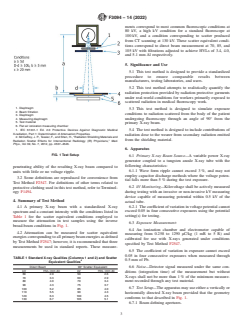
FIG. 1 Test Setup
6.1 Primary X-ray Beam Source—A variable power X-ray
generator coupled
...