

ASTM F1342/F1342M-05(2022)
(Test Method)Standard Test Method for Protective Clothing Material Resistance to Puncture
General Information
- Abstract
SIGNIFICANCE AND USE
5.1 This test method evaluates puncture resistance of protective clothing materials which may include plastics or elastomeric films, coated fabrics, flexible materials, laminates, or textile materials.
5.2 This test method is not intended to measure puncture resistance of all types of punctures encountered using protective clothing material. This test method involves a procedure where a puncture probe of specified dimensions is used for puncturing specimens.
5.3 This test method evaluates puncture resistance of protective clothing materials, specifically for puncture forced on specimens perpendicular to material surface. There is no supporting structure under the material specimen.
5.4 Evaluation of puncture resistance for snag-type puncture should be performed in accordance with Test Method D2582.
SCOPE
1.1 This test method determines the puncture resistance of a protective clothing material specimen by measuring the force required to cause a pointed puncture probe to penetrate through the specimen. This test method describes three protocols that may be used: Method A, Method B, and Method C.
1.1.1 Method A requires the use of Probe A only. The probe used for testing shall be recorded in the test report.
1.1.1.1 Probe A may be used to measure puncture resistance for the following types of materials:
(1) Elastomeric materials,
(2) Textiles, and
(3) Coated materials.
1.1.2 Method B requires the use of Probe B. The probe used for testing shall be recorded in the test report.
1.1.2.1 Probe B may be used to measure puncture resistance for the following types of materials:
(1) Textiles.
(2) Coated materials.
Note 1: Probe B is not suited for measuring the puncture resistance of unsupported elastomeric materials.
1.2 The values stated in SI units are to be regarded as the standard. The values in inch-pound units in brackets are for information purposes only. The values stated in each system may not be exact equivalents; therefore, each system must be used independently of the other, without combining values in any way.
1.3 This standard does not purport to address all of the safety concerns, if any, associated with its use. It is the responsibility of the user of this standard to establish appropriate safety, health, and environmental practices and determine the applicability of regulatory limitations prior to use.
1.4 This international standard was developed in accordance with internationally recognized principles on standardization established in the Decision on Principles for the Development of International Standards, Guides and Recommendations issued by the World Trade Organization Technical Barriers to Trade (TBT) Committee.
- Status
- Published
- Publication Date
- 31-Jan-2022
- Technical Committee
- F23 - Personal Protective Clothing and Equipment
- Drafting Committee
- F23.20 - Physical
Overview
ASTM F1342/F1342M-05(2022): Standard Test Method for Protective Clothing Material Resistance to Puncture is a widely recognized ASTM International standard. It outlines a method for measuring the puncture resistance of materials used in protective clothing, including elastomeric films, coated fabrics, flexible materials, laminates, plastics, and textiles. The test is essential for evaluating the protective capability of materials against puncture hazards, contributing to the development and verification of personal protective equipment (PPE).
This standard is adopted in accordance with international principles established by the World Trade Organization Technical Barriers to Trade (TBT) Committee, ensuring its global relevance and acceptability.
Key Topics
- Puncture Resistance Evaluation: Measures the force required for a probe of specified dimensions to penetrate a material specimen under controlled conditions.
- Test Protocols:
- Method A (Probe A): Suitable for elastomeric materials, textiles, and coated materials.
- Method B (Probe B): Intended for textiles and coated materials. Not suitable for unsupported elastomeric materials.
- Method C (Probe C): Protocol is available, covering different probe configurations.
- Test Specimen Preparation: Ensures standardized measurement by specifying placement, size, and measurement of sample thickness at the puncture point.
- Reporting Requirements: Includes the method and probe used, specimen description and thickness, load required for each puncture, and deflection.
- Safety and Applicability: Users must ensure proper safety, health, and environmental practices during testing, as the standard does not address all potential hazards.
Applications
This ASTM test method is critically important in multiple industries where protective clothing forms a line of defense against physical hazards. Practical applications include:
- Personal Protective Equipment Manufacturers: Used to evaluate and compare the puncture resistance of materials for gloves, garments, and other wearable items designed for industrial, medical, or emergency response use.
- Quality Assurance: Ensures that batches of protective clothing meet specified puncture resistance benchmarks, supporting product certification and compliance efforts.
- Research and Development: Facilitates the development of new materials and fabric technologies with improved resistance to puncture for high-risk environments.
- Regulatory Compliance: Helps organizations demonstrate that their protective equipment meets industry and regulatory requirements for puncture resistance.
- Procurement and Specification: Enables buyers and users to make informed decisions about the suitability of materials for specific puncture hazard scenarios.
Related Standards
- ASTM D2582: Test Method for Puncture-Propagation Tear Resistance of Plastic Film and Thin Sheeting - referenced for evaluating snag-type puncture resistance in protective clothing materials.
- ASTM D3767: Practice for Rubber-Measurement of Dimensions - provides guidance on measuring thickness for test specimens.
Additional standards on physical testing of textiles and flexible materials may also be relevant depending on the application.
Keywords: ASTM F1342, puncture resistance, protective clothing, test method, material testing, PPE, coated fabrics, elastomeric films, textile materials, safety standards, compliance testing.
Relations
- Effective Date
- 01-May-2009
- Effective Date
- 01-Nov-2008
- Effective Date
- 01-Mar-2007
- Effective Date
- 10-Mar-2003
- Effective Date
- 10-Apr-2000
Get Certified
Connect with accredited certification bodies for this standard

CIS Institut d.o.o.
Personal Protective Equipment (PPE) certification body. Notified Body NB-2890 for EU Regulation 2016/425 PPE.

Kiwa BDA Testing
Building and construction product certification.
Kmetijski inštitut Slovenije
Agricultural Institute of Slovenia. Soil testing, plant health, agricultural product analysis.
Sponsored listings
Frequently Asked Questions
ASTM F1342/F1342M-05(2022) is a standard published by ASTM International. Its full title is "Standard Test Method for Protective Clothing Material Resistance to Puncture". This standard covers: SIGNIFICANCE AND USE 5.1 This test method evaluates puncture resistance of protective clothing materials which may include plastics or elastomeric films, coated fabrics, flexible materials, laminates, or textile materials. 5.2 This test method is not intended to measure puncture resistance of all types of punctures encountered using protective clothing material. This test method involves a procedure where a puncture probe of specified dimensions is used for puncturing specimens. 5.3 This test method evaluates puncture resistance of protective clothing materials, specifically for puncture forced on specimens perpendicular to material surface. There is no supporting structure under the material specimen. 5.4 Evaluation of puncture resistance for snag-type puncture should be performed in accordance with Test Method D2582. SCOPE 1.1 This test method determines the puncture resistance of a protective clothing material specimen by measuring the force required to cause a pointed puncture probe to penetrate through the specimen. This test method describes three protocols that may be used: Method A, Method B, and Method C. 1.1.1 Method A requires the use of Probe A only. The probe used for testing shall be recorded in the test report. 1.1.1.1 Probe A may be used to measure puncture resistance for the following types of materials: (1) Elastomeric materials, (2) Textiles, and (3) Coated materials. 1.1.2 Method B requires the use of Probe B. The probe used for testing shall be recorded in the test report. 1.1.2.1 Probe B may be used to measure puncture resistance for the following types of materials: (1) Textiles. (2) Coated materials. Note 1: Probe B is not suited for measuring the puncture resistance of unsupported elastomeric materials. 1.2 The values stated in SI units are to be regarded as the standard. The values in inch-pound units in brackets are for information purposes only. The values stated in each system may not be exact equivalents; therefore, each system must be used independently of the other, without combining values in any way. 1.3 This standard does not purport to address all of the safety concerns, if any, associated with its use. It is the responsibility of the user of this standard to establish appropriate safety, health, and environmental practices and determine the applicability of regulatory limitations prior to use. 1.4 This international standard was developed in accordance with internationally recognized principles on standardization established in the Decision on Principles for the Development of International Standards, Guides and Recommendations issued by the World Trade Organization Technical Barriers to Trade (TBT) Committee.
SIGNIFICANCE AND USE 5.1 This test method evaluates puncture resistance of protective clothing materials which may include plastics or elastomeric films, coated fabrics, flexible materials, laminates, or textile materials. 5.2 This test method is not intended to measure puncture resistance of all types of punctures encountered using protective clothing material. This test method involves a procedure where a puncture probe of specified dimensions is used for puncturing specimens. 5.3 This test method evaluates puncture resistance of protective clothing materials, specifically for puncture forced on specimens perpendicular to material surface. There is no supporting structure under the material specimen. 5.4 Evaluation of puncture resistance for snag-type puncture should be performed in accordance with Test Method D2582. SCOPE 1.1 This test method determines the puncture resistance of a protective clothing material specimen by measuring the force required to cause a pointed puncture probe to penetrate through the specimen. This test method describes three protocols that may be used: Method A, Method B, and Method C. 1.1.1 Method A requires the use of Probe A only. The probe used for testing shall be recorded in the test report. 1.1.1.1 Probe A may be used to measure puncture resistance for the following types of materials: (1) Elastomeric materials, (2) Textiles, and (3) Coated materials. 1.1.2 Method B requires the use of Probe B. The probe used for testing shall be recorded in the test report. 1.1.2.1 Probe B may be used to measure puncture resistance for the following types of materials: (1) Textiles. (2) Coated materials. Note 1: Probe B is not suited for measuring the puncture resistance of unsupported elastomeric materials. 1.2 The values stated in SI units are to be regarded as the standard. The values in inch-pound units in brackets are for information purposes only. The values stated in each system may not be exact equivalents; therefore, each system must be used independently of the other, without combining values in any way. 1.3 This standard does not purport to address all of the safety concerns, if any, associated with its use. It is the responsibility of the user of this standard to establish appropriate safety, health, and environmental practices and determine the applicability of regulatory limitations prior to use. 1.4 This international standard was developed in accordance with internationally recognized principles on standardization established in the Decision on Principles for the Development of International Standards, Guides and Recommendations issued by the World Trade Organization Technical Barriers to Trade (TBT) Committee.
ASTM F1342/F1342M-05(2022) is classified under the following ICS (International Classification for Standards) categories: 13.340.10 - Protective clothing. The ICS classification helps identify the subject area and facilitates finding related standards.
ASTM F1342/F1342M-05(2022) has the following relationships with other standards: It is inter standard links to ASTM D2582-09, ASTM D2582-08, ASTM D2582-07, ASTM D2582-03, ASTM D2582-00. Understanding these relationships helps ensure you are using the most current and applicable version of the standard.
ASTM F1342/F1342M-05(2022) is available in PDF format for immediate download after purchase. The document can be added to your cart and obtained through the secure checkout process. Digital delivery ensures instant access to the complete standard document.
Standards Content (Sample)
This international standard was developed in accordance with internationally recognized principles on standardization established in the Decision on Principles for the
Development of International Standards, Guides and Recommendations issued by the World Trade Organization Technical Barriers to Trade (TBT) Committee.
Designation: F1342/F1342M − 05 (Reapproved 2022)
Standard Test Method for
Protective Clothing Material Resistance to Puncture
ThisstandardisissuedunderthefixeddesignationF1342/F1342M;thenumberimmediatelyfollowingthedesignationindicatestheyear
of original adoption or, in the case of revision, the year of last revision. A number in parentheses indicates the year of last reapproval.
A superscript epsilon (´) indicates an editorial change since the last revision or reapproval.
1. Scope mendations issued by the World Trade Organization Technical
Barriers to Trade (TBT) Committee.
1.1 This test method determines the puncture resistance of a
protective clothing material specimen by measuring the force
2. Referenced Documents
required to cause a pointed puncture probe to penetrate through
2.1 ASTM Standards:
the specimen. This test method describes three protocols that
D2582 Test Method for Puncture-Propagation Tear Resis-
may be used: Method A, Method B, and Method C.
tance of Plastic Film and Thin Sheeting
1.1.1 MethodArequires the use of ProbeAonly. The probe
D3767 Practice for Rubber—Measurement of Dimensions
used for testing shall be recorded in the test report.
1.1.1.1 ProbeAmay be used to measure puncture resistance
3. Terminology
for the following types of materials:
3.1 Definitions:
(1) Elastomeric materials,
3.1.1 protective clothing material, n—any element,
(2) Textiles, and
constituent, or substance from which protective clothing is
(3) Coated materials.
composed or can be made.
1.1.2 Method B requires the use of Probe B.The probe used
for testing shall be recorded in the test report.
4. Summary of Test Method
1.1.2.1 Probe B may be used to measure puncture resistance
4.1 A material specimen is placed in a stationary support
for the following types of materials:
assembly that is in turn affixed to the lower arm of a tension
(1) Textiles.
testing machine.
(2) Coated materials.
4.2 A pointed puncture probe of set dimensions is mounted
NOTE 1—Probe B is not suited for measuring the puncture resistance of
to the test fixture and the whole assembly is attached to the
unsupported elastomeric materials.
compression cell of the testing machine.
1.2 The values stated in SI units are to be regarded as the
standard. The values in inch-pound units in brackets are for 4.3 The puncture probe is moved at a constant velocity until
information purposes only. The values stated in each system it punctures the material specimen.
may not be exact equivalents; therefore, each system must be
4.4 The force required to puncture the material specimen is
used independently of the other, without combining values in
measured by the compression cell. The elongation (or deflec-
any way.
tion) of the specimen prior to puncture is also measured. The
1.3 This standard does not purport to address all of the
reported puncture resistance is the average of twelve test
safety concerns, if any, associated with its use. It is the
replicates.
responsibility of the user of this standard to establish appro-
5. Significance and Use
priate safety, health, and environmental practices and deter-
mine the applicability of regulatory limitations prior to use.
5.1 This test method evaluates puncture resistance of pro-
1.4 This international standard was developed in accor-
tective clothing materials which may include plastics or
dance with internationally recognized principles on standard-
elastomeric films, coated fabrics, flexible materials, laminates,
ization established in the Decision on Principles for the
or textile materials.
Development of International Standards, Guides and Recom-
5.2 This test method is not intended to measure puncture
resistance of all types of punctures encountered using protec-
tive clothing material. This test method involves a procedure
This test method is under the jurisdiction ofASTM Committee F23 on Personal
Protective Clothing and Equipment and is the direct responsibility of Subcommittee
F23.20 on Physical. For referenced ASTM standards, visit the ASTM website, www.astm.org, or
Current edition approved Feb. 1, 2022. Published February 2022. Originally contact ASTM Customer Service at service@astm.org. For Annual Book of ASTM
approved in 1991. Last previous edition approved in 2013 as F1342/F1342M – 05 Standards volume information, refer to the standard’s Document Summary page on
ɛ1
(2013) . DOI: 10.1520/F1342_F1342M-05R22. the ASTM website.
Copyright © ASTM International, 100 Barr Harbor Drive, PO Box C700, West Conshohocken, PA 19428-2959. United States
F1342/F1342M − 05 (2022)
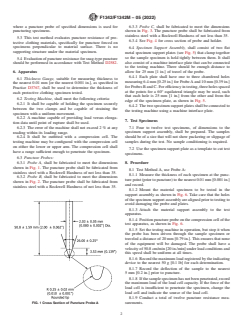
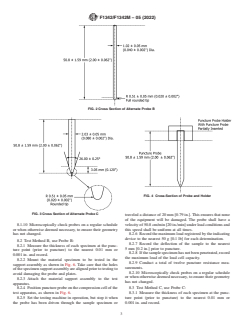
where a puncture probe of specified dimensions is used for 6.3.3 Probe C, shall be fabricated to meet the dimensions
puncturing specimens. shown in Fig. 3. The puncture probe shall be fabricated from
stainless steel with a Rockwell Hardness of not less than 35.
5.3 This test method evaluates puncture resistance of pro-
6.3.4 See Fig. 4 for cross section of probe and holder.
tective clothing materials, specifically for puncture forced on
specimens perpendicular to material surface. There is no
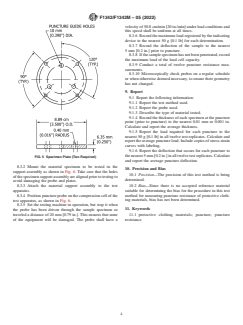
6.4 Specimen Support Assembly, shall consist of two flat
supporting structure under the material specimen.
metal specimen support plates (see Fig. 5) that clamp together
so the sample specimen is held tightly between them. It shall
5.4 Evaluationofpunctureresistanceforsnag-typepuncture
also consist of a machine interface plate that can be connected
should be performed in accordance with Test Method D2582.
to the testing machine. There should be enough distance to
6. Apparatus allow for 25 mm [1 in.] of travel of the probe.
6.4.1 Each plate shall have one to three chamfered holes
6.1 Thickness Gauge, suitable for measuring thickness to
measuring 6.4 mm [0.25 in.] for ProbeAand 10 mm [0.39 in.]
the nearest 0.01 mm [or the nearest 0.001 in.], as specified in
forProbesBandC.Forefficiencyintesting,threeholesspaced
Practice D3767, shall be used to determine the thickness of
at the points for a 60° equilateral triangle may be used, such
each protective clothing specimen tested.
that each hole is 25 mm [1 in.] from the other and from the
6.2 Testing Machine, shall meet the following criteria:
edge of the specimen plate, as shown in Fig. 5.
6.2.1 It shall be capable of holding the specimen securely
6.4.2 The two specimen support plates shall be connected to
between the two clamps and be capable of straining the
the testing machine using a machine interface plate.
specimen with a uniform movement.
6.2.2 A machine capable of providing load versus elonga-
7. Test Specimens
tion data until point of rupture shall be used.
7.1 Four to twelve test specimens, of dimensions to the
6.2.3 The error of the machine shall not exceed 2 % at any
reading within its loading range. specimen support assembly, shall be prepared. The samples
should be of a size that will not show puckering or slippage of
6.2.4 It shall be outfitted with a compression cell. The
samples during the test. No sample conditioning is required.
testing machine may be configured with the compression cell
on either the lower or upper arm. The compression cell shall
7.2 Use the specimen support plate as a template to cut test
have a range sufficient enough to penetrate the specimen.
specimens.
6.3 Puncture Probes:
6.3.1 Probe A, shall be fabricated to meet the dimensions
8. Procedure
shown in Fig. 1. The puncture probe shall be fabricated
...