

ASTM C1717-19
(Test Method)Standard Test Methods for Conducting Strength Tests of Masonry Wall Panels
General Information
- Abstract
SIGNIFICANCE AND USE
4.1 The test methods described in this standard are intended for use as a starting point in developing specific testing protocols for masonry elements.
4.1.1 The testing protocols could be used for general research on the load-deflection behavior of masonry elements.
4.1.2 The testing protocols could be used for qualification of masonry elements and materials by evaluation services and other parties.
4.1.3 The test methods described in this standard are general, and are intended to be adaptable to address a wide range of anticipated support and loading conditions.
4.2 How the test results are interpreted will depend on the intended use of the masonry element being tested.
SCOPE
1.1 These test methods cover methods for determining the strength and load-deflection characteristics of masonry wall elements.
1.2 The values stated in inch-pound units are to be regarded as standard. The values given in parentheses are mathematical conversions to SI units that are provided for information only and are not considered standard.
1.3 This standard does not purport to address all of the safety concerns, if any, associated with its use. It is the responsibility of the user of this standard to establish appropriate safety, health, and environmental practices and determine the applicability of regulatory limitations prior to use.
1.4 This international standard was developed in accordance with internationally recognized principles on standardization established in the Decision on Principles for the Development of International Standards, Guides and Recommendations issued by the World Trade Organization Technical Barriers to Trade (TBT) Committee.
- Status
- Published
- Publication Date
- 30-Apr-2019
- Technical Committee
- C15 - Masonry – Manufactured Masonry Units, Mortars and Grouts
- Drafting Committee
- C15.04 - Research for Masonry Units and Assemblies
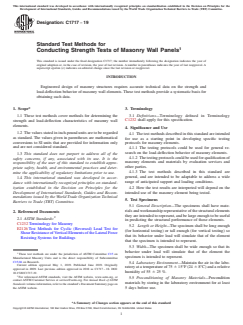
Overview
ASTM C1717-19: Standard Test Methods for Conducting Strength Tests of Masonry Wall Panels provides essential procedures for determining the structural strength and load-deflection characteristics of masonry wall panels. Developed by ASTM International, this standard serves as a general framework for the development of specific testing protocols tailored to various masonry elements. It covers key testing conditions, specimen preparation, apparatus requirements, and data recording procedures for researchers, manufacturers, and evaluation bodies in the construction industry.
Key Topics
- Strength and Load-Deflection Behavior: The standard focuses on systematically assessing how masonry wall panels perform under various loading scenarios, including axial, transverse, and in-plane shear loads.
- Test Methods:
- Axial compression tests
- Transverse quarter-point loading (both horizontal and vertical specimens)
- Tests with uniformly distributed loading using air bags
- Concentrated load tests
- In-plane shear load tests
- Specimen Preparation:
- Requirements for materials and workmanship representative of actual structural elements
- Proper specimen size, conditioning, and laboratory environment controls
- Instrumentation and Measurement:
- Precision requirements for load cells, displacement gauges, and pressure measuring devices
- Standard procedures for data collection and load-deflection curve analysis
- Loading Protocols: Guidance on different loading approaches such as monotonic to failure or cyclic protocols, adaptable to a wide range of support and loading conditions.
Applications
ASTM C1717-19 applies to a broad range of real-world situations, including:
- Research and Development: Provides baseline methods for laboratory-based research on the performance and failure modes of masonry wall panels under various loads.
- Product Qualification and Certification: Used by evaluation services, manufacturers, and other auditing bodies to qualify masonry products and materials for structural use.
- Quality Assurance: Facilities can apply these test methods as part of their internal quality control processes before products are released to market or specified in projects.
- Engineered Design Verification: Helps structural engineers and designers verify that masonry wall elements meet strength and deformation requirements as per building codes and project specifications.
- International Trade Compliance: Developed in line with WTO Technical Barriers to Trade (TBT) Committee principles, ensuring recognition in global procurement and construction contexts.
Related Standards
To maximize accuracy and consistency, ASTM C1717-19 references and aligns with several key standards, including:
- ASTM C1232 - Terminology for Masonry: Defines the terminology used throughout C1717-19 and other masonry standards.
- ASTM E2126 - Test Methods for Cyclic (Reversed) Load Test for Shear Resistance of Vertical Elements: Offers advanced protocols for evaluating lateral force resistance in buildings.
Practical Value
Utilizing ASTM C1717-19 ensures:
- Standardization of masonry wall panel testing methods and reporting
- Reliable assessment of wall strength, deformation, and failure behavior
- Confidence in the structural integrity of masonry elements for architects, engineers, and builders
- Enhanced compliance with both national and international construction and safety requirements
By following the methods set out in ASTM C1717-19, construction professionals, testing laboratories, and product manufacturers can ensure their masonry wall panels are tested comprehensively and results are reported in a way that is widely understood and accepted, supporting safer and more reliable masonry construction around the world.
Relations
- Effective Date
- 01-May-2019
- Effective Date
- 15-Dec-2023
- Effective Date
- 01-Aug-2019
- Effective Date
- 01-Jul-2018
- Effective Date
- 01-Jun-2017
- Effective Date
- 01-Sep-2015
- Effective Date
- 01-Jun-2015
- Effective Date
- 01-Jun-2012
- Effective Date
- 01-May-2011
- Effective Date
- 15-Dec-2010
- Effective Date
- 01-Sep-2010
- Effective Date
- 15-Jun-2010
- Effective Date
- 01-May-2010
- Effective Date
- 01-Jan-2010
- Effective Date
- 15-Dec-2009
Get Certified
Connect with accredited certification bodies for this standard

DIBt (Deutsches Institut für Bautechnik)
German Institute for Building Technology.
DIN CERTCO
DIN Group product certification.

Aboma Certification B.V.
Specialized in construction, metal, and transport sectors.
Sponsored listings
Frequently Asked Questions
ASTM C1717-19 is a standard published by ASTM International. Its full title is "Standard Test Methods for Conducting Strength Tests of Masonry Wall Panels". This standard covers: SIGNIFICANCE AND USE 4.1 The test methods described in this standard are intended for use as a starting point in developing specific testing protocols for masonry elements. 4.1.1 The testing protocols could be used for general research on the load-deflection behavior of masonry elements. 4.1.2 The testing protocols could be used for qualification of masonry elements and materials by evaluation services and other parties. 4.1.3 The test methods described in this standard are general, and are intended to be adaptable to address a wide range of anticipated support and loading conditions. 4.2 How the test results are interpreted will depend on the intended use of the masonry element being tested. SCOPE 1.1 These test methods cover methods for determining the strength and load-deflection characteristics of masonry wall elements. 1.2 The values stated in inch-pound units are to be regarded as standard. The values given in parentheses are mathematical conversions to SI units that are provided for information only and are not considered standard. 1.3 This standard does not purport to address all of the safety concerns, if any, associated with its use. It is the responsibility of the user of this standard to establish appropriate safety, health, and environmental practices and determine the applicability of regulatory limitations prior to use. 1.4 This international standard was developed in accordance with internationally recognized principles on standardization established in the Decision on Principles for the Development of International Standards, Guides and Recommendations issued by the World Trade Organization Technical Barriers to Trade (TBT) Committee.
SIGNIFICANCE AND USE 4.1 The test methods described in this standard are intended for use as a starting point in developing specific testing protocols for masonry elements. 4.1.1 The testing protocols could be used for general research on the load-deflection behavior of masonry elements. 4.1.2 The testing protocols could be used for qualification of masonry elements and materials by evaluation services and other parties. 4.1.3 The test methods described in this standard are general, and are intended to be adaptable to address a wide range of anticipated support and loading conditions. 4.2 How the test results are interpreted will depend on the intended use of the masonry element being tested. SCOPE 1.1 These test methods cover methods for determining the strength and load-deflection characteristics of masonry wall elements. 1.2 The values stated in inch-pound units are to be regarded as standard. The values given in parentheses are mathematical conversions to SI units that are provided for information only and are not considered standard. 1.3 This standard does not purport to address all of the safety concerns, if any, associated with its use. It is the responsibility of the user of this standard to establish appropriate safety, health, and environmental practices and determine the applicability of regulatory limitations prior to use. 1.4 This international standard was developed in accordance with internationally recognized principles on standardization established in the Decision on Principles for the Development of International Standards, Guides and Recommendations issued by the World Trade Organization Technical Barriers to Trade (TBT) Committee.
ASTM C1717-19 is classified under the following ICS (International Classification for Standards) categories: 91.060.10 - Walls. Partitions. Facades. The ICS classification helps identify the subject area and facilitates finding related standards.
ASTM C1717-19 has the following relationships with other standards: It is inter standard links to ASTM C1717-18, ASTM C1232-23, ASTM E2126-19, ASTM E2126-11(2018), ASTM C1232-17, ASTM C1232-15a, ASTM C1232-15, ASTM C1232-12, ASTM E2126-11, ASTM C1232-10c, ASTM E2126-10, ASTM C1232-10b, ASTM C1232-10a, ASTM C1232-10, ASTM C1232-09b. Understanding these relationships helps ensure you are using the most current and applicable version of the standard.
ASTM C1717-19 is available in PDF format for immediate download after purchase. The document can be added to your cart and obtained through the secure checkout process. Digital delivery ensures instant access to the complete standard document.
Standards Content (Sample)
This international standard was developed in accordance with internationally recognized principles on standardization established in the Decision on Principles for the
Development of International Standards, Guides and Recommendations issued by the World Trade Organization Technical Barriers to Trade (TBT) Committee.
Designation: C1717 − 19
Standard Test Methods for
Conducting Strength Tests of Masonry Wall Panels
This standard is issued under the fixed designation C1717; the number immediately following the designation indicates the year of
original adoption or, in the case of revision, the year of last revision.Anumber in parentheses indicates the year of last reapproval.A
superscript epsilon (´) indicates an editorial change since the last revision or reapproval.
INTRODUCTION
Engineered design of masonry structures requires accurate technical data on the strength and
load-deflection behavior of masonry wall elements.These test methods provide a systematic basis for
obtaining such data.
1. Scope* 3. Terminology
3.1 Definitions—Terminology defined in Terminology
1.1 These test methods cover methods for determining the
C1232 shall apply for this specification.
strength and load-deflection characteristics of masonry wall
elements.
4. Significance and Use
1.2 The values stated in inch-pound units are to be regarded
4.1 Thetestmethodsdescribedinthisstandardareintended
as standard. The values given in parentheses are mathematical
for use as a starting point in developing specific testing
conversions to SI units that are provided for information only
protocols for masonry elements.
and are not considered standard.
4.1.1 The testing protocols could be used for general re-
search on the load-deflection behavior of masonry elements.
1.3 This standard does not purport to address all of the
4.1.2 Thetestingprotocolscouldbeusedforqualificationof
safety concerns, if any, associated with its use. It is the
masonry elements and materials by evaluation services and
responsibility of the user of this standard to establish appro-
other parties.
priate safety, health, and environmental practices and deter-
4.1.3 The test methods described in this standard are
mine the applicability of regulatory limitations prior to use.
general, and are intended to be adaptable to address a wide
1.4 This international standard was developed in accor-
range of anticipated support and loading conditions.
dance with internationally recognized principles on standard-
4.2 How the test results are interpreted will depend on the
ization established in the Decision on Principles for the
Development of International Standards, Guides and Recom- intended use of the masonry element being tested.
mendations issued by the World Trade Organization Technical
5. Test Specimens
Barriers to Trade (TBT) Committee.
5.1 General Description—The specimens shall have mate-
rialsandworkmanshiprepresentativeofthestructuralelements
2. Referenced Documents
theyareintendedtorepresent,andbelargeenoughtobeuseful
2.1 ASTM Standards:
in predicting the structural performance of those elements.
C1232Terminology for Masonry
5.2 Length or Height—The specimen shall be long enough
E2126Test Methods for Cyclic (Reversed) Load Test for
(for horizontal testing) or tall enough (for vertical testing) so
ShearResistanceofVerticalElementsoftheLateralForce
that its behavior under load will simulate that of the element
Resisting Systems for Buildings
that the specimen is intended to represent.
5.3 Width—The specimen shall be wide enough so that its
behavior under load will simulate that of the element the
These test methods are under the jurisdiction of ASTM Committee C15 on
specimen is intended to represent.
Manufactured Masonry Units and is the direct responsibility of Subcommittee
C15.04 on Research.
5.4 Laboratory Environment—Maintain the air in the labo-
Current edition approved May 1, 2019. Published June 2019. Originally
ratoryatatemperatureof75 615°F(24 68°C)andarelative
approved in 2009. Last previous edition approved in 2018 as C1717–18. DOI:
humidity of 55 6 25%.
10.1520/C1717-19.
For referenced ASTM standards, visit the ASTM website, www.astm.org, or
5.5 Preconditioning of Masonry Materials—Precondition
contact ASTM Customer Service at service@astm.org. For Annual Book of ASTM
materials by storing in the laboratory environment for at least
Standards volume information, refer to the standard’s Document Summary page on
the ASTM website. 5 days before use.
*A Summary of Changes section appears at the end of this standard
Copyright © ASTM International, 100 Barr Harbor Drive, PO Box C700, West Conshohocken, PA 19428-2959. United States
C1717 − 19
FIG. 1 Test Setup for Axial Compressive Loading
5.6 Age—Test masonry construction at an age of at least 28 loading protocol is cycles of loading (possibly reversed) to
days after fabrication, unless specified otherwise. monotonically increasing maximum amplitudes. Other proto-
cols shall be permitted to be used.
6. General Requirements for Instrumentation
NOTE 1—A wide range of loading protocols for in-plane tests is
provided in Test Methods E2126.
6.1 Load Measurement—Measure loads with a load cell or
pressure transducer having a precision better than or equal to
8. Axial Compression Test
1% of the expected maximum load.
8.1 Apparatus—Use a test setup incorporating the essential
6.2 Displacement Measurement—Measure displacements
aspects of Fig. 1. Design the test setup to resist at least twice
with a linear potentiometer, linear variable displacement trans-
the maximum anticipated load. Design the test setup so its
former (LVDT), or dial gauge having a precision equal to or
stiffness parallel to the axis of the specimen is at least 10× the
better than the lesser of 61% of the expected maximum
anticipatedaxialstiffnessofthespecimenitself.Thebottomof
displacement, or 60.02 in. (60.5 mm).
the specimen shall be simply supported (with a zero or
6.3 Data Acquisition—Record sufficient data to define the
non-zero eccentricity) or restrained. The top of the specimen
load-displacement curve with sufficient precision for the pur-
shallbesimplysupported(withazeroornon-zeroeccentricity)
poses of the test. Each set of data (load and displacement) is
or restrained. Apply the axial load at the top with a zero or
referred to as a “loading point.”
non-zero eccentricity. Apply the load uniformly along the top
of the specimen.
7. General Requirements for Loading
8.2 Instrumentation:
7.1 LoadingMethod—Loadspecimenshydraulicallyusinga
8.2.1 Axial Load—Measure the applied axial load.
hand pump, electrical pump, or air-driven pump.
8.2.2 Axial Deformation—Attach a bracket to the specimen
7.2 Test Control—Control the load manually or automati-
near the upper end, supporting a metal rod. Attach another
cally (servo-controlled feedback system).
bracket to the specimen near its lower end, supporting a
7.2.1 Manual Control—If the load is controlled manually,
displacement gauge. Other means of measuring the axial
displacements are imposed on the specimen. The loading
deformation shall be acceptable, provided that they meet the
protocol may be based on target loads or target displacements.
requirements of 6.2.
Itisgenerallyconvenienttousetargetloadsuntiltheloadlevel
8.2.3 Out-of-plane Deflection—Measure out-of-plane de-
approachestheexpectedcapacity,andthenusetargetdisplace-
flection using either a reference line attached to the wall, or a
ments.
fixed reference.
7.2.2 Automatic Control—If the load is controlled
8.2.3.1 Out-of-plane Deflection Using a Reference Line—
automatically, either load or displacement is imposed on the
Measure out-of-plane deflection using a deflection gauge
system. The loading protocol may be based on target loads or
oriented perpendicular to the plane of the wall, and placed at
target displacements. Use load control until the load level
the mid-height and plan mid-length of the wall. Alternatively,
approaches the expected capacity, and then use displacement
use two deflection gauges oriented perpendicular to the plane
control.
of the wall, and placed at the mid-height and plan ends of the
7.3 Loading Protocol—Usealoadingprotocolthatisappro- wall. Attach one end of the deflection gauge or gauges to the
priate for the purposes of the test. The simplest loading wall, and the other end to a reference line between the top and
protocol is monotonic loading to failure. A more complex bottom of the wall.
C1717 − 19
FIG. 2 Test Setup for Transverse Quarter-point Loading (Specimen Horizontal)
8.2.3.2 Out-of-plane Deflection Using a Fixed Reference— line vertically above one support, and the third ball vertically
Use three deflection gauges, oriented perpendicular to the above the other support. Attach two deflection gauges to the
plane of the wall, one placed at mid-height, the other two frame at midspan, one near each longitudinal edge of the
placed at the top and the bottom, and all placed at the plan specimen. Other means of measuring the difference between
mid-lengthofthewall.Attachoneendofeachdeflectiongauge the support and midspan deflections shall be acceptable,
to the wall, and attach the other end to a fixed reference. provided that they meet the requirements of 6.2.
8.3 Data Recording—Report the bottom support conditions
9.2 Procedure:
andeccentricity.Ateachloadingpoint,recordtheappliedload,
9.2.1 Loading—Apply the load to the designated face of the
axial deformation of each axial deformation gauge and the
specimen.
average of these deformations, and the out-of-plane deflection.
9.2.1.1 Quarter-point Loading—Test the specimen as a
simply supported beam (Fig. 2) on a span approximately 6 in.
9. Transverse Quarter-Point Loading—Specimen
(150 mm) less than the specimen length. Apply two equal
Horizontal
loads, each at a distance of one quarter of the span from the
9.1 Apparatus—The apparatus shall incorporate the essen-
supports, toward the middle of the span. Measure the loads
tialaspectsofFig.2,andbeabletowithstandatleasttwicethe
using a single load cell between the hydraulic ram and the
anticipated maximum load, with a maximum deformation not
loading beam, or using two load cells, one at each end of the
more than 1% of the expected deformation of the specimen.
loading beam.The reported load on the specimen shall include
9.1.1 Roller Supports—Provide steel roller supports with
the weight of specimen between the supports.
steel bearing plates between the roller supports and the
9.2.1.2 Uniformly Distributed Loading—Uniformly distrib-
specimen.Usecompressibleshimsorabedofgypsumcapping
uted loading shall be permitted to be used instead of quarter-
material to ensure uniform application of the support reaction.
point loading, if a satisfactory method is available. Transverse
9.1.2 Loading Assembly—The loading assembly shall con-
load, uniformly distributed, may be applied by air pressure,
sist of two steel rollers with a steel plate between each loading
either in a bag or in a chamber having the specimen as one
rollerandthespecimen.Usefull-length,compressibleshimsor
face. Support specimens tested under uniform loading by
a bed of gypsum capping material to ensure uniform applica-
rollers as for quarter-point loading.
tion of load.
9.2.2 Strength on Short Span—If the strength of the con-
9.1.3 Hydraulic Ram.
struction for a shorter span is desired, do not compute it, but
9.1.4 Load-measur
...
This document is not an ASTM standard and is intended only to provide the user of an ASTM standard an indication of what changes have been made to the previous version. Because
it may not be technically possible to adequately depict all changes accurately, ASTM recommends that users consult prior editions as appropriate. In all cases only the current version
of the standard as published by ASTM is to be considered the official document.
Designation: C1717 − 18 C1717 − 19
Standard Test Methods for
Conducting Strength Tests of Masonry Wall Panels
This standard is issued under the fixed designation C1717; the number immediately following the designation indicates the year of
original adoption or, in the case of revision, the year of last revision. A number in parentheses indicates the year of last reapproval. A
superscript epsilon (´) indicates an editorial change since the last revision or reapproval.
INTRODUCTION
Engineered design of masonry structures requires accurate technical data on the strength and
load-deflection behavior of masonry wall elements. These test methods provide a systematic basis for
obtaining such data.
1. Scope*
1.1 These test methods cover methods for determining the strength and load-deflection characteristics of masonry wall elements.
1.2 The values stated in inch-pound units are to be regarded as standard. The values given in parentheses are mathematical
conversions to SI units that are provided for information only and are not considered standard.
1.3 This standard does not purport to address all of the safety concerns, if any, associated with its use. It is the responsibility
of the user of this standard to establish appropriate safety, health, and environmental practices and determine the applicability of
regulatory limitations prior to use.
1.4 This international standard was developed in accordance with internationally recognized principles on standardization
established in the Decision on Principles for the Development of International Standards, Guides and Recommendations issued
by the World Trade Organization Technical Barriers to Trade (TBT) Committee.
2. Referenced Documents
2.1 ASTM Standards:
C1232 Terminology for Masonry
E2126 Test Methods for Cyclic (Reversed) Load Test for Shear Resistance of Vertical Elements of the Lateral Force Resisting
Systems for Buildings
3. Terminology
3.1 Definitions—Terminology defined in Terminology C1232 shall apply for this specification.
4. Significance and Use
4.1 The test methods described in this standard are intended for use as a starting point in developing specific testing protocols
for masonry elements.
4.1.1 The testing protocols could be used for general research on the load-deflection behavior of masonry elements.
4.1.2 The testing protocols could be used for qualification of masonry elements and materials by evaluation services and other
parties.
4.1.3 The test methods described in this standard are general, and are intended to be adaptable to address a wide range of
anticipated support and loading conditions.
4.2 How the test results are interpreted will depend on the intended use of the masonry element being tested.
These test methods are under the jurisdiction of ASTM Committee C15 on Manufactured Masonry Units and is the direct responsibility of Subcommittee C15.04 on
Research.
Current edition approved Dec. 15, 2018May 1, 2019. Published January 2019June 2019. Originally approved in 2009. Last previous edition approved in 20122018 as
C1717 – 12.C1717 – 18. DOI: 10.1520/C1717-18.10.1520/C1717-19.
For referenced ASTM standards, visit the ASTM website, www.astm.org, or contact ASTM Customer Service at service@astm.org. For Annual Book of ASTM Standards
volume information, refer to the standard’s Document Summary page on the ASTM website.
*A Summary of Changes section appears at the end of this standard
Copyright © ASTM International, 100 Barr Harbor Drive, PO Box C700, West Conshohocken, PA 19428-2959. United States
C1717 − 19
5. Test Specimens
5.1 General Description—The specimens shall have materials and workmanship representative of the structural elements they
are intended to represent, and be large enough to be useful in predicting the structural performance of those elements.
5.2 Length or Height—The specimen shall be long enough (for horizontal testing) or tall enough (for vertical testing) so that
its behavior under load will simulate that of the element that the specimen is intended to represent.
5.3 Width—The specimen shall be wide enough so that its behavior under load will simulate that of the element the specimen
is intended to represent.
5.4 Laboratory Environment—Maintain the air in the laboratory at a temperature of 75 6 15°F (24 6 8°C) and a relative
humidity of 55 6 25 %.
5.5 Preconditioning of Masonry Materials—Precondition materials by storing in the laboratory environment for at least 5 days
before use.
5.6 Age—Test masonry construction at an age of at least 28 days after fabrication, unless specified otherwise.
6. General Requirements for Instrumentation
6.1 Load Measurement—Measure loads with a load cell or pressure transducer having a precision better than or equal to 1 %
of the expected maximum load.
6.2 Displacement Measurement—Measure displacements with a linear potentiometer, linear variable displacement transformer
(LVDT), or dial gauge having a precision equal to or better than the lesser of 61 % of the expected maximum displacement, or
60.02 in. (60.5 mm).
6.3 Data Acquisition—Record sufficient data to define the load-displacement curve with sufficient precision for the purposes of
the test. Each set of data (load and displacement) is referred to as a “loading point.”
7. General Requirements for Loading
7.1 Loading Method—Load specimens hydraulically using a hand pump, electrical pump, or air-driven pump.
7.2 Test Control—Control the load manually or automatically (servo-controlled feedback system).
7.2.1 Manual Control—If the load is controlled manually, displacements are imposed on the specimen. The loading protocol
may be based on target loads or target displacements. It is generally convenient to use target loads until the load level approaches
the expected capacity, and then use target displacements.
7.2.2 Automatic Control—If the load is controlled automatically, either load or displacement is imposed on the system. The
loading protocol may be based on target loads or target displacements. Use load control until the load level approaches the expected
capacity, and then use displacement control.
7.3 Loading Protocol—Use a loading protocol that is appropriate for the purposes of the test. The simplest loading protocol is
monotonic loading to failure. A more complex loading protocol is cycles of loading (possibly reversed) to monotonically increasing
maximum amplitudes. Other protocols shall be permitted to be used.
NOTE 1—A wide range of loading protocols for in-plane tests is provided in Test Methods E2126.
8. Axial Compression Test
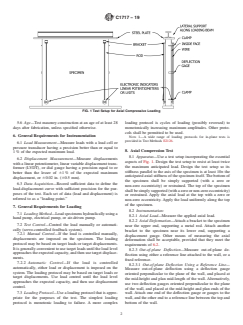
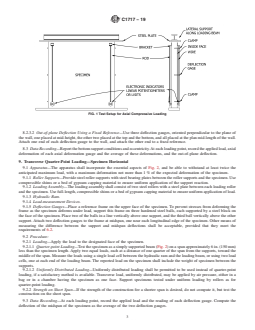
8.1 Apparatus—Use a test setup incorporating the essential aspects of Fig. 1. Design the test setup to resist at least twice the
maximum anticipated load. Design the test setup so its stiffness parallel to the axis of the specimen is at least 10× the anticipated
axial stiffness of the specimen itself. The bottom of the specimen shall be simply supported (with a zero or non-zero eccentricity)
or restrained. The top of the specimen shall be simply supported (with a zero or non-zero eccentricity) or restrained. Apply the axial
load at the top with a zero or non-zero eccentricity. Apply the load uniformly along the top of the specimen.
8.2 Instrumentation:
8.2.1 Axial Load—Measure the applied axial load.
8.2.2 Axial Deformation—Attach a bracket to the specimen near the upper end, supporting a metal rod. Attach another bracket
to the specimen near its lower end, supporting a displacement gauge. Other means of measuring the axial deformation shall be
acceptable, provided that they meet the requirements of 6.2.
8.2.3 Out-of-plane Deflection—Measure out-of-plane deflection using either a reference line attached to the wall, or a fixed
reference.
8.2.3.1 Out-of-plane Deflection Using a Reference Line—Measure out-of-plane deflection using a deflection gauge oriented
perpendicular to the plane of the wall, and placed at the mid-height and plan mid-length of the wall. Alternatively, use two
deflection gauges oriented perpendicular to the plane of the wall, and placed at the mid-height and plan ends of the wall. Attach
one end of the deflection gauge or gauges to the wall, and the other end to a reference line between the top and bottom of the wall.
C1717 − 19
FIG. 1 Test Setup for Axial Compressive Loading
8.2.3.2 Out-of-plane Deflection Using a Fixed Reference—Use three deflection gauges, oriented perpendicular to the plane of
the wall, one placed at mid-height, the other two placed at the top and the bottom, and all placed at the plan mid-length of the wall.
Attach one end of each deflection gauge to the wall, and attach the other end to a fixed reference.
8.3 Data Recording—Report the bottom support conditions and eccentricity. At each loading point, record the applied load, axial
deformation of each axial deformation gauge and the average of these deformations, and the out-of-plane deflection.
9. Transverse Quarter-Point Loading—Specimen Horizontal
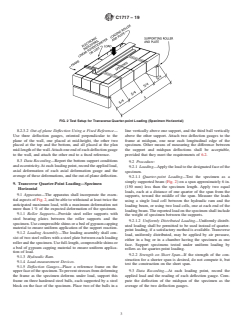
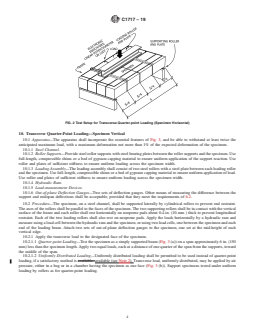
9.1 Apparatus—The apparatus shall incorporate the essential aspects of Fig. 2, and be able to withstand at least twice the
anticipated maximum load, with a maximum deformation not more than 1 % of the expected deformation of the specimen.
9.1.1 Roller Supports—Provide steel roller supports with steel bearing plates between the roller supports and the specimen. Use
compressible shims or a bed of gypsum capping material to ensure uniform application of the support reaction.
9.1.2 Loading Assembly—The loading assembly shall consist of two steel rollers with a steel plate between each loading roller
and the specimen. Use full-length, compressible shims or a bed of gypsum capping material to ensure uniform application of load.
9.1.3 Hydraulic Ram.
9.1.4 Load-measurement Devices.
9.1.5 Deflection Gauges—Place a reference frame on the upper face of the specimen. To prevent stresses from deforming the
frame as the specimen deforms under load, support this frame on three hardened steel balls, each supported by a steel block on
the face of the specimen. Place two of the balls in a line vertically above one support, and the third ball vertically above the other
support. Attach two deflection gauges to the frame at midspan, one near each longitudinal edge of the specimen. Other means of
measuring the difference between the support and midspan deflections shall be acceptable, provided that they meet the
requirements of 6.2.
9.2 Procedure:
9.2.1 Loading—Apply the load to the designated face of the specimen.
Fig. 2) on a span approximately 6 in. (150 mm)
9.2.1.1 Quarter-point Loading—Test the specimen as a simply supported beam (
less than the specimen length. Apply two equal loads, each at a distance of one quarter of the span from the supports, toward the
middle of the span. Measure the loads using a single load cell between the hydraulic ram and the loading beam, or using two load
cells, one at each end of the loading beam. The reported load on the specimen shall include the weight of specimen between the
supports.
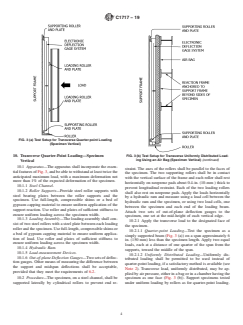
9.2.1.2 Uniformly Distributed Loading—Uniformly distributed loading shall be permitted to be used instead of quarter-point
loading, if a satisfactory method is available. Transverse load, uniformly distributed, may be applied by air pressure, either in a
bag or in a chamber having the specimen as one face. Suppo
...