

ASTM C1196-20
(Test Method)Standard Test Method for In Situ Compressive Stress Within Solid Unit Masonry Estimated Using Flatjack Measurements
General Information
- Abstract
SIGNIFICANCE AND USE
5.1 Stress is applied as pressure over the area of the flatjack. In the case of multi-wythe masonry, stress is estimated only in the wythe in which the flatjack is inserted. Stress in other wythes may be different.
SCOPE
1.1 This test method covers the determination of the average compressive stress in existing unreinforced solid-unit masonry (see Note 1). This test method concerns the measurement of in-situ compressive stress in existing masonry by use of thin, bladder-like flatjack devices that are installed in cut mortar joints in the masonry wall. This test method provides a relatively non-destructive means of determining masonry properties in place.
Note 1: Solid-unit masonry is that built with stone, concrete, or clay units whose net area is equal to or greater than 75 % of the gross area.
1.2 The values stated in inch-pound units are to be regarded as standard. The values given in parentheses are mathematical conversions to SI units that are provided for information only and are not considered standard.
1.3 This standard does not purport to address all of the safety concerns, if any, associated with its use. It is the responsibility of the user of this standard to establish appropriate safety, health, and environmental practices and determine the applicability of regulatory limitations prior to use.
1.4 This international standard was developed in accordance with internationally recognized principles on standardization established in the Decision on Principles for the Development of International Standards, Guides and Recommendations issued by the World Trade Organization Technical Barriers to Trade (TBT) Committee.
- Status
- Published
- Publication Date
- 14-Dec-2020
- Technical Committee
- C15 - Masonry – Manufactured Masonry Units, Mortars and Grouts
- Drafting Committee
- C15.04 - Research for Masonry Units and Assemblies
Buy Documents
ASTM C1196-20 - Standard Test Method for In Situ Compressive Stress Within Solid Unit Masonry Estimated Using Flatjack Measurements
REDLINE ASTM C1196-20 - Standard Test Method for In Situ Compressive Stress Within Solid Unit Masonry Estimated Using Flatjack Measurements
Overview
ASTM C1196-20: Standard Test Method for In Situ Compressive Stress Within Solid Unit Masonry Estimated Using Flatjack Measurements is a widely recognized standard developed by ASTM International. This test method provides a procedure for estimating the average compressive stress in existing, unreinforced solid-unit masonry structures, such as those constructed with stone, concrete, or clay units. The method utilizes flatjack devices, which are thin, bladder-like hydraulic instruments inserted into bed joints of the masonry to measure in-situ compressive stress with minimal disturbance to the structure. ASTM C1196-20 is a valuable tool for nondestructive evaluation (NDE) of masonry, supporting the assessment and maintenance of historic and modern masonry constructions.
Key Topics
- In Situ Compressive Stress Measurement: The core of ASTM C1196-20 is the reliable measurement of existing stress within unreinforced masonry using flatjack devices. These measurements are critical for structural analysis and determining current load-resisting capacity.
- Relatively Nondestructive Testing: Unlike destructive test methods, the flatjack technique involves creating minimal modifications to the masonry, preserving structural integrity while allowing assessment of stress levels.
- Flatjack Calibration and Setup: The standard outlines calibration requirements for the flatjack tools and provides guidelines for accurate slot preparation, gage placement, and pressure monitoring.
- Applicability to Solid-Unit Masonry: The method is specifically relevant for masonry built with units whose net area is at least 75% of their gross area, ensuring broad applicability for various masonry types.
- Precision, Bias, and Test Replication: The standard discusses the variability of results and recommends conducting multiple tests in the same area to improve reliability.
Applications
ASTM C1196-20 is especially relevant for:
- Structural Assessment of Existing Masonry: Engineers and inspectors use this method to determine in-situ compressive stresses in historic and modern masonry buildings, informing rehabilitation and safety evaluations.
- Preservation of Heritage Structures: The flatjack method allows for accurate stress determination without causing irreparable damage, meeting the needs of heritage conservation projects.
- Quality Control of Masonry Assemblies: Assessing compressive stress helps identify construction defects, material degradation, and load distribution issues.
- Forensic Engineering: The technique supports investigations of structural failures or distress within masonry walls, aiding in root cause analysis.
- Evaluation Prior to Modifications: When retrofitting, adding load, or altering existing masonry, measuring current stresses ensures design changes are safe and appropriate.
Related Standards
For comprehensive masonry testing and terminology, consider these related ASTM standards:
- ASTM C1180: Terminology of Mortar and Grout for Unit Masonry
- ASTM C1232: Terminology for Masonry
- ASTM E74: Practices for Calibration and Verification for Force-Measuring Instruments
These standards are often referenced together with ASTM C1196-20 to ensure accurate communication, data collection, and calibration when performing masonry evaluations.
By following ASTM C1196-20, professionals gain a robust, reliable approach for in-situ compressive stress measurement in solid-unit masonry. The relatively nondestructive nature of flatjack testing, combined with standardization, makes it a cornerstone method for structural diagnostics, preservation, and quality assurance in masonry construction. Using this standard supports safer, more informed decisions regarding the ongoing use and maintenance of masonry structures.
Relations
- Effective Date
- 15-Dec-2023
- Effective Date
- 01-Dec-2018
- Effective Date
- 01-Jun-2017
- Effective Date
- 01-Sep-2015
- Effective Date
- 01-Jun-2015
- Effective Date
- 01-May-2013
- Effective Date
- 01-Mar-2013
- Effective Date
- 01-Dec-2012
- Effective Date
- 01-Jun-2012
- Effective Date
- 15-Dec-2010
- Effective Date
- 01-Dec-2010
- Effective Date
- 15-Jun-2010
- Effective Date
- 01-May-2010
- Effective Date
- 01-Jan-2010
- Effective Date
- 15-Dec-2009
Buy Documents
ASTM C1196-20 - Standard Test Method for In Situ Compressive Stress Within Solid Unit Masonry Estimated Using Flatjack Measurements
REDLINE ASTM C1196-20 - Standard Test Method for In Situ Compressive Stress Within Solid Unit Masonry Estimated Using Flatjack Measurements
Get Certified
Connect with accredited certification bodies for this standard

DIBt (Deutsches Institut für Bautechnik)
German Institute for Building Technology.
DIN CERTCO
DIN Group product certification.

Aboma Certification B.V.
Specialized in construction, metal, and transport sectors.
Sponsored listings
Frequently Asked Questions
ASTM C1196-20 is a standard published by ASTM International. Its full title is "Standard Test Method for In Situ Compressive Stress Within Solid Unit Masonry Estimated Using Flatjack Measurements". This standard covers: SIGNIFICANCE AND USE 5.1 Stress is applied as pressure over the area of the flatjack. In the case of multi-wythe masonry, stress is estimated only in the wythe in which the flatjack is inserted. Stress in other wythes may be different. SCOPE 1.1 This test method covers the determination of the average compressive stress in existing unreinforced solid-unit masonry (see Note 1). This test method concerns the measurement of in-situ compressive stress in existing masonry by use of thin, bladder-like flatjack devices that are installed in cut mortar joints in the masonry wall. This test method provides a relatively non-destructive means of determining masonry properties in place. Note 1: Solid-unit masonry is that built with stone, concrete, or clay units whose net area is equal to or greater than 75 % of the gross area. 1.2 The values stated in inch-pound units are to be regarded as standard. The values given in parentheses are mathematical conversions to SI units that are provided for information only and are not considered standard. 1.3 This standard does not purport to address all of the safety concerns, if any, associated with its use. It is the responsibility of the user of this standard to establish appropriate safety, health, and environmental practices and determine the applicability of regulatory limitations prior to use. 1.4 This international standard was developed in accordance with internationally recognized principles on standardization established in the Decision on Principles for the Development of International Standards, Guides and Recommendations issued by the World Trade Organization Technical Barriers to Trade (TBT) Committee.
SIGNIFICANCE AND USE 5.1 Stress is applied as pressure over the area of the flatjack. In the case of multi-wythe masonry, stress is estimated only in the wythe in which the flatjack is inserted. Stress in other wythes may be different. SCOPE 1.1 This test method covers the determination of the average compressive stress in existing unreinforced solid-unit masonry (see Note 1). This test method concerns the measurement of in-situ compressive stress in existing masonry by use of thin, bladder-like flatjack devices that are installed in cut mortar joints in the masonry wall. This test method provides a relatively non-destructive means of determining masonry properties in place. Note 1: Solid-unit masonry is that built with stone, concrete, or clay units whose net area is equal to or greater than 75 % of the gross area. 1.2 The values stated in inch-pound units are to be regarded as standard. The values given in parentheses are mathematical conversions to SI units that are provided for information only and are not considered standard. 1.3 This standard does not purport to address all of the safety concerns, if any, associated with its use. It is the responsibility of the user of this standard to establish appropriate safety, health, and environmental practices and determine the applicability of regulatory limitations prior to use. 1.4 This international standard was developed in accordance with internationally recognized principles on standardization established in the Decision on Principles for the Development of International Standards, Guides and Recommendations issued by the World Trade Organization Technical Barriers to Trade (TBT) Committee.
ASTM C1196-20 is classified under the following ICS (International Classification for Standards) categories: 91.060.10 - Walls. Partitions. Facades. The ICS classification helps identify the subject area and facilitates finding related standards.
ASTM C1196-20 has the following relationships with other standards: It is inter standard links to ASTM C1232-23, ASTM C1180-18, ASTM C1232-17, ASTM C1232-15a, ASTM C1232-15, ASTM E74-13a, ASTM E74-13, ASTM E74-12, ASTM C1232-12, ASTM C1232-10c, ASTM C1180-10, ASTM C1232-10b, ASTM C1232-10a, ASTM C1232-10, ASTM C1232-09b. Understanding these relationships helps ensure you are using the most current and applicable version of the standard.
ASTM C1196-20 is available in PDF format for immediate download after purchase. The document can be added to your cart and obtained through the secure checkout process. Digital delivery ensures instant access to the complete standard document.
Standards Content (Sample)
This international standard was developed in accordance with internationally recognized principles on standardization established in the Decision on Principles for the
Development of International Standards, Guides and Recommendations issued by the World Trade Organization Technical Barriers to Trade (TBT) Committee.
Designation:C1196 −20
Standard Test Method for
In Situ Compressive Stress Within Solid Unit Masonry
Estimated Using Flatjack Measurements
This standard is issued under the fixed designation C1196; the number immediately following the designation indicates the year of
original adoption or, in the case of revision, the year of last revision. A number in parentheses indicates the year of last reapproval. A
superscript epsilon (´) indicates an editorial change since the last revision or reapproval.
1. Scope* E74 Practices for Calibration and Verification for Force-
Measuring Instruments
1.1 Thistestmethodcoversthedeterminationoftheaverage
compressive stress in existing unreinforced solid-unit masonry
3. Terminology
(see Note 1). This test method concerns the measurement of
3.1 Definitions of Terms Specific to This Standard:
in-situ compressive stress in existing masonry by use of thin,
3.1.1 shim, n—item inserted into a flatjack slot prior to
bladder-like flatjack devices that are installed in cut mortar
testing to minimize the inflation of the test flatjack.
joints in the masonry wall. This test method provides a
3.1.1.1 Discussion—The use of shims may be necessary
relativelynon-destructivemeansofdeterminingmasonryprop-
during testing to achieve a tight fit of the flatjack in the slot and
erties in place.
to ensure uniform transfer of pressure (stress) to the masonry
NOTE 1—Solid-unit masonry is that built with stone, concrete, or clay
overthecompleteareaoftheflatjack.SeeAnnexA1forfurther
units whose net area is equal to or greater than 75 % of the gross area.
discussion on allowable types of shims.
1.2 The values stated in inch-pound units are to be regarded
3.1.2 spacer—metal plate used in the calibration process to
as standard. The values given in parentheses are mathematical
control flatjack thickness.
conversions to SI units that are provided for information only
3.2 For definitions of other terms used in this test method
and are not considered standard.
refer to Terminology C1180 for mortar and grout and Termi-
1.3 This standard does not purport to address all of the
nology C1232 for masonry.
safety concerns, if any, associated with its use. It is the
responsibility of the user of this standard to establish appro-
4. Summary of Test Method
priate safety, health, and environmental practices and deter-
4.1 When a slot is formed in the masonry, compressive
mine the applicability of regulatory limitations prior to use.
stress at that point will cause the masonry above and below the
1.4 This international standard was developed in accor-
slot to move together. Compressive stress in the masonry may
dance with internationally recognized principles on standard-
be measured by inserting a flatjack into the slot and increasing
ization established in the Decision on Principles for the
its internal pressure until the original distance between points
Development of International Standards, Guides and Recom-
above and below the slot is restored. The state of compressive
mendations issued by the World Trade Organization Technical
stress in the masonry is approximately equal to the flatjack
Barriers to Trade (TBT) Committee.
pressure multiplied by factors which account for the physical
characteristics of the jack and the ratio of (a) the bearing area
2. Referenced Documents
of the jack in contact with the masonry to (b) the bearing area
2.1 ASTM Standards:
of the slot.
C1180 Terminology of Mortar and Grout for Unit Masonry
5. Significance and Use
C1232 Terminology for Masonry
5.1 Stress is applied as pressure over the area of the flatjack.
In the case of multi-wythe masonry, stress is estimated only in
This test method is under the jurisdiction of ASTM Committee C15 on the wythe in which the flatjack is inserted. Stress in other
Manufactured Masonry Units and is the direct responsibility of Subcommittee
wythes may be different.
C15.04 on Research.
Current edition approved Dec. 15, 2020. Published December 2020. Originally
6. Apparatus
approved in 1992. Last previous edition approved in 2014 as C1196 – 14a. DOI:
10.1520/C1196-20.
6.1 Flatjack:
For referenced ASTM standards, visit the ASTM website, www.astm.org, or
6.1.1 Aflatjackisathinenvelope-likebladderwithinletand
contact ASTM Customer Service at service@astm.org. For Annual Book of ASTM
outlet ports which may be pressurized with hydraulic fluid.
Standards volume information, refer to the standard’s Document Summary page on
the ASTM website. Flatjacks may be of any shape in plan, and are designed to be
*A Summary of Changes section appears at the end of this standard
Copyright © ASTM International, 100 Barr Harbor Drive, PO Box C700, West Conshohocken, PA 19428-2959. United States
C1196−20
compatible with the masonry being tested. Typical configura- be capable of maintaining constant pressure within 1 % of full
tions are shown in Fig. 1. scale for at least 5 min.
6.1.2 For determination of the state of compressive stress,
6.3 Displacement Measurement—Measure displacements of
dimension A should be equal to or greater than the length of a
the masonry by a mechanical gage extensometer which mea-
single masonry unit, but not less than 8 in. (200 mm).
sures the distance between fixed gage points on the masonry as
Dimension B should be equal to or greater than the thickness
shown in Fig. 3. The method or device used to measure
ofonewytheandnotlessthan3in.(75mm).Theradius, R,for
deformationsshallbecapableofdeformationmeasurementsup
circular and semi-rectangular flatjacks shall be equal to the
to ⁄16 in. (5 mm). Deformation measurements shall have an
radius of the circular saw blade used to cut the slot.
accuracy of at least 60.005 % of gage length.
6.1.3 Flatjacksshallbemadeofmetalorothermaterialsuch
6.4 Gage Points—Use adhered metal discs or embedded
thattheflatjackinaslotinmasonrywillbecapableofapplying
metal inserts as gage points during the measurement process.
operating pressures up to the expected maximum flatjack
Attach gage points securely to the masonry (using a rigid
pressure. See Note 2 and Note 3. The flatjack fabricator shall
adhesive for discs or cementitious grout for plugs) which will
provide the manufactured undeformed thickness for each
prevent movement and ensure the required measurement accu-
flatjack. Fig. 2 shows examples of manufactured undeformed
racy. The gage points shall have a conical depression at their
thicknesses.
center, compatible with the pointed elements of the extensom-
NOTE 2—Metal flatjacks suitable for this purpose have successfully
eter. The angles of the depression of the cone and the
been made of type 304 stainless steel sheet of 0.024 in. (0.6 mm) to
extensometer points shall be the same.
0.048 in. (1.2 mm) in thickness with welded seams along the edges and
incorporating hydraulic inlet or outlet ports.
7. Preparation of Slots
NOTE 3—A maximum operating pressure of 1000 psi (6.9 MPa) is
adequate for most older existing masonry, but flatjacks with higher
7.1 Slotsinmasonryarenormallypreparedbyremovingthe
operating pressures are available for higher strength masonry, often found
mortar from masonry bed joints to avoid disfiguring the
in more recently constructed buildings. Flatjacks manufactured with
masonry. Remove all mortar in the bed joint, so that pressure
flexiblepolymersthathaveoperatingpressurerangesoflessthan1000psi
(6.9 MPa) may be useful for stress measurements in some historic
exertedbyaflatjackshallbedirectlyagainstthesurfacesofthe
masonry.
masonry units.
6.1.4 Calibrate all flatjacks as described in Section 8 to
7.2 The plan geometry of the slot shall be similar to that of
determine their pressure-applied load characteristics.
the flatjack being used. Plan dimensions of the prepared slot
shall not exceed those of the flatjack by more than ⁄2 in. (12
6.2 Hydraulic System—A hydraulic pump with hydraulic
mm).
hoses is required. Hose connections shall fit the flatjack inlet
port. Measure pressure using gages calibrated to a traceable
7.3 Prepare rectangular slots into which rectangular flat-
standard having both an accuracy of 1 % of full hydraulic scale
jacks are to be inserted by drilling adjacent or overlapping
and an appropriate operating range.The hydraulic system shall
holes(stitchdrilling)andsubsequentlyusingadrill,bar,ortool
to remove mortar and produce a slot of desired dimensions
with smooth upper and lower surfaces. Other tools, such as
oscillating blade grinders that can be reliably used to form
rectangular slots in masonry mortar joints without damaging
the surrounding masonry, are also permitted to be used.
7.4 Prepare slots for circular and semi-rectangular flatjacks
using circular saws of sufficient radius to provide the depth
required (Fig. 1, dimension B). Use carbide or diamond tipped
blades to remove all mortar from the slot.
8. Calibration
8.1 A flatjack has an inherent stiffness which resists expan-
sion when the jack is pressurized. Therefore, the fluid pressure
in the flatjack is greater than the stress the flatjack applies to
masonry.Aflatjack must be calibrated to provide a conversion
factor, K , to relate internal fluid pressure to stress applied.
m
8.2 Calibrate flatjacks in a compression machine of at least
100 kip (450 KN) capacity which has been calibrated accord-
ing to Practice E74.
8.3 Place a 2 in. (50 mm) thick steel bearing plate on the
lower platen of the compression machine. The bearing plate
shall be of sufficient size to completely cover the flatjack being
calibrated. Place the flatjack on the lower bearing plate such
FIG. 1 Flatjack Configurations (Plan View) that the edge of the flatjack with the inlet/outlet ports is
C1196−20
FIG. 2Schematic Section Diagram of Two Types of Flatjacks Showing Examples of Manufactured Undeformed Thicknesses
be directly above the lower bearing plate. Position the bearing
plate/flatjack/spacer assembly on the lower platen such that the
centroidoftheareaoftheflatjackiswithin ⁄4in.(6mm)ofthe
axis of thrust of the test machine. The calibration setup is
illustrated in Fig. 4.
8.4 Raise or lower the moveable platen such that both
platens are in contact with the bearing plates.Apply a pre-load
sufficienttoprovidefullcontactbetweenthebearingplatesand
thespacers,equivalentto10psi(0.07MPa)overthegrossarea
of the flatjack.
FIG. 3 Flatjack Test Setup for In Situ Stress Measurement
8.5 The distance between platens must be held constant
during the calibration procedure. Fix the displacement of the
coincident with the edge of the bearing plate. Place steel
test machine at this point if using a displacement-control
spacers around the other edges of the flatjack. The thickness of
the spacers shall be 0.015 to 0.050 in. (0.38 to 1.27 mm) machine. If not, attach displacement gages (mechanical or
electrical)suchthatthedistancebetweenplatensestablishedby
greater than the manufactured undeformed thickness of the
flatjack (see Fig. 2). Place the upper 2 in. (50 mm) thick the procedures of paragraph 8.4 can be held constant when
bearing plate on top of the spacers and flatjack, and align it to using a force-control test machine.
FIG. 4 Flatjack Calibration Setup (Elevation View)
C1196−20
8.6 Pressurize and depressurize the flatjack three times over 9.4 Measure the initial distance between each pair of gage
the full operating pressure range. Do not exceed the maximum points.
flatjack operating pressure.
9.5 Prepare the slot (see Note 5) (see Section 7) and record
8.6.1 While holding the distance between the platens
the measured slot dimensions and the time. Clean slots of all
constant, increase the pressure in the flatjack in equal incre-
mortar and brick particles prior to the insertion of flatjacks.
ments to within 5 percent of the maximum flatjack operating
NOTE 5—The location of the slot shall be at least 1 ⁄2 flatjack lengths
pressure. Use at lea
...
This document is not an ASTM standard and is intended only to provide the user of an ASTM standard an indication of what changes have been made to the previous version. Because
it may not be technically possible to adequately depict all changes accurately, ASTM recommends that users consult prior editions as appropriate. In all cases only the current version
of the standard as published by ASTM is to be considered the official document.
Designation: C1196 − 14a C1196 − 20
Standard Test Method for
In Situ Compressive Stress Within Solid Unit Masonry
Estimated Using Flatjack Measurements
This standard is issued under the fixed designation C1196; the number immediately following the designation indicates the year of
original adoption or, in the case of revision, the year of last revision. A number in parentheses indicates the year of last reapproval. A
superscript epsilon (´) indicates an editorial change since the last revision or reapproval.
1. Scope*
1.1 This test method covers the determination of the average compressive stress in existing unreinforced solid-unit masonry (see
Note 1). This test method concerns the measurement of in-situ compressive stress in existing masonry by use of thin, bladder-like
flatjack devices that are installed in cut mortar joints in the masonry wall. This test method provides a relatively non-destructive
means of determining masonry properties in place.
NOTE 1—Solid-unit masonry is that built with stone, concrete, or clay units whose net area is equal to or greater than 75 % of the gross area.
1.2 The values stated in inch-pound units are to be regarded as standard. The values given in parentheses are mathematical
conversions to SI units that are provided for information only and are not considered standard.
1.3 This standard does not purport to address all of the safety concerns, if any, associated with its use. It is the responsibility
of the user of this standard to establish appropriate safety safety, health, and healthenvironmental practices and determine the
applicability of regulatory limitations prior to use.
1.4 This international standard was developed in accordance with internationally recognized principles on standardization
established in the Decision on Principles for the Development of International Standards, Guides and Recommendations issued
by the World Trade Organization Technical Barriers to Trade (TBT) Committee.
2. Referenced Documents
2.1 ASTM Standards:
C1180 Terminology of Mortar and Grout for Unit Masonry
C1232 Terminology for Masonry
E74 Practices for Calibration and Verification for Force-Measuring Instruments
3. Terminology
3.1 Definitions of Terms Specific to This Standard:
3.1.1 shim, n—item inserted into a flatjack slot prior to testing to minimize the inflation of the test flatjack.
3.1.1.1 Discussion—
The use of shims may be necessary during testing to achieve a tight fit of the flatjack in the slot and to ensure uniform transfer
of pressure (stress) to the masonry over the complete area of the flatjack. See Annex A1 for further discussion on allowable types
of shims.
This test method is under the jurisdiction of ASTM Committee C15 on Manufactured Masonry Units and is the direct responsibility of Subcommittee C15.04 on Research.
Current edition approved Dec. 1, 2014Dec. 15, 2020. Published December 2014December 2020. Originally approved in 1992. Last previous edition approved in 2014 as
C1196 – 14.C1196 – 14a. DOI: 10.1520/C1196-14A.10.1520/C1196-20.
For referenced ASTM standards, visit the ASTM website, www.astm.org, or contact ASTM Customer Service at service@astm.org. For Annual Book of ASTM Standards
volume information, refer to the standard’s Document Summary page on the ASTM website.
*A Summary of Changes section appears at the end of this standard
Copyright © ASTM International, 100 Barr Harbor Drive, PO Box C700, West Conshohocken, PA 19428-2959. United States
C1196 − 20
3.1.2 spacer—metal plate used in the calibration process to control flatjack thickness.
3.2 For definitions of other terms used in this test method refer to Terminology C1180 for mortar and grout and Terminology
C1232 for masonry.
4. Summary of Test Method
4.1 When a slot is formed in the masonry, compressive stress at that point will cause the masonry above and below the slot to move
together. Compressive stress in the masonry may be measured by inserting a flatjack into the slot and increasing its internal
pressure until the original distance between points above and below the slot is restored. The state of compressive stress in the
masonry is approximately equal to the flatjack pressure multiplied by factors which account for the physical characteristics of the
jack and the ratio of (a) the bearing area of the jack in contact with the masonry to (b) the bearing area of the slot.
5. Significance and Use
5.1 Stress is applied as pressure over the area of the flatjack. In the case of multi-wythe masonry, stress is estimated only in the
wythe in which the flatjack is inserted. Stress in other wythes may be different.
6. Apparatus
6.1 Flatjack:
6.1.1 A flatjack is a thin envelope-like bladder with inlet and outlet ports which may be pressurized with hydraulic fluid. Flatjacks
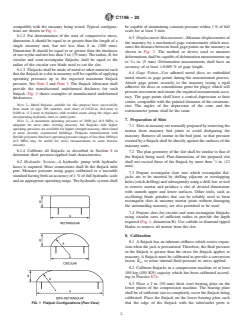
may be of any shape in plan, and are designed to be compatible with the masonry being tested. Typical configurations are shown
in Fig. 1.
6.1.2 For determination of the state of compressive stress, dimension A should be equal to or greater than the length of a single
masonry unit, but not less than 8 in. (200 mm). Dimension B should be equal to or greater than the thickness of one wythe and
not less than 3 in. (75 mm). The radius, R, for circular and semi-rectangular flatjacks shall be equal to the radius of the circular
saw blade used to cut the slot.
FIG. 1 Flatjack Configurations (Plan View)
C1196 − 20
6.1.3 Flatjacks shall be made of metal or other material such that the flatjack in a slot in masonry will be capable of applying
operating pressures up to the expected maximum flatjack pressure. See Note 2 and Note 3. Metal flatjacks suitable for this purpose
shall be made of type 304 stainless steel sheet of 0.024 in. (0.6 mm) to 0.048 in. (1.2 mm) in thickness with welded seams
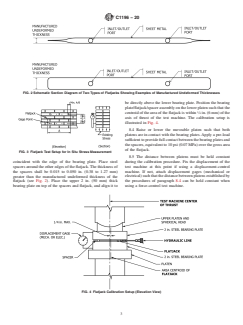
alongThe flatjack fabricator shall provide the manufactured undeformed thickness for each flatjack. Fig. 2 the edges and
incorporating hydraulic inlet or outlet ports. shows examples of manufactured undeformed thicknesses.
NOTE 2—Metal flatjacks suitable for this purpose have successfully been made of type 304 stainless steel sheet of 0.024 in. (0.6 mm) to 0.048 in. (1.2 mm)
in thickness with welded seams along the edges and incorporating hydraulic inlet or outlet ports.
NOTE 3—A maximum operating pressure of 1000 psi (6.9 MPa) or less is often adequate for most older existing masonry, but flatjacks with higher
operating pressures may be required for are available for higher strength masonry, often found in more recently constructed buildings. Flatjacks
manufactured with flexible polymers that have operating pressure ranges of less than 1000 psi (6.9 MPa) may be useful for stress measurements in some
historic masonry.
6.1.4 Calibrate all flatjacks as described in Section 8 to determine their pressure-applied load characteristics.
6.2 Hydraulic System—A hydraulic pump with hydraulic hoses is required. Hose connections shall fit the flatjack inlet port.
Measure pressure using gages calibrated to a traceable standard having both an accuracy of 1 % of full hydraulic scale and an
appropriate operating range. The hydraulic system shall be capable of maintaining constant pressure within 1 % of full scale for
at least 5 min.
6.3 Displacement Measurement—Measure displacements of the masonry by a mechanical gage extensometer which measures the
distance between fixed gage points on the masonry as shown in Fig. 23. The method or device used to measure deformations shall
be capable of deformation measurements up to ⁄16 in. (5 mm). Deformation measurements shall have an accuracy of at least
60.005 % of gage length.
6.4 Gage Points—Use adhered metal discs or embedded metal inserts as gage points during the measurement process. Attach gage
points securely to the masonry (using a rigid adhesive for discs or cementitious grout for plugs) which will prevent movement and
ensure the required measurement accuracy. The gage points shall have a conical depression at their center, compatible with the
pointed elements of the extensometer. The angles of the depression of the cone and the extensometer points shall be the same.
7. Preparation of Slots
7.1 Slots in masonry are normally prepared by removing the mortar from masonry bed joints to avoid disfiguring the masonry.
Remove all mortar in the bed joint, so that pressure exerted by a flatjack shall be directly against the surfaces of the masonry units.
7.2 The plan geometry of the slot shall be similar to that of the flatjack being used. Plan dimensions of the prepared slot shall not
exceed those of the flatjack by more than ⁄2 in. (12 mm).
7.3 Prepare rectangular slots into which rectangular flatjacks are to be inserted by drilling adjacent or overlapping holes (stitch
FIG. 2 Schematic Section Diagram of Two Types of Flatjacks Showing Examples of Manufactured Undeformed Thicknesses
C1196 − 20
FIG. 23 Flatjack Test Setup for In Situ Stress Measurement
drilling) and subsequently using a drill, bar, or tool to remove mortar and produce a slot of desired dimensions with smooth upper
and lower surfaces. Other tools, such as oscillating blade grinders that can be reliably used to form rectangular slots in masonry
mortar joints without damaging the surrounding masonry, are also permitted to be used.
7.4 Prepare slots for circular and semi-rectangular flatjacks using circular saws of sufficient radius to provide the depth required
(Fig. 1, dimension B). Use carbide or diamond tipped blades to remove all mortar from the slot.
8. Calibration
8.1 A flatjack has an inherent stiffness which resists expansion when the jack is pressurized. Therefore, the fluid pressure in the
flatjack is greater than the stress the flatjack applies to masonry. A flatjack must be calibrated to provide a conversion factor, K ,
m
to relate internal fluid pressure to stress applied.
8.2 Calibrate flatjacks in a compression machine of at least 100 kip (450 KN) capacity which has been calibrated according to
Practice E74.
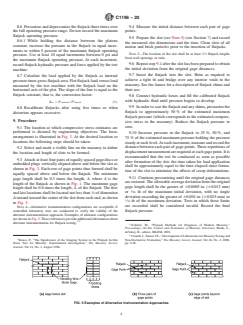
8.3 Place a 2 in. (50 mm) thick steel bearing plate on the lower platen of the compression machine. The bearing plate shall be
of sufficient size to completely cover the flatjack being calibrated. Place the flatjack on the lower bearing plate such that the edge
of the flatjack with the inlet/outlet ports is coincident with the edge of the bearing plate. Place steel spacers around the other edges
of the flatjack. The thickness of the spacers shall be 0.015 to 0.050 in. (0.38 to 1.27 mm) greater than the sum of the combined
manufactured undeformed thickness of the two sheetsflatjack (see Fig. 2plus the thickness of inlet/outlet port used in fabrication
of the flatjack. ). Place the upper 2 in. (50 mm) thick bearing plate on top of the spacers and flatjack, and align it to be directly
above the lower bearing plate. Position the bearing plate/flatjack/spacer assembly on the lower platen such that the centroid of the
area of the flatjack is within ⁄4 in. (6 mm) of the axis of thrust of the test machine. The calibration setup is illustrated in Fig. 34.
8.4 Raise or lower the moveable platen such that both platens are in contact with the bearing plates. Apply a pre-load sufficient
to provide full contact between the bearing plates and the spacers, equivalent to 10 psi (0.07 MPa) over the gross area of the
flatjack.
8.5 The distance between platens must be held constant during the calibration procedure. Fix the displacement of the test machine
at this point if using a displacement-control machine. If not, attach displacement gages (mechanical or electrical) such that the
distance between platens established by the procedures of paragraph 8.4 can be held constant when using a force-control test
machine.
8.6 Pressurize and depressurize the flatjack three times over the full operating pressure range. Do not exceed the maximum flatjack
operating pressure.
8.6.1 While holding the distance between the platens constant, increase the pressure in the flatjack in equal increments to within
5 percent of the maximum flatjack operating pressure. Use at least 10 equal increments between 0 psi and the maximum flatjack
operating pressure. At each increment, record flatjack hydraulic pressure and force applied by the test machine.
8.7 Calculate the load applied by the flatjack as internal pressure times gross flatjack area. Plot flatjack load versus load measured
by the test machine with the flatjack load on the horizontal axis of the plot. The slope of the line is equal to the flatjack constant,
that is, the conversion factor:
C119
...