

ASTM E518/E518M-22
(Test Method)Standard Test Methods for Flexural Bond Strength of Masonry
General Information
- Abstract
SIGNIFICANCE AND USE
4.1 These test methods are intended to provide simplified and economical means for gathering comparative research data on the flexural bond strength developed with different types of masonry units and mortar or for the purpose of checking job quality control (materials and workmanship).
Note 2: These test methods are not intended for use in establishing design stresses. For this purpose, Test Methods C1717 should be used.
SCOPE
1.1 These test methods cover determination of the flexural bond strength of unreinforced masonry assemblages. Two procedures are provided:
1.1.1 Test Method A—Simply supported beam with third-point loading.
1.1.2 Test Method B—Simply supported beam with uniform loading.
Note 1: Third-point loading (Test Method A) produces a moment distribution that is significantly different from uniformly distributed loading (Test Method B).Third-point loading (Test Method A) subjects more mortar joints to the maximum moment and thus, is likely to produce more conservative capacities than uniform loading (Test Method B).
1.2 The text of this standard refers to notes and footnotes that provide explanatory material. These notes and footnotes (excluding those in tables and figures) shall not be considered as requirements of the standard.
1.3 These test methods cover the application of the tests using either inch-pound or SI units. The values stated in either SI units or inch-pound units are to be regarded separately as standard. Within the text, the inch-pound units are shown in brackets. The values stated in each system may not be exact equivalents; therefore, each system shall be used independently of the other. Combining values from the two systems may result in nonconformance with the standard.
1.4 This standard does not purport to address all of the safety concerns, if any, associated with its use. It is the responsibility of the user of this standard to establish appropriate safety, health, and environmental practices and determine the applicability of regulatory limitations prior to use.
1.5 This international standard was developed in accordance with internationally recognized principles on standardization established in the Decision on Principles for the Development of International Standards, Guides and Recommendations issued by the World Trade Organization Technical Barriers to Trade (TBT) Committee.
- Status
- Published
- Publication Date
- 30-Nov-2022
- Technical Committee
- C15 - Masonry – Manufactured Masonry Units, Mortars and Grouts
- Drafting Committee
- C15.04 - Research for Masonry Units and Assemblies
Overview
ASTM E518/E518M-22: Standard Test Methods for Flexural Bond Strength of Masonry provides procedures to determine the flexural bond strength of unreinforced masonry assemblages, which include various masonry units and mortar types. Developed by ASTM International, this standard is crucial for comparative research and jobsite quality control of masonry construction. It specifies two test methods - third-point loading and uniform loading - for evaluating the flexural bond performance of masonry prisms under controlled laboratory conditions. The results gained from ASTM E518/E518M are particularly valuable for assessing materials and workmanship, but are not intended for establishing design stresses.
Key Topics
- Scope and Purpose
- Determines the flexural bond strength of unreinforced masonry using standard test procedures.
- Facilitates quality control, comparative research, and evaluation of different mortar and masonry unit combinations.
- Test Methods
- Test Method A: Third-Point Loading
- Employs simply supported prisms subjected to loads at two points, ensuring more conservative measurements.
- Test Method B: Uniform Loading
- Distributes load across the span with an airbag, representing a different moment distribution than Method A.
- Test Method A: Third-Point Loading
- Specimen Preparation and Curing
- Stack-bonded prism specimens are constructed, typically cured for 28 days in controlled environments.
- Specimens reflect field or laboratory conditions to simulate real-life application scenarios.
- Measurement and Reporting
- Results include maximum load, modulus of rupture (gross or net area), curing history, mortar properties, failure description, and identification details.
- Reports follow the format set by ASTM E575, supporting comparability and reproducibility.
- Units and Safety
- Allows use of both SI and inch-pound units, but they must not be mixed.
- Users must ensure compliance with local safety and environmental regulations.
Applications
The ASTM E518/E518M-22 standard is widely used in the construction materials industry for:
- Comparative Research:
Comparing flexural bond properties of different masonry units (such as clay brick or concrete block) and types of mortar, aiding material selection for masonry construction. - Quality Control:
Ensuring the consistent quality of materials and workmanship on construction sites by periodically sampling and testing masonry assemblies. - Material Development:
Supporting the development and validation of new masonry products and mortar formulations. - Educational Purposes:
Providing a repeatable and recognized testing framework for academic and training programs focused on masonry engineering. - Troubleshooting and Forensics:
Assisting in the evaluation of field samples to diagnose construction or material failures.
Related Standards
The standard references several other important ASTM standards that support a comprehensive approach to masonry testing and quality assurance:
- ASTM C67/C67M: Test Methods for Sampling and Testing Brick and Structural Clay Tile
- ASTM C78/C78M: Test Method for Flexural Strength of Concrete (Using Simple Beam with Third-Point Loading)
- ASTM C140/C140M: Test Methods for Sampling and Testing Concrete Masonry Units
- ASTM C270: Specification for Mortar for Unit Masonry
- ASTM C778: Specification for Standard Sand
- ASTM C1717: Test Methods for Conducting Strength Tests of Masonry Wall Panels (recommended for structural design stresses)
- ASTM E4: Practices for Force Calibration and Verification of Testing Machines
- ASTM E575: Practice for Reporting Data from Structural Tests of Building Constructions
By adhering to ASTM E518/E518M-22, organizations benefit from standardized, reliable methods for assessing the flexural bond strength of masonry. This underpins higher confidence in material performance, construction quality, and regulatory compliance across the masonry industry.
Relations
- Effective Date
- 15-Dec-2023
- Effective Date
- 01-Dec-2023
- Refers
ASTM C67/C67M-19 - Standard Test Methods for Sampling and Testing Brick and Structural Clay Tile - Effective Date
- 01-Jul-2019
- Effective Date
- 01-May-2019
- Effective Date
- 01-May-2019
- Effective Date
- 01-May-2019
- Effective Date
- 01-Feb-2019
- Effective Date
- 15-Dec-2018
- Effective Date
- 15-Jul-2018
- Effective Date
- 01-Jul-2018
- Refers
ASTM C67/C67M-18 - Standard Test Methods for Sampling and Testing Brick and Structural Clay Tile - Effective Date
- 01-Feb-2018
- Effective Date
- 15-Dec-2017
- Effective Date
- 01-Jun-2017
- Effective Date
- 01-Jun-2017
- Effective Date
- 01-Feb-2017
Get Certified
Connect with accredited certification bodies for this standard

DIBt (Deutsches Institut für Bautechnik)
German Institute for Building Technology.
DIN CERTCO
DIN Group product certification.

Aboma Certification B.V.
Specialized in construction, metal, and transport sectors.
Sponsored listings
Frequently Asked Questions
ASTM E518/E518M-22 is a standard published by ASTM International. Its full title is "Standard Test Methods for Flexural Bond Strength of Masonry". This standard covers: SIGNIFICANCE AND USE 4.1 These test methods are intended to provide simplified and economical means for gathering comparative research data on the flexural bond strength developed with different types of masonry units and mortar or for the purpose of checking job quality control (materials and workmanship). Note 2: These test methods are not intended for use in establishing design stresses. For this purpose, Test Methods C1717 should be used. SCOPE 1.1 These test methods cover determination of the flexural bond strength of unreinforced masonry assemblages. Two procedures are provided: 1.1.1 Test Method A—Simply supported beam with third-point loading. 1.1.2 Test Method B—Simply supported beam with uniform loading. Note 1: Third-point loading (Test Method A) produces a moment distribution that is significantly different from uniformly distributed loading (Test Method B).Third-point loading (Test Method A) subjects more mortar joints to the maximum moment and thus, is likely to produce more conservative capacities than uniform loading (Test Method B). 1.2 The text of this standard refers to notes and footnotes that provide explanatory material. These notes and footnotes (excluding those in tables and figures) shall not be considered as requirements of the standard. 1.3 These test methods cover the application of the tests using either inch-pound or SI units. The values stated in either SI units or inch-pound units are to be regarded separately as standard. Within the text, the inch-pound units are shown in brackets. The values stated in each system may not be exact equivalents; therefore, each system shall be used independently of the other. Combining values from the two systems may result in nonconformance with the standard. 1.4 This standard does not purport to address all of the safety concerns, if any, associated with its use. It is the responsibility of the user of this standard to establish appropriate safety, health, and environmental practices and determine the applicability of regulatory limitations prior to use. 1.5 This international standard was developed in accordance with internationally recognized principles on standardization established in the Decision on Principles for the Development of International Standards, Guides and Recommendations issued by the World Trade Organization Technical Barriers to Trade (TBT) Committee.
SIGNIFICANCE AND USE 4.1 These test methods are intended to provide simplified and economical means for gathering comparative research data on the flexural bond strength developed with different types of masonry units and mortar or for the purpose of checking job quality control (materials and workmanship). Note 2: These test methods are not intended for use in establishing design stresses. For this purpose, Test Methods C1717 should be used. SCOPE 1.1 These test methods cover determination of the flexural bond strength of unreinforced masonry assemblages. Two procedures are provided: 1.1.1 Test Method A—Simply supported beam with third-point loading. 1.1.2 Test Method B—Simply supported beam with uniform loading. Note 1: Third-point loading (Test Method A) produces a moment distribution that is significantly different from uniformly distributed loading (Test Method B).Third-point loading (Test Method A) subjects more mortar joints to the maximum moment and thus, is likely to produce more conservative capacities than uniform loading (Test Method B). 1.2 The text of this standard refers to notes and footnotes that provide explanatory material. These notes and footnotes (excluding those in tables and figures) shall not be considered as requirements of the standard. 1.3 These test methods cover the application of the tests using either inch-pound or SI units. The values stated in either SI units or inch-pound units are to be regarded separately as standard. Within the text, the inch-pound units are shown in brackets. The values stated in each system may not be exact equivalents; therefore, each system shall be used independently of the other. Combining values from the two systems may result in nonconformance with the standard. 1.4 This standard does not purport to address all of the safety concerns, if any, associated with its use. It is the responsibility of the user of this standard to establish appropriate safety, health, and environmental practices and determine the applicability of regulatory limitations prior to use. 1.5 This international standard was developed in accordance with internationally recognized principles on standardization established in the Decision on Principles for the Development of International Standards, Guides and Recommendations issued by the World Trade Organization Technical Barriers to Trade (TBT) Committee.
ASTM E518/E518M-22 is classified under the following ICS (International Classification for Standards) categories: 91.060.10 - Walls. Partitions. Facades. The ICS classification helps identify the subject area and facilitates finding related standards.
ASTM E518/E518M-22 has the following relationships with other standards: It is inter standard links to ASTM C1232-23, ASTM C140/C140M-23a, ASTM C67/C67M-19, ASTM C1717-19, ASTM C270-19a, ASTM C270-19ae1, ASTM C270-19, ASTM C1717-18, ASTM C140/C140M-18, ASTM E575-05(2018), ASTM C67/C67M-18, ASTM C140/C140M-17b, ASTM C140/C140M-17a, ASTM C1232-17, ASTM C140/C140M-17. Understanding these relationships helps ensure you are using the most current and applicable version of the standard.
ASTM E518/E518M-22 is available in PDF format for immediate download after purchase. The document can be added to your cart and obtained through the secure checkout process. Digital delivery ensures instant access to the complete standard document.
Standards Content (Sample)
This international standard was developed in accordance with internationally recognized principles on standardization established in the Decision on Principles for the
Development of International Standards, Guides and Recommendations issued by the World Trade Organization Technical Barriers to Trade (TBT) Committee.
Designation: E518/E518M − 22
Standard Test Methods for
Flexural Bond Strength of Masonry
This standard is issued under the fixed designation E518/E518M; the number immediately following the designation indicates the year
of original adoption or, in the case of revision, the year of last revision. A number in parentheses indicates the year of last reapproval.
A superscript epsilon (´) indicates an editorial change since the last revision or reapproval.
1. Scope* 2. Referenced Documents
1.1 These test methods cover determination of the flexural 2.1 ASTM Standards:
bond strength of unreinforced masonry assemblages. Two C67/C67M Test Methods for Sampling and Testing Brick
and Structural Clay Tile
procedures are provided:
1.1.1 Test Method A—Simply supported beam with third- C78/C78M Test Method for Flexural Strength of Concrete
(Using Simple Beam with Third-Point Loading)
point loading.
1.1.2 Test Method B—Simply supported beam with uniform C140/C140M Test Methods for Sampling and Testing Con-
crete Masonry Units and Related Units
loading.
C270 Specification for Mortar for Unit Masonry
NOTE 1—Third-point loading (Test Method A) produces a moment
C778 Specification for Standard Sand
distribution that is significantly different from uniformly distributed
C1232 Terminology for Masonry
loading (Test Method B).Third-point loading (Test Method A) subjects
more mortar joints to the maximum moment and thus, is likely to produce C1717 Test Methods for Conducting Strength Tests of Ma-
more conservative capacities than uniform loading (Test Method B).
sonry Wall Panels
E4 Practices for Force Calibration and Verification of Test-
1.2 The text of this standard refers to notes and footnotes
that provide explanatory material. These notes and footnotes ing Machines
E575 Practice for Reporting Data from Structural Tests of
(excluding those in tables and figures) shall not be considered
as requirements of the standard. Building Constructions, Elements, Connections, and As-
semblies
1.3 These test methods cover the application of the tests
using either inch-pound or SI units. The values stated in either
3. Terminology
SI units or inch-pound units are to be regarded separately as
3.1 For terms used in these test methods, refer to Terminol-
standard. Within the text, the inch-pound units are shown in
ogy C1232.
brackets. The values stated in each system may not be exact
equivalents;therefore,eachsystemshallbeusedindependently
4. Significance and Use
of the other. Combining values from the two systems may
4.1 These test methods are intended to provide simplified
result in nonconformance with the standard.
and economical means for gathering comparative research data
1.4 This standard does not purport to address all of the
on the flexural bond strength developed with different types of
safety concerns, if any, associated with its use. It is the
masonry units and mortar or for the purpose of checking job
responsibility of the user of this standard to establish appro-
quality control (materials and workmanship).
priate safety, health, and environmental practices and deter-
mine the applicability of regulatory limitations prior to use.
NOTE 2—These test methods are not intended for use in establishing
design stresses. For this purpose, Test Methods C1717 should be used.
1.5 This international standard was developed in accor-
dance with internationally recognized principles on standard-
5. Apparatus
ization established in the Decision on Principles for the
Development of International Standards, Guides and Recom- 5.1 Testing Machine, conforming to the requirements of
Practices E4.
mendations issued by the World Trade Organization Technical
Barriers to Trade (TBT) Committee.
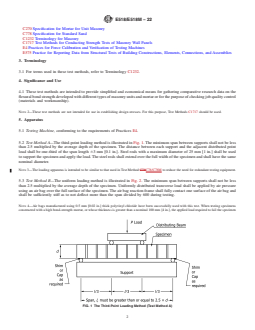
5.2 Test Method A—The third-point loading method is
illustrated in Fig. 1.The minimum span between supports shall
not be less than 2.5 multiplied by the average depth of the
These test methods are under the jurisdiction of ASTM Committee C15 on
Manufactured Masonry Units and are the direct responsibility of Subcommittee
C15.04 on Research. For referenced ASTM standards, visit the ASTM website, www.astm.org, or
Current edition approved Dec. 1, 2022. Published December 2022. Originally contact ASTM Customer Service at service@astm.org. For Annual Book of ASTM
approved in 1974. Last previous edition approved in 2021 as E518/E518M – 21. Standards volume information, refer to the standard’s Document Summary page on
DOI: 10.1520/E0518_E0518M-22. the ASTM website.
*A Summary of Changes section appears at the end of this standard
Copyright © ASTM International, 100 Barr Harbor Drive, PO Box C700, West Conshohocken, PA 19428-2959. United States
E518/E518M − 22
FIG. 1 The Third-Point Loading Method (Test Method A)
required to fail the specimen may be such as to rupture the seams of the
specimen. The distance between each support and the adjacent
air bag. In such cases Test Method A is recommended.
distributed point load shall be one-third of the span length
63 mm [0.1 in.]. Steel rods with a maximum diameter of 25
6. Sampling and Testing
mm [1 in.] shall be used to support the specimen and apply the
load. The steel rods shall extend over the full width of the
6.1 Masonry Units—Representative masonry units shall be
specimen and shall have the same nominal diameter.
sampledandtestedinaccordancewiththefollowingapplicable
NOTE 3—The loading apparatus is intended to be similar to that used in
methods: Test Methods C67/C67M for brick, or Test Methods
Test Method C78/C78M to reduce the need for redundant testing equip-
C140/C140M for concrete masonry units. Minimum tests
ment.
required shall be compressive strength, and initial rate of
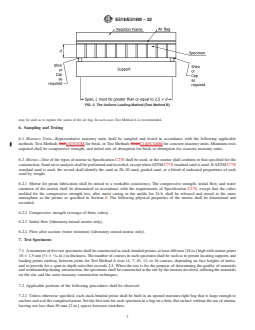
5.3 Test Method B—The uniform loading method is illus-
absorption for brick or absorption for concrete masonry units.
trated in Fig. 2. The minimum span between supports shall not
6.2 Mortar—One of the types of mortar in Specification
be less than 2.5 multiplied by the average depth of the
C270 shall be used, or the mortar shall conform to that
specimen. Uniformly distributed transverse load shall be ap-
specified for the construction. Sand sieve analysis shall be
pliedbyairpressureusinganairbagoverthefullsurfaceofthe
performed and recorded, except when ASTM C778 standard
specimen. The air bag reaction frame shall fully contact one
sand is used. If ASTM C778 standard sand is used, the record
surface of the air bag and shall be sufficiently stiff as to not
shall identify the sand as 20–30 sand, graded sand, or a blend
deflect more than the span divided by 600 during testing.
of indicated proportions of each sand by weight.
NOTE 4—Air bags manufactured using 0.5 mm [0.02 in.] thick
6.2.1 Mortar for prism fabrication shall be mixed to a
polyvinyl chloride have been successfully used with this test. When
workable consistency. The compressive strength, initial flow,
testing specimens constructed with a high bond-strength mortar, or whose
thickness is greater than a nominal 100 mm [4 in.], the applied load and water retention of the mortar shall be determined in
FIG. 2 The Uniform Loading Method (Test Method B)
E518/E518M − 22
accordance with the requirements of Specification C270, ex- 8.1.1 Where prisms are made during construction at the job
cept that the cubes molded for the compressive strength test, site, they shall be constructed in a place where they will not be
after moist curing in the molds for 24 h, shall be released and disturbed, but will be subjected to air conditions similar to
stored in the same atmosphere as the prisms as specified in those in the masonry structure. Bagging of the prisms is not
Section8.Thefollowingphysicalpropertiesofthemortarshall required if prisms are to be representative of field curing
be determined and recorded: conditions.
6.2.2 Compressive strength (average of three cubes),
9. Procedure
6.2.3 Initial flow (laboratory-mixed mortar only),
6.2.4 Flow after suction (water retention) (laboratory-mixed
9.1 Place the test specimen horizontally on its supports as a
mortar only). simply supported beam. If full contact is not obtained between
the specimen and the load-applying blocks and
...
This document is not an ASTM standard and is intended only to provide the user of an ASTM standard an indication of what changes have been made to the previous version. Because
it may not be technically possible to adequately depict all changes accurately, ASTM recommends that users consult prior editions as appropriate. In all cases only the current version
of the standard as published by ASTM is to be considered the official document.
Designation: E518/E518M − 21 E518/E518M − 22
Standard Test Methods for
Flexural Bond Strength of Masonry
This standard is issued under the fixed designation E518/E518M; the number immediately following the designation indicates the year
of original adoption or, in the case of revision, the year of last revision. A number in parentheses indicates the year of last reapproval.
A superscript epsilon (´) indicates an editorial change since the last revision or reapproval.
1. Scope*
1.1 These test methods cover determination of the flexural bond strength of unreinforced masonry assemblages. Two procedures
are provided:
1.1.1 Test Method A—Simply supported beam with third-point loading.
1.1.2 Test Method B—Simply supported beam with uniform loading.
NOTE 1—Third-point loading (Test Method A) produces a moment distribution that is significantly different from uniformly distributed loading (Test
Method B).Third-point loading (Test Method A) subjects more mortar joints to the maximum moment and thus, is likely to produce more conservative
capacities than uniform loading (Test Method B).
1.2 The text of this standard refers to notes and footnotes that provide explanatory material. These notes and footnotes (excluding
those in tables and figures) shall not be considered as requirements of the standard.
1.3 These test methods cover the application of the tests using either inch-pound or SI units. The values stated in either SI units
or inch-pound units are to be regarded separately as standard. Within the text, the inch-pound units are shown in brackets. The
values stated in each system may not be exact equivalents; therefore, each system shall be used independently of the other.
Combining values from the two systems may result in nonconformance with the standard.
1.4 This standard does not purport to address all of the safety concerns, if any, associated with its use. It is the responsibility
of the user of this standard to establish appropriate safety, health, and environmental practices and determine the applicability of
regulatory limitations prior to use.
1.5 This international standard was developed in accordance with internationally recognized principles on standardization
established in the Decision on Principles for the Development of International Standards, Guides and Recommendations issued
by the World Trade Organization Technical Barriers to Trade (TBT) Committee.
2. Referenced Documents
2.1 ASTM Standards:
C67C67/C67M Test Methods for Sampling and Testing Brick and Structural Clay Tile
C78C78/C78M Test Method for Flexural Strength of Concrete (Using Simple Beam with Third-Point Loading)
C140C140/C140M Test Methods for Sampling and Testing Concrete Masonry Units and Related Units
These test methods are under the jurisdiction of ASTM Committee C15 on Manufactured Masonry Units and are the direct responsibility of Subcommittee C15.04 on
Research.
Current edition approved June 1, 2021Dec. 1, 2022. Published January 2016December 2022. Originally approved in 1974. Last previous edition approved in 20152021
as E518 – 15.E518/E518M – 21. DOI: 10.1520/E0518_E0518M-21.10.1520/E0518_E0518M-22.
For referenced ASTM standards, visit the ASTM website, www.astm.org, or contact ASTM Customer Service at service@astm.org. For Annual Book of ASTM Standards
volume information, refer to the standard’s Document Summary page on the ASTM website.
*A Summary of Changes section appears at the end of this standard
Copyright © ASTM International, 100 Barr Harbor Drive, PO Box C700, West Conshohocken, PA 19428-2959. United States
E518/E518M − 22
C270 Specification for Mortar for Unit Masonry
C778 Specification for Standard Sand
C1232 Terminology for Masonry
C1717 Test Methods for Conducting Strength Tests of Masonry Wall Panels
E4 Practices for Force Calibration and Verification of Testing Machines
E575 Practice for Reporting Data from Structural Tests of Building Constructions, Elements, Connections, and Assemblies
3. Terminology
3.1 For terms used in these test methods, refer to Terminology C1232.
4. Significance and Use
4.1 These test methods are intended to provide simplified and economical means for gathering comparative research data on the
flexural bond strength developed with different types of masonry units and mortar or for the purpose of checking job quality control
(materials and workmanship).
NOTE 2—These test methods are not intended for use in establishing design stresses. For this purpose, Test Methods C1717 should be used.
5. Apparatus
5.1 Testing Machine, conforming to the requirements of Practices E4.
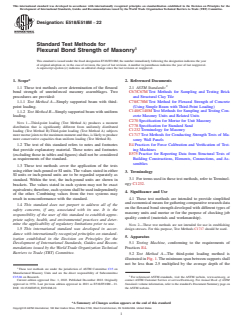
5.2 Test Method A—The third-point loading method is illustrated in Fig. 1. The minimum span between supports shall not be less
than 2.5 multiplied by the average depth of the specimen. The distance between each support and the adjacent distributed point
load shall be one-third of the span length 63 mm [0.1 in.]. Steel rods with a maximum diameter of 25 mm [1 in.] shall be used
to support the specimen and apply the load. The steel rods shall extend over the full width of the specimen and shall have the same
nominal diameter.
NOTE 3—The loading apparatus is intended to be similar to that used in Test Method C78C78/C78M to reduce the need for redundant testing equipment.
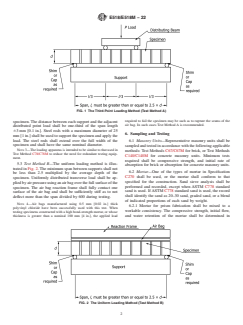
5.3 Test Method B—The uniform loading method is illustrated in Fig. 2. The minimum span between supports shall not be less
than 2.5 multiplied by the average depth of the specimen. Uniformly distributed transverse load shall be applied by air pressure
using an air bag over the full surface of the specimen. The air bag reaction frame shall fully contact one surface of the air bag and
shall be sufficiently stiff as to not deflect more than the span divided by 600 during testing.
NOTE 4—Air bags manufactured using 0.5 mm [0.02 in.] thick polyvinyl chloride have been successfully used with this test. When testing specimens
constructed with a high bond-strength mortar, or whose thickness is greater than a nominal 100 mm [4 in.], the applied load required to fail the specimen
FIG. 1 The Third-Point Loading Method (Test Method A)
E518/E518M − 22
FIG. 2 The Uniform Loading Method (Test Method B)
may be such as to rupture the seams of the air bag. In such cases Test Method A is recommended.
6. Sampling and Testing
6.1 Masonry Units—Representative masonry units shall be sampled and tested in accordance with the following applicable
methods: Test Methods C67C67/C67M for brick, or Test Methods C140C140/C140M for concrete masonry units. Minimum tests
required shall be compressive strength, and initial rate of absorption for brick or absorption for concrete masonry units.
6.2 Mortar—One of the types of mortar in Specification C270 shall be used, or the mortar shall conform to that specified for the
construction. Sand sieve analysis shall be performed and recorded, except when ASTM C778 standard sand is used. If ASTM C778
standard sand is used, the record shall identify the sand as 20–30 sand, graded sand, or a blend of indicated proportions of each
sand by weight.
6.2.1 Mortar for prism fabrication shall be mixed to a workable consistency. The compressive strength, initial flow, and water
retention of the mortar shall be determined in accordance with the requirements of Specification C270, except that the cubes
molded for the compressive strength test, after moist curing in the molds for 24 h, shall be released and stored in the same
atmosphere as the prisms as specified in Section 8. The following physical properties of the mortar shall be determined and
recorded:
6.2.2 Compressive strength (average of three cubes),
6.2.3 Initial flow (laboratory-mixed mortar only),
6.2.4 Flow after suction (water retention) (laboratory-mixed mortar only).
7. Test Specimens
7.1 A minimum of five test specimens shall be constructed as stack-bonded prisms, at least 460 mm [18 in.] high with mortar joints
3 1
10 6 1.5 mm [ ⁄8 6 ⁄16 in.] in thickness. The number of courses in each specimen shall be such as to permit locating supports and
loading points midway between joints for Test Method A tests (4, 7, 10, 13, or 16 courses, depending on face heights of units),
and to provide for a span-to-depth ratio that exceeds 2.5. When the test is for the purpose of determining the quality of materials
and workmanship during construction, t
...