

ASTM D4025-18
(Practice)Standard Practice for Reporting Results of Examination and Analysis of Deposits Formed from Water for Subsurface Injection
General Information
- Abstract
SIGNIFICANCE AND USE
5.1 This practice sets down the manner in which data obtained from other test methods should be reported. This is done in an effort to standardize the report form used.
SCOPE
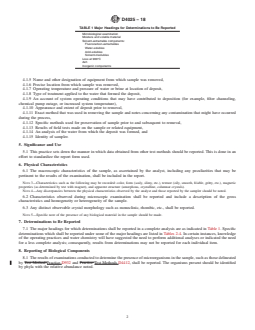
1.1 This practice covers the manner in which the various results of examination and analysis to determine the composition of deposits formed from water for subsurface injection are to be reported.
1.2 All analyses shall be made in accordance with the test methods of ASTM, unless otherwise specified.
Note 1: While reporting of inorganic constituents in water-formed deposits as specified in Practice D933 is sufficient for certain industries, this practice provides for the reporting of organic and biological materials as well as inorganic constituents.
Note 2: Consistent with practices in industries where subsurface injection of water is practiced, reporting includes specifying of inorganic constituents as probable molecular combinations of the species for which analyses are performed.
1.3 The values stated in SI units are to be regarded as standard. No other units of measurement are included in this standard.
1.4 This standard does not purport to address all of the safety concerns, if any, associated with its use. It is the responsibility of the user of this standard to establish appropriate safety, health, and environmental practices and determine the applicability of regulatory limitations prior to use.
1.5 This international standard was developed in accordance with internationally recognized principles on standardization established in the Decision on Principles for the Development of International Standards, Guides and Recommendations issued by the World Trade Organization Technical Barriers to Trade (TBT) Committee.
- Status
- Published
- Publication Date
- 30-Apr-2018
- Technical Committee
- D19 - Water
- Drafting Committee
- D19.05 - Inorganic Constituents in Water
Buy Documents

ASTM D4025-18 - Standard Practice for Reporting Results of Examination and Analysis of Deposits Formed from Water for Subsurface Injection
REDLINE ASTM D4025-18 - Standard Practice for Reporting Results of Examination and Analysis of Deposits Formed from Water for Subsurface Injection
Overview
ASTM D4025-18: Standard Practice for Reporting Results of Examination and Analysis of Deposits Formed from Water for Subsurface Injection provides a standardized framework for documenting and reporting the results of examinations and analyses of deposits that develop from water used in subsurface injection applications. This standard ensures consistency, accuracy, and clarity in the presentation of analysis results, facilitating industry-wide communication and regulatory compliance. Developed by ASTM International, it specifies the reporting of inorganic, organic, and biological components of such deposits, providing a reliable approach for industries relying on water injection processes.
Key Topics
- Reporting Structure: Establishes a uniform method for presenting analytical data on deposits formed from water used for subsurface injection.
- Comprehensive Composition Analysis: Includes documentation of inorganic, organic, and biological substances present within the deposit.
- Sample Documentation: Requires detailed information on the sample's origin, history, handling, and analytical methods used.
- Physical and Chemical Characterization: Mandates the inclusion of both macroscopic (e.g., color, form, texture) and microscopic observations in the final report.
- Quantitative and Qualitative Reporting:
- Results must be reported in SI units.
- Data is to be expressed as weight percentages, with accuracy and completeness emphasized.
- Chemical analyses include moisture, volatile materials, ash, and solvent-extractable fractions.
- Special Categories:
- Biological materials and their relative abundance must be reported when present.
- Probable mineral compositions are deduced from ionic data and industry-accepted stability constants.
- Reporting Methods: Guidance for results obtained by spectrochemical, petrographic, or X-ray diffraction analysis.
Applications
ASTM D4025-18 holds significant practical value in industries such as oil and gas, geothermal energy, and water treatment, where subsurface water injection is a critical process. Key applications include:
- Oilfield Operations: Standardizing the reporting of deposit analyses to diagnose and mitigate formation damage, scaling, and system fouling in injection wells.
- Regulatory Compliance: Providing a uniform reporting format to demonstrate adherence to environmental and safety regulations for subsurface water injection.
- Water Treatment Facilities: Enhancing the detection and management of deposits that affect subsurface injection system efficiency.
- Research and Quality Assurance: Facilitating robust data exchange among laboratories, operators, and regulators to improve treatment strategies and membrane/system longevity.
- System Troubleshooting: Supporting root-cause analyses for operational issues related to deposit buildup from injected water.
Related Standards
To ensure comprehensive analysis and reporting, ASTM D4025-18 references several related ASTM standards:
- ASTM D887 - Practices for Sampling Water-Formed Deposits
- ASTM D932 - Practice for Filamentous Iron Bacteria in Water and Water-Formed Deposits
- ASTM D933 - Practice for Reporting Results of Examination and Analysis of Water-Formed Deposits
- ASTM D1129 - Terminology Relating to Water
- ASTM D4412 - Test Methods for Sulfate-Reducing Bacteria in Water and Water-Formed Deposits
- ASTM E29 - Practice for Using Significant Digits in Test Data to Determine Conformance with Specifications
Practical Value
The consensus-based approach of ASTM D4025-18 streamlines data reporting for deposits from subsurface water injection, supporting data integrity, traceability, and cross-site comparability. When implemented, the standard reduces ambiguity in deposit analysis, aids in operational decision-making, and supports due diligence for regulatory audits and industry best practices regarding water-based injection systems.
Keywords: data reporting, deposit analysis, subsurface injection, water injection, standardized reporting, ASTM D4025-18
Relations
- Effective Date
- 01-May-2018
- Effective Date
- 01-Apr-2024
- Refers
ASTM D932-20 - Standard Practice for Filamentous Iron Bacteria in Water and Water-Formed Deposits - Effective Date
- 01-May-2020
- Effective Date
- 01-May-2020
- Effective Date
- 01-May-2020
- Effective Date
- 01-Dec-2019
- Refers
ASTM D932-15 - Standard Practice for Filamentous Iron Bacteria in Water and Water-Formed Deposits - Effective Date
- 01-Feb-2015
- Effective Date
- 01-Jan-2012
- Effective Date
- 01-Mar-2010
- Refers
ASTM D932-85(2009) - Standard Test Method for Iron Bacteria in Water and Water-Formed Deposits - Effective Date
- 01-May-2009
- Effective Date
- 01-May-2009
- Effective Date
- 01-Oct-2008
- Effective Date
- 01-May-2008
- Effective Date
- 01-Dec-2007
- Effective Date
- 15-Nov-2006
Buy Documents
ASTM D4025-18 - Standard Practice for Reporting Results of Examination and Analysis of Deposits Formed from Water for Subsurface Injection
REDLINE ASTM D4025-18 - Standard Practice for Reporting Results of Examination and Analysis of Deposits Formed from Water for Subsurface Injection
Get Certified
Connect with accredited certification bodies for this standard

CIS Institut d.o.o.
Personal Protective Equipment (PPE) certification body. Notified Body NB-2890 for EU Regulation 2016/425 PPE.

Kiwa BDA Testing
Building and construction product certification.
Kmetijski inštitut Slovenije
Agricultural Institute of Slovenia. Soil testing, plant health, agricultural product analysis.
Sponsored listings
Frequently Asked Questions
ASTM D4025-18 is a standard published by ASTM International. Its full title is "Standard Practice for Reporting Results of Examination and Analysis of Deposits Formed from Water for Subsurface Injection". This standard covers: SIGNIFICANCE AND USE 5.1 This practice sets down the manner in which data obtained from other test methods should be reported. This is done in an effort to standardize the report form used. SCOPE 1.1 This practice covers the manner in which the various results of examination and analysis to determine the composition of deposits formed from water for subsurface injection are to be reported. 1.2 All analyses shall be made in accordance with the test methods of ASTM, unless otherwise specified. Note 1: While reporting of inorganic constituents in water-formed deposits as specified in Practice D933 is sufficient for certain industries, this practice provides for the reporting of organic and biological materials as well as inorganic constituents. Note 2: Consistent with practices in industries where subsurface injection of water is practiced, reporting includes specifying of inorganic constituents as probable molecular combinations of the species for which analyses are performed. 1.3 The values stated in SI units are to be regarded as standard. No other units of measurement are included in this standard. 1.4 This standard does not purport to address all of the safety concerns, if any, associated with its use. It is the responsibility of the user of this standard to establish appropriate safety, health, and environmental practices and determine the applicability of regulatory limitations prior to use. 1.5 This international standard was developed in accordance with internationally recognized principles on standardization established in the Decision on Principles for the Development of International Standards, Guides and Recommendations issued by the World Trade Organization Technical Barriers to Trade (TBT) Committee.
SIGNIFICANCE AND USE 5.1 This practice sets down the manner in which data obtained from other test methods should be reported. This is done in an effort to standardize the report form used. SCOPE 1.1 This practice covers the manner in which the various results of examination and analysis to determine the composition of deposits formed from water for subsurface injection are to be reported. 1.2 All analyses shall be made in accordance with the test methods of ASTM, unless otherwise specified. Note 1: While reporting of inorganic constituents in water-formed deposits as specified in Practice D933 is sufficient for certain industries, this practice provides for the reporting of organic and biological materials as well as inorganic constituents. Note 2: Consistent with practices in industries where subsurface injection of water is practiced, reporting includes specifying of inorganic constituents as probable molecular combinations of the species for which analyses are performed. 1.3 The values stated in SI units are to be regarded as standard. No other units of measurement are included in this standard. 1.4 This standard does not purport to address all of the safety concerns, if any, associated with its use. It is the responsibility of the user of this standard to establish appropriate safety, health, and environmental practices and determine the applicability of regulatory limitations prior to use. 1.5 This international standard was developed in accordance with internationally recognized principles on standardization established in the Decision on Principles for the Development of International Standards, Guides and Recommendations issued by the World Trade Organization Technical Barriers to Trade (TBT) Committee.
ASTM D4025-18 is classified under the following ICS (International Classification for Standards) categories: 13.060.50 - Examination of water for chemical substances. The ICS classification helps identify the subject area and facilitates finding related standards.
ASTM D4025-18 has the following relationships with other standards: It is inter standard links to ASTM D4025-08a(2013), ASTM D4412-19(2024), ASTM D932-20, ASTM D1129-13(2020)e2, ASTM D933-20, ASTM D4412-19, ASTM D932-15, ASTM D933-84(2012), ASTM D1129-10, ASTM D932-85(2009), ASTM D4412-84(2009), ASTM E29-08, ASTM D887-08, ASTM D933-84(2007), ASTM E29-06b. Understanding these relationships helps ensure you are using the most current and applicable version of the standard.
ASTM D4025-18 is available in PDF format for immediate download after purchase. The document can be added to your cart and obtained through the secure checkout process. Digital delivery ensures instant access to the complete standard document.
Standards Content (Sample)
This international standard was developed in accordance with internationally recognized principles on standardization established in the Decision on Principles for the
Development of International Standards, Guides and Recommendations issued by the World Trade Organization Technical Barriers to Trade (TBT) Committee.
Designation: D4025 − 18
Standard Practice for
Reporting Results of Examination and Analysis of Deposits
Formed from Water for Subsurface Injection
This standard is issued under the fixed designation D4025; the number immediately following the designation indicates the year of
original adoption or, in the case of revision, the year of last revision.Anumber in parentheses indicates the year of last reapproval.A
superscript epsilon (´) indicates an editorial change since the last revision or reapproval.
1. Scope* D932Practice for Filamentous Iron Bacteria in Water and
Water-Formed Deposits
1.1 This practice covers the manner in which the various
D933Practice for Reporting Results of Examination and
results of examination and analysis to determine the composi-
Analysis of Water-Formed Deposits
tionofdepositsformedfromwaterforsubsurfaceinjectionare
D1129Terminology Relating to Water
to be reported.
D4412TestMethodsforSulfate-ReducingBacteriainWater
1.2 All analyses shall be made in accordance with the test
and Water-Formed Deposits
methods of ASTM, unless otherwise specified.
E29Practice for Using Significant Digits in Test Data to
Determine Conformance with Specifications
NOTE 1—While reporting of inorganic constituents in water-formed
deposits as specified in Practice D933 is sufficient for certain industries,
this practice provides for the reporting of organic and biological materials
3. Terminology
as well as inorganic constituents.
NOTE 2—Consistent with practices in industries where subsurface 3.1 Definitions:
injection of water is practiced, reporting includes specifying of inorganic
3.1.1 For definitions of terms used in this standard, refer to
constituents as probable molecular combinations of the species for which
Terminology D1129 and Practices D887.
analyses are performed.
1.3 The values stated in SI units are to be regarded as
4. History of Sample
standard. No other units of measurement are included in this
4.1 Information regarding the source and history of the
standard.
sample shall be included in the report of the analysis. This
1.4 This standard does not purport to address all of the
information should be that supplied by the individual submit-
safety concerns, if any, associated with its use. It is the
ting the sample as follows:
responsibility of the user of this standard to establish appro-
4.1.1 Name of company supplying the sample,
priate safety, health, and environmental practices and deter-
4.1.2 Name of location of plant, facility, and well,
mine the applicability of regulatory limitations prior to use.
4.1.3 Date and time of sampling,
1.5 This international standard was developed in accor-
4.1.4 Number of sample,
dance with internationally recognized principles on standard-
4.1.5 Nameandotherdesignationofequipmentfromwhich
ization established in the Decision on Principles for the
sample was removed,
Development of International Standards, Guides and Recom-
4.1.6 Precise location from which sample was removed,
mendations issued by the World Trade Organization Technical
4.1.7 Operating temperature and pressure of water or brine
Barriers to Trade (TBT) Committee.
at location of deposit,
4.1.8 Type of treatment applied to the water that formed the
2. Referenced Documents
deposit,
2.1 ASTM Standards:
4.1.9 An account of system operating conditions that may
D887Practices for Sampling Water-Formed Deposits
have contributed to deposition (for example, filter channeling,
chemical pump outage, or increased system temperature),
This practice is under the jurisdiction ofASTM Committee D19 on Water and 4.1.10 Appearance and extent of deposit prior to removal,
is the direct responsibility of Subcommittee D19.05 on Inorganic Constituents in
4.1.11 Exact method that was used in removing the sample
Water.
and notes concerning any contamination that might have
Current edition approved May 1, 2018. Published May 2018. Originally
occurred during the process,
approved in 1981. Last previous edition approved in 2013 as D4025–08a (2013).
DOI: 10.1520/D4025-18.
4.1.12 Specific methods used for preservation of sample
For referenced ASTM standards, visit the ASTM website, www.astm.org, or
prior to and subsequent to removal,
contact ASTM Customer Service at service@astm.org. For Annual Book of ASTM
4.1.13 Results of field tests made on the sample or related
Standards volume information, refer to the standard’s Document Summary page on
the ASTM website. equipment,
*A Summary of Changes section appears at the end of this standard
Copyright © ASTM International, 100 Barr Harbor Drive, PO Box C700, West Conshohocken, PA 19428-2959. United States
D4025 − 18
TABLE 1 Major Headings for Determinations to Be Reported TABLE 2 Acid-Soluble Portion Ions to Be Reported
Microbiological examination Inorganic materials:
Moisture and volatile material calcium carbonate
Solvent-extractable components: magnesium sulfide
Fluorocarbon-extractables barium sulfate
Water-solubles iron phosphate
A
Acid-solubles sodium hydroxide
A
Solvent-insolubles oxide
Loss at 900°C Organic materials
Ash
A
These ions are determined by difference. The specific ion reported is determined
Inorganic components
by direct evidence or in absence of such evidence as hydroxide.
4.1.14 An analysis of the water from which the deposit was
TABLE 3 Ash—Common Constituents to Be Reported
formed, and
calcium zinc
4.1.15 Identity of sampler.
magnesium sodium
barium potassium
strontium phosphate
5. Significance and Use
iron sulfate
5.1 This practice sets down the manner in which data aluminum chloride
silicon
obtained from other test methods should be reported. This is
manganese
done in an effort to standardize the report form used.
6. Physical Characteristics
TABLE 4 Common Inorganic Components Found in
6.1 The macroscopic characteristics of the sample, as ascer-
Water-Formed Deposits and Their K Values
sp
tained by the analyst, including any peculiarities that may be
Inorganic Temperature,
K Reference
sp
Material °C
pertinent to the results of the examination, shall be included in
−33 A
the report. Al(OH) 1.3×10 18—25
−9 B
BaCO 2.6×10 25
−23 A
NOTE 3—Characteristics such as the following may be recorded: color, Ba (PO ) 3.4×10 18–25
3 4 2
−10 B
form (scaly, slimy, etc.), texture (oily, smooth, friable, gritty, etc.), BaSO 1.1×10 25
−9 B
CaCO 4.9×10 25
magnetic properties (as determined by test with magnet), and apparent 3
−6 B
Ca(OH) 4.7×10 25
structure (amorphous, crystalline, columnar crystals).
−33 B
Ca (PO ) 2.1×10 25
3 4 2
NOTE 4—Any discrepancies between the physical characteristics ob-
−5 B
CaSO 7.1×10 25
served by the analyst and those reported by the sampler should be noted.
−11 B
FeCO 3.1×10 25
−36 B
Fe O 1.1×10 18
2 3
6.2 Characteristics observed during microscopic examina-
−39 B
Fe(OH) 2.6×10 25
tion shall be reported and include a description of the gross
−29 B
FePO ·2H O 9.9×10 25
4 2
−10 B
characteristics and homogeneity or heterogeneity of the
SrCO 5.6×10 25
−28 A
Sr (PO ) 4.0×10 18–25
sample. 3 4 2
−7 B
SrSO 3.4×10 25
−10 B
ZnCO 1.2×10 25
6.3 Any distinct observable crystal morphology such as
−17 B
Zn(OH) 6.8×10 25
monoclinic, rhombic, etc., shall be reported.
−25 B
ZnS 2.2 × 10 25
Na CO
2 3
NOTE 5—Specific note of the presence of any biological material in the
NaCl
sample should be made.
Na SO
2 4
S
7. Determinations to Be Reported
SiO
Other siliceous
7.1 The major headings for which determinations shall be
material
reported in a complete analysis are as indicated in Table 1.
A
Lange’s Handbook of Chemistry, Dean, J. A., Ed., McGraw-Hill Book Co., 13th
Specific determinations which shall be reported under some of
Edition, pp. 5–7 to 5–12.
B
themajorheadingsarelistedinTables2-4.Incertaininstances,
Handbook of Chemistry and Physics, Weast, R. C., Ed., Chemical Rubber Co.,
1991, pp. 8–39.
knowledge of the operating practices and water chemistry will
have suggested the need to perform additional analyses or
indicated the need for a less complete analysis; consequently,
results from determinations may not be reported for each
NOTE 6—In the absence of quantitative measurements, the microbio-
individual item.
logical constituents may be grouped as major, minor, and trace. In
categorizingtheconstituents,thequalitativenatureoftheexaminationand
8. Reporting of Biological Components
the subjective appraisal of its proportion must be considered.
NOTE7—Theresultsoftheexaminationshouldbequalifiedonthebasis
8.1 The results of examinations conducted to determine the
of any known or suspected effects related to sample handling prior to or
presence of microorganisms in the sample, such as those
during analysis likely to influence the validity.
delineatedbyPracticeD932andTestMethodsD4412,shallbe
reported. The organisms present should be identified by phyla
9. Reporting of Chemical Analyses
with the relative abundance noted.
9.1 The major headings under which chemical analysis
determination shall be reported are moisture and volatile
D4025 − 18
material, solvent-extractable components, loss at 900°C, ash, 9.6 The total ash shall be reported with the constituents
and inorganic components. listed in Table 3 specified.
9.7 Theinorganicconstituentsidentifiedinananalysisshall
9.2 All data shall be reported as weight percent both on an
as-receivedbasisandonadryweightbasis,withtheexception be reported both as their common ionic species and also in
terms of probable molecular combinations listed in Table 4.
of water and volatile material, which shall be reported on an
as-received basis only. For convenience of calculation, the ionic species may also be
reported as equivalents.
9.3 The loss at 105°C shall be reported as the moisture and
9.7.1 Theprobablemineralcompositionshallbedetermined
volatile material content of the sample.
by association of ions on an equivalent basis so as to form the
9.4 Reporting of solvent-extractable materials shall be di-
compoundhavingthelowest K (basedonstabilityconstantof
sp
vided into organic solvent extractables, water-sol
...
This document is not an ASTM standard and is intended only to provide the user of an ASTM standard an indication of what changes have been made to the previous version. Because
it may not be technically possible to adequately depict all changes accurately, ASTM recommends that users consult prior editions as appropriate. In all cases only the current version
of the standard as published by ASTM is to be considered the official document.
Designation: D4025 − 08a (Reapproved 2013) D4025 − 18
Standard Practice for
Reporting Results of Examination and Analysis of Deposits
Formed from Water for Subsurface Injection
This standard is issued under the fixed designation D4025; the number immediately following the designation indicates the year of
original adoption or, in the case of revision, the year of last revision. A number in parentheses indicates the year of last reapproval. A
superscript epsilon (´) indicates an editorial change since the last revision or reapproval.
1. Scope Scope*
1.1 This practice covers the manner in which the various results of examination and analysis to determine the composition of
deposits formed from water for subsurface injection are to be reported.
1.2 All analyses shall be made in accordance with the test methods of ASTM, unless otherwise specified.
NOTE 1—While reporting of inorganic constituents in water-formed deposits as specified in Test Methods Practice D4412D933 is sufficient for certain
industries, this practice provides for the reporting of organic and biological materials as well as inorganic constituents.
NOTE 2—Consistent with practices in industries where subsurface injection of water is practiced, reporting includes specifying of inorganic constituents
as probable molecular combinations of the species for which analyses are performed.
1.3 The values stated in SI units are to be regarded as standard. No other units of measurement are included in this standard.
1.4 This standard does not purport to address all of the safety concerns, if any, associated with its use. It is the responsibility
of the user of this standard to establish appropriate safety safety, health, and healthenvironmental practices and determine the
applicability of regulatory limitations prior to use.
1.5 This international standard was developed in accordance with internationally recognized principles on standardization
established in the Decision on Principles for the Development of International Standards, Guides and Recommendations issued
by the World Trade Organization Technical Barriers to Trade (TBT) Committee.
2. Referenced Documents
2.1 ASTM Standards:
D887 Practices for Sampling Water-Formed Deposits
D932 Practice for Filamentous Iron Bacteria in Water and Water-Formed Deposits
D933 Practice for Reporting Results of Examination and Analysis of Water-Formed Deposits
D1129 Terminology Relating to Water
D4412 Test Methods for Sulfate-Reducing Bacteria in Water and Water-Formed Deposits
E29 Practice for Using Significant Digits in Test Data to Determine Conformance with Specifications
3. Terminology
3.1 Definitions—Definitions: For definitions of terms used in this practice, reference should be made to Terminology D1129 and
Practice D887.
3.1.1 For definitions of terms used in this standard, refer to Terminology D1129 and Practices D887.
4. History of Sample
4.1 Information regarding the source and history of the sample shall be included in the report of the analysis. This information
should be that supplied by the individual submitting the sample as follows:
4.1.1 Name of company supplying the sample,
4.1.2 Name of location of plant, facility, and well,
4.1.3 Date and time of sampling,
4.1.4 Number of sample,
This practice is under the jurisdiction of ASTM Committee D19 on Water and is the direct responsibility of Subcommittee D19.05 on Inorganic Constituents in Water.
Current edition approved June 1, 2013May 1, 2018. Published July 2013May 2018. Originally approved in 1981. Last previous edition approved in 20082013 as
D4025 – 08a.D4025 – 08a (2013). DOI: 10.1520/D4025-08AR13.10.1520/D4025-18.
For referenced ASTM standards, visit the ASTM website, www.astm.org, or contact ASTM Customer Service at service@astm.org. For Annual Book of ASTM Standards
volume information, refer to the standard’s Document Summary page on the ASTM website.
*A Summary of Changes section appears at the end of this standard
Copyright © ASTM International, 100 Barr Harbor Drive, PO Box C700, West Conshohocken, PA 19428-2959. United States
D4025 − 18
TABLE 1 Major Headings for Determinations to Be Reported
Microbiological examination
Moisture and volatile material
Solvent-extractable components:
Fluorocarbon-extractables
Water-solubles
Acid-solubles
Solvent-insolubles
Loss at 900°C
Ash
Inorganic components
4.1.5 Name and other designation of equipment from which sample was removed,
4.1.6 Precise location from which sample was removed,
4.1.7 Operating temperature and pressure of water or brine at location of deposit,
4.1.8 Type of treatment applied to the water that formed the deposit,
4.1.9 An account of system operating conditions that may have contributed to deposition (for example, filter channeling,
chemical pump outage, or increased system temperature),
4.1.10 Appearance and extent of deposit prior to removal,
4.1.11 Exact method that was used in removing the sample and notes concerning any contamination that might have occurred
during the process,
4.1.12 Specific methods used for preservation of sample prior to and subsequent to removal,
4.1.13 Results of field tests made on the sample or related equipment,
4.1.14 An analysis of the water from which the deposit was formed, and
4.1.15 Identity of sampler.
5. Significance and Use
5.1 This practice sets down the manner in which data obtained from other test methods should be reported. This is done in an
effort to standardize the report form used.
6. Physical Characteristics
6.1 The macroscopic characteristics of the sample, as ascertained by the analyst, including any peculiarities that may be
pertinent to the results of the examination, shall be included in the report.
NOTE 3—Characteristics such as the following may be recorded: color, form (scaly, slimy, etc.), texture (oily, smooth, friable, gritty, etc.), magnetic
properties (as determined by test with magnet), and apparent structure (amorphous, crystalline, columnar crystals).
NOTE 4—Any discrepancies between the physical characteristics observed by the analyst and those reported by the sampler should be noted.
6.2 Characteristics observed during microscopic examination shall be reported and include a description of the gross
characteristics and homogeneity or heterogeneity of the sample.
6.3 Any distinct observable crystal morphology such as monoclinic, rhombic, etc., shall be reported.
NOTE 5—Specific note of the presence of any biological material in the sample should be made.
7. Determinations to Be Reported
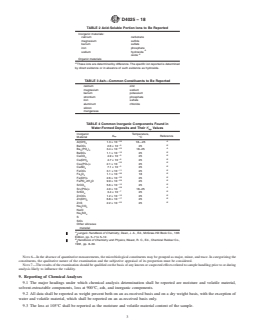
7.1 The major headings for which determinations shall be reported in a complete analysis are as indicated in Table 1. Specific
determinations which shall be reported under some of the major headings are listed in Tables 2-4. In certain instances, knowledge
of the operating practices and water chemistry will have suggested the need to perform additional analyses or indicated the need
for a less complete analysis; consequently, results from determinations may not be reported for each individual item.
8. Reporting of Biological Components
8.1 The results of examinations conducted to determine the presence of microorganisms in the sample, such as those delineated
by Test Method Practice D932 and Practice Test Methods D4412, shall be reported. The organisms present should be identified
by phyla with the relative abundance noted.
D4025 − 18
TABLE 2 Acid-Soluble Portion Ions to Be Reported
Inorganic materials:
calcium carbonate
magnesium sulfide
barium sulfate
iron phosphate
A
sodium hydroxide
A
oxide
Organic materials
A
These ions are determined by difference. The specific ion reported is determined
by direct evidence or in absence of such evidence as hydroxide.
TABLE 3 Ash—Common Constituents to Be Reported
calcium zinc
magnesium sodium
barium potassium
strontium phosphate
iron sulfate
aluminum chloride
silicon
manganese
TABLE 4 Common Inorganic Components Found in
Water-Formed Deposits and Their K Values
sp
Inorganic Temperature,
K Reference
sp
Material °C
−33 A
Al(OH) 1.3 × 10 18—25
−9 B
BaCO 2.6 × 10 25
−23 A
Ba (PO ) 3.4 × 10 18–25
3 4 2
−10 B
BaSO 1.1 × 10 25
−9 B
CaCO 4.9 × 10 25
−6 B
Ca(OH) 4.7 × 10 25
−33 B
Ca (PO ) 2.1 × 10 25
3 4 2
−5 B
CaSO 7.1 × 10 25
−11 B
FeCO 3.1 × 10 25
−36 B
Fe O 1.1 × 10 18
2 3
−39 B
Fe(OH) 2.6 × 10 25
−29 B
FePO ·2H O 9.9 × 10 25
4 2
−10 B
SrCO 5.6 × 10 25
−28 A
Sr (PO ) 4.0 × 10 18–25
3 4 2
−7 B
SrSO 3.4 × 10 25
−10 B
ZnCO 1.2 × 10 25
−17 B
Zn(OH) 6.8 × 10 25
−25 B
ZnS 2.2 × 10 25
Na CO
2 3
NaCl
Na SO
2 4
S
SiO
Other siliceous
material
A
Lange’s Handbook of Chemistry, Dean, J. A., Ed., McGraw-Hill Book Co., 13th
Edition, pp. 5–7 to 5–12.
B
Handbook of Chemistry and Physics, Weast, R. C., Ed., Chemical Rubber Co.,
1991, pp. 8–39.
NOTE 6—In the absence of quantitative measurements, the microbiological constituents may be grouped as major, minor, and trace. In categorizing the
constituents, the qualitative nature of the examination and the subjective appraisal of its proportion must be considered.
NOTE 7—The results of the examination should be qualified on the basis of any known or suspected effects related to sample handling prior to or during
analysis likely to influence the validity.
9. Reporting of Chemical Analyses
9.1 The major headings under which chemical analysis determination shall be reported are moisture and volatile material,
solvent-extractable components, loss at 900°C, ash, and inorganic components.
9.2 All data shall be reported as weight percent both on an as-received basis and on a dry weight basis, with the exception of
water and volatile material, which shall be reported on an as-received basis only.
9.3 The loss at 105°C shall be reported as the moisture and volatile material content of the sample.
D4025 − 18
9.4 Reporting of solvent-extractable materials shall be divided into organic solvent extractables, water-solubles, acid-
extractables, and solvent insolubles.
9.4.1 The organic solvent-extractable constituents shall be reported in terms of the generic nature of the extracted material.
When the extractable portion of the deposit comprises greater than 10 % on a dry weight basis of the deposit, more specific
identification of its composition is advised.
NOTE 8—A fluorocarbo
...