


ASTM D2771-90(1997)e1
(Test Method)Standard Test Methods for Compaction Density of Electrical Grade Magnesium Oxide (Withdrawn 2003)
Standard Test Methods for Compaction Density of Electrical Grade Magnesium Oxide (Withdrawn 2003)
SCOPE
1.1 These test methods cover the determination of the compaction density of electrical grade magnesium oxide in heating units.
1.2 Two alternative procedures are described: Test Method A -Water Displacement, and Test Method B -Absorption.
1.3 This standard does not purport to address all of the safety concerns, if any, associated with its use. It is the responsibility of the user of this standard to establish appropriate safety and health practices and determine the applicability of regulatory limitations prior to use.
General Information
Standards Content (Sample)
NOTICE: This standard has either been superceded and replaced by a new version or discontinued.
Contact ASTM International (www.astm.org) for the latest information.
An American National Standard
e1
Designation: D 2771 – 90 (Reapproved 1997)
Standard Test Methods for
Compaction Density of Electrical Grade Magnesium Oxide
This standard is issued under the fixed designation D 2771; the number immediately following the designation indicates the year of
original adoption or, in the case of revision, the year of last revision. A number in parentheses indicates the year of last reapproval. A
superscript epsilon (e) indicates an editorial change since the last revision or reapproval.
e NOTE—Keywords were added editorially in October 1997.
1. Scope 5.2.1 Canada balsam, molten paraffin wax, RTV silicone
3 4
rubber, or heat-shrinkable poly (vinyl chloride) tubing.
1.1 These test methods cover the determination of the
compaction density of electrical grade magnesium oxide in NOTE 1—The sealant must cover each face of the sample and extend at
least 5 mm along the sheath from each end.
heating units.
1.2 Two alternative procedures are described:
5.3 Dry, cure, or otherwise fix the sealant according to the
Test Method A—Water Displacement, and
standard procedure appropriate to the material used.
Test Method B—Absorption.
5.4 Weigh the sealed specimen in air to the nearest 1 mg.
1.3 This standard does not purport to address the safety
5.5 Suspend the specimen in distilled water and weigh while
problems associated with its use. It is the responsibility of the
suspended.
user of this standard to establish appropriate safety and health
NOTE 2—Caution: Use the smallest and lightest suspension wire pos-
practices and determine the applicability of regulatory limita-
sible to minimize error.
tions prior to use.
5.6 Strip the seals from the specimen. Remove all magne-
2. Referenced Documents
sium oxide from the specimen by deforming the sheath with a
vise or hammer to loosen the insulation. Weigh the sheath and
2.1 ASTM Standards:
resistance wire together in air.
D 176 Test Methods for Solid Filling and Treating Com-
5.7 Suspend the sheath and resistance wire together in water
pounds Used for Electrical Insulation
and weigh while suspended (see Note 2).
3. Apparatus
6. Calculation
3.1 For either test method, a balance capable of weighing to
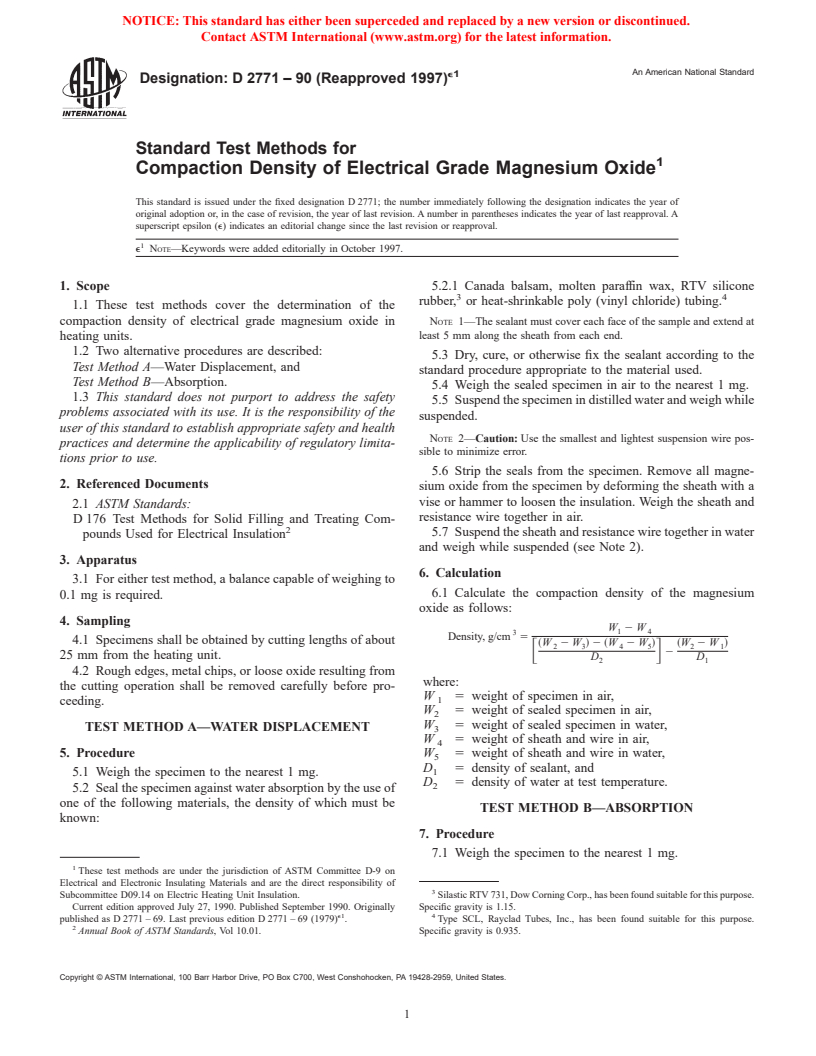
6.1 Calculate the compaction density of the magnesium
0.1 mg is required.
oxide as follows:
4. Sampling
W 2 W
1 4
Density, g/cm 5
4.1 Specimens shall be obtained by cutting lengths of about
~W 2 W ! 2 ~W 2 W ! ~W 2 W !
2 3 4 5 2 1
F G
25 mm from the heating unit.
D D
2 1
4.2 Rough edges, metal chips, or loose oxide resulting from
where:
the cutting operation shall be removed carefully before pro-
W 5 weight of specimen in air,
ceeding.
W 5 weight of sealed specimen in air,
W 5 weight of sealed specimen in water,
TEST METHOD A—WATER DISPLACEMENT 3
W 5 weight of sheath and wire in air,
5. Procedure W 5 weight of sheath and wire in water,
D 5 density of sealant, and
5.1 Weigh the specimen to the nearest 1 mg.
D 5 density of water at test temperature.
5.2 Seal the specimen against water absorption by the use of
one of the following materials, the density of which must be
TEST METHOD B—ABSORPTION
known:
7. Procedure
7.1 Weigh the specimen to the nearest 1 mg.
These test methods are under the jurisdiction of ASTM Committee D-9 on
Electrical and Electronic Insulating Materials and are the direct responsibility of
Subcommittee D09.14 on Electric Heating Unit Insulation. Silastic RTV 731, Dow Corning Corp., has been found suitable for this purpose.
Curr
...
Questions, Comments and Discussion
Ask us and Technical Secretary will try to provide an answer. You can facilitate discussion about the standard in here.