

ASTM C862-16(2020)
(Practice)Standard Practice for Preparing Refractory Concrete Specimens by Casting
General Information
- Abstract
SIGNIFICANCE AND USE
3.1 This practice is used to standardize mixing, mold conditions, placement, and curing of refractory concrete specimens to be used for testing and evaluation under other test methods.
3.2 This practice standardizes laboratory conditions for producing refractory concrete specimens to minimize laboratory-to-laboratory variation and does not attempt to duplicate the conditions of field installations.
3.3 This practice can be used for the preparation of specimens used in referee testing.
SCOPE
1.1 This practice covers the mixing, casting, and curing of monolithic refractory concrete specimens under laboratory conditions for use in further testing. It does not apply to monolithic castable refractories intended primarily for gunning applications.
1.2 The values stated in inch-pound units are to be regarded as standard. The values given in parentheses are mathematical conversions to SI units that are provided for information only and are not considered standard.
1.3 Various specimen sizes are required for specific test methods. Refer to these test methods to determine the size and number of specimens, which will be required from the sample.
1.4 This standard does not purport to address all of the safety concerns, if any, associated with its use. It is the responsibility of the user of this standard to establish appropriate safety, health, and environmental practices and determine the applicability of regulatory limitations prior to use.
1.5 This international standard was developed in accordance with internationally recognized principles on standardization established in the Decision on Principles for the Development of International Standards, Guides and Recommendations issued by the World Trade Organization Technical Barriers to Trade (TBT) Committee.
- Status
- Published
- Publication Date
- 31-Oct-2020
- Technical Committee
- C08 - Refractories
- Drafting Committee
- C08.09 - Monolithics

Overview
ASTM C862-16(2020) - Standard Practice for Preparing Refractory Concrete Specimens by Casting provides a comprehensive procedure for mixing, casting, and curing monolithic refractory concrete specimens in laboratory settings. This standard is essential for ensuring consistent specimen preparation for subsequent testing and evaluation, aiming to minimize variability between laboratories. It serves as a foundation for quality control, research, and product comparison in the refractories industry while not intending to replicate field installation conditions.
Key Topics
- Standardized Laboratory Preparation: The practice details specific requirements for mixing, mold conditions, placement, and curing, ensuring that refractory concrete test specimens are produced under controlled conditions.
- Equipment and Apparatus: Recommends the use of scalable mechanical mixers, appropriate molds (metal, plastic, or rubber), calipers, thermometers, ovens, humidity cabinets, and related tools to optimize specimen quality.
- Mixing and Casting Procedures: Outlines methods for both mechanical and manual mixing, including the water addition process and batch size considerations, to achieve homogenous mixtures suitable for test specimens.
- Curing Methods: Describes curing schemes-covering temperature ranges, humidity control, and timeframes-to develop appropriate physical properties in the test specimens, following manufacturer or referee specifications.
- Specimen Measurement and Documentation: Stresses the importance of detailed record keeping, including temperatures, batch sizes, specimen sizes, cure times, and laboratory ambient conditions, which is critical for valid test results and inter-laboratory comparisons.
- Safety and Regulatory Compliance: Reminds users to implement appropriate safety, health, and environmental practices, and to verify regulatory requirements before use.
Applications
The ASTM C862-16(2020) standard is widely used in:
- Laboratory Quality Control: Ensuring repeatable and reliable preparation of test specimens for industry-based and research laboratories assessing refractory concrete performance.
- Referee Testing: Providing a common ground for dispute resolution, inter-laboratory comparison, and reference testing through standardized specimen preparation.
- Product Development & R&D: Supporting new product evaluation by delivering consistent sample preparation routines for comparative analysis under subsequent test methods.
- Compliance Audits: Assisting manufacturers and suppliers aiming to demonstrate adherence to recognized industry standards in refractory material testing.
- Performance Testing: Facilitating preparation of specimens for key tests like compressive strength, modulus of rupture, thermal shock resistance, and dimensional stability.
Related Standards
- ASTM C133: Test Methods for Cold Crushing Strength and Modulus of Rupture of Refractories - For which the specimens prepared per ASTM C862 are often utilized.
- ASTM C192/C192M: Practice for Making and Curing Concrete Test Specimens in the Laboratory - Referenced for mold size and configuration guidance.
- Other Monolithic Refractory Standards: This practice is compatible with additional ASTM and ISO standards governing the testing of refractory materials, excluding castables for gunning applications.
Keywords: ASTM C862, refractory concrete specimens, specimen preparation, laboratory casting, curing, refractories testing, monolithic refractory, quality control, standardization, mixing procedures.
By standardizing specimen casting and curing, ASTM C862-16(2020) helps ensure reliable, comparable test results across the refractories industry, supporting safe, high-performance material selection and validation.
Relations
- Effective Date
- 01-Apr-2024
- Effective Date
- 01-Feb-2016
- Effective Date
- 01-Aug-2014
- Effective Date
- 01-Dec-2012
- Effective Date
- 01-Aug-2008
- Effective Date
- 01-Aug-2008
- Effective Date
- 01-Aug-2007
- Effective Date
- 01-Jun-2006
- Effective Date
- 01-May-2005
- Effective Date
- 10-Apr-2003
- Effective Date
- 10-Aug-2002
- Effective Date
- 01-Jan-1997
Frequently Asked Questions
ASTM C862-16(2020) is a standard published by ASTM International. Its full title is "Standard Practice for Preparing Refractory Concrete Specimens by Casting". This standard covers: SIGNIFICANCE AND USE 3.1 This practice is used to standardize mixing, mold conditions, placement, and curing of refractory concrete specimens to be used for testing and evaluation under other test methods. 3.2 This practice standardizes laboratory conditions for producing refractory concrete specimens to minimize laboratory-to-laboratory variation and does not attempt to duplicate the conditions of field installations. 3.3 This practice can be used for the preparation of specimens used in referee testing. SCOPE 1.1 This practice covers the mixing, casting, and curing of monolithic refractory concrete specimens under laboratory conditions for use in further testing. It does not apply to monolithic castable refractories intended primarily for gunning applications. 1.2 The values stated in inch-pound units are to be regarded as standard. The values given in parentheses are mathematical conversions to SI units that are provided for information only and are not considered standard. 1.3 Various specimen sizes are required for specific test methods. Refer to these test methods to determine the size and number of specimens, which will be required from the sample. 1.4 This standard does not purport to address all of the safety concerns, if any, associated with its use. It is the responsibility of the user of this standard to establish appropriate safety, health, and environmental practices and determine the applicability of regulatory limitations prior to use. 1.5 This international standard was developed in accordance with internationally recognized principles on standardization established in the Decision on Principles for the Development of International Standards, Guides and Recommendations issued by the World Trade Organization Technical Barriers to Trade (TBT) Committee.
SIGNIFICANCE AND USE 3.1 This practice is used to standardize mixing, mold conditions, placement, and curing of refractory concrete specimens to be used for testing and evaluation under other test methods. 3.2 This practice standardizes laboratory conditions for producing refractory concrete specimens to minimize laboratory-to-laboratory variation and does not attempt to duplicate the conditions of field installations. 3.3 This practice can be used for the preparation of specimens used in referee testing. SCOPE 1.1 This practice covers the mixing, casting, and curing of monolithic refractory concrete specimens under laboratory conditions for use in further testing. It does not apply to monolithic castable refractories intended primarily for gunning applications. 1.2 The values stated in inch-pound units are to be regarded as standard. The values given in parentheses are mathematical conversions to SI units that are provided for information only and are not considered standard. 1.3 Various specimen sizes are required for specific test methods. Refer to these test methods to determine the size and number of specimens, which will be required from the sample. 1.4 This standard does not purport to address all of the safety concerns, if any, associated with its use. It is the responsibility of the user of this standard to establish appropriate safety, health, and environmental practices and determine the applicability of regulatory limitations prior to use. 1.5 This international standard was developed in accordance with internationally recognized principles on standardization established in the Decision on Principles for the Development of International Standards, Guides and Recommendations issued by the World Trade Organization Technical Barriers to Trade (TBT) Committee.
ASTM C862-16(2020) is classified under the following ICS (International Classification for Standards) categories: 81.080 - Refractories. The ICS classification helps identify the subject area and facilitates finding related standards.
ASTM C862-16(2020) has the following relationships with other standards: It is inter standard links to ASTM C133-24, ASTM C192/C192M-16, ASTM C192/C192M-14, ASTM C192/C192M-12a, ASTM C133-97(2008)e1, ASTM C133-97(2008), ASTM C192/C192M-07, ASTM C192/C192M-06, ASTM C192/C192M-05, ASTM C133-97(2003), ASTM C192/C192M-02, ASTM C133-97. Understanding these relationships helps ensure you are using the most current and applicable version of the standard.
ASTM C862-16(2020) is available in PDF format for immediate download after purchase. The document can be added to your cart and obtained through the secure checkout process. Digital delivery ensures instant access to the complete standard document.
Standards Content (Sample)
This international standard was developed in accordance with internationally recognized principles on standardization established in the Decision on Principles for the
Development of International Standards, Guides and Recommendations issued by the World Trade Organization Technical Barriers to Trade (TBT) Committee.
Designation: C862 − 16 (Reapproved 2020)
Standard Practice for
Preparing Refractory Concrete Specimens by Casting
This standard is issued under the fixed designation C862; the number immediately following the designation indicates the year of
original adoption or, in the case of revision, the year of last revision.Anumber in parentheses indicates the year of last reapproval.A
superscript epsilon (´) indicates an editorial change since the last revision or reapproval.
This standard has been approved for use by agencies of the U.S. Department of Defense.
1. Scope 3. Significance and Use
3.1 This practice is used to standardize mixing, mold
1.1 This practice covers the mixing, casting, and curing of
conditions, placement, and curing of refractory concrete speci-
monolithic refractory concrete specimens under laboratory
mens to be used for testing and evaluation under other test
conditions for use in further testing. It does not apply to
methods.
monolithiccastablerefractoriesintendedprimarilyforgunning
applications.
3.2 This practice standardizes laboratory conditions for
producing refractory concrete specimens to minimize
1.2 The values stated in inch-pound units are to be regarded
laboratory-to-laboratory variation and does not attempt to
as standard. The values given in parentheses are mathematical
duplicate the conditions of field installations.
conversions to SI units that are provided for information only
and are not considered standard.
3.3 This practice can be used for the preparation of speci-
mens used in referee testing.
1.3 Various specimen sizes are required for specific test
methods. Refer to these test methods to determine the size and
4. Apparatus and Conditions
number of specimens, which will be required from the sample.
4.1 Laboratory Conditions—The laboratory ambient should
1.4 This standard does not purport to address all of the
be controlled between 70 and 80°F (20 and 27°C) (Note 1)
safety concerns, if any, associated with its use. It is the
and from 40 to 60% relative humidity for preconditioning
responsibility of the user of this standard to establish appro-
materials and equipment, batching and mixing casting test
priate safety, health, and environmental practices and deter-
specimens, stripping molds, and testing specimens. Report
mine the applicability of regulatory limitations prior to use.
laboratorytemperatureandrelativehumiditywithphysicaltest
1.5 This international standard was developed in accor-
results if other than specified.
dance with internationally recognized principles on standard-
NOTE 1—A5 to 6°F temperature difference can drastically change the
ization established in the Decision on Principles for the
set time of a mix. It is a good practice to always record ambient
Development of International Standards, Guides and Recom-
temperature conditions for each cast.
mendations issued by the World Trade Organization Technical
4.2 Balances—Appropriately sized scales having a sensitiv-
Barriers to Trade (TBT) Committee.
ity of 0.2% of the related batch size.
4.3 Castable Mixers—An electrically operated mechanical
2. Referenced Documents
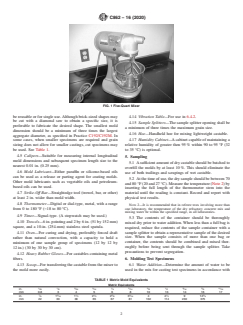
mixer (Fig. 1) may be used for preparing castable batches for
3 3 3
2.1 ASTM Standards: 1
casting specimens.A2-ft (0.057m ) mixing bowl or a 2 ⁄2-ft
C133Test Methods for Cold Crushing Strength and Modu-
(0.071m ) concrete mixer has sufficient capacity to mix about
lus of Rupture of Refractories 3 3
1ft (0.0285 m ) of refractory castable. The smallest batches
C192/C192MPracticeforMakingandCuringConcreteTest
required for casting 1-in. (25mm) square bars can be mixed in
Specimens in the Laboratory 3 3
a 0.10-ft (0.0028m ) bowl available with bench mixers. Size
mixing bowl to contain from 50 to 75% volume loading with
the dry batch. Castable water requirement variation becomes
more significant as dry volume loadings drop below 40%
ThispracticeisunderthejurisdictionofASTMCommitteeC08onRefractories
and is the direct responsibility of Subcommittee C08.09 on Monolithics.
because the water required to wet the bowl surfaces changes
Current edition approved Nov. 1, 2020. Published November 2020. Originally
more rapidly with decreasing volume loadings.
approved in 1977. Last previous edition approved in 2016 as C862–16. DOI:
10.1520/C0862-16R20.
4.4 Molds—Typical molds are 9 by 2 by 2 in. and 2 by 2 by
For referenced ASTM standards, visit the ASTM website, www.astm.org, or
2 in. made from metal, plastic, or rubber and are watertight,
contact ASTM Customer Service at service@astm.org. For Annual Book of ASTM
rigid, and removable. There are commercially available molds
Standards volume information, refer to the standard’s Document Summary page on
the ASTM website. from concrete testing suppliers and other sources. Molds may
Copyright © ASTM International, 100 Barr Harbor Drive, PO Box C700, West Conshohocken, PA 19428-2959. United States
C862 − 16 (2020)
FIG. 1 Five-Quart Mixer
be reusable or for single use.Although brick-sized shapes may 4.14 Vibration Table—For use in 6.4.2.
be cut with a diamond saw to obtain a specific size, it is
4.15 Sample Splitters—The sample splitter opening shall be
preferable to fabricate the desired shape. The smallest mold
a minimum of three times the maximum grain size.
dimension should be a minimum of three times the largest
4.16 Hoe—Handheld hoe for mixing lightweight castable.
aggregate diameter, as specified in Practice C192/C192M.In
4.17 Humidity Cabinet—Acabinet capable of maintaining a
some cases, when smaller specimens are required and grain
relative humidity of greater then 95% within 90 to 95°F (32
sizing does not allow for smaller castings, cut specimens may
to 35°C) is optional.
be used. See Table 1.
4.5 Calipers—Suitable for measuring internal longitudinal
5. Sampling
mold dimensions and subsequent specimen length size to the
5.1 Asufficientamountofdrycastableshouldbebatchedto
nearest 0.01 in. (0.25 mm).
overfill the molds by at least 10%. This should eliminate the
4.6 Mold Lubricant—Either paraffin or silicone-based oils use of both trailings and scrapings of wet castable.
can be used as a release or parting agent for coating molds.
5.2 Atthetimeofuse,thedrysampleshouldbebetween70
Other mold lubricants such as vegetable oils and petroleum-
and80°F(20and27°C).Measurethetemperature(Note2)by
based oils can be used.
inserting the full length of the thermometer stem into the
4.7 Strike-Off Bar—Straightedge tool (trowel, bar, or other)
material until the reading is constant. Record and report with
at least 2 in. wider than mold width. physical test results.
4.8 Thermometer—Digital or dial-type, metal, with a range
NOTE 2—It is recommended that in referee tests involving more than
one laboratory, the temperature of the dry refractory concrete mix and
from 0 to 180°F (−18 to 80°C).
mixing water be within the specified range, in all laboratories.
4.9 Timer—Signal-type. (A stopwatch may be used.)
5.3 The contents of the container should be thoroughly
4.10 Trowels—6 in. pointing and 2 by 6 in. (51 by 152 mm)
mixed dry prior to water addition. When less than a full bag is
square, and a 10-in. (254-mm) stainless steel spatula.
required, reduce the contents of the sample container with a
sample splitter to obtain a representative sample of the desired
4.11 Oven—For curing and drying, preferably forced draft
size. When the sample consists of more than one bag or
rather than natural convection, with a capacity to hold a
container, the contents should be combined and mixed thor-
minimum of one sample group of specimens (12 by 12 by
oughly before being sent through the sample splitter. Take
12in.) (30 by 30 by 30 cm).
precautions to prevent segregation.
4.12 Heavy Rubber Gloves—For castables containing metal
fibers.
6. Molding Test Specimens
4.13 Scoop—For transferring the castable from the mixer to 6.1 Water Addition—Determine the amount of water to be
the mold more easily. used in the mix for casting test specimens in accordance with
TABLE 1 Metric Mold Equivalents
Metric Equivalents
1 1 5 3 1 5 3 1 9 5 11
in. ⁄32 ⁄8 ⁄32 ⁄16 ⁄4 ⁄16 ⁄8 ⁄2 ⁄16 ⁄8 ⁄16
mm 0.8 3 4 5 6 8 10 13 14 16 17
7 3 1 1 5 3 1 3
in. ⁄8 1 ⁄16 1 ⁄2 2 ⁄2 2 ⁄8 3 ⁄16 4 4 ⁄2 9 14 ⁄4
mm 22 30 38 65 67 81 102 114 230 375
C862 − 16 (2020)
the manufacturer’s or referee’s recommendations. Use potable 6.4.2.1 When filling deep molds, that is, brick molds 4 in.
water (Note 3) having temperature between 70 and 80°F (20 (100 mm) deep or larger, fill the mold cavity halfway and
and 27°C). Report the temperature with any physical test consolidate the material in the molds by spading at close
results. Measure the water addition to the nearest 0.1% by intervals with a square trowel or spatula held vertically, and
weight. with the blade turned to form an angle of 45° with the
...