

ASTM C1844-16
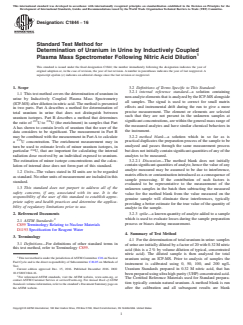
(Test Method)Standard Test Method for Determination of Uranium in Urine by Inductively Coupled Plasma Mass Spectrometer Following Nitric Acid Dilution
General Information
- Abstract
SIGNIFICANCE AND USE
5.1 It is common practice within the nuclear industry for internal dose assessment to be made as part of a bioassay program for nuclear facility workers. For indirect bioassay of workers that may be exposed to uranium at enrichments that may differ from natural then the 235U concentration must be measured in addition to the total uranium isotopes so that an estimate of uranium enrichment may be made for use in the dose assessment.
5.2 The enrichment measurement may also be of value in tracing the source of uranium exposure should significant uranium levels be detected in a sample.
5.3 A modern, quadrupole ICPMS should be capable of delivering performance characteristics close to those claimed in this test method; however, older models or those where performance has deteriorated over time may be unable to do so. It is the responsibility of the user to validate the performance of their equipment.
SCOPE
1.1 This test method covers the determination of uranium in urine by Inductively Coupled Plasma Mass Spectrometry (ICP-MS) after dilution in nitric acid. The method is presented in two parts. Part A describes a method for determination of total uranium in urine that does not distinguish between uranium isotopes. Part B describes a method that determines the ratio of 235U to 238U (the enrichment) in samples that Part A has shown to contain levels of uranium that the user of the data considers to be significant. The measurement in Part B may be combined with the measurement in Part A to calculate a 235U concentration. The enrichment measurement may in turn be used to estimate levels of minor uranium isotopes, in particular 234U, that are important for calculating the internal radiation dose received by an individual exposed to uranium. The estimation of minor isotope concentrations and the calculation of internal dose does not form part of this standard.
1.2 Units—The values stated in SI units are to be regarded as standard. No other units of measurement are included in this standard.
1.3 This standard does not purport to address all of the safety concerns, if any, associated with its use. It is the responsibility of the user of this standard to establish appropriate safety and health practices and determine the applicability of regulatory limitations prior to use.
- Status
- Published
- Publication Date
- 14-Dec-2016
- Technical Committee
- C26 - Nuclear Fuel Cycle
- Drafting Committee
- C26.05 - Methods of Test
Overview
ASTM C1844-16: Standard Test Method for Determination of Uranium in Urine by Inductively Coupled Plasma Mass Spectrometer Following Nitric Acid Dilution is an internationally recognized ASTM standard designed for use in the nuclear industry as part of bioassay programs. This method utilizes Inductively Coupled Plasma Mass Spectrometry (ICP-MS) following nitric acid dilution to determine uranium in human urine. The procedure is integral to assessing internal dose exposure among workers in nuclear facilities and for tracing the source of uranium exposure.
The standard is applicable in scenarios where uranium exposure may involve enriched uranium of varying isotope compositions. It provides robust guidance for both total uranium determination and measurements of uranium isotope ratios, which are essential for enrichment estimation and potential source identification.
Key Topics
- Determination of Total Uranium: The method outlines the dilution of urine samples with nitric acid and subsequent analysis via ICP-MS, allowing for detection and quantification of uranium irrespective of isotope.
- Uranium Enrichment Measurement: For samples with significant uranium levels, the standard details a process for measuring the ratio of Uranium-235 to Uranium-238, which is critical for enrichment calculations used in nuclear worker dose assessments.
- Instrument Calibration and Quality Control: Detailed requirements for calibration standards, quality control samples, method blanks, and internal reference standards to ensure accuracy and precision.
- Validation and Equipment Performance: Users must validate their equipment performance, especially when employing older ICP-MS models, to meet the standard’s measurement reliability.
- Safety Guidance: Emphasizes the safe handling of strong acids and biological materials, urging suitable laboratory health and safety practices.
- Use of SI Units: All measurements and concentrations are reported using the International System of Units.
Applications
ASTM C1844-16 is primarily used in:
- Nuclear Safety Programs: Assessing uranium exposure for internal dose calculation in occupational settings.
- Occupational Health Monitoring: Supporting indirect bioassay monitoring for workers handling or exposed to uranium or enriched uranium compounds.
- Environmental and Biological Monitoring: Used in contexts where trace uranium detection in biological samples is required to monitor environmental or accidental exposure.
- Source Attribution of Uranium: Isotope ratio measurements aid in determining whether uranium exposure comes from natural sources, low-level enrichment, or reprocessed materials.
- Regulatory Compliance: Ensuring facility adherence to both local and international safety standards for radiation protection.
Related Standards
For comprehensive nuclear facility bioassay and radiological analysis, laboratories often reference additional ASTM and international standards in conjunction with ASTM C1844-16, including:
- ASTM C859: Terminology Relating to Nuclear Materials
- ASTM D1193: Specification for Reagent Water (used for preparing diluents and standards)
- ISO 16172: Measurement of uranium isotopes in water by ICP-MS
- ASTM C1672: Standard Practice for Storing and Handling Uranium Hexafluoride (for context on nuclear material management)
- ISO/ASTM 11752: International standard on urine bioassay procedures
Practical Value
ASTM C1844-16 ensures that laboratories perform uranium in urine analysis with accuracy, reproducibility, and regulatory compliance using ICP-MS technology-a crucial aspect of protecting nuclear industry workers and supporting nuclear safety. By standardizing sample preparation, calibration, measurement, and quality control, the method promotes reliable health risk assessments and facilitates rapid response in cases of possible radiological exposure.
Key benefits include:
- Reliable internal dose quantification for radiological protection programs.
- Traceability using isotope ratio measurements for investigative and compliance purposes.
- Flexible application across diverse laboratory setups, with guidance for performance validation.
Utilizing ASTM C1844-16 helps organizations align with best practices in radiological bioassay and supports ongoing worker health and safety initiatives in the nuclear industry.
Relations
- Effective Date
- 27-Jun-2017
- Effective Date
- 01-Jan-2024
- Effective Date
- 15-Jun-2014
- Effective Date
- 15-Jan-2014
- Effective Date
- 01-Jun-2013
- Effective Date
- 01-May-2013
- Effective Date
- 01-Nov-2010
- Effective Date
- 01-Aug-2010
- Effective Date
- 01-Feb-2010
- Effective Date
- 15-Feb-2009
- Effective Date
- 15-Sep-2008
- Effective Date
- 01-Mar-2006
- Effective Date
- 10-Feb-1999
- Effective Date
- 10-Feb-1999
- Effective Date
- 01-Jan-1992
Get Certified
Connect with accredited certification bodies for this standard

DNV
DNV is an independent assurance and risk management provider.

Lloyd's Register
Lloyd's Register is a global professional services organisation specialising in engineering and technology.
DNV Energy Systems
Energy and renewable energy certification.
Sponsored listings
Frequently Asked Questions
ASTM C1844-16 is a standard published by ASTM International. Its full title is "Standard Test Method for Determination of Uranium in Urine by Inductively Coupled Plasma Mass Spectrometer Following Nitric Acid Dilution". This standard covers: SIGNIFICANCE AND USE 5.1 It is common practice within the nuclear industry for internal dose assessment to be made as part of a bioassay program for nuclear facility workers. For indirect bioassay of workers that may be exposed to uranium at enrichments that may differ from natural then the 235U concentration must be measured in addition to the total uranium isotopes so that an estimate of uranium enrichment may be made for use in the dose assessment. 5.2 The enrichment measurement may also be of value in tracing the source of uranium exposure should significant uranium levels be detected in a sample. 5.3 A modern, quadrupole ICPMS should be capable of delivering performance characteristics close to those claimed in this test method; however, older models or those where performance has deteriorated over time may be unable to do so. It is the responsibility of the user to validate the performance of their equipment. SCOPE 1.1 This test method covers the determination of uranium in urine by Inductively Coupled Plasma Mass Spectrometry (ICP-MS) after dilution in nitric acid. The method is presented in two parts. Part A describes a method for determination of total uranium in urine that does not distinguish between uranium isotopes. Part B describes a method that determines the ratio of 235U to 238U (the enrichment) in samples that Part A has shown to contain levels of uranium that the user of the data considers to be significant. The measurement in Part B may be combined with the measurement in Part A to calculate a 235U concentration. The enrichment measurement may in turn be used to estimate levels of minor uranium isotopes, in particular 234U, that are important for calculating the internal radiation dose received by an individual exposed to uranium. The estimation of minor isotope concentrations and the calculation of internal dose does not form part of this standard. 1.2 Units—The values stated in SI units are to be regarded as standard. No other units of measurement are included in this standard. 1.3 This standard does not purport to address all of the safety concerns, if any, associated with its use. It is the responsibility of the user of this standard to establish appropriate safety and health practices and determine the applicability of regulatory limitations prior to use.
SIGNIFICANCE AND USE 5.1 It is common practice within the nuclear industry for internal dose assessment to be made as part of a bioassay program for nuclear facility workers. For indirect bioassay of workers that may be exposed to uranium at enrichments that may differ from natural then the 235U concentration must be measured in addition to the total uranium isotopes so that an estimate of uranium enrichment may be made for use in the dose assessment. 5.2 The enrichment measurement may also be of value in tracing the source of uranium exposure should significant uranium levels be detected in a sample. 5.3 A modern, quadrupole ICPMS should be capable of delivering performance characteristics close to those claimed in this test method; however, older models or those where performance has deteriorated over time may be unable to do so. It is the responsibility of the user to validate the performance of their equipment. SCOPE 1.1 This test method covers the determination of uranium in urine by Inductively Coupled Plasma Mass Spectrometry (ICP-MS) after dilution in nitric acid. The method is presented in two parts. Part A describes a method for determination of total uranium in urine that does not distinguish between uranium isotopes. Part B describes a method that determines the ratio of 235U to 238U (the enrichment) in samples that Part A has shown to contain levels of uranium that the user of the data considers to be significant. The measurement in Part B may be combined with the measurement in Part A to calculate a 235U concentration. The enrichment measurement may in turn be used to estimate levels of minor uranium isotopes, in particular 234U, that are important for calculating the internal radiation dose received by an individual exposed to uranium. The estimation of minor isotope concentrations and the calculation of internal dose does not form part of this standard. 1.2 Units—The values stated in SI units are to be regarded as standard. No other units of measurement are included in this standard. 1.3 This standard does not purport to address all of the safety concerns, if any, associated with its use. It is the responsibility of the user of this standard to establish appropriate safety and health practices and determine the applicability of regulatory limitations prior to use.
ASTM C1844-16 is classified under the following ICS (International Classification for Standards) categories: 27.120.30 - Fissile materials and nuclear fuel technology. The ICS classification helps identify the subject area and facilitates finding related standards.
ASTM C1844-16 has the following relationships with other standards: It is inter standard links to ASTM C1379-10, ASTM C859-24, ASTM C859-14a, ASTM C859-14, ASTM C859-13a, ASTM C859-13, ASTM C859-10b, ASTM C859-10a, ASTM C859-10, ASTM C859-09, ASTM C859-08, ASTM D1193-06, ASTM D1193-99e1, ASTM D1193-99, ASTM C859-92b. Understanding these relationships helps ensure you are using the most current and applicable version of the standard.
ASTM C1844-16 is available in PDF format for immediate download after purchase. The document can be added to your cart and obtained through the secure checkout process. Digital delivery ensures instant access to the complete standard document.
Standards Content (Sample)
This international standard was developed in accordance with internationally recognized principles on standardization established in the Decision on Principles for the
Development of International Standards, Guides and Recommendations issued by the World Trade Organization Technical Barriers to Trade (TBT) Committee.
Designation: C1844 − 16
Standard Test Method for
Determination of Uranium in Urine by Inductively Coupled
Plasma Mass Spectrometer Following Nitric Acid Dilution
This standard is issued under the fixed designation C1844; the number immediately following the designation indicates the year of
original adoption or, in the case of revision, the year of last revision. A number in parentheses indicates the year of last reapproval. A
superscript epsilon (´) indicates an editorial change since the last revision or reapproval.
1. Scope 3.2 Definitions of Terms Specific to This Standard:
3.2.1 internal reference standard—a solution containing
1.1 This test method covers the determination of uranium in
non-analyteelementsthatisanalyzedbytheICP-MSalongside
urine by Inductively Coupled Plasma Mass Spectrometry
all samples. The signal is used to correct for small matrix
(ICP-MS) after dilution in nitric acid. The method is presented
effects and instrumental drift during the run to give a more
in two parts. Part A describes a method for determination of
precise measurement. The element or elements are selected
total uranium in urine that does not distinguish between
such that they are not present in the unknown samples at
uranium isotopes. Part B describes a method that determines
235 238 significant concentrations, are within the general mass range of
the ratio of Uto U (the enrichment) in samples that Part
the measured analytes and have similar chemical behaviors in
A has shown to contain levels of uranium that the user of the
the instrument.
data considers to be significant. The measurement in Part B
3.2.2 method blank—a solution which in so far as is
may be combined with the measurement in PartAto calculate
practical duplicates the preparation process of the sample to be
a U concentration. The enrichment measurement may in
analyzed and passes through the same measurement process
turn be used to estimate levels of minor uranium isotopes, in
butdoesnotinitiallycontainsignificantquantitiesofanyofthe
particular U, that are important for calculating the internal
analytes to be measured.
radiation dose received by an individual exposed to uranium.
3.2.2.1 Discussion—The method blank does not initially
The estimation of minor isotope concentrations and the calcu-
contain significant quantities of analyte, hence the value of any
lation of internal dose does not form part of this standard.
analyte measured may be assumed to be due to interference,
1.2 Units—The values stated in SI units are to be regarded
matrix effects or contamination introduced as a consequence of
as standard. No other units of measurement are included in this
sample processing. If the contribution of such factors is
standard.
evaluated to be representative to the measurement of the
1.3 This standard does not purport to address all of the
unknown samples in the batch then subtracting the measured
safety concerns, if any, associated with its use. It is the
value for the method blank from the value measured on the
responsibility of the user of this standard to establish appro-
genuine sample will eliminate these interferences, typically
priate safety and health practices and determine the applica-
providing a better estimate for the true value of the quantity of
bility of regulatory limitations prior to use.
analyte in the sample.
2. Referenced Documents 3.2.3 spike—a known quantity of analyte added to a sample
which is used to evaluate losses during the sample preparation
2.1 ASTM Standards:
process or biases during measurement.
C859 Terminology Relating to Nuclear Materials
D1193 Specification for Reagent Water
4. Summary of Test Method
3. Terminology
4.1 For the determination of total uranium in urine: samples
3.1 Definitions—For definitions of other standard terms in
ofurineareinitiallydilutedbyafactorof20with0.32Mnitric
this test method, refer to Terminology C859.
acid (this is a 2 % by volume dilution of typical, concentrated
nitric acid). The diluted sample is then analyzed for total
This test method is under the jurisdiction ofASTM Committee C26 on Nuclear
uranium using an ICP-MS. Prior to analysis of samples the
Fuel Cycle and is the direct responsibility of Subcommittee C26.05 on Methods of
instrument is calibrated using 0, 50, 100, and 200 ng/L
Test.
Uranium Standards prepared in 0.32 M nitric acid, that has
Current edition approved Dec. 15, 2016. Published December 2016. DOI:
10.1520/C1844-16.
been prepared using ultra high purity (UHP) concentrated acid.
For referenced ASTM standards, visit the ASTM website, www.astm.org, or
The Certified Reference Materials used for Standard prepara-
contact ASTM Customer Service at service@astm.org. For Annual Book of ASTM
tion typically contain natural uranium. A method blank is run
Standards volume information, refer to the standard’s Document Summary page on
the ASTM website. after the calibration and all subsequent results are blank
Copyright © ASTM International, 100 Barr Harbor Drive, PO Box C700, West Conshohocken, PA 19428-2959. United States
C1844 − 16
corrected. A 50 ng/L Uranium Instrument Quality Control ment. The ratio may be significantly higher for reprocessed
Sample is also analyzed after the calibration in order to uranium; however, even in this case any bias is likely to be less
maintain quality control of the instrument. An on-line internal than 10 % of the U value. A highly enriched uranium
reference standard of 2 µg/L thorium is analyzed with every referencematerial(NBS930,93.28 %mass U,1.08 %mass
sample in order to correct results for minor matrix effects and U) was measured repeatedly during the validation of the
instrumental variation between samples, in particular for in- method and the results for the U enrichment level agreed
strumental drift. with the certified value to well within the uncertainty for the
235 238
method.
4.2 For the determination of the Uto U ratio in urine:
samplesthathavebeenshowntocontainlevelsofuraniumthat
PART A – DETERMINATION OF TOTAL URANIUM
are sufficiently high to allow enrichment to be determined and
IN URINE
that the user of the data considers to be significant are diluted
235 238
by a factor of 5 with 0.32 M nitric acid, UHP.The Uto U
7. Apparatus
ratio in the diluted sample is measured on an ICP-MS which
7.1 Equipment materials must be compatible with nitric
has been calibrated for mass bias parameter using a 200 ng/L
acid. Each type of container should be tested to ensure that it
solution of a uranium reference material with certified enrich-
does not contain leachable uranium that might affect the
ment level. A 200 ng/L Uranium Instrument Quality Control
measurementbysoakingindilutenitricacidandmeasuringthe
Sample is analyzed after the calibration in order to maintain
uranium content of the acid after leaching.
quality control of the instrument. At the end of the measure-
7.2 Required apparatus is:
ment run a method quality control sample in a urine matrix is
7.2.1 ICP-MS controlled by computer and fitted with asso-
also measured.
ciated software and peripherals. A compatible autosampler is
4.3 The concentration of U may be calculated using the
highly recommended.
results from the two determinations.
7.2.2 Pipets, variable volume, in appropriate sizes such as 1
NOTE 1—A lower dilution factor than the 20 used for total uranium
to 10 mL; 100 to 1200 µL; 20 to 300 µL; 5 to 100 µLused with
235 238
measurement may be used for the determination of the Uto U ratio
polyethylene pipette tips.
as any interference from the matrix should affect each isotope equally.
7.2.3 Volumetric flask, 100 mL.
7.2.4 Graduated cylinder, 100 mL or 250 mL.
5. Significance and Use
7.2.5 Sample bottles,125mL,1L,2L.
5.1 It is common practice within the nuclear industry for
7.2.6 Aspirator bottle, 10 L.
internal dose assessment to be made as part of a bioassay
7.2.7 Screw cap sample tubes, 50 mL (polypropylene cen-
program for nuclear facility workers. For indirect bioassay of
trifuge tubes have been found to be suitable).
workers that may be exposed to uranium at enrichments that
7.2.8 Plastic Pasteur Pipets, 1 mL.
may differ from natural then the U concentration must be
measured in addition to the total uranium isotopes so that an
8. Reagents and Materials
estimate of uranium enrichment may be made for use in the
8.1 Purity of Reagents—Reagent grade chemicals shall be
dose assessment.
used in all tests. Unless otherwise indicated, it is intended that
5.2 The enrichment measurement may also be of value in
all reagents shall conform to the specifications of the Commit-
tracing the source of uranium exposure should significant
tee onAnalytical Reagents of theAmerican Chemical Society,
uranium levels be detected in a sample.
where such specifications are available.
5.3 A modern, quadrupole ICPMS should be capable of
8.2 Purity of Water—Unless otherwise indicated, references
delivering performance characteristics close to those claimed
to water shall be understood to mean laboratory accepted
in this test method; however, older models or those where
demineralized or deionized water in conformance with Speci-
performancehasdeterioratedovertimemaybeunabletodoso.
fication D1193, Type 1.
It is the responsibility of the user to validate the performance
8.3 UHP concentrated nitric acid (HNO ), density 1.42
of their equipment.
g/mL, (16 M, ~70 % mass).
6. Interferences
8.4 Dilute nitric acid, 0.32 M, UHP (a 2 % by volume
6.1 No isobaric elemental interferences have been identified dilution of the acid listed in 8.3). Add approximately 9 L of
when employing this method in uranium processing facilities; water to a 10 LAspirator Bottle. Add 200 mL of concentrated
however, interferences can be envisaged for facilities also nitric acid, UHP to the aspirator bottle using a graduated
processing transuranic elements such as plutonium. In such cylinder and dilute to 10 L with water. Mix thoroughly before
instances, the facility will need to determine whether the use.
quantity present could result in interference that is significant.
8.5 Certified standards, traceable to a national standards
6.2 Itispossiblethatsignificantquantitiesofminoruranium body such as the National Institute for Standards and Technol-
234 236
isotopes, such as U and U could result in a bias on the ogy (NIST):
235 238 234
Uto U ratio measured in part B. The ratio of U and 8.5.1 Certified uranium standard (calibration), 1000 µg/mL,
236 235
Uto U is low for unirradiated uranium at all enrichments used for preparation of calibration stock solutions and subse-
and will make no significant contribution to the U measure- quent calibration standards.
C1844 − 16
8.5.2 Certifieduraniumstandard(QC),1000µg/mLusedfor 9. Hazards
preparation of quality control/spike solutions, and independent
9.1 Strong acids are used to prepare solutions used in this
from the standard in 8.5.1.
analysis. Safety glasses and gloves must be worn when
8.5.3 Certified thorium standard, 1000 µg/mL, used for
handling these solutions.
preparation of an internal reference standard.An element other
9.2 Fumes and splashes of urine present a possible biologi-
than thorium may be used as the internal reference in which
cal hazard. Gloves should be worn when handling urine
case this standard would be substituted by an equivalent
samples. Work should be carried out in a dedicated area,
certified standard containing the element to be used.
preferably within a fume hood, which should be cleaned
8.6 Uranium Stock Solution, 5 µg/mL, for Calibration regularly. Samples and waste items contaminated with urine
Standards (it is recommended to prepare every 6 months).Add
should be disposed of appropriately.
~50 mL of dilute nitric acid, 0.32 M, UHP to a thoroughly
9.3 The ICP-MS is a source of intense ultra-violet radiation
cleaned 100 mL volumetric flask. Pipet 0.5 mL of certified
from the radio frequency induced plasma. Protection from
uranium standard (calibration), 1000 µg/mL, into the flask and
radio frequency radiation and UV radiation is provided by the
dilute to volume with dilute nitric acid, 0.32 M, UHP. Mix
instrument under normal operation.
thoroughly and transfer to a labelled 125 mL bottle.
10. Preparation of Apparatus
8.7 Uranium Quality Control Spike Solution, 1 µg/mL, (it is
recommended to prepare every 6 months). Add ~50 mL of
10.1 All flasks to be used for preparation of stock solutions
dilutenitricacid,0.32M,UHPtoathoroughlycleaned100mL
and quality control spike solutions should be left soaking in
volumetric flask. Pipet 0.1 mL of certified uranium standard
dilutenitricacid,0.32M,UHP.Beforeuse,theflasksshouldbe
(QC), 1000 µg/mL, into the flask and dilute to volume with
rinsed three times with demineralized water.
dilute nitric acid, 0.32 M, UHP. Mix thoroughly and transfer to
a labelled 125 mL bottle.
11. Calibration and Standardization
8.8 Thorium Internal Reference Standard Stock Solution, 2
11.1 Standards and blanks are prepared as described below.
µg/mL, (it is recommended to prepare every 6 months). Add The laboratory may choose to prepare different volumes of
~50 mL of dilute nitric acid, 0.32 M, UHP to a thoroughly
these materials at different concentrations and in containers of
cleaned 100 mL volumetric flask. Pipet 0.2 mL of certified different volume where appropriate to the requirements of the
thorium standard, 1000 µg/mL, into the flask and dilute to
laboratory and the measurement to be performed.
volume with dilute nitric acid, 0.32 M, UHP. Mix thoroughly
11.2 Calibration standards are prepared in dilute nitric acid,
and transfer to a labelled 125 mL bottle.
0.32M,UHP.Duringpreparationoftheworkingstandards,the
uranium containing solutions should always be the last reagent
8.9 Uranium Stock Solution, 5 µg/L, for Calibration Stan-
to be added to the tube to avoid possible contamination of
dards (it is recommended to prepare every 3 months).Add ~50
samples.
mL of dilute nitric acid, 0.32 M, UHP to a thoroughly cleaned
100 mL volumetric flask. Pipet 0.1 mL of the Uranium Stock
11.3 It is recommended that every tenth urine sample and
Solution, 5 µg/mL, for Calibration Standards into the flask and
the final urine sample to be analyzed should be prepared both
dilute to volume with dilute nitric acid, 0.32 M, UHP. Mix
as a normal urine sample (see Section 12) and as a spiked
thoroughly and transfer to a labelled 125 mL bottle.
sample with a spike concentration of 50 ng/L uranium in the
final analytical solution (see 11.9).
8.10 Uranium Instrument Quality Control/Spike Solution, 1
µg/L, (it is recommended to prepare every 3 months).Add ~50 11.4 A50ng/LUraniumInstrumentQualityControlSample
mL of dilute nitric acid, 0.32 M, UHP to a thoroughly cleaned is prepared and analyzed after the calibration standards.
100 mLvolumetric flask. Pipet 0.1 mLof the Uranium Quality
11.5 Preparation of Uranium Calibration Standard, 0 ng/L.
Control Spike Solution, 1 µg/mL, into the flask and dilute to
11.5.1 Label a 50 mL screw cap sample tube.
volume with dilute nitric acid, 0.32 M, UHP. Mix thoroughly
11.5.2 Pipet 10 mL of dilute nitric acid, 0.32 M, UHP into
and transfer to a labelled 125 mL bottle.
the 50 mL tube.
11.5.3 Placeascrewtoplidtightlyontothesampletubeand
8.11 Thorium Internal Reference Standard, 2 µg/L.Add ~50
mix thoroughly by inversion.
mL of dilute nitric acid, 0.32 M, UHP to a thoroughly cleaned
100 mLvolumetric flask. Pipet 0.1 mLof theThorium Internal
11.6 Preparation of Uranium Calibration Standard, 50 ng/L.
Reference Standard Stock Solution, 2 µg/mLinto the flask and
11.6.1 Label a 50 mL screw cap sample tube.
dilute to volume with dilute nitric acid, 0.32 M, UHP. Mix
11.6.2 Pipet 9.9 mL of dilute nitric acid, 0.32 M, UHP into
thoroughly and transfer to a labelled 125 mL bottle.
the 50 mL tube.
11.6.3 Pipet 0.1 mL of Uranium Stock Solution, 5 µg/L, for
NOTE 2—Instructions for the preparation and use of reference materials
Calibration Standards into the 50 mL tube.
and standards throughout this method are based upon the concentrations
given for the certified standards. The laboratory may choose to use 11.6.4 Placeascrewtoplidtightlyontothesampletubeand
different concentrations and preparation schemes to prepare standards and
mix thoroughly by inversion.
spikes that suit its purposes. It is the responsibility of the laboratory to
11.7 Preparation of Uranium Calibration Standard, 100
adjust dilutions to deliver the required concentration of uranium or
internal reference standard. ng/L.
C1844 − 16
11.7.1 Label a 50 mL screw cap sample tube. 12.4.1 Pipet 10 mL of dilute nitric acid, 0.32 M, UHP into
11.7.2 Pipet 9.8 mL of dilute nitric acid, 0.32 M, UHP into the labelled 50 mL tube.
the 50 mL tube.
12.4.2 Placeascrewtoplidtightlyontothesampletubeand
11.7.3 Pipet 0.2 mL of Uranium Stock Solution, 5 µg/L, for mix thoroughly by inversion.
Calibration Standards into the 50 mL tube.
NOTE 3—Amethod blank would ideally contain the same matrix as the
11.7.4 Place a screwtoplidtightlyontothesampletubeand
samples to be measured; however, the matrix will vary between samples
mix thoroughly by inversion.
due to differences in the composition of urine. Use of dilute nitric acid
from the same batch used for sample preparation with no added urine
11.8 Preparation of Uranium Calibration Standard, 200
provides consistency for all measurements and has been found to be
ng/L.
acceptable.
11.8.1 Label a 50 mL screw cap sample tube.
12.5 Prepare the ICP-MS for analysis in accordance with
11.8.2 Pipet 9.6 mL of dilute nitric acid, 0.32 M, UHP into
the manufacturer’s instructions. Conduct any necessary tuning
the 50 mL tube.
and performance checks.
11.8.3 Pipet 0.4 mL of Uranium Stock Solution, 5 µg/L, for
Calibration Standards into the 50 mL tube. 12.6 The ICP-MS must be set up to measure total uranium
234 238
11.8.4 Place a screwtoplidtightlyontothesampletubeand in a mass range that encompasses isotopes from Uto U.
mix thoroughly by inversion.
12.7 Take the four sample bottles containing the calibration
11.9 Preparation of uranium spiked urine samples.
solutions described in paragraphs 11.5 – 11.8 and the sample
11.9.1 Label a 50 mL screw cap sample tube with the
bottle containing the Instrument Quality Control sample de-
sample number and a spike identifier (for example, a + symbol
scribed in 11.10 and place them in appropriate positions for
may be added to the sample number).
calibration and quality control. The four calibration samples
11.9.2 Pipet 9.0 mL of dilute nitric acid, 0.32 M, UHP into would typically be positioned as the first four samples for
the 50 mL tube.
measurement, followed by the method blank described in 12.4
11.9.3 Pipet 0.5 mLof the appropriate urine sample into the and then the Instrument Quality Control Sample.
50 mL tube.
NOTE 4—This method uses a three point calibration plus blank;
11.9.4 Pipet0.5mLofUraniumInstrumentQualityControl/
however, fewer calibration points may be used if shown to produce the
Spike Solution, 1 µg/L into the 50 mL tube.
required measurement performance.
11.9.5 Place a screwtoplidtightlyontothesampletubeand
12.8 Provide the instrument with an appropriate quantity of
mix thoroughly by inversion.
the internal reference standard described in 8.11.
11.10 Preparation of Uranium Instrument Quality Control
12.9 Position the bottles containing the samples and spiked
Sample, 50 ng/L.
samples for measurement after the standards. It is recom-
11.10.1 Label a 50 mL screw cap sample tube.
mended that a spiked sample be positioned after every ten
11.10.2 Pipet 9.5 mLof dilute nitric acid, 0.32 M, UHPinto
samples and at the end of the run.
the 50 mL tube.
12.10 Program the instrument and auto-sampler software to
11.10.3 Pipet 0.5 mL of Uranium Instrument Quality
initially calibrate the instrument against the four calibration
Control/Spike Solution, 1 µg/L into the 50 mL tube.
standardsandthentomeasuretheuraniumconcentrationinthe
11.10.4 Place a screw top lid tightly onto the sample tube
Instrument Quality Control sample, method blank and in each
and mix thoroughly by inversion.
of the samples. The internal reference standard should be
analyzed with every sample and the instrument programmed to
12. Procedure
use the measurement to automatically correct for instrumental
12.1 Samples are prepared as described below. The labora-
variation.
tory may choose to prepare different volumes of sample where
appropriate by altering the volume of reagents in equal NOTE 5—Use of an internal reference standard is recommended (see
definition in 3.2.1). The internal reference standard is added to the sample
proportion and adjusting the volume of the sample container
using the dedicated injection and mixing system on the instrument, where
accordingly.
available. Alternatively, an appropriate aliquot of the internal reference
standard could be added manually to each sample. The laboratory ma
...