

ASTM C1479/C1479M-22
(Practice)Standard Practice for Installation of Precast Concrete Sewer, Storm Drain, and Culvert Pipe Using Standard Installations
General Information
- Abstract
SIGNIFICANCE AND USE
4.1 This practice is useful as a reference by an owner and the owner's engineer in preparing project specifications.
SCOPE
1.1 This practice covers the installation of precast concrete pipe intended to be used for the conveyance of sewage, industrial wastes, and storm water and for the construction of culverts.
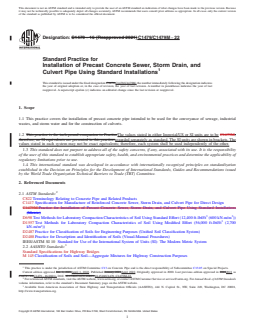
1.2 The values stated in either Imperial/US or SI units are to be regarded separately as standard. The SI units are shown in brackets. The values stated in each system may not be exact equivalents; therefore, each system shall be used independently of the other.
1.3 This standard does not purport to address all of the safety concerns, if any, associated with its use. It is the responsibility of the user of this standard to establish appropriate safety, health, and environmental practices and determine the applicability of regulatory limitations prior to use.
1.4 This international standard was developed in accordance with internationally recognized principles on standardization established in the Decision on Principles for the Development of International Standards, Guides and Recommendations issued by the World Trade Organization Technical Barriers to Trade (TBT) Committee.
- Status
- Published
- Publication Date
- 31-Mar-2022
- Technical Committee
- C13 - Concrete Pipe
- Drafting Committee
- C13.05 - Special Projects
Buy Documents
ASTM C1479/C1479M-22 - Standard Practice for Installation of Precast Concrete Sewer, Storm Drain, and Culvert Pipe Using Standard Installations
REDLINE ASTM C1479/C1479M-22 - Standard Practice for Installation of Precast Concrete Sewer, Storm Drain, and Culvert Pipe Using Standard Installations
Overview
ASTM C1479/C1479M-22 sets the accepted industry practice for the installation of precast concrete sewer, storm drain, and culvert pipe using standard installations. Developed and published by ASTM International, this standard provides guidance for owners, engineers, and contractors to ensure safe, reliable, and effective construction of underground pipe systems intended for the conveyance of sewage, industrial waste, storm water, and for culverts.
The standard addresses considerations for both Imperial/US and SI units, emphasizing the importance of using one system per project for consistency. While it focuses on best practices for installation, it also underlines the user's responsibility to address all safety, health, and environmental considerations relevant to the project.
Key Topics
- Standard Installation Methods: The document details four types of standard embankment and trench installations, ranked by required construction effort, material quality, and quality control. The most stringent (Type 1) offers maximum performance, and the least stringent (Type 4) requires minimal soil and compaction management.
- Pipe Bedding and Support: Specifications for bedding material type and thickness to ensure even load distribution and support for the pipe. It covers procedures for dealing with unsuitable or unstable foundations, including cushioning over rock.
- Soil Classification and Compaction: Guidance on appropriate soil types (based on Unified Soil Classification System and AASHTO criteria) and minimum compaction efforts for each installation type, which are critical for pipe stability and structural integrity.
- Pipe Placement and Joining: Recommendations for accurate placement to line and grade, with emphasis on the correct joining of pipe sections and compaction of bedding before and after pipe placement.
- Backfill and Overfill Procedures: Instructions on selecting, placing, and compacting backfill and overfill materials, including measures to prevent pipe displacement and damage from construction loads or equipment.
- Special Considerations: Advice on trench sheathing removal, trench shield advancement, foundation dewatering, the inclusion of precast appurtenances (like manholes and fittings), and managing minimum cover for construction vehicle loads.
Applications
ASTM C1479/C1479M-22 is widely used as a reference standard by:
- Municipalities and utility owners to specify requirements in construction documents for new and replacement sewer, storm drain, and culvert projects.
- Civil and structural engineers when designing underground precast concrete piping systems, ensuring compatibility with soil conditions, traffic loads, and long-term performance requirements.
- Contractors and construction teams tasked with the installation of precast concrete pipes, providing clear instructions for materials, methods, and inspection points.
- Quality control and inspection professionals to verify that pipe installation aligns with industry expectations for compaction, bedding, soil stability, and other critical parameters.
Using this standard minimizes installation defects, reduces the risk of pipe settlement or structural failure, and supports compliance with recognized international construction practices.
Related Standards
ASTM C1479/C1479M-22 references and builds upon several related industry standards, including:
- ASTM C822 – Terminology Relating to Concrete Pipe and Related Products
- ASTM C1417 – Specification for Manufacture of Reinforced Concrete Sewer, Storm Drain, and Culvert Pipe for Direct Design
- ASTM D698/D1557 – Test Methods for Laboratory Compaction Characteristics of Soil
- ASTM D2487/D2488 – Classification and Identification of Soils
- IEEE/ASTM SI 10 – Standard for Use of SI Units
- AASHTO M 145 – Classification of Soils and Soil-Aggregate Mixtures for Highway Construction Purposes
- ASCE 15 – Standard Practice for the Direct Design of Buried Precast Reinforced Concrete Pipe Using Standard Installations
Following ASTM C1479/C1479M-22 in conjunction with these related standards ensures a comprehensive approach to precast concrete pipe installation, from materials selection to onsite execution and long-term durability.
Relations
- Effective Date
- 15-Jul-2019
- Effective Date
- 01-Jan-2018
- Effective Date
- 15-Dec-2017
- Effective Date
- 15-Dec-2017
- Effective Date
- 15-Jul-2017
- Effective Date
- 01-Oct-2015
- Effective Date
- 01-Feb-2014
- Effective Date
- 01-Feb-2014
- Effective Date
- 01-Jul-2013
- Effective Date
- 01-Feb-2013
- Effective Date
- 01-Sep-2012
- Effective Date
- 01-May-2012
- Effective Date
- 01-May-2012
- Effective Date
- 01-May-2012
- Effective Date
- 01-Nov-2011
Buy Documents
ASTM C1479/C1479M-22 - Standard Practice for Installation of Precast Concrete Sewer, Storm Drain, and Culvert Pipe Using Standard Installations
REDLINE ASTM C1479/C1479M-22 - Standard Practice for Installation of Precast Concrete Sewer, Storm Drain, and Culvert Pipe Using Standard Installations
Get Certified
Connect with accredited certification bodies for this standard

Institut za varilstvo d.o.o. (Welding Institute)
Slovenia's leading welding institute since 1952. ISO 3834, EN 1090, pressure equipment certification, NDT personnel, welder qualification. Only IIW Au
Sponsored listings
Frequently Asked Questions
ASTM C1479/C1479M-22 is a standard published by ASTM International. Its full title is "Standard Practice for Installation of Precast Concrete Sewer, Storm Drain, and Culvert Pipe Using Standard Installations". This standard covers: SIGNIFICANCE AND USE 4.1 This practice is useful as a reference by an owner and the owner's engineer in preparing project specifications. SCOPE 1.1 This practice covers the installation of precast concrete pipe intended to be used for the conveyance of sewage, industrial wastes, and storm water and for the construction of culverts. 1.2 The values stated in either Imperial/US or SI units are to be regarded separately as standard. The SI units are shown in brackets. The values stated in each system may not be exact equivalents; therefore, each system shall be used independently of the other. 1.3 This standard does not purport to address all of the safety concerns, if any, associated with its use. It is the responsibility of the user of this standard to establish appropriate safety, health, and environmental practices and determine the applicability of regulatory limitations prior to use. 1.4 This international standard was developed in accordance with internationally recognized principles on standardization established in the Decision on Principles for the Development of International Standards, Guides and Recommendations issued by the World Trade Organization Technical Barriers to Trade (TBT) Committee.
SIGNIFICANCE AND USE 4.1 This practice is useful as a reference by an owner and the owner's engineer in preparing project specifications. SCOPE 1.1 This practice covers the installation of precast concrete pipe intended to be used for the conveyance of sewage, industrial wastes, and storm water and for the construction of culverts. 1.2 The values stated in either Imperial/US or SI units are to be regarded separately as standard. The SI units are shown in brackets. The values stated in each system may not be exact equivalents; therefore, each system shall be used independently of the other. 1.3 This standard does not purport to address all of the safety concerns, if any, associated with its use. It is the responsibility of the user of this standard to establish appropriate safety, health, and environmental practices and determine the applicability of regulatory limitations prior to use. 1.4 This international standard was developed in accordance with internationally recognized principles on standardization established in the Decision on Principles for the Development of International Standards, Guides and Recommendations issued by the World Trade Organization Technical Barriers to Trade (TBT) Committee.
ASTM C1479/C1479M-22 is classified under the following ICS (International Classification for Standards) categories: 23.040.50 - Pipes and fittings of other materials. The ICS classification helps identify the subject area and facilitates finding related standards.
ASTM C1479/C1479M-22 has the following relationships with other standards: It is inter standard links to ASTM C1417-19, ASTM C822-18, ASTM D2487-17, ASTM D2487-17e1, ASTM D2488-17, ASTM C1417-15, ASTM C1417-14e1, ASTM C1417-14, ASTM C1417-13, ASTM C822-13, ASTM C1417-12, ASTM D1557-12, ASTM D698-12e1, ASTM D698-12, ASTM C822-11. Understanding these relationships helps ensure you are using the most current and applicable version of the standard.
ASTM C1479/C1479M-22 is available in PDF format for immediate download after purchase. The document can be added to your cart and obtained through the secure checkout process. Digital delivery ensures instant access to the complete standard document.
Standards Content (Sample)
This international standard was developed in accordance with internationally recognized principles on standardization established in the Decision on Principles for the
Development of International Standards, Guides and Recommendations issued by the World Trade Organization Technical Barriers to Trade (TBT) Committee.
Designation: C1479/C1479M − 22
Standard Practice for
Installation of Precast Concrete Sewer, Storm Drain, and
Culvert Pipe Using Standard Installations
This standard is issued under the fixed designation C1479/C1479M; the number immediately following the designation indicates the
year of original adoption or, in the case of revision, the year of last revision. A number in parentheses indicates the year of last
reapproval. A superscript epsilon (´) indicates an editorial change since the last revision or reapproval.
1. Scope D1557 Test Methods for Laboratory Compaction Character-
istics of Soil Using Modified Effort (56,000 ft-lbf/ft
1.1 This practice covers the installation of precast concrete
(2,700 kN-m/m ))
pipe intended to be used for the conveyance of sewage,
D2487 Practice for Classification of Soils for Engineering
industrial wastes, and storm water and for the construction of
Purposes (Unified Soil Classification System)
culverts.
D2488 Practice for Description and Identification of Soils
1.2 The values stated in either Imperial/US or SI units are to
(Visual-Manual Procedures)
be regarded separately as standard. The SI units are shown in
IEEE/ASTM SI 10 Standard for Use of the International
brackets. The values stated in each system may not be exact
System of Units (SI): The Modern Metric System
equivalents;therefore,eachsystemshallbeusedindependently 3
2.2 AASHTO Standards:
of the other.
Standard Specifications for Highway Bridges
1.3 This standard does not purport to address all of the
M 145 Classification of Soils and Soil—Aggregate Mixtures
safety concerns, if any, associated with its use. It is the
for Highway Construction Purposes
responsibility of the user of this standard to establish appro-
T99 The Moisture-Density Relations of Soils Using a 5.5 lb
priate safety, health, and environmental practices and deter-
(2.5 kg) Rammer and a 12-in. (305 mm) Drop
mine the applicability of regulatory limitations prior to use.
T 180 TheMoisture-DensityRelationsofSoilsUsinga10lb
1.4 This international standard was developed in accor-
(4.54 kg) Rammer and an 18-in. (457 mm) Drop
dance with internationally recognized principles on standard-
T 310 In-Place Density and Moisture Content of Soil and
ization established in the Decision on Principles for the
Soil—Aggregate by Nuclear Methods (Shallow Depth)
Development of International Standards, Guides and Recom-
2.3 ASCE Standards:
mendations issued by the World Trade Organization Technical
ASCE 15 Standard Practice for the Direct Design of Buried
Barriers to Trade (TBT) Committee.
Precast Reinforced Concrete Pipe Using Standard Instal-
lations (SIDD)
2. Referenced Documents
3. Terminology
2.1 ASTM Standards:
3.1 For definitions of terms relating to concrete pipe, see
C822 Terminology Relating to Concrete Pipe and Related
Terminology C822.
Products
C1417 Specification for Manufacture of Reinforced Con-
3.2 For terminology related to soil classifications, see Prac-
crete Sewer, Storm Drain, and Culvert Pipe for Direct
tice D2487 and Practice D2488.
Design
3.3 For terminology and definitions of terms relating to
D698 Test Methods for Laboratory Compaction Character-
3 structural design, see ASCE 15.
istics of Soil Using Standard Effort (12,400 ft-lbf/ft (600
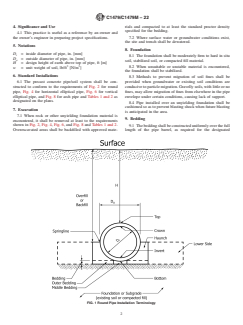
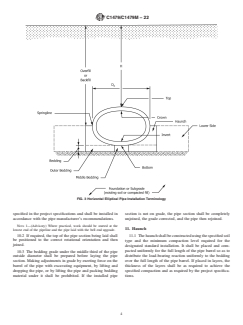
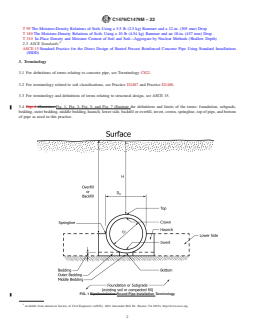
3.4 Fig. 1, Fig. 3, Fig. 5, and Fig. 7 illustrate the definitions
kN-m/m ))
and limits of the terms: foundation, subgrade, bedding, outer
bedding, middle bedding, haunch, lower side, backfill or
overfill, invert, crown, springline, top of pipe, and bottom of
This practice is under the jurisdiction of ASTM Committee C13 on Concrete
pipe as used in this practice.
Pipe and is the direct responsibility of Subcommittee C13.05 on Special Projects.
Current edition approved April 1, 2022. Published April 2022. Originally
approved in 2000. Last previous edition approved in 2021 as C1479 - 16(2021).
DOI: 10.1520/C1479_C1479M-22. Available from American Association of State Highway and Transportation
For referenced ASTM standards, visit the ASTM website, www.astm.org, or Officials (AASHTO), 444 N. Capitol St., NW, Suite 249, Washington, DC 20001,
contact ASTM Customer Service at service@astm.org. For Annual Book of ASTM http://www.transportation.org.
Standards volume information, refer to the standard’s Document Summary page on Available from American Society of Civil Engineers (ASCE), 1801 Alexander
the ASTM website. Bell Dr., Reston, VA 20191, http://www.asce.org.
Copyright © ASTM International, 100 Barr Harbor Drive, PO Box C700, West Conshohocken, PA 19428-2959. United States
C1479/C1479M − 22
4. Significance and Use rials and compacted to at least the standard proctor density
specified for the bedding.
4.1 This practice is useful as a reference by an owner and
7.2 Where surface water or groundwater conditions exist,
the owner’s engineer in preparing project specifications.
the site and trench shall be dewatered.
5. Notations
8. Foundation
D = inside diameter of pipe, in. [mm]
i
8.1 The foundation shall be moderately firm to hard in situ
D = outside diameter of pipe, in. [mm]
o
soil, stabilized soil, or compacted fill material.
H = design height of earth above top of pipe, ft [m]
3 3
8.2 When unsuitable or unstable material is encountered,
w = unit weight of soil, lb/ft [N/m ]
the foundation shall be stabilized.
6. Standard Installations
8.3 Methods to prevent migration of soil fines shall be
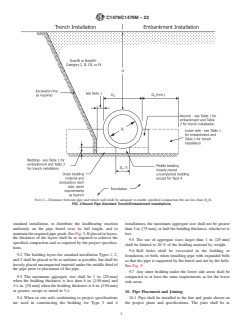
6.1 The precast concrete pipe/soil system shall be con- provided when groundwater or existing soil conditions are
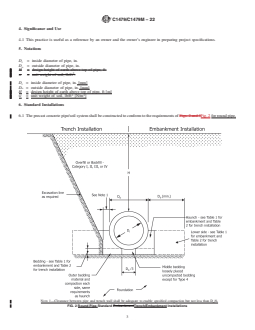
structed to conform to the requirements of Fig. 2 for round conducive to particle migration. Gravelly soils, with little or no
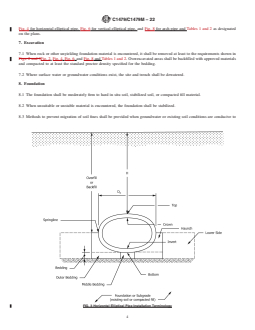
pipe, Fig. 4 for horizontal elliptical pipe, Fig. 6 for vertical fines, may allow migration of fines from elsewhere in the pipe
elliptical pipe, and Fig. 8 for arch pipe and Tables 1 and 2 as envelope under certain conditions, causing lack of support.
designated on the plans.
8.4 Pipe installed over an unyielding foundation shall be
cushioned so as to prevent blasting shock when future blasting
7. Excavation
is anticipated in the area.
7.1 When rock or other unyielding foundation material is
9. Bedding
encountered, it shall be removed at least to the requirements
shown in Fig. 2, Fig. 4, Fig. 6, and Fig. 8 and Tables 1 and 2. 9.1 Thebeddingshallbeconstructeduniformlyoverthefull
Overexcavated areas shall be backfilled with approved mate- length of the pipe barrel, as required for the designated
FIG. 1 Round Pipe Installation Terminology
C1479/C1479M − 22
NOTE 1—Clearance between pipe and trench wall shall be adequate to enable specified compaction but not less than D /6.
o
FIG. 2 Round Pipe Standard Trench/Embankment Installations
standard installation, to distribute the loadbearing reaction installations, the maximum aggregate size shall not be greater
uniformly on the pipe barrel over its full length, and to than 3 in. [75 mm], or half the bedding thickness, whichever is
maintaintherequiredpipegrade.SeeFig.9.Ifplacedinlayers, less.
the thickness of the layers shall be as required to achieve the
9.5 The use of aggregate sizes larger than 1 in. [25 mm]
specified compaction and as required by the project specifica-
shall be limited to 20 % of the bedding material by weight.
tions.
9.6 Bell holes shall be excavated in the bedding or
9.2 The bedding layers for standard installation Types 1, 2,
foundation, or both, when installing pipe with expanded bells
and 3 shall be placed to be as uniform as possible, but shall be
so that the pipe is supported by the barrel and not by the bells.
loosely placed uncompacted material under the middle third of
See Fig. 9.
the pipe prior to placement of the pipe.
9.7 Any outer bedding under the lower side areas shall be
9.3 The maximum aggregate size shall be 1 in. [25 mm]
compacted to at least the same requirements as for the lower
when the bedding thickness is less than 6 in. [150 mm] and
side areas.
1 ⁄2-in. [38 mm] when the bedding thickness is 6 in. [150 mm]
or greater, except as noted in 9.4.
10. Pipe Placement and Joining
9.4 When in situ soils conforming to project specifications 10.1 Pipe shall be installed to the line and grade shown on
are used in constructing the bedding for Type 3 and 4 the project plans and specifications. The joint shall be as
C1479/C1479M − 22
FIG. 3 Horizontal Elliptical Pipe Installation Terminology
specified in the project specifications and shall be installed in section is not on grade, the pipe section shall be completely
accordance with the pipe manufacturer’s recommendations.
unjoined, the grade corrected, and the pipe then rejoined.
NOTE 1—(Advisory) Where practical, work should be started at the
11. Haunch
lowest end of the pipeline and the pipe laid with the bell end upgrade.
10.2 If required, the top of the pipe section being laid shall
11.1 Thehaunchshallbeconstructedusingthespecifiedsoil
be positioned to the correct rotational orientation and then
type and the minimum compaction level required for the
joined.
designated standard installation. It shall be placed and com-
pacted uniformly for the full length of the pipe barrel so as to
10.3 The bedding grade under the middle third of the pipe
distribute the load-bearing reaction uniformly to the bedding
outside diameter shall be prepared before laying the pipe
over the full length of the pipe barrel. If placed in layers, the
section. Making adjustments in grade by exerting force on the
thickness of the layers shall be as required to achieve the
barrel of the pipe with excavating equipment, by lifting and
dropping the pipe, or by lifting the pipe and packing bedding specified compaction and as required by the project specifica-
material under it shall be prohibited. If the installed pipe
tions.
C1479/C1479M − 22
NOTE 1—Clearance between pipe and trench wall shall be adequate to enable specified compaction but not less than D /6.
o
FIG. 4 Horizontal Elliptical Pipe Standard Trench/Embankment Installations
11.2 The maximum aggregate size for the haunch shall be 12.2 The soil, if not in situ, shall be material conforming to
the same as the maximum aggregate size in the bedding as the project specifications, and contain no debris, organic
defined in 9.3, except as noted in 11.3. matter, frozen material, or large stones with a diameter greater
than one half the thickness of the compacted layers being
11.3 When in situ soils conforming to project specifications
placed.
are used in constructing the pipe haunches for Type 3 and 4
installations, the maximum aggregate size shall not be greater 12.3 Placed soil shall be deposited and compacted to the
than 3 in. [75 mm]. specified density uniformly on each side of the pipe to prevent
lateral displacement of the pipe.
11.4 The use of aggregate sizes larger than 1 in. [25 mm]
shall be limited to 20 % of the haunch material by weight.
13. Overfill
11.5 Placed soil shall be deposited and compacted to the
13.1 Overfill shall be constructed as specified in the project
specified density uniformly on each side of the pipe to prevent
specifications. If placed in layers, the thickness of the layers
lateral displacement of the pipe.
shall be as required to achieve the specified compaction and as
required by the project specifications.
12. Lower Side
13.2 The soil shall be material conforming to the project
12.1 Thelowerside,ifnotinsitu,shallbeconstructedusing
specifications, and contain no debris, organic matter, frozen
the specified soil type and the minimum compaction level
material, or large stones with a diameter greater than one half
required for the designated standard installation. If placed in
the thickness of the compacted layers being placed.
layers, the thickness of the layers shall be as required to
achievethespecifiedcompactionandasrequiredbytheproject 13.3 Placed soil shall be deposited and compacted to the
specifications. specified density uniformly on each side of the pipe to prevent
C1479/C1479M − 22
FIG. 5 Vertical Elliptical Pipe Installation Terminology
lateral displacement of the pipe. The overfill placed within one deadman anchors or other means. Voids that are created by
outside diameter of the pipe that is above the springline and movement of a shield or box shall be filled and compacted.
below the top of the pipe shall be compacted to at least the
15. Precast Concrete Appurtenances
same density as the majority of the overfill above the pipe.
15.1 Manholes shall be installed in a manner that will
13.4 When impact or vibratory equipment is used for
minimize differential settlement between the pipe and man-
compaction, care shall be taken to avoid damaging the pipe,
hole.
particularly for installations with less than 2 ft [0.6 m] of
earthfill over the pipe. Contractor shall demonstrate to the
15.2 Precast concrete fittings, such as tees and wyes, shall
satisfaction of the engineer that the installation process will not be bedded, installed, and overfilled with the same material and
result in damage to the pipe.
in the same manner as the remainder of the pipeline to reduce
the possibility of differential settlement between pipe and
NOTE 2—Compaction stresses generated by vibratory compaction
fittings.
equipment vary with the type of equipment used and tend to decrease as
the pipe diameter increases. For most installations, 2 ft [0.6 m] of earth fill
16. Minimum Cover for Construction Loads
over the top of the pipe is sufficient to adequately distribute compaction
forces to the surrounding soil mass.
16.1 If the passage of construction equipment over an
installed pipeline is necessary during project construction,
14. Sheathing Removal and Trench Shield Advancement
compacted overfill in the form of a ramp shall be constructed
14.1 Unless sheathing is to be left in place, it shall be pulled
to a minimum elevation of 3 ft [0.9 m] over the top of the pipe
out in vertical increments to permit placement and compaction
or to a height such that the equipment loads on the pipe do not
of fill material for the full width of the trench.
exceed the pipe design strength. To prevent possible lateral
14.2 When trench shields or boxes are moved, the previ- displacement of the pipe when the existing ground is higher or
ously placed pipe shall not be disturbed. The owner is advised lower than the top of this ramp, the overfill shall extend a
that it may be necessary to restrain the installed pipe by use of minimumofonepipediameterwidthor3ft[0.9 m],whichever
C1479/C1479M − 22
NOTE 1—Clearance between pipe and trench wall shall be adequate to enable specified compaction but not less than D /6.
o
FIG. 6 Vertical Elliptical Pipe Standard Trench/Embankment Installations
is greater, beyond each side of the pipe and then have a gradual 17.2 Open ends of installed pipe shall be covered during
slope to ground level, not exceeding 1 vertical to 6 horizontal.
overnight or longer periods of suspended work to prevent
If a large volume of construction traffic must cross an installed
access by animals, personnel, and accumulation of soil and
pipe, the point of crossing shall be changed occasionally to
debris. Covers shall be braced or fastened to prevent move-
minimize the possibility of lateral displacement.
ment. It is not required that these covers be watertight.
17. Safety
NOTE 3—(Advisory) If the pipe is plugged watertight when empty, the
possibility of pipe flotation should be investigated, and, if necessary,
17.1 Safety requirements for construction shall be in accor-
appropriate measures shall be taken to prevent flotation.
dance with the applicable federal, state, and local regulations.
C1479/C1479M − 22
FIG. 7 Arch Pipe Installation Terminology
C1479/C1479M − 22
NOTE 1—Clearance between pipe and trench wall shall be adequate to enable specified compaction but not less than D /6.
o
FIG. 8 Arch Pipe Standard Trench/Embankment Installations
C1479/C1479M − 22
TABLE 1 Standard Embankment Installation Soils and Minimum Compaction Requirements
NOTE 1—Compaction and soil symbols (that is, 95 % Category I) refer to a soil material category with a minimum standard proctor density. See Table
3 for equivalent modified proctor values and soil types.
NOTE 2—Type 1 installations require greater soil stiffness from the surrounding soils than the Type 2, 3, and 4 installations. Proper field verification
of soil properties and compaction levels must be performed to ensure compliance with the design requirements. See Appendix X2 for more information
and guidance.
NOTE 3—For Type 1 installation, crushed rock is not an appropriate material for bedding under the pipe.An uncompacted, non-crushed material must
beusedunderthemiddlethirdofthepipeoutsidediameter.Whilecrushedrockmeetingtherequirementsofthisspecificationmayselfcompactvertically,
it will not flow laterally to provide support for the haunches of the pipe. To achieve a 90 to 95 % compaction with crushed rock, work material under
the haunch and compact it to achieve the specified density. Otherwise, the specified installation is not achieved.
NOTE 4—Soil in the outer bedding, haunch, and lower side zones, except under the middle ⁄3 of the pipe, shall be compacted to at least the same
compaction as the majority of soil in the overfill zone.
NOTE 5—Required bedding thickness is the thickness of the bedding prior to placement of the pipe.
NOTE 6—Asubtrench is defined as a trench with its top below finished grade by more than 0.1 H or, for roadways, its top is at an elevation lower than
1 ft [0.3 m] below the bottom of the pavement base material.
The minimum width o
...
This document is not an ASTM standard and is intended only to provide the user of an ASTM standard an indication of what changes have been made to the previous version. Because
it may not be technically possible to adequately depict all changes accurately, ASTM recommends that users consult prior editions as appropriate. In all cases only the current version
of the standard as published by ASTM is to be considered the official document.
Designation: C1479 − 16 (Reapproved 2021) C1479/C1479M − 22
Standard Practice for
Installation of Precast Concrete Sewer, Storm Drain, and
Culvert Pipe Using Standard Installations
This standard is issued under the fixed designation C1479;C1479/C1479M; the number immediately following the designation indicates
the year of original adoption or, in the case of revision, the year of last revision. A number in parentheses indicates the year of last
reapproval. A superscript epsilon (´) indicates an editorial change since the last revision or reapproval.
1. Scope
1.1 This practice covers the installation of precast concrete pipe intended to be used for the conveyance of sewage, industrial
wastes, and storm water and for the construction of culverts.
1.2 This practice is the inch-pound companion to PracticeThe values stated in either Imperial/US or SI units are to be C1479M;
therefore, no SI equivalents are presented in this practice.regarded separately as standard. The SI units are shown in brackets. The
values stated in each system may not be exact equivalents; therefore, each system shall be used independently of the other.
1.3 This standard does not purport to address all of the safety concerns, if any, associated with its use. It is the responsibility
of the user of this standard to establish appropriate safety, health, and environmental practices and determine the applicability of
regulatory limitations prior to use.
1.4 This international standard was developed in accordance with internationally recognized principles on standardization
established in the Decision on Principles for the Development of International Standards, Guides and Recommendations issued
by the World Trade Organization Technical Barriers to Trade (TBT) Committee.
2. Referenced Documents
2.1 ASTM Standards:
C822 Terminology Relating to Concrete Pipe and Related Products
C1417 Specification for Manufacture of Reinforced Concrete Sewer, Storm Drain, and Culvert Pipe for Direct Design
C1479M Practice for Installation of Precast Concrete Sewer, Storm Drain, and Culvert Pipe Using Standard Installations
(Metric)
3 3
D698 Test Methods for Laboratory Compaction Characteristics of Soil Using Standard Effort (12,400 ft-lbf/ft (600 kN-m/m ))
D1557 Test Methods for Laboratory Compaction Characteristics of Soil Using Modified Effort (56,000 ft-lbf/ft (2,700
kN-m/m ))
D2487 Practice for Classification of Soils for Engineering Purposes (Unified Soil Classification System)
D2488 Practice for Description and Identification of Soils (Visual-Manual Procedures)
IEEE/ASTM SI 10 Standard for Use of the International System of Units (SI): The Modern Metric System
2.2 AASHTO Standards:
Standard Specifications for Highway Bridges
M 145 Classification of Soils and Soil—Aggregate Mixtures for Highway Construction Purposes
This practice is under the jurisdiction of ASTM Committee C13 on Concrete Pipe and is the direct responsibility of Subcommittee C13.05 on Special Projects.
Current edition approved Jan. 1, 2021April 1, 2022. Published January 2021April 2022. Originally approved in 2000. Last previous edition approved in 20162021 as
C1479 - 16.C1479 - 16(2021). DOI: 10.1520/C1479-16R21.10.1520/C1479_C1479M-22.
For referenced ASTM standards, visit the ASTM website, www.astm.org, or contact ASTM Customer Service at service@astm.org. For Annual Book of ASTM Standards
volume information, refer to the standard’s Document Summary page on the ASTM website.
Available from American Association of State Highway and Transportation Officials (AASHTO), 444 N. Capitol St., NW, Suite 249, Washington, DC 20001,
http://www.transportation.org.
Copyright © ASTM International, 100 Barr Harbor Drive, PO Box C700, West Conshohocken, PA 19428-2959. United States
C1479/C1479M − 22
T 99 The Moisture-Density Relations of Soils Using a 5.5 lb (2.5 kg) Rammer and a 12-in. (305 mm) Drop
T 180 The Moisture-Density Relations of Soils Using a 10 lb (4.54 kg) Rammer and an 18-in. (457 mm) Drop
T 310 In-Place Density and Moisture Content of Soil and Soil—Aggregate by Nuclear Methods (Shallow Depth)
2.3 ASCE Standards:
ASCE 15 Standard Practice for the Direct Design of Buried Precast Reinforced Concrete Pipe Using Standard Installations
(SIDD)
3. Terminology
3.1 For definitions of terms relating to concrete pipe, see Terminology C822.
3.2 For terminology related to soil classifications, see Practice D2487 and Practice D2488.
3.3 For terminology and definitions of terms relating to structural design, see ASCE 15.
3.4 Fig. 1 illustrates Fig. 1, Fig. 3, Fig. 5, and Fig. 7 illustrate the definitions and limits of the terms: foundation, subgrade,
bedding, outer bedding, middle bedding, haunch, lower side, backfill or overfill, invert, crown, springline, top of pipe, and bottom
of pipe as used in this practice.
FIG. 1 Pipe/Installation Round Pipe Installation Terminology
Available from American Society of Civil Engineers (ASCE), 1801 Alexander Bell Dr., Reston, VA 20191, http://www.asce.org.
C1479/C1479M − 22
4. Significance and Use
4.1 This practice is useful as a reference by an owner and the owner’s engineer in preparing project specifications.
5. Notations
D = inside diameter of pipe, in.
i
D = outside diameter of pipe, in.
o
H = design height of earth above top of pipe, ft.
w = unit weight of soil, lb/ft .
D = inside diameter of pipe, in. [mm]
i
D = outside diameter of pipe, in. [mm]
o
H = design height of earth above top of pipe, ft [m]
3 3
w = unit weight of soil, lb/ft [N/m ]
6. Standard Installations
6.1 The precast concrete pipe/soil system shall be constructed to conform to the requirements of Figs. 2 and 3Fig. 2 for round pipe,
NOTE 1—Clearance between pipe and trench wall shall be adequate to enable specified compaction but not less than D /6.
o
FIG. 2 Round Pipe Standard EmbankmentTrench/Embankment Installations
C1479/C1479M − 22
Fig. 4 for horizontal elliptical pipe, Fig. 6 for vertical elliptical pipe, and Fig. 8 for arch pipe and Tables 1 and 2 as designated
on the plans.
7. Excavation
7.1 When rock or other unyielding foundation material is encountered, it shall be removed at least to the requirements shown in
Figs. 2 and 3Fig. 2, Fig. 4, Fig. 6, and Fig. 8 and Tables 1 and 2. Overexcavated areas shall be backfilled with approved materials
and compacted to at least the standard proctor density specified for the bedding.
7.2 Where surface water or groundwater conditions exist, the site and trench shall be dewatered.
8. Foundation
8.1 The foundation shall be moderately firm to hard in situ soil, stabilized soil, or compacted fill material.
8.2 When unsuitable or unstable material is encountered, the foundation shall be stabilized.
8.3 Methods to prevent migration of soil fines shall be provided when groundwater or existing soil conditions are conducive to
FIG. 3 Horizontal Elliptical Pipe Installation Terminology
C1479/C1479M − 22
NOTE 1—Clearance between pipe and trench wall shall be adequate to enable specified compaction but not less than D /6.
o
FIG. 34 Standard TrenchHorizontal Elliptical Pipe Standard Trench/Embankment Installations
particle migration. Gravelly soils, with little or no fines, could migrate may allow migration of fines from elsewhere in the pipe
envelope under certain conditions, causing lack of support.
8.4 Pipe installed over an unyielding foundation shall be cushioned so as to prevent blasting shock when future blasting is
anticipated in the area.
9. Bedding
9.1 The bedding shall be constructed uniformly over the full length of the pipe barrel, as required for the designated standard
installation, to distribute the loadbearing reaction uniformly on the pipe barrel over its full length, and to maintain the required pipe
grade. See Fig. 49. If placed in layers, the thickness of the layers shall be as required to achieve the specified compaction and as
required by the project specifications.
9.2 The bedding layers for standard installation Types 1, 2, and 3 shall be placed to be as uniform as possible, but shall be loosely
placed uncompacted material under the middle third of the pipe prior to placement of the pipe.
9.3 The maximum aggregate size shall be 1 in. [25 mm] when the bedding thickness is less than 6 in. [150 mm] and 1 ⁄2-in.
[38 mm] when the bedding thickness is 6 in. [150 mm] or greater, except as noted in 9.4.
C1479/C1479M − 22
FIG. 5 Vertical Elliptical Pipe Installation Terminology
9.4 When in situ soils conforming to project specifications are used in constructing the outer bedding for Type 3 and 4 installations,
the maximum aggregate size shall not be greater than 3 in., in. [75 mm], or half the bedding thickness, whichever is less.
9.5 The use of aggregate sizes larger than 1 in. [25 mm] shall be limited to 20 % of the bedding material by weight.
9.6 Bell holes shall be excavated in the bedding or foundation, or both, when installing pipe with expanded bells so that the pipe
is supported by the barrel and not by the bells. See Fig. 49.
9.7 Any outer bedding under the lower side areas shall be compacted to at least the same requirements as for the lower side areas.
10. Pipe Placement and Joining
10.1 Pipe shall be installed to the line and grade shown on the project plans and specifications. The joint shall be as specified in
the project specifications and shall be installed in accordance with the pipe manufacturer’s recommendations.
NOTE 1—(Advisory) Where practical, work should be started at the lowest end of the pipeline and the pipe laid with the bell end upgrade.
10.2 If required, the top of the pipe section being laid shall be positioned to the correct rotational orientation and then joined.
10.3 The bedding grade under the middle third of the pipe outside diameter shall be prepared before laying the pipe section.
C1479/C1479M − 22
NOTE 1—Clearance between pipe and trench wall shall be adequate to enable specified compaction but not less than D /6.
o
FIG. 6 Vertical Elliptical Pipe Standard Trench/Embankment Installations
Making adjustments in grade by exerting force on the barrel of the pipe with excavating equipment, by lifting and dropping the
pipe, or by lifting the pipe and packing bedding material under it shall be prohibited. If the installed pipe section is not on grade,
the pipe section shall be completely unjoined, the grade corrected, and the pipe then rejoined.
11. Haunch
11.1 The haunch shall be constructed using the specified soil type and the minimum compaction level required for the designated
standard installation. It shall be placed and compacted uniformly for the full length of the pipe barrel so as to distribute the
load-bearing reaction uniformly to the bedding over the full length of the pipe barrel. If placed in layers, the thickness of the layers
shall be as required to achieve the specified compaction and as required by the project specifications.
11.2 The maximum aggregate size for the haunch shall be the same as the maximum aggregate size in the bedding as defined in
9.3, except as noted in 11.3.
11.3 When in situ soils conforming to project specifications are used in constructing the pipe haunches for Type 3 and 4
installations, the maximum aggregate size shall not be greater than 3 in. [75 mm].
11.4 The use of aggregate sizes larger than 1 in. [25 mm] shall be limited to 20 % of the haunch material by weight.
C1479/C1479M − 22
FIG. 47 UniformArch Pipe SupportInstallation Terminology
11.5 Placed soil shall be deposited and compacted to the specified density uniformly on each side of the pipe to prevent lateral
displacement of the pipe.
12. Lower Side
12.1 The lower side, if not in situ, shall be constructed using the specified soil type and the minimum compaction level required
for the designated standard installation. If placed in layers, the thickness of the layers shall be as required to achieve the specified
compaction and as required by the project specifications.
12.2 The soil, if not in situ, shall be material conforming to the project specifications, and contain no debris, organic matter, frozen
material, or large stones with a diameter greater than one half the thickness of the compacted layers being placed.
12.3 Placed soil shall be deposited and compacted to the specified density uniformly on each side of the pipe to prevent lateral
displacement of the pipe.
13. Overfill
13.1 Overfill shall be constructed as specified in the project specifications. If placed in layers, the thickness of the layers shall be
as required to achieve the specified compaction and as required by the project specifications.
C1479/C1479M − 22
NOTE 1—Clearance between pipe and trench wall shall be adequate to enable specified compaction but not less than D /6.
o
FIG. 8 Arch Pipe Standard Trench/Embankment Installations
13.2 The soil shall be material conforming to the project specifications, and contain no debris, organic matter, frozen material, or
large stones with a diameter greater than one half the thickness of the compacted layers being placed.
13.3 Placed soil shall be deposited and compacted to the specified density uniformly on each side of the pipe to prevent lateral
displacement of the pipe. The overfill placed within one outside diameter of the pipe that is above the springline and below the
top of the pipe shall be compacted to at least the same density as the majority of the overfill above the pipe.
13.4 When impact or vibratory equipment is used for compaction, care shall be taken to avoid damaging the pipe, particularly for
installations with less than 2 ft [0.6 m] of earthfill over the pipe. Contractor shall demonstrate to the satisfaction of the engineer
that the installation process will not result in damage to the pipe.
NOTE 2—Compaction stresses generated by vibratory compaction equipment vary with the type of equipment used and tend to decrease as the pipe
diameter increases. For most installations, two feet2 ft [0.6 m] of earth fill over the top of the pipe is sufficient to adequately distribute compaction forces
to the surrounding soil mass.
14. Sheathing Removal and Trench Shield Advancement
14.1 Unless sheathing is to be left in place, it shall be pulled out in vertical increments to permit placement and compaction of
fill material for the full width of the trench.
C1479/C1479M − 22
TABLE 1 Standard Embankment Installation Soils and Minimum Compaction Requirements
NOTE 1—Compaction and soil symbols (that is, 95 % Category I) refer to a soil material category with a minimum standard proctor density. See Table
3 for equivalent modified proctor values and soil types.
NOTE 2—Type 1 installations require greater soil stiffness from the surrounding soils than the Type 2, 3, and 4 installations. Proper field verification
of soil properties and compaction levels must be performed to ensure compliance with the design requirements. See Appendix X2 for more information
and guidance.
NOTE 3—For Type 1 installation, crushed rock is not an appropriate material for bedding under the pipe. An uncompacted, non-crushed material must
be used under the middle third of the pipe outside diameter. While crushed rock meeting the requirements of this specification may self compact vertically,
it will not flow laterally to provide support for the haunches of the pipe. To achieve a 90 to 95 % compaction with crushed rock, work material under
the haunch and compact it to achieve the specified density. Otherwise, the specified installation is not achieved.
NOTE 4—Soil in the outer bedding, haunch, and lower side zones, except within Dunder /3 from the pipe springline,the middle ⁄3 of the pipe, shall
o
be compacted to at least the same compaction as the majority of soil in the overfill zone.
NOTE 5—Required bedding thickness is the thickness of the bedding prior to placement of the pipe.
NOTE 6—A subtrench is defined as a trench with its top below finished grade by more than 0.1 H or, for roadways, its top is at an elevation lower than
1 ft [0.3 m] below the bottom of the pavement base material.
The minimum width of a subtrench shall be 1.33 D , or wider, if required for adequate space to attain the specified compaction in the haunch and
o
bedding zones.
For subtrenches, except within Dunder /3 from the springline,middle ⁄3 of the pipe, any portion of the lower side zone in the subtrench wall shall
o
be at least as firm as an equivalent soil placed to the compaction requirements specified for the lower side zone and as firm as the majority of soil in the
overfill zone, or it shall be removed and replaced with soil compacted to the specified level.
NOTE 7—“Dumped” material without additional compactive effort will not provide the design haunch support required for Type 1 and 2 installations.
For Type 3 installations, “Dumped” material without additional compactive effort should be checked for design haunch support.
NOTE 8—For horizontal elliptical, vertical elliptical, and arch pipes only Type 2 and Type 3 installations are available.
Installation Bedding Haunch and Lower
Type Thickness Outer Bedding Side
Type 1 D /24 minimum; not less than 3 in. [75 mm]. If 95 % Category I 90 % Category I,
o
rock foundation, use D /12 minimum; not less 95 % Category II
o
than 6 in. [150 mm].
Type 2 D /24 minimum; not less than 3 in. [75 mm]. If 90 % Category I or 85 % Category I,
o
rock foundation, use D /12 minimum; not less 95 % Category II 90 % Category II,
o
than 6 in. [150 mm]. or 95 % Category III
Type 3 D /24 minimum; not less than 3 in. [75 mm]. If 85 % Category I, 85 % Category I,
o
rock foundation, use D /12 minimum; not less 90 % Category II, or 90 % Category II, or
o
than 6 in. [150 mm]. 95 % Category III 95 % Category III
Type 4 No bedding required, except if rock foundation, No compaction required, No compaction required,
use D /12 minimum; not less than 6 in. except if Category III, except if Category III,
o
[150 mm]. use 85 % Category III use 85 % Category III
14.2 When trench shields or boxes are moved, the previously placed pipe shall not be disturbed. The own
...