

ASTM C1840/C1840M-24
(Practice)Standard Practice for Inspection and Acceptance of Installed Reinforced Concrete Culvert, Storm Drain, and Storm Sewer Pipe
General Information
- Abstract
SIGNIFICANCE AND USE
4.1 The inspection of installed reinforced concrete pipe verifies proper installation of the product and establishes thresholds for comparison further evaluation.
4.2 This practice is useful as a reference by an owner in preparing project specifications and to identify, evaluate and interpret observations during post installation inspections of pipe.
SCOPE
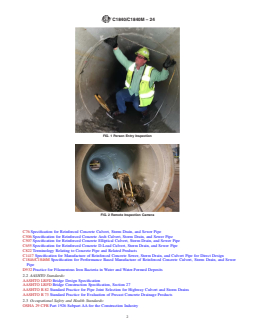
1.1 This practice covers the requirements for inspection and acceptance of installed reinforced concrete pipe by either person-entry, or remote inspection as shown in Figs. 1 and 2, respectively.
FIG. 1 Person Entry Inspection
FIG. 2 Remote Inspection Camera
1.2 The scope of this specification is intended for installation related observations and assumes that pre-installation inspection has been completed.
1.3 The reinforced concrete culvert, storm drain and storm sewer pipe shall be manufactured in accordance with Specification C76, C506, C507, C655, C1417, or C1846/C1846M and accepted in accordance with AASHTO R 73. This specification shall only be used for gravity, non-pressure storm drainage applications.
1.4 Person Entry shall be used unless extenuating circumstances preclude this type inspection. Remote inspection is acceptable for use for pipe diameters of 30 in. [750 mm] and smaller unless otherwise specified by owner or engineer.
1.5 Access of installed pipe for manual inspection shall follow OSHA 29 CFR PART 1926 SUBPART AA regulations for confined space entry. However, this standard does not purport to address all of the safety concerns, if any, associated with its use. It is the responsibility of the user of this standard to establish appropriate safety, health, and environmental practices and determine the applicability of regulatory limitations prior to use.
1.6 This practice does not cover deformation or deflection assessment. Concrete pipe is classified as a rigid structure because they do not bend or deflect appreciably under load before cracking. Due to these facts shape evaluation are of little or no value when evaluating concrete pipe.
1.7 The values stated in either Imperial/US or [SI units] are to be regarded separately as standard. The SI units are shown in brackets. The values stated in each system may not be exact equivalents; therefore, each system shall be used independently of the other.
1.8 This international standard was developed in accordance with internationally recognized principles on standardization established in the Decision on Principles for the Development of International Standards, Guides and Recommendations issued by the World Trade Organization Technical Barriers to Trade (TBT) Committee.
- Status
- Published
- Publication Date
- 31-Dec-2023
- Technical Committee
- C13 - Concrete Pipe
- Drafting Committee
- C13.05 - Special Projects
Buy Documents
ASTM C1840/C1840M-24 - Standard Practice for Inspection and Acceptance of Installed Reinforced Concrete Culvert, Storm Drain, and Storm Sewer Pipe
REDLINE ASTM C1840/C1840M-24 - Standard Practice for Inspection and Acceptance of Installed Reinforced Concrete Culvert, Storm Drain, and Storm Sewer Pipe
Overview
ASTM C1840/C1840M-24: Standard Practice for Inspection and Acceptance of Installed Reinforced Concrete Culvert, Storm Drain, and Storm Sewer Pipe provides comprehensive guidance and criteria for the inspection and acceptance of newly installed reinforced concrete pipe (RCP) in gravity, non-pressure storm drainage systems. Developed by ASTM International, this standard is crucial for verifying proper installation, establishing evaluation thresholds, and ensuring long-term system performance and safety.
The standard details requirements for both person-entry and remote inspection techniques, referencing figures for each method. It is intended for use after installation is complete and assumes that pre-installation assessments have already been carried out. This practice is regularly used by owners, engineers, and contractors to establish inspection protocols, interpret post-installation observations, and support project specifications.
Key Topics
- Inspection Methods: Covers person-entry and remote camera inspection for evaluating RCP. Person-entry is the default unless conditions prevent it; remote inspection is suitable for pipes 30 in. [750 mm] or smaller.
- Acceptance Criteria: Defines specific criteria for evaluating cracks, joint offsets, separations, and infiltration, distinguishing between cases that require routine documentation, further engineering evaluation, or remediation.
- Inspection Procedures:
- Person-entry inspections follow OSHA confined space regulations and require appropriate documentation and safety practices.
- Remote inspections use calibrated video systems capable of detecting and measuring minor defects, with strict requirements on image clarity and measurement accuracy.
- Documentation & Reporting: Mandates thorough record-keeping, including video, still images, and detailed reports with precise measurements of cracks, joint separations, and any notable pipeline condition.
- Evaluation and Remediation Guidance: Provides detailed thresholds for structural anomalies such as cracks, scaling, spalling, infiltration, staining, and joint integrity, with clear guidance on when repair or engineering assessment is necessary.
Applications
ASTM C1840/C1840M-24 is widely used for:
- Municipal and Infrastructure Projects: Ensuring that installed reinforced concrete stormwater and sewer systems meet installation quality and performance standards.
- Engineering and Construction Specifications: Supporting owners, consultants, and contractors in developing and enforcing post-installation inspection protocols for new pipe installations.
- Regulatory Compliance: Providing procedures that align with safety standards (OSHA 29 CFR 1926 Subpart AA) and other accepted practices for confined space inspection.
- Maintenance Planning: Enabling informed decision-making on the need for repairs, structural assessment, or monitoring based on observed defect severity.
This standard is especially valuable for its practical approach to differentiating acceptable post-installation conditions from those necessitating further action or remediation and provides a systematic foundation for long-term maintenance programs.
Related Standards
ASTM C1840/C1840M-24 references and complements several key standards, including:
- ASTM C76: Specification for Reinforced Concrete Culvert, Storm Drain, and Sewer Pipe
- ASTM C506, C507, C655, C1417, C1846/C1846M: Related specifications for various RCP forms and manufacturing methods
- AASHTO R 73: Standard Practice for Evaluation of Precast Concrete Drainage Products
- OSHA 29 CFR Part 1926 Subpart AA: Confined Space Entry Safety Standards
- ISO/IEC 17025: Requirements for testing and calibration laboratory competence
Keywords: reinforced concrete pipe, RCP, storm drain, culvert, storm sewer, inspection, acceptance, ASTM C1840, remote inspection, person-entry inspection, post-installation evaluation, concrete pipe defect assessment, stormwater drainage standards, municipal infrastructure.
Relations
- Effective Date
- 01-Jan-2024
- Effective Date
- 01-Apr-2024
- Effective Date
- 01-Jul-2019
Buy Documents
ASTM C1840/C1840M-24 - Standard Practice for Inspection and Acceptance of Installed Reinforced Concrete Culvert, Storm Drain, and Storm Sewer Pipe
REDLINE ASTM C1840/C1840M-24 - Standard Practice for Inspection and Acceptance of Installed Reinforced Concrete Culvert, Storm Drain, and Storm Sewer Pipe
Get Certified
Connect with accredited certification bodies for this standard

Institut za varilstvo d.o.o. (Welding Institute)
Slovenia's leading welding institute since 1952. ISO 3834, EN 1090, pressure equipment certification, NDT personnel, welder qualification. Only IIW Au
Sponsored listings
Frequently Asked Questions
ASTM C1840/C1840M-24 is a standard published by ASTM International. Its full title is "Standard Practice for Inspection and Acceptance of Installed Reinforced Concrete Culvert, Storm Drain, and Storm Sewer Pipe". This standard covers: SIGNIFICANCE AND USE 4.1 The inspection of installed reinforced concrete pipe verifies proper installation of the product and establishes thresholds for comparison further evaluation. 4.2 This practice is useful as a reference by an owner in preparing project specifications and to identify, evaluate and interpret observations during post installation inspections of pipe. SCOPE 1.1 This practice covers the requirements for inspection and acceptance of installed reinforced concrete pipe by either person-entry, or remote inspection as shown in Figs. 1 and 2, respectively. FIG. 1 Person Entry Inspection FIG. 2 Remote Inspection Camera 1.2 The scope of this specification is intended for installation related observations and assumes that pre-installation inspection has been completed. 1.3 The reinforced concrete culvert, storm drain and storm sewer pipe shall be manufactured in accordance with Specification C76, C506, C507, C655, C1417, or C1846/C1846M and accepted in accordance with AASHTO R 73. This specification shall only be used for gravity, non-pressure storm drainage applications. 1.4 Person Entry shall be used unless extenuating circumstances preclude this type inspection. Remote inspection is acceptable for use for pipe diameters of 30 in. [750 mm] and smaller unless otherwise specified by owner or engineer. 1.5 Access of installed pipe for manual inspection shall follow OSHA 29 CFR PART 1926 SUBPART AA regulations for confined space entry. However, this standard does not purport to address all of the safety concerns, if any, associated with its use. It is the responsibility of the user of this standard to establish appropriate safety, health, and environmental practices and determine the applicability of regulatory limitations prior to use. 1.6 This practice does not cover deformation or deflection assessment. Concrete pipe is classified as a rigid structure because they do not bend or deflect appreciably under load before cracking. Due to these facts shape evaluation are of little or no value when evaluating concrete pipe. 1.7 The values stated in either Imperial/US or [SI units] are to be regarded separately as standard. The SI units are shown in brackets. The values stated in each system may not be exact equivalents; therefore, each system shall be used independently of the other. 1.8 This international standard was developed in accordance with internationally recognized principles on standardization established in the Decision on Principles for the Development of International Standards, Guides and Recommendations issued by the World Trade Organization Technical Barriers to Trade (TBT) Committee.
SIGNIFICANCE AND USE 4.1 The inspection of installed reinforced concrete pipe verifies proper installation of the product and establishes thresholds for comparison further evaluation. 4.2 This practice is useful as a reference by an owner in preparing project specifications and to identify, evaluate and interpret observations during post installation inspections of pipe. SCOPE 1.1 This practice covers the requirements for inspection and acceptance of installed reinforced concrete pipe by either person-entry, or remote inspection as shown in Figs. 1 and 2, respectively. FIG. 1 Person Entry Inspection FIG. 2 Remote Inspection Camera 1.2 The scope of this specification is intended for installation related observations and assumes that pre-installation inspection has been completed. 1.3 The reinforced concrete culvert, storm drain and storm sewer pipe shall be manufactured in accordance with Specification C76, C506, C507, C655, C1417, or C1846/C1846M and accepted in accordance with AASHTO R 73. This specification shall only be used for gravity, non-pressure storm drainage applications. 1.4 Person Entry shall be used unless extenuating circumstances preclude this type inspection. Remote inspection is acceptable for use for pipe diameters of 30 in. [750 mm] and smaller unless otherwise specified by owner or engineer. 1.5 Access of installed pipe for manual inspection shall follow OSHA 29 CFR PART 1926 SUBPART AA regulations for confined space entry. However, this standard does not purport to address all of the safety concerns, if any, associated with its use. It is the responsibility of the user of this standard to establish appropriate safety, health, and environmental practices and determine the applicability of regulatory limitations prior to use. 1.6 This practice does not cover deformation or deflection assessment. Concrete pipe is classified as a rigid structure because they do not bend or deflect appreciably under load before cracking. Due to these facts shape evaluation are of little or no value when evaluating concrete pipe. 1.7 The values stated in either Imperial/US or [SI units] are to be regarded separately as standard. The SI units are shown in brackets. The values stated in each system may not be exact equivalents; therefore, each system shall be used independently of the other. 1.8 This international standard was developed in accordance with internationally recognized principles on standardization established in the Decision on Principles for the Development of International Standards, Guides and Recommendations issued by the World Trade Organization Technical Barriers to Trade (TBT) Committee.
ASTM C1840/C1840M-24 is classified under the following ICS (International Classification for Standards) categories: 23.040.50 - Pipes and fittings of other materials. The ICS classification helps identify the subject area and facilitates finding related standards.
ASTM C1840/C1840M-24 has the following relationships with other standards: It is inter standard links to ASTM C1840/C1840M-22, ASTM C1846/C1846M-19(2024), ASTM C1846/C1846M-19. Understanding these relationships helps ensure you are using the most current and applicable version of the standard.
ASTM C1840/C1840M-24 is available in PDF format for immediate download after purchase. The document can be added to your cart and obtained through the secure checkout process. Digital delivery ensures instant access to the complete standard document.
Standards Content (Sample)
This international standard was developed in accordance with internationally recognized principles on standardization established in the Decision on Principles for the
Development of International Standards, Guides and Recommendations issued by the World Trade Organization Technical Barriers to Trade (TBT) Committee.
Designation: C1840/C1840M − 24
Standard Practice for
Inspection and Acceptance of Installed Reinforced Concrete
Culvert, Storm Drain, and Storm Sewer Pipe
This standard is issued under the fixed designation C1840/C1840M; the number immediately following the designation indicates the
year of original adoption or, in the case of revision, the year of last revision. A number in parentheses indicates the year of last
reapproval. A superscript epsilon (´) indicates an editorial change since the last revision or reapproval.
1. Scope in brackets. The values stated in each system may not be exact
equivalents; therefore, each system shall be used independently
1.1 This practice covers the requirements for inspection and
of the other.
acceptance of installed reinforced concrete pipe by either
person-entry, or remote inspection as shown in Figs. 1 and 2,
1.8 This international standard was developed in accor-
respectively. dance with internationally recognized principles on standard-
ization established in the Decision on Principles for the
1.2 The scope of this specification is intended for installa-
Development of International Standards, Guides and Recom-
tion related observations and assumes that pre-installation
mendations issued by the World Trade Organization Technical
inspection has been completed.
Barriers to Trade (TBT) Committee.
1.3 The reinforced concrete culvert, storm drain and storm
sewer pipe shall be manufactured in accordance with Specifi-
2. Referenced Documents
cation C76, C506, C507, C655, C1417, or C1846/C1846M and
2.1 ASTM Standards:
accepted in accordance with AASHTO R 73. This specification
C76 Specification for Reinforced Concrete Culvert, Storm
shall only be used for gravity, non-pressure storm drainage
Drain, and Sewer Pipe
applications.
C506 Specification for Reinforced Concrete Arch Culvert,
1.4 Person Entry shall be used unless extenuating circum-
Storm Drain, and Sewer Pipe
stances preclude this type inspection. Remote inspection is
C507 Specification for Reinforced Concrete Elliptical
acceptable for use for pipe diameters of 30 in. [750 mm] and
Culvert, Storm Drain, and Sewer Pipe
smaller unless otherwise specified by owner or engineer.
C655 Specification for Reinforced Concrete D-Load
1.5 Access of installed pipe for manual inspection shall Culvert, Storm Drain, and Sewer Pipe
follow OSHA 29 CFR PART 1926 SUBPART AA regulations
C822 Terminology Relating to Concrete Pipe and Related
for confined space entry. However, this standard does not Products
purport to address all of the safety concerns, if any, associated
C1417 Specification for Manufacture of Reinforced Con-
with its use. It is the responsibility of the user of this standard
crete Sewer, Storm Drain, and Culvert Pipe for Direct
to establish appropriate safety, health, and environmental
Design
practices and determine the applicability of regulatory limita-
C1846/C1846M Specification for Performance Based Manu-
tions prior to use.
facture of Reinforced Concrete Culvert, Storm Drain, and
1.6 This practice does not cover deformation or deflection
Sewer Pipe
assessment. Concrete pipe is classified as a rigid structure D932 Practice for Filamentous Iron Bacteria in Water and
because they do not bend or deflect appreciably under load
Water-Formed Deposits
before cracking. Due to these facts shape evaluation are of little
2.2 AASHTO Standards:
or no value when evaluating concrete pipe.
AASHTO LRFD Bridge Design Specification
AASHTO LRFD Bridge Construction Specification, Section
1.7 The values stated in either Imperial/US or [SI units] are
to be regarded separately as standard. The SI units are shown 27
AASHTO R 82 Standard Practice for Pipe Joint Selection
for Highway Culvert and Storm Drains
AASHTO R 73 Standard Practice for Evaluation of Precast
This test method is under the jurisdiction of ASTM Committee C13 on
Concrete Drainage Products
Concrete Pipe and is the direct responsibility of Subcommittee C13.05 on Special
Projects.
2.3 Occupational Safety and Health Standards:
Current edition approved Jan. 1, 2024. Published January 2024. Originally
OSHA 29 CFR Part 1926 Subpart AA for the Construction
approved in 2017. Last previous edition approved in 2022 as C1840/C1840M – 22.
DOI: 10.1520/C1840_C1840M-24 Industry
Copyright © ASTM International, 100 Barr Harbor Drive, PO Box C700, West Conshohocken, PA 19428-2959. United States
C1840/C1840M − 24
FIG. 3 Calcium Carbonate Filled Crack
3.2.2 clock positions—the relative circumferential position,
direction or location of an observation on the pipe interior is
FIG. 1 Person Entry Inspection
described using the analogy of a 12-hour clock as shown in
Fig. 4. For example, 12 o’clock is the pipe crown; 3 o’clock the
spring line right; 6 o’clock the invert; and 9 o’clock the spring
line left. The viewing orientation (upstream or downstream) of
the clock position observations must be identified to establish
the spring line positions. When two clock positions are utilized
to characterize the location or relative size of an anomaly
within the pipe, the clock positions should be entered clock-
wise (for example, circumferential crack begins at 10 o’clock
and ends at 2 o’clock).
3.2.3 quadrant—descriptor for one fourth of the circumfer-
ence of the pipe, or a circumferential 90-degree arc. An
example quadrant shown in Fig. 5.
3.2.4 crack—a measurable surface separation found in con-
crete indicating stress is being transferred from the concrete to
the reinforcement.
FIG. 2 Remote Inspection Camera
3.2.4.1 circumferential crack—a crack aligned with the
circumference of the pipe and perpendicular to the longitudinal
axis of the pipe as shown in Fig. 6.
2.4 ISO/IEC Standards:
ISO/IEC 17025 General Requirements for the Competence
of Testing and Calibration Laboratories
3. Terminology
3.1 For definitions of other terms relating to concrete pipe
not defined in this specification, see Terminology C822.
3.2 Definitions:
3.2.1 calcium carbonate crystals—as shown in Fig. 3,
crystals are formed when the carbon dioxide in the surrounding
soil, air and water carbonates the free (un-hydrated) calcium
oxide in the cement and the calcium hydroxide liberated by the
hydration of the tricalcium silicate of the cement. This chemi-
cal process results in white crystals along the pipe wall at a
crack location and if it fills the crack is commonly referred to
as autogenous healing. FIG. 4 Clock Positions
C1840/C1840M − 24
3.2.4.3 longitudinal crack—a crack aligned with the axis of
the pipe as shown in Fig. 8.
3.2.4.4 multi-directional crack—a combination of longitu-
dinal and circumferential cracks that intersect at one point as
shown in Fig. 9.
3.2.4.5 diagonal tension crack—longitudinal cracks 630 to
60 degrees from the invert or obvert of the pipe (1-2 o’clock,
4-5 o’clock, 7-8 o’clock, or 10-11 o’clock) with a visible
vertical offset across the crack.
3.2.4.6 Discussion—Normal load induced longitudinal
cracks can be present in the same locations but will not have a
vertical offset across the crack.
3.2.5 engineer—The qualifications for an engineer involved
FIG. 5 Pipe Wall Quadrants in the evaluation of installed RCP shall be established by the
owner. Engineer designation as noted in this standard can be
the design engineer of record for the subject project, an
engineer working for or on behalf of the owner, or an engineer
specializing in the evaluation of installed RCP.
3.2.6 infiltration—ground water entering the pipe.
3.2.6.1 Level 1 Infiltration—moisture visible on the surface
of the pipe wall without any observable active water movement
such as drips or water traveling along the surface as shown in
Fig. 10.
3.2.6.2 Level 2 Infiltration—the slow entry of water identi-
fied by visible drips or a constant flow of water traveling along
the surface. See Fig. 11.
3.2.6.3 Level 3 Infiltration—a continuous stream of water
running into the pipe or spraying through the pipe “under
pressure.” See Fig. 12.
3.2.7 joint offset—when the inside surface of the spigot
(tongue) is not in alignment or centered with the interior pipe
FIG. 6 Circumferential Crack
surface on the Bell (groove) end of the installed joint. See Fig.
13.
3.2.4.2 hinge cracks—when more than one longitudinal 3.2.8 joint separation—the space from the end of the spigot
crack (at 12, 3, 6, or 9 o’clock) occurs at the same cross section (tongue) to the face (shoulder) of the bell (groove) of the
location in the pipe as shown in Fig. 7. installed joint. See Fig. 14.
FIG. 7 Hinged Cracks (Multiple Longitudinal Cracks)
C1840/C1840M − 24
3.2.14 slabbing—a radial tension failure of the concrete
wall which occurs from straightening of the reinforcement cage
due to tension in the reinforcing as shown in Fig. 15.
3.2.15 spalling—a fracture of the concrete inclined to the
surface resulting in pieces of concrete detaching from the pipe
wall, as shown in Fig. 16, or along a crack.
3.2.16 soil tight joint—a joint that is resistant to infiltration
of particles larger than those retained on a No. 200 sieve.
3.2.17 stain/efflorescence—deposits left by the partial
evaporation of infiltrating groundwater containing dissolved
salts or minerals. These deposits will often be concentrated at
or alongside infiltration locations.
3.2.18 soil/watermark—discoloration(s) on the pipe interior
left by the evaporation of water containing minerals or soil
fines contained in the pipe effluent or surrounding groundwater.
This type of discoloration is often observed longitudinally
along the pipe wall coincident with the effluent water line level.
FIG. 8 Longitudinal Crack
3.2.19 rust colored staining—a rust colored stain may occur
due to iron ochre bacteria as determined by Practice D932,
iron-oxide, or other mineral accumulation on the pipe surface.
In the absence of cracks and infiltration in excess of those
permitted in 8.5, or spalling that exposes the primary steel
reinforcement, rust colored staining is not indicative of struc-
tural distress and does not require remediation. See Fig. 17.
4. Significance and Use
4.1 The inspection of installed reinforced concrete pipe
verifies proper installation of the product and establishes
thresholds for comparison further evaluation.
4.2 This practice is useful as a reference by an owner in
preparing project specifications and to identify, evaluate and
interpret observations during post installation inspections of
FIG. 9 Multi-Directional Crack
pipe.
5. Pipe Inspection Equipment and Procedures
5.1 Pipe inspections may be made using person-entry,
remote equipment, or a combination thereof. In general, pipe
3.2.9 leak resistant joint—according to AASHTO R 82 and
diameters 30 in. [750 mm] and smaller are not considered to be
for the purpose of this specification, a joint that limits water
person-entry and typically require the use of remote equip-
leakage at a maximum rate of 200 gallons/(inch of internal
ment.
diameter) (mile of pipeline) (24h) [18.5 L/(mm of internal
diameter) (km of pipeline) (24h)] for the pipeline sysytem.
5.2 Remote Inspection Equipment:
5.2.1 The remote inspection system shall be equipped with
3.2.10 non-corrosive environments—according to AASHTO
adjustable or variable lighting suitable to allow a clear color
Section 27 and for the purpose of this specification, “a pH level
image of the entire interior perimeter of the pipe.
of the soil surrounding the pipe or effluent water running
5.2.2 The system shall produce a video image with a
through the pipe greater than 5.5” or less than a pH of 10 or
resolution to properly classify any observed features on the
environments established by the engineer or owner.
pipe wall. The image shall be clear, focused, and free from roll,
3.2.11 owner—the person or entity that owns or has main-
static, or other image distortion qualities that would prevent the
tenance and operation responsibility of the pipeline or storm
reviewer from evaluating the condition of the pipe.
system being inspected.
5.2.3 The pipe shall be free from debris and other obstruc-
3.2.12 scaling—surface damage that appears as local flaking
tions to allow for a reasonable view of the pipe during
of poor concrete. Scaling is often associated with exposure to
inspection. Standing water in the bottom of the pipe is
freezing and thawing cycles.
common. Acceptable water depth or water volume limits for
3.2.13 silt-tight joint—according to AASHTO R 82 and for inspection shall be established in the project specifications, or
the purpose of this specification, a joint that is resistant to for existing lines in the inspection protocol. Pipe with water
infiltration of particles smaller than those retained on the No. volume or depth that exceeds acceptable limits must be
200 sieve. dewatered.
C1840/C1840M − 24
FIG. 10 Level 1 Infiltration
FIG. 11 Level 2 Infiltration
FIG. 12 Level 3 Infiltration
0.05 in. [1.5 mm]. Therefore, measurements less than 0.05 in. are only
5.2.4 The remote inspection video equipment shall be able
expected to be made during person-entry inspections.
to accurately measure and verify in accordance with Section 6,
crack width and or other observable items as small as 0.05 in.
5.2.5 The inspection equipment shall have a distance coun-
[1.5 mm] 6 0.01 in [0.3 mm], or be so equipped that the image
ter so as to accurately locate the observations made along the
can be analyzed by computer software to accurately determine
pipe run.
observation measurement and distances as small as 0.05 in.
5.2.6 The video equipment shall be calibrated in accordance
[1.5 mm] 6 0.01 in [0.3 mm]. For purposes of evaluation,
with the manufacturer’s recommendation within one year prior
visible cracks less than 0.05 in. [1.5 mm] shall be reported as
to the inspection date.
less than 0.05 in. [1.5 mm].
5.3 Remote Inspection Procedures:
NOTE 1—Equipment limitations may preclude measurements less than
C1840/C1840M − 24
FIG. 16 Minor Spalling at a Joint
FIG. 13 Joint Offset
FIG. 17 Rust Colored Staining
FIG. 14 Joint Separation
5.3.2 The camera should be stopped while the operator
views and records observations. Side scan cameras are not
required to stop, pan, and tilt while recording video as these
operations may be accomplished during the post inspection
evaluation process.
5.3.3 The operator’s objective in positioning the camera to
view an observation or feature will be to provide a perspective
view of the observation and the entire circumference of the
surrounding pipe.
5.4 Person-Entry Inspection Equipment:
5.4.1 The installed pipe is a confined space. Follow proper
OSHA 29 CFR PART 1926 SUBPART AA regulations and
safety protocols in assuring safe entry for project inspection
personnel.
5.4.2 The person-entry inspection shall utilize a high reso-
FIG. 15 Extreme Slabbing Due to Radial Tension lution hand held digital video or still camera capable of clearly
documenting inspection observations. Video may be necessary
in order to document some observations.
5.4.3 Measurements of observations may be made with any
5.3.1 The instrument shall be moved through the pipe at a combination of measurement tools including: measuring tapes,
steady pace not to exceed 30 ft/min [9 m/min]. rulers, feeler gauges (Fig. 18), calipers, micrometers, optical
C1840/C1840M − 24
6.2.1.5 More than one operator may be certified on a
specific piece of equipment. Every operator certified for a
particular piece of equipment must be tested individually and
prove proficiency in setup, usage and be able to make accurate
and repeatable measurements as required above. The test data
for any or all certified operators for a piece of equipment shall
be included in the proof of certification.
7. Inspection Report Requirements
7.1 Person-entry and Remote Inspection Report Require-
ments:
7.1.1 A report
...
This document is not an ASTM standard and is intended only to provide the user of an ASTM standard an indication of what changes have been made to the previous version. Because
it may not be technically possible to adequately depict all changes accurately, ASTM recommends that users consult prior editions as appropriate. In all cases only the current version
of the standard as published by ASTM is to be considered the official document.
Designation: C1840/C1840M − 22 C1840/C1840M − 24
Standard Practice for
Inspection and Acceptance of Installed Reinforced Concrete
Culvert, Storm Drain, and Storm Sewer Pipe
This standard is issued under the fixed designation C1840/C1840M; the number immediately following the designation indicates the
year of original adoption or, in the case of revision, the year of last revision. A number in parentheses indicates the year of last
reapproval. A superscript epsilon (´) indicates an editorial change since the last revision or reapproval.
1. Scope
1.1 This practice covers the requirements for inspection and acceptance of installed reinforced concrete pipe by either
person-entry, or remote inspection as shown in Figs. 1 and 2, respectively.
1.2 The scope of this specification is intended for installation related observations and assumes that pre-installation inspection has
been completed.
1.3 The reinforced concrete culvert, storm drain and storm sewer pipe shall be manufactured in accordance with Specification C76,
C506, C507, C655, C1417, or C1846/C1846M and accepted in accordance with AASHTO R 73. This specification shall only be
used for gravity, non-pressure storm drainage applications.
1.4 Person Entry shall be used unless extenuating circumstances preclude this type inspection. Remote inspection is acceptable
for use for pipe diameters of 30 in. [750 mm] and smaller unless otherwise specified by owner or engineer.
1.5 Access of installed pipe for manual inspection shall follow OSHA 29 CFR PART 1926 SUBPART AA regulations for
confined space entry. However, this standard does not purport to address all of the safety concerns, if any, associated with its use.
It is the responsibility of the user of this standard to establish appropriate safety, health, and environmental practices and
determine the applicability of regulatory limitations prior to use.
1.6 This practice does not cover deformation or deflection assessment. Concrete pipe is classified as a rigid structure because they
do not bend or deflect appreciably under load before cracking. Due to these facts shape evaluation are of little or no value when
evaluating concrete pipe.
1.7 The values stated in either Imperial/US or [SI units] are to be regarded separately as standard. The SI units are shown in
brackets. The values stated in each system may not be exact equivalents; therefore, each system shall be used independently of
the other.
1.8 This international standard was developed in accordance with internationally recognized principles on standardization
established in the Decision on Principles for the Development of International Standards, Guides and Recommendations issued
by the World Trade Organization Technical Barriers to Trade (TBT) Committee.
2. Referenced Documents
2.1 ASTM Standards:
This test method is under the jurisdiction of ASTM Committee C13 on Concrete Pipe and is the direct responsibility of Subcommittee C13.05 on Special Projects.
Current edition approved Sept. 1, 2022Jan. 1, 2024. Published September 2022January 2024. Originally approved in 2017. Last previous edition approved in 20172022
as C1840/C1840M – 17.C1840/C1840M – 22. DOI: 10.1520/C1840_C1840M-2210.1520/C1840_C1840M-24
Copyright © ASTM International, 100 Barr Harbor Drive, PO Box C700, West Conshohocken, PA 19428-2959. United States
C1840/C1840M − 24
FIG. 1 Person Entry Inspection
FIG. 2 Remote Inspection Camera
C76 Specification for Reinforced Concrete Culvert, Storm Drain, and Sewer Pipe
C506 Specification for Reinforced Concrete Arch Culvert, Storm Drain, and Sewer Pipe
C507 Specification for Reinforced Concrete Elliptical Culvert, Storm Drain, and Sewer Pipe
C655 Specification for Reinforced Concrete D-Load Culvert, Storm Drain, and Sewer Pipe
C822 Terminology Relating to Concrete Pipe and Related Products
C1417 Specification for Manufacture of Reinforced Concrete Sewer, Storm Drain, and Culvert Pipe for Direct Design
C1846/C1846M Specification for Performance Based Manufacture of Reinforced Concrete Culvert, Storm Drain, and Sewer
Pipe
D932 Practice for Filamentous Iron Bacteria in Water and Water-Formed Deposits
2.2 AASHTO Standards:
AASHTO LRFD Bridge Design Specification
AASHTO LRFD Bridge Construction Specification, Section 27
AASHTO R 82 Standard Practice for Pipe Joint Selection for Highway Culvert and Storm Drains
AASHTO R 73 Standard Practice for Evaluation of Precast Concrete Drainage Products
2.3 Occupational Safety and Health Standards:
OSHA 29 CFR Part 1926 Subpart AA for the Construction Industry
C1840/C1840M − 24
2.4 ISO/IEC Standards:
ISO/IEC 17025 General Requirements for the Competence of Testing and Calibration Laboratories
3. Terminology
3.1 For definitions of other terms relating to concrete pipe not defined in this specification, see Terminology C822.
3.2 Definitions:
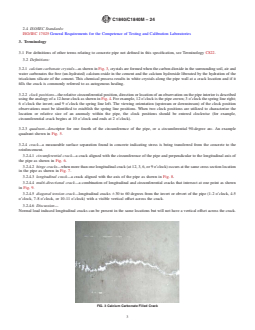
3.2.1 calcium carbonate crystals—as shown in Fig. 3, crystals are formed when the carbon dioxide in the surrounding soil, air and
water carbonates the free (un-hydrated) calcium oxide in the cement and the calcium hydroxide liberated by the hydration of the
tricalcium silicate of the cement. This chemical process results in white crystals along the pipe wall at a crack location and if it
fills the crack is commonly referred to as autogenous healing.
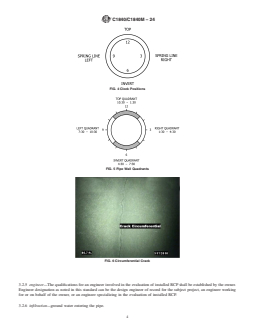
3.2.2 clock positions—the relative circumferential position, direction or location of an observation on the pipe interior is described
using the analogy of a 12-hour clock as shown in Fig. 4. For example, 12 o’clock is the pipe crown; 3 o’clock the spring line right;
6 o’clock the invert; and 9 o’clock the spring line left. The viewing orientation (upstream or downstream) of the clock position
observations must be identified to establish the spring line positions. When two clock positions are utilized to characterize the
location or relative size of an anomaly within the pipe, the clock positions should be entered clockwise (for example,
circumferential crack begins at 10 o’clock and ends at 2 o’clock).
3.2.3 quadrant—descriptor for one fourth of the circumference of the pipe, or a circumferential 90-degree arc. An example
quadrant shown in Fig. 5.
3.2.4 crack—a measurable surface separation found in concrete indicating stress is being transferred from the concrete to the
reinforcement.
3.2.4.1 circumferential crack—a crack aligned with the circumference of the pipe and perpendicular to the longitudinal axis of
the pipe as shown in Fig. 6.
3.2.4.2 hinge cracks—when more than one longitudinal crack (at 12, 3, 6, or 9 o’clock) occurs at the same cross section location
in the pipe as shown in Fig. 7.
3.2.4.3 longitudinal crack—a crack aligned with the axis of the pipe as shown in Fig. 8.
3.2.4.4 multi-directional crack—a combination of longitudinal and circumferential cracks that intersect at one point as shown
in Fig. 9.
3.2.4.5 diagonal tension crack—longitudinal cracks 630 to 60 degrees from the invert or obvert of the pipe (1-2 o’clock, 4-5
o’clock, 7-8 o’clock, or 10-11 o’clock) with a visible vertical offset across the crack.
3.2.4.6 Discussion—
Normal load induced longitudinal cracks can be present in the same locations but will not have a vertical offset across the crack.
FIG. 3 Calcium Carbonate Filled Crack
C1840/C1840M − 24
FIG. 4 Clock Positions
FIG. 5 Pipe Wall Quadrants
FIG. 6 Circumferential Crack
3.2.5 engineer—The qualifications for an engineer involved in the evaluation of installed RCP shall be established by the owner.
Engineer designation as noted in this standard can be the design engineer of record for the subject project, an engineer working
for or on behalf of the owner, or an engineer specializing in the evaluation of installed RCP.
3.2.6 infiltration—ground water entering the pipe.
C1840/C1840M − 24
FIG. 7 Hinged Cracks (Multiple Longitudinal Cracks)
FIG. 8 Longitudinal Crack
FIG. 9 Multi-Directional Crack
3.2.6.1 Level 1 Infiltration—moisture visible on the surface of the pipe wall without any observable active water movement such
as drips or water traveling along the surface as shown in Fig. 10.
3.2.6.2 Level 2 Infiltration—the slow entry of water identified by visible drips or a constant flow of water traveling along the
surface. See Fig. 11.
C1840/C1840M − 24
FIG. 10 Level 1 Infiltration
FIG. 11 Level 2 Infiltration
3.2.6.3 Level 3 Infiltration—a continuous stream of water running into the pipe or spraying through the pipe “under pressure.”
See Fig. 12.
3.2.7 joint offset—when the inside surface of the spigot (tongue) is not in alignment or centered with the interior pipe surface on
the Bell (groove) end of the installed joint. See Fig. 13.
3.2.8 joint separation—the space from the end of the spigot (tongue) to the face (shoulder) of the bell (groove) of the installed
joint. See Fig. 14.
3.2.9 leak resistant joint—according to AASHTO R 82 and for the purpose of this specification, a joint that limits water leakage
at a maximum rate of 200 gallons/(inch of internal diameter) (mile of pipeline) (24h) [18.5 L/(mm of internal diameter) (km of
pipeline) (24h)] for the pipeline sysytem.
FIG. 12 Level 3 Infiltration
C1840/C1840M − 24
FIG. 13 Joint Offset
FIG. 14 Joint Separation
3.2.10 non-corrosive environments—according to AASHTO Section 27 and for the purpose of this specification, “a pH level of
the soil surrounding the pipe or effluent water running through the pipe greater than 5.5” or less than a pH of 10 or environments
established by the engineer or owner.
3.2.11 owner—the person or entity that owns or has maintenance and operation responsibility of the pipeline or storm system being
inspected.
3.2.12 scaling—surface damage that appears as local flaking of poor concrete. Scaling is often associated with exposure to freezing
and thawing cycles.
3.2.13 silt-tight joint—according to AASHTO R 82 and for the purpose of this specification, a joint that is resistant to infiltration
of particles smaller than those retained on the No. 200 sieve.
3.2.14 slabbing—a radial tension failure of the concrete wall which occurs from straightening of the reinforcement cage due to
tension in the reinforcing as shown in Fig. 15.
3.2.15 spalling—a fracture of the concrete inclined to the surface resulting in pieces of concrete detaching from the pipe wall, as
shown in Fig. 16, or along a crack.
C1840/C1840M − 24
FIG. 15 Extreme Slabbing Due to Radial Tension
FIG. 16 Minor Spalling at a Joint
3.2.16 soil tight joint—a joint that is resistant to infiltration of particles larger than those retained on a No. 200 sieve.
3.2.17 stain/efflorescence—deposits left by the partial evaporation of infiltrating groundwater containing dissolved salts or
minerals. These deposits will often be concentrated at or alongside infiltration locations.
3.2.18 soil/watermark—discoloration(s) on the pipe interior left by the evaporation of water containing minerals or soil fines
contained in the pipe effluent or surrounding groundwater. This type of discoloration is often observed longitudinally along the pipe
wall coincident with the effluent water line level.
3.2.19 rust colored staining—a rust colored stain may occur due to iron ochre bacteria as determined by Practice D932, iron-oxide,
or other mineral accumulation on the pipe surface. In the absence of cracks and infiltration in excess of those permitted in 8.5, or
spalling that exposes the primary steel reinforcement, rust colored staining is not indicative of structural distress and does not
require remediation. See Fig. 17.
4. Significance and Use
4.1 The inspection of installed reinforced concrete pipe verifies proper installation of the product and establishes thresholds for
comparison further evaluation.
4.2 This practice is useful as a reference by an owner in preparing project specifications and to identify, evaluate and interpret
observations during post installation inspections of pipe.
C1840/C1840M − 24
FIG. 17 Rust Colored Staining
5. Pipe Inspection Equipment and Procedures
5.1 Pipe inspections may be made using person-entry, remote equipment, or a combination thereof. In general, pipe diameters 30
in. [750 mm] and smaller are not considered to be person-entry and typically require the use of remote equipment.
5.2 Remote Inspection Equipment:
5.2.1 The remote inspection system shall be equipped with adjustable or variable lighting suitable to allow a clear color image
of the entire interior perimeter of the pipe.
5.2.2 The system shall produce a video image with a resolution to properly classify any observed features on the pipe wall. The
image shall be clear, focused, and free from roll, static, or other image distortion qualities that would prevent the reviewer from
evaluating the condition of the pipe.
5.2.3 The pipe shall be free from debris and other obstructions to allow for a reasonable view of the pipe during inspection.
Standing water in the bottom of the pipe is common. Acceptable water depth or water volume limits for inspection shall be
established in the project specifications, or for existing lines in the inspection protocol. Pipe with water volume or depth that
exceeds acceptable limits must be dewatered.
5.2.4 The remote inspection video equipment shall be able to accurately measure and verify in accordance with Section 6, crack
width and or other observable items as small as 0.05 in. [1.5 mm] 6 0.01 in [0.3 mm], or be so equipped that the image can be
analyzed by computer software to accurately determine observation measurement and distances as small as 0.05 in. [1.5 mm] 6
0.01 in [0.3 mm]. For purposes of evaluation, visible cracks less than 0.05 in. [1.5 mm] shall be reported as less than 0.05 in. [1.5
mm].
NOTE 1—Equipment limitations may preclude measurements less than 0.05 in. [1.5 mm]. Therefore, measurements less than 0.05 in. are only expected
to be made during person-entry inspections.
5.2.5 The inspection equipment shall have a distance counter so as to accurately locate the observations made along the pipe run.
5.2.6 The video equipment shall be calibrated in accordance with the manufacturer’s recommendation within one year prior to the
inspection date.
5.3 Remote Inspection Procedures:
5.3.1 The instrument shall be moved through the pipe at a steady pace not to exceed 30 ft/min [9 m/min].
5.3.2 The camera should be stopped while the operator views and records observations. Side scan cameras are not required to stop,
pan, and tilt while recording video as these operations may be accomplished during the post inspection evaluation process.
C1840/C1840M − 24
5.3.3 The operator’s objective in positioning the camera to view an observation or feature will be to provide a perspective view
of the observation and the entire circumference of the surrounding pipe.
5.4 Person-Entry Inspection Equipment:
5.4.1 The installed pipe is a confined space. Follow proper OSHA 29 CFR PART 1926 SUBPART AA regulations and safety
protocols in assuring safe entry for project inspection personnel.
5.4.2 The person-entry inspection shall utilize a high resolution hand held digital video or still camera capable of clearly
documenting inspection observations. Video may be necessary in order to document some observations.
5.4.3 Measurements of observations may be made with any combination of measurement tools including: measuring tapes, rulers,
feeler gauges (Fig. 18), calipers, micrometers, optical comparators, etc. Cracks shall be measured from 0.01 in. [0.3 mm] to 0.10
in. [3 mm] on an accurate and repeatable basis.
5.4.4 Cracks greater than 0.10 in. [3 mm], and joint separations and/or vertical or horizontal offsets may be measured with either
a metal or fabric tape capable of measuring to the nearest ⁄16 in. [2 mm].
5.4.5 Adequate lighting shall be provided during the person entry inspection. Headlamps and
...