

ASTM D7181-20
(Test Method)Standard Test Method for Consolidated Drained Triaxial Compression Test for Soils
General Information
- Abstract
SIGNIFICANCE AND USE
5.1 The shear strength of a saturated soil in triaxial compression depends on the stresses applied, time of consolidation, strain rate, and the stress history experienced by the soil.
5.2 In this test method, the shear characteristics are measured under drained conditions and are applicable to field conditions where soils have been fully consolidated under the existing normal stresses and the normal stress changes under drained conditions similar to those in the test method.
5.3 The shear strength determined from this test method can be expressed in terms of effective stress because a strain rate or load application rate slow enough to allow pore pressure dissipation during shear is used to result in negligible excess pore pressure conditions. The shear strength may be applied to field conditions where full drainage can occur (drained conditions), and the field stress conditions are similar to those in the test method.
5.4 The shear strength determined from the test can be used in embankment stability analyses, earth pressure calculations, and foundation design.
Note 1: The quality of the result produced by this standard is dependent on the competence of the personnel performing it and the suitability of the equipment and facilities used. Agencies that meet the criteria of Practice D3740 are generally considered capable of competent and objective testing/sampling/inspection/etc. Users of this standard are cautioned that compliance with Practice D3740 does not assure reliable results. Reliable results depend on many factors; Practice D3740 provides a means of evaluating some of those factors.
SCOPE
1.1 This test method covers the determination of strength and stress-strain relationships of a cylindrical specimen of either intact or reconstituted soil. Specimens are consolidated and sheared in compression with drainage at a constant rate of axial deformation (strain controlled).
1.2 This test method provides for the calculation of principal stresses and axial compression by measurement of axial load, axial deformation, and volumetric changes.
1.3 This test method provides data useful in determining strength and deformation properties such as Mohr strength envelopes. Generally, three specimens are tested at different effective consolidation stresses to define a strength envelope. The stresses should be specified by the engineer requesting the test. A test on a new specimen is required for each consolidation stress.
1.4 If this test method is used on cohesive soil, a test may take weeks to complete.
1.5 The determination of strength envelopes and the development of relationships to aid in interpreting and evaluating test results are beyond the scope of this test method and must be performed by a qualified, experienced professional.
1.6 All observed and calculated values shall conform to the guidelines for significant digits and rounding established in Practice D6026.
1.6.1 The procedures used to specify how data are collected, calculated, or recorded in this standard are regarded as the industry standard. In addition, they are representative of the significant digits that generally should be retained. The procedures used do not consider material variations, purpose for obtaining the data, special purpose studies or any consideration for the user’s objectives; and it is common practice to increase or reduce the significant digits of the reported data to be commensurate with these considerations. It is beyond the scope of this test standard to consider significant digits used in analysis methods for engineering design.
1.7 Units—The values stated in SI units are to be regarded as standard. The inch-pound units given in parentheses are mathematical conversions, which are provided for information purposes only and are not considered standard. Reporting of test results in units other than SI shall not be regarded as non-conformance with this test method.
1.7.1 The g...
- Status
- Published
- Publication Date
- 31-Dec-2019
- Technical Committee
- D18 - Soil and Rock
- Drafting Committee
- D18.05 - Strength and Compressibility of Soils
Buy Documents
ASTM D7181-20 - Standard Test Method for Consolidated Drained Triaxial Compression Test for Soils
REDLINE ASTM D7181-20 - Standard Test Method for Consolidated Drained Triaxial Compression Test for Soils
Overview
ASTM D7181-20: Standard Test Method for Consolidated Drained Triaxial Compression Test for Soils outlines procedures for determining the strength and stress-strain relationships of cylindrical soil specimens under consolidated drained conditions. Developed by ASTM International, this method is widely employed in geotechnical engineering to evaluate the shear strength and deformation properties of both intact and reconstituted soils. The test is performed by shearing the specimen at a controlled axial deformation rate while ensuring full drainage, allowing for pore water pressures to dissipate, which enables accurate measurement of the soil's effective stress properties.
Key Topics
- Shear Strength Determination: The method measures the shear strength of saturated soils under drained conditions, which is critical for understanding how soils will behave under prolonged loading where drainage can occur.
- Stress-Strain Relationships: By measuring axial load, deformation, and volumetric changes, stress-strain curves and principal stresses are derived, providing insight into soil deformation and failure behavior.
- Effective Stress Evaluation: Results are expressed in terms of effective stress, necessary for analyzing situations where field soils can achieve full drainage during loading.
- Test Specimen Characteristics: The standard covers both intact (undisturbed) and reconstituted (remolded or compacted) specimens, accommodating a range of soil types and sampling conditions.
- Applicable Conditions: The test is best suited for geotechnical scenarios where soils are fully consolidated and where stress changes can occur under drained conditions.
- Precision and Practice: Reliable results are highly dependent on operator expertise, equipment quality, and adherence to preparation and measurement protocols consistent with ASTM Practice D3740 and D6026.
Applications
ASTM D7181-20 is essential for several key geotechnical applications, particularly in scenarios requiring knowledge of soil behavior under long-term loading and drained conditions:
- Embankment Stability: Engineers use results for evaluating the stability of soil embankments and slopes, particularly where consolidation and full drainage are expected during the life of the structure.
- Foundation Design: Data derived from the triaxial compression test informs the safe and effective design of shallow and deep foundations, helping mitigate risks associated with shear failure.
- Earth Pressure Calculations: The method supports calculations of lateral earth pressures for the design of retaining walls, excavation supports, and other underground structures.
- Mohr Strength Envelope Development: By testing specimens at multiple consolidation stresses, engineers can plot a Mohr stress envelope, key to predicting peak and residual shear strengths under varied loading conditions.
- Soil Classification and Analysis: Results contribute to broader soil classification systems and aid in characterizing soil deformation and strength properties for engineering design and analysis.
Related Standards
Numerous ASTM standards provide supporting procedures and background for effective implementation of ASTM D7181-20, including:
- ASTM D653: Terminology relating to soil, rock, and contained fluids.
- ASTM D1587: Practice for thin-walled tube sampling of fine-grained soils.
- ASTM D2216: test methods for laboratory determination of water content of soil and rock.
- ASTM D2435: Test methods for one-dimensional consolidation properties of soils.
- ASTM D2487: Practice for classification of soils (Unified Soil Classification System).
- ASTM D2850: Unconsolidated-undrained triaxial compression test on cohesive soils.
- ASTM D3740: Minimum requirements for agencies engaged in soil and rock testing.
- ASTM D6026: Practice for using significant digits in geotechnical data.
- ASTM D7263: Laboratory determination of density (unit weight) of soil specimens.
- ASTM D4767: Consolidated undrained triaxial compression test for cohesive soils.
Conclusion
ASTM D7181-20 provides a rigorous, internationally recognized framework for assessing consolidated, drained triaxial strength characteristics of soils. Adhering to this standard ensures accurate and reliable data for the design and analysis of geotechnical structures, supporting safe and sustainable engineering practices. Geotechnical engineers, laboratories, and construction professionals rely on this standard to ensure consistent, high-quality soil testing essential for foundational and earthworks projects.
Relations
- Effective Date
- 01-Jan-2020
- Effective Date
- 01-Feb-2024
- Effective Date
- 01-Nov-2023
- Effective Date
- 01-Nov-2023
- Effective Date
- 01-Apr-2020
- Effective Date
- 01-Oct-2019
- Effective Date
- 01-Mar-2019
- Effective Date
- 15-Feb-2018
- Effective Date
- 15-Feb-2018
- Effective Date
- 15-Dec-2017
- Effective Date
- 15-Dec-2017
- Effective Date
- 01-Jun-2017
- Refers
ASTM D4318-17 - Standard Test Methods for Liquid Limit, Plastic Limit, and Plasticity Index of Soils - Effective Date
- 01-Jun-2017
- Effective Date
- 01-May-2016
- Effective Date
- 01-May-2016
Buy Documents
ASTM D7181-20 - Standard Test Method for Consolidated Drained Triaxial Compression Test for Soils
REDLINE ASTM D7181-20 - Standard Test Method for Consolidated Drained Triaxial Compression Test for Soils
Get Certified
Connect with accredited certification bodies for this standard

CIS Institut d.o.o.
Personal Protective Equipment (PPE) certification body. Notified Body NB-2890 for EU Regulation 2016/425 PPE.

Kiwa BDA Testing
Building and construction product certification.
Kmetijski inštitut Slovenije
Agricultural Institute of Slovenia. Soil testing, plant health, agricultural product analysis.
Sponsored listings
Frequently Asked Questions
ASTM D7181-20 is a standard published by ASTM International. Its full title is "Standard Test Method for Consolidated Drained Triaxial Compression Test for Soils". This standard covers: SIGNIFICANCE AND USE 5.1 The shear strength of a saturated soil in triaxial compression depends on the stresses applied, time of consolidation, strain rate, and the stress history experienced by the soil. 5.2 In this test method, the shear characteristics are measured under drained conditions and are applicable to field conditions where soils have been fully consolidated under the existing normal stresses and the normal stress changes under drained conditions similar to those in the test method. 5.3 The shear strength determined from this test method can be expressed in terms of effective stress because a strain rate or load application rate slow enough to allow pore pressure dissipation during shear is used to result in negligible excess pore pressure conditions. The shear strength may be applied to field conditions where full drainage can occur (drained conditions), and the field stress conditions are similar to those in the test method. 5.4 The shear strength determined from the test can be used in embankment stability analyses, earth pressure calculations, and foundation design. Note 1: The quality of the result produced by this standard is dependent on the competence of the personnel performing it and the suitability of the equipment and facilities used. Agencies that meet the criteria of Practice D3740 are generally considered capable of competent and objective testing/sampling/inspection/etc. Users of this standard are cautioned that compliance with Practice D3740 does not assure reliable results. Reliable results depend on many factors; Practice D3740 provides a means of evaluating some of those factors. SCOPE 1.1 This test method covers the determination of strength and stress-strain relationships of a cylindrical specimen of either intact or reconstituted soil. Specimens are consolidated and sheared in compression with drainage at a constant rate of axial deformation (strain controlled). 1.2 This test method provides for the calculation of principal stresses and axial compression by measurement of axial load, axial deformation, and volumetric changes. 1.3 This test method provides data useful in determining strength and deformation properties such as Mohr strength envelopes. Generally, three specimens are tested at different effective consolidation stresses to define a strength envelope. The stresses should be specified by the engineer requesting the test. A test on a new specimen is required for each consolidation stress. 1.4 If this test method is used on cohesive soil, a test may take weeks to complete. 1.5 The determination of strength envelopes and the development of relationships to aid in interpreting and evaluating test results are beyond the scope of this test method and must be performed by a qualified, experienced professional. 1.6 All observed and calculated values shall conform to the guidelines for significant digits and rounding established in Practice D6026. 1.6.1 The procedures used to specify how data are collected, calculated, or recorded in this standard are regarded as the industry standard. In addition, they are representative of the significant digits that generally should be retained. The procedures used do not consider material variations, purpose for obtaining the data, special purpose studies or any consideration for the user’s objectives; and it is common practice to increase or reduce the significant digits of the reported data to be commensurate with these considerations. It is beyond the scope of this test standard to consider significant digits used in analysis methods for engineering design. 1.7 Units—The values stated in SI units are to be regarded as standard. The inch-pound units given in parentheses are mathematical conversions, which are provided for information purposes only and are not considered standard. Reporting of test results in units other than SI shall not be regarded as non-conformance with this test method. 1.7.1 The g...
SIGNIFICANCE AND USE 5.1 The shear strength of a saturated soil in triaxial compression depends on the stresses applied, time of consolidation, strain rate, and the stress history experienced by the soil. 5.2 In this test method, the shear characteristics are measured under drained conditions and are applicable to field conditions where soils have been fully consolidated under the existing normal stresses and the normal stress changes under drained conditions similar to those in the test method. 5.3 The shear strength determined from this test method can be expressed in terms of effective stress because a strain rate or load application rate slow enough to allow pore pressure dissipation during shear is used to result in negligible excess pore pressure conditions. The shear strength may be applied to field conditions where full drainage can occur (drained conditions), and the field stress conditions are similar to those in the test method. 5.4 The shear strength determined from the test can be used in embankment stability analyses, earth pressure calculations, and foundation design. Note 1: The quality of the result produced by this standard is dependent on the competence of the personnel performing it and the suitability of the equipment and facilities used. Agencies that meet the criteria of Practice D3740 are generally considered capable of competent and objective testing/sampling/inspection/etc. Users of this standard are cautioned that compliance with Practice D3740 does not assure reliable results. Reliable results depend on many factors; Practice D3740 provides a means of evaluating some of those factors. SCOPE 1.1 This test method covers the determination of strength and stress-strain relationships of a cylindrical specimen of either intact or reconstituted soil. Specimens are consolidated and sheared in compression with drainage at a constant rate of axial deformation (strain controlled). 1.2 This test method provides for the calculation of principal stresses and axial compression by measurement of axial load, axial deformation, and volumetric changes. 1.3 This test method provides data useful in determining strength and deformation properties such as Mohr strength envelopes. Generally, three specimens are tested at different effective consolidation stresses to define a strength envelope. The stresses should be specified by the engineer requesting the test. A test on a new specimen is required for each consolidation stress. 1.4 If this test method is used on cohesive soil, a test may take weeks to complete. 1.5 The determination of strength envelopes and the development of relationships to aid in interpreting and evaluating test results are beyond the scope of this test method and must be performed by a qualified, experienced professional. 1.6 All observed and calculated values shall conform to the guidelines for significant digits and rounding established in Practice D6026. 1.6.1 The procedures used to specify how data are collected, calculated, or recorded in this standard are regarded as the industry standard. In addition, they are representative of the significant digits that generally should be retained. The procedures used do not consider material variations, purpose for obtaining the data, special purpose studies or any consideration for the user’s objectives; and it is common practice to increase or reduce the significant digits of the reported data to be commensurate with these considerations. It is beyond the scope of this test standard to consider significant digits used in analysis methods for engineering design. 1.7 Units—The values stated in SI units are to be regarded as standard. The inch-pound units given in parentheses are mathematical conversions, which are provided for information purposes only and are not considered standard. Reporting of test results in units other than SI shall not be regarded as non-conformance with this test method. 1.7.1 The g...
ASTM D7181-20 is classified under the following ICS (International Classification for Standards) categories: 13.080.20 - Physical properties of soils. The ICS classification helps identify the subject area and facilitates finding related standards.
ASTM D7181-20 has the following relationships with other standards: It is inter standard links to ASTM D7181-11, ASTM D4753-24, ASTM D854-23, ASTM D3740-23, ASTM D4767-11(2020), ASTM D3740-19, ASTM D2216-19, ASTM D7263-09(2018), ASTM D7263-09(2018)e1, ASTM D2487-17e1, ASTM D2487-17, ASTM D4318-17e1, ASTM D4318-17, ASTM D7928-16e1, ASTM D7928-16. Understanding these relationships helps ensure you are using the most current and applicable version of the standard.
ASTM D7181-20 is available in PDF format for immediate download after purchase. The document can be added to your cart and obtained through the secure checkout process. Digital delivery ensures instant access to the complete standard document.
Standards Content (Sample)
This international standard was developed in accordance with internationally recognized principles on standardization established in the Decision on Principles for the
Development of International Standards, Guides and Recommendations issued by the World Trade Organization Technical Barriers to Trade (TBT) Committee.
Designation: D7181 − 20
Standard Test Method for
Consolidated Drained Triaxial Compression Test for Soils
This standard is issued under the fixed designation D7181; the number immediately following the designation indicates the year of
original adoption or, in the case of revision, the year of last revision.Anumber in parentheses indicates the year of last reapproval.A
superscript epsilon (´) indicates an editorial change since the last revision or reapproval.
1. Scope of this test standard to consider significant digits used in
analysis methods for engineering design.
1.1 This test method covers the determination of strength
and stress-strain relationships of a cylindrical specimen of 1.7 Units—The values stated in SI units are to be regarded
either intact or reconstituted soil. Specimens are consolidated as standard. The inch-pound units given in parentheses are
and sheared in compression with drainage at a constant rate of mathematical conversions, which are provided for information
axial deformation (strain controlled). purposes only and are not considered standard. Reporting of
test results in units other than SI shall not be regarded as
1.2 This test method provides for the calculation of princi-
non-conformance with this test method.
pal stresses and axial compression by measurement of axial
1.7.1 The gravitational system of inch-pound units is used
load, axial deformation, and volumetric changes.
when dealing with inch-pound units. In this system, the pound
1.3 This test method provides data useful in determining
(lbf)representsaunitofforce(weight),whiletheunitformass
strength and deformation properties such as Mohr strength
is slugs. The slug unit is not given, unless dynamic (F = ma)
envelopes. Generally, three specimens are tested at different
calculations are involved.
effective consolidation stresses to define a strength envelope.
1.7.2 It is common practice in the engineering/construction
The stresses should be specified by the engineer requesting the
profession to concurrently use pounds to represent both a unit
test. A test on a new specimen is required for each consolida-
of mass (lbm) and of force (lbf). This implicitly combines two
tion stress.
separate systems of units: that is, the absolute system and the
gravitational system. It is scientifically undesirable to combine
1.4 If this test method is used on cohesive soil, a test may
take weeks to complete. theuseoftwoseparatesetsofinch-poundunitswithinasingle
standard. As stated, this standard includes the gravitational
1.5 The determination of strength envelopes and the devel-
system of inch-pound units and does not use/present the slug
opment of relationships to aid in interpreting and evaluating
unitformass.However,theuseofbalancesorscalesrecording
test results are beyond the scope of this test method and must
pounds of mass (lbm) or recording density in lbm/ft shall not
be performed by a qualified, experienced professional.
be regarded as non-conformance with this standard.
1.6 All observed and calculated values shall conform to the
1.7.3 The terms density and unit weight are often used
guidelines for significant digits and rounding established in
interchangeably. Density is mass per unit volume whereas unit
Practice D6026.
weight is force per unit volume. In this standard density is
1.6.1 Theproceduresusedtospecifyhowdataarecollected,
given only in SI units. After the density has been determined,
calculated, or recorded in this standard are regarded as the
the unit weight is calculated in SI or inch-pound units, or both.
industry standard. In addition, they are representative of the
1.8 This standard may involve hazardous materials,
significant digits that generally should be retained. The proce-
operations, and equipment. This standard does not purport to
dures used do not consider material variations, purpose for
address all of the safety concerns, if any, associated with its
obtainingthedata,specialpurposestudiesoranyconsideration
use. It is the responsibility of the user of this standard to
for the user’s objectives; and it is common practice to increase
establish appropriate safety, health, and environmental prac-
or reduce the significant digits of the reported data to be
tices and determine the applicability of regulatory limitations
commensuratewiththeseconsiderations.Itisbeyondthescope
prior to use.
1.9 This international standard was developed in accor-
dance with internationally recognized principles on standard-
ThistestmethodisunderthejurisdictionofASTMCommitteeD18onSoiland
Rock and is the direct responsibility of Subcommittee D18.05 on Strength and
ization established in the Decision on Principles for the
Compressibility of Soils.
Development of International Standards, Guides and Recom-
Current edition approved Jan. 1, 2020. Published February 2020. Originally
mendations issued by the World Trade Organization Technical
approved in 2011. Last previous edition approved in 2011 as D7181-11. DOI:
10.1520/D7181-20. Barriers to Trade (TBT) Committee.
Copyright © ASTM International, 100 Barr Harbor Drive, PO Box C700, West Conshohocken, PA 19428-2959. United States
D7181 − 20
2. Referenced Documents 3.2.4 failure, n—a maximum-stress condition or stress at a
2 defined strain for a test specimen.
2.1 ASTM Standards:
3.2.4.1 Discussion—Failure is often taken to correspond to
D653Terminology Relating to Soil, Rock, and Contained
the maximum principal stress difference (maximum deviator
Fluids
stress) attained or the principal stress difference (deviator
D854Test Methods for Specific Gravity of Soil Solids by
stress) at 15% axial strain, whichever is obtained first during
Water Pycnometer
theperformanceofatest.Dependingonsoilbehaviorandfield
D1587Practice for Thin-Walled Tube Sampling of Fine-
application, other suitable failure criteria may be defined, such
Grained Soils for Geotechnical Purposes
’ ’
as maximum effective stress obliquity, σ /σ ,orthe
1 3max
D2216Test Methods for Laboratory Determination ofWater
principal stress difference (deviator stress) at a selected axial
(Moisture) Content of Soil and Rock by Mass
strain other than 15%.
D2435Test Methods for One-Dimensional Consolidation
Properties of Soils Using Incremental Loading
4. Summary of Test Method
D2487Practice for Classification of Soils for Engineering
4.1 The test specimen, either intact or reconstituted, is
Purposes (Unified Soil Classification System)
mounted in the testing apparatus using either a dry or wet
D3740Practice for Minimum Requirements for Agencies
mounting procedure. The test specimen is cylindrical in shape
Engaged in Testing and/or Inspection of Soil and Rock as
and dimensions are measured prior to mounting. The test
Used in Engineering Design and Construction
specimen is then back pressure saturated.After saturation, the
D4220 Practices for Preserving and Transporting Soil
specimen is isotropically or anisotropically consolidated. The
Samples
testspecimenisthenaxiallyloadingataconstantrateandwith
D4318Test Methods for Liquid Limit, Plastic Limit, and
the drainage lines open to allow the sample to drain.
Plasticity Index of Soils
D4753Guide for Evaluating, Selecting, and Specifying Bal-
5. Significance and Use
ances and Standard Masses for Use in Soil, Rock, and
5.1 The shear strength of a saturated soil in triaxial com-
Construction Materials Testing
pressiondependsonthestressesapplied,timeofconsolidation,
D4767Test Method for Consolidated Undrained Triaxial
strain rate, and the stress history experienced by the soil.
Compression Test for Cohesive Soils
5.2 In this test method, the shear characteristics are mea-
D6026Practice for Using Significant Digits in Geotechnical
sured under drained conditions and are applicable to field
Data
conditions where soils have been fully consolidated under the
D6913Test Methods for Particle-Size Distribution (Grada-
existing normal stresses and the normal stress changes under
tion) of Soils Using Sieve Analysis
drained conditions similar to those in the test method.
D7263Test Methods for Laboratory Determination of Den-
sity (Unit Weight) of Soil Specimens
5.3 Theshearstrengthdeterminedfromthistestmethodcan
D7928Test Method for Particle-Size Distribution (Grada-
beexpressedintermsofeffectivestressbecauseastrainrateor
tion) of Fine-Grained Soils Using the Sedimentation
load application rate slow enough to allow pore pressure
(Hydrometer) Analysis
dissipation during shear is used to result in negligible excess
pore pressure conditions.The shear strength may be applied to
3. Terminology
field conditions where full drainage can occur (drained
3.1 Definitions:
conditions), and the field stress conditions are similar to those
3.1.1 For definitions of common technical terms, refer to
in the test method.
Terminology D653.
5.4 The shear strength determined from the test can be used
3.2 Definitions of Terms Specific to This Standard:
in embankment stability analyses, earth pressure calculations,
3.2.1 back pressure, n—a pressure applied to the specimen
and foundation design.
pore-water to cause air in the pore space to compress and to
NOTE 1—The quality of the result produced by this standard is
pass into solution in the pore-water thereby increasing the dependent on the competence of the personnel performing it and the
suitability of the equipment and facilities used. Agencies that meet the
percent saturation of the specimen.
criteria of Practice D3740 are generally considered capable of competent
3.2.2 effective consolidation stress, n—the difference be-
and objective testing/sampling/inspection/etc. Users of this standard are
tween the cell pressure and the pore-water pressure prior to
cautioned that compliance with Practice D3740 does not assure reliable
results. Reliable results depend on many factors; Practice D3740 provides
shearing the specimen.
a means of evaluating some of those factors.
3.2.3 effective consolidation stresses, n—for anisotropic
6. Apparatus
(9.4), the vertical and lateral stress applied magnitudes are not
equal by design, with lateral stress equal to the cell pressure
6.1 The requirements for equipment needed to perform
minus pore-water pressure, and the vertical stress equal to the
satisfactory tests are given in the following sections. See Fig.
desired total vertical stress (9.4.2) minus the pore pressure.
6.2 Axial Loading Device—Theaxialloadingdevicemaybe
For referenced ASTM standards, visit the ASTM website, www.astm.org, or
a screw jack driven by an electric motor through a geared
contact ASTM Customer Service at service@astm.org. For Annual Book of ASTM
transmission, a hydraulic loading device, or any other com-
Standards volume information, refer to the standard’s Document Summary page on
the ASTM website. pression device with sufficient capacity and control to provide
D7181 − 20
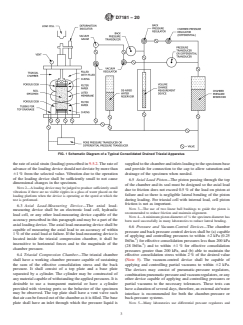
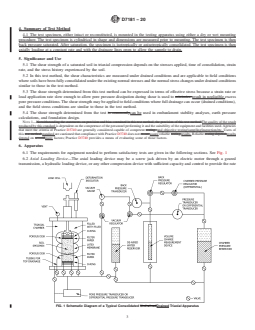
FIG. 1 Schematic Diagram of a Typical Consolidated Drained Triaxial Apparatus
therateofaxialstrain(loading)prescribedin9.5.2.Therateof suppliedtothechamberandinletsleadingtothespecimenbase
advance of the loading device should not deviate by more than and provide for connection to the cap to allow saturation and
61% from the selected value. Vibration due to the operation drainage of the specimen when needed.
of the loading device shall be sufficiently small to not cause
6.5 Axial Load Piston—The piston passing through the top
dimensional changes in the specimen.
of the chamber and its seal must be designed so the axial load
NOTE 2—Aloading device may be judged to produce sufficiently small
due to friction does not exceed 0.5% of the load on piston at
vibrations if there are no visible ripples in a glass of water placed on the
failure and so there is negligible lateral bending of the piston
loading platform when the device is operating at the speed at which the
test is performed. during loading. For triaxial cell with internal load, cell piston
friction is not as important.
6.3 Axial Load-Measuring Device—The axial load-
NOTE 3—The use of two linear ball bushings to guide the piston is
measuring device shall be an electronic load cell, hydraulic
recommended to reduce friction and maintain alignment.
load cell, or any other load-measuring device capable of the
NOTE 4—Aminimum piston diameter of ⁄6 the specimen diameter has
accuracy prescribed in this paragraph and may be a part of the
been used successfully in many laboratories to reduce lateral bending.
axial loading device. The axial load-measuring device shall be
6.6 Pressure and Vacuum-Control Devices—The chamber
capable of measuring the axial load to an accuracy of within
pressure and back pressure control devices shall be (a) capable
1% of the axial load at failure. If the load-measuring device is
of applying and controlling pressures to within 62 kPa (0.25
located inside the triaxial compression chamber, it shall be
lbf/in. ) for effective consolidation pressures less than 200 kPa
insensitive to horizontal forces and to the magnitude of the
(28 lbf/in. ) and to within 61% for effective consolidation
chamber pressure.
pressures greater than 200 kPa, and (b) able to maintain the
6.4 Triaxial Compression Chamber—The triaxial chamber
effective consolidation stress within 2% of the desired value
shall have a working chamber pressure capable of sustaining
(Note 5). The vacuum-control device shall be capable of
the sum of the effective consolidation stress and the back
applying and controlling partial vacuums to within 62 kPa.
pressure. It shall consist of a top plate and a base plate
The devices may consist of pneumatic-pressure regulators,
separated by a cylinder. The cylinder may be constructed of
combinationpneumaticpressureandvacuumregulators,orany
anymaterialcapableofwithstandingtheappliedpressures.Itis
other device capable of applying and controlling pressures or
desirable to use a transparent material or have a cylinder
partial vacuums to the necessary tolerances. These tests can
provided with viewing ports so the behavior of the specimen haveadurationofseveraldays,therefore,anexternalair/water
may be observed. The top plate shall have a vent valve such
interface is recommended for both the chamber-pressure or
thataircanbeforcedoutofthechamberasitisfilled.Thebase back-pressure systems.
plate shall have an inlet through which the pressure liquid is NOTE 5—Many laboratories use differential pressure regulators and
D7181 − 20
transducers to achieve the requirements for small differences between
surface of the specimen base and cap that contacts the
chamber and back pressure.
membranetoformasealshallbesmoothandfreeofscratches.
6.7 Pressure- and Vacuum-Measurement Devices—The
6.11 Porous Disks—A rigid porous disk shall be used to
chamber pressure-, back pressure-, and vacuum-measuring
provide drainage at each end of the specimen. The coefficient
devices shall be capable of measuring the ranges of pressures
of permeability of the disks shall be greater than that of fine
-4 –5
or partial vacuums to the tolerances given in 6.6. They may
sand (1 × 10 cm/s (4 × 10 in./s)). The disks shall be
consist of electronic pressure transducers, or any other device
regularly cleaned by ultrasonic or boiling and brushing and
capable of measuring pressures, or partial vacuums to the
checked to determine whether they have become clogged.
stated tolerances. If separate devices are used to measure the
6.12 Filter-Paper Strips and Disk—Filter-paper strips are
chamber pressure and back pressure, the devices must be
used by many laboratories to decrease the time needed for
normalized simultaneously and against the same pressure
testing. Filter-paper disks of a diameter equal to that of the
source. Since the chamber and back pressure are the pressures
specimen may be placed between the porous disks and speci-
taken at the midheight of the specimen, it may be necessary to
men to avoid clogging of the porous disks. If filter strips or
adjust the zero-offset of the devices to reflect the hydraulic
disks are used, they shall be of a type that does not dissolve in
head of fluids in the chamber and back pressure control
water. The coefficient of permeability of the filter paper shall
systems.
-5 -6
not be less than1×10 cm/s (4 × 10 in./s) for a normal
6.8 Volume Change Measurement Device—The volume of pressure of 550 kPa (80 lbf/in. ). To avoid hoop tension, filter
strips should cover no more than 50% of the specimen
water entering or leaving the specimen shall be measured with
periphery. Many laboratories have successfully used filter strip
an accuracy of within 60.05% of the total volume of the
cages.Anequationforcorrectingtheprincipalstressdifference
specimen. The volume-measuring device is usually a burette
(deviator stress) for the effect of the strength of vertical filter
connected to the back pressure but may be any other device
strips is given in 11.3.3.1.
meeting the accuracy requirement. The device must be able to
NOTE 6—Grade No. 54 Filter Paper has been found to meet the
withstand the maximum back pressure and of sufficient capac-
permeability and durability requirements.
ity for the performance of the test. Volume changes during
shearareoftenontheorderof 620%ormoreofthespecimen 6.13 Rubber Membrane—The rubber membrane used to
volume. Either allowing for resetting of the system during encase the specimen shall provide reliable protection against
shearorhavingatotalcapacitycapableofmeasuringtheentire leakage. Membranes shall be carefully inspected prior to use
change may meet the needed capacity. andifanyflawsorpinholesareevident,themembraneshallbe
discarded. To offer minimum restraint to the specimen, the
6.9 Deformation Indicator—The vertical deformation of the
unstretched membrane diameter shall be between 90 and 95%
specimen is usually determined from the travel of the piston
of that of the specimen. The membrane thickness shall not
acting on the top of the specimen. The piston travel shall be
exceed 1% of the diameter of the specimen. The membrane
measured with an accuracy of at least 0.25% of the initial
shall be sealed to the specimen cap and base with rubber
specimen height. The deformation indicator shall have a range
O-ringsforwhichtheunstressedinsidediameterisbetween75
of at least 20% of the initial height of the specimen and may
and 85% of the diameter of the cap and base, or by other
be a dial indicator, linear variable differential transformer
means that will provide a positive seal. An equation for
(LVDT), extensometer, or other measuring device meeting the
correcting the principal stress difference (deviator stress) for
requirements for accuracy and range.
the effect of the stiffness of the membrane is given in 11.3.3.2.
6.10 Specimen Cap and Base—The specimen cap and base
6.14 Valves—Changesinvolumeduetoopeningandclosing
shall be designed to provide drainage from both ends of the
valves may result in inaccurate volume change and pore-water
specimen. They shall be constructed of a rigid, noncorrosive,
pressuremeasurements.Forthisreason,valvesinthespecimen
impermeable material, and each shall, except for the drainage
drainage system shall be of the type that produces minimum
provision, have a circular plane surface of contact with the
volume changes due to their operation. A valve may be
porous disks and a circular cross section. It is desirable for the
assumed to produce minimum volume change if opening or
massofthespecimencapandtopporousdisktobeasminimal
closing the valve in a closed, saturated pore-water pressure
aspossible.However,themassmaybeasmuchas10%ofthe
system does not induce a pressure change of greater than 0.7
axial load at failure. If the mass is greater than 0.5% of the
kPa(60.1lbf/in. ).Allvalvesmustbecapableofwithstanding
applied axial load at failure and greater than 50 g (0.1 lb), the
applied pressures without leakage.
axial load must be corrected for the mass of the specimen cap
NOTE 7—Ball valves have been found to provide minimum volume-
and top porous disk. The diameter of the cap and base shall be
change characteristics; however, any other type of valve having suitable
volume-change characteristics may be used.
equal or only nominally greater than the initial diameter of the
specimen.The specimen base shall be connected to the triaxial
6.15 Specimen-Size Measurement Devices—Devicesusedto
compression chamber to prevent lateral motion or tilting, and
determine the height and diameter of the specimen shall
thespecimencapshallbedesignedsuchthateccentricityofthe
measuretherespectivedimensionstofoursignificantdigitsand
piston-to-cap contact relative to the vertical axis of the speci-
shall be constructed such that their use will not disturb/deform
men does not exceed 1.3 mm (0.05 in.). The end of the piston
the specimen.
and specimen cap contact area shall be designed so that tilting
NOTE 8—Circumferential measuring tapes are recommended over
of the specimen cap during the test is minimal.The cylindrical calipers for measuring the diameter.
D7181 − 20
6.16 Data Acquisition—Specimen behavior may be re- change is kept to a minimum. Where removal of pebbles or
cordedmanuallyorbyelectronicdigitaloranalogrecorders.If crumblingresultingfromtrimmingcausesvoidsonthesurface
electronic data acquisition is used, it shall be necessary to of the specimen, carefully fill the voids with remolded soil
calibrate the measuring devices through the recording device obtained from the trimmings. If the sample can be trimmed
using known input standards. with minimal disturbance, a vertical trimming lathe may be
used to reduce the specimen to the necessary diameter. After
6.17 Timer—A timing device indicating the elapsed testing
obtainingthenecessarydiameter,placethespecimeninamiter
time to the nearest 1 s readability, shall be used to obtain
box, and cut the specimen to the final height with a wire saw
consolidation data (9.3.3).
or other suitable device. Trim the surfaces with the steel
6.18 Balance—A balance or scale conforming to the re-
straightedge. Perform one or more water content determina-
quirements of Specification D4753 readable to four significant
tions on material trimmed from the specimen in accordance
digits.
with Test Method D2216. Determine and record the mass and
dimensionsofthespecimenusingthedevicesdescribedin6.16
6.19 Water Deaeration Device—The amount of dissolved
gas (air) in the water used to saturate the specimen shall be and 6.20. A minimum of three height measurements (120°
decreased by boiling, by heating and spraying into a vacuum, apart) and at least three diameter measurements at the quarter
points of the height shall be made to determine the average
or by any other method that will satisfy the requirement for
saturating the specimen within the limits imposed by the height and diameter of the specimen.
availablemaximumbackpressureandtimetoperformthetest.
7.3 Reconstituted Specimens by Compaction—
6.20 Testing Environment—The consolidation and shear
Reconstituted specimens shall be prepared at the conditions
portion of the test shall be performed in an environment where specified for the test. Soil used for a reconstituted specimen
temperature fluctuations are less than 64°C(67.2 °F) and
shall be thoroughly mixed with enough water to produce the
there is no direct exposure with sunlight. desired water content. If water is added to the soil, store the
material in a covered container for at least 16 h prior to
6.21 Miscellaneous Apparatus—Specimen trimming and
compaction. Reconstituted specimen may be prepared by
carving tools including a wire saw, steel straightedge, miter
compacting material in at least six layers using a split mold of
box, vertical trimming lathe, apparatus for preparing reconsti-
circular cross section having dimensions meeting the require-
tuted specimens, membrane and O-ring expander, water con-
ments enumerated in 7.1. Specimens may be compacted to the
tent cans, and data sheets shall be provided as necessary.
desired density by either: (1) kneading or tamping each layer
until the accumulative mass of the soil placed in the mold is
7. Test Specimen Preparation
compacted to a known volume; or (2) by adjusting the number
7.1 Specimen Size—Specimensshallbecylindricalandhave
of layers, the number of tamps per layer, and the force per
a minimum diameter of 33 mm (1.3 in.). The average-height-
tamp. The top of each layer shall be scarified prior to the
to-average-diameter ratio shall be between 2 and 2.5. An
addition of material for the next layer. The tamper used to
individual measurement of height or diameter shall not vary
compactthematerialshallhaveadiameterequaltoorlessthan
from average by more than 2%. The largest particle size shall
⁄2 the diameter of the mold.After a specimen is formed, with
be smaller than ⁄6 the specimen diameter. If, after completion
the ends perpendicular to the longitudinal axis, remove the
of a test, it is found based on visual observation that oversize
moldanddetermineandrecordthemassanddimensionsofthe
particles are present, indicate this information in the report of
specimen using the devices described in 6.14 and 6.17.A
test data (12.2.5).
minimum of three height measurements (120° apart) and at
NOTE 9—If oversize particles are found in the specimen after testing, a
least three diameter measurements at the quarter points of the
particle-size analysis may be performed on the tested specimen in
height shall be made to determine the average height and
accordance with Test Method D6913 to confirm the visual observation.
diameter of the specimen. Perform one or more water content
7.2 Intact Specimens—Prepare intact specimens from large
determinationsonexcessmaterialusedtopreparethespecimen
intact samples or from samples secured in accordance with
in accordance with Test Method D2216.
Practice D1587 or other acceptable intact tube sampling
procedures. Samples shall be preserved and transported in
NOTE 10—It is common for the density or unit weight of the specimen
afterremovalfromthemoldtobelessthanthevaluebasedonthevolume
accordance with the practice for Group C samples in Practices
of the mold.This change occurs as a result of the specimen swelling after
D4220. Specimens obtained by tube sampling may be tested
removal of the lateral confinement provided by the mold.
without trimming except for cutting the end surfaces plane and
7.4 Reconstituted Specimens by Other Methods—Prepare
perpendicular to the longitudinal axis of the specimen, pro-
reconstitutedspecimensinthemannerspecifiedbytherequest-
vided soil characteristics are such that no significant distur-
ing agency. These methods will usually require a forming
bance results from sampling. Handle specimens carefully to
jacket used to form the specimen directly on the base pedestal.
havenegligibledisturbance,changeincrosssection,orchange
Theformingjacketwillallowthespecimentobeprepareinthe
in water content. If compression or any type of noticeable
membrane. There are steps in Section 8 that may not be
disturbance would be caused by the extrusion device, split the
required by some of the methods. Common methods include:
sample tube lengthwise or cut the tube in suitable sections to
facilitate removal of the specimen with minimum disturbance. 7.4.1 Pluviation Through Water Method—Forthisspecimen
Prepare trimmed specimen, in an environment such as a preparation method, a granular soil is saturated initially in a
controlled high-humidity room where soil water content container, poured through water into a water-filled membrane
D7181 − 20
placed on a forming mold, and then densified to the required 8.2 Depending on whether the saturation portion of the test
densitybyvibration;refertoreferencebyChaneyandMullis. will be initiated with either a wet or dry drainage system,
mount the specimen using the appropriate method, as follows
NOTE 11—A specimen may be vibrated either on the side of the mold
in either 8.2.1 or 8.2.2. The dry mounting method is strongly
or the base of the cell using a variety of apparatus. These include the
recommended for specimens with initial saturation less than
following: tapping with an implement of some type such as a spoon or
metal rod, pneumatic vibrator, or electric engraving tool.
90%. The dry mounting method removes air prior to adding
backpressure and lowers the backpressure needed to attain an
7.4.2 Dry Screening Method—For this method a tube with a
adequate percent saturation.
screen attached to one end is placed inside a membrane
stretched over a forming mold. A dry uniform sand is then
NOTE12—Itisrecommendedthatthedrymountingmethodbeusedfor
poured into the tube. The tube is then slowly withdrawn from
specimens of soils that swell appreciably when in contact with water. If
the wet mounting method is used for such soils, it will be necessary to
this membrane/mold allowing the sand to pass through the
obtain the specimen dimensions after the specimen has been mounted. In
screen forming a specimen. If a greater density of the sand is
such cases, it will be necessary to determine the double thickness of the
desired the mold may be vibrated.
membrane,thedoublethicknessofthewetfilterpaperstrips(ifused),and
7.4.3 Dry or Moist Vibration Method—In this procedure
the combined height of the cap, base, and porous disks (including the
compact oven-dried, or moist granular material in layers
thicknessoffilterdisksiftheyareused)sothattheappropriatevaluesmay
be subtracted from the measurements.
(typically six to seven layers) in a membrane-lined split mold
attached to the bottom platen of the triaxial cell. Compact the
8.2.1 Wet Mounting Method:
material for each lift by vibration to the dry unit weight
8.2.1.1 Fill the specimen drainage lines and the pore-water
necessary to obtain the prescribed density. Scarify the soil
pressure measurement device with deaired water.
surface between lifts. It should be noted that to obtain uniform
8.2.1.2 Saturate the porous disks by boiling them in water
density,thebottomlayershavetobeslightlyundercompacted,
for at least 10 min and allow to cool to room temperature.
since compaction of each succeeding layer increases the
8.2.1.3 Place a saturated porous disk on the specimen base
density of sand in layers below it. After the final layer is
and after wiping away all free water on the disk, place the
partially compacted, put the top cap in place and continue
specimen on the disk. Next, place another porous disk and the
vibration until the desired dry unit weight is obtained.
specimen cap on top of the specimen. Check that the specimen
7.4.4 Tamping Method—For this procedure tamp air dry or
cap, specimen, and porous disks are centered on the specimen
moist granular or cohesive soil in layers into a mold. The only
base.
difference between the tamping method and the vibration
NOTE13—Iffilter-paperdisksaretobeplacedbetweentheporousdisks
method is that each layer is compacted by hand tamping with
and specimen, they should be dipped in water prior to placement.
a compaction foot instead of with a vibrator, refer to reference
8.2.1.4 If filter-paper strips or a filter-paper cage are to be
by Ladd, R.S.
used, saturate the paper with water prior to placing it on the
7.4.5 After the specimen has been formed, place the speci-
specimen.Toavoidhooptension,donotcovermorethan50%
men cap in place and seal the specimen with O-rings or rubber
of the specimen periphery with vertical strips of filter paper.
bands after placing the membrane ends over the cap and base.
The filter paper should extend to porous disks on top and
Then apply a partial vacuum of 35 kPa (5 lbf/in.)tothe
bottom of sample.
specimen and remove the forming jacket. If the test confining-
8.2.1.5 Proceed with 8.3.
pressure is greater than 103 kPa (14.7 lbf/in. ), a full vacuum
8.2.2 Dry Mounting Method:
maybeappliedtothespecimeninstagespriortoremovingthe
8.2.2.1 Dry the specimen drainage system. This mounting
jacket.
method may be accomplished by allowing dry air to flow
8. Mounting Specimen through the system prior to mounting the specimen.
8.2.2.2 Dry the porous disks in an oven and then place the
8.1 Preparations—Before mounting the specimen in the
disks in a desiccator to cool to room temperature prior to
triaxial chamber, make the following preparations:
mounting the specimen.
8.1.1 Inspect the rubber membrane for flaws, pinholes, and
8.2.2.3 Place a dry porous disk on the specimen base and
leaks.
place the specimen on the disk. Next, place a dry porous disk
8.1.2 Place the membrane on the membrane expander or, if
and the specimen cap on the specimen. Check that the
it is to be rolled onto the specimen, roll the membrane on the
specimen cap, porous disks, and specimen are centered on the
cap or base.
specimen base.
8.1.3 Check the porous disks and specimen drainage tubes
are not obstructed by passing air or water through the appro-
NOTE 14—If desired, dry filter-paper disks may be placed between the
priate lines. porous disks and specimen.
8.1.4 Attach the pressure-control and volume-measurement
8.2.2.4 If filter-paper strips or a filter paper cage are to be
system and a pore-pressure measurement device to the cham-
used,thecageorstripsmaybeheldinplacebysmallpiecesof
ber
...
This document is not an ASTM standard and is intended only to provide the user of an ASTM standard an indication of what changes have been made to the previous version. Because
it may not be technically possible to adequately depict all changes accurately, ASTM recommends that users consult prior editions as appropriate. In all cases only the current version
of the standard as published by ASTM is to be considered the official document.
Designation: D7181 − 11 D7181 − 20
Standard Test Method for
Consolidated Drained Triaxial Compression Test for Soils
This standard is issued under the fixed designation D7181; the number immediately following the designation indicates the year of
original adoption or, in the case of revision, the year of last revision. A number in parentheses indicates the year of last reapproval. A
superscript epsilon (´) indicates an editorial change since the last revision or reapproval.
1. Scope
1.1 This test method covers the determination of strength and stress-strain relationships of a cylindrical specimen of either intact
or reconstituted soil. Specimens are consolidated and sheared in compression with drainage at a constant rate of axial deformation
(strain controlled).
1.2 This test method provides for the calculation of principal stresses and axial compression by measurement of axial load, axial
deformation, and volumetric changes.
1.3 This test method provides data useful in determining strength and deformation properties such as Mohr strength envelopes.
Generally, three specimens are tested at different effective consolidation stresses to define a strength envelope. The stresses should
be specified by the engineer requesting the test. A test on a new specimen is required for each consolidation stress.
1.4 If this test method is used on cohesive soil, a test may take weeks to complete.
1.5 The determination of strength envelopes and the development of relationships to aid in interpreting and evaluating test
results are beyond the scope of this test method and must be performed by a qualified, experienced professional.
1.6 All observed and calculated values shall conform to the guidelines for significant digits and rounding established in Practice
D6026.
1.6.1 The methodsprocedures used to specify how data are collected, calculated, or recorded in this standard are regarded as
the industry standard. In addition, they are representative of the significant digits that generally should be retained. The procedures
used do not consider material variations, purpose for obtaining the data, special purpose studies or any consideration of the end
use. for the user’s objectives; and it is common practice to increase or reduce the significant digits of the reported data to be
commensurate with these considerations. It is beyond the scope of this test methodstandard to consider significant digits used in
analysis methods for engineering design.
1.7 Units—The values stated in SI units are to be regarded as standard. The inch-pound units given in parentheses are
mathematical conversions, which are provided for information purposes only and are not considered standard. Reporting of test
results in units other than SI shall not be regarded as non-conformance with this test method.
1.7.1 The gravitational system of inch-pound units is used when dealing with inch-pound units. In this system, the pound (lbf)
represents a unit of force (weight), while the unit for mass is slugs. The slug unit is not given, unless dynamic (F = ma) calculations
are involved.
1.7.2 It is common practice in the engineering/construction profession to concurrently use pounds to represent both a unit of
mass (lbm) and of force (lbf). This implicitly combines two separate systems of units: that is, the absolute system and the
gravitational system. It is scientifically undesirable to combine the use of two separate sets of inch-pound units within a single
standard. As stated, this standard includes the gravitational system of inch-pound units and does not use/present the slug unit for
mass. However, the use of balances or scales recording pounds of mass (lbm) or recording density in lbm/ft shall not be regarded
as non-conformance with this standard.
1.7.3 The terms density and unit weight are often used interchangeably. Density is mass per unit volume whereas unit weight
is force per unit volume. In this standard density is given only in SI units. After the density has been determined, the unit weight
is calculated in SI or inch-pound units, or both.
1.8 This standard may involve hazardous materials, operations, and equipment. This standard does not purport to address all
of the safety concerns, if any, associated with its use. It is the responsibility of the user of this standard to establish appropriate
safety and health practices and determine the applicability of regulatory limitations prior to use.
This test method is under the jurisdiction of ASTM Committee D18 on Soil and Rock and is the direct responsibility of Subcommittee D18.05 on Strength and
Compressibility of Soils.
Current edition approved July 1, 2011Jan. 1, 2020. Published August 2011February 2020. Originally approved in 2011. Last previous edition approved in 2011 as
D7181 - 11. DOI: 10.1520/D7181-11.10.1520/D7181-20.
Copyright © ASTM International, 100 Barr Harbor Drive, PO Box C700, West Conshohocken, PA 19428-2959. United States
D7181 − 20
1.8 This standard may involve hazardous materials, operations, and equipment. This standard does not purport to address all
of the safety concerns, if any, associated with its use. It is the responsibility of the user of this standard to establish appropriate
safety, health, and environmental practices and determine the applicability of regulatory limitations prior to use.
1.9 This international standard was developed in accordance with internationally recognized principles on standardization
established in the Decision on Principles for the Development of International Standards, Guides and Recommendations issued
by the World Trade Organization Technical Barriers to Trade (TBT) Committee.
2. Referenced Documents
2.1 ASTM Standards:
D422 Test Method for Particle-Size Analysis of Soils (Withdrawn 2016)
D653 Terminology Relating to Soil, Rock, and Contained Fluids
D854 Test Methods for Specific Gravity of Soil Solids by Water Pycnometer
D1587 Practice for Thin-Walled Tube Sampling of Fine-Grained Soils for Geotechnical Purposes
D2166 Test Method for Unconfined Compressive Strength of Cohesive Soil
D2216 Test Methods for Laboratory Determination of Water (Moisture) Content of Soil and Rock by Mass
D2435 Test Methods for One-Dimensional Consolidation Properties of Soils Using Incremental Loading
D2487 Practice for Classification of Soils for Engineering Purposes (Unified Soil Classification System)
D2850 Test Method for Unconsolidated-Undrained Triaxial Compression Test on Cohesive Soils
D3740 Practice for Minimum Requirements for Agencies Engaged in Testing and/or Inspection of Soil and Rock as Used in
Engineering Design and Construction
D4220 Practices for Preserving and Transporting Soil Samples
D4318 Test Methods for Liquid Limit, Plastic Limit, and Plasticity Index of Soils
D4753 Guide for Evaluating, Selecting, and Specifying Balances and Standard Masses for Use in Soil, Rock, and Construction
Materials Testing
D4767 Test Method for Consolidated Undrained Triaxial Compression Test for Cohesive Soils
D6026 Practice for Using Significant Digits in Geotechnical Data
D6913 Test Methods for Particle-Size Distribution (Gradation) of Soils Using Sieve Analysis
D7263 Test Methods for Laboratory Determination of Density (Unit Weight) of Soil Specimens
D7928 Test Method for Particle-Size Distribution (Gradation) of Fine-Grained Soils Using the Sedimentation (Hydrometer)
Analysis
3. Terminology
3.1 Definitions—Definitions: Refer to Terminology D653 for standard definitions of common technical terms.
3.1.1 For definitions of common technical terms, refer to Terminology D653.
3.2 Definitions of Terms Specific to This Standard:
3.2.1 back pressure, n—a pressure applied to the specimen pore-water to cause air in the pore space to compress and to pass
into solution in the pore-water thereby increasing the percent saturation of the specimen.
3.2.2 effective consolidation stress, n—the difference between the cell pressure and the pore-water pressure prior to shearing the
specimen.
3.2.3 effective consolidation stresses, n—for anisotropic (9.4), the vertical and lateral stress applied magnitudes are not equal
by design, with lateral stress equal to the cell pressure minus pore-water pressure, and the vertical stress equal to the desired total
vertical stress (9.4.2) minus the pore pressure.
3.2.4 failure, n—a maximum-stress condition or stress at a defined strain for a test specimen. Failure is often taken to correspond
to the maximum principal stress difference (maximum deviator stress) attained or the principal stress difference (deviator stress)
at 15 % axial strain, whichever is obtained first during the performance of a test. Depending on soil behavior and field application,
other suitable failure criteria may be defined, such as maximum effective stress obliquity, σ /σ , or the principal stress difference
1 3max
(deviator stress) at a selected axial strain other than 15 %.
3.2.4.1 Discussion—
Failure is often taken to correspond to the maximum principal stress difference (maximum deviator stress) attained or the principal
stress difference (deviator stress) at 15 % axial strain, whichever is obtained first during the performance of a test. Depending on
soil behavior and field application, other suitable failure criteria may be defined, such as maximum effective stress obliquity,
’ ’
σ /σ , or the principal stress difference (deviator stress) at a selected axial strain other than 15 %.
1 3max
For referenced ASTM standards, visit the ASTM website, www.astm.org, or contact ASTM Customer Service at service@astm.org. For Annual Book of ASTM Standards
volume information, refer to the standard’s Document Summary page on the ASTM website.
D7181 − 20
4. Summary of Test Method
4.1 The test specimen, either intact or reconstituted, is mounted in the testing apparatus using either a dry or wet mounting
procedure. The test specimen is cylindrical in shape and dimensions are measured prior to mounting. The test specimen is then
back pressure saturated. After saturation, the specimen is isotropically or anisotropically consolidated. The test specimen is then
axially loading at a constant rate and with the drainage lines open to allow the sample to drain.
5. Significance and Use
5.1 The shear strength of a saturated soil in triaxial compression depends on the stresses applied, time of consolidation, strain
rate, and the stress history experienced by the soil.
5.2 In this test method, the shear characteristics are measured under drained conditions and are applicable to field conditions
where soils have been fully consolidated under the existing normal stresses and the normal stress changes under drained conditions
similar to those in the test method.
5.3 The shear strength determined from this test method can be expressed in terms of effective stress because a strain rate or
load application rate slow enough to allow pore pressure dissipation during shear is used to minimize result in negligible excess
pore pressure conditions. The shear strength may be applied to field conditions where full drainage can occur (drained conditions),
and the field stress conditions are similar to those in the test method.
5.4 The shear strength determined from the test is commonlycan be used in embankment stability analyses, earth pressure
calculations, and foundation design.
NOTE 1—Notwithstanding the statements on precision and bias contained in this test method, the precision of this test method The quality of the result
produced by this standard is dependent on the competence of the personnel performing it and the suitability of the equipment and facilities used. Agencies
that meet the criteria of Practice D3740 are generally considered capable of competent testing. and objective testing/sampling/inspection/etc. Users of
this test method standard are cautioned that compliance with Practice D3740 does not ensureassure reliable testing.results. Reliable testing dependsresults
depend on severalmany factors; Practice D3740 provides a means of evaluating some of those factors.
6. Apparatus
6.1 The requirements for equipment needed to perform satisfactory tests are given in the following sections. See Fig. 1
6.2 Axial Loading Device—The axial loading device may be a screw jack driven by an electric motor through a geared
transmission, a hydraulic loading device, or any other compression device with sufficient capacity and control to provide the rate
FIG. 1 Schematic Diagram of a Typical Consolidated UndrainedDrained Triaxial Apparatus
D7181 − 20
of axial strain (loading) prescribed in 8.4.29.5.2. The rate of advance of the loading device should not deviate by more than 61 %
from the selected value. Vibration due to the operation of the loading device shall be sufficiently small to not cause dimensional
changes in the specimen.
NOTE 2—A loading device may be judged to produce sufficiently small vibrations if there are no visible ripples in a glass of water placed on the loading
platform when the device is operating at the speed at which the test is performed.
6.3 Axial Load-Measuring Device—The axial load-measuring device shall be an electronic load cell, hydraulic load cell, or any
other load-measuring device capable of the accuracy prescribed in this paragraph and may be a part of the axial loading device.
The axial load-measuring device shall be capable of measuring the axial load to an accuracy of within 1 % of the axial load at
failure. If the load-measuring device is located inside the triaxial compression chamber, it shall be insensitive to horizontal forces
and to the magnitude of the chamber pressure.
6.4 Triaxial Compression Chamber—The triaxial chamber shall have a working chamber pressure capable of sustaining the sum
of the effective consolidation stress and the back pressure. It shall consist of a top plate and a base plate separated by a cylinder.
The cylinder may be constructed of any material capable of withstanding the applied pressures. It is desirable to use a transparent
material or have a cylinder provided with viewing ports so the behavior of the specimen may be observed. The top plate shall have
a vent valve such that air can be forced out of the chamber as it is filled. The base plate shall have an inlet through which the
pressure liquid is supplied to the chamber and inlets leading to the specimen base and provide for connection to the cap to allow
saturation and drainage of the specimen when required.needed.
6.5 Axial Load Piston—The piston passing through the top of the chamber and its seal must be designed so the axial load due
to friction does not exceed 0.1 %0.5 % of the axial load on piston at failure and so there is negligible lateral bending of the piston
during loading. For triaxial cell with internal load, cell piston friction is not as important.
NOTE 3—The use of two linear ball bushings to guide the piston is recommended to minimizereduce friction and maintain alignment.
NOTE 4—A minimum piston diameter of ⁄6 the specimen diameter has been used successfully in many laboratories to minimizereduce lateral bending.
6.6 Pressure and Vacuum-Control Devices—The chamber pressure and back pressure control devices shall be (a) capable of
applying and controlling pressures to within 62 kPa (0.25 lbf/in. ) for effective consolidation pressures less than 200 kPa (28
lbf/in. ) and to within 61 % for effective consolidation pressures greater than 200 kPa, and (b) able to maintain the effective
consolidation stress within 2 % of the desired value (Note 5). The vacuum-control device shall be capable of applying and
controlling partial vacuums to within 62 kPa. The devices may consist of pneumatic-pressure regulators, combination pneumatic
pressure and vacuum regulators, or any other device capable of applying and controlling pressures or partial vacuums to the
requirednecessary tolerances. These tests can requirehave a duration of several days, therefore, an external air/water interface is
recommended for both the chamber-pressure or back-pressure systems.
NOTE 5—Many laboratories use differential pressure regulators and transducers to achieve the requirements for small differences between chamber and
back pressure.
6.7 Pressure- and Vacuum-Measurement Devices—The chamber pressure-, back pressure-, and vacuum-measuring devices shall
be capable of measuring the ranges of pressures or partial vacuums to the tolerances given in 5.66.6. They may consist of electronic
pressure transducers, or any other device capable of measuring pressures, or partial vacuums to the stated tolerances. If separate
devices are used to measure the chamber pressure and back pressure, the devices must be normalized simultaneously and against
the same pressure source. Since the chamber and back pressure are the pressures taken at the midheight of the specimen, it may
be necessary to adjust the zero-offset of the devices to reflect the hydraulic head of fluids in the chamber and back pressure control
systems.
6.8 Volume Change Measurement Device—The volume of water entering or leaving the specimen shall be measured with an
accuracy of within 60.05 % of the total volume of the specimen. The volume-measuring device is usually a burette connected to
the back pressure but may be any other device meeting the accuracy requirement. The device must be able to withstand the
maximum back pressure and of sufficient capacity for the performance of the test. Volume changes during shear are often on the
order of 620 % or more of the specimen volume. Either allowing for resetting of the system during shear or having a total capacity
capable of measuring the entire change may meet the requiredneeded capacity.
6.9 Deformation Indicator—The vertical deformation of the specimen is usually determined from the travel of the piston acting
on the top of the specimen. The piston travel shall be measured with an accuracy of at least 0.25 % of the initial specimen height.
The deformation indicator shall have a range of at least 20 % of the initial height of the specimen and may be a dial indicator, linear
variable differential transformer (LVDT), extensometer, or other measuring device meeting the requirements for accuracy and
range.
6.10 Specimen Cap and Base—The specimen cap and base shall be designed to provide drainage from both ends of the
specimen. They shall be constructed of a rigid, noncorrosive, impermeable material, and each shall, except for the drainage
provision, have a circular plane surface of contact with the porous disks and a circular cross section. It is desirable for the mass
of the specimen cap and top porous disk to be as minimal as possible. However, the mass may be as much as 10 % of the axial
load at failure. If the mass is greater than 0.5 % of the applied axial load at failure and greater than 50 g (0.1 lb), the axial load
must be corrected for the mass of the specimen cap and top porous disk. The diameter of the cap and base shall be equal to or
only nominally greater than the initial diameter of the specimen. The specimen base shall be connected to the triaxial compression
D7181 − 20
chamber to prevent lateral motion or tilting, and the specimen cap shall be designed such that eccentricity of the piston-to-cap
contact relative to the vertical axis of the specimen does not exceed 1.3 mm (0.05 in.). The end of the piston and specimen cap
contact area shall be designed so that tilting of the specimen cap during the test is minimal. The cylindrical surface of the specimen
base and cap that contacts the membrane to form a seal shall be smooth and free of scratches.
6.11 Porous Disks—A rigid porous disk shall be used to provide drainage at each end of the specimen. The coefficient of
-4 –5
permeability of the disks shall be at most equal to greater than that of fine sand (1 × 10 cm/s (4 × 10 in./s)). The disks shall
be regularly cleaned by ultrasonic or boiling and brushing and checked to determine whether they have become clogged.
6.12 Filter-Paper Strips and Disk—Filter-paper strips are used by many laboratories to decrease the time requiredneeded for
testing. Filter-paper disks of a diameter equal to that of the specimen may be placed between the porous disks and specimen to
avoid clogging of the porous disks. If filter strips or disks are used, they shall be of a type that does not dissolve in water. The
-5 -6
coefficient of permeability of the filter paper shall not be less than 1 × 10 cm/s (4 × 10 in./s) for a normal pressure of 550 kPa
(80 lbf/in. ). To avoid hoop tension, filter strips should cover no more than 50 % of the specimen periphery. Many laboratories have
successfully used filter strip cages. An equation for correcting the principal stress difference (deviator stress) for the effect of the
strength of vertical filter strips is given in 10.3.3.111.3.3.1.
NOTE 6—Grade No. 54 Filter Paper has been found to meet the permeability and durability requirements.
6.13 Rubber Membrane—The rubber membrane used to encase the specimen shall provide reliable protection against leakage.
Membranes shall be carefully inspected prior to use and if any flaws or pinholes are evident, the membrane shall be discarded. To
offer minimum restraint to the specimen, the unstretched membrane diameter shall be between 90 and 95 % of that of the specimen.
The membrane thickness shall not exceed 1 % of the diameter of the specimen. The membrane shall be sealed to the specimen cap
and base with rubber O-rings for which the unstressed inside diameter is between 75 and 85 % of the diameter of the cap and base,
or by other means that will provide a positive seal. An equation for correcting the principal stress difference (deviator stress) for
the effect of the stiffness of the membrane is given in 10.3.3.211.3.3.2.
6.14 Valves—Changes in volume due to opening and closing valves may result in inaccurate volume change and pore-water
pressure measurements. For this reason, valves in the specimen drainage system shall be of the type that produces minimum
volume changes due to their operation. A valve may be assumed to produce minimum volume change if opening or closing the
valve in a closed, saturated pore-water pressure system does not induce a pressure change of greater than 0.7 kPa (60.1 lbf/in. ).
All valves must be capable of withstanding applied pressures without leakage.
NOTE 7—Ball valves have been found to provide minimum volume-change characteristics; however, any other type of valve having suitable
volume-change characteristics may be used.
6.15 Specimen-Size Measurement Devices—Devices used to determine the height and diameter of the specimen shall measure
the respective dimensions to four significant digits and shall be constructed such that their use will not disturb/deform the
specimen.
NOTE 8—Circumferential measuring tapes are recommended over calipers for measuring the diameter.
6.16 Data Acquisition—Specimen behavior may be recorded manually or by electronic digital or analog recorders. If electronic
data acquisition is used, it shall be necessary to calibrate the measuring devices through the recording device using known input
standards.
6.17 Timer—A timing device indicating the elapsed testing time to the nearest 1 s readability, shall be used to obtain
consolidation data (8.3.39.3.3).
6.18 Balance—A balance or scale conforming to the requirements of Specification D4753 readable to four significant digits.
6.19 Water Deaeration Device—The amount of dissolved gas (air) in the water used to saturate the specimen shall be decreased
by boiling, by heating and spraying into a vacuum, or by any other method that will satisfy the requirement for saturating the
specimen within the limits imposed by the available maximum back pressure and time to perform the test.
6.20 Testing Environment—The consolidation and shear portion of the test shall be performed in an environment where
temperature fluctuations are less than 64 °C (67.2 °F) and there is no direct exposure with sunlight.
6.21 Miscellaneous Apparatus—Specimen trimming and carving tools including a wire saw, steel straightedge, miter box,
vertical trimming lathe, apparatus for preparing reconstituted specimens, membrane and O-ring expander, water content cans, and
data sheets shall be provided as required.necessary.
7. Test Specimen Preparation
7.1 Specimen Size—Specimens shall be cylindrical and have a minimum diameter of 33 mm (1.3 in.). The average-height-to-
average-diameter ratio shall be between 2 and 2.5. An individual measurement of height or diameter shall not vary from average
by more than 2 %. The largest particle size shall be smaller than ⁄6 the specimen diameter. If, after completion of a test, it is found
based on visual observation that oversize particles are present, indicate this information in the report of test data (11.1.412.2.5).
NOTE 9—If oversize particles are found in the specimen after testing, a particle-size analysis may be performed on the tested specimen in accordance
with Test Method D422D6913 to confirm the visual observation and the results provided with the test report (observation.11.1.4).
D7181 − 20
7.2 Intact Specimens—Prepare intact specimens from large intact samples or from samples secured in accordance with Practice
D1587 or other acceptable intact tube sampling procedures. Samples shall be preserved and transported in accordance with the
practicespractice for Group C samples in Practices D4220. Specimens obtained by tube sampling may be tested without trimming
except for cutting the end surfaces plane and perpendicular to the longitudinal axis of the specimen, provided soil characteristics
are such that no significant disturbance results from sampling. Handle specimens carefully to minimize have negligible
disturbance, changeschange in cross section, or change in water content. If compression or any type of noticeable disturbance
would be caused by the extrusion device, split the sample tube lengthwise or cut the tube in suitable sections to facilitate removal
of the specimen with minimum disturbance. Prepare trimmed specimens,specimen, in an environment such as a controlled
high-humidity room where soil water content change is minimized. kept to a minimum. Where removal of pebbles or crumbling
resulting from trimming causes voids on the surface of the specimen, carefully fill the voids with remolded soil obtained from the
trimmings. If the sample can be trimmed with minimal disturbance, a vertical trimming lathe may be used to reduce the specimen
to the requirednecessary diameter. After obtaining the requirednecessary diameter, place the specimen in a miter box, and cut the
specimen to the final height with a wire saw or other suitable device. Trim the surfaces with the steel straightedge. Perform one
or more water content determinations on material trimmed from the specimen in accordance with Test Method D2216. Determine
and record the mass and dimensions of the specimen using the devices described in 5.166.16 and 5.206.20. A minimum of three
height measurements (120° apart) and at least three diameter measurements at the quarter points of the height shall be made to
determine the average height and diameter of the specimen.
7.3 Reconstituted Specimens—Specimens by Compaction—Reconstituted specimens shall be prepared at the conditions
specified for the test. Soil required for Reconstituted specimens used for a reconstituted specimen shall be thoroughly mixed with
sufficientenough water to produce the desired water content. If water is added to the soil, store the material in a covered container
for at least 16 h prior to compaction. Reconstituted specimensspecimen may be prepared by compacting material in at least six
layers using a split mold of circular cross section having dimensions meeting the requirements enumerated in 6.17.1. Specimens
may be compacted to the desired density by either: (1) kneading or tamping each layer until the accumulative mass of the soil
placed in the mold is compacted to a known volume; or (2) by adjusting the number of layers, the number of tamps per layer, and
the force per tamp. The top of each layer shall be scarified prior to the addition of material for the next layer. The tamper used
to compact the material shall have a diameter equal to or less than ½ ⁄2 the diameter of the mold. After a specimen is formed, with
the ends perpendicular to the longitudinal axis, remove the mold and determine and record the mass and dimensions of the
specimen using the devices described in 5.146.14 and 5.176.17. A minimum of three height measurements (120° apart) and at least
three diameter measurements at the quarter points of the height shall be made to determine the average height and diameter of the
specimen. Perform one or more water content determinations on excess material used to prepare the specimen in accordance with
Test Method D2216.
NOTE 10—It is common for the density or unit weight of the specimen after removal from the mold to be less than the value based on the volume of
the mold. This change occurs as a result of the specimen swelling after removal of the lateral confinement due toprovided by the mold.
7.4 Reconstituted Specimens—Specimens by Other Methods—Prepare reconstituted specimens in the manner specified by the
requesting agency. These methods will usually require a forming jacket used to form the specimen directly on the base pedestal.
The forming jacket will allow the specimen to be prepare in the membrane. There are steps in Section 8 that may not be required
by some of the methods. Common methods include:
7.4.1 Pluviation Through Water Method—For this specimen preparation method, a granular soil is saturated initially in a
container, poured through water into a water-filled membrane placed on a forming mold, and then densified to the required density
by vibration; refer to reference by Chaney and Mullis.
NOTE 11—A specimen may be vibrated either on the side of the mold or the base of the cell using a variety of apparatus. These include the following:
tapping with an implement of some type such as a spoon or metal rod, pneumatic vibrator, or electric engraving tool.
7.4.2 Dry Screening Method—For this method a tube with a screen attached to one end is placed inside a membrane stretched
over a forming mold. A dry uniform sand is then poured into the tube. The tube is then slowly withdrawn from this membrane/mold
allowing the sand to pass through the screen forming a specimen. If a greater density of the sand is desired the mold may be
vibrated.
7.4.3 Dry or Moist Vibration Method—In this procedure compact oven-dried, or moist granular material in layers (typically six
to seven layers) in a membrane-lined split mold attached to the bottom platen of the triaxial cell. Compact the weighed material
for each lift by vibration to the dry unit weight requirednecessary to obtain the prescribed density. Scarify the soil surface between
lifts. It should be noted that to obtain uniform density, the bottom layers have to be slightly under compacted, since compaction
of each succeeding layer increases the density of sand in layers below it. After the final layer is partially compacted, put the top
cap in place and continue vibration until the desired dry unit weight is obtained.
Chaney, R., and Mulilis, J., “Wet Sample Preparation Techniques,” Geotechnical Testing Journal, ASTM, 1978, pp. 107-108.
D7181 − 20
7.4.4 Tamping Method—For this procedure tamp air dry or moist granular or cohesive soil in layers into a mold. The only
difference between the tamping method and the vibration method is that each layer is compacted by hand tamping with a
compaction foot instead of with a vibrator, refer to reference by Ladd, R.S.
7.4.5 After the specimen has been formed, place the specimen cap in place and seal the specimen with O-rings or rubber bands
after placing the membrane ends over the cap and base. Then apply a partial vacuum of 35 kPa (5 lbf/in. ) to the specimen and
remove the forming jacket. If the test confining-pressure is greater than 103 kPa (14.7 lbf/in. ), a full vacuum may be applied to
the specimen in stages prior to removing the jacket.
8. Mounting Specimen
8.1 Preparations—Before mounting the specimen in the triaxial chamber, make the following preparations:
8.1.1 Inspect the rubber membrane for flaws, pinholes, and leaks.
8.1.2 Place the membrane on the membrane expander or, if it is to be rolled onto the specimen, roll the membrane on the cap
or base.
8.1.3 Check that the porous disks and specimen drainage tubes are not obstructed by passing air or water through the appropriate
lines.
8.1.4 Attach the pressure-control and volume-measurement system and a pore-pressure measurement device to the chamber
base.
8.2 Depending on whether the saturation portion of the test will be initiated with either a wet or dry drainage system, mount
the specimen using the appropriate method, as follows in either 7.2.18.2.1 or 7.2.28.2.2. The dry mounting method is strongly
recommended for specimens with initial saturation less than 90 %. The dry mounting method removes air prior to adding
backpressure and lowers the backpressure needed to attain an adequate percent saturation.
NOTE 12—It is recommended that the dry mounting method be used for specimens of soils that swell appreciably when in contact with water. If the
wet mounting method is used for such soils, it will be necessary to obtain the specimen dimensions after the specimen has been mounted. In such cases,
it will be necessary to determine the double thickness of the membrane, the double thickness of the wet filter paper strips (if used), and the combined
height of the cap, base, and porous disks (including the thickness of filter disks if they are used) so that the appropriate values may be subtracted from
the measurements.
8.2.1 Wet Mounting Method:
8.2.1.1 Fill the specimen drainage lines and the pore-water pressure measurement device with deaired water.
8.2.1.2 Saturate the porous disks by boiling them in water for at least 10 min and allow to cool to room temperature.
8.2.1.3 Place a saturated porous disk on the specimen base and after wiping away all free water on the disk, place the specimen
on the disk. Next, place another porous disk and the specimen cap on top of the specimen. Check that the specimen cap, specimen,
and porous disks are centered on the specimen base.
NOTE 13—If filter-paper disks are to be placed between the porous disks and specimen, they should be dipped in water prior to placement.
8.2.1.4 If filter-paper strips or a filter-paper cage are to be used, saturate the paper with water prior to placing it on the specimen.
To avoid hoop tension, do not cover more than 50 % of the specimen periphery with vertical strips of filter paper. The filter paper
should extend to porous disks on top and bottom of sample.
8.2.1.5 Proceed with 7.38.3.
8.2.2 Dry Mounting Method:
8.2.2.1 Dry the specimen drainage system. This mounting method may be accomplished by allowing dry air to flow through the
system prior to mounting the specimen.
8.2.2.2 Dry the porous disks in an oven and then place the disks in a desiccator to cool to room temperature prior to mounting
the specimen.
8.2.2.3 Place a dry porous disk on the specimen base and place the specimen on the disk. Next, place a dry porous disk and
the specimen cap on the specimen. Check that the specimen cap, porous disks, and specimen are centered on the specimen base.
NOTE 14—If desired, dry filter-paper disks may be placed between the porous disks and specimen.
8.2.2.4 If filter-paper strips or a filter paper cage are to be used, the cage or strips may be held in place by small pieces of tape
at the top and bottom.
8.3 Place the rubber membrane around the specimen and seal it at the cap and base with two rubber O-rings or other positive
seal at each end. A thin coating of silicon grease on the vertical surfaces of the cap and base will aid in sealing the membrane. If
filter-paper strips or a filter-paper cage are used, do not apply grease to surfaces in contact with the filter paper.
8.4 Attach the top drainage line and check the alignment of the specimen and the specimen cap. If the dry mounting method
has been used, apply a partial vacuum of approximately 35 kPa (5 lbf/in. ) (not to exceed the consolidation stress) to the specimen
through the top drainage line prior to checking the alignment. If there is any eccentricity, release the partial vacuum, realign the
Ladd, R.S., “Preparing Test Specimens Using Under-Compaction,” Geotechnical Testing Journal, ASTM, Vol. 1, No. 1, March, 1978, pp. 16-23.
D7181 − 20
specimen and cap, and then reapply the partial vacuum. If the wet mounting method has been used, the alignment of the specimen
and the specimen cap may be checked and adjusted without the use of a partial vacuum.
9. Procedure
9.1 Prior to Saturation—After assembling the triaxial chamber, perform the following operations:
9.1.1 Bring When possible, bring the axial load piston into contact with the specimen cap several times to permit proper seating
and alignment of the piston with the cap. During this procedure, take care not to apply an axial load to the specimen exceeding
0.5 % of the estimated axial load at failure. When the piston is brought into contact, record the reading of the deformation indicator.
9.1.2 Fill the chamber with the chamber liquid, being careful to avoid trapping air or leaving an air space in the chamber.
9.2 Saturation—The objective of the saturation phase of the test is to fill all voids in the specimen with water without
undesirable prestressing of the specimen, allowing the specimen to swell, or causing migration of fines. Saturation is usually
accomplished by applying back pressure to the specimen pore water to drive air into solution after saturating the system by either:
(1) applying vacuum to the specimen and dry drainage system (lines, porous disks, pore-pressure device, filter-strips or cage, and
disks) and then allowing deaired water to flow through the system and specimen while maintaining the vacuum; or (2) saturating
the drainage system by boiling the porous disks in water and allowing water to flow through the system prior to mounting the
specimen. It should be noted that placing the air into solution is a function of both time and pressure. Accordingly, removing as
much air as possible prior to applying back pressure will decrease the amount of air that will have to be placed into solution and
will also decrease the back pressure required for saturation. In addition, air remaining in the specimen and drainage system just
prior to applying back pressure will go into solution much more readily if deaired water is used for saturation. The use of deaired
water will also decrease the time and backpressure required for saturation. Many procedures have been developed to accomplish
saturation. The following are suggested procedures:
9.2.1 Starting with Initially Dry Drainage System—Increase from partial vacuum acting on top of the specimen to the maximum
available vacuum. If the final effective consolidation stress is less than the maximum partial vacuum, apply a lower vacuum to the
chamber. The difference between the partial vacuum applied to the specimen and the chamber should never exceed the effective
consolidation stress for the test and should not be less than 35 kPa (5 lbf/in. ) to allow for flow through the sample.specimen. After
approximately 10 min, allow deaired water to slowly percolate from the bottom to the top of the specimen (Note 15).
9.2.1.1 There should always be a positive effective stress of at least 13 kPa (2 lbf/in. ) at the bottom of the specimen during
this part of the procedure. When water appears in the burette connected to the top of the specimen, close the valve to the bottom
of the specimen and fill the burette with deaired water. Next, reduce the vacuum acting on top of the specimen through the burette
to atmospheric pressure while simultaneously increasing the chamber pressure by an equal amount. This process should be
performed slowly such that the difference between the pore pressure measured at the bottom of the specimen and the pressure at
the top of the specimen should be allowed to equalize. When the pore pressure at the bottom of the specimen stabilizes, proceed
with back pressuring of the specimen pore-water as described in 8.2.39.2.3. To check for equalization, close the drainage valves
to the specimen and measure the pore pressure change until stable for at least 2 min. If the change is less than 5 % of the effective
stress, the pore pressure can be assumed to be stabilized.
NOTE 15—For saturated clays, percolation may not be necessary, and water can be added simultaneously at both top and bottom.
9.2.2 Starting with Initially Saturated Drainage System—After filling the burette connected to the top of the specimen with
deaired water, apply a chamber pressure of 35 kPa (5 lbf/in. ) or less and open the specimen drainage valves. When the pore
pressure at the bottom of the specimen stabilizes, according to the method described in 8.2.1.19.2.1.1, or when the burette reading
stabilizes, back pressuring of the specimen pore-water may be initiated.
9.2.3 Applying Back Pressure—Simultaneously increase the chamber and back pressure in steps with specimen drainage valves
opened so that deaired water from the burette connected to the top and bottom of the specimen may flow into the specimen. To
avoid undesirable prestressing of the specimen while applying back pressure, the pressures must be applied incrementally with
adequate time between increments to permit equalization of pore-water pressure throughout the specimen. The size of each
increment may range from 35 kPa (5 lbf/in. ). A minimum of three height measurements (120° apart) and at least three diameter
measurements at the quarter points of the height shall be made to determine the average height and diameter of the specimen ),
up to 140 kPa (20 lbf/in. ), depending on the magnitude of the desired effective consolidation stress, and the percent saturation
of the specimen just prior to the addition of the increment. The difference between the chamber pressure and the backpressure
during back pressuring should not exceed 35 kPa (5 lbf/in. ) unless it is deemed necessary to control swelling of the specimen
during the procedure. The difference between the chamber and back pressure must also remain within 65 % when the pressures
are raised and within 62 % when the pressures are constant. To check for equalization after application of a backpressure
increment or after the full value of backpressure has been applied, close the specimen drainage valves and measure the change in
pore-pressure over a 1-min interval. If the change in pore pressure is less than 5 % of the difference between the chamber pressure
and the back pressure, another back pressure increment may be added or a measurement may be taken of the pore pressure
Parameter B (see 8.2.49.2.4) to determine if saturation is completed. Specimens shall be considered to be saturated if the value of
B is equal to or greater than 0.95, or if B remains unchanged with addition of backpressure increments. The B Parameter could
also be checkchecked following consolidation stage.
D7181 − 20
NOTE 16—Although the pore pressure Parameter B is used to determine adequate saturation, the B-value is also a function of soil stiffness. If the
saturation of the sample is 100 %, the B-value measurement will decrease with increasing soil stiffness. Therefore, when testing softstiff soil samples,
a B-value of 95 % or even below may indicate a saturation approaching 100 %.
NOTE 17—The back pressure requiredneeded to saturate a specimen may be higher for the wet mounting method than for the dry mounting method
because of the added difficulty of flushing out the air before back-pressure saturation and may be as high as 1400 kPa (200 lbf/in. ).
9.2.4 Measurement of the Pore Pressure Parameter B—Determine the value of the pore pressure Parameter B in accordance
with 8.2.4.19.2.4.1 – 8.2.4.49.2.4.4. The pore pressure Parameter B is defined by the following equation:
Δu
B 5 (1)
...