

ASTM G108-23
(Test Method)Standard Test Methods for Electrochemical Reactivation (EPR) for Detecting Sensitization of AISI Type 304 and 304L Stainless Steels
General Information
- Abstract
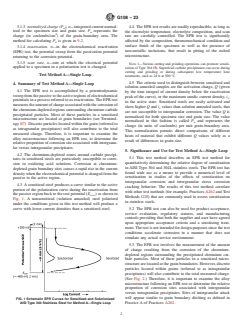
SIGNIFICANCE AND USE
5.1 This test method describes an EPR test method for quantitatively determining the relative degree of sensitization in AISI Type 304 and 304L stainless steels. The EPR test has found wide use as a means to provide a numerical level of sensitization in studies of the effects of sensitization on intergranular corrosion and intergranular stress corrosion cracking behavior. The results of this test method correlate with other test methods (for example, Practices A262 and Test Methods G28) that are commonly used to assess sensitization in stainless steels.
5.2 The EPR test can also be used for product acceptance, service evaluation, regulatory statutes, and manufacturing controls providing that both the supplier and user have agreed upon appropriate acceptance criteria and a sensitizing treatment. The test is not intended for design purposes since the test conditions accelerate corrosion in a manner that does not simulate any actual service environment.
5.3 The EPR test involves the measurement of the amount of charge resulting from the corrosion of the chromium-depleted regions surrounding the precipitated chromium carbide particles. Most of these particles in a sensitized microstructure are located at the grain boundaries. However, discrete particles located within grains (referred to as intragranular precipitates) will also contribute to the total measured charge. (See Fig. 2.) Therefore, it is important to examine the alloy microstructure following an EPR test to determine the relative proportion of corrosion sites associated with intergranular versus intragranular precipitates. Sites of intergranular attack will appear similar to grain boundary ditching as defined in Practice A of Practices A262.
FIG. 2 Schematic Microstructures After EPR Testing for Method A—Single Loop
Note 1: The calculation of Pa is based on the assumptions illustrated at left. Mild cases of sensitization usually result in a combination of intergranular attack and pitting as illustr...
SCOPE
1.1 These test methods cover a laboratory procedure for conducting an electrochemical reactivation (EPR) test on AISI Type 304 and 304L (UNS No. S30400 and S30403, respectively) stainless steels. These test methods can provide a nondestructive means of quantifying the degree of sensitization in Type 304 stainless steels (1, 2, 3).2 These EPR test methods have found wide acceptance in studies of the effects of sensitization on intergranular corrosion and intergranular stress corrosion cracking behavior (see Terminology G193). The EPR technique has been successfully used to evaluate other stainless steels and nickel base alloys (4), but the test conditions and evaluation criteria used were modified in each case from those cited in the current test methods. This standard test covers two tests, (1) Test Method A or Single Loop, and (2) Test Method B or Double Loop.
1.2 The values stated in SI units are to be regarded as standard. The values given in parentheses after SI units are provided for information only and are not considered standard.
1.3 This standard does not purport to address all of the safety concerns, if any, associated with its use. It is the responsibility of the user of this standard to establish appropriate safety, health, and environmental practices and determine the applicability of regulatory limitations prior to use.
1.4 This international standard was developed in accordance with internationally recognized principles on standardization established in the Decision on Principles for the Development of International Standards, Guides and Recommendations issued by the World Trade Organization Technical Barriers to Trade (TBT) Committee.
- Status
- Published
- Publication Date
- 14-Feb-2023
- Technical Committee
- G01 - Corrosion of Metals
- Drafting Committee
- G01.11 - Electrochemical Measurements in Corrosion Testing
Buy Documents
ASTM G108-23 - Standard Test Methods for Electrochemical Reactivation (EPR) for Detecting Sensitization of AISI Type 304 and 304L Stainless Steels
REDLINE ASTM G108-23 - Standard Test Methods for Electrochemical Reactivation (EPR) for Detecting Sensitization of AISI Type 304 and 304L Stainless Steels
Overview
ASTM G108-23 sets out standard test methods for electrochemical reactivation (EPR) to detect and quantify sensitization in AISI Type 304 and 304L stainless steels. Sensitization, a process where chromium carbide formation depletes chromium at grain boundaries, can severely affect corrosion resistance. This standard supports laboratories, manufacturers, and inspectors in evaluating the relative degree of sensitization, which directly impacts the susceptibility of stainless steels to intergranular corrosion and intergranular stress corrosion cracking.
The EPR technique described is a nondestructive, quantitative approach, offering consistent results when adequate control over test conditions is maintained. Results obtained by this standard are relevant for product acceptance, service evaluation, manufacturing controls, and regulatory compliance, provided acceptance criteria are mutually established between supplier and user.
Key Topics
- Purpose of EPR Testing: Provides a numerical measure of sensitization in AISI 304 and 304L stainless steels by detecting chromium-depleted zones susceptible to corrosion.
- Applicable Materials: Primarily AISI Type 304 and 304L (UNS S30400 and S30403), but adaptable with modifications for other stainless steels and nickel-base alloys.
- Test Methods: Includes two main methods:
- Single Loop EPR (Method A): A potentiodynamic sweep from passive to active potentials; measures total charge associated with corrosion of chromium-depleted grain boundaries.
- Double Loop EPR (Method B): A forward and reverse scan yielding two peaks; the ratio of reverse to forward peak current (Ir/Ia) quantifies degree of sensitization.
- Data Interpretation: Emphasizes the importance of correlating EPR results with other established tests (ASTM A262, ASTM G28) and metallographic examination to distinguish intergranular from intragranular corrosion.
- Precision and Reproducibility: Provides guidelines on specimen preparation, test apparatus, and test parameters. Repeatability and interlaboratory reproducibility data are included.
Applications
The ASTM G108-23 EPR test methods are widely applied in the following areas:
- Product Qualification: Verification of raw material or component quality before installation, especially in critical environments where corrosion resistance is paramount.
- Process Control: Evaluation of the sensitization effects from manufacturing processes such as welding and heat treatment.
- Service Evaluation: Determination of in-service degradation, enabling proactive maintenance or replacement to prevent failure.
- Regulatory Compliance: Supporting documentation to demonstrate compliance with standards regarding corrosion resistance and material performance.
- Research & Development: Investigation of the impact of alloy composition, heat treatment, or environmental exposure on sensitization and corrosion behavior.
Test results enable informed decisions on material suitability, predict long-term performance, and help optimize heat treatment or fabrication processes for corrosion-sensitive applications in industries such as chemical processing, power generation, and construction.
Related Standards
ASTM G108-23 references and complements several other standards that address stainless steel corrosion and testing methodologies:
- ASTM A262 - Practices for Detecting Susceptibility to Intergranular Attack in Austenitic Stainless Steels
- ASTM G28 - Test Methods for Detecting Susceptibility to Intergranular Corrosion in Wrought, Nickel-Rich, Chromium-Bearing Alloys
- ASTM D1193 - Specification for Reagent Water
- ASTM E3 - Guide for Preparation of Metallographic Specimens
- ASTM E112 - Test Methods for Determining Average Grain Size
- ASTM G5, G61 - Methods for Potentiodynamic and Cyclic Potentiodynamic Polarization Measurements
- ASTM G193 - Terminology Relating to Corrosion
Using ASTM G108-23 in conjunction with these related standards ensures comprehensive material evaluation and a robust approach to managing corrosion risks in stainless steel components.
Relations
- Effective Date
- 01-May-2019
- Effective Date
- 01-May-2018
- Effective Date
- 01-Jan-2017
- Effective Date
- 01-May-2016
- Effective Date
- 01-Jun-2015
- Effective Date
- 15-Dec-2014
- Effective Date
- 01-Nov-2014
- Effective Date
- 01-Nov-2014
- Effective Date
- 01-May-2014
- Effective Date
- 01-Dec-2013
- Effective Date
- 01-May-2013
- Effective Date
- 01-May-2013
- Effective Date
- 01-Feb-2013
- Effective Date
- 01-Feb-2013
- Effective Date
- 01-Feb-2013
Buy Documents
ASTM G108-23 - Standard Test Methods for Electrochemical Reactivation (EPR) for Detecting Sensitization of AISI Type 304 and 304L Stainless Steels
REDLINE ASTM G108-23 - Standard Test Methods for Electrochemical Reactivation (EPR) for Detecting Sensitization of AISI Type 304 and 304L Stainless Steels
Get Certified
Connect with accredited certification bodies for this standard

Element Materials Technology
Materials testing and product certification.

Inštitut za kovinske materiale in tehnologije
Institute of Metals and Technology. Materials testing, metallurgical analysis, NDT.
Sponsored listings
Frequently Asked Questions
ASTM G108-23 is a standard published by ASTM International. Its full title is "Standard Test Methods for Electrochemical Reactivation (EPR) for Detecting Sensitization of AISI Type 304 and 304L Stainless Steels". This standard covers: SIGNIFICANCE AND USE 5.1 This test method describes an EPR test method for quantitatively determining the relative degree of sensitization in AISI Type 304 and 304L stainless steels. The EPR test has found wide use as a means to provide a numerical level of sensitization in studies of the effects of sensitization on intergranular corrosion and intergranular stress corrosion cracking behavior. The results of this test method correlate with other test methods (for example, Practices A262 and Test Methods G28) that are commonly used to assess sensitization in stainless steels. 5.2 The EPR test can also be used for product acceptance, service evaluation, regulatory statutes, and manufacturing controls providing that both the supplier and user have agreed upon appropriate acceptance criteria and a sensitizing treatment. The test is not intended for design purposes since the test conditions accelerate corrosion in a manner that does not simulate any actual service environment. 5.3 The EPR test involves the measurement of the amount of charge resulting from the corrosion of the chromium-depleted regions surrounding the precipitated chromium carbide particles. Most of these particles in a sensitized microstructure are located at the grain boundaries. However, discrete particles located within grains (referred to as intragranular precipitates) will also contribute to the total measured charge. (See Fig. 2.) Therefore, it is important to examine the alloy microstructure following an EPR test to determine the relative proportion of corrosion sites associated with intergranular versus intragranular precipitates. Sites of intergranular attack will appear similar to grain boundary ditching as defined in Practice A of Practices A262. FIG. 2 Schematic Microstructures After EPR Testing for Method A—Single Loop Note 1: The calculation of Pa is based on the assumptions illustrated at left. Mild cases of sensitization usually result in a combination of intergranular attack and pitting as illustr... SCOPE 1.1 These test methods cover a laboratory procedure for conducting an electrochemical reactivation (EPR) test on AISI Type 304 and 304L (UNS No. S30400 and S30403, respectively) stainless steels. These test methods can provide a nondestructive means of quantifying the degree of sensitization in Type 304 stainless steels (1, 2, 3).2 These EPR test methods have found wide acceptance in studies of the effects of sensitization on intergranular corrosion and intergranular stress corrosion cracking behavior (see Terminology G193). The EPR technique has been successfully used to evaluate other stainless steels and nickel base alloys (4), but the test conditions and evaluation criteria used were modified in each case from those cited in the current test methods. This standard test covers two tests, (1) Test Method A or Single Loop, and (2) Test Method B or Double Loop. 1.2 The values stated in SI units are to be regarded as standard. The values given in parentheses after SI units are provided for information only and are not considered standard. 1.3 This standard does not purport to address all of the safety concerns, if any, associated with its use. It is the responsibility of the user of this standard to establish appropriate safety, health, and environmental practices and determine the applicability of regulatory limitations prior to use. 1.4 This international standard was developed in accordance with internationally recognized principles on standardization established in the Decision on Principles for the Development of International Standards, Guides and Recommendations issued by the World Trade Organization Technical Barriers to Trade (TBT) Committee.
SIGNIFICANCE AND USE 5.1 This test method describes an EPR test method for quantitatively determining the relative degree of sensitization in AISI Type 304 and 304L stainless steels. The EPR test has found wide use as a means to provide a numerical level of sensitization in studies of the effects of sensitization on intergranular corrosion and intergranular stress corrosion cracking behavior. The results of this test method correlate with other test methods (for example, Practices A262 and Test Methods G28) that are commonly used to assess sensitization in stainless steels. 5.2 The EPR test can also be used for product acceptance, service evaluation, regulatory statutes, and manufacturing controls providing that both the supplier and user have agreed upon appropriate acceptance criteria and a sensitizing treatment. The test is not intended for design purposes since the test conditions accelerate corrosion in a manner that does not simulate any actual service environment. 5.3 The EPR test involves the measurement of the amount of charge resulting from the corrosion of the chromium-depleted regions surrounding the precipitated chromium carbide particles. Most of these particles in a sensitized microstructure are located at the grain boundaries. However, discrete particles located within grains (referred to as intragranular precipitates) will also contribute to the total measured charge. (See Fig. 2.) Therefore, it is important to examine the alloy microstructure following an EPR test to determine the relative proportion of corrosion sites associated with intergranular versus intragranular precipitates. Sites of intergranular attack will appear similar to grain boundary ditching as defined in Practice A of Practices A262. FIG. 2 Schematic Microstructures After EPR Testing for Method A—Single Loop Note 1: The calculation of Pa is based on the assumptions illustrated at left. Mild cases of sensitization usually result in a combination of intergranular attack and pitting as illustr... SCOPE 1.1 These test methods cover a laboratory procedure for conducting an electrochemical reactivation (EPR) test on AISI Type 304 and 304L (UNS No. S30400 and S30403, respectively) stainless steels. These test methods can provide a nondestructive means of quantifying the degree of sensitization in Type 304 stainless steels (1, 2, 3).2 These EPR test methods have found wide acceptance in studies of the effects of sensitization on intergranular corrosion and intergranular stress corrosion cracking behavior (see Terminology G193). The EPR technique has been successfully used to evaluate other stainless steels and nickel base alloys (4), but the test conditions and evaluation criteria used were modified in each case from those cited in the current test methods. This standard test covers two tests, (1) Test Method A or Single Loop, and (2) Test Method B or Double Loop. 1.2 The values stated in SI units are to be regarded as standard. The values given in parentheses after SI units are provided for information only and are not considered standard. 1.3 This standard does not purport to address all of the safety concerns, if any, associated with its use. It is the responsibility of the user of this standard to establish appropriate safety, health, and environmental practices and determine the applicability of regulatory limitations prior to use. 1.4 This international standard was developed in accordance with internationally recognized principles on standardization established in the Decision on Principles for the Development of International Standards, Guides and Recommendations issued by the World Trade Organization Technical Barriers to Trade (TBT) Committee.
ASTM G108-23 is classified under the following ICS (International Classification for Standards) categories: 77.140.20 - Stainless steels. The ICS classification helps identify the subject area and facilitates finding related standards.
ASTM G108-23 has the following relationships with other standards: It is inter standard links to ASTM G3-14(2019), ASTM G61-86(2018), ASTM G215-17, ASTM G215-16, ASTM E7-15, ASTM G3-14, ASTM E7-14, ASTM G5-14, ASTM G61-86(2014), ASTM G3-13, ASTM E691-13, ASTM A262-13, ASTM G5-13, ASTM G5-13e1, ASTM G5-13e2. Understanding these relationships helps ensure you are using the most current and applicable version of the standard.
ASTM G108-23 is available in PDF format for immediate download after purchase. The document can be added to your cart and obtained through the secure checkout process. Digital delivery ensures instant access to the complete standard document.
Standards Content (Sample)
This international standard was developed in accordance with internationally recognized principles on standardization established in the Decision on Principles for the
Development of International Standards, Guides and Recommendations issued by the World Trade Organization Technical Barriers to Trade (TBT) Committee.
Designation: G108 − 23
Standard Test Methods for
Electrochemical Reactivation (EPR) for Detecting
Sensitization of AISI Type 304 and 304L Stainless Steels
This standard is issued under the fixed designation G108; the number immediately following the designation indicates the year of
original adoption or, in the case of revision, the year of last revision. A number in parentheses indicates the year of last reapproval. A
superscript epsilon (´) indicates an editorial change since the last revision or reapproval.
1. Scope 2. Referenced Documents
1.1 These test methods cover a laboratory procedure for 2.1 ASTM Standards:
conducting an electrochemical reactivation (EPR) test on AISI A262 Practices for Detecting Susceptibility to Intergranular
Type 304 and 304L (UNS No. S30400 and S30403, respec- Attack in Austenitic Stainless Steels
tively) stainless steels. These test methods can provide a D1193 Specification for Reagent Water
nondestructive means of quantifying the degree of sensitization E3 Guide for Preparation of Metallographic Specimens
in Type 304 stainless steels (1, 2, 3). These EPR test methods E7 Terminology Relating to Metallography
have found wide acceptance in studies of the effects of E112 Test Methods for Determining Average Grain Size
sensitization on intergranular corrosion and intergranular stress E691 Practice for Conducting an Interlaboratory Study to
corrosion cracking behavior (see Terminology G193). The EPR Determine the Precision of a Test Method
technique has been successfully used to evaluate other stainless G1 Practice for Preparing, Cleaning, and Evaluating Corro-
steels and nickel base alloys (4), but the test conditions and sion Test Specimens
evaluation criteria used were modified in each case from those G3 Practice for Conventions Applicable to Electrochemical
cited in the current test methods. This standard test covers two Measurements in Corrosion Testing
tests, (1) Test Method A or Single Loop, and (2) Test Method G5 Reference Test Method for Making Potentiodynamic
B or Double Loop. Anodic Polarization Measurements
G28 Test Methods for Detecting Susceptibility to Inter-
1.2 The values stated in SI units are to be regarded as
granular Corrosion in Wrought, Nickel-Rich, Chromium-
standard. The values given in parentheses after SI units are
Bearing Alloys
provided for information only and are not considered standard.
G61 Test Method for Conducting Cyclic Potentiodynamic
1.3 This standard does not purport to address all of the
Polarization Measurements for Localized Corrosion Sus-
safety concerns, if any, associated with its use. It is the
ceptibility of Iron-, Nickel-, or Cobalt-Based Alloys
responsibility of the user of this standard to establish appro-
G193 Terminology and Acronyms Relating to Corrosion
priate safety, health, and environmental practices and deter-
G215 Guide for Electrode Potential Measurement
mine the applicability of regulatory limitations prior to use.
1.4 This international standard was developed in accor-
3. Terminology
dance with internationally recognized principles on standard-
3.1 Definitions of Terms Specific to This Standard:
ization established in the Decision on Principles for the
3.1.1 integrated charge (Q), n—charge measured, in
Development of International Standards, Guides and Recom-
coulombs, during reactivation as given by the time integral of
mendations issued by the World Trade Organization Technical
current below the reactivation peak of the curve.
Barriers to Trade (TBT) Committee.
3.1.2 maximum anodic current density (i ), n—current den-
r
sity measured at the peak of the anodic curve during reactiva-
These test methods are under the jurisdiction of ASTM Committee G01 on
tion.
Corrosion of Metals and are the direct responsibility of Subcommittee G01.11 on
Electrochemical Measurements in Corrosion Testing.
Current edition approved Feb. 15, 2023. Published September 2023. Originally
approved in 1992. Last previous edition approved in 2015 as G108 – 94 (2015). For referenced ASTM standards, visit the ASTM website, www.astm.org, or
DOI: 10.1520/G0108-23. contact ASTM Customer Service at service@astm.org. For Annual Book of ASTM
The boldface numbers in parentheses refer to a list of references at the end of Standards volume information, refer to the standard’s Document Summary page on
this standard. the ASTM website.
Copyright © ASTM International, 100 Barr Harbor Drive, PO Box C700, West Conshohocken, PA 19428-2959. United States
G108 − 23
3.1.3 normalized charge (P ), n—integrated current normal- 4.4 The EPR test results are readily reproducible, as long as
a
ized to the specimen size and grain size. P represents the the electrolyte temperature, electrolyte composition, and scan
a
charge (in coulombs/cm ) of the grain-boundary area. The
rate are carefully controlled. The EPR test is significantly
method for calculating P is given in 9.2. affected by the composition, thermomechanical condition and
a
surface finish of the specimen as well as the presence of
3.1.4 reactivation, n—in the electrochemical reactivation
non-metallic inclusions, that result in pitting of the etched
(EPR) test, the potential sweep from the passivation potential
microstructure.
returning to the corrosion potential.
3.1.5 scan rate, n—rate at which the electrical potential
NOTE 1—Various cutting and grinding operations can promote sensiti-
applied to a specimen in a polarization test is changed.
zation of Type 304 (5). Superficial carbide precipitation can occur during
cutting and grinding or during subsequent low temperature heat
Test Method A—Single Loop treatments, such as 24 h at 500 °C.
4.5 The criteria used to distinguish between sensitized and
4. Summary of Test Method A—Single Loop
solution annealed samples are the activation charge, Q (given
4.1 The EPR test is accomplished by a potentiodynamic
by the time integral of current density below the reactivation
sweep from the passive to the active regions of electrochemical
peak of the curve), or the maximum anodic current density, i ,
r
potentials in a process referred to as reactivation. The EPR test
in the active state. Sensitized steels are easily activated and
measures the amount of charge associated with the corrosion of
show higher Q and i values than solution annealed steels, that
r
the chromium-depleted regions surrounding chromium carbide
are not susceptible to intergranular corrosion. The value Q is
precipitated particles. Most of these particles in a sensitized
normalized for both specimen size and grain size. The value
microstructure are located at grain boundaries (see Terminol-
normalized in this fashion is called P and represents the
a
ogy E7). Discrete particles located within the grain (referred to
charge (in units of coulombs) per unit grain-boundary area.
as intragranular precipitates) will also contribute to the total
This normalization permits direct comparisons of different
measured charge. Therefore, it is important to examine the
heats of material that exhibit different Q values solely as a
alloy microstructure following an EPR test, to determine the
result of differences in grain size.
relative proportion of corrosion site associated with intergranu-
lar versus intragranular precipitates.
5. Significance and Use for Test Method A—Single Loop
4.2 The chromium-depleted zones around carbide precipi-
5.1 This test method describes an EPR test method for
tates in sensitized steels are particularly susceptible to corro-
quantitatively determining the relative degree of sensitization
sion in oxidizing acid solutions. Corrosion at chromium-
in AISI Type 304 and 304L stainless steels. The EPR test has
depleted grain boundary sites causes a rapid rise in the current
found wide use as a means to provide a numerical level of
density when the electrochemical potential is changed from the
sensitization in studies of the effects of sensitization on
passive to the active region.
intergranular corrosion and intergranular stress corrosion
4.3 A sensitized steel produces a curve similar to the active
cracking behavior. The results of this test method correlate
portion of the polarization curve during the reactivation from
with other test methods (for example, Practices A262 and Test
the passive region back to the rest potential (E ) as shown in
corr
Methods G28) that are commonly used to assess sensitization
Fig. 1. A nonsensitized (solution annealed) steel polarized
in stainless steels.
under the conditions given in this test method will produce a
curve with lower current densities than a sensitized steel. 5.2 The EPR test can also be used for product acceptance,
service evaluation, regulatory statutes, and manufacturing
controls providing that both the supplier and user have agreed
upon appropriate acceptance criteria and a sensitizing treat-
ment. The test is not intended for design purposes since the test
conditions accelerate corrosion in a manner that does not
simulate any actual service environment.
5.3 The EPR test involves the measurement of the amount
of charge resulting from the corrosion of the chromium-
depleted regions surrounding the precipitated chromium car-
bide particles. Most of these particles in a sensitized micro-
structure are located at the grain boundaries. However, discrete
particles located within grains (referred to as intragranular
precipitates) will also contribute to the total measured charge.
(See Fig. 2.) Therefore, it is important to examine the alloy
microstructure following an EPR test to determine the relative
proportion of corrosion sites associated with intergranular
versus intragranular precipitates. Sites of intergranular attack
will appear similar to grain boundary ditching as defined in
FIG. 1 Schematic EPR Curves for Sensitized and Solutionized
AISI Type 304 Stainless Steel for Method A—Single Loop Practice A of Practices A262.
G108 − 23
6.2.1.2 Scanning back to the open circuit potential (reacti-
vation) at a voltage scan rate of 1.67 mV/s (6 V/h).
6.2.2 Potential Measuring Instruments—Requirements shall
be in accordance with 4.3 of Reference Test Method G5 except
that the potential range is as stated above.
6.2.3 Current Measuring Instruments—Requirements shall
be in accordance with 4.4 of Reference Test Method G5.
However, current measurements are essential for passivation
assessment and other intermediate checks of system stability.
The currents encountered in EPR for a specimen with the
NOTE 1—The calculation of P is based on the assumptions illustrated
a
dimensions given in 7.3 are in the range of 1 μA to
at left. Mild cases of sensitization usually result in a combination of 2 2
100 mA ⁄cm . For samples of less than 100 mm test area,
intergranular attack and pitting as illustrated at right (6).
currents above about 20 mA/cm rarely have been reported.
FIG. 2 Schematic Microstructures After EPR Testing for Method
6.2.4 Current Integration Measurement Instruments
A—Single Loop
(Optional)—Current integration, or charge, can be measured by
an electronic device incorporated into the potentiostat, or by a
6. Apparatus for Test Method A—Single Loop
separate electronic device, such as a coulometer. If a coulom-
eter is used, it shall be capable of measuring charges from
6.1 The apparatus necessary for obtaining EPR data consists
0.001 coulombs to 2 coulombs. The use of a coulometer shall
of electronic instruments and a test cell. These instruments may
be considered optional. Charge can also be measured by using
be integrated into one instrument package or may be individual
a chart recorder, as illustrated in Fig. 3, to record a current
components. Either form of instrumentation can provide ac-
versus time trace and then, subsequently, integrating it by
ceptable data.
various methods. When potentiostat measurements are avail-
6.2 Typical apparatus, as illustrated in Fig. 3, shall consist of
able in a digitized format, an appropriate computer integration
the following: scanning potentiostat (or potentiostat/voltage
routine can also be used to obtain a value for charge.
ramp generator combination), potential measuring instrument,
6.2.5 EPR Test Cell—Requirements shall be in accordance
current and current integration measuring instruments, and test
with 4.1 of Reference Test Method G5. A deaeration tube is not
cell and specimen holder.
required and only one counter electrode is required for EPR
6.2.1 Scanning Potentiostat—Requirements shall be in ac-
testing. A suitable cell and electrode arrangement is shown in
cordance with 4.2 of Reference Test Method G5 with the
Fig. 4.
following refinements: the potentiostat shall control the poten-
6.2.6 Electrode Holder—Requirements shall be in accor-
tial within 65 mV accuracy over the range of potential and
dance with 4.6 of Reference Test Method G5 or 4.2.1 of Test
current density encountered in the EPR measurements. The
Method G61. The requirements for the working electrode
potentiostat shall be operable in a potential range of −600 mV
(specimen) and counter electrode holders are that the holders
to +500 mV (SCE) and a current density range of 1 μA to
100 mA ⁄cm . The applied potential is changed either automati-
cally or manually in the following manners:
6.2.1.1 Shifting the potential from the open circuit potential
to a potential in the passive range, and
NOTE 1—The sample face is completely immersed but the connection to
the electrode holder is not immersed.
FIG. 3 Schematic Diagram of EPR Test Apparatus for Method FIG. 4 Schematic Diagram of Electrochemical Cell for EPR Test-
A—Single Loop ing
G108 − 23
be made of an inert material and any seals must not allow treatment. The most common sensitizing treatment is 1 h at
leakage of the electrolyte. When using the Reference Test 675 °C (1250 °F) according to 15.3 of Practices A262.
Method G5-type holder the working electrode can be mounted
7.2.2 Heat treatment, particularly carburization, may alter
as shown in Fig. 5 and described in Appendix X1.
the surface to be tested and may invalidate the EPR test results.
6.2.7 Auxiliary (Counter) Electrodes—Requirements are in
Precautions shall be taken to ensure that the specimen surface
accordance with 4.7.2 of Reference Test Method G5 except
is representative of the product form in service. Refer to
that only one counter electrode is necessary for EPR testing.
Section 6 of Practice G1 for descaling procedures and 7.3, as
However, two auxiliary electrodes can provide for a more
well as Section 5 of Practices A262 for guidance in preparing
uniform distribution of current. Titanium or high-purity carbon
specimens.
may be used in place of platinum for the counter electrode
7.2.3 Expose specimens to be given a sensitization treat-
since it is always the cathode.
ment prior to EPR testing in a furnace at the required
6.2.8 Calomel Reference Electrode—Requirements are in
temperature and for the required time and then water-quench.
accordance or equivalent to 4.7.3 of Reference Test Method
Use a thermocouple and a timer to ensure that the entire
G5. A KCl saturated silver/silver chloride electrode can also be
specimen cross sections are at the specified temperature for the
used for testing (Practice G3 and Guide G215).
specified amount of time. The number of thermocouples
needed to obtain a reliable reading for all specimens exposed in
NOTE 2—The precision for Method A has not been determined for a
KCl saturated silver/silver chloride electrode. a furnace at a given time is left to the discretion of the user.
7.3 Specimen Preparation:
7. Sampling, Test Specimens, and Test Units for Test
7.3.1 Test specimens can be any shape but shall be at least
Method A—Single Loop
3.2 mm (0.125 in.) in diameter or on a side dimension and of
7.1 Sampling:
a suitable thickness. Specimens shall not be larger than
7.1.1 When using this test method to meet product accep-
2 2
130 mm (0.2 in. ) in area since such specimens will not fit into
tance criteria, the means of sampling of a test specimen shall be
the recommended mold for mounting (see Appendix X1). A
decided by agreement between the parties involved; for
mounted specimen is illustrated in Fig. 5.
instance, but not limited to, a user and a supplier.
7.3.2 Remove any oxides or grease from the specimen as
7.1.2 Specimens removed from a piece of AISI Type 304 or
such film may promote loss of adhesion between the mounting
304L steel by shearing, cutting, burning, and so forth shall have
compound and the specimen that could cause a crevice to form
the affected edges removed by grinding or machining.
thereby producing erroneously high current densities during
7.2 Sensitization of Test Specimens—Specimens can be
the EPR measurement.
given a sensitizing treatment when it is desired to assess the
7.3.3 The front surface of the specimen will be evaluated in
influence of a thermal exposure during fabrication on corrosion
the EPR test. The back surface of the test specimen is used to
resistance.
establish electrical contact with the specimen (see Note 3).
7.2.1 Specimens may be tested in a condition simulating
that of the product as installed in service. Specimens may be NOTE 3—A convenient way to make this attachment may be either by
spot welding or by using a conducting cement to fasten a stainless steel
welded or heat treated in as nearly the same manner as the
machine screw (for example, NC4-40 × 0.3 cm (0.75 in.) long) to the back
product will experience in fabrication or service. The user and
surface of the specimen. This assembly is mounted in a suitable compound
supplier must agree to the use and conditions of a sensitization
that is inert in the EPR electrolyte (see Appendix X1) such that the front
surface upon immersion in the EPR electrolyte is fully in contact with the
electrolyte.
7.3.4 Measure the surface area of the front surface of the test
specimen within 0.1 mm precision and record on the EPR data
record sheet (see Appendix X2).
7.3.5 Specimens can be in any shape that will not be
susceptible to crevice corrosion in the solution. Test surface
2 2 2
area shall be at least 10 mm 6 0.1 mm (0.016 in. ). It is
occasionally useful to mask the area to be measured leaving an
opening for exposure to the electrolyte. One suitable masking
method uses precut pieces of an acid resistant tape. Care must
be taken not to introduce undercutting of the tape during the
EPR measurement because it will cause erroneously large
currents.
8. Procedure for Test Method A—Single Loop
8.1 Metallographic Preparation:
8.1.1 Polish and attach the test specimen, mounted in a
suitable inert compound, to the electrode holder following the
FIG. 5 A Method of Mounting Specimens for EPR Testing (6) for
Method A—Single Loop procedures and cautions described in 8.1.2 to 8.1.6:
G108 − 23
8.1.2 Exercise care since any crevice between the specimen 8.4 Reactivation Scan:
and the mounting compound could lead to erroneously large 8.4.1 Set the current integration to zero and start the current
current densities. integrator instrument. (Some instruments perform these steps
automatically.) Start the potential scan in the active direction at
8.1.3 Prepare the surface within 1 h of the experiment, or
the rate of 1.67 mV ⁄s 6 0.08 mV/s (6 V/h). During the
store the prepared specimen in a suitable desiccating cabinet.
reactivation scan, the current density will decay quite rapidly.
Wet grind with 240 grit and 400 grit silicon carbide papers, and
8.4.2 Record the reading on current integrator when poten-
wet polish with 600 grit silicon carbide paper until all coarse
tial reaches 50 mV above (more positive) the initial E . This
scratches are removed. Rinse with water and dry. Polish the
corr
reading is the integrated current or charge value in coulombs.
specimens in two additional stages with 6 and 1 μm diamond
(Some instruments are capable of ending the experiment
paste on a low speed polishing wheel in accordance with Guide
automatically.) The test is complete once this reading has been
E3.
obtained.
8.1.4 Polishing specimens on automated, high speed wheels
8.4.3 Once the test is complete, put all electrochemical
using aluminum oxide slurries is not recommended. Specimens
polarization equipment on standby. Remove the specimen from
tend to retain an alumina impregnated surface layer that gives
the cell and holder, rinse it in water, clean with alcohol or
erroneous results during the EPR test.
detergent, rinse again, and then air dry.
8.1.5 Attach the specimen to the specimen holder as de-
8.4.4 Optional E Versus Log I Plot—The recorder automati-
scribed in either 4.6.1 of Reference Test Method G5 or 4.2.1 of
cally plots the anodic polarization data on semilogarithmic
Test Method G61. In the case of the Reference Test Method
paper in accordance with Practice G3. A strip chart recorder
G5-type holder, tighten the assembly by holding the upper end
may also be used since potential is linear with time.
of the mounting rod in a vise or clamp while turning the
mounting nut until the gasket is properly compressed. Simi- 8.5 Metallographic Inspection:
larly for the Test Method G61-type holder, it is important to 8.5.1 Photograph surface of each specimen after testing
properly compress the TFE-fluorocarbon gasket to minimize (without additional preparation or etching) at a suitable mag-
the potential for crevice corrosion. nification to determine grain size and to document the micro-
structures and extent of grain boundary attack. If the specimen
8.1.6 Clean the specimen just before immersion in the
is not sufficiently etched after the EPR test to delineate the
electrolyte by degreasing with a suitable detergent, rinsing in
microstructure for grain size determination, then the specimen
distilled water, then reagent grade methanol, and air drying.
shall be etched by either electrolytic 10 % oxalic acid (in
8.2 Test Solution Preparation:
accordance with Practice A of Practices A262), 60 % HNO -
8.2.1 Prepare a mixture of reagent grade sulfuric acid
40 % H O (7), or by other suitable means to delineate the grain
(H SO ) and potassium thiocyanate (KSCN) in reagent water
2 4
boundaries.
as follows: 1 L of 0.5 M H SO +0.01 M KSCN and Type IV
2 4
8.5.2 Examine the microstructure after the EPR test to
reagent water (in accordance with Specification D1193). The
ensure that the bulk of the integrated current Q value actually
solution can be made up in bulk and stored for one month at
represents attack of the grain boundary areas (that is, “ditch-
room temperature. Transfer approximately 500 mL to 600 mL
ing” in terms of Practice A of Practices A262 has occurred).
of solution to a clean test cell.
Reactivation of intragranular (matrix) precipitates (principally
chromium carbides) that may be present in substantial quanti-
8.3 Initiating the Test:
ties in some specimens (6, 8) may contribute to the integrated
8.3.1 Bring the temperature of the solution to 30 °C 6 1 °C
current Q value. Intragranular precipitates are only of concern
by immersing the cell in a controlled temperature water bath or
when the Q value is above an established acceptance criteria.
by other convenient means.
In such cases, the user and supplier may have to agree to higher
8.3.2 Place the specimen, counter electrodes, salt bridge
acceptance criteria values that reflect the contribution of
probe, and other components in the test cell. Ensure the salt
intragranular precipitates to the measured Q value. Examples
bridge is filled with the test solution and contains no air
of correlations of Pa values to the degree of sensitization for
bubbles, particularly in the restricted space at the tip.
AISI Type 304 and 304L stainless steels are offered as a
8.3.3 Record the open circuit potential (OCP) of the test
general guide to interpretation of EPR results in Appendix X3.
specimen after 1 min to 2 min of immersion. If the OCP is not
consistent with typical values for the given alloy (for ex-
9. Calculation for Test Method A—Single Loop
ample, −350 mV to −450 mV versus SCE for AISI Type 304), 2
9.1 Calculate the surface area (As) of the specimen in cm
cathodically polarize the specimen to −600 mV versus SCE for
by using the dimensions in 7.3.4.
0.1 to 1 min and recheck the rest potential. If the rest potential
9.2 Calculate and record the normalized charge (P ) in units
a
is still abnormal (relative to the usual value around −200 mV
of coulomb
...
This document is not an ASTM standard and is intended only to provide the user of an ASTM standard an indication of what changes have been made to the previous version. Because
it may not be technically possible to adequately depict all changes accurately, ASTM recommends that users consult prior editions as appropriate. In all cases only the current version
of the standard as published by ASTM is to be considered the official document.
Designation: G108 − 94 (Reapproved 2015) G108 − 23
Standard Test MethodMethods for
Electrochemical Reactivation (EPR) for Detecting
Sensitization of AISI Type 304 and 304L Stainless Steels
This standard is issued under the fixed designation G108; the number immediately following the designation indicates the year of
original adoption or, in the case of revision, the year of last revision. A number in parentheses indicates the year of last reapproval. A
superscript epsilon (´) indicates an editorial change since the last revision or reapproval.
1. Scope
1.1 This test method coversThese test methods cover a laboratory procedure for conducting an electrochemical reactivation (EPR)
test on AISI Type 304 and 304L (UNS No. S30400 and S30403, respectively) stainless steels. This test methodThese test methods
can provide a nondestructive means of quantifying the degree of sensitization in these Type 304 stainless steels (1, 2, 3). This test
method hasThese EPR test methods have found wide acceptance in studies of the effects of sensitization on intergranular corrosion
and intergranular stress corrosion cracking behavior (see Terminology G15G193). The EPR technique has been successfully used
to evaluate other stainless steels and nickel base alloys (4), but the test conditions and evaluation criteria used were modified in
each case from those cited in this test method. the current test methods. This standard test covers two tests, (1) Test Method A or
Single Loop, and (2) Test Method B or Double Loop.
1.2 The values stated in SI units are to be regarded as the standard. The inch-pound units values given in parentheses are for
information only.after SI units are provided for information only and are not considered standard.
1.3 This standard does not purport to address all of the safety concerns, if any, associated with its use. It is the responsibility
of the user of this standard to establish appropriate safety and healthsafety, health, and environmental practices and determine
the applicability of regulatory limitations prior to use.
1.4 This international standard was developed in accordance with internationally recognized principles on standardization
established in the Decision on Principles for the Development of International Standards, Guides and Recommendations issued
by the World Trade Organization Technical Barriers to Trade (TBT) Committee.
2. Referenced Documents
2.1 ASTM Standards:
A262 Practices for Detecting Susceptibility to Intergranular Attack in Austenitic Stainless Steels
D1193 Specification for Reagent Water
E3 Guide for Preparation of Metallographic Specimens
E7 Terminology Relating to Metallography
E112 Test Methods for Determining Average Grain Size
E691 Practice for Conducting an Interlaboratory Study to Determine the Precision of a Test Method
G1 Practice for Preparing, Cleaning, and Evaluating Corrosion Test Specimens
G3 Practice for Conventions Applicable to Electrochemical Measurements in Corrosion Testing
This test method isThese test methods are under the jurisdiction of ASTM Committee G01 on Corrosion of Metals and isare the direct responsibility of Subcommittee
G01.11 on Electrochemical Measurements in Corrosion Testing.
Current edition approved Nov. 1, 2015Feb. 15, 2023. Published December 2015September 2023. Originally approved in 1992. Last previous edition approved in 20102015
as G108–94(2010).G108 – 94 (2015). DOI: 10.1520/G0108-94R15.10.1520/G0108-23.
The boldface numbers in parentheses refer to a list of references at the end of this standard.
For referenced ASTM standards, visit the ASTM website, www.astm.org, or contact ASTM Customer Service at service@astm.org. For Annual Book of ASTM Standards
volume information, refer to the standard’sstandard’s Document Summary page on the ASTM website.
Copyright © ASTM International, 100 Barr Harbor Drive, PO Box C700, West Conshohocken, PA 19428-2959. United States
G108 − 23
G5 Reference Test Method for Making Potentiodynamic Anodic Polarization Measurements
G15 Terminology Relating to Corrosion and Corrosion Testing (Withdrawn 2010)
G28 Test Methods for Detecting Susceptibility to Intergranular Corrosion in Wrought, Nickel-Rich, Chromium-Bearing Alloys
G61 Test Method for Conducting Cyclic Potentiodynamic Polarization Measurements for Localized Corrosion Susceptibility of
Iron-, Nickel-, or Cobalt-Based Alloys
G193 Terminology and Acronyms Relating to Corrosion
G215 Guide for Electrode Potential Measurement
3. Terminology
3.1 Definitions of Terms Specific to This Standard:
3.1.1 integrated charge (Q)—(Q), n—the charge measured, in coulombs, during reactivation as given by the time integral of
current density below the reactivation peak of the curve.
3.1.2 maximum anodic current density (I(i )—), n—the current density measured at the peak of the anodic curve during
r
reactivation.
3.1.3 normalized charge (P )—), n—the integrated current normalized to the specimen size and grain size. P represents the charge
a a
(in coulombs/cm ) of the grain-boundary area. The method for calculating P is given in 9.2.
a
3.1.4 reactivation—reactivation, n—in the electrochemical reactivation (EPR) test, the potential sweep from the passivation
potential returning to the corrosion potential.
3.1.5 scan rate—rate, n—the rate at which the electrical potential applied to a specimen in a polarization test is changed.
Test Method A—Single Loop
4. Summary of Test Method A—Single Loop
4.1 The EPR test is accomplished by a potentiodynamic sweep from the passive to the active regions of electrochemical potentials
in a process referred to as reactivation. The EPR test measures the amount of charge associated with the corrosion of the
chromium-depleted regions surrounding chromium carbide precipitated particles. Most of these particles in a sensitized
microstructure are located at grain boundaries (see Terminology E7). Discrete particles located within the grain (referred to as
intragranular precipitates) will also contribute to the total measured charge. Therefore, it is important to examine the alloy
microstructure following an EPR test, to determine the relative proportion of corrosion site associated with intergranular versus
intragranular precipitates.
4.2 The chromium-depleted zones around carbide precipitates in sensitized steels are particularly susceptible to corrosion in
oxidizing acid solutions. Corrosion at chromium-depleted grain boundary sites causes a rapid rise in the current density when the
electrochemical potential is changed from the passive to the active region.
4.3 A sensitized steel produces a curve similar to the active portion of the polarization curve during the reactivation from the
passive region back to the rest potential (E ) as shown in Fig. 1. A nonsensitized (solution annealed) steel polarized under the
corr
conditions given in this test method will produce a curve with lower current densities than a sensitized steel.
4.4 The EPR test results are readily reproducible, as long as the electrolyte temperature, electrolyte composition, and scan rate are
carefully controlled. The EPR test is significantly affected by the composition, thermomechanical condition and surface finish of
the specimen as well as the presence of non-metallic inclusions, that result in pitting of the etched microstructure.
NOTE 1—Various cutting and grinding operations can promote sensitization of Type 304 (5). Superficial carbide precipitation can occur during cutting
and grinding or during subsequent low temperature heat treatments, such as 24 h at 500°C.500 °C.
4.5 The criteria used to distinguish between sensitized and solution annealed samples are the activation charge density, charge, Q
(given by the time integral of current density below the reactivation peak of the curve), or the maximum anodic current density,
Ii , in the active state. Sensitized steels are easily activated and show higher Q and Ii values than solution annealed steels, that
r r
G108 − 23
FIG. 1 Schematic EPR Curves for Sensitized and Solutionized AISI Type 304 Stainless Steel for Method A—Single Loop
are not susceptible to intergranular corrosion. The value Q is normalized for both specimen size and grain size. The value
normalized in this fashion is called P and represents the charge (in units of coulombs) per unit grain-boundary area. This
a
normalization permits direct comparisons of different heats of material that exhibit different Q values solely as a result of
differences in grain size.
5. Significance and Use for Test Method A—Single Loop
5.1 This test method describes an EPR test method for quantitatively determining the relative degree of sensitization in AISI Type
304 and 304L stainless steels. The EPR test has found wide use as a means to provide a numerical level of sensitization in studies
of the effects of sensitization on intergranular corrosion and intergranular stress corrosion cracking behavior. The results of this
test method correlate with other test methods (for example, Practices A262 and Test Methods G28) that are commonly used to
assess sensitization in stainless steels.
5.2 The EPR test can also be used for product acceptance, service evaluation, regulatory statutes, and manufacturing controls
providing that both the supplier and user have agreed upon appropriate acceptance criteria and a sensitizing treatment. The test is
not intended for design purposes since the test conditions accelerate corrosion in a manner that does not simulate any actual service
environment.
5.3 The EPR test involves the measurement of the amount of charge resulting from the corrosion of the chromium-depleted
regions surrounding the precipitated chromium carbide particles. Most of these particles in a sensitized microstructure are located
at the grain boundaries. However, discrete particles located within grains (referred to as intragranular precipitates) will also
contribute to the total measured charge. (See Fig. 2.) Therefore, it is important to examine the alloy microstructure following an
EPR test to determine the relative proportion of corrosion sites associated with intergranular versus intragranular precipitates. Sites
of intergranular attack will appear similar to grain boundary ditching as defined in Practice A of Practices A262.
NOTE 1—The calculation of P is based on the assumptions illustrated at left. Mild cases of sensitization usually result in a combination of intergranular
a
attack and pitting as illustrated at right (6).
FIG. 2 Schematic Microstructures After EPR Testing for Method A—Single Loop
G108 − 23
6. Apparatus for Test Method A—Single Loop
6.1 The apparatus necessary for obtaining EPR data consists of electronic instruments and a test cell. These instruments may be
integrated into one instrument package or may be individual components. Either form of instrumentation can provide acceptable
data.
6.2 Typical apparatus, as illustrated in Fig. 3, shall consist of the following: scanning potentiostat (or potentiostat/voltage ramp
generator combination), potential measuring instrument, current and current integration measuring instruments, and test cell and
specimen holder.
6.2.1 Scanning Potentiostat—Requirements shall be in accordance with 4.2 of Reference Test Method G5 with the following
refinements: the potentiostat shall control the potential within 65 mV accuracy over the range of potential and current density
encountered in the EPR measurements. The potentiostat shall be operable in a potential range of −600of −600 mV to +500 mV
(SCE) and a current density range of 1 μA to 100 100 mA mA/cm⁄cm . The applied potential is changed either automatically or
manually in the following manners:
6.2.1.1 Shifting the potential from the open circuit potential to a potential in the passive range, and
6.2.1.2 Scanning back to the open circuit potential (reactivation) at a voltage scan rate of 1.67 mV/s (6 V/h).
6.2.2 Potential Measuring Instruments—Requirements shall be in accordance with 4.3 of Reference Test Method G5 except that
the potential range is as stated above.
6.2.3 Current Measuring Instruments—Requirements shall be in accordance with 4.4 of Reference Test Method G5. However,
current measurements are essential for passivation assessment and other intermediate checks of system stability. The currents
encountered in EPR for a specimen with the dimensions given in 7.3 are in the range of 1 μA to 100 100 mA mA/cm⁄cm . For
2 2
samples of less than 100 mm test area, currents above about 20 mA/cm rarely have been reported.
6.2.4 Current Integration Measurement Instruments (Optional)—Current integration, or charge, can be measured by an electronic
device incorporated into the potentiostat, or by a separate electronic device, such as a coulometer. If a coulometer is used, it shall
be capable of measuring charges from 0.0010.001 coulombs to 2 coulombs. The use of a coulometer shall be considered optional.
Charge can also be measured by using a chart recorder, as illustrated in Fig. 3, to record a current versus time trace and then,
subsequently, integrating it by various methods. When potentiostat measurements are available in a digitized format, an appropriate
computer integration routine can also be used to obtain a value for charge.
6.2.5 EPR Test Cell—Requirements shall be in accordance with 4.1 of Reference Test Method G5. A deaeration tube is not
required and only one counter electrode is required for EPR testing. A suitable cell and electrode arrangement is shown in Fig. 4.
6.2.6 Electrode Holder—Requirements shall be in accordance with 4.6 of Reference Test Method G5 or 4.2.1 of Test Method G61.
FIG. 3 Schematic Diagram of an EPR Test Apparatus for Method A—Single Loop
G108 − 23
NOTE 1—The sample face is completely immersed but the connection to the electrode holder is not immersed.
FIG. 4 Schematic Diagram of an Electrochemical Cell for EPR Testing
The requirements for the working electrode (specimen) and counter electrode holders are that the holders be made of an inert
material and any seals must not allow leakage of the electrolyte. When using the Reference Test Method G5-type holder the
working electrode can be mounted as shown in Fig. 5 and described in Appendix X1.
6.2.7 Auxiliary (Counter) Electrodes—Requirements are in accordance with 4.7.2 of Reference Test Method G5 except that only
one counter electrode is necessary for EPR testing. However, two auxiliary electrodes can provide for a more uniform distribution
of current. Titanium or high-purity carbon may be used in place of platinum for the counter electrode since it is always the cathode.
6.2.8 Calomel Reference Electrode—Requirements are in accordance or equivalent to 4.7.3 of Reference Test Method G5. A KCl
saturated silver/silver chloride electrode can also be used for testing (Practice G3 and Guide G215).
NOTE 2—The precision for Method A has not been determined for a KCl saturated silver/silver chloride electrode.
7. Sampling, Test Specimens, and Test Units for Test Method A—Single Loop
7.1 Sampling:
FIG. 5 A Method of Mounting Specimens for EPR Testing (6) for Method A—Single Loop
G108 − 23
7.1.1 When using this test method to meet product acceptance criteria, the means of sampling of a test specimen shall be decided
by agreement between the parties involved; for instance, but not limited to, a user and a supplier.
7.1.2 Specimens removed formfrom a piece of AISI Type 304 or 304L steel by shearing, cutting, burning, and so forth shall have
the affected edges removed by grinding or machining.
7.2 Sensitization of Test Specimens—Specimens can be given a sensitizing treatment when it is desired to assess the influence of
a thermal exposure during fabrication on corrosion resistance.
7.2.1 Specimens may be tested in a condition simulating that of the product as installed in service. Specimens may be welded or
heat treated in as nearly the same manner as the product will experience in fabrication or service. The user and supplier must agree
to the use and conditions of a sensitization treatment. The most common sensitizing treatment is 1 h at 675°C (1250°F)675 °C
(1250 °F) according to 15.3 of Practices A262.
7.2.2 Heat treatment, particularly carburization, may alter the surface to be tested and may invalidate the EPR test results.
Precautions shall be taken to ensure that the specimen surface is representative of the product form in service. Refer to Section
6 of Practice G1 for descaling procedures and 7.3, as well as Section 5 of Practices A262 for guidance in preparing specimens.
7.2.3 Expose specimens to be given a sensitization treatment prior to EPR testing in a furnace at the required temperature and for
the required time and then water-quench. Use a thermocouple and a timer to ensure that the entire specimen cross sections are at
the specified temperature for the specified amount of time. The number of thermocouples needed to obtain a reliable reading for
all specimens exposed in a furnace at a given time is left to the discretion of the user.
7.3 Specimen Preparation:
7.3.1 Test specimens can be any shape but shall be at least 3.2 mm (0.125 in.) in diameter or on a side dimension and of a suitable
2 2
thickness. Specimens shall not be larger than 130 mm (0.2 in. ) in area since such specimens will not fit into the recommended
mold for mounting (see Appendix X1). A mounted specimen is illustrated in Fig. 5.
7.3.2 Remove any oxides or grease from the specimen as such film may promote loss of adhesion between the mounting
compound and the specimen that could cause a crevice to form thereby producing erroneously high current densities during the
EPR measurement.
7.3.3 The front surface of the specimen will be evaluated in the EPR test. The back surface of the test specimen is used to establish
electrical contact with the specimen (see Note 23).
NOTE 3—A convenient way to make this attachment may be either by spot welding or by using a conducting cement to fasten a stainless steel machine
screw (for example, NC4-40 × 0.3 cm (0.75 in.) long) to the back surface of the specimen. This assembly is mounted in a suitable compound that is inert
in the EPR electrolyte (see Appendix X1) such that the front surface upon immersion in the EPR electrolyte is fully in contact with the electrolyte.
7.3.4 Measure the surface area of the front surface of the test specimen within 0.1 mm precision and record on the EPR data
record sheet (see Appendix X2).
7.3.5 Specimens can be in any shape that will not be susceptible to crevice corrosion in the solution. Test surface area shall be
2 2 2
at least 1010 mm 6 0.1 mm (0.016 in. ). It is occasionally useful to mask the area to be measured leaving an opening for
exposure to the electrolyte. One suitable masking method uses precut pieces of an acid resistant tape. Care must be taken not to
introduce undercutting of the tape during the EPR measurement because it will cause erroneously large currents.
8. Procedure for Test Method A—Single Loop
8.1 Metallographic Preparation:
8.1.1 Polish and attach the test specimen, mounted in a suitable inert compound, to the electrode holder following the procedures
and cautions described below:in 8.1.2 to 8.1.6:
8.1.2 Exercise care since any crevice between the specimen and the mounting compound could lead to erroneously large current
densities.
G108 − 23
8.1.3 Prepare the surface within 1 h of the experiment, or store the prepared specimen in a suitable desiccating cabinet. Wet grind
with 240-grit and 400-grit240 grit and 400 grit silicon carbide papers, and wet polish with 600-grit600 grit silicon carbide paper
until all coarse scratches are removed. Rinse with water and dry. Polish the specimens in two additional stages with 6 and 1 μm
diamond paste on a low speed polishing wheel in accordance with Guide E3.
8.1.4 Polishing specimens on automated, high speed wheels using aluminum oxide slurries is not recommended. Specimens tend
to retain an alumina impregnated surface layer that gives erroneous results during the EPR test.
8.1.5 Attach the specimen to the specimen holder as described in either 4.6.1 of Reference Test Method G5 or 4.2.1 of Test Method
G61. In the case of the Reference Test Method G5-type holder, tighten the assembly by holding the upper end of the mounting
rod in a vise or clamp while turning the mounting nut until the gasket is properly compressed. Similarly for the Test Method
G61-type holder, it is important to properly compress the TFE-fluorocarbon gasket to minimize the potential for crevice corrosion.
8.1.6 Clean the specimen just before immersion in the electrolyte by degreasing with a suitable detergent, rinsing in distilled water,
then reagent grade methanol, and air drying.
8.2 Test Solution Preparation:
8.2.1 Prepare a mixture of reagent grade sulfuric acid (H SO ) and potassium thiocyanate (KSCN) in reagent water as follows:
2 4
1 L of 0.5 M H SO +0.01 M KSCN and Type IV reagent water (in accordance with Specification D1193). The solution can be
2 4
made up in bulk and stored for one month at room temperature. Transfer approximately 500500 mL to 600 mL of solution to a
clean test cell.
8.3 Initiating the Test:
8.3.1 Bring the temperature of the solution to 30 6 1°C30 °C 6 1 °C by immersing the cell in a controlled temperature water bath
or by other convenient means.
8.3.2 Place the specimen, counter electrodes, salt bridge probe, and other components in the test cell. Ensure the salt bridge is filled
with the test solution and contains no air bubbles, particularly in the restricted space at the tip.
8.3.3 Record the open circuit potential (OCP) of the test specimen after 11 min to 2 min of immersion. If the OCP is not consistent
with typical values for the given alloy (for example, −350example, −350 mV to −450 mV versus SCE for AISI Type 304),
cathodically polarize the specimen to −600 mV versus SCE for 0.1 to 1 min and recheck the rest potential. If the rest potential is
still abnormal (relative to the usual value around −200 mV for solutionized Type 304 and 304L), the specimen must be removed
from the cell and repolished (back to the step for polish with 11 μm or 6 μm diamond paste is usually sufficient).
8.3.4 Passivation is accomplished by applying the potential to +200 mV versus standard calomel electrode and holding for 2 min.
2 2
For specimens 1 cm or less in area, a current density of 10 μA/cm or less indicates that the specimen has passivated.
8.4 Reactivation Scan:
8.4.1 Set the current integration to zero and start the current integrator instrument. (Some instruments perform these steps
automatically.) Start the potential scan in the active direction at the rate of 1.671.67 mV ⁄s 6 0.08 mV/s (6 V/h). During the
reactivation scan, the current density will decay quite rapidly.
8.4.2 Record the reading on current integrator when potential reaches 50 mV above (more positive) the initial E . This reading
corr
is the integrated current or charge value in coulombs. (Some instruments are capable of ending the experiment automatically.) The
test is complete once this reading has been obtained.
8.4.3 Once the test is complete, put all electrochemical polarization equipment on standby. Remove the specimen from the cell
and holder, rinse it in water, clean with alcohol or detergent, rinse again, and then air dry.
8.4.4 Optional E Versus Log I Plot—The recorder automatically plots the anodic polarization data on semilogarithmic paper in
accordance with Practice G3. A strip chart recorder may also be used since potential is linear with time.
G108 − 23
8.5 Metallographic Inspection:
8.5.1 Photograph surface of each specimen after testing (without additional preparation or etching) at a suitable magnification to
determine grain size and to document the microstructures and extent of grain boundary attack. If the specimen is not sufficiently
etched after the EPR test to delineate the microstructure for grain size determination, then the specimen shall be etched by either
electrolytic 10 % oxalic acid (in accordance with Practice A of Practices A262), 60 % HNO -40 % H O (7), or by other suitable
3 2
means to delineate the grain boundaries.
8.5.2 Examine the microstructure after the EPR test to ensure that the bulk of the integrated current Q value actually represents
attack of the grain boundary areas (that is, “ditching” in terms of Practice A of Practices A262 has occurred). Reactivation of
intragranular (matrix) precipitates (principally chromium carbides) that may be present in substantial quantities in some specimens
(6, 8) may contribute to the integrated current Q value. Intragranular precipitates are only of concern when the Q value is above
an established acceptance criteria. In such cases, the user and supplier may have to agree to higher acceptance criteria values that
reflect the contribution of intragranular precipitates to the measured Q value. Examples of correlations of Pa values to the degree
of sensitization for AISI Type 304 and 304L stainless steels are offered as a general guide to interpretation of EPR results in
Appendix X3.
9. Calculation for Test Method A—Single Loop
9.1 DetermineCalculate the surface area (As) of the specimen in cm by measuring all dimensions tousing the dimensions in
7.3.4the nearest 0.1 mm.
9.2 Calculate and record the normalized charge (P ) in units of coulombs/cm , using the following equation:
a
P 5 Q/X (1)
a
where:
where:
Q = charge measured on current integration measuring instrument (coulombs).
...