

ASTM D5526-18
(Test Method)Standard Test Method for Determining Anaerobic Biodegradation of Plastic Materials Under Accelerated Landfill Conditions
General Information
- Abstract
SIGNIFICANCE AND USE
5.1 Decomposition of a plastic within a landfill involves biological processes that will affect the decomposition of other materials enclosed by, or in close proximity to, the plastic. Rapid degradation of the plastic has the ability to increase the economic feasibility of landfill-gas recovery, minimize the duration of after-care of the landfill, and make possible the recovery of the volume reduction of the waste due to biodegradation during the active life of the landfill. This procedure has been developed to permit determination of the anaerobic biodegradability of plastic products when placed in biologically active environments simulating landfill conditions.
5.2 As degradation occurs inevitably in a landfill, it is of immediate concern that the plastic materials do not produce toxic metabolites or end products under the various conditions that have the potential to occur in a landfill. The mixtures remaining after completion of the test method, containing fully or partially degraded plastic materials or extracts, can be submitted subsequently to ecotoxicity testing in order to assess the environmental hazards posed by the breakdown of plastics to varying degrees in landfills. This test method has been designed to assess biodegradation under optimum and less-than-optimum conditions.
5.3 Limitations—Because a wide variation exists in the construction and operation of landfills, and because regulatory requirements for landfills vary greatly, this procedure is not intended to simulate the environment of all landfills. However, it is expected to closely resemble the environment of a biologically active landfill. More specifically, the procedure is intended to create a standard laboratory environment that permits rapid and reproducible determination of the anaerobic biodegradability under accelerated landfill conditions, while at the same time producing reproducible mixtures of fully and partially decomposed household waste with plastic materials for ecotoxicol...
SCOPE
1.1 This test method covers determination of the degree and rate of anaerobic biodegradation of plastic materials in an accelerated-landfill test environment. This test method is also designed to produce mixtures of household waste and plastic materials after different degrees of decomposition under conditions that resemble landfill conditions. The test materials are mixed with pretreated household waste and exposed to a methanogenic inoculum derived from anaerobic digesters operating only on pretreated household waste. The anaerobic decomposition occurs under dry (more than 30 % total solids) and static nonmixed conditions. The mixtures obtained after this test method can be used to assess the environmental and health risks of plastic materials that are degraded in a landfill.
1.2 This test method is designed to yield a percentage of conversion of carbon in the sample to carbon in the gaseous form under conditions that resemble landfill conditions. It is possible that this test method will not simulate all conditions found in landfills, especially biologically inactive landfills. This test method more closely resembles those types of landfills in which the gas generated is recovered or even actively promoted, or both, for example, by inoculation (codeposition of anaerobic sewage sludge and anaerobic leachate recirculation), moisture control in the landfill (leachate recirculation), and temperature control (short-term injection of oxygen and heating of recirculated leachate) (1-7).2
1.3 This test method is designed to produce partially degraded mixtures of municipal solid waste and plastics that can be used to assess the ecotoxicological risks associated with the anaerobic degradation of plastics after various stages of anaerobic biodegradation in a landfill.
1.4 Claims of performance shall be limited to the numerical result obtained in the test and not be used for unqualified “biodegradable” claims. Reports sha...
- Status
- Published
- Publication Date
- 14-Sep-2018
- Technical Committee
- D20 - Plastics
- Drafting Committee
- D20.96 - Environmentally Degradable Plastics and Biobased Products
Buy Documents
ASTM D5526-18 - Standard Test Method for Determining Anaerobic Biodegradation of Plastic Materials Under Accelerated Landfill Conditions
REDLINE ASTM D5526-18 - Standard Test Method for Determining Anaerobic Biodegradation of Plastic Materials Under Accelerated Landfill Conditions
Overview
ASTM D5526-18, titled Standard Test Method for Determining Anaerobic Biodegradation of Plastic Materials Under Accelerated Landfill Conditions, is an internationally recognized standard developed by ASTM International. This test method provides a scientific approach to determine the degree and rate at which plastic materials undergo anaerobic biodegradation when exposed to laboratory conditions simulating active landfill environments. The method focuses on replicating landfill conditions with controlled variables to produce accurate and reproducible data on plastic breakdown, gas generation, and subsequent environmental impacts.
By assessing how plastics decompose in landfill-like environments, ASTM D5526-18 plays a critical role in evaluating the environmental performance of biodegradable plastics, guiding material development, environmental risk assessment, and supporting sustainable waste management practices.
Key Topics
Anaerobic Biodegradation of Plastics: The standard outlines procedures to measure the conversion of carbon from plastic materials to methane and carbon dioxide under anaerobic, static, and dry conditions.
Controlled Test Environment: Testing is performed by combining plastic samples with pretreated household waste and a methanogenic inoculum, inside sealed, pressure-resistant vessels. The process closely simulates the conditions found in biologically active landfills.
Reproducibility and Comparisons: The method offers clear guidelines for sample preparation, control substances (such as cellulose as a positive control), and negative controls (e.g., polyethylene) to ensure comparison and replicability.
Gas Measurement and Reporting: It prescribes the measurement and reporting of carbon conversion percentages as net gaseous carbon (from methane and carbon dioxide) produced, allowing quantification of biodegradability.
Environmental and Health Risk Assessment: The remaining mixtures, after the test, can be further analyzed for ecotoxicity-helping determine possible environmental risks associated with plastic degradation products.
Limitations: While the method closely resembles active landfill conditions, it does not simulate all possible landfill environments, especially inert landfills. Claims made must be limited to the numerical results obtained and should not be used for unqualified biodegradable statements.
Applications
ASTM D5526-18 serves a range of industries and stakeholders, including:
- Manufacturers of Biodegradable Plastics: Enables product validation by quantifying anaerobic biodegradation rates under landfill-like conditions.
- Environmental Risk Assessors: Provides data needed to evaluate potential hazards of plastic breakdown products in landfills.
- Waste Management Experts: Supports decisions on landfill gas recovery, waste volume reduction strategies, and long-term landfill care.
- Regulatory Agencies: Informs the development of policies and regulations addressing plastics in solid waste streams and their environmental impact.
- Research and Development: Facilitates the assessment and comparison of new biopolymer formulations for landfill disposability and ecological compatibility.
By offering a standardized approach, the method assists in environmentally responsible plastics design and provides reliable data for eco-labeling and certification programs.
Related Standards
To ensure comprehensive test results and compliance, ASTM D5526-18 references several related standards:
- ASTM D618: Practice for Conditioning Plastics for Testing
- ASTM D883: Terminology Relating to Plastics
- ASTM D1293: Test Methods for pH of Water
- ASTM D4129: Test Method for Total and Organic Carbon in Water
- ASTM D2908 & D3590: Methods for analyzing volatile organic matter and nitrogen in water
Further, practices from APHA-AWWA-WPCF on solids and nitrogen content are incorporated for environmental analysis.
Summary
ASTM D5526-18 is a vital standard for determining anaerobic biodegradation of plastics under accelerated landfill conditions. Adopting this method supports the responsible development, qualification, and disposal of biodegradable plastics, contributing to sustainable waste management and environmental protection.
Relations
- Effective Date
- 15-Sep-2018
- Effective Date
- 01-Apr-2024
- Effective Date
- 01-Feb-2024
- Effective Date
- 01-Nov-2023
- Effective Date
- 01-Jan-2020
- Effective Date
- 01-Jan-2020
- Effective Date
- 01-Sep-2019
- Effective Date
- 01-Aug-2019
- Effective Date
- 15-Apr-2019
- Effective Date
- 01-Feb-2019
- Effective Date
- 01-Dec-2018
- Effective Date
- 01-Nov-2018
- Effective Date
- 15-Dec-2017
- Effective Date
- 15-Aug-2017
- Effective Date
- 01-Jun-2017
Buy Documents
ASTM D5526-18 - Standard Test Method for Determining Anaerobic Biodegradation of Plastic Materials Under Accelerated Landfill Conditions
REDLINE ASTM D5526-18 - Standard Test Method for Determining Anaerobic Biodegradation of Plastic Materials Under Accelerated Landfill Conditions
Get Certified
Connect with accredited certification bodies for this standard

CIS Institut d.o.o.
Personal Protective Equipment (PPE) certification body. Notified Body NB-2890 for EU Regulation 2016/425 PPE.

Kiwa BDA Testing
Building and construction product certification.
Kmetijski inštitut Slovenije
Agricultural Institute of Slovenia. Soil testing, plant health, agricultural product analysis.
Sponsored listings
Frequently Asked Questions
ASTM D5526-18 is a standard published by ASTM International. Its full title is "Standard Test Method for Determining Anaerobic Biodegradation of Plastic Materials Under Accelerated Landfill Conditions". This standard covers: SIGNIFICANCE AND USE 5.1 Decomposition of a plastic within a landfill involves biological processes that will affect the decomposition of other materials enclosed by, or in close proximity to, the plastic. Rapid degradation of the plastic has the ability to increase the economic feasibility of landfill-gas recovery, minimize the duration of after-care of the landfill, and make possible the recovery of the volume reduction of the waste due to biodegradation during the active life of the landfill. This procedure has been developed to permit determination of the anaerobic biodegradability of plastic products when placed in biologically active environments simulating landfill conditions. 5.2 As degradation occurs inevitably in a landfill, it is of immediate concern that the plastic materials do not produce toxic metabolites or end products under the various conditions that have the potential to occur in a landfill. The mixtures remaining after completion of the test method, containing fully or partially degraded plastic materials or extracts, can be submitted subsequently to ecotoxicity testing in order to assess the environmental hazards posed by the breakdown of plastics to varying degrees in landfills. This test method has been designed to assess biodegradation under optimum and less-than-optimum conditions. 5.3 Limitations—Because a wide variation exists in the construction and operation of landfills, and because regulatory requirements for landfills vary greatly, this procedure is not intended to simulate the environment of all landfills. However, it is expected to closely resemble the environment of a biologically active landfill. More specifically, the procedure is intended to create a standard laboratory environment that permits rapid and reproducible determination of the anaerobic biodegradability under accelerated landfill conditions, while at the same time producing reproducible mixtures of fully and partially decomposed household waste with plastic materials for ecotoxicol... SCOPE 1.1 This test method covers determination of the degree and rate of anaerobic biodegradation of plastic materials in an accelerated-landfill test environment. This test method is also designed to produce mixtures of household waste and plastic materials after different degrees of decomposition under conditions that resemble landfill conditions. The test materials are mixed with pretreated household waste and exposed to a methanogenic inoculum derived from anaerobic digesters operating only on pretreated household waste. The anaerobic decomposition occurs under dry (more than 30 % total solids) and static nonmixed conditions. The mixtures obtained after this test method can be used to assess the environmental and health risks of plastic materials that are degraded in a landfill. 1.2 This test method is designed to yield a percentage of conversion of carbon in the sample to carbon in the gaseous form under conditions that resemble landfill conditions. It is possible that this test method will not simulate all conditions found in landfills, especially biologically inactive landfills. This test method more closely resembles those types of landfills in which the gas generated is recovered or even actively promoted, or both, for example, by inoculation (codeposition of anaerobic sewage sludge and anaerobic leachate recirculation), moisture control in the landfill (leachate recirculation), and temperature control (short-term injection of oxygen and heating of recirculated leachate) (1-7).2 1.3 This test method is designed to produce partially degraded mixtures of municipal solid waste and plastics that can be used to assess the ecotoxicological risks associated with the anaerobic degradation of plastics after various stages of anaerobic biodegradation in a landfill. 1.4 Claims of performance shall be limited to the numerical result obtained in the test and not be used for unqualified “biodegradable” claims. Reports sha...
SIGNIFICANCE AND USE 5.1 Decomposition of a plastic within a landfill involves biological processes that will affect the decomposition of other materials enclosed by, or in close proximity to, the plastic. Rapid degradation of the plastic has the ability to increase the economic feasibility of landfill-gas recovery, minimize the duration of after-care of the landfill, and make possible the recovery of the volume reduction of the waste due to biodegradation during the active life of the landfill. This procedure has been developed to permit determination of the anaerobic biodegradability of plastic products when placed in biologically active environments simulating landfill conditions. 5.2 As degradation occurs inevitably in a landfill, it is of immediate concern that the plastic materials do not produce toxic metabolites or end products under the various conditions that have the potential to occur in a landfill. The mixtures remaining after completion of the test method, containing fully or partially degraded plastic materials or extracts, can be submitted subsequently to ecotoxicity testing in order to assess the environmental hazards posed by the breakdown of plastics to varying degrees in landfills. This test method has been designed to assess biodegradation under optimum and less-than-optimum conditions. 5.3 Limitations—Because a wide variation exists in the construction and operation of landfills, and because regulatory requirements for landfills vary greatly, this procedure is not intended to simulate the environment of all landfills. However, it is expected to closely resemble the environment of a biologically active landfill. More specifically, the procedure is intended to create a standard laboratory environment that permits rapid and reproducible determination of the anaerobic biodegradability under accelerated landfill conditions, while at the same time producing reproducible mixtures of fully and partially decomposed household waste with plastic materials for ecotoxicol... SCOPE 1.1 This test method covers determination of the degree and rate of anaerobic biodegradation of plastic materials in an accelerated-landfill test environment. This test method is also designed to produce mixtures of household waste and plastic materials after different degrees of decomposition under conditions that resemble landfill conditions. The test materials are mixed with pretreated household waste and exposed to a methanogenic inoculum derived from anaerobic digesters operating only on pretreated household waste. The anaerobic decomposition occurs under dry (more than 30 % total solids) and static nonmixed conditions. The mixtures obtained after this test method can be used to assess the environmental and health risks of plastic materials that are degraded in a landfill. 1.2 This test method is designed to yield a percentage of conversion of carbon in the sample to carbon in the gaseous form under conditions that resemble landfill conditions. It is possible that this test method will not simulate all conditions found in landfills, especially biologically inactive landfills. This test method more closely resembles those types of landfills in which the gas generated is recovered or even actively promoted, or both, for example, by inoculation (codeposition of anaerobic sewage sludge and anaerobic leachate recirculation), moisture control in the landfill (leachate recirculation), and temperature control (short-term injection of oxygen and heating of recirculated leachate) (1-7).2 1.3 This test method is designed to produce partially degraded mixtures of municipal solid waste and plastics that can be used to assess the ecotoxicological risks associated with the anaerobic degradation of plastics after various stages of anaerobic biodegradation in a landfill. 1.4 Claims of performance shall be limited to the numerical result obtained in the test and not be used for unqualified “biodegradable” claims. Reports sha...
ASTM D5526-18 is classified under the following ICS (International Classification for Standards) categories: 13.030.40 - Installations and equipment for waste disposal and treatment. The ICS classification helps identify the subject area and facilitates finding related standards.
ASTM D5526-18 has the following relationships with other standards: It is inter standard links to ASTM D5526-12, ASTM D2908-91(2024), ASTM D883-24, ASTM D883-23, ASTM D883-20, ASTM D4129-05(2020), ASTM E260-96(2019), ASTM D883-19c, ASTM D883-19a, ASTM D883-19, ASTM D883-18a, ASTM D883-18, ASTM D2908-91(2017), ASTM D883-17, ASTM D3590-17. Understanding these relationships helps ensure you are using the most current and applicable version of the standard.
ASTM D5526-18 is available in PDF format for immediate download after purchase. The document can be added to your cart and obtained through the secure checkout process. Digital delivery ensures instant access to the complete standard document.
Standards Content (Sample)
This international standard was developed in accordance with internationally recognized principles on standardization established in the Decision on Principles for the
Development of International Standards, Guides and Recommendations issued by the World Trade Organization Technical Barriers to Trade (TBT) Committee.
Designation:D5526 −18
Standard Test Method for
Determining Anaerobic Biodegradation of Plastic Materials
Under Accelerated Landfill Conditions
This standard is issued under the fixed designation D5526; the number immediately following the designation indicates the year of
original adoption or, in the case of revision, the year of last revision.Anumber in parentheses indicates the year of last reapproval.A
superscript epsilon (´) indicates an editorial change since the last revision or reapproval.
1. Scope “biodegradable”claims.Reportsshallclearlystatethepercent-
age of net gaseous carbon generation for both the test and
1.1 Thistestmethodcoversdeterminationofthedegreeand
reference samples at the completion of the test. Furthermore,
rate of anaerobic biodegradation of plastic materials in an
results shall not be extrapolated past the actual duration of the
accelerated-landfill test environment. This test method is also
test.
designed to produce mixtures of household waste and plastic
materials after different degrees of decomposition under con- 1.5 The values stated in SI units are to be regarded as the
ditions that resemble landfill conditions. The test materials are standard.
mixed with pretreated household waste and exposed to a
1.6 This standard does not purport to address all of the
methanogenic inoculum derived from anaerobic digesters op-
safety concerns, if any, associated with its use. It is the
erating only on pretreated household waste. The anaerobic
responsibility of the user of this standard to establish appro-
decomposition occurs under dry (more than 30% total solids)
priate safety, health, and environmental practices and deter-
and static nonmixed conditions. The mixtures obtained after
mine the applicability of regulatory limitations prior to use.
this test method can be used to assess the environmental and
Specific hazards statements are given in Section 8.
health risks of plastic materials that are degraded in a landfill.
NOTE 1—There is no known ISO equivalent to this standard.
1.2 This test method is designed to yield a percentage of
1.7 This international standard was developed in accor-
conversion of carbon in the sample to carbon in the gaseous
dance with internationally recognized principles on standard-
form under conditions that resemble landfill conditions. It is
ization established in the Decision on Principles for the
possible that this test method will not simulate all conditions
Development of International Standards, Guides and Recom-
found in landfills, especially biologically inactive landfills.
mendations issued by the World Trade Organization Technical
This test method more closely resembles those types of
Barriers to Trade (TBT) Committee.
landfills in which the gas generated is recovered or even
actively promoted, or both, for example, by inoculation (code-
2. Referenced Documents
position of anaerobic sewage sludge and anaerobic leachate
2.1 ASTM Standards:
recirculation), moisture control in the landfill (leachate
D618Practice for Conditioning Plastics for Testing
recirculation), and temperature control (short-term injection of
2 D883Terminology Relating to Plastics
oxygen and heating of recirculated leachate) (1-7).
D1293Test Methods for pH of Water
1.3 This test method is designed to produce partially de-
D1888MethodsOfTestforParticulateandDissolvedMatter
graded mixtures of municipal solid waste and plastics that can
in Water (Withdrawn 1989)
beusedtoassesstheecotoxicologicalrisksassociatedwiththe
D2908Practice for Measuring Volatile Organic Matter in
anaerobic degradation of plastics after various stages of an-
Water by Aqueous-Injection Gas Chromatography
aerobic biodegradation in a landfill.
D3590Test Methods for Total Kjeldahl Nitrogen in Water
D4129Test Method for Total and Organic Carbon in Water
1.4 Claimsofperformanceshallbelimitedtothenumerical
result obtained in the test and not be used for unqualified by High Temperature Oxidation and by Coulometric
Detection
E260Practice for Packed Column Gas Chromatography
ThistestmethodisunderthejurisdictionofASTMCommitteeD20onPlastics
and is the direct responsibility of Subcommittee D20.96 on Environmentally
Degradable Plastics and Biobased Products. For referenced ASTM standards, visit the ASTM website, www.astm.org, or
Current edition approved Sept. 15, 2018. Published October 2018. Originally contact ASTM Customer Service at service@astm.org. For Annual Book of ASTM
approved in 1994. Last previous edition approved in 2012 as D5526–12. DOI: Standards volume information, refer to the standard’s Document Summary page on
10.1520/D5526-18. the ASTM website.
2 4
Theboldfacenumbersinparenthesesrefertothelistofreferencesattheendof The last approved version of this historical standard is referenced on
this standard. www.astm.org.
Copyright © ASTM International, 100 Barr Harbor Drive, PO Box C700, West Conshohocken, PA 19428-2959. United States
D5526−18
E355PracticeforGasChromatographyTermsandRelation- the environmental hazards posed by the breakdown of plastics
ships to varying degrees in landfills. This test method has been
designed to assess biodegradation under optimum and less-
2.2 APHA-AWWA-WPCF Standards:
than-optimum conditions.
2540DTotal Suspended Solids Dried at 103°–105°C
2540EFixed and Volatile Solids Ignited at 550°C
5.3 Limitations—Because a wide variation exists in the
212Nitrogen Ammonia
construction and operation of landfills, and because regulatory
requirements for landfills vary greatly, this procedure is not
3. Terminology
intended to simulate the environment of all landfills. However,
3.1 Definitions—For definitions of terms used in this test
it is expected to closely resemble the environment of a
method see Terminology D883.
biologically active landfill. More specifically, the procedure is
3.2 Definitions of Terms Specific to This Standard: intended to create a standard laboratory environment that
3.2.1 methanogenic inoculum—anaerobically digested or- permits rapid and reproducible determination of the anaerobic
ganic waste containing a high concentration of anaerobic biodegradability under accelerated landfill conditions, while at
methane-producing microorganisms. the same time producing reproducible mixtures of fully and
partially decomposed household waste with plastic materials
4. Summary of Test Method
for ecotoxicological assessment.
4.1 Thistestmethoddescribedconsistsofthefollowing:(1)
6. Apparatus
selecting and analyzing material for testing; (2) obtaining a
pretreated municipal-solid-waste fraction and a concentrated
6.1 Pressure-Resistant Glass Vessels—Twenty-seven, each
anaerobic inoculum from an anaerobic digester; (3) exposing
with a volume of 4 to 6 L, which can be closed airtight and
the material to an anaerobic static batch fermentation at more
capable of withstanding an overpressure of two atmospheres.
than 30% solids; (4) measuring total carbon in the gas (CO
The lids of the reactors are equipped with an overpressure
and CH ) evolved as a function of time; (5) removing the
valve (to prevent the overpressure from becoming higher than
specimens for cleaning (optional), conditioning, testing, and
2 bars), a manometer that provides a rough indication of the
reporting; (6) assessing the degree of biodegradability; and (7)
overpressure,aseptumthatallowsonetotakegassamplesand
assessing the degree of biodegradability under less than opti-
measure the exact overpressure, and, finally, a valve to release
mum conditions.
the overpressure (Fig. 1).
4.2 The percentage of biodegradability is obtained by de-
6.2 Incubators, sufficient to store the vessels in the dark at
termining the percent of conversion of carbon from the test
35 6 2°C for the duration of the test.
material to carbon in the gaseous phase (CH and CO ). This
4 2
percentage of biodegradability will not include the amount of
6.3 Pressure Transducer, connected to a syringe needle to
carbonfromthetestsubstancethatisconvertedtocellbiomass
measure the headspace pressure in the test vessel.
and that is not, in turn, metabolized to CO and CH .
2 4
6.4 Gas Chromatograph, or other apparatus, equipped with
a suitable detector and column(s) for measuring methane and
5. Significance and Use
carbon dioxide concentrations in the evolved gases.
5.1 Decomposition of a plastic within a landfill involves
biologicalprocessesthatwillaffectthedecompositionofother 6.5 pHMeter,precisionbalance(60.1g),analyticalbalance
materials enclosed by, or in close proximity to, the plastic. (60.1 mg), thermometer, and barometer.
Rapid degradation of the plastic has the ability to increase the
6.6 Suitable Devices, for determining volatile fatty acids by
economic feasibility of landfill-gas recovery, minimize the
aqueous-injection chromatography, total Kjeldahl nitrogen,
duration of after-care of the landfill, and make possible the
ammonia nitrogen, dry solids (105°C), and volatile solids
recovery of the volume reduction of the waste due to biodeg-
(550°C) concentrations.
radation during the active life of the landfill. This procedure
has been developed to permit determination of the anaerobic
7. Reagents and Materials
biodegradability of plastic products when placed in biologi-
cally active environments simulating landfill conditions.
7.1 Pretreated-Household Waste, derived from mixed mu-
nicipal solid waste or the organic fraction thereof, after
5.2 As degradation occurs inevitably in a landfill, it is of
homogenizing, screening over a screen with holes of a diam-
immediate concern that the plastic materials do not produce
eterof40to80mm,andaerobicallystabilizedoveraperiodof
toxic metabolites or end products under the various conditions
2 to 4 weeks by blowing air into the material and maintaining
that have the potential to occur in a landfill. The mixtures
a dry-matter content of 50 6 5% and a temperature of 55 6
remainingaftercompletionofthetestmethod,containingfully
10°C. (Optional: the pretreated household waste can be re-
or partially degraded plastic materials or extracts, can be
placed by a similarly pretreated simulated solid waste.)
submittedsubsequentlytoecotoxicitytestinginordertoassess
7.2 Anaerobic Inoculum, derived from a properly operating
anaerobic digester with pretreated household waste as a sole
5 th
Standard Methods for the Examination of Water and Wastewater,20 ed.,
substrate or a digester that treats predominantly household
1999, available from American Public Health Association, 800 I Street, NW,
Washington, D.C. 20001-3710, or http://www.standardmethods.org. waste.
D5526−18
8.4 The methane produced during the procedure is explo-
sive and flammable. Upon release of the biogas from the
gas-collection system, take care in venting the biogas to the
outside or to a hood.
9. Inoculum
9.1 The inoculum can be derived either from a laboratory-
scale or full-scale continuous digester or batch digester, oper-
ating at 35°C and functioning with an organic fraction of
household waste as the predominant substrate. In case the
inoculum is derived from a continuous laboratory-scale or
full-scale digester, the digester must be operating for a period
of at least one month on the organic fraction of household
waste, with a maximum retention time of 30 days under
mesophilicconditions(35 62°C).Gasproductionyieldsmust
be at least 15 mL at standard temperature and pressure of
biogas/gramofdrysolidsinthedigesterandperdayforatleast
7 days. In case the inoculum is derived from a batch digester,
the gas production rate must have exceeded 1 L/kg waste/day,
and the methane concentration of the biogas being produced
must be above 60%.
9.2 The prepared inoculum needs to undergo a short meso-
philic post-fermentation of approximately 7 days at the same
dry-matter content as the digester from which it was derived.
This means that the inoculum is not fed but is allowed to
post-ferment anaerobically by itself. This is to ensure that
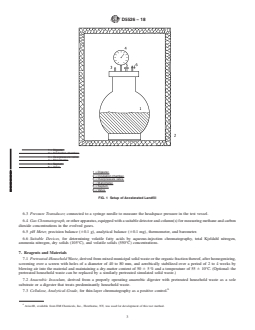
1 = Digester.
large, easily biodegradable particles are degraded during this
2 = Incubation chamber.
3 = Overpressure valve.
period and also to reduce the background level of degradation
4 = Manometer.
of the inoculum itself.
5 = Septum.
6 = Valve.
9.3 Thebiochemicalcharacteristicsoftheinoculumshallbe
as follows:
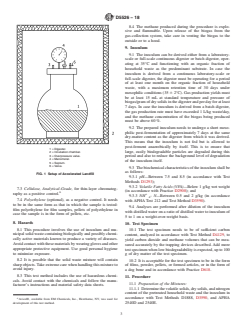
FIG. 1 Setup of Accelerated Landfill
9.3.1 pH—Between 7.5 and 8.5 (in accordance with Test
Methods D1293);
9.3.2 Volatile Fatty Acids (VFA)—Below 1 g/kg wet weight
7.3 Cellulose, Analytical-Grade, for thin-layer chromatog-
(in accordance with Practice D2908); and
raphy as a positive control.
+
9.3.3 NH - N—Between 0.5 and 2 g/kg (in accordance
7.4 Polyethylene (optional), as a negative control. It needs
with APHATest 212 and Test Method D3590).
to be in the same form
...
This document is not an ASTM standard and is intended only to provide the user of an ASTM standard an indication of what changes have been made to the previous version. Because
it may not be technically possible to adequately depict all changes accurately, ASTM recommends that users consult prior editions as appropriate. In all cases only the current version
of the standard as published by ASTM is to be considered the official document.
Designation: D5526 − 12 D5526 − 18
Standard Test Method for
Determining Anaerobic Biodegradation of Plastic Materials
Under Accelerated Landfill Conditions
This standard is issued under the fixed designation D5526; the number immediately following the designation indicates the year of
original adoption or, in the case of revision, the year of last revision. A number in parentheses indicates the year of last reapproval. A
superscript epsilon (´) indicates an editorial change since the last revision or reapproval.
1. Scope
1.1 This test method covers determination of the degree and rate of anaerobic biodegradation of plastic materials in an
accelerated-landfill test environment. This test method is also designed to produce mixtures of household waste and plastic
materials after different degrees of decomposition under conditions that resemble landfill conditions. The test materials are mixed
with pretreated household waste and exposed to a methanogenic inoculum derived from anaerobic digesters operating only on
pretreated household waste. The anaerobic decomposition occurs under dry (more than 30 % total solids) and static nonmixed
conditions. The mixtures obtained after this test method can be used to assess the environmental and health risks of plastic
materials that are degraded in a landfill.
1.2 This test method is designed to yield a percentage of conversion of carbon in the sample to carbon in the gaseous form under
conditions that resemble landfill conditions. It is possible that this test method will not simulate all conditions found in landfills,
especially biologically inactive landfills. This test method more closely resembles those types of landfills in which the gas
generated is recovered or even actively promoted, or both, for example, by inoculation (codeposition of anaerobic sewage sludge
and anaerobic leachate recirculation), moisture control in the landfill (leachate recirculation), and temperature control (short-term
injection of oxygen and heating of recirculated leachate) (1-7).
1.3 This test method is designed to produce partially degraded mixtures of municipal solid waste and plastics that can be used
to assess the ecotoxicological risks associated with the anaerobic degradation of plastics after various stages of anaerobic
biodegradation in a landfill.
1.4 Claims of performance shall be limited to the numerical result obtained in the test and not be used for unqualified
“biodegradable” claims. Reports shall clearly state the percentage of net gaseous carbon generation for both the test and reference
samples at the completion of the test. Furthermore, results shall not be extrapolated past the actual duration of the test.
1.5 The values stated in SI units are to be regarded as the standard.
1.6 This standard does not purport to address all of the safety concerns, if any, associated with its use. It is the responsibility
of the user of this standard to establish appropriate safety safety, health, and healthenvironmental practices and determine the
applicability of regulatory limitations prior to use. Specific hazards statements are given in Section 8.
NOTE 1—There is no known ISO equivalent to this standard.
1.7 This international standard was developed in accordance with internationally recognized principles on standardization
established in the Decision on Principles for the Development of International Standards, Guides and Recommendations issued
by the World Trade Organization Technical Barriers to Trade (TBT) Committee.
2. Referenced Documents
2.1 ASTM Standards:
D618 Practice for Conditioning Plastics for Testing
D883 Terminology Relating to Plastics
D1293 Test Methods for pH of Water
This test method is under the jurisdiction of ASTM Committee D20 on Plastics and is the direct responsibility of Subcommittee D20.96 on Environmentally Degradable
Plastics and Biobased Products.
Current edition approved May 1, 2012Sept. 15, 2018. Published June 2012October 2018. Originally approved in 1994. Last previous edition approved in 20112012 as
ε1
D5526 – 94D5526 – 12.(2011) . DOI: 10.1520/D5526-12.10.1520/D5526-18.
The boldface numbers in parentheses refer to the list of references at the end of this standard.
For referenced ASTM standards, visit the ASTM website, www.astm.org, or contact ASTM Customer Service at service@astm.org. For Annual Book of ASTM Standards
volume information, refer to the standard’s Document Summary page on the ASTM website.
Copyright © ASTM International, 100 Barr Harbor Drive, PO Box C700, West Conshohocken, PA 19428-2959. United States
D5526 − 18
D1888 Methods Of Test for Particulate and Dissolved Matter in Water (Withdrawn 1989)
D2908 Practice for Measuring Volatile Organic Matter in Water by Aqueous-Injection Gas Chromatography
D3590 Test Methods for Total Kjeldahl Nitrogen in Water
D4129 Test Method for Total and Organic Carbon in Water by High Temperature Oxidation and by Coulometric Detection
E260 Practice for Packed Column Gas Chromatography
E355 Practice for Gas Chromatography Terms and Relationships
2.2 APHA-AWWA-WPCF Standards:
2540D Total Suspended Solids Dried at 103°–105°C
2540E Fixed and Volatile Solids Ignited at 550°C
212 Nitrogen Ammonia
3. Terminology
3.1 Definitions—For definitions of terms used in this test method see Terminology D883.
3.2 Definitions of Terms Specific to This Standard:
3.2.1 methanogenic inoculum—anaerobically digested organic waste containing a high concentration of anaerobic methane-
producing microorganisms.
4. Summary of Test Method
4.1 This test method described consists of the following: (1) selecting and analyzing material for testing; (2) obtaining a
pretreated municipal-solid-waste fraction and a concentrated anaerobic inoculum from an anaerobic digester; (3) exposing the
material to an anaerobic static batch fermentation at more than 30 % solids; (4) measuring total carbon in the gas (CO and CH )
2 4
evolved as a function of time; (5) removing the specimens for cleaning (optional), conditioning, testing, and reporting; (6)
assessing the degree of biodegradability; and (7) assessing the degree of biodegradability under less than optimum conditions.
4.2 The percentage of biodegradability is obtained by determining the percent of conversion of carbon from the test material
to carbon in the gaseous phase (CH and CO ). This percentage of biodegradability will not include the amount of carbon from
4 2
the test substance that is converted to cell biomass and that is not, in turn, metabolized to CO and CH .
2 4
5. Significance and Use
5.1 Decomposition of a plastic within a landfill involves biological processes that will affect the decomposition of other
materials enclosed by, or in close proximity to, the plastic. Rapid degradation of the plastic has the ability to increase the economic
feasibility of landfill-gas recovery, minimize the duration of after-care of the landfill, and make possible the recovery of the volume
reduction of the waste due to biodegradation during the active life of the landfill. This procedure has been developed to permit
determination of the anaerobic biodegradability of plastic products when placed in biologically active environments simulating
landfill conditions.
5.2 As degradation occurs inevitably in a landfill, it is of immediate concern that the plastic materials do not produce toxic
metabolites or end products under the various conditions that have the potential to occur in a landfill. The mixtures remaining after
completion of the test method, containing fully or partially degraded plastic materials or extracts, can be submitted subsequently
to ecotoxicity testing in order to assess the environmental hazards posed by the breakdown of plastics to varying degrees in
landfills. This test method has been designed to assess biodegradation under optimum and less-than-optimum conditions.
5.3 Limitations—Because a wide variation exists in the construction and operation of landfills, and because regulatory
requirements for landfills vary greatly, this procedure is not intended to simulate the environment of all landfills. However, it is
expected to closely resemble the environment of a biologically active landfill. More specifically, the procedure is intended to create
a standard laboratory environment that permits rapid and reproducible determination of the anaerobic biodegradability under
accelerated landfill conditions, while at the same time producing reproducible mixtures of fully and partially decomposed
household waste with plastic materials for ecotoxicological assessment.
6. Apparatus
6.1 Pressure-Resistant Glass Vessels—Twenty-seven, each with a volume of 4 to 6 L, which can be closed airtight and capable
of withstanding an overpressure of two atmospheres. The lids of the reactors are equipped with an overpressure valve (to prevent
the overpressure from becoming higher than 2 bars), a manometer that provides a rough indication of the overpressure, a septum
that allows one to take gas samples and measure the exact overpressure, and, finally, a valve to release the overpressure (Fig. 1).
6.2 Incubators, sufficient to store the vessels in the dark at 35 6 2°C for the duration of the test.
The last approved version of this historical standard is referenced on www.astm.org.
th
Standard Methods for the Examination of Water and Wastewater, 20 ed., 1999, available from American Public Health Association, 800 I Street, NW, Washington, D.C.
20001-3710, or http://www.standardmethods.org.
D5526 − 18
1 = Digester.
2 = Incubation chamber.
3 = Overpressure valve.
4 = Manometer.
5 = Septum.
6 = Valve.
1 = Digester.
2 = Incubation chamber.
3 = Overpressure valve.
4 = Manometer.
5 = Septum.
6 = Valve.
FIG. 1 Setup of Accelerated Landfill
6.3 Pressure Transducer, connected to a syringe needle to measure the headspace pressure in the test vessel.
6.4 Gas Chromatograph, or other apparatus, equipped with a suitable detector and column(s) for measuring methane and carbon
dioxide concentrations in the evolved gases.
6.5 pH Meter, precision balance (60.1 g), analytical balance (60.1 mg), thermometer, and barometer.
6.6 Suitable Devices, for determining volatile fatty acids by aqueous-injection chromatography, total Kjeldahl nitrogen,
ammonia nitrogen, dry solids (105°C), and volatile solids (550°C) concentrations.
7. Reagents and Materials
7.1 Pretreated-Household Waste, derived from mixed municipal solid waste or the organic fraction thereof, after homogenizing,
screening over a screen with holes of a diameter of 40 to 80 mm, and aerobically stabilized over a period of 2 to 4 weeks by
blowing air into the material and maintaining a dry-matter content of 50 6 5 % and a temperature of 55 6 10°C. (Optional: the
pretreated household waste can be replaced by a similarly pretreated simulated solid waste.)
7.2 Anaerobic Inoculum, derived from a properly operating anaerobic digester with pretreated household waste as a sole
substrate or a digester that treats predominantly household waste.
7.3 Cellulose, Analytical-Grade, for thin-layer chromatography as a positive control.
Avicel®, available from EM Chemicals, Inc., Hawthorne, NY, was used for development of this test method.
D5526 − 18
7.4 Polyethylene (optional), as a negative control. It needs to be in the same form as that in which the sample is tested: film
polyethylene for film samples, pellets of polyethylene in case the sample is in the form of pellets, etc.
8. Hazards
8.1 This procedure involves the use of inoculum and municipal solid waste containing biologically and possibly chemically
active materials known to produce a variety of diseases. Avoid contact with these materials by wearing gloves and other appropriate
protective equipment. Use good personal hygiene to minimize exposure.
8.2 It is possible that the solid waste mixture will contain sharp objects. Take extreme care when handling this mixture to avoid
injury.
8.3 This test method includes the use of hazardous chemicals. Avoid contact with the chemicals and follow the manufacturer’s
instructions and material safety data sheets.
8.4 The methane produced during the procedure is explosive and flammable. Upon release of the biogas from the gas-collection
system, take care in venting the biogas to the outside or to a hood.
9. Inoculum
9.1 The inoculum can be derived either from a laboratory-scale or full-scale continuous digester or batch digester, operating at
35°C and functioning with an organic fraction of household waste as the predominant substrate. In case the inoculum is derived
from a continuous laboratory-scale or full-scale digester, the digester must be operating for a period of at least one month on the
organic fraction of household waste, with a maximum retention time of 30 days under mesophilic conditions (35 6 2°C). Gas
production yields must be at least 15 mL at standard temperature and pressure of biogas/gram of dry solids in the digester and per
day for at least 7 days. In case the inoculum is derived from a batch digester, the gas production rate must have exceeded 1 L/kg
waste/day, and the methane concentration of the biogas being produced must be above 60 %.
9.2 The prepared inoculum needs to undergo a short mesophilic post-fermentation of approximately
...