

ASTM C1545-02(2020)
(Practice)Standard Practice for Dispersing Pigments and Other Materials Into Water-Based Suspensions With High Intensity Mixer
General Information
- Abstract
SIGNIFICANCE AND USE
4.1 The traditional method of preparing glazes and slurries has been to add stains (pigments), stabilizers, viscosity control agents, bactericides, and so forth, to the pebble mill batch along with normal batch materials such as clay, frit, quartz, feldspar, whiting (calcium carbonate), zinc oxide, opacifier, and so forth. This method had the disadvantage of over grinding some of the materials of the batch and under grinding other materials. While part of the disadvantage could be alleviated by double or triple batching (where the pebble mill was stopped at one or two points in the cycle and one or more materials added), the practice was labor intensive and not always well controlled. Another disadvantage of the traditional method was that it was necessary to thoroughly wash out the mill between batches of different colors. An obvious advantage, however, was that small components of the batch (such as pigments) were thoroughly dispersed in the batch and even today it is necessary to use this procedure when small quantities of strongly colored pigments are to be used.
4.2 With the advent of high speed intensive mixers using a rotating shaft-mounted impeller, it is now the usual practice to add pigments, conditioners, and so forth, to the batch from the pebble mill and accomplish the same uniform dispersion as would be the case if the pigments were milled in rather than “stirred” in. In addition, the pigments tend to yield a stronger color in the glaze because they have not been over ground in the pebble mill. It is not uncommon to make a reduction in the amount of pigment needed to develop the desired color when the pigment is stirred in rather than milled in. An even greater benefit is using the “stirred in” technique is that a single large batch of a base glaze (for example, clear) can be made by milling, and individual colors developed by stirring appropriate pigments and conditioners into small amounts of the base glaze. In this way, a large pebble mill can be...
SCOPE
1.1 In preparing ceramic glazes and slurries for use, it is often necessary to add pigments to develop a desired fired color, to incorporate viscosity control agents for developing, or providing to develop the desired thickness of the glaze on the ware, to add materials which stabilize the suspension, control bacterial growth, and develop the desired hardness of the glaze on the ware to allow moving and handling before firing. While it is convenient to add these materials to the glaze or slurry in the dry form, it is often possible to use slurries where these materials are dispersed in a slurry and the slurry then added to the liquid glaze. Regardless of the state of the additions (dry or slurry), the dispersion can be done efficiently and effectively by the use of a high intensity mixer (sometimes referred to as a dissolver) and the procedure used is described here.
1.2 The values stated in SI units are to be regarded as the standard.
1.3 This standard does not purport to address all of the safety concerns, if any, associated with its use. It is the responsibility of the user of this standard to establish appropriate safety, health, and environmental practices and determine the applicability of regulatory limitations prior to use.
1.4 This international standard was developed in accordance with internationally recognized principles on standardization established in the Decision on Principles for the Development of International Standards, Guides and Recommendations issued by the World Trade Organization Technical Barriers to Trade (TBT) Committee.
- Status
- Published
- Publication Date
- 31-Oct-2020
- Technical Committee
- C21 - Ceramic Whitewares and Related Products
- Drafting Committee
- C21.03 - Methods for Whitewares and Environmental Concerns

Overview
ASTM C1545-02(2020) Standard Practice for Dispersing Pigments and Other Materials Into Water-Based Suspensions With High Intensity Mixer establishes guidelines for effectively and efficiently dispersing pigments, stabilizers, viscosity control agents, and other additives into water-based ceramic glazes and slurries using high intensity mixers. This standard addresses both laboratory-scale and production-scale processes in the preparation of ceramic products. Through optimized mixing techniques, manufacturers can achieve more uniform dispersions, stronger and consistent color development, and improved processing efficiency in the ceramics industry.
Key Topics
- Dispersing Pigments: Incorporating colorants and functional additives into ceramic glazes and slurries to achieve desired fired colors and properties.
- High Intensity Mixers: Use of high speed mixers, sometimes referred to as dissolvers, to ensure uniform dispersion without over-grinding or under-grinding various batch components.
- Process Efficiency: Methods that reduce labor intensiveness, minimize cleaning between batches, and improve pigment usage efficiency compared to traditional pebble mill techniques.
- Apparatus Guidance: Selection of suitable mixer types (laboratory or production), container specifications, correct impeller sizing and placement, and operational tips for optimal mixing performance.
- Handling and Safety: Emphasis on equipment safeguards, proper ventilation, storage of materials, and regular cleaning and maintenance to ensure safe and consistent operations in glaze preparation areas.
- Quality Control: Determining proper solids content versus specific gravity, taking samples for viscosity and color testing, and maintaining consistent batch quality.
Applications
ASTM C1545-02(2020) is widely applied in the ceramics industry, particularly in the production of:
- Ceramic tiles
- Sanitaryware
- Tableware
- Decorative ware
The standard is critical when:
- Preparing custom-colored batches by adding pigments and conditioners to a pre-milled base glaze
- Transitioning from traditional pebble milling to more efficient high-speed mixing to save labor and reduce cleaning time
- Developing stable and uniform water-based suspensions that ensure ease of application and handling prior to firing
- Achieving consistent and vibrant color performance with reduced pigment usage
- Streamlining manufacturing processes in both laboratory research and industrial-scale production environments
By following this practice, manufacturers can make process improvements such as:
- Dedication of large mills to base glaze preparation, while individual colors are easily produced in smaller batches
- Reduction in downtime for cleaning and color changes
- Enhanced control over final product characteristics, including film thickness, suspension stability, and fired hardness
Related Standards
- ASTM C242: Terminology of Ceramic Whitewares and Related Products - Provides definitions and terminology relevant to ceramic materials and processes.
- Other ASTM Ceramic Standards: Includes various practices and test methods for ceramic raw materials, product properties, and processing methods.
- International Standards for Ceramic Processing: Relevant ISO and national standards may also complement or reference ASTM C1545 practices.
Keywords: ASTM C1545-02, ceramic glazes, water-based suspensions, high intensity mixer, dispersing pigments, ceramics manufacturing, glaze preparation, pigment dispersion, glaze stability, industrial mixing, ceramic slurries, additive incorporation
By adopting ASTM C1545-02(2020), ceramic manufacturers benefit from improved pigment dispersion, process efficiency, and product consistency, supporting both quality goals and competitive production practices.
Relations
- Effective Date
- 01-Feb-2020
- Effective Date
- 01-Oct-2019
- Effective Date
- 01-Aug-2019
- Effective Date
- 01-Feb-2018
- Effective Date
- 01-Mar-2015
- Effective Date
- 01-Feb-2014
- Effective Date
- 01-May-2012
- Effective Date
- 01-Nov-2007
- Effective Date
- 10-Jul-2001
- Effective Date
- 10-Jul-2001
- Effective Date
- 10-Jul-2001
Get Certified
Connect with accredited certification bodies for this standard

DIN CERTCO
DIN Group product certification.

Smithers Quality Assessments
US management systems and product certification.
Sponsored listings
Frequently Asked Questions
ASTM C1545-02(2020) is a standard published by ASTM International. Its full title is "Standard Practice for Dispersing Pigments and Other Materials Into Water-Based Suspensions With High Intensity Mixer". This standard covers: SIGNIFICANCE AND USE 4.1 The traditional method of preparing glazes and slurries has been to add stains (pigments), stabilizers, viscosity control agents, bactericides, and so forth, to the pebble mill batch along with normal batch materials such as clay, frit, quartz, feldspar, whiting (calcium carbonate), zinc oxide, opacifier, and so forth. This method had the disadvantage of over grinding some of the materials of the batch and under grinding other materials. While part of the disadvantage could be alleviated by double or triple batching (where the pebble mill was stopped at one or two points in the cycle and one or more materials added), the practice was labor intensive and not always well controlled. Another disadvantage of the traditional method was that it was necessary to thoroughly wash out the mill between batches of different colors. An obvious advantage, however, was that small components of the batch (such as pigments) were thoroughly dispersed in the batch and even today it is necessary to use this procedure when small quantities of strongly colored pigments are to be used. 4.2 With the advent of high speed intensive mixers using a rotating shaft-mounted impeller, it is now the usual practice to add pigments, conditioners, and so forth, to the batch from the pebble mill and accomplish the same uniform dispersion as would be the case if the pigments were milled in rather than “stirred” in. In addition, the pigments tend to yield a stronger color in the glaze because they have not been over ground in the pebble mill. It is not uncommon to make a reduction in the amount of pigment needed to develop the desired color when the pigment is stirred in rather than milled in. An even greater benefit is using the “stirred in” technique is that a single large batch of a base glaze (for example, clear) can be made by milling, and individual colors developed by stirring appropriate pigments and conditioners into small amounts of the base glaze. In this way, a large pebble mill can be... SCOPE 1.1 In preparing ceramic glazes and slurries for use, it is often necessary to add pigments to develop a desired fired color, to incorporate viscosity control agents for developing, or providing to develop the desired thickness of the glaze on the ware, to add materials which stabilize the suspension, control bacterial growth, and develop the desired hardness of the glaze on the ware to allow moving and handling before firing. While it is convenient to add these materials to the glaze or slurry in the dry form, it is often possible to use slurries where these materials are dispersed in a slurry and the slurry then added to the liquid glaze. Regardless of the state of the additions (dry or slurry), the dispersion can be done efficiently and effectively by the use of a high intensity mixer (sometimes referred to as a dissolver) and the procedure used is described here. 1.2 The values stated in SI units are to be regarded as the standard. 1.3 This standard does not purport to address all of the safety concerns, if any, associated with its use. It is the responsibility of the user of this standard to establish appropriate safety, health, and environmental practices and determine the applicability of regulatory limitations prior to use. 1.4 This international standard was developed in accordance with internationally recognized principles on standardization established in the Decision on Principles for the Development of International Standards, Guides and Recommendations issued by the World Trade Organization Technical Barriers to Trade (TBT) Committee.
SIGNIFICANCE AND USE 4.1 The traditional method of preparing glazes and slurries has been to add stains (pigments), stabilizers, viscosity control agents, bactericides, and so forth, to the pebble mill batch along with normal batch materials such as clay, frit, quartz, feldspar, whiting (calcium carbonate), zinc oxide, opacifier, and so forth. This method had the disadvantage of over grinding some of the materials of the batch and under grinding other materials. While part of the disadvantage could be alleviated by double or triple batching (where the pebble mill was stopped at one or two points in the cycle and one or more materials added), the practice was labor intensive and not always well controlled. Another disadvantage of the traditional method was that it was necessary to thoroughly wash out the mill between batches of different colors. An obvious advantage, however, was that small components of the batch (such as pigments) were thoroughly dispersed in the batch and even today it is necessary to use this procedure when small quantities of strongly colored pigments are to be used. 4.2 With the advent of high speed intensive mixers using a rotating shaft-mounted impeller, it is now the usual practice to add pigments, conditioners, and so forth, to the batch from the pebble mill and accomplish the same uniform dispersion as would be the case if the pigments were milled in rather than “stirred” in. In addition, the pigments tend to yield a stronger color in the glaze because they have not been over ground in the pebble mill. It is not uncommon to make a reduction in the amount of pigment needed to develop the desired color when the pigment is stirred in rather than milled in. An even greater benefit is using the “stirred in” technique is that a single large batch of a base glaze (for example, clear) can be made by milling, and individual colors developed by stirring appropriate pigments and conditioners into small amounts of the base glaze. In this way, a large pebble mill can be... SCOPE 1.1 In preparing ceramic glazes and slurries for use, it is often necessary to add pigments to develop a desired fired color, to incorporate viscosity control agents for developing, or providing to develop the desired thickness of the glaze on the ware, to add materials which stabilize the suspension, control bacterial growth, and develop the desired hardness of the glaze on the ware to allow moving and handling before firing. While it is convenient to add these materials to the glaze or slurry in the dry form, it is often possible to use slurries where these materials are dispersed in a slurry and the slurry then added to the liquid glaze. Regardless of the state of the additions (dry or slurry), the dispersion can be done efficiently and effectively by the use of a high intensity mixer (sometimes referred to as a dissolver) and the procedure used is described here. 1.2 The values stated in SI units are to be regarded as the standard. 1.3 This standard does not purport to address all of the safety concerns, if any, associated with its use. It is the responsibility of the user of this standard to establish appropriate safety, health, and environmental practices and determine the applicability of regulatory limitations prior to use. 1.4 This international standard was developed in accordance with internationally recognized principles on standardization established in the Decision on Principles for the Development of International Standards, Guides and Recommendations issued by the World Trade Organization Technical Barriers to Trade (TBT) Committee.
ASTM C1545-02(2020) is classified under the following ICS (International Classification for Standards) categories: 83.040.30 - Auxiliary materials and additives for plastics. The ICS classification helps identify the subject area and facilitates finding related standards.
ASTM C1545-02(2020) has the following relationships with other standards: It is inter standard links to ASTM C242-20, ASTM C242-19a, ASTM C242-19, ASTM C242-18, ASTM C242-15, ASTM C242-14, ASTM C242-12, ASTM C242-01(2007), ASTM C242-00a, ASTM C242-00, ASTM C242-01. Understanding these relationships helps ensure you are using the most current and applicable version of the standard.
ASTM C1545-02(2020) is available in PDF format for immediate download after purchase. The document can be added to your cart and obtained through the secure checkout process. Digital delivery ensures instant access to the complete standard document.
Standards Content (Sample)
This international standard was developed in accordance with internationally recognized principles on standardization established in the Decision on Principles for the
Development of International Standards, Guides and Recommendations issued by the World Trade Organization Technical Barriers to Trade (TBT) Committee.
Designation: C1545 − 02 (Reapproved 2020)
Standard Practice for
Dispersing Pigments and Other Materials Into Water-Based
Suspensions With High Intensity Mixer
This standard is issued under the fixed designation C1545; the number immediately following the designation indicates the year of
original adoption or, in the case of revision, the year of last revision.Anumber in parentheses indicates the year of last reapproval.A
superscript epsilon (´) indicates an editorial change since the last revision or reapproval.
1. Scope 3. Terminology
1.1 In preparing ceramic glazes and slurries for use, it is 3.1 Definitions:
often necessary to add pigments to develop a desired fired 3.1.1 Standard terminology for ceramic whitewares and
color,toincorporateviscositycontrolagentsfordeveloping,or related products is given in Terminology C242.
providing to develop the desired thickness of the glaze on the
4. Significance and Use
ware, to add materials which stabilize the suspension, control
bacterialgrowth,anddevelopthedesiredhardnessoftheglaze
4.1 The traditional method of preparing glazes and slurries
on the ware to allow moving and handling before firing.While
has been to add stains (pigments), stabilizers, viscosity control
it is convenient to add these materials to the glaze or slurry in
agents, bactericides, and so forth, to the pebble mill batch
the dry form, it is often possible to use slurries where these
along with normal batch materials such as clay, frit, quartz,
materials are dispersed in a slurry and the slurry then added to
feldspar, whiting (calcium carbonate), zinc oxide, opacifier,
theliquidglaze.Regardlessofthestateoftheadditions(dryor
and so forth. This method had the disadvantage of over
slurry),thedispersioncanbedoneefficientlyandeffectivelyby
grinding some of the materials of the batch and under grinding
the use of a high intensity mixer (sometimes referred to as a
other materials. While part of the disadvantage could be
dissolver) and the procedure used is described here.
alleviated by double or triple batching (where the pebble mill
was stopped at one or two points in the cycle and one or more
1.2 The values stated in SI units are to be regarded as the
materials added), the practice was labor intensive and not
standard.
alwayswellcontrolled.Anotherdisadvantageofthetraditional
1.3 This standard does not purport to address all of the
method was that it was necessary to thoroughly wash out the
safety concerns, if any, associated with its use. It is the
mill between batches of different colors. An obvious
responsibility of the user of this standard to establish appro-
advantage, however, was that small components of the batch
priate safety, health, and environmental practices and deter-
(such as pigments) were thoroughly dispersed in the batch and
mine the applicability of regulatory limitations prior to use.
even today it is necessary to use this procedure when small
1.4 This international standard was developed in accor-
quantities of strongly colored pigments are to be used.
dance with internationally recognized principles on standard-
ization established in the Decision on Principles for the 4.2 With the advent of high speed intensive mixers using a
Development of International Standards, Guides and Recom- rotating shaft-mounted impeller, it is now the usual practice to
mendations issued by the World Trade Organization Technical add pigments, conditioners, and so forth, to the batch from the
pebble mill and accomplish the same uniform dispersion as
Barriers to Trade (TBT) Committee.
would be the case if the pigments were milled in rather than
2. Referenced Documents
“stirred” in. In addition, the pigments tend to yield a stronger
2.1 ASTM Standards:
color in the glaze because they have not been over ground in
C242Terminology of Ceramic Whitewares and Related the pebble mill. It is not uncommon to make a reduction in the
Products
amount of pigment needed to develop the desired color when
the pigment is stirred in rather than milled in.An even greater
This practice is under the jurisdiction of Committee C21 on Ceramic White-
benefit is using the “stirred in” technique is that a single large
waresandRelatedProductsandisthedirectresponsibilityofSubcommitteeC21.03
batch of a base glaze (for example, clear) can be made by
on Methods for Whitewares and Environmental Concerns.
milling,andindividualcolorsdevelopedbystirringappropriate
Current edition approved Nov. 1, 2020. Published December 2020. Originally
pigments and conditioners into small amounts of the base
approved in 2002. Last previous edition approved in 2016 as C1545–02(2016).
DOI: 10.1520/C1545-02R20.
glaze. In this way, a large pebble mill can be dedicated to clear
For referenced ASTM standards, visit the ASTM website, www.astm.org, or
baseglazeandcleaningthemillbetweenbatchesisnotneeded.
contact ASTM Customer Service at service@astm.org. For Annual Book of ASTM
Glaze stains frequently are treated with proprietary materials
Standards volume information, refer to the standard’s Document Summary page on
the ASTM website. which assist in dispersing the stain into the glaze.
Copyright © ASTM International, 100 Barr Harbor Drive, PO Box C700, West Conshohocken, PA 19428-2959. United States
C1545 − 02 (2020)
5. Apparatus
5.1 There are two types of high intensity mixers
(dissolvers), those designed for laboratory use, where capacity
is approximately 10 to 15 litres of liquid, and those designed
for production use, where capacity can be 1200 litres or more.
Typical characteristics of both types of mixer are shown in
Table 1.
5.2 Essentialinstallationandoperating“tips”forthemixers
are:
5.2.1 The motor power must be sufficient to maintain
desired speed with specified load.
5.2.2 The floor mounted model must be rigidly secured to
the floor.
5.2.3 A cylindrical container can be used for the glaze
whether it is laboratory or production equipment. Production
equipment must be fitted with a guide which centers and holds
in place the container on the same center as the impeller. A
rectangular container can be used, provided that the side and
bottom corners are well-rounded to avoid “dead” areas in the
mixture, just as is necessary with the bottom corner of the
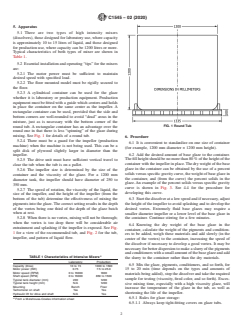
FIG. 1 Round Tub
round tub. A rectangular container has an advantage over the
round one in that there is less “spinning” of the glaze during
mixing. See Fig. 1 for details of a round tub.
6. Procedure
5.2.4 There must be a guard for the impeller (production
6.1 It is convenient to standardize on one size of container
machine) when the machine is not being used. This can be a
(for example, 1200 mm diameter × 1200 mm height).
split disk of plywood slightly larger in diameter than the
6.2 Add the desired amount of base glaze to th
...